

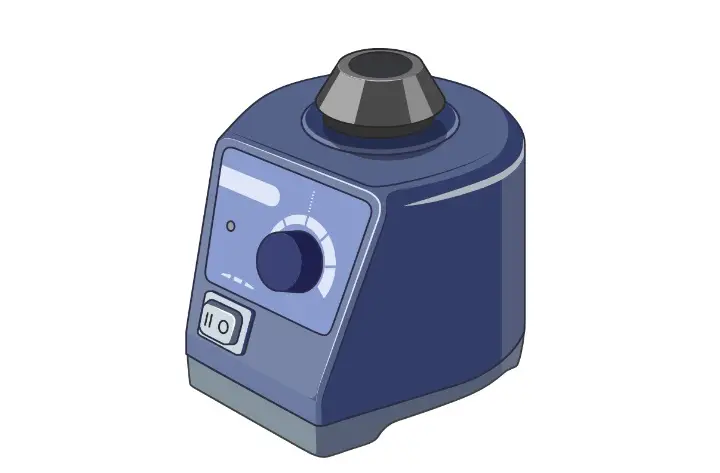
Vortex mixer is a laboratory instrument that is used to mix small amount of liquid samples rapidly. It is commonly used for mixing liquids in test tubes, vials, and well plates. It produces a swirling movement in the liquid sample, and this movement is called a vortex.
It is made up of an electric motor and a small cupped rubber part. The rubber part is fixed slightly off-centre with the motor. When the motor starts, the rubber cup moves in rapid circular motion. This circular movement is transferred to the liquid present inside the tube or vial.
During this process, the liquid starts rotating very fast and forms a small whirlpool like movement. This helps in proper mixing of reagents, suspension of cells, and homogenization of samples. It does not require any glass rod or stirring material inside the liquid, so contamination chances are less.
The vortex mixer is very useful in microbiology, biochemistry, molecular biology and clinical laboratory. It is mostly used where small volume of sample is needed to mix within a very short time. It gives uniform mixing in few seconds.
The first motorized vortex mixer was developed in the late 1950s by Jack A. Kraft and Harold D. Kraft. Before this, scientists used manual shaking or finger vortex method for mixing test tubes. Later, the Kraft brothers made the first working prototype using their experience from record player motor. The first commercial model was produced as Vortex Jr. Mixer in 1962. Later this type of mixer became common in laboratories as Vortex Genie type mixer.
Principle of Vortex Mixer
Vortex mixer is based on the principle of centrifugal force and eccentric drive mechanism. In this instrument, an electric motor is attached with a vertical drive shaft and a cup-shaped rubber head. The rubber head is fixed slightly off-centre from the axis of the motor.
When the motor starts, the rubber head does not rotate only around its own axis. It moves rapidly in a circular orbital motion. This rapid oscillation produces mechanical vibration on the rubber cup.
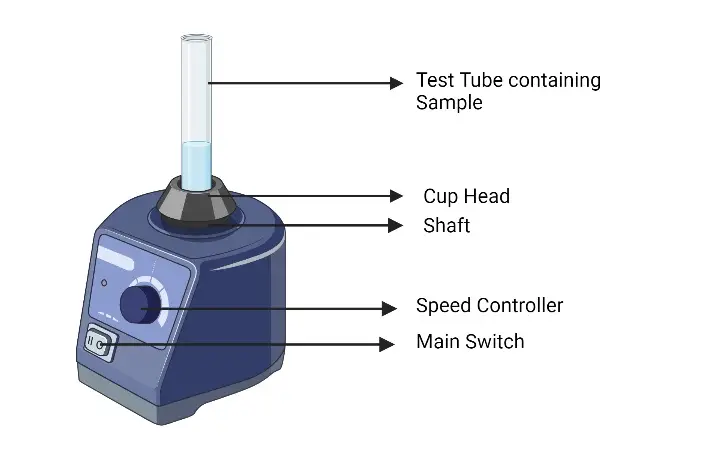
When the test tube or vial is pressed against the rubber cup, the kinetic energy is transferred through the wall of the container to the liquid sample. Due to this movement, the liquid is pushed towards the outer side of the tube by centrifugal force.
This forms a turbulent swirling motion inside the liquid. This swirling motion is called vortex. During this process, the sample components are mixed rapidly and uniformly within few seconds.

Parts of Vortex Mixer
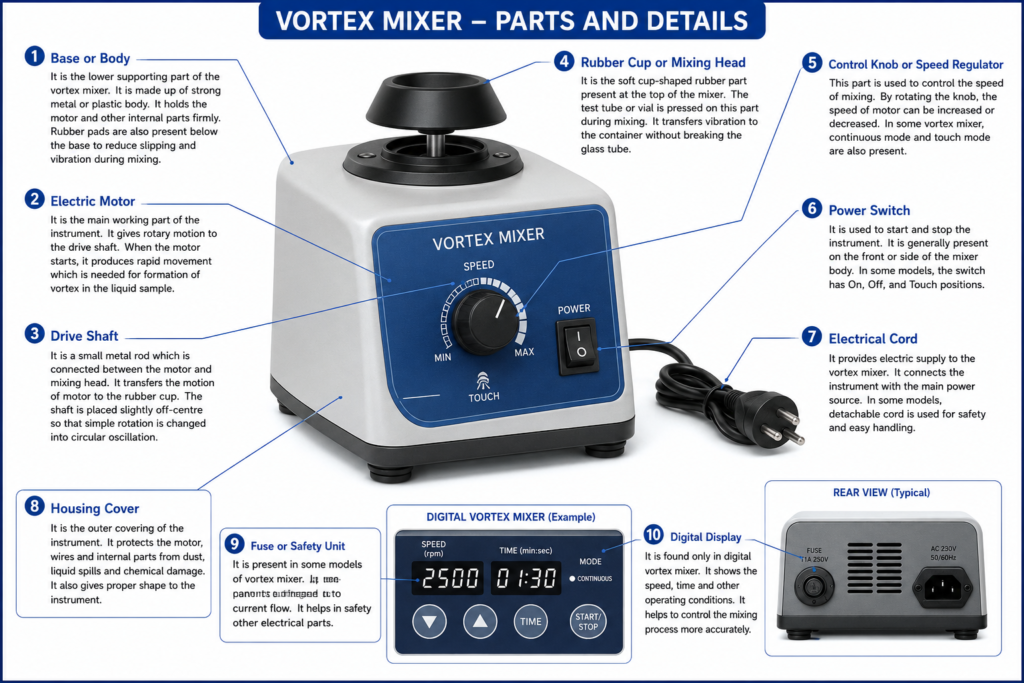
- Base or Body – It is the lower supporting part of the vortex mixer. It is made up of strong metal or plastic body. It holds the motor and other internal parts firmly. Rubber pads are also present below the base to reduce slipping and vibration during mixing.
- Electric Motor – It is the main working part of the instrument. It gives rotary motion to the drive shaft. When the motor starts, it produces rapid movement which is needed for formation of vortex in the liquid sample.
- Drive Shaft – It is a small metal rod which is connected between the motor and mixing head. It transfers the motion of motor to the rubber cup. The shaft is placed slightly off-centre so that simple rotation is changed into circular oscillation.
- Rubber Cup or Mixing Head – It is the soft cup-shaped rubber part present at the top of the mixer. The test tube or vial is pressed on this part during mixing. It transfers vibration to the container without breaking the glass tube.
- Control Knob or Speed Regulator – This part is used to control the speed of mixing. By rotating the knob, the speed of motor can be increased or decreased. In some vortex mixer, continuous mode and touch mode are also present.
- Power Switch – It is used to start and stop the instrument. It is generally present on the front or side of the mixer body. In some models, the switch has On, Off, and Touch positions.
- Electrical Cord – It provides electric supply to the vortex mixer. It connects the instrument with the main power source. In some models, detachable cord is used for safety and easy handling.
- Housing Cover – It is the outer covering of the instrument. It protects the motor, wires and internal parts from dust, liquid spills and chemical damage. It also gives proper shape to the instrument.
- Fuse or Safety Unit – It is present in some models of vortex mixer. It prevents damage due to overheating or excess current flow. It helps in safety of motor and other electrical parts.
- Digital Display – It is found only in digital vortex mixer. It shows the speed, time and other operating conditions. It helps to control the mixing process more accurately.
Operating Procedure of Vortex Mixer
- The sample is first taken in a clean test tube or vial. The tube should be closed properly with cap. It should not be filled fully, because space is needed for the liquid movement inside the tube.
- Gloves and safety glass should be used before starting the instrument. This is done to protect from splash of sample.
- The vortex mixer is kept on a flat laboratory bench. The bench should be stable and dry. Then the plug is connected to the electric supply.
- The switch is turned on. The mode is selected as required. In touch mode, the instrument works when the tube is pressed on the rubber cup. In continuous mode, it runs without pressing again and again.
- The speed knob is kept at low speed at first. This prevents sudden shaking of the tube and spilling of the liquid.
- The tube is held by hand and the bottom part of the tube is placed on the rubber mixing cup. The tube is pressed gently. It may be slightly tilted for better mixing.
- The speed is increased slowly. The liquid starts rotating inside the tube and forms a whirlpool like movement. This movement is called vortex.
- The tube is kept on the mixer for few seconds or according to the need of the sample. During this process, the liquid components are mixed with each other.
- Excessive mixing should not be done. It may cause foam formation, heating of sample or damage of some sensitive materials.
- After mixing, the tube is removed from the rubber cup. The sample is observed whether it is mixed properly or not.
- After the work is finished, the switch is turned off. The plug is removed from the socket. The rubber cup and outer surface are cleaned with damp cloth or suitable disinfectant.
Safety Precautions
- The vortex mixer should be kept on a flat and stable laboratory bench. It should not be placed near edge of the table, because during vibration it may move from its position.
- The rubber cup or mixing head should be checked before use. It should be fitted properly with the instrument. Loose mixing head may cause improper mixing and spilling of sample.
- The test tube or vial should be closed tightly with cap before mixing. If the cap is loose, the liquid may splash out during vortexing.
- Cracked or broken glass tube should not be used. During high speed movement, the cracked tube may break and cause injury to hand or eye.
- The tube should not be filled completely. Some empty space should be present inside the tube. If the tube is overfilled, the liquid may reach the cap and leak out.
- Gloves and safety goggles should be worn during the operation. It protects the hand and eye from splash, aerosol and broken glass particles.
- The speed should be started from low position. Then it may be increased slowly according to the need. Sudden high speed may cause spilling of liquid and strong vibration of tube.
- Hazardous, infectious or toxic sample should be mixed only in closed container. These samples should be vortexed inside biosafety cabinet or fume hood, if required.
- Flammable liquid should not be vortexed near flame or hot surface. During vortexing, small aerosol may form and it can catch fire easily.
- The tube should be held properly while mixing. Long time holding on vibrating head should be avoided, because it may cause pain, numbness or strain in hand.
- The instrument should be connected with proper grounded electric socket. It should not be used with wet hand or near spilled water.
- Before cleaning, the switch should be turned off and plug should be removed from socket. This prevents electric shock and accidental starting of the instrument.
- The rubber cup and outer surface should be cleaned after use. Spilled sample should not be left on the instrument, because it may cause contamination and damage of body.
- The instrument should not be used if unusual sound, burning smell, heating or excess vibration is observed. In such condition, the instrument should be stopped and checked properly.
Types of Vortex Mixer
- Variable speed – It is a type of vortex mixer in which the speed can be changed according to the need. It is used for slow mixing and also for strong mixing of sample.
- Fixed speed – It works at only one fixed speed. It does not have much speed changing system. It gives same speed mixing when the tube is placed on the mixing head.
- Analog type – It is controlled by manual knob or dial. The speed is adjusted by hand. It is simple and used in routine laboratory work.
- Digital type – It has digital display and timer system. It gives more proper control of speed and time. It is used when same mixing condition is required again.
- Touch activated – It starts only when the tube is pressed on the rubber cup. When the tube is removed, the motor stops.
- Continuous run – It works continuously after switching on. It does not need pressing of tube again and again. It is useful for longer mixing.
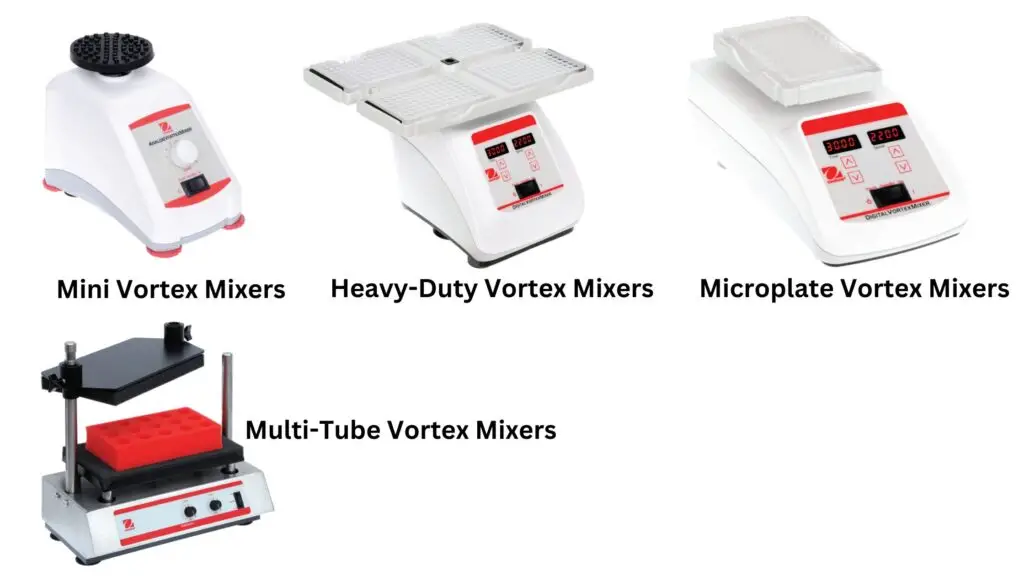
- Mini or portable – It is small in size and easy to carry. It is used for quick mixing of single tube sample and takes less space.
- Multi-tube type – It is used for mixing many tubes at the same time. It has large platform or rack for holding several test tubes or vials.
- Microplate type – It is used for mixing sample in 96-well or 384-well microplate. It gives small orbital movement for mixing low volume samples.
- Pulse type – It gives mixing by pulse movement. The motion is stopped and started rapidly. It is used for cell disruption, homogenization and thick liquid mixing.
- Incubating or refrigerated – It has temperature control system with mixing. It can heat or cool the sample during vortexing.
- Heavy duty – It is a strong type of vortex mixer. It has powerful motor and can run for long time with heavy accessories.
Applications of Vortex Mixer
- Vortex mixer is used for quick mixing of small volume liquid samples. It mixes reagents, buffers and other laboratory solutions in very short time.
- It is used to make the sample uniform. Different components present in the sample are mixed properly by rapid vortex movement.
- It is used to dissolve small amount of solid substance in liquid solvent. The fast shaking helps the solute to dissolve and mix with the solvent.
- It is used to resuspend cell pellet in liquid medium. After centrifugation, the settled cells can be mixed again by vortexing.
- It is used for breaking of cell membrane in some laboratory procedures. This helps in release of DNA, RNA, proteins and other intracellular materials.
- It is used during DNA extraction, RNA extraction, protein sample preparation and PCR mixture preparation. It helps to mix enzymes, primers, buffer and sample properly.
- It is used in clinical laboratory for mixing blood, serum, urine and other patient samples. It makes the sample uniform before diagnostic test.
- It is used in enzyme reaction, antigen-antibody reaction and other biochemical tests. It helps the molecules to come in close contact with each other.
- It is used to mix the sample before placing it in centrifuge. It is also used after centrifugation to mix the separated pellet with liquid.
- It is used for mixing drug sample, chemical formulation and quality control sample. It is also used before HPLC and GC analysis.
- It is used for mixing small amount of paints, inks, adhesives and other chemical materials. It gives rapid and uniform mixing in short time.
Advantages of Vortex Mixer
- Vortex mixer mixes the sample very quickly. It can mix small volume of liquid within few seconds and reduces the time of manual shaking.
- It gives proper and uniform mixing of sample. Same type of mixing can be obtained again and again, so the result becomes more consistent.
- It reduces human error during mixing. Manual shaking may not be same every time, but vortex mixer gives controlled mixing of the sample.
- It does not need any stirring rod, probe or magnetic bar inside the liquid. The mixing is done through the wall of the tube, so chances of contamination is less.
- It is small in size and occupies less space on laboratory bench. It can also be used inside biosafety cabinet or fume hood easily.
- It is simple to operate. In many vortex mixer, the instrument starts only by pressing the tube on the rubber cup. So special training is not needed.
- It can be used for different types of containers like test tubes, vials, small flasks and microplates. Different mixing heads can also be attached according to the use.
- It can be used for gentle mixing as well as strong mixing. By changing the speed, cell suspension, reagent mixing and cell disruption can be done.
- Some vortex mixer can mix many tubes at a time. This is useful when large number of sample are processed in laboratory.
- It is less costly than many large mixing instruments. It also needs less maintenance and less operating materials.
- It reduces physical effort of laboratory worker. Long time hand shaking is not required, so fatigue of hand is also less.
Limitation of Vortex Mixer
- Vortex mixer is mainly used for small volume of liquid sample. It is not suitable for mixing large volume samples or large containers.
- It may cause spilling of sample if the tube is not closed properly. Overfilled tube may also leak during rapid vortexing.
- It does not mix all types of samples equally. Samples with very different density may remain separated in upper and lower layer.
- It may produce heat during long time mixing. This heat can affect sensitive samples like enzymes, proteins and some biological materials.
- It is not useful for mixing solid with solid materials. Some solid and liquid mixture also may not mix properly by vortex mixer.
- It may form foam in some liquid samples. Foam formation can affect the sample volume and also interfere in some laboratory tests.
- Long time holding of tube on the rubber cup may cause hand discomfort. It may also cause pain or fatigue due to continuous vibration.
- It can break cracked or weak glass tube during high speed mixing. So damaged tube cannot be used safely.
- It may create aerosol if the tube cap is loose or sample is infectious. This may increase contamination risk in laboratory.
- It cannot replace large shaker or magnetic stirrer where continuous mixing of large solution is required.
References
- Patel, A. K., Jha, A., Patwardhan, A., Pawar, J., & Henry, R. (2018). Design and fabrication of low cost vortex mixer using additive manufacturing. International Journal of Research in Advent Technology, 6(12).
- Wei, L. (2023). 3 basic knowledge guide to vortex mixers. Drawell.
- Avantor. (n.d.). 42 results for vortex shakers..
- pinkledstone. (2025, February 13). A comprative analytics of orbital shakers and vortex mixers in laboratories. China manufacturers.
- Wei, L. (n.d.). A comprehensive guide to vortex mixers: Understanding their types, applications and safe operation. Drawell.
- VELP Scientifica. (n.d.). CLASSIC vortex mixer..
- VORTEX Mixing Technology. (n.d.). Common issues with the conical mixers..
- Wei, L. (n.d.). Comparison of orbital shaker vs. vortex mixer in laboratory settings. Drawell.
- Comprehensive technical evaluation of vortex mixing systems: Origins, mechanics, and laboratory applications. (n.d.).
- Stone, D. (2023, January 13). Difference between orbital shakers & vortex mixers. Pipette.com.
- AHN Biotechnologie GmbH. (2026, March 25). How to choose the best vortex mixer for your laboratory?.
- MRC Laboratory Instruments. (n.d.). How to use vortex mixers..
- Borosil Scientific. (n.d.). How to use a vortex mixer: Step-by-step guide..
- Laboratory Equipment Pty Ltd. (n.d.). Instruction manual vortex mixer..
- Wei, L. (n.d.). Lab vortex mixer: Applications and operating precautions. Drawell.
- Terra Universal Staff. (n.d.). Lab vortexer guide: Features, accessories, and style comparison. Laboratory Equipment.
- Laboratory Equipment. (n.d.). Laboratory shakers and vortexers..
- VIVID NINE. (n.d.). Laboratory vortex mixer design case study..
- Om Scientific & Electronic Devices. (n.d.). Maintaining vortex mixers: Dos and don’ts..
- Watkins-Dulaney, E. (2026, February 12). Making the vortex mixer. Asimov Press.
- DSCBalances. (2024, January 23). Mastering vortex mixing: Techniques and tips for optimal laboratory results..
- Numerical and experimental study on mixing performances of simple and vortex micro T-mixers. (n.d.). PMC.
- Etcon Analytical and Environmental Systems & Services Ltd. (n.d.). Scilogex – Vortex mixers..
- Biolab Scientific. (n.d.). Shakers or mixers – What’s best for my lab?.
- Glas-Col. (2021, February 4). The benefits of a vortex mixer. AZoM.
- Thermoline. (n.d.). Troubleshooting and repair | Vortex mixer..
- VELP Scientifica. (n.d.). Instruction manual vortex mixer. GSECARS.
- Constantinides, D., & Bordenstein, S. (2024, July 22). Vortex mixer. LabXchange.
- Vortex mixer and their importance in a laboratory. (n.d.). Slideshare.
- INNOVA Biomed. (n.d.). Vortex mixer for fast and efficient laboratory mixing..
- Zinsser Analytic. (n.d.). Vortex mixer in automated processes..
- Simson Chemtech. (2026, January 13). Vortex mixer: The ultimate how to use a vortex mixer guide..
- Simson Chemtech. (2025, September 20). Vortex mixer: Uses, benefits, and buying..
- Hogentogler & Co. Inc. (n.d.). Vortex mixers..
- MRC Laboratory Instruments. (n.d.). Vortex mixers: A complete guide for scientists and researchers..
- Vortex mixer. (2025, October 23). In Wikipedia..
- VORTEX Mixing Technology. (n.d.). Vortex’s guide: Troubleshooting common faults in ribbon mixers..
- Wakeling, L. (n.d.). What does a vortex mixer do? Camlab.
- Johanna. (2014, August 20). What is vortex mixer and vortex mixer functions? Micro Centrifuge.
- Om Scientific & Electronic Devices. (n.d.). What is a vortex mixer and how does it work?.
- Pipette.com Team. (2025, September 16). What is a vortex mixer? A lab-ready guide for beginners. Pipette.com.
- Biolab Scientific. (n.d.). Product catalog vortex mixer..
- Denagene Tajhiz. (2024, October 15). Vortex mixer usage in the laboratory: Definition, application, principal, operational procedure..