

For the creation of solutions and manipulation of liquids, numerous vessels and apparatuses are employed in the laboratory. They differ in their intended application and precision. Volumes must always be measured at a constant temperature because changes in temperature result in volume changes owing to thermal expansion. At 10 °C, water has a substantially smaller volume than at 80 °C.
Typically, volumetric vessels are calibrated at 20 °C (25 °C in the United States). Every volumetric vessel displays the calibration temperature. Changes in temperature during the dilution of an acid, for instance, can lead to substantial errors. During dilution, significant heat is emitted and the temperature rises. When the volume of acid is measured before it has cooled, the actual volume will be lower. Therefore, the criterion for constant temperature must be observed.
List of Instruments used for measuring volume of liquids in laboratory
The following are the common devices used for measuring volume of liquids in laboratory-
- Graduated cylinder
Graduated cylinder is a tall cylindrical glass or plastic vessel used to measure volume of liquid. It is used for general purpose measurement with moderate accuracy. - Volumetric pipette
Volumetric pipette is used to deliver a single fixed volume of liquid. It is highly accurate and used when exact volume is required. - Graduated pipette
Graduated pipette is a pipette having many markings on its body. It is used to measure and transfer different volumes of liquid. - Serological pipette
Serological pipette is a graduated pipette used for accurate measurement and transfer of liquid. It is commonly used in biological and chemical laboratory. - Mohr pipette
Mohr pipette is used to measure and deliver exact volume of liquid. It is not much suitable for highly viscous liquids. - Micropipette
Micropipette is a hand operated device used to measure very small amount of liquid. It measures liquid in microlitre (µL) range. - Capillary pipette
Capillary pipette is a small pipette used for minute quantity of liquid. It is calibrated to contain a definite volume. - Burette
Burette is a long graduated glass tube having a stopcock at the lower end. It is used to deliver variable volume of liquid during titration. - Volumetric flask
Volumetric flask is a pear shaped flask with narrow neck and single calibration mark. It is used to prepare standard solution of exact volume. - Beaker
Beaker is a general laboratory vessel with approximate volume markings. It is used for rough measurement, mixing and heating of liquids. - Erlenmeyer flask
Erlenmeyer flask is a conical flask having narrow neck and broad base. Its scale is used only for approximate measurement of liquid volume. - Laboratory syringe
Laboratory syringe is used for accurate delivery of fluid. It is also used for transferring volatile, non-aqueous or viscous liquids. - Piston-operated volumetric apparatus (POVA)
Piston-operated volumetric apparatus is a mechanical liquid handling device. It works by movement of piston to displace specific volume of liquid. - Density bottle or Pycnometer
Density bottle is a calibrated bottle used to contain a fixed volume of liquid. It is mainly used for determination of density of liquids. - Dropping funnel
Dropping funnel is a special funnel used to add liquids drop by drop. Some dropping funnels have graduated scale for approximate volume measurement. - Test measure
Test measure is a volumetric standard used for measuring contained or delivered volume. It is mainly used in calibration and testing work. - Graduated medicine measure
Graduated medicine measure is a small plastic measure used for quick approximate volume checking. It is mostly used for liquid medicines. - Graduated jug
Graduated jug is a vessel with graduations and a spout. It is used for measuring and pouring larger volume of liquids easily.
1. Graduated Cylinders
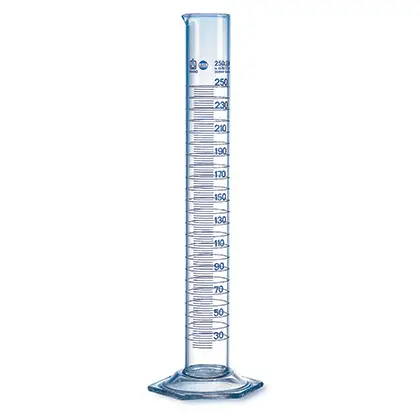
Graduated cylinder is a tall and narrow cylindrical container used to measure the volume of liquids in laboratory. It has horizontal volume markings on its side. It is used for measuring liquid volume more accurately than beaker and conical flask.
Graduated cylinder gives moderate accuracy in measurement. Usually it gives reliable measurement within about 1% error. It is less precise than pipette, burette and volumetric flask.
The following are the important points about Graduated cylinders–
- Graduated cylinder is tall, narrow and cylindrical in shape. Its narrow diameter helps to read small changes in volume properly.
- It has many horizontal markings on the side. These markings show the volume of liquid present inside the cylinder.
- It has a flat base for keeping the cylinder stable. The base may be round or hexagonal.
- Most of the graduated cylinders have a small spout at the upper end. It is used for easy pouring of liquid.
- Graduated cylinders are commonly made up of borosilicate glass or transparent plastic. Glass cylinders are resistant to heat and chemicals. Plastic cylinders are light and not easily broken.
- Graduated cylinders may be calibrated as To Contain (TC/IN) or To Deliver (TD/EX). In TC cylinder, the mark indicates the volume contained in it. In TD cylinder, the mark indicates the volume delivered from it.
- There are mainly two accuracy classes of graduated cylinder. Class A is more accurate and has less tolerance. Class B is used for general laboratory work and has more tolerance than Class A.
- Some glass cylinders have protective bumpers near the top. It prevents breaking of the cylinder when it is tipped over.
- Mixing cylinder is a type of graduated cylinder having ground glass joint and stopper. It is used when liquids are to be mixed by closing and shaking the cylinder.
- Squat-form cylinder is wider and shorter than ordinary cylinder. It gives better stability and is useful in small working space like fume cupboard.
- The volume is read at eye level to avoid parallax error. The reading is taken from the lower part of the meniscus, which is the curved surface of liquid.
- Graduated cylinder is used for measuring and transferring approximate volume of liquid. It is also used to measure the volume of solid by liquid displacement method.
2. Volumetric Pipettes
Volumetric pipette is a glass pipette used to measure and deliver one fixed volume of liquid. It is also called bulb pipette or single-volume pipette. It has a bulb like middle part and a single graduation mark near the upper part.
Volumetric pipette is used when exact volume of liquid is required. It can deliver fixed volume like 10 mL, 25 mL or 50 mL. It is more accurate than graduated cylinder and graduated pipette.
The following are the important points about Volumetric pipettes–
- Volumetric pipette has a bulbous centre portion and narrow tube on both sides. The bulb portion holds the fixed volume of liquid.
- It has only one calibration mark near the top. This mark is used to adjust the liquid level before delivery.
- It is designed to measure and deliver only one specific volume. So, one pipette is used for one fixed volume only.
- Volumetric pipette is highly precise in liquid transfer. Its accuracy may be more than 0.05% of total volume.
- It is considered as one of the most accurate device for measuring liquid volume in laboratory.
- Volumetric pipettes are available in two accuracy grades. Class A pipette has highest precision. Class B pipette has lower precision and is used for general work.
- It is mostly calibrated as To Deliver (TD or Ex). This means it delivers the exact stated volume by taking account the small liquid film left on the glass wall.
- During use, liquid is drawn up to the calibration mark. The pipette is kept vertical so that liquid can drain by gravity.
- The tip of pipette should touch the wet inner wall of receiving vessel during emptying. It helps in complete delivery of liquid.
- A small drop of liquid remains in the tip after dispensing. This final drop should not be blown out because the pipette is already calibrated for gravity delivery.
- Volumetric pipettes commonly measure volume from 0.5 mL to 100 mL. The volume is usually printed on the bulb part.
- Some volumetric pipettes have large numerals and colour coded bands. These help to identify the correct pipette easily in laboratory.
3. Graduated Pipettes (Measuring Pipettes)
Graduated pipette is a pipette used to measure and deliver different volume of liquids. It is also known as measuring pipette. It has many graduation marks on its side for taking variable amount of liquid.
Graduated pipette is used when requested amount of liquid is to be measured. It is commonly used for adding reagents, buffers and other laboratory liquids. It is less accurate than volumetric pipette.
The following are the important points about Graduated pipettes–
- Graduated pipette is used to measure and transfer variable volume of liquid. It is not fixed for one volume only.
- It has a long narrow tube with many graduation marks. These markings help to read partial volume and different required volume.
- It usually measures volume from 0.1 mL to 50 mL. The range depends on the size of the pipette.
- Graduated pipette is mostly calibrated as To Deliver (TD or Ex). This means it is made to deliver the indicated volume of liquid.
- It is slightly less accurate than volumetric pipette. This is because it has flexible scale and broader tolerance.
- Graduated pipettes are available in Class A and Class B accuracy grades. Class A has more accuracy and Class B is used for general purpose work.
- During use, liquid should be drawn by pipette bulb or pipette pump. Pipetting by mouth should not be done.
- The tip of the pipette should touch the side of the receiving container. It helps in proper transfer of liquid.
- Type 1 graduated pipette has nominal volume at the bottom. It allows partial delivery for all volumes.
- Type 2 graduated pipette has nominal volume at the top. It allows total delivery for partial volumes.
- Type 3 graduated pipette has nominal volume at the bottom. It allows total delivery only for the nominal volume.
- Mohr pipette is a type of graduated pipette. It has graduation scale marked on the stem and is used for measuring different volume of liquid.
- Mohr pipette is not suitable for highly viscous liquids and liquids having high surface tension.
- Serological pipette is another common type of graduated pipette. It is often made up of clear disposable plastic like polystyrene or polypropylene.
- Serological pipette is widely used in biological and medical laboratory. It is used in cell culture, protein assay and other liquid transfer works.
4. Serological Pipettes
Serological pipette is a type of graduated pipette used to measure and deliver variable volume of liquid. It is a long and slender tube with many graduation marks along its length. It is commonly used in biological, medical and chemical laboratory.
Serological pipette is useful for transferring different amount of liquid. It gives flexible measurement but it is slightly less precise than volumetric pipette. It is mostly used where exact fixed volume is not only required.
The following are the important points about Serological pipettes–
- Serological pipette has a long narrow tube with multiple graduation markings. These markings help to measure and deliver different volumes of liquid.
- It has a narrow tip at the lower end. This tip helps in controlled and precise dispensing of liquid.
- The upper end of the pipette is tapered. It is used for attaching pipette bulb or pipette pump.
- Serological pipettes are commonly made up of transparent plastic like polystyrene or polypropylene. Reusable glass serological pipettes are also available.
- Plastic serological pipettes are often disposable after single use. This helps to prevent contamination between samples.
- They are available in different capacity. Common volume range is from 1 mL to 50 mL or more.
- Serological pipettes may be calibrated as To Contain (TC) or To Deliver (TD). This depends on manufacturer and specific use.
- Some serological pipettes are made for blow-out delivery. In this type, the last drop must be expelled to get the correct volume.
- They are used in cell culture, drug discovery, protein assay, reagent mixing and preparation of general solutions.
- Serological pipettes are widely used in chemical, medical and biological laboratories. They are useful for routine liquid transfer work.
- They have broader tolerance than single-mark volumetric pipette. So, the measurement is flexible but less exact.
- Improper handling may cause wrong delivery of liquid. It may also introduce air bubbles during pipetting.
- Serological pipettes are available as sterile or non-sterile type. Sterile pipettes are used when contamination should be avoided.
- Some types have tooled suction end. It can hold a cotton-wool plug to protect the liquid and pipette system.
5. Mohr Pipettes
Mohr pipette is a type of graduated pipette used to measure and deliver variable volume of liquid. It has a graduated scale marked along the stem. It is also called measuring pipette.
Mohr pipette is used when specific but different volume of liquid is required. It is useful for routine laboratory measurement. It gives flexibility but it is not as accurate as volumetric pipette.
The following are the important points about Mohr pipettes–
- Mohr pipette has a long narrow glass tube with graduation marks on the stem. These marks help to measure required volume of liquid.
- It is used to measure variable volume of liquids. Different volumes can be taken from the same pipette according to need.
- Mohr pipette is usually calibrated as To Deliver (TD). This means it is adjusted to deliver the indicated volume of liquid.
- It is available in different sizes. Common size range is from 1 mL to 50 mL.
- Mohr pipette is frequently used in titration work. It is also used in sample preparation and solution preparation.
- It is used for mixing liquids and producing reagents in laboratory. It is suitable for everyday liquid measurement work.
- Mohr pipette gives good efficiency and flexibility during routine measurements. But it has broader tolerance level than single-mark volumetric tools.
- It is less precise than volumetric pipette. So it is not used where very exact fixed volume is required.
- Mohr pipette is not suitable for highly viscous liquids. It is also not suitable for liquids having high surface tension.
- Proper handling is important during using Mohr pipette. Wrong handling may cause air gaps and irregular delivery of liquid.
- Liquid should be drawn with pipette bulb or pipette pump. Mouth pipetting should not be done in laboratory.
- During delivery, the pipette is kept in proper position and the liquid is allowed to flow carefully. This helps to reduce delivery error.
6. Micropipettes
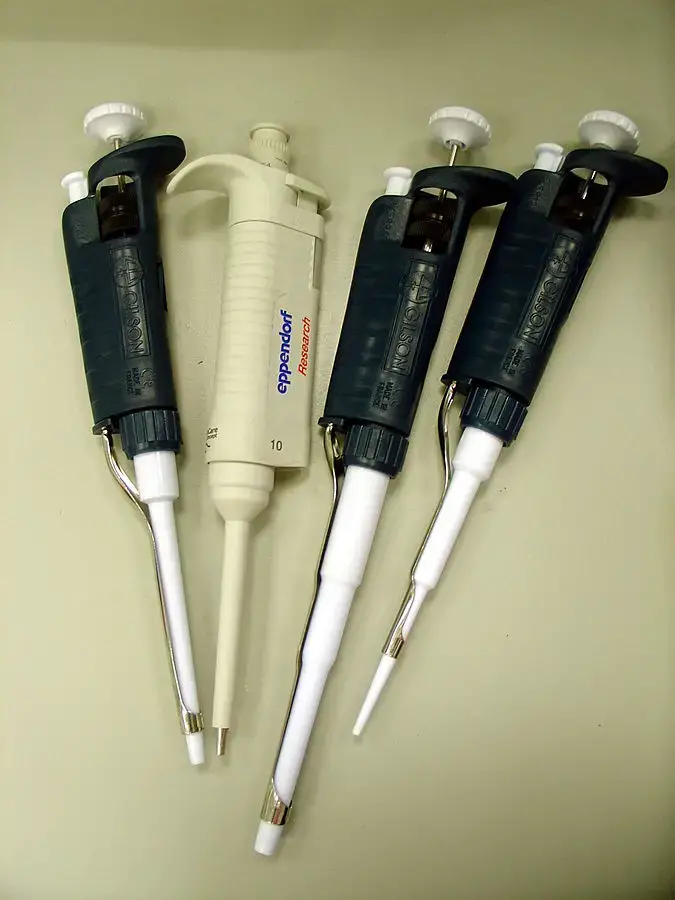
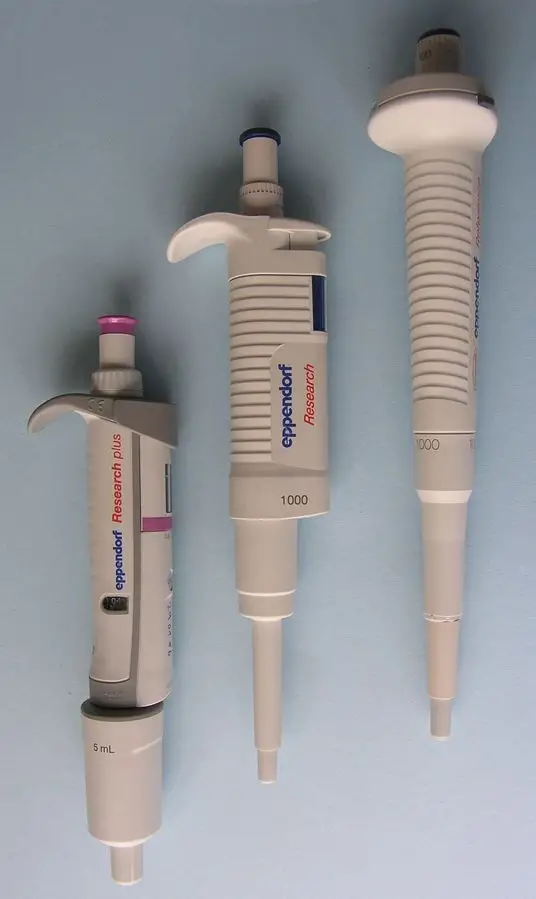
Micropipette is a highly precise hand held laboratory device used to measure and transfer very small volume of liquid. It is used for measuring liquid in microlitre (µL) range. It is commonly used in molecular biology and biochemistry laboratory.
Micropipette is used for handling small samples like DNA, RNA and proteins. It gives accurate transfer of minute liquid volume. It is used where very small quantity of sample is required.
The following are the important points about Micropipettes–
- Micropipette is used to measure and transfer minute volume of liquid. The volume is usually measured in microlitre (µL).
- It is a hand operated device. It has plunger, volume adjustment part, tip ejector and place for attaching disposable tip.
- Air-displacement micropipette is the most common type. It uses an internal piston to create vacuum and draw liquid into the disposable tip.
- In air-displacement micropipette, the liquid does not touch the piston. There is a small dead air cushion between piston and liquid.
- Positive-displacement micropipette is another type. In this type, the piston comes in direct contact with the liquid.
- Positive-displacement micropipette is useful for highly viscous, volatile or foaming liquids. It does not depend on air cushion.
- Micropipettes may be mechanical or electronic. Mechanical micropipette is operated manually by pressing the plunger.
- Electronic micropipette is motor operated. It helps to reduce thumb strain and repetitive strain injury during repeated pipetting.
- Electronic type can also perform automatic multi-dispensing and mixing. It is useful when same volume is to be delivered many times.
- Single-channel micropipette is used for individual liquid transfer. It has one channel and one tip.
- Multi-channel micropipette has many channels, commonly 8 or 12 channels. It is used for high-throughput work like filling 96-well microtiter plates.
- Forward pipetting is the common method for aqueous solutions. In this method, the plunger is pressed to first stop for aspiration and to second stop for complete dispensing.
- Reverse pipetting is used for viscous, volatile or foaming liquids. In this method, excess liquid is taken and only exact target volume is delivered.
- Micropipettes use disposable tips. These tips prevent cross contamination between different samples.
- Different types of tips are used according to work. Filter tips block aerosols, wide-bore tips are used for thick liquids and low-retention tips help in maximum sample recovery.
- According to modern ISO 8655 standard, micropipette and its tip are considered as one integrated system.
- Micropipettes should be calibrated regularly to keep accuracy. Calibration is mostly done by gravimetric analysis, by weighing dispensed distilled water on precise balance.
- Calibration may be done after 1 to 12 months. It depends on frequency of use and importance of the laboratory work.
7. Erlenmeyer Flasks
Erlenmeyer flask is a conical flask used in laboratory for mixing, heating and storing liquids. It has flat base and conical body. The body becomes narrow towards the neck.
Erlenmeyer flask is not a precision volumetric instrument. The graduation marks present on it gives only approximate volume of liquid. It is not used when exact volume measurement is required.
The following are the important points about Erlenmeyer flasks–
- Erlenmeyer flask has a flat base and conical body. This shape gives good stability during laboratory work.
- It has narrow or wide neck at the upper part. The narrow neck helps to reduce spilling during shaking and mixing.
- Erlenmeyer flasks have printed graduation scale on the side. These markings are not strictly calibrated and are used only as rough guide.
- It is used for mixing liquids. The conical shape allows swirling of liquid without easy spillage.
- Erlenmeyer flask is used for dissolving solids in liquids. The liquid can be shaken or swirled properly inside the flask.
- It is also used for exothermic reactions, such as dilution of strong acids. Such reactions should not be done in highly calibrated volumetric flask or graduated cylinder.
- Erlenmeyer flasks are frequently used for storing culture specimens and culture media. It is common in microbiology laboratory.
- Glass Erlenmeyer flasks are commonly made up of borosilicate glass such as Pyrex. It gives resistance to thermal shock and chemical corrosion.
- Heavy-duty glass Erlenmeyer flask has thicker wall and reinforced rim. It helps to prevent chipping and tolerate mechanical impact.
- Plastic Erlenmeyer flasks are made up of polypropylene (PP) or polymethylpentene (PMP/TPX). These plastics have good chemical resistance.
- Plastic flasks are autoclavable. They can be sterilized by heat under proper condition.
- Erlenmeyer flasks may have ground glass socket, glass stopper, plastic stopper or screwcap. The closure is selected according to the use.
- During steam sterilization or dry heat sterilization, the screwcap should be loosened. Stoppers should be removed before autoclaving.
- If the flask is tightly closed during autoclaving, pressure may build up inside. This can cause breaking, fracturing or imploding of the flask.
8. Precision Laboratory Syringes
Precision laboratory syringe is a highly precise instrument used to deliver very small volume of liquid. It is used for liquid delivery in microlitre (µL) range. It is commonly used in analytical chemistry, clinical diagnostics and animal research.
Precision laboratory syringe gives accurate fluid delivery. It is useful for handling very small sample volume. It is also useful for liquids which are viscous, volatile or corrosive.
The following are the important points about Precision laboratory syringes–
- Precision laboratory syringe is used to deliver extremely small volume of liquid. The volume is generally measured in microlitre (µL).
- It gives high accuracy in liquid delivery. It usually works within about ±1% of its nominal volume.
- It also gives good precision within 1% when measured at 80% of its total scale volume.
- Precision laboratory syringe generally works as positive-displacement system. In this system, plunger directly displaces the liquid.
- The plunger may be made up of stainless steel or may have PTFE-tipped end. It comes in direct contact with the liquid.
- It does not have dead air cushion like ordinary air-displacement micropipette. So it gives better delivery for difficult liquids.
- It is useful for highly viscous, volatile and corrosive liquids. These liquids can be measured more properly by this type of syringe.
- Some advanced syringes have tungsten plunger wire which extends through the needle up to the tip. This helps to give zero dead volume and almost complete sample recovery.
- Standard syringes may have very small dead volume. This is the liquid left inside the needle after delivery.
- Dead volume may be less than 1.0 µL in small syringes and about 6.8 µL in larger syringes.
- Precision laboratory syringes are available with cemented needle or removable needle (RN). The type is selected according to the laboratory work.
- Removable needle syringe is used when autoclaving or strict decontamination is needed. It can withstand temperature up to 115°C.
- Cemented needle should not be heated above 50°C. High heat may damage the adhesive bond between glass and metal.
- The glass barrel should not be held by hand for long time. Body heat can expand the glass and change the liquid volume.
- The syringe should be held only by the flange and plunger button. This helps to maintain accuracy during use.
- The plunger of each syringe is made to fit its own glass barrel. Plungers are not interchangeable between syringes.
- If the plunger is changed with another syringe, it may cause leakage or seizing of the syringe.
- Precision laboratory syringes are made according to strict calibration standards. The standard EN ISO 8655-9:2022 gives rules for construction, metrological requirements and maximum permissible errors.
9. Piston-Operated Volumetric Apparatus (POVA)
Piston-operated volumetric apparatus (POVA) is an advanced mechanical liquid delivery system used to measure and deliver specific volume of liquid. It uses an internal piston for displacement of liquid. It is used when accurate and repeated liquid handling is required.
POVA is used in micro-scale analysis and routine laboratory work. It is commonly used in genomics, proteomics and clinical chemistry. It often replaces traditional glass volumetric apparatus in many works.
The following are the important points about Piston-operated volumetric apparatus (POVA)–
- POVA works by movement of an internal piston. The piston helps to displace and deliver a fixed or selected volume of liquid.
- It includes many mechanical laboratory instruments. These include micropipettes, burettes, dilutors, bottletop dispensers, repetitive pipettes and manually operated precision laboratory syringes.
- POVA may work by air-displacement mechanism. In this type, a dead air cushion is present between the piston and the liquid.
- It may also work by positive-displacement mechanism. In this type, the piston comes in direct contact with the liquid.
- Positive-displacement POVA does not have air cushion. So it is useful for liquids which are viscous, volatile or difficult to handle.
- POVA is used for accurate delivery of small liquid volume. It is also used when same volume is to be delivered many times.
- It can measure and deliver very small volume in microlitre (µL) range. Some apparatus can also deliver larger volume up to two litres.
- Modern POVA and its exchangeable parts are considered as one integrated system. Example, micropipette and disposable pipette tip are taken together.
- Calibration is valid only for the specific tip or exchangeable part used during the test. Changing the tip type may change the accuracy.
- POVA is made and controlled according to international standard. The important standard is ISO 8655:2022.
- The performance of POVA may decrease with time. This may happen due to part wear, leakage or calibration drift.
- Regular calibration and testing are required to maintain accuracy. This is also called metrological confirmation.
- Calibration is commonly done by gravimetric method or photometric reference method. These methods check the delivered volume properly.
- POVA is important in modern laboratory because it gives fast, accurate and controlled liquid handling. It is useful where manual glass apparatus is not enough.
10. Dropping Funnels
Dropping funnel is a laboratory glass apparatus used to add liquid slowly into another vessel. It is commonly fitted with a stopcock for controlling the flow of liquid. It is useful when liquid is to be added drop by drop.
Dropping funnel is not a precise volumetric instrument. The scale present on it gives only approximate idea of volume. It is used for controlled addition of liquid, not for highly accurate measurement.
The following are the important points about Dropping funnels–
- Dropping funnel is used to add liquid slowly in chemical reaction vessel. The liquid can be added dropwise by controlling the stopcock.
- It may contain graduations on the body. These graduations are used only as approximate guide for volume contained or delivered.
- Dropping funnels are usually made up of chemically resistant borosilicate glass such as Pyrex®.
- They are available as ungraduated type or graduated type. Some have double graduated scale printed on the body.
- The graduation scale is often printed in white enamel. It helps to see the liquid volume more clearly.
- Dropping funnel has a stopcock at the lower part. It is used to control the rate of liquid flow.
- Stopcock may have interchangeable glass key. It may also have PTFE or Teflon key.
- PTFE key is useful because it gives grease-free and non-stick working. It does not need lubrication.
- Some dropping funnels have Rotaflo® stopcock. It helps in smooth and controlled flow of liquid.
- Dropping funnels are supplied with polyethylene stopper or glass stopper. The stopper helps to close the top opening.
- Some models have open top instead of standard socket. It makes addition of solutions into the funnel easier.
- Stem with cone type has an integral ground-glass cone. It helps to fit the funnel safely into the socket of flasks and other glassware.
- Stem inside cone type has the stem present inside the cone. The stem does not protrude outside.
- Stem inside cone type is useful for fitting on the top of chromatography columns. A protruding stem may create problem in this work.
- Many dropping funnels are manufactured according to international standard. One common standard is ISO 4800.
11. Test Measures
Test measure is a volumetric tool used for calibration and checking of liquid volume. It is mainly used in petroleum measurement work. It helps to maintain traceability and fair measurement of valuable liquids.
Test measure is used for checking whether a liquid measuring system gives correct volume or not. It is commonly used for calibration of provers and fuel dispensers. It is not a routine laboratory measuring cylinder.
The following are the important points about Test measures–
- Test measure is used for calibration of liquid volume. It is used to check and maintain correct measurement in liquid trade.
- It is mainly used in petroleum measurement. It helps in fair and equitable trade of liquids like gasoline and diesel.
- Test measures are frequently used to calibrate volume in piston provers and ball provers. These provers are used for checking liquid flow measurement.
- It is also used by weights and measures inspectors. They commonly use 5-gallon test measures to check retail fuel dispensers.
- Test measure can be calibrated by contained volume. In this case, the volume is the amount of liquid present when filled up to the zero mark on the neck scale.
- It can also be calibrated by delivered volume. In this case, the volume is the amount of liquid discharged after a fixed draining procedure.
- Delivered volume is generally more important in field work. This is because the test measure is used repeatedly and drying the inside each time is not practical.
- Standards laboratories usually calibrate test measures by using water. Very low uncertainty about 0.01% can be obtained during calibration.
- After calibration with water, the same test measure may be used in field for other liquids like gasoline or diesel.
- The accuracy of delivered volume depends on the liquid retained on the inner wall. Some liquid remains on the wall after draining.
- Retained volume depends on the kinematic viscosity of liquid. More viscous liquid may remain more on the wall.
- Proper draining time is important for correct measurement. It includes main flow time and fixed drip time, such as 30 seconds.
- Smaller test measures are more affected by drainage error. This is because they have higher surface area in relation to their volume.
- Larger test measures are less affected by small retained liquid variation. So their drainage effect is comparatively less.
- The design of test measure affects retained volume and drain time. Height to diameter ratio, cone angle and drain pipe shape can change the result.
- Internal baffles, wall material and surface roughness also affect the measurement. These factors control how much liquid remains after discharge.
12. Graduated Medicine Measures
Graduated medicine measure is a small measuring vessel used for quick measurement of liquid. It is mostly used for measuring liquid medicines and other small liquid volume. It is not used for highly accurate volumetric work.
Graduated medicine measure is simple and robust in structure. It has graduation marks on the side. These marks help to check approximate volume of liquid.
The following are the important points about Graduated medicine measures–
- Graduated medicine measure is usually made up of polypropylene. It is strong, light and not easily broken.
- It is translucent in nature. So the liquid level can be seen from outside during measurement.
- It has graduation marks on its side. These markings help to measure small quantity of liquid.
- Graduated medicine measures are designed to nest together. This helps to save storage space in laboratory.
- It is used for basic volume measurement. It is useful when quick checking of liquid volume is required.
- It is also suitable during taking pH measurements. The liquid can be kept in the measure during the test.
- Graduated medicine measures are commonly available in 30 mL capacity. This type has 1.0 mL subdivisions.
- They are also available in 50 mL capacity. This type has 5.0 mL subdivisions.
- It is mostly used for approximate measurement only. It should not be used when exact and precise volume is needed.
13. Graduated Jugs
Graduated jug is a measuring vessel used for measuring and pouring liquid. It has graduation marks on its body. It is used when larger amount of liquid is to be measured and dispensed easily.
Graduated jug is not used for very precise volumetric measurement. It is mostly used for routine laboratory work, food and pharmaceutical work. It gives easy handling and easy pouring of liquids.
The following are the important points about Graduated jugs–
- Graduated jugs are commonly made up of high-clarity polypropylene or stainless steel. Both types are used according to the need of work.
- Polypropylene graduated jug is clear and light in weight. The liquid level can be seen easily from outside.
- Stainless steel graduated jug is strong and durable. It is used where strong and clean vessel is required.
- Graduated jug usually has tapered shape. This helps in easy handling and proper pouring of liquid.
- It has a pour spout at the upper side. The spout helps to dispense liquid without much spilling.
- Polypropylene jugs often have ergonomic handle with thumb grip. It helps in safe carrying and pouring.
- Polypropylene graduated jugs may have permanent moulded graduations. Some types have clear blue printed graduations.
- Stainless steel jugs have internal moulded graduations. The graduations are measured in milliliters (mL).
- Stainless steel graduated jug has seamless inner surface. This helps to reduce contamination and makes cleaning easy.
- It has a beaded rim for more durability. It also has flared base which gives better stability.
- Stainless steel jugs are useful in pharmaceutical, food and beverage and general laboratory applications.
- The surface of stainless steel jug is non-reacting and has zero absorption. So it does not easily hold chemicals or liquid residues.
- The polished surface of stainless steel jug makes it easy to clean. It also reduces contamination risk.
- Polypropylene graduated jugs are durable and autoclavable. They can be autoclaved at 121°C.
- Graduated jug is used for measuring and transferring larger volume of liquids. It is useful where quick volume checking and easy pouring is needed.
14. Capillary Pipettes
Capillary pipette is a small narrow tube used to measure minute quantity of liquid. It has very narrow internal diameter. It works by capillary effect which pulls the liquid upward inside the tube.
Capillary pipette is used when very small amount of liquid is required. It is commonly used in medical and diagnostic work. It is calibrated to contain the exact volume inside the tube.
The following are the important points about Capillary pipettes–
- Capillary pipette has a very narrow bore. Because of this narrow tube, adhesion force pulls the liquid upward.
- The upward movement of liquid inside the tube is called capillary effect. This helps in filling the pipette automatically.
- Capillary pipette is usually calibrated as To Contain (TC or In). This means the exact volume is the volume held inside the tube.
- It does not deliver the exact volume only by natural draining. The liquid remains inside because of narrow diameter.
- Capillary pipettes are used for minute volume measurement. They generally measure volume up to 200 µL.
- Some capillary pipettes can be used with special pipetting aids for volume up to 1 mL.
- Single ring mark capillary pipette has one calibration mark. The measured volume is between one end of the tube and this mark.
- End-to-end capillary pipette has no ring mark. It contains exact volume when the whole tube is filled from one end to other end.
- Capillary pipette can be filled by capillary action. It can also be filled by using a special pipetting aid.
- After filling up to the mark, the pipette is kept horizontal. The outside liquid should be wiped carefully with tissue.
- Since it is calibrated to contain, the liquid should be blown out by pipetting aid during dispensing.
- After blowing out, the pipette is rinsed two to three times with diluting medium. This helps to transfer all liquid from the capillary.
- End-to-end capillary pipette may be placed directly into dilution solution. Then it is washed out by shaking.
- Capillary pipettes are used in medical field. They are used as blood diluting pipettes and blood sugar pipettes.
- It is useful for small sample work where only very little liquid is available.
15. Beakers
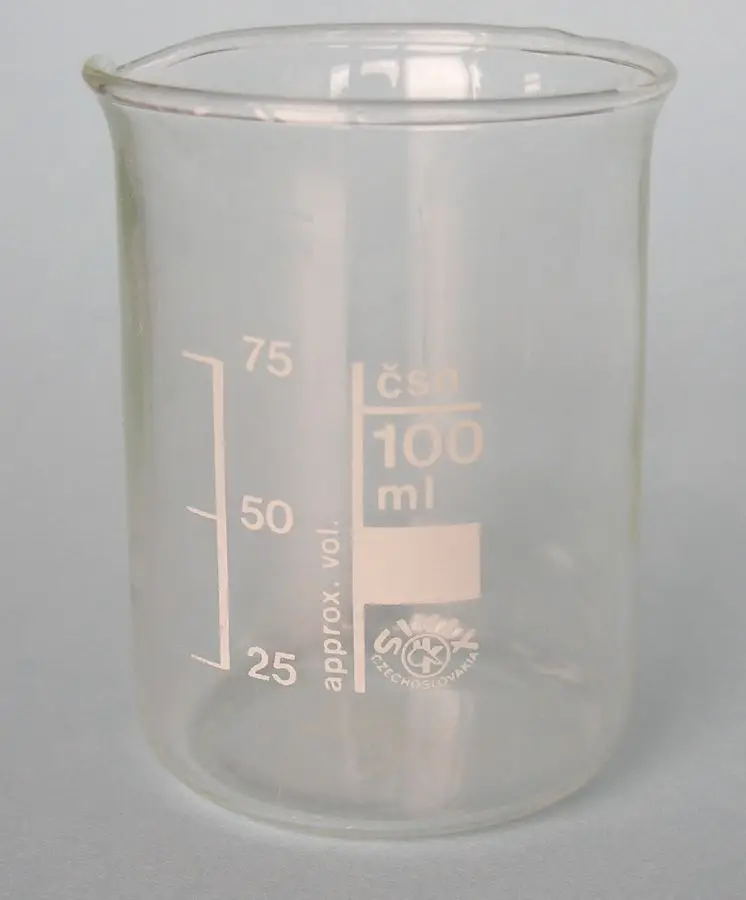
Beaker is a general purpose laboratory container used for mixing, stirring and heating of liquids. It is also used for preparing non-critical volume of liquids. It has straight side, flat base and a small pouring spout.
Beaker is not a precise volumetric instrument. It should not be used for accurate measurement of liquid. The graduations present on beaker gives only rough idea of volume.
The following are the important points about Beakers–
- Beaker is used for mixing and stirring of liquids in laboratory. It is also used for heating and preparing solutions.
- It is used when exact volume is not required. It is suitable for routine and general laboratory work.
- Beakers have approximate graduation marks on the side. These marks only give rough measurement of liquid volume.
- The volume reading from beaker may have about 5-10% error of total volume. So it is not used for accurate volumetric work.
- Glass beaker is commonly made up of borosilicate glass such as Pyrex. It gives resistance to chemical attack and thermal shock during heating.
- Plastic beaker is made up of shatter-resistant plastics like polypropylene (PP), polymethylpentene (PMP) and PTFE. These are used for routine handling and educational laboratory.
- Metal beaker may be made up of aluminum or stainless steel. It is strong and can withstand high temperature.
- A typical beaker has a flat base. This helps the beaker to stand properly on bench or heating surface.
- It has straight sides which helps in easy mixing of liquid. The liquid can be stirred by glass rod or magnetic stirrer.
- Beaker has a small pour spout at the rim. It helps in safe and easy transfer of liquid from one vessel to another.
- Many beakers have white or blue printed graduations. They also have a marking spot for labelling the sample.
- Low form beaker is the common type of beaker. It is used for general heating, mixing and solution preparation.
- Tall form beaker is narrow and high in shape. It is useful when more depth of liquid is needed.
- Conical beaker or Phillips pattern beaker is another form. It has conical shape and is used for special laboratory handling.
- Heavy-duty beaker has thick wall, heavy base and reinforced rim. It reduces chipping and breakage during washing and handling.
- Jacketed beaker has an outer jacket. Temperature controlling liquid can circulate through it to keep the sample at constant temperature.
16. Volumetric Flasks
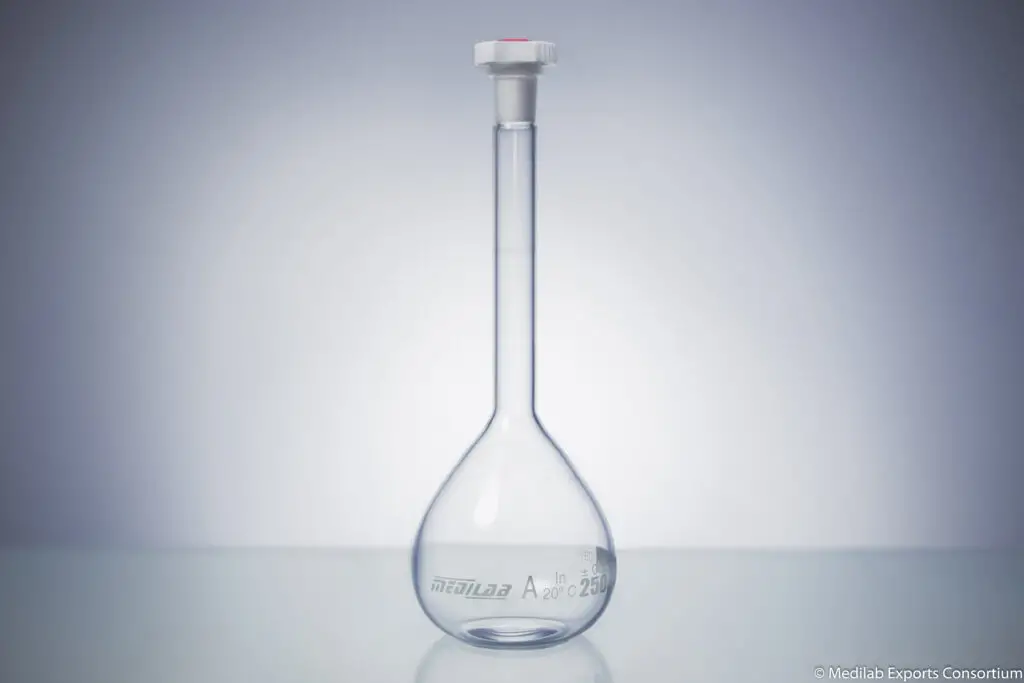
Volumetric flask is a laboratory glassware used to prepare solution of exact volume. It has a pear shaped body, flat bottom and long narrow neck. It has a single calibration ring on the neck.
Volumetric flask is mainly used for preparing standard solutions and accurate dilutions. It is used when definite volume and concentration is required. It is not used for exact transfer of liquid from one vessel to another.
The following are the important points about Volumetric flasks–
- Volumetric flask has a pear shaped body with flat bottom. This shape helps to hold the solution properly and keep the flask stable.
- It has a long and narrow neck. The narrow neck helps to read the volume accurately because small change in liquid height shows very small volume difference.
- A single etched calibration ring is present on the neck. The liquid level is adjusted up to this mark.
- Volumetric flask is used to prepare solution of precise volume and concentration. It is commonly used in analytical work.
- It is used for accurate dilution of solutions. It is useful when absolute precision is needed.
- Volumetric flasks are mainly calibrated as To Contain (TC or In). This means the flask contains exactly the stated volume when filled up to the mark.
- It should not be used for exact delivery of liquid. After pouring, a thin film of liquid remains on the glass wall, so less volume is delivered.
- Volumetric flask is highly accurate. It generally gives precision better than 0.2%.
- Class A volumetric flask has tight tolerance. It is used in analytical and pharmaceutical work.
- Class B volumetric flask has twice the permissible error than Class A. It is used for general and educational purpose.
- For preparation of solution, first the solute is added in the flask. Then solvent is added up to about two-third volume and the flask is swirled to dissolve the solute.
- After dissolving, more solvent is added slowly. At the end, solvent is added drop by drop until the bottom of the meniscus touches the calibration mark.
- The reading should be taken at eye level. This prevents parallax error and gives proper adjustment of volume.
- After making up the volume, the flask is stoppered and inverted several times. This helps to mix the solution uniformly.
- Measurement should be done at calibrated temperature. Usually this temperature is 20°C.
- Volumetric flask should not be dried in high temperature oven above 150°C. High heat may change its calibration and reduce accuracy.
- Volumetric flasks are commonly made up of borosilicate glass. This glass is resistant to chemicals and thermal change.
- Some volumetric flasks are made up of plastic like PFA or PMP. These are durable and useful in some laboratory works.
- Wide-mouth volumetric flask is used for easy insertion of pipettes or solid tablets. It makes addition of solid material easy.
- Square-shaped volumetric flask is a variation which takes less storage space. It is useful when many flasks are stored in laboratory.
17. Burettes
Burette is a precision laboratory instrument used to measure and deliver variable volume of liquid. It is mainly used in quantitative chemical analysis. It is an important apparatus in titration.
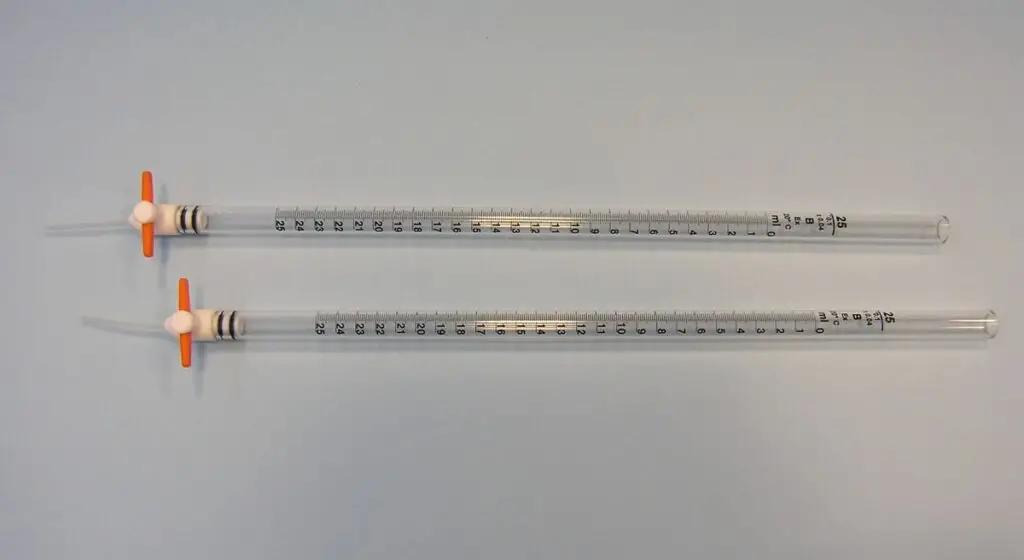
Burette is a long and narrow tube having fine graduations on its side. It has a valve at the lower end called stopcock. The stopcock is used to control the flow of liquid.
The following are the important points about Burettes–
- Burette is used to dispense liquid accurately. It can deliver variable volume according to the need of the experiment.
- It is mainly used in titration work. It helps to add the titrant slowly until the end point is reached.
- Burette is made up of glass or plastic. It has long slender body with fine volume markings.
- The lower end of burette has a stopcock. It controls the liquid flow from the tube.
- Burettes are calibrated as To Deliver (TD or Ex). This means the markings show the volume delivered from the burette.
- The calibration also accounts for thin liquid film which remains on the inner wall after delivery.
- Common sizes of burettes are 10 mL, 25 mL and 50 mL. These are mostly used in laboratory titration.
- A 50 mL burette usually has 0.1 mL graduations. The reading can be estimated up to 0.05 mL or 0.01 mL by careful observation.
- Burette gives high precision in liquid measurement. It is more accurate than ordinary measuring cylinders.
- Stopcock allows drop by drop delivery of liquid. This is very important for finding exact end point in titration.
- Traditional stopcock is made up of ground glass. Modern burettes may have PTFE or Teflon stopcock key.
- PTFE stopcock is chemically resistant and self lubricating. It does not require grease for smooth working.
- Before use, the burette should be rinsed with the same solution which is to be filled in it. This is called conditioning of burette.
- Conditioning prevents dilution of the solution inside the burette. It also helps to maintain correct concentration.
- To find the volume delivered, initial reading and final reading are recorded. The difference between these two readings gives the dispensed volume.
- The final drop hanging at the tip should be touched to the inner wall of the receiving vessel. This drop is included in the calibrated delivered volume.
- Schellbach burette is a special type of burette. It has a vertical white stripe with a thin coloured line inside the glass.
- In Schellbach burette, the coloured line appears hourglass shaped through the liquid. This helps to read the meniscus more accurately.
- Automatic burette or self-zeroing burette is attached to a reservoir bottle. When the bottle is squeezed, liquid enters the burette and excess liquid returns back automatically.
- In self-zeroing burette, the liquid level becomes set at zero. It makes repeated titration work easier.
- Digital bottletop burette is a mechanical or electronic burette fitted on reagent bottle. It dispenses liquid by piston movement.
- Digital bottletop burette shows delivered volume on digital display. It does not need visual reading of meniscus.
References
- 5 Common Volumetric Measurement Errors & How to Avoid Them … (n.d.). [URL].
- ASTM E1272-02(2007) – Standard Specification for Laboratory Glass Graduated Cylinders. (n.d.). [URL].
- Accurate Techniques for Liquid Measurement – BNS Institute. (n.d.). [URL].
- Astm E694 18 | PDF | Litre | Metrology – Scribd. (n.d.). [URL].
- BURETTES – ChemScience. (n.d.). [PDF].
- Borosilicate Glass vs. Polypropylene Labware: Benefits, Drawbacks & How to Choose. (n.d.). [URL].
- Burette & pipette – basic volumetric glassware used in titrations, ASTM E287-02 standard specification. (n.d.). [URL].
- Burettes In Titration: Why Class A Accuracy Matters – LabChoice Australia. (n.d.). [URL].
- Certification Standards for Analytical Chemistry: Essential Tools for Reliable Laboratory Practice. (n.d.). [URL].
- Chemical Resistance Chart – Plastics International. (n.d.). [URL].
- Chemical Resistance Chart for Plastic Labware – Bel-Art. (n.d.). [PDF].
- Chemical resistance, PFA | Materials – Polyfluor. (n.d.). [URL].
- Choosing Between Volumetric and Graduated Glassware for Lab Accuracy – MSE Supplies. (n.d.). [URL].
- Class A Vs Class B Glassware: Accuracy Standards Explained – LabChoice Australia. (n.d.). [URL].
- Class A vs. Class B Volumetrics – When to Spend vs. Save | BRANDTECH Scientific. (n.d.). [URL].
- Cleaning a Glass Syringe | Knowledge Center – Hamilton Company. (n.d.). [URL].
- Common Types of Laboratory Equipment Used to Measure Liquid Volume | Notes – Pearson. (n.d.). [URL].
- DWK Life Sciences – KIMBLE® VOLUMETRIC GLASSWARE – Thermo Fisher Scientific. (n.d.). [PDF].
- E1272 Standard Specification for Laboratory Glass Graduated Cylinders – ASTM. (n.d.). [URL].
- E288 Standard Specification for Laboratory Glass Volumetric Flasks – ASTM. (n.d.). [URL].
- E694 Standard Specification for Laboratory Glass Volumetric Apparatus – ASTM. (n.d.). [URL].
- Factors Affecting Pipette Accuracy | Thermo Fisher Scientific – US. (n.d.). [URL].
- Factors affecting the accuracy of laboratory glassware – WUBOLAB. (n.d.). [URL].
- Glass vs Plastic: Which Laboratory Containers are Best for Your Applic. (n.d.). [URL].
- Glass vs. Plastic in Education Labs: What to Use, When, and Why. (n.d.). [URL].
- Glassware and Plasticware Properties – Arbor Scientific. (n.d.). [URL].
- Graduated & Volumetric Cylinders | Thomas Scientific. (n.d.). [URL].
- Graduated cylinder – Wikipedia. (n.d.). [URL].
- How to pipette viscous and volatile liquids – Integra Biosciences. (n.d.). [URL].
- IBC Guidelines for Proper Hamilton Syringe Use with Viral Vectors – Research Safety. (n.d.). [PDF].
- ISO 8655 Balances | Pipette Calibration Equipment – Mettler Toledo. (n.d.). [URL].
- ISO 8655:2022 — Everything you need to know about the new pipette standard. (n.d.). [URL].
- KIMBLE® KIMAX® Volumetric Flask, Class A, TC and TD – DWK Life Sciences. (n.d.). [URL].
- Lab Measuring Equipment | Types & Significance – Westlab. (n.d.). [URL].
- Lab Plasticware vs. Glassware: Pros, Cons & When to Use Which – aseschem. (n.d.). [URL].
- Laboratory Glassware – What are TD (To Deliver) and TC (To Contain), a – Globe Scientific. (n.d.). [URL].
- Liquid Volume Measuring Devices: The Graduated Cylinder and Buret. (n.d.). [PDF].
- Materials Compatability. (n.d.). [PDF].
- Metrological Analysis of Volumetric Instrumentation in the Analytical Laboratory: Principles, Material Science, and Standardized Methodologies. (n.d.). [Markdown].
- Microliter Syringes | Articles, FAQs, & Materials – Hamilton Company. (n.d.). [URL].
- Microliter™ Syringes – Scientific Laboratory Supplies. (n.d.). [URL].
- Operation and Calibration Procedure of Micropipette – Pharma Beginners. (n.d.). [URL].
- PFA (Perfluoroalkoxy) – Chemical Resistance Chart – Darwin Microfluidics. (n.d.). [URL].
- Pipette Calibration and Compliance: A Practical Guide to ISO 8655. (n.d.). [PDF].
- Pipette Calibration | Knowledge Center – Hamilton Company. (n.d.). [URL].
- Policy for Preparation of Hamilton Syringes for Use in Injections – Wayne State University. (n.d.). [URL].
- Polypropylene Chemical Compatibility Chart – CP Lab Safety. (n.d.). [URL].
- Reverse Pipetting | Sartorius. (n.d.). [URL].
- Sartorius LPS Service: ISO 8655:2022 POVA FAQ. (n.d.). [PDF].
- SoftGrip™ Single Channel Pipettes User Manual. (n.d.). [PDF].
- Specifications and tolerances for reference standards and field standard weights and measures 2. specifications and tolerances f – NIST Technical Series Publications. (n.d.). [PDF].
- Syringe Care and Use Guide | Knowledge Center – Hamilton Company. (n.d.). [URL].
- TC or TD? Choosing the Right Measuring Cylinder. (n.d.). [Youtube].
- Techniques for Pipetting Challenging Liquids – Sartorius. (n.d.). [PDF].
- The Complete Guide to Micropipette Calibration: Achieving Accuracy with AHN Micropipettes – AHN Biotechnologie GmbH. (n.d.). [URL].
- The Effect of Liquid Kinematic Viscosity and Drain Time on the Volume Delivered from a Test Measure∗. (n.d.). [PDF].
- The Effects of Intravenous Fluid Viscosity on the Accuracy of Intravenous Infusion Flow Regulators – PMC. (n.d.). [URL].
- Tutorial: How to Reverse Pipette?. (n.d.). [Youtube].
- Understanding Laboratory Glassware Classifications – Globe Scientific. (n.d.). [URL].
- Understanding “TD” And “TC” in Laboratory Glassware – Blogs – News. (n.d.). [URL].
- Updated ISO 8655 Guidelines for Pipette Calibration and Testing – Learning Hub – Gilson. (n.d.). [URL].
- Viscous Liquid Handling in Molecular Biology and Proteomics. (n.d.). [URL].
- Volumetric Flasks In Analytical Chemistry: Accuracy Standards Explained. (n.d.). [URL].
- Volumetric Measurement – brand.de. (n.d.). [PDF].
- What is the Difference Between TD & TC Pipettes? – Westlab. (n.d.). [URL].
- Why Does Fluid Viscosity Matter When Selecting a Flow Meter – Proteus Industries. (n.d.). [URL].
- Why are pipettes calibrated to leave a little liquid in the tip? : r/askscience – Reddit. (n.d.). [URL].
- glassware 15-19 Technical information – IDEA CONCEPTION. (n.d.). [PDF].