

Micropipette is a laboratory instrument that is used to measure and transfer very small volume of liquid in microliter range.
It is highly accurate instrument and commonly used in molecular biology, chemistry and clinical diagnostic laboratory. It works by a piston mechanism which creates suction and draws liquid into a disposable plastic tip. The volume can be adjusted according to need and used tip can be ejected to prevent contamination.
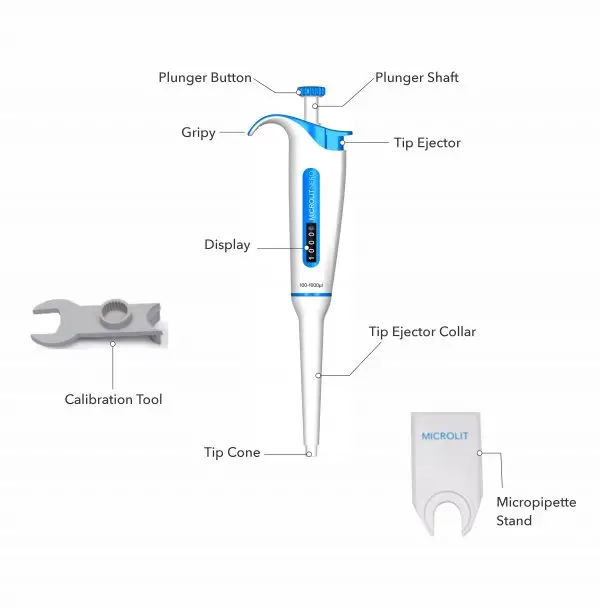
Working mechanism of Micropipette
Micropipette is based on the principle of displacement of air or direct displacement of liquid by the movement of piston.
In air displacement micropipette, an air space is present between the piston and the liquid. When the plunger is pressed, air is removed from the inside part. When the plunger is released slowly, suction is produced and liquid enters into the disposable tip.
In positive displacement micropipette, there is no air space between piston and liquid. The piston directly touches the liquid inside the capillary tip. When the piston moves upward, liquid is taken into the tip and when piston moves downward, liquid is pushed out from the tip.
This principle is used for measuring and transferring small volume of liquid accurately. Positive displacement micropipette is used for thick, dense, foaming and volatile liquid.
What is the purpose of pipetting?
The following are the purposes of pipetting–
- Pipetting is used to measure and transfer small volume of liquid accurately.
- It is used for safe transfer of sample from one tube or container to another.
- It is used to prepare solution by mixing reagents, buffers and chemicals in proper amount.
- It is used in serial dilution where the sample concentration is reduced step by step.
- It is used to load samples in microplates, PCR tubes, spectrophotometer cuvette and other instruments.
- It is used in cell culture for adding media, transferring cells and adding drugs in sterile condition.
- It is used in DNA, RNA and protein analysis where exact volume of liquid is required.
- It is used in titration, colour reaction and quantitative assay for dispensing reagents.
- It is used in clinical diagnostic test for handling blood, serum and other biological samples.
- It is used in pharmaceutical quality control and research work for accurate and reproducible result.
How to Use a Micropipette?
The following are the steps to use a micropipette–
- At first, required range of micropipette is selected.
- The volume is then adjusted by rotating the volume adjustment knob.
- The volume should not be adjusted above or below the range of the micropipette.
- A sterile disposable tip is fixed with the tip cone.
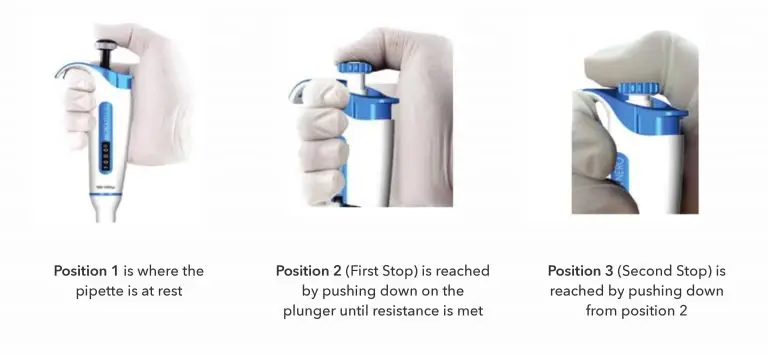
- The plunger is pressed up to the first stop.
- The tip is dipped slightly into the liquid.
- The plunger is released slowly. In this step, liquid enters into the tip.
- The tip is placed inside the receiving tube by touching the wall of the tube.
- The plunger is pressed up to the first stop to release the liquid.
- Then the plunger is pressed up to the second stop to remove remaining liquid.
- The tip is removed from the tube without releasing the plunger.
- The plunger is then allowed to return in its normal position.
- The used tip is removed by pressing the tip ejector button.
- A new tip is used for next sample to avoid contamination.
Parts of a micropipette
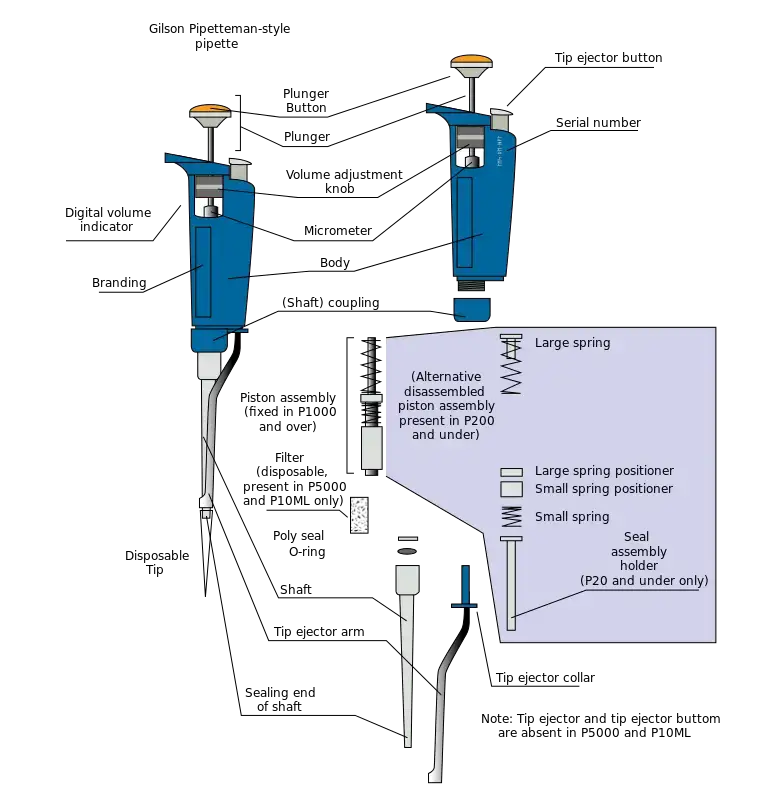
The following are the important parts of a micropipette–
- Plunger button – It is present at the top of the micropipette. It is pressed for taking and releasing the liquid.
- Volume adjustment knob – It is used to adjust the required volume of liquid.
- Volume display – It shows the adjusted volume of the micropipette.
- Tip ejector button – It is used to remove the used tip without touching it by hand.
- Body – It is the main outer part of the micropipette. It protects the inner parts.
- Finger hook – It helps to hold the micropipette properly during work.
- Shaft – It is the lower tubular part of the micropipette. It connects the body with the tip cone.
- Tip cone – It is the end part where disposable tip is attached.
- Disposable tip – It is a plastic tip which holds the liquid during pipetting.
- Piston – It is an internal moving part. It creates suction for drawing the liquid into the tip.
- Seal or O-ring – It keeps the inside part airtight and prevents loss of suction.
- Return spring – It helps the piston to return back to its normal position.
- Micrometer – It helps in accurate adjustment of the piston movement.
- Friction ring – It prevents sudden change of the adjusted volume during pipetting.
Types of micropipette
The following are the types of micropipette–
- Air displacement micropipette – It works by air cushion present between piston and liquid. It is commonly used for normal aqueous solution.
- Positive displacement micropipette – In this micropipette, piston comes in direct contact with the liquid. It is used for viscous, foaming, dense and volatile liquid.
- Mechanical micropipette – It is operated by hand. It works by spring loaded piston system.
- Electronic micropipette – It is operated by battery. It is controlled by button and gives same pipetting again and again.
- Single channel micropipette – It has one tip cone. It is used to transfer one sample at a time.
- Multichannel micropipette – It has many tip cones, generally 8, 12 or 16 channels. It is used to transfer many samples at a same time.
- Fixed volume micropipette – It gives only one fixed volume. The volume cannot be changed.
- Variable volume micropipette – Its volume can be changed within a fixed range by adjustment knob.
- Mini micropipette – It is small and light weight micropipette. It is used for low volume work and small laboratory space.
Volume adjustment on Micropipette – How to Adjust Volume in Micropipette?
The following are the steps for adjustment of volume in micropipette–
- At first, the required micropipette is selected according to volume range.
- The volume adjustment knob or plunger button is located.
- The knob is rotated to increase or decrease the volume.
- The volume display is observed during rotation of the knob.
- The required volume is adjusted according to the display.
- The volume should be adjusted slowly and carefully.
- For accurate setting, the volume is first taken slightly above the required volume.
- Then it is brought down slowly to the exact required volume.
- The volume should not be adjusted above the maximum range of micropipette.
- The volume should not be adjusted below the minimum range of micropipette.
- Forceful rotation of knob can damage the internal micrometer and calibration.
- If volume lock is present, it is locked after adjustment.
- This prevents accidental change of volume during pipetting.
Size and Range / Technical Specifications of Micropipette
| Volume Range (ul) | Classification | Increment (ul) | Accuracy (± %) | Accuracy (±ul) | CV (± %) | CV ( ± ul) |
| 0.2-2 | P2 | 0.002 | 2 | 0.04 | 1.2 | 0.024 |
| 0.5-10 | P10 | 0.02 | 1 | 0.1 | 0.5 | 0.05 |
| 2-20 | P20 | 0.02 | 0.8 | 0.16 | 0.4 | 0.08 |
| 5-50 | P50 | 0.1 | 0.8 | 0.4 | 0.4 | 0.2 |
| 10-100 | P100 | 0.2 | 0.6 | 0.6 | 0.2 | 0.2 |
| 20-200 | P200 | 0.2 | 0.6 | 1.2 | 0.2 | 0.4 |
| 100-1000 | P1000 | 1.0 | 0.6 | 6 | 0.2 | 2 |
| 500-5000 | P5000 | 10.0 | 0.6 | 30 | 0.2 | 10 |
| 1000-10000 | P10000 | 20.0 | 0.6 | 60 | 0.2 | 20 |
The measuring ranges for the micropipettes most frequently used are:
- P10 – 1.0-10.0µL – White tips (slightly translucent)
- P20 – 2.0-20.0 µL – Yellow tips
- P100 -10.0-100.0 µL – Yellow tips
- P200 – 20.0-200.0 µL – Yellow tips
- P1000 – 11000.0 µL –Blue tips (should only be used for volumes 200 or greater)
Different pipetting techniques
The following are the different pipetting techniques–
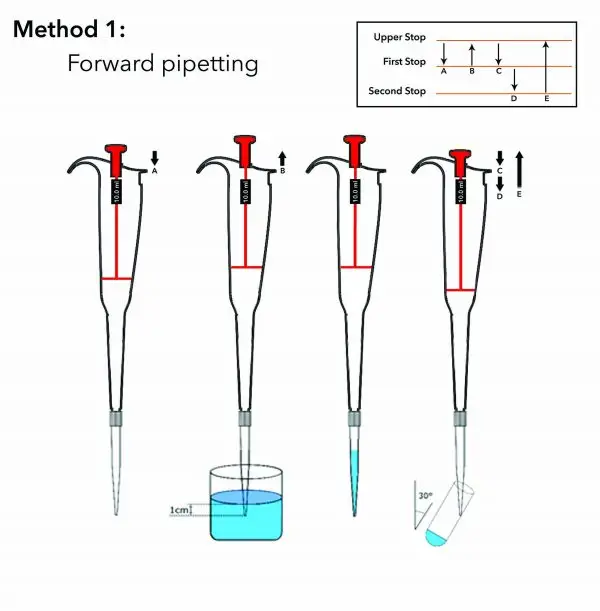
- Forward pipetting – It is the common method of pipetting. It is used for normal aqueous solution. In this method, plunger is pressed up to first stop for taking liquid and then pressed up to second stop for complete releasing of liquid.
- Reverse pipetting – It is used for viscous, foaming, dense and volatile liquid. In this method, plunger is pressed up to second stop for taking more liquid and then liquid is released only up to first stop. Extra liquid remains in the tip.
- Repetitive pipetting – It is used to release same volume of liquid many times. It is generally done by electronic pipette or repeater pipette.
- Side wall touch-off – In this method, tip is touched with the inner wall of receiving tube during releasing of liquid. It helps to remove liquid sticking at the end of tip.
- Into liquid dispense – In this method, liquid is released directly into the receiving liquid. It is used when small volume may stick to the wall of the tube.
- Surface touch-off – In this method, the droplet at the tip is touched with the surface of liquid present in the tube. It is used for very small volume, generally less than 1 µL.


How to calibrate the Micropipette?
The following are the steps for calibration of micropipette–
- At first, distilled water or deionized water is kept in the room for 15-20 minutes.
- The temperature of water is measured by thermometer.
- The micropipette is also kept in same room condition for some time.
- A clean empty beaker or weighing boat is placed on the analytical balance.
- The balance is then tared to zero.
- A suitable disposable tip is attached with the micropipette.
- The tip is pre-wetted by taking and releasing water for 7-10 times.
- The required calibration volume is set in the micropipette.
- Distilled water is taken slowly into the tip. Air bubble should not be present.
- The water is dispensed into the beaker placed on the balance.
- The weight of dispensed water is recorded.
- The same process is repeated for 5-10 times. For standard calibration, 10 readings are taken.
- The weight is converted into volume by using the formula-
V = W × Z
where, V = actual volume, W = weight of water, Z = conversion factor of water according to temperature.
- The average volume is calculated from all readings.
- Accuracy is calculated by using the formula-
A = 100 × (Vavg / V0)
where, A = accuracy, Vavg = average calculated volume, V0 = set volume of the micropipette.
- The result is compared with permissible error limit.
- If reading is not correct, calibration screw is adjusted according to manufacturer guideline.
- After adjustment, the test is repeated again to confirm the calibration.
Uses of Micropipette
The following are the uses of micropipette–
- Micropipette is used to transfer very small volume of liquid from one container to another.
- It is used to measure liquid in microliter range accurately.
- It is used to prepare standard solution by mixing chemicals, buffers and reagents.
- It is used in serial dilution of sample.
- It is used in DNA, RNA and protein handling.
- It is used in PCR reaction setup, gel electrophoresis and other molecular biology work.
- It is used to load sample in 96-well plate, 384-well plate, ELISA plate and spectrophotometer.
- It is used in cell culture for transferring cells and adding media.
- It is used in clinical diagnosis for handling blood, serum and urine sample.
- It is used in analytical chemistry for titration, colour reaction and chromatography sample preparation.
- It is used in pharmaceutical research and quality control of drugs.
- It is used in food testing and environmental testing for measuring sample and detecting contaminants.
Limitations of Micropipette
The following are the limitations of micropipette–
- Micropipette cannot measure all types of liquid accurately.
- Air displacement micropipette gives error with viscous, dense, volatile and foaming liquid.
- Change in temperature, humidity and air pressure can affect the volume.
- The result depends on the skill of the operator.
- Fast release of plunger, wrong dipping of tip and tilted holding can give wrong result.
- Manual micropipette may cause hand fatigue due to repeated thumb movement.
- It needs regular cleaning, maintenance and calibration.
- Damaged O-ring, seal or piston can cause inaccurate pipetting.
- One micropipette works accurately only within its fixed volume range.
- Very low volume below the range gives more error.
- Liquid can enter into the shaft if the sample is taken too fast.
- This may cause contamination, corrosion and calibration failure.
- Used tip may cause cross-contamination if fresh tip is not used.
- Electronic, multichannel and positive displacement micropipette are costly.
- Disposable tips are needed every time, so running cost is also high.
Advantages of micropipette
The following are the advantages of micropipette–
- Micropipette is used to measure and transfer very small volume of liquid accurately.
- It gives precise volume in microliter range.
- It saves time during laboratory work.
- It makes liquid handling easy and fast.
- Multichannel micropipette can transfer many samples at a same time.
- It is easy to hold and operate.
- It reduces hand strain during repeated pipetting.
- It uses sterile disposable tip, so contamination is reduced.
- The sample does not directly touch the inner part of the micropipette.
- It gives same volume repeatedly, so experimental error is reduced.
- It helps to get reproducible result in laboratory work.
- It is available as single channel, multichannel, fixed volume and adjustable volume type.
- Positive displacement micropipette can be used for viscous, dense and volatile liquid.
Precautions To Be Taken While Using Micropipettes
The following are the precautions while using micropipette–
- The volume should not be adjusted above or below the range of micropipette.
- The micropipette should be kept upright during pipetting.
- It should not be inverted when liquid is present in the tip.
- It should not be kept flat on the table with liquid in the tip.
- The plunger should be pressed and released slowly.
- The plunger should not be released suddenly.
- During taking liquid, the micropipette should be held vertically.
- During releasing liquid, the tip is touched with the wall of receiving tube.
- The tip should be dipped only slightly below the liquid surface.
- Deep dipping of tip should be avoided because extra liquid may remain outside the tip.
- The disposable tip should not be touched by hand, gloves or table surface.
- Fresh tip should be used for each different sample.
- The micropipette, tips and liquid should be kept at room temperature before use.
- The micropipette should not be held in hand for long time without use.
- The tip should be fixed gently with the tip cone.
- Excess force should not be used for attaching the tip.
- After use, micropipette should be stored vertically on pipette stand.
References
- Arnold, R. (2024, October 28). What is a micropipette? Pipette.com.
- Behera, D. (n.d.). Components and parts of a micropipette. Ossila.
- Biocompare. (n.d.). How to choose the right pipette for your application. Biocompare.
- Biocompare. (n.d.). Tips to improve your pipetting technique and accuracy. Biocompare.
- Bios, L. (2025, September 10). Electric pipettes vs manual pipettes – Which is more suitable for PCR? Ucallmlabs.
- Borosil Scientific. (n.d.). Micropipettes: Types, uses, and how they work. Borosil Scientific.
- BRANDTECH Scientific. (n.d.). Pipette maintenance guide for reliable lab performance. BRANDTECH Scientific.
- BRANDTECH Scientific. (n.d.). Pipetting techniques for accurate results. BRANDTECH Scientific.
- Corning. (n.d.). How to reduce pipetting errors. Corning.
- Craftnexgen Infotech. (2025, July 30). What is a micropipette? Its working principle, types, uses. Uma Scientific.
- Craftnexgen Infotech. (2025, August 6). Micropipettes: Types, usage, techniques, and Uma Scientific’s leadership in India. Uma Scientific.
- ElDoradoAvacado. (2025). Pipette calibration/maintenance [Online forum post]. Reddit.
- Eppendorf. (n.d.). How to use forward and reverse pipetting with Eppendorf Research® 3 neo pipettes | Pipette tutorial [Video]. YouTube.
- Eppendorf. (n.d.). Pipetting techniques. Eppendorf.
- Gilson. (n.d.). The ultimate guide to cleaning and decontaminating your pipette. Learning Hub – Gilson.
- Gilson. (n.d.). Updated ISO 8655 guidelines for pipette calibration and testing. Learning Hub – Gilson.
- Gilson. (n.d.). What are the benefits of positive-displacement versus air-displacement pipettes? Gilson.
- Goutham, S. (2026, February 6). Micropipette guide: Usage & calibration. Medikabazaar.
- Hamilton Company. (n.d.). Analytical chemistry | Applications. Hamilton Company.
- Heller, S., & Friedrich, K. (2023). Air displacement pipette or repetitive pipette? BRAND GMBH + CO KG.
- Henry, K. (2011, April). How to use a micropipette. UCLA.
- Huhmann, S. (2026, January 12). Pipetting made easy – Part 1: Best practice. KNAUER.
- Hurtado, A. (2023, October 2). Choosing the right liquid handling tools: Air displacement vs. positive displacement pipettes. Research & Development World.
- Integra Biosciences. (n.d.). 8 common pipetting errors – and simple solutions to address them. Integra Biosciences.
- International Process Solutions. (n.d.). Common pipette calibration errors: Expert tips for accurate lab results. International Process Solutions.
- Lab Manager. (n.d.). The intricacies of HPLC sample preparation. Lab Manager.
- LABOLIT. (2026, February 12). What is a micropipette? A complete guide to types, uses, and handling. LABOLIT.
- MasterControl. (2025, May 6). ISO 8655:2022 standard: Pipette calibration for life science labs. MasterControl.
- Mettler Toledo. (n.d.). ISO 8655 balances | Pipette calibration equipment. Mettler Toledo.
- Microlit. (2021, January 20). Micropipette product guide. Microlit USA.
- Microlit. (n.d.). Micropipettes guide. Microlit.
- NOVA. (n.d.). Pipette cleaning. NOVA.
- Organomation. (n.d.). HPLC sample preparation. Organomation.
- Perfect Products. (2026, February 12). What is a micropipette? A complete guide to types, uses, and handling. Perfect Products.
- POBEL. (2025, March 18). What are micropipettes for | uses and applications. POBEL.
- POBEL. (2025, March 25). Parts of a micropipette. POBEL.
- Rainin Instrument, LLC. (2005). Pipetman. Pipette.com.
- Rainin Instrument, LLC. (2006). Rainin Classic™. Pipette Supplies.
- Sartorius. (n.d.). Choose between electronic and mechanical pipettes. Sartorius.
- Sartorius. (2023, March 22). Six things you should know about the pipette calibration ISO 8655:2022. Sartorius.
- Science Equip. (n.d.). What are micropipettes and their different types? Science Equip.
- Simson Chemtech. (2025, August 2). Top 10 common uses of pipettes in scientific laboratories. Simson Chemtech.
- Söderholm, S., & Artimo, P. (2021, November 26). Techniques for pipetting challenging liquids. Sartorius.
- Taube, A., Ake, J., Hage, E., & Wallbaum, L. (2023, February). Pipette calibration and compliance: A practical guide to ISO 8655. Sartorius.
- The engineering and metrology of micropipettes: A comprehensive analysis of precision liquid handling. (n.d.).
- Thermo Fisher Scientific. (n.d.). Air vs. positive displacement pipettes. Thermo Fisher Scientific – US.
- Thermo Fisher Scientific. (n.d.). Pipette decontamination. Thermo Fisher Scientific – US.
- Thermo Fisher Scientific. (n.d.). Pipette types for different applications. Thermo Fisher Scientific – US.
- Troemner. (n.d.). Pipette standards handbook. Troemner.
- Yelimeshyn, S. (2025, December 24). Exploring multichannel pipettes and micropipettes: Types, functions, and applications in laboratory science. Boston Med Supply.
- Yelimeshyn, S. (2025, December 24). Micropipettes: Types, uses, functions & complete guide. Boston Med Supply.