

Chromatography is a laboratory analytical technique which is used to separate a chemical mixture into its individual components. It is used for identification, purification and estimation of different substances present in a mixture. It separates the components according to their different movement through two phases.
In this technique, the mixture is distributed between a mobile phase and a stationary phase. The mobile phase may be a liquid or gas which carries the sample through the system. The stationary phase is a fixed material which holds some components more strongly.
Different components of the mixture have different attraction towards these two phases. The components which have more attraction for the stationary phase move slowly. The components which have more attraction for the mobile phase move faster. Due to this different rate of movement, the substances are separated into distinct bands.
Chromatography may be analytical or preparative. Analytical chromatography is used to find out the components and amount of substances in a mixture. Preparative chromatography is used to purify and collect larger amount of a particular substance for further use.
What is Column Chromatography?
Column chromatography is a laboratory technique which is used to separate, isolate and purify chemical compounds from a complex mixture. It is carried out in a vertical cylindrical tube called column. The column may be made up of glass, plastic or metal.
In this technique, the column is packed with a solid porous adsorbent material. This packed material is called stationary phase. The common stationary phases used are silica gel and alumina.
The sample mixture is placed at the top of the column. Then a liquid solvent is passed through the column. This liquid solvent is called mobile phase. It moves down through the stationary phase by gravity or by pressure.
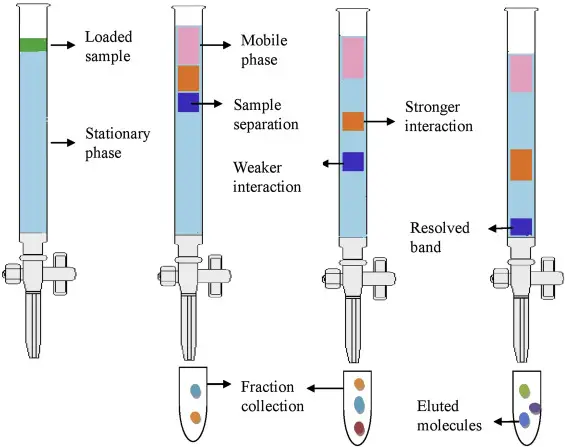
The separation is based on the different attraction of the components towards the stationary phase and mobile phase. The components which are strongly adsorbed on the stationary phase move slowly. The components which are less adsorbed and more soluble in the mobile phase move faster.
Due to different rate of movement, the components separate into different bands in the column. These separated compounds come out from the bottom of the column at different times. They are collected in separate fractions and used for further analysis or purification.
Principle of Column Chromatography
Column chromatography is based on different movement of components in a column. It is based on the different attraction of components towards the stationary phase and mobile phase.
The column is packed with solid stationary phase. The solvent acts as mobile phase. The sample mixture is added at the top of the column.
During this process, some components are strongly adsorbed on the stationary phase. So they move slowly. Some components are weakly adsorbed and dissolve more in mobile phase. So they move faster.
Due to this different movement, the components are separated in the column. They come out from the bottom of the column at different time. This separated part are collected separately.
Types of Column Chromatography
The following are the types of Column chromatography–
- Gravity Chromatography
In this type, the mobile phase moves down through the column by the force of gravity. No external pressure is used. It is simple type of column chromatography. - Flash Chromatography
In this type, the solvent is pushed through the column by using air pressure, gas pressure or pump. It is faster than gravity chromatography. It gives better separation in less time. - High Performance Liquid Chromatography (HPLC)
In this type, the solvent is passed through the column by high pressure pump. It is used for rapid and sensitive analysis. It gives high resolution separation. - Adsorption Chromatography
It is based on the adsorption of compounds on solid stationary phase. The compounds which are adsorbed strongly move slowly. The compounds which are weakly adsorbed move faster. - Partition Chromatography
It is based on the partition of components between liquid stationary phase and mobile phase. The components are separated according to their different solubility in these two phases. - Normal Phase Chromatography
In this type, the stationary phase is polar and the mobile phase is non-polar. Polar compounds are held more strongly and move slowly. Non-polar compounds move faster. - Reverse Phase Chromatography
In this type, the stationary phase is non-polar and the mobile phase is polar. Non-polar compounds are held for longer time. Polar compounds come out first. - Ion Exchange Chromatography
It is used to separate charged molecules like proteins and nucleic acids. It is based on the attraction between charged molecules and oppositely charged groups present on the stationary phase. - Size Exclusion Chromatography
It is also called Gel filtration chromatography. It separates molecules according to their size. Large molecules pass quickly through the column. Small molecules enter into pores and move slowly. - Affinity Chromatography
It is based on specific biological interaction between the molecule and ligand attached to the stationary phase. It is used to separate specific target molecules. Example, antigen-antibody interaction.
Instrumentation of Column Chromatography
The following are the important instruments of Column chromatography–
- Chromatography Column
It is the main part of column chromatography. It is a vertical tube made up of glass, plastic or stainless steel. The lower end has a stopcock for controlling the flow of solvent. - Frit or Cotton Plug
It is present at the bottom of the column. It may be a sintered glass disc, glass wool or cotton plug. It holds the packed material inside the column and prevents its loss with solvent. - Stationary Phase
It is the solid adsorbent material packed inside the column. The commonly used stationary phases are silica gel and alumina. It helps in separation of components by adsorption. - Mobile Phase
It is the solvent or solvent mixture which passes through the column. It carries the sample components through the stationary phase. The choice of mobile phase depends on nature of compound. - Solvent Reservoir
It is used to hold the mobile phase at the top of the column. In simple gravity chromatography, solvent flows from this reservoir by gravity. In advanced system, solvent is passed by pump. - Pump
Pump is used in flash chromatography and HPLC. It pushes the mobile phase through the column under pressure. It gives constant and controlled flow of solvent. - Sample Loading System
It is used to introduce sample into the column. In simple method, sample is loaded manually with pipette. In advanced system, injection valve or autosampler is used for adding fixed volume of sample. - Detector
Detector is used to detect the separated compounds coming out from the column. Common detectors are UV-Visible detector, fluorescence detector, refractive index detector and mass spectrometry detector. - Fraction Collector
It is used to collect the eluted liquid from the column in separate test tubes or vials. Each fraction may contain separated compound. These fractions are further tested or purified. - Data and Control System
It is used in automated column chromatography. It controls pump, detector and other parts of the system. It also gives the chromatogram of separated compounds. - Column Oven
Column oven is used to maintain fixed temperature of the column. It is mainly used in HPLC. It helps to get uniform and reproducible separation.
Steps in Column Chromatography
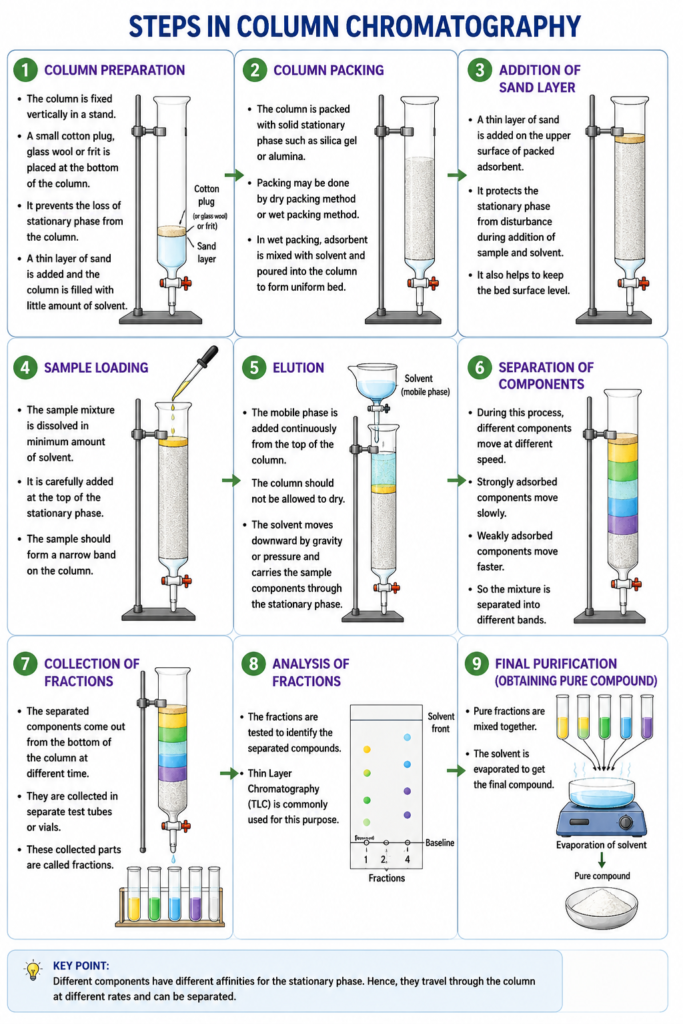
The following are the steps of Column chromatography–
- Column preparation
The column is fixed vertically in a stand. A small cotton plug, glass wool or frit is placed at the bottom of the column. It prevents the loss of stationary phase from the column. A thin layer of sand is added and the column is filled with little amount of solvent. - Column packing
The column is packed with solid stationary phase such as silica gel or alumina. Packing may be done by dry packing method or wet packing method. In wet packing, adsorbent is mixed with solvent and poured into the column to form uniform bed. - Addition of sand layer
A thin layer of sand is added on the upper surface of packed adsorbent. It protects the stationary phase from disturbance during addition of sample and solvent. It also helps to keep the bed surface level. - Sample loading
The sample mixture is dissolved in minimum amount of solvent. It is carefully added at the top of the stationary phase. The sample should form a narrow band on the column. - Elution
The mobile phase is added continuously from the top of the column. The column should not be allowed to dry. The solvent moves downward by gravity or pressure and carries the sample components through the stationary phase. - Separation of components
During this process, different components move at different speed. Strongly adsorbed components move slowly. Weakly adsorbed components move faster. So the mixture is separated into different bands. - Collection of fractions
The separated components come out from the bottom of the column at different time. They are collected in separate test tubes or vials. These collected parts are called fractions. - Analysis of fractions
The fractions are tested to identify the separated compounds. Thin Layer Chromatography (TLC) is commonly used for this purpose. Pure fractions are mixed together and solvent is evaporated to get the final compound.
Factors Affecting Column Efficiency
The following are the important factors affecting column efficiency–
- Column dimension
Column length and diameter affect the separation. A long column gives better separation because the components get more time for interaction. A narrow column also improves the resolution of the separated bands. - Particle size of stationary phase
The size of adsorbent particles affects the efficiency. Small and uniform particles give more surface area for adsorption. So better separation occurs, but the flow of solvent becomes slow. - Uniform packing of column
The column should be packed uniformly with the stationary phase. Air bubbles, cracks and empty spaces should not be present in the column. If such gaps are present, solvent passes through one side and poor separation occurs. - Flow rate of mobile phase
The flow rate of the mobile phase should be slow and steady. If the solvent moves very fast, the components do not get enough time to interact with the stationary phase. So separation becomes poor. - Polarity and pH of mobile phase
The solvent should be selected according to the nature of compounds. The polarity and pH of mobile phase affect the movement of components in the column. Proper solvent gives better separation. - Sample concentration and loading
The sample should be added as a narrow band at the top of the column. Too much sample should not be loaded. Overloading forms broad and overlapping bands and separation becomes poor. - Temperature
Temperature affects the viscosity of solvent and adsorption of components. Higher temperature may increase the flow of solvent. But it may also decrease adsorption and change the separation. - Adsorbent activity
The activity of adsorbent affects the binding of components. Moisture content and chemical nature of adsorbent change its adsorption power. Highly active adsorbent holds the components more strongly.
Applications of Column Chromatography
The following are the applications of Column chromatography–
- It is used to purify active pharmaceutical ingredients (APIs) from drugs. It is also used to remove impurities and isolate target compounds during drug development.
- It is used to isolate and purify natural compounds from plants, fungi and marine organisms. Alkaloids, flavonoids and terpenes are separated by this method.
- It is used to separate and analyse compounds present in food and beverages. Sugars, vitamins and antioxidants are tested by this method.
- It is used to detect additives, contaminants and pesticide residues in food samples. It helps in food quality testing.
- It is used to detect pollutants present in soil, water and air samples. It is also used for analysis of pesticide residues and environmental markers.
- It is used to purify newly synthesized chemical compounds. It separates the desired product from unreacted materials and unwanted by-products.
- It is used for separation and purification of biological molecules. Proteins, peptides and nucleic acids can be isolated by this method.
- It is used as a preliminary purification step before further analysis. It removes interfering substances from the sample before methods like mass spectrometry.
Advantages of Column Chromatography
The following are the advantages of Column chromatography–
- It is used for separation in small scale and large scale. Small amount of sample and large amount of material can be separated by this method.
- It is simple method and does not require very complex instrument. Basic laboratory setup is enough for ordinary column chromatography.
- It is cost effective technique. The materials used in this method are easily available and not very expensive.
- It can be used for separation of different types of complex mixtures. Different compounds, solvents and adsorbents can be used in this technique.
- It helps to separate, isolate and collect purified compounds. The separated compounds can be used for further analysis and other works.
- It reduces cross contamination because the stationary phase can be discarded after use. Fresh adsorbent can be used for new separation.
- It is useful for sensitive compounds also. In rapid methods like flash chromatography, the compound remains in the column for short time and degradation is less.
Limitations of Column Chromatography
The following are the limitations of Column chromatography–
- It is a time consuming method. In gravity column chromatography, the solvent moves slowly and separation may take long time.
- It needs continuous observation during the process. The column should not become dry. If the column becomes dry, cracks are formed in the stationary phase and separation becomes poor.
- It requires large amount of solvent. Continuous flow of mobile phase is needed for separation. This increases cost and produces solvent waste.
- It is more costly than some simple methods like Thin Layer Chromatography (TLC). Advanced methods like High Performance Liquid Chromatography (HPLC) require costly instrument and maintenance.
- Overloading of sample gives poor result. If large amount of sample is added, broad and distorted bands are formed in the column.
- It is not very suitable for very minute amount of sample. Traditional column chromatography works better when enough sample is present.
- The sample should be properly dissolved and filtered before loading. Undissolved particles may block the column and disturb the flow of solvent.
- Advanced column chromatography needs special instruments and skilled person. Flash chromatography needs pressure source and HPLC needs proper calibration and maintenance.
References
- Schaller, C. (2022, October 4). 7.9: Column chromatography (normal phase). Chemistry LibreTexts.
- Nichols, L. (2024, August 16). 9.4: Column chromatography. Chemistry LibreTexts.
- Advanced separation science: A comprehensive technical analysis of column chromatography and its industrial evolution. (n.d.).
- ALWSCI. (2025, September 23). Advantages, limitations, and future trends of high-performance liquid chromatography (HPLC).
- Sorbent Technologies, Inc. (2025, September 11). Automated flash chromatography systems.
- CHM 326 lecture note – FUNAAB. (n.d.).
- Boldens, S. (2019, December 31). Chromatography. Chemistry LibreTexts.
- Mahadevarao Premnath, S., & Zubair, M. (2024, January 11). Chromatography. StatPearls – NCBI Bookshelf.
- Chromatography. (2026, March 23). In Wikipedia.
- Chromatography column (with integral sintered disc, PTFE needle valve stopcock, socket). (n.d.). Vitrify Labs.
- Column chromatography. (n.d.). Organic Chemistry at CU Boulder.
- Phenomenex Team. (2025, December 12). Column chromatography: Principles, procedure, and applications. Phenomenex.
- Column chromatography principle. (n.d.). BYJU’S.
- Ware, Q. (2019). Column chromatography and HPLC. Edubirdie.
- Tamang, S. (2026, March 1). Column chromatography: Principle, parts, types, steps, uses. Microbe Notes.
- Column chromatography. (n.d.).
- Column chromatography. (2025, March 29). In Wikipedia.
- Comparing manual vs automated column chromatography systems — Throughput, cost and data quality. (2025, August 21). PatSnap Eureka.
- Comparing UHPLC columns to traditional HPLC columns. (n.d.). Danaher Life Sciences.
- Murov, S. (2010, April 10). Eluotropic series of solvents pdf 13.
- Eluotropic values. (n.d.).
- Extraction, isolation and characterization of bioactive compounds from plants’ extracts. (n.d.). PMC.
- Chromatography Direct. (2025, January 29). Flash chromatography vs. traditional methods: Which is more efficient?.
- Phenomenex Team. (2025, June 6). Flash chromatography: Principles, mechanisms, and practical applications. Phenomenex.
- Greener chromatography solvents. (2015). Sigma-Aldrich.
- Bailey, D. (2025, December 10). HPLC components overview: The 5 key parts explained. Timberline Instruments.
- HPLC troubleshooting guide. (n.d.). Sigma-Aldrich.
- HPLC troubleshooting guide. (n.d.). Thermo Fisher Scientific.
- Phenomenex Team. (2022, January 4). HPLC troubleshooting: Solutions for common problems. Phenomenex.
- How to scale up chromatography for industrial bioproduction. (2025, April 29). PatSnap.
- Introduction to column chromatography methods and instrumentation. (n.d.). Bio-Rad.
- Isolation and purification of natural compounds. (2024, August 12). Column Chromatography.
- LC troubleshooting essentials: A guide to common problems and solutions for peak tailing, ghost peaks, and pressure spikes. (n.d.). LCGC International.
- Runcie, N., & Skowronska, I. (n.d.). Manual vs automated flash chromatography. Teledyne ISCO.
- Mastering column chromatography: Techniques and tips. (2024, November 20). Chrom Tech, Inc.
- Ashenhurst, J. (2022, October 31). Natural product isolation (2) – Purification techniques, an overview. Master Organic Chemistry.
- Method scale-up. (n.d.). Waters Corporation.
- Principles of chromatography. (n.d.). Khan Academy.
- Safer solvents for active pharmaceutical ingredient purification using column chromatography. (n.d.). PMC.
- Susanti, I., Pratiwi, R., Rosandi, Y., & Hasanah, A. N. (2024). Separation methods of phenolic compounds from plant extract as antioxidant agents candidate. Plants, 13(7), 965.
- Separation techniques: Chromatography. (n.d.). PMC.
- Frontier, A. (n.d.). Solvent systems for flash column chromatography. University of Rochester.
- Solvent systems for silica gel column chromatography. (n.d.). Common Organic Chemistry.
- Solvents for a safer, sustainable lab. (n.d.). University of Southern California.
- TLC fundamentals – Stationary & mobile phase choice (part 4). (2020, February). Interchim.
- The eluotropic series of solvents and solvent. (n.d.). ResearchGate.
- Tips and tricks for the lab: Column troubleshooting and alternatives. (n.d.). ChemistryViews.
- Cytiva. (2026, April 9). Peak tailing and peak fronting in chromatography. Cytiva.
- Jensen, O. E., & Kidal, S. (2006, March 1). Using volumetric flow to scaleup chromatographic processes. BioPharm International, 19(3).
- What is high performance liquid chromatography (HPLC)? (n.d.). Teledyne LABS.