

Affinity chromatography is a liquid chromatography method. It is used to separate and purify a specific biomolecule from a mixture. It is mostly used for proteins, enzymes, antibodies and nucleic acids.
This method is based on the specific binding of target molecule with a ligand. The ligand is fixed on the solid stationary phase. When the sample passes through the column, only the molecule having affinity binds with the ligand.
Other unwanted molecules do not bind with the ligand. They pass out from the column with the mobile phase. So the required molecule remains attached inside the column.
After this, the column is washed properly. The bound molecule is then removed by changing the pH, salt concentration or by adding a competing ligand. This removal of bound molecule is called elution.
The interaction in this method is like lock and key type. Examples are enzyme-substrate, antigen-antibody and receptor-hormone binding. Due to this specific binding, highly purified product can be obtained.
Affinity chromatography was developed by Pedro Cuatrecasas and Meir Wilchek in 1968. It is now an important method in biochemical research, protein purification and biopharmaceutical work.
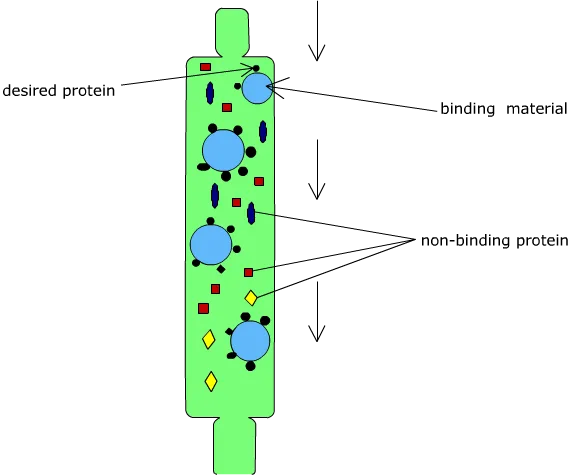
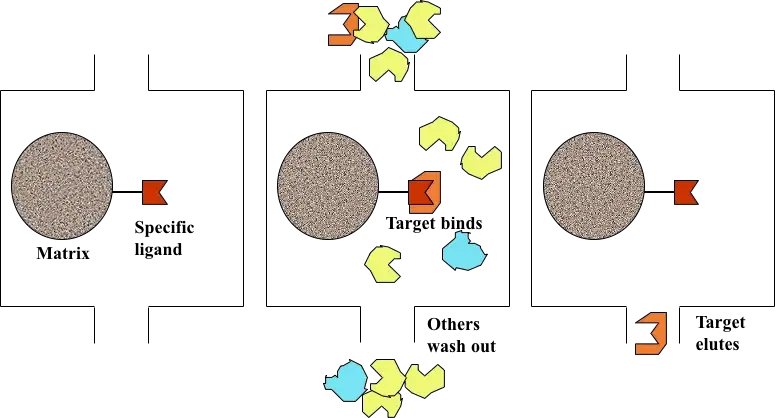
Principle of Affinity chromatography
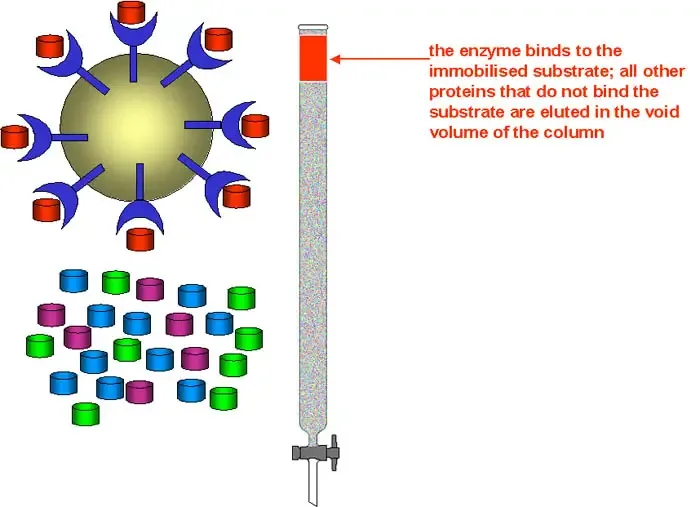
Principle of Affinity Chromatography is based on the specific and reversible binding between the target molecule and the ligand. The ligand is fixed on the solid stationary phase inside the column. The target molecule binds with this ligand due to its affinity.
When the sample mixture is passed through the column, only the required molecule binds with the ligand. Other unwanted molecules do not bind. They pass out from the column with the buffer.
The binding occurs by weak non-covalent forces. These include hydrogen bond, ionic interaction, hydrophobic interaction and van der Waals force. These forces help to hold the target molecule on the ligand.
This interaction is like lock and key type. The ligand works like lock and the binding site of target molecule works like key. So only specific molecule is retained in the column.
After washing, the bound molecule is removed from the column. This is done by changing the pH, ionic strength or polarity of buffer. Sometimes a competitive ligand is added to break the binding. The purified target molecule is then collected.
Components of affinity chromatography
- Matrix – Matrix is the solid support used in affinity chromatography. The ligand is attached with this matrix. It gives large surface area for binding of target molecule. Common matrix are agarose, cellulose, dextran and silica gel.
- Ligand – Ligand is the specific molecule which binds with the target molecule. It is fixed on the matrix. It acts like lock in lock and key mechanism. The ligand may be antibody, enzyme, receptor, dye or metal ion.
- Spacer arm – Spacer arm is a chemical linker between matrix and ligand. It keeps the ligand little away from the matrix surface. This helps the target molecule to bind easily with the ligand. It also reduces steric hindrance.
- Mobile phase – Mobile phase is the liquid phase which passes through the column. It carries the sample mixture and buffers. It includes binding buffer, wash buffer and elution buffer.
- Binding buffer – Binding buffer gives proper condition for binding of target molecule with the ligand. It maintains suitable pH and salt concentration. Due to this condition, the target molecule gets attached with the ligand.
- Wash buffer – Wash buffer is used after binding step. It removes the unbound and unwanted molecules from the column. The target molecule remains bound with the ligand during this step.
- Elution buffer – Elution buffer is used to remove the bound target molecule from the ligand. It changes pH, ionic strength or other condition. Sometimes competitive agent is also added for elution.
- Column – Column is the container in which the matrix with attached ligand is packed. The sample and buffers pass through this column. It gives controlled flow of liquid phase during separation.
- Target molecule – Target molecule is the desired biomolecule present in the sample. It has specific affinity for the ligand. It may be protein, antibody, enzyme or nucleic acid which is purified by this method.
Types of Affinity Chromatography
- Boronate affinity chromatography – It uses boronic acid or phenyl borate as ligand. These ligands bind with compounds having cis-diol group. This method is used for glycoproteins and glycated hemoglobin (HbA1c) estimation.
- Lectin affinity chromatography – It uses lectins as ligand. Lectins are non-immune proteins and they bind with specific carbohydrate residues. This type is used for separation of polysaccharides, glycoproteins and cells.
- Dye-ligand affinity chromatography – It uses synthetic dye as ligand. Cibacron Blue is one common dye used in this method. The dye acts like substrate and binds with some proteins. It is used for purification of enzymes, blood proteins and albumin.
- Immunoaffinity chromatography – It is based on antigen-antibody binding. In this method, antibody is fixed on the matrix. The specific antigen binds with this antibody and other molecules are washed out.
- Immobilized metal ion affinity chromatography (IMAC) – It uses metal ions fixed on the matrix. Nickel, cobalt and copper are commonly used metal ions. These ions bind with histidine residues and it is used for purification of polyhistidine tagged proteins.
- Analytical affinity chromatography – It is used for analytical purpose. It is used to isolate and measure specific target molecule. It is not mainly used for large amount purification.
Procedure of Affinity Chromatography (affinity chromatography steps)
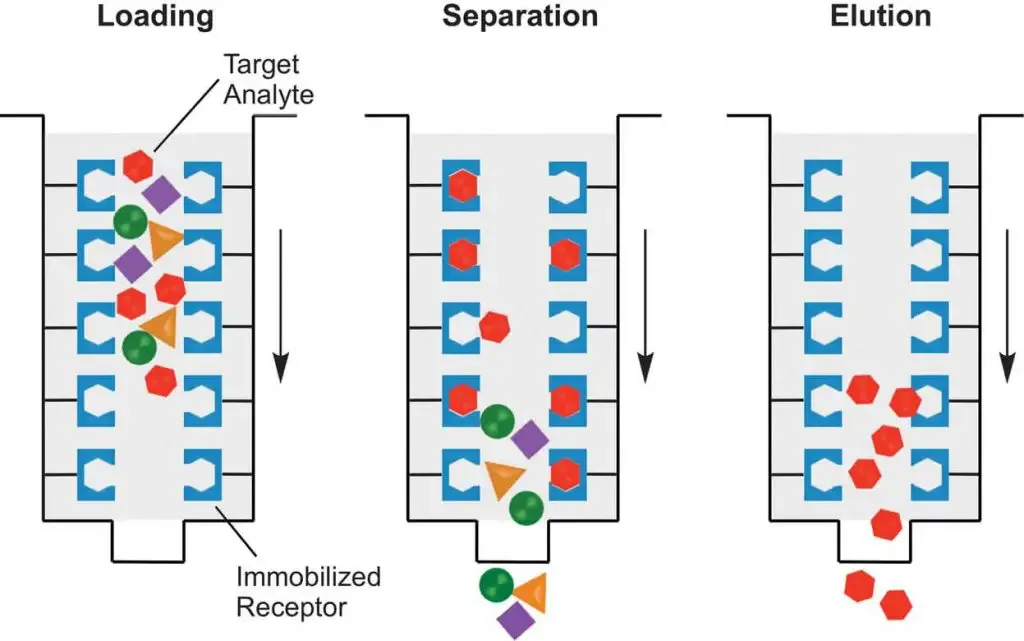
- The chromatography column is first prepared. The solid matrix is packed inside the column. The specific ligand is attached with the matrix, sometimes with the help of spacer arm.
- The column is washed with binding buffer. This makes the column ready for sample loading. Proper pH and salt condition is maintained in this step.
- The sample mixture is added into the column. The sample is allowed to pass slowly through the affinity medium. The target molecule binds with the ligand.
- Other molecules do not bind with the ligand. They pass out from the column with the buffer. So the required molecule remains attached inside the column.
- The column is washed again with wash buffer. This removes unbound proteins and other impurities. Washing is continued until unwanted materials are removed.
- The bound target molecule is then removed from the ligand. This step is called elution. It is done by changing the pH, ionic strength or polarity of buffer.
- Sometimes a competitive ligand is added for elution. It competes with the target molecule and breaks the target-ligand binding. Then the purified molecule comes out from the column.
- The eluted target molecule is collected in clean tubes. If low pH buffer is used, then the collected sample is neutralized. This prevents damage of the purified molecule.
- After elution, the column is again washed with binding buffer. This is called re-equilibration of the column. Then the column can be used again for next sample.
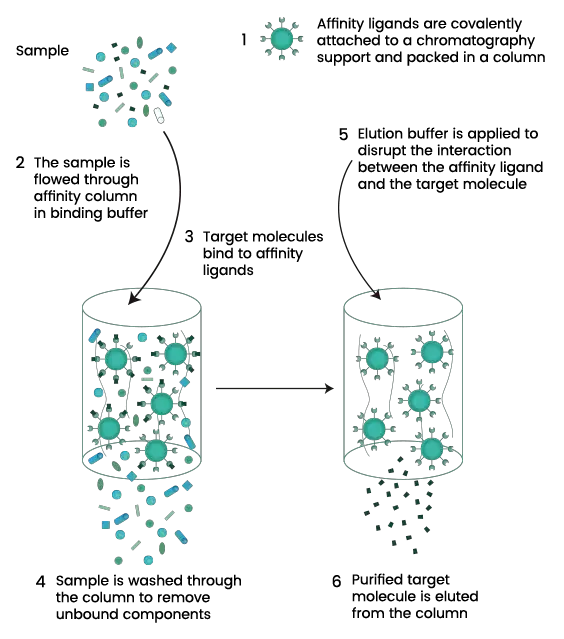
Elution Methods of Affinity Chromatography and Its Steps
Elution Methods of Affinity Chromatography
- Competitive elution – In this method, a competing ligand is added into the mobile phase. This ligand competes with the target molecule for binding site. Then the target molecule is released from the column.
- pH shift elution – In this method, the pH of the buffer is changed. Low or high pH changes the charge of the target molecule and ligand. Due to this, the binding becomes weak and the molecule comes out.
- Ionic strength elution – In this method, salt concentration of the buffer is increased. High salt breaks the electrostatic interaction between target molecule and ligand. Then the bound molecule is eluted.
- Chaotropic or denaturing elution – In this method, strong agents are used when binding is very strong. Urea, guanidine or SDS may be used. These agents disturb the interaction and release the target molecule.
- Enzymatic elution – In this method, enzyme is used to cut the affinity tag from the target protein. The target protein is released from the column. The tag remains attached with the ligand on the column.
Steps of Elution
- First the proper elution buffer is selected. It may be competitive buffer, changed pH buffer, high salt buffer or enzymatic solution.
- The elution buffer is added into the column. It passes through the affinity medium slowly. During this step, the binding between target molecule and ligand is broken.
- The target molecule starts coming out from the column with the buffer. The liquid coming out is collected in small tubes. These small collections are called fractions.
- The collected fractions are checked for the target molecule. The fractions having the required molecule are selected. Other fractions may be discarded.
- If harsh buffer is used, the collected fraction is neutralized immediately. For example, low pH fraction is mixed with high pH buffer. This protects the purified molecule from damage.
- After this, the eluted molecule is transferred into suitable buffer. This is done by dialysis, desalting column or ultrafiltration. It removes salt, competitor or denaturing chemicals from the purified sample.
- The purified molecule is then stored or used for further analysis. The column may be washed and again equilibrated with binding buffer for next use.
Factors Affecting Affinity Chromatography
- Specificity of ligand – The ligand should be specific for the target molecule. If the ligand binds with many other molecules, then separation will not be proper. Non-specific binding gives impure product.
- Binding strength – The binding between ligand and target molecule should be proper. If binding is weak, the target molecule may wash out from the column. If binding is very strong, the molecule becomes difficult to elute.
- Nature of matrix – The matrix should be chemically and physically inert. It should have large surface area for ligand attachment. The pore size should be suitable for entry of target molecule.
- pH – Proper pH is needed for binding of target molecule with ligand. Very low or very high pH may break the interaction. It may also denature the protein.
- Buffer composition – The buffer should maintain proper pH and salt concentration. It should keep both ligand and target molecule stable. Wrong buffer gives poor binding and poor purification.
- Ionic strength – Salt concentration affects the binding. High salt may break ionic interaction between target and ligand. Low salt may increase non-specific binding in some cases.
- Flow rate – The flow rate of mobile phase should be controlled. If the flow is too fast, the target molecule may not get enough time to bind. If it is too slow, the process takes more time.
- Temperature – Temperature affects binding and stability of biomolecules. High temperature may damage protein or enzyme. Low temperature is used when the sample is heat sensitive.
- Amount of ligand – The amount of ligand attached to matrix should be sufficient. Less ligand gives low binding capacity. Too much ligand may cause steric problem and non-specific binding.
- Sample condition – The sample should be clear and free from large debris. Dirty or viscous sample may block the column. This reduces flow and affects separation.
Types of affinity media used in Affinity Chromatography
- Amino acid media – It contains amino acid as affinity ligand. It is used for purification of serum proteins, peptides and some enzymes. It is also used for rRNA and dsDNA separation.
- Avidin-biotin media – It is based on binding between avidin and biotin. This interaction is very strong. It is used for purification of biotin, avidin and their derivatives.
- Carbohydrate bonding media – It is used for molecules having carbohydrate binding property. It is mainly used for glycoproteins, lectins and carbohydrate containing substances.
- Dye-ligand media – It contains synthetic dye as ligand. Cibacron Blue is common example. It acts like biological substrate and binds with some proteins. It is used for enzymes and blood proteins.
- Glutathione media – It contains glutathione as ligand. It is used for purification of GST-tagged recombinant proteins. The GST tag binds with glutathione and the protein is retained in the column.
- Heparin media – It contains heparin as affinity ligand. It is used for isolation of plasma coagulation proteins, lipases and nucleic acid enzymes. It is a general affinity medium.
- Hydrophobic interaction media – It separates molecules by hydrophobic interaction. It is used for some specific proteins and molecules having free carboxyl groups. Binding depends on salt condition also.
- Immunoaffinity media – It is based on antigen-antibody reaction. Antibody or antigen is attached on the matrix. It is used for highly specific capture of target molecule.
- Immobilized metal affinity media (IMAC) – It contains fixed metal ions on the matrix. Nickel, cobalt and copper are commonly used. It is used for purification of His-tagged proteins.
- Nucleic acid media – It is used for separation of nucleic acids. It can bind and separate mRNA, DNA, rRNA and other oligonucleotides.
- Nucleotide or coenzyme media – It contains nucleotide or coenzyme type ligand. It is used for separation of enzymes like kinases, dehydrogenases and transaminases.
- Protein A, G or L media – It contains Protein A, Protein G or Protein L as ligand. These proteins bind with antibody molecules. It is commonly used for purification of immunoglobulins.
- Specialty media – It is made for special target molecule. It works only for a particular type of protein, coenzyme or other biomolecule. So it is used in specific purification work.
- Ready-to-use media – This media is already prepared with attached ligand, dye or metal ion. It can be used directly in the laboratory. Examples are Protein A media, IMAC media and Blue dye media.
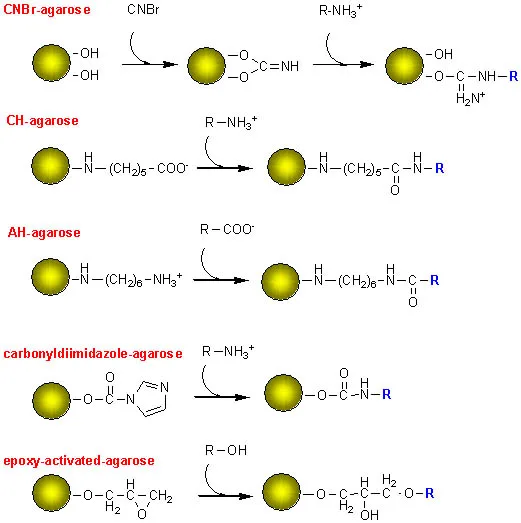
- Activated media – This media is chemically activated for attaching a selected ligand. The ligand is coupled with the matrix by the user. Cyanogen bromide, epoxide and carbodiimide activated media are used in this type.
Application of Affinity Chromatography
- Affinity chromatography is used for purification of biomolecules. It purifies specific proteins, enzymes and recombinant proteins from complex sample.
- It is used for purification of monoclonal antibodies. This is an important step in research work and biopharmaceutical industry.
- It is used for isolation of substances present in very low concentration. The target molecule binds with ligand and gets concentrated in the column.
- It is used to separate active biomolecules from inactive or denatured molecules. Only the molecule having proper binding site can bind with the ligand.
- It is used for removal of unwanted substances from biological solution. Pathogens, endotoxins and unwanted proteins can be removed by this method.
- It is used in protein interaction study. In pulldown assay, one protein is captured and its interacting partner proteins are identified from cell lysate.
- It is used in clinical diagnosis. Boronate affinity chromatography is used for measurement of glycated hemoglobin (HbA1c) in diabetes monitoring.
- It is used in biomarker study. Disease related proteins or other molecules can be captured from blood, urine or other biological fluids.
- It is used in drug study. Binding between drug and protein can be studied by this method.
- It is used for protein immobilization. Tagged proteins can be fixed on surfaces like ELISA plate or surface plasmon resonance chip for further detection and analysis.
Advantages of Affinity Chromatography
- Affinity chromatography has high specificity. The target molecule binds only with its specific ligand. So the desired molecule can be separated from complex mixture.
- It gives highly purified product in one step. The unwanted molecules pass out from the column and only target molecule remains attached with the ligand.
- It gives good recovery of active molecule. The target molecule can be collected in concentrated form after elution.
- It is useful for low concentration sample. Even small amount of target molecule can bind with ligand and can be isolated from the mixture.
- It helps to preserve biological activity of the molecule. The binding is usually done under normal pH and salt condition. So the structure of protein is not damaged easily.
- It saves time in purification work. Many steps are not needed because separation is done by specific binding.
- It reduces effort in laboratory work. A complex sample can be purified by passing through the affinity column.
- It can be used with different sample volume. The method works if the column has enough binding capacity for the target molecule.
- The matrix can be reused in many cases. After elution, the column is washed and equilibrated again. Then it can be used for another purification cycle.
- It is useful for purification of proteins, enzymes, antibodies and recombinant proteins. So it is widely used in biochemical and pharmaceutical work.
Disadvantages of Affinity Chromatography
- Affinity chromatography is costly method. The specific ligand used in the column may be expensive. Sometimes the ligand is also not easily available.
- It may need more amount of buffer and solvent. This increases the total cost of purification.
- Preparation of affinity column takes time. The ligand has to be attached with the matrix properly. So the method is not always simple.
- The binding and elution condition must be optimized. Proper pH, salt concentration and flow rate are needed. If condition is not proper, purification becomes poor.
- The target protein may be damaged during elution. Extreme pH or harsh chemical may denature the protein. Then the biological activity may be lost.
- Non-specific binding may occur in the column. Some unwanted molecules may also attach with the matrix or ligand. So completely pure product is not always obtained.
- The immobilized ligand may become unstable. It may degrade or leak out from the matrix during repeated use. This reduces the efficiency of the column.
- In recombinant protein purification, the affinity tag may not be exposed properly. If the tag is hidden inside the folded protein, it cannot bind with the matrix.
- The added affinity tag may affect the protein. It can disturb folding, expression or activity of the target protein.
- The affinity matrix cannot always separate active and inactive forms. If both forms have same binding site or same tag, both may bind with the ligand. So misfolded or inactive protein may also be purified.
Troubleshooting of Affinity Chromatography
- Fresh sample should be used for affinity chromatography. Stored sample may degrade or change during storage. This can affect binding with the ligand.
- The sample should be filtered or centrifuged before loading. Large particles and cell debris should be removed. Otherwise the column may be blocked.
- The column should be cleaned properly before use. Then it is equilibrated with binding buffer. This gives proper condition for target molecule binding.
- Air bubbles should not be present inside the column. Air bubble can disturb the flow of buffer and sample. It also reduces the binding efficiency.
- Degassed buffer is passed through the column for removing small air bubbles. This helps in smooth flow of mobile phase.
- The packed column should not be stored without preservative. Microbial growth may occur during storage. So column is stored in 20% ethanol when it is not in use.
- If target molecule does not bind, then pH and salt concentration are checked. Wrong buffer condition may prevent binding. Wrong ligand also gives poor binding.
- If elution is poor, then the molecule may be bound too strongly. In this case salt concentration is increased or competing ligand is added. Sometimes chaotropic agent is used.
- Non-specific binding may give impure product. Proper wash buffer is used to remove unwanted molecules. Competitive ligand may also be used in washing step.
Safety Considerations of Affinity Chromatography
- Proper PPE should be worn during the process. Laboratory coat, gloves and eye protection are used. Some chemicals used in this method may be toxic.
- Organic solvents should be handled carefully. They may be harmful and sometimes inflammable. They should be used in proper working area.
- Chaotropic agents like urea and guanidine should be used carefully. These chemicals may irritate skin and eyes. Direct contact should be avoided.
- Synthetic dyes used in dye-ligand chromatography should not be handled with bare hand. Some dyes may be toxic. Spillage should be cleaned immediately.
- All chemical waste should be collected separately. Dye containing solution, solvent and other hazardous liquid should not be thrown directly into sink.
- Used buffers and waste are discarded according to laboratory safety rule. Biohazard sample should be treated as infectious material.
- The column and tubing should be checked before starting. Leakage should not be present. Leakage may cause loss of sample and exposure to chemical.
- After work, the working area is cleaned properly. Hands are washed after removing gloves. The column is stored in proper storage buffer or 20% ethanol.
References
- Abcam. (n.d.). Antibody purification. [URL]
- Affinity chromatography – CNBr-activated Sepharose 4 fast flow. (n.d.). [PDF]
- Affinity chromatography. (2026, May 18). In Wikipedia. [URL]
- Affinity chromatography: A review of trends and developments over the past 50 years. (n.d.). PubMed Central (PMC). [URL]
- Affinity chromatography vs size exclusion chromatography: Selecting the best protein purification method. (n.d.). Lab Manager. [URL]
- Ahern, K., & Rajagopal, I. (2025, September 4). 3.4.1. Affinity chromatography. Chemistry LibreTexts. [URL]
- Analysis of biological interactions by affinity chromatography. (n.d.). PubMed Central (PMC). [URL]
- Bestchrom. (2025, May 21). Fundamental principles of chromatography purification. [URL]
- Bian, N., Charkoudian, J., Soice, N., Umana, J., & Wang, C. (2010, December 7). Affinity chromatography matrices and methods of making and using the same (U.S. Patent No. 7,846,682 B2). U.S. Patent and Trademark Office. [URL]
- Bio-Rad Laboratories. (n.d.). Activated supports. [URL]
- Bio-Rad Laboratories. (n.d.). Introduction to affinity chromatography. [URL]
- Bio-Rad Laboratories. (n.d.). Types of chromatography. [URL]
- Bolt Pharmacy. (2026, April 17). Boronate affinity HbA1c principle: Method, accuracy, and NHS clinical use. [URL]
- Boronate affinity chromatography. (n.d.). ResearchGate. [URL]
- Chrom Tech. (2025, October 20). Understanding affinity chromatography. [URL]
- Chromatography for clinical diagnostics explained. (2026, May 12). [URL]
- Cibachrom blue F 3 G-A and related dyes as ligands in affinity chromatography. (n.d.). ResearchGate. [URL]
- Cibacron blue F3GA ligand dye-based magnetic silica particles for the albumin purification. (n.d.). PubMed Central (PMC). [URL]
- Cube Biotech. (n.d.). Affinity chromatography | Principles. [URL]
- Cyanogen bromide activation and coupling of ligands to diol-containing silica for high-performance affinity chromatography optimization of conditions. (n.d.). PubMed. [URL]
- Cytiva. (2024, September 2). Fundamentals of affinity chromatography. [URL]
- Dye-ligand affinity chromatography. (2025, October 13). In Wikipedia. [URL]
- Dye-ligand affinity chromatography: The interaction of Cibacron Blue F3GA with proteins and enzymes. (n.d.). Semantic Scholar. [URL]
- Fields, D. (2019, February 26). Affinity chromatography – How does it work? News-Medical.Net. [URL]
- Keyfi, F., Alaei, A., Mirahmadi Daryasari, H., Hakimi, A., & Gharavi, P. (2024, December 26). Utilizing high-performance liquid chromatography (HPLC) in clinical diagnostics. In O. Núñez (Ed.), Relevant applications of high-performance liquid chromatography in food, environmental, clinical and biological fields. IntechOpen. https://doi.org/10.5772/intechopen.1008238
- MilliporeSigma. (n.d.). Affinity chromatography. [URL]
- MilliporeSigma. (2021, September). Cyanogen bromide-activated matrices. [PDF]
- Patsnap. (2025, May 9). Affinity vs. ion exchange chromatography: Which one to choose? [URL]
- Patsnap. (2025, May 9). What is the difference between affinity and ion exchange chromatography? [URL]
- Pharmaceutical and biomedical applications of affinity chromatography: Recent trends and developments. (n.d.). PubMed Central (PMC). [URL]
- Purification of monoclonal antibodies using chromatographic methods: Increasing purity and recovery. (n.d.). PubMed Central (PMC). [URL]
- Rawal, A. (2025, April 3). Affinity chromatography: Principle, parts, steps, uses. Microbe Notes. [URL]
- Recent advances in supramolecular affinity separations: Affinity… (n.d.). PubMed Central (PMC). [URL]
- Sino Biological. (n.d.). Monoclonal antibody purification: Process, methods. [URL]
- Tamang, S. (2026, March 10). Dye ligand chromatography: Principle, components, steps, uses. Microbe Notes. [URL]
- The biotechnical foundations and industrial applications of affinity chromatography: A comprehensive technical analysis. (n.d.). [Markdown]
- The Protein Man. (2017, June 6). CNBr-activated resin to immobilize ligands for affinity chromatography. G-Biosciences. [URL]
- Thermo Fisher Scientific. (n.d.). Antibody purification methods. [URL]
- Thermo Fisher Scientific. (n.d.). Overview of affinity purification. [URL]
- Trinity Biotech. (n.d.). Boronate affinity – High performance liquid chromatography (HPLC). [URL]
- Xiamen Biotime Biotechnology. (2022, March 14). The development of the boronate affinity chromatography and Biotime’s success. [URL]