

ELISA (Enzyme-Linked Immunosorbent Assay) is a sensitive laboratory test used for detection of antigen, antibody, protein, peptide and hormone from biological samples.
It is based on the specific binding between antigen and antibody. So the particular substance present in the sample can be detected by this reaction.
In this test, the sample or target molecule is attached on the solid surface of microplate. Then enzyme linked antibody is added. It binds with the target molecule if the molecule is present.
After binding, a specific substrate is added. The enzyme acts on the substrate and colour is produced. This colour formation is the positive indication of reaction.
The amount of colour depends on the amount of target molecule. More intense colour indicates more concentration of the substance. So ELISA is used for both qualitative and quantitative detection.
Principle of ELISA test
Principle of ELISA test is based on the specific binding reaction between antigen and antibody. The target molecule present in the biological sample binds with its specific antibody only.
In this test, the antigen or target molecule is fixed on the solid surface of microtiter plate. The unbound substances are removed by washing. So only the bound molecule remains attached on the plate.
Then enzyme-linked antibody is added. It binds with the fixed target molecule. This forms antigen-antibody complex on the surface of the plate.
After this, specific substrate is added. The enzyme acts on this substrate and colour is produced. This colour formation is observed as the reaction.
The intensity of the colour depends on the amount of bound target molecule. More colour means more amount of antigen or target substance. Thus ELISA is used for detection and measurement of protein, pathogen, hormone or antibody in the sample.
Types of ELISA test
The following are the main types of ELISA test–
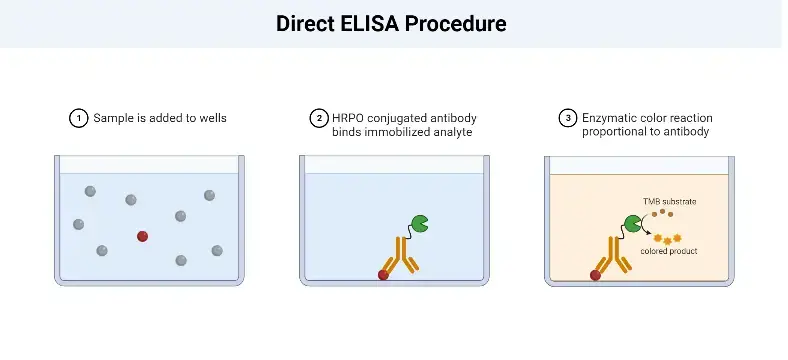
- Direct ELISA– In this type, the target antigen is directly fixed on the test plate. Then one enzyme-labelled primary antibody is added which directly binds with the antigen.
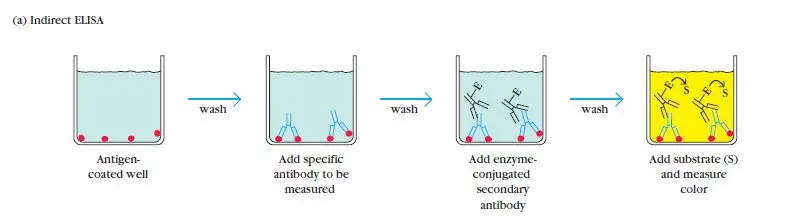
- Indirect ELISA– In this type, the target antigen is fixed on the plate. First primary antibody binds with the antigen and then enzyme-labelled secondary antibody binds with the primary antibody.
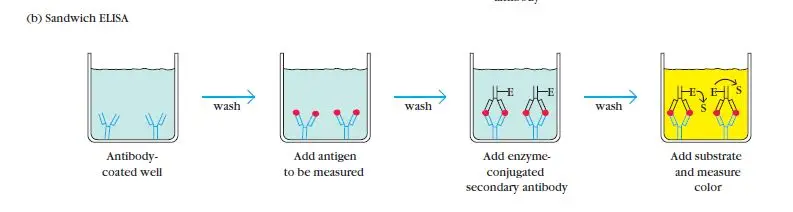
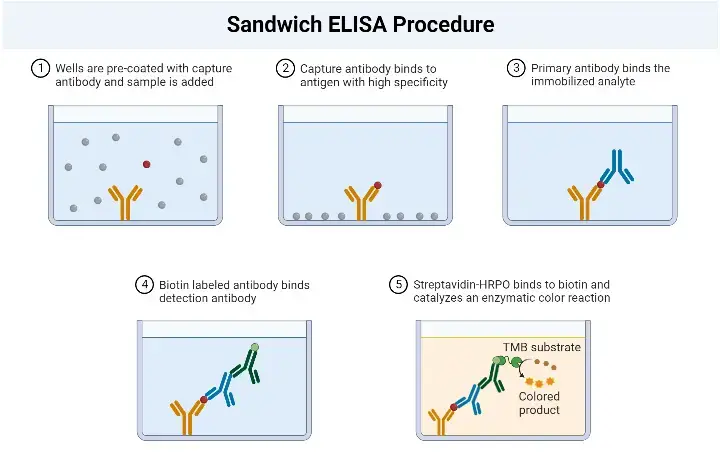
- Sandwich ELISA– In this type, capture antibody is first coated on the plate. The target antigen from the sample binds with it and then detection antibody binds with another site of same antigen, so antigen remains between two antibodies.
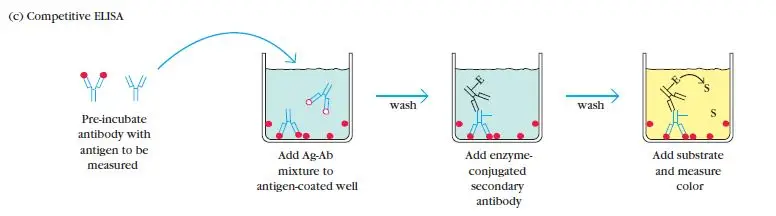
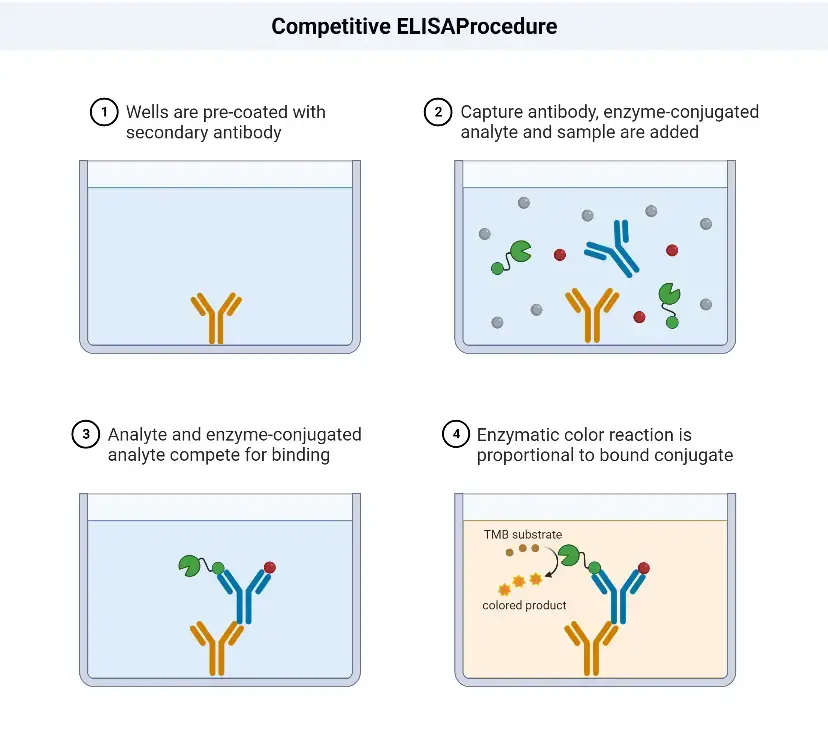
- Competitive ELISA– This is also called inhibition ELISA. In this type, the sample antigen competes with known reference antigen for binding with limited amount of labelled antibody.
Requirements for ELISA test
The following are the requirements for ELISA test–
- Microplate– It is generally 96 well or 384 well polystyrene plate. It acts as the solid surface where antigen or antibody is attached.
- Microplate reader– It is used to read the final colour or signal. It measures absorbance, fluorescence or chemiluminescence according to the type of reaction.
- Pipettes and tips– These are used for taking and transferring the sample, buffer, antibody and other reagents in proper amount.
- Washing equipment– It is used to wash the wells after each reaction step. Microplate washer, multichannel pipette or wash bottle can be used.
- Incubator– It is used to maintain suitable temperature during antigen-antibody binding reaction.
- Plate shaker– It is used for gentle mixing of sample and reagents in the wells.
- Plate sealer and reagent reservoir– Plate sealer is used to cover the plate during incubation. Reagent reservoir is used for holding reagent during pipetting.
- Antibodies– Capture antibody and detection antibody are required according to the type of ELISA. Detection antibody is commonly linked with enzyme like Horseradish Peroxidase (HRP) or Alkaline Phosphatase (AP).
- Sample– The test sample may be serum, plasma, cell lysate or other biological fluid. It contains the unknown target molecule.
- Standards– These are known concentration of target molecule. It is used to prepare standard curve for measuring concentration of unknown sample.
- Coating buffer– It is used for attaching antigen or antibody on the microplate surface. Carbonate-bicarbonate buffer or phosphate buffer are commonly used.
- Blocking buffer– It contains non-reactive protein like Bovine Serum Albumin (BSA) or non-fat dry milk. It blocks the empty space of plate and prevents non-specific binding.
- Wash buffer– It is used to remove unbound substances from the wells. It is generally PBS or TBS with mild detergent like Tween-20.
- Substrate solution– It reacts with enzyme linked antibody and produces colour or signal. TMB is used for HRP and pNPP is used for AP enzyme.
- Stop solution– It is used to stop the enzyme-substrate reaction. Sulfuric acid or other strong acid is commonly used for stopping the colour reaction.
- Diluent solution– It is used for dilution of sample, standard and antibody before adding to the wells.
Direct ELISA
Direct ELISA Procedure
The following are the step by step procedure of Direct ELISA–
- The antigen or sample is diluted with coating buffer. It is then added into the wells of microplate.
- The plate is incubated for about 1 hour at room temperature or overnight at 4°C. During this step, antigen become attached on the bottom surface of the well.
- The antigen solution is removed from the wells. The wells are washed 3 times with wash buffer to remove the unbound antigen.
- Blocking buffer is added into the wells. It contains non-reactive protein like Bovine Serum Albumin (BSA).
- The plate is incubated for 30 to 60 minutes. It blocks the empty binding sites of the plate and prevents non-specific binding of antibody.
- The blocking solution is removed. The wells are again washed with wash buffer.
- Enzyme-conjugated primary antibody is added into each well. It directly binds with the fixed antigen.
- The plate is incubated for about 1 hour. During this time antigen-antibody binding takes place.
- The wells are washed properly for about 5 times. It removes the unbound enzyme-conjugated antibody.
- Suitable substrate solution such as TMB is added into each well.
- The plate is incubated for 5 to 30 minutes. The enzyme reacts with the substrate and colour is produced.
- Stop solution such as sulfuric acid is added into the wells. It stops the enzyme-substrate reaction.
- The plate is placed in microplate reader. The optical density or absorbance is measured at proper wavelength, usually 450 nm for TMB.
- The colour intensity is observed. More intense colour indicates more amount of antigen present in the sample.
Uses of Direct ELISA
The following are the uses of Direct ELISA–
- It is used for rapid detection of specific antigen in biological sample.
- It is used to screen the sample where quick result is required.
- It is used for qualitative detection of antigen, that means to know antigen is present or absent.
- It is used for quantitative detection of antigen by measuring the colour intensity.
- It is used to check the binding of primary antibody with its specific antigen.
- It is used in antibody affinity testing to know how strongly antibody binds with antigen.
- It is used in epitope mapping. In this, the binding site of antibody on antigen is detected.
- It is used in food safety testing for detection of food borne pathogen and allergen.
- It is used in rapid diagnostic test where simple and fast procedure is needed.
- It is used in research work for direct detection of antigen without using secondary antibody.
Indirect ELISA
Indirect ELISA Procedure
The following are the step by step procedure of Indirect ELISA–
- The antigen is diluted with coating buffer and added into the wells of microplate.
- The plate is incubated overnight at 4°C. During this step, antigen get attached on the surface of the well.
- The wells are washed 3 times with wash buffer. It removes the unbound antigen from the wells.
- Blocking buffer is added into the wells. It blocks the empty spaces present on the plastic surface of the plate.
- The plate is incubated for about 1 hour at 37°C. It prevents non-specific binding of antibody.
- The wells are again washed 4 times with wash buffer. The excess blocking solution is removed.
- The diluted test sample or standard is added into the wells. The sample may contain unlabelled primary antibody.
- The plate is incubated for about 90 minutes at 37°C or overnight at 4°C. In this step, primary antibody binds with the fixed antigen.
- The wells are washed 3 times with wash buffer. It removes unbound primary antibody.
- Enzyme-labelled secondary antibody is added into the wells. This antibody binds with the primary antibody.
- The plate is incubated for about 1 hour at 37°C. During this time, binding between primary antibody and secondary antibody takes place.
- The wells are washed properly 3 times. It removes the unbound enzyme-conjugated secondary antibody.
- Suitable substrate solution is added into each well. The plate is kept at room temperature until colour is developed.
- The enzyme reacts with the substrate and colour is produced. This colour shows the positive reaction.
- Stop solution is added into the wells. It stops the enzyme-substrate reaction.
- The plate is placed in microplate reader. The optical density or absorbance is measured at proper wavelength.
- The intensity of colour is observed. More colour indicates more amount of antibody present in the sample.
Uses of Indirect ELISA
The following are the uses of Indirect ELISA–
- It is mainly used for detection of specific antibody in serum or other biological fluid.
- It is used to measure the amount of antibody present in the sample.
- It is used in serological survey for screening large number of samples.
- It is used to study the antibody response in a population after infection or exposure.
- It is used in vaccine titer monitoring. In this, the level of antibody formed after vaccination is measured.
- It is used in vaccine development to check the immune response produced by vaccine.
- It is used in immune response study. It helps to know how the immune system reacts against specific pathogen or foreign substance.
- It is used in clinical diagnosis for detecting antibodies formed against infectious agents.
Sandwich ELISA
Sandwich ELISA Procedure
The following are the step by step procedure of Sandwich ELISA–
- Specific capture antibody is added into the wells of microplate.
- The plate is incubated overnight at 4°C. In this step, capture antibody become attached on the bottom surface of the well.
- The coating solution is removed from the wells. The wells are washed with wash buffer to remove unbound capture antibody.
- Blocking buffer is added into the wells. It may contain Bovine Serum Albumin (BSA) or non-fat milk.
- The plate is incubated for some time. It blocks the empty spaces of the plate and prevents non-specific binding of other proteins.
- The blocking solution is removed. The wells are again washed with wash buffer.
- Diluted test sample and known standard are added into the wells. The sample contains the target antigen.
- The plate is incubated for about 90 minutes at 37°C. During this step, target antigen binds with the fixed capture antibody.
- The wells are washed several times with wash buffer. It removes unbound substances present in the sample.
- Detection antibody is added into the wells. It binds with another site of the same antigen.
- In this way the antigen remains between capture antibody and detection antibody. This is called sandwich formation.
- The detection antibody is usually linked with enzyme like Horseradish Peroxidase (HRP).
- If the detection antibody is biotinylated, then enzyme linked molecule like Streptavidin-HRP is added. Then plate is incubated and washed.
- The wells are washed properly for 3 to 5 times. It removes the unbound detection antibody or enzyme conjugate.
- Suitable substrate solution such as TMB is added into each well.
- The plate is incubated in dark condition. The enzyme reacts with substrate and colour is formed.
- Stop solution such as sulfuric acid is added into the wells. It stops the colour producing reaction.
- The plate is placed in microplate reader. The absorbance is measured at proper wavelength, commonly 450 nm.
- The intensity of colour is observed. More colour indicates more concentration of antigen in the sample.
Uses of Sandwich ELISA
The following are the uses of Sandwich ELISA–
- It is used for detection of specific antigen from complex biological sample.
- It is used to measure antigen present in serum, plasma and tissue lysate.
- It is used when very high sensitivity and specificity is required.
- It is used in clinical diagnosis for detection of disease related biomarkers.
- It is used for detection of tumor marker in patient sample.
- It is used to measure cytokines in biological fluid.
- It is used in food testing for detection of food allergen.
- It is used to detect very low amount of allergen in food product.
- It is used to check allergen free food product and food safety purpose.
- It is used in research work to monitor protein expression.
- It is used for measuring chemokines, growth factors and cytokines level.
- It is used in biomedical and clinical study where exact amount of protein is needed.
Competition/Inhibition ELISA
Competition/Inhibition ELISA Procedure
The following are the step by step procedure of Competition ELISA or Inhibition ELISA–
- Known reference antigen is added into the wells of microplate.
- The plate is incubated overnight at 4°C. In this step, reference antigen become attached on the bottom surface of the well.
- The antigen solution is removed from the wells.
- The wells are washed properly with wash buffer. It removes the unbound reference antigen.
- Blocking buffer is added into the wells. It may contain Bovine Serum Albumin (BSA) or non-fat milk.
- The plate is incubated for some time. It blocks the empty binding sites present on the plastic surface.
- The blocking solution is removed and wells are again washed with wash buffer.
- Test sample containing unknown target antigen is added into the wells with specific primary antibody.
- In this step, sample antigen compete with the fixed reference antigen for binding with primary antibody.
- The sample and primary antibody can also be mixed first and then added into the wells.
- The plate is incubated for proper time. During this period competition reaction takes place.
- The wells are washed properly with wash buffer. It removes free sample antigen and unbound antibody.
- Only those primary antibodies remain which are bound with the fixed reference antigen on the plate.
- If the primary antibody is not enzyme labelled, then enzyme-conjugated secondary antibody is added into the wells.
- The plate is incubated again. The secondary antibody binds with the primary antibody.
- The wells are washed properly to remove unbound secondary antibody.
- Suitable substrate solution such as TMB is added into each well.
- The enzyme reacts with the substrate and colour is produced.
- Stop solution such as sulfuric acid is added into the wells. It stops the enzyme-substrate reaction.
- The plate is placed in microplate reader. The optical density or absorbance is measured.
- In Competition ELISA, colour intensity is inversely proportional to the amount of target antigen in sample.
- Less colour means more amount of antigen present in the sample. More colour means less amount of antigen present in the sample.
Uses of Competition/Inhibition ELISA
The following are the uses of Competition ELISA or Inhibition ELISA–
- It is used for measuring small molecule antigen.
- It is used for detection of low molecular weight substances like hapten, short peptide and hormone.
- It is used when the target molecule is too small and cannot bind with two antibodies at same time.
- It is used for detection of food toxin and environmental toxin.
- It is used for screening of mycotoxins such as aflatoxin in grains.
- It is used for detection of bacterial enterotoxins in dairy products.
- It is used for measuring small molecular inhibitors in different samples.
- It is used in drug screening for detection of pharmaceutical drugs and drug residues.
- It is used in virology for study of antibody neutralization.
- It is used in vaccine research to check the level of neutralizing antibody.
- It is used for detection of specific antigen in complex mixture.
- It is also used for detection of specific antibody by competitive method.
ELISA Test Result Interpretation
ELISA result is interpreted by measuring the final colour or signal formed in the well. The plate is read by microplate reader or spectrophotometer. It measures optical density (OD) or absorbance. For TMB substrate, reading is generally taken at 450 nm.
Qualitative interpretation is used to know whether the target antigen or antibody is present or absent. The sample OD is compared with blank well or negative control. If the OD value is higher than the cut off value, the result is positive. If the OD value is lower than cut off value, the result is negative.
Semi-quantitative interpretation is used to compare one sample with another sample. Exact concentration is not calculated here. More colour indicates more amount of target molecule. Less colour indicates less amount of target molecule.
Quantitative interpretation is used to measure the exact concentration of antigen or antibody. For this, known standards are used. The OD value of standard is plotted against its concentration and a standard curve is prepared. Then the OD value of unknown sample is compared with the curve.
In Direct ELISA, Indirect ELISA and Sandwich ELISA, the result is directly proportional. More colour means more amount of target molecule. Less colour means less amount of target molecule.
In Competitive ELISA or Inhibition ELISA, the result is opposite. The colour intensity is inversely proportional to the amount of target antigen. Less colour means more amount of antigen in the sample. More colour means less amount of antigen in the sample.
The cut off value is used to separate positive and negative result. It may be calculated as two times of average OD of negative control. Sometimes it is calculated as average OD of negative control plus three times standard deviation (SD).
For proper interpretation, positive control and negative control must be checked first. Positive control should show high OD value. Negative control should show low or no OD value. If the controls are not proper, then the test result is not accepted.
The standard curve should be within proper range. The unknown sample OD should fall inside the range of the standard curve. If the OD value is outside the range, then the sample is diluted and tested again.
For reliable result, coefficient of variation (CV), spike and recovery test and standard curve value are checked. A good standard curve gives proper linear portion for calculation. This helps to avoid wrong interpretation of ELISA result.
Applications of ELISA Test
The following are the applications of ELISA–
- It is used in diagnosis of infectious diseases such as HIV, HCV, Hepatitis B, Dengue and tuberculosis, and also used for allergy test, autoimmune disease, cancer tumor marker like PSA and monitoring of therapeutic drug level in patient.
- It is used in research work for measuring protein, peptide, antigen and antibody, and also for studying immune response, vaccine response and new disease biomarker.
- It is used in drug related study for finding new drug target, screening of different compounds and to study absorption and metabolism of drug in the body.
- It is used in food industry for detection of food borne pathogens like Salmonella, Listeria and E. coli, and also for detection of food allergen and harmful contaminants like mycotoxin.
- It is used in environmental testing for checking water, soil and air sample for harmful bacteria, pesticide, heavy metal, air pollutant and industrial discharge.
- It is used in animals for diagnosis of infectious disease in livestock, pet animals and wildlife, and also for screening of animal population and detection of drug residues in milk and meat.
- It is used in plant disease study for detection of viral and bacterial pathogens in plants and seeds, checking crop health and detection of transgenic or Genetically Modified Organism (GMO) content in grain sample.
Advantages of ELISA Test
The following are the advantages of ELISA–
- It is highly sensitive test and can detect very low amount of antigen, antibody, protein or hormone in the sample.
- It is highly specific because the reaction occurs between specific antigen and antibody, so there is less chance of reaction with other molecules.
- It gives result in short time. So it is useful in medical diagnosis and research work where quick result is needed.
- It is less costly method because ELISA kit and reagents are not very expensive and it does not need very complex instrument.
- It is used for testing large number of samples at same time because the test is done in 96 well or 384 well microplate.
- It can be used for both qualitative and quantitative detection. It can show presence of target molecule and also measure its concentration.
- The procedure is simple and can be done by laboratory worker with normal training.
- It is a versatile test because it can detect many types of substances such as proteins, hormones, antibodies and pathogens from serum, urine and other sample.
- It requires less sample preparation than many other analytical methods. So time is saved and sample damage is also reduced.
- It is safer than radioimmunoassay (RIA) because radioactive substance is not used. In ELISA, enzyme reaction and colour change is used for detection.
Limitations of ELISA Test
The following are the limitations of ELISA–
- It may give false positive result due to non-specific binding of antibody or cross reaction with other molecules present in the sample.
- It may also give false negative result when the target antigen or antibody is very low or the reaction does not occur properly.
- The preparation of specific antibody is costly and it needs proper cell culture media and laboratory condition.
- Commercial ELISA kit may be costly than simple rapid test, especially when large number of samples are tested.
- It needs special instruments like microplate reader, washer and proper incubator for accurate reading.
- It requires trained laboratory person because small error in washing, pipetting or incubation can affect the result.
- The final colour reaction is temporary because it depends on active enzyme and substrate reaction, so reading should be taken within proper time.
- It gives only presence or amount of target molecule. It does not give full biological information about the sample.
- In microbiology and food testing, ELISA cannot differentiate between living and dead microorganisms.
- Complex sample like plasma, crude plant extract or food sample may interfere with enzyme activity and decrease the sensitivity of test.
- It takes more time than rapid screening test like lateral flow test.
- Antibodies, enzyme conjugates and reagents are not always stable and need cold storage condition.
- A standard ELISA usually detects only one specific antigen or antibody at one time. It cannot detect many different antigens together in same test.
Reference
- Lucas Learns. (n.d.). 4 Types of ELISA (Direct, Indirect, Sandwich, Competitive) [Video]. YouTube.
- Biomatik. (2023, December 20). 7 key benefits of using Elisa kits in laboratory testing.
- Patil, R. (n.d.). A guide to building a direct sandwich ELISA. Proteintech Group.
- Neogen. (2026, January 13). Allergen testing methods explained: Lateral flow assay vs. ELISA.
- An ELISA protocol to improve the accuracy and reliability of serological antibody assays. (n.d.). PubMed Central.
- An overview of ELISA: A review and update on best laboratory practices for quantifying peptides and proteins in biological fluids. (n.d.). PubMed Central.
- An overview of ELISA: A review and update on best laboratory practices for quantifying peptides and proteins in biological fluids. (n.d.). PubMed.
- BOC Sciences. (n.d.). Application of ELISA.
- Applications of digital enzyme-linked immunosorbent assays in ophthalmology. (n.d.). PubMed Central.
- MyBioSource. (n.d.). Applications of ELISA: What is an ELISA used for?
- Thermo Fisher Scientific. (n.d.). Basic sandwich ELISA protocols.
- Garnsey, S. M., & Cambra, M. (n.d.). Ch15: Enzyme-linked immunosorbent assay (ELISA).
- Figueira, A. R., Domier, L. L., & D’Arcy, C. J. (1997). Comparison of techniques for detection of barley yellow dwarf virus-PAV-IL. Plant Disease, 81(11), 1236-1240.
- Creative Diagnostics. (n.d.). Competitive ELISA protocol.
- St John’s Laboratory. (n.d.). Competitive ELISA protocol.
- Abcam. (n.d.). Competitive ELISA protocol.
- Comprehensive clinical and industrial analysis of the Enzyme-Linked Immunosorbent Assay (ELISA): Biochemical principles, methodological variations, and quality systems. (n.d.).
- Fortis Life Sciences. (n.d.). Direct ELISA protocol.
- St John’s Laboratory. (n.d.). Direct ELISA protocol.
- University of Florida. (2023, February 24). Disease testing.
- Azure Biosystems. (n.d.). ELISA explained | Principles, workflow & common applications.
- Sigma-Aldrich. (n.d.). ELISA protocols.
- Hygiena. (n.d.). ELISA in food safety testing: A complete overview.
- Food Safety Institute. (2025, June 11). ELISA: A robust method for detecting foodborne pathogens.
- Midhun, N., Sonia Bai, J. K., Chakrapani, K. V., Haripriya, G., Pathuri, C. K. V. S., & Ramalakshmi, N. S. (2021). Enzyme linked immunosorbantassay- lab diagnosis: A review. Indian Journal of Microbiology Research, 8(1), 10-14. https://doi.org/10.18231/j.ijmr.2021.003
- Zubair, M., Singh, C., & Farhana, A. (2026, February 20). Enzyme-linked immunosorbent assay (ELISA). StatPearls Publishing.
- Hayrapetyan, H., Tran, T., Tellez-Corrales, E., & Madiraju, C. (2023). Enzyme-linked immunosorbent assay: Types and applications. Methods in Molecular Biology, 2612, 1-17. https://doi.org/10.1007/978-1-0716-2903-1_1
- Hayrapetyan, H., Tran, T., Tellez-Corrales, E., & Madiraju, C. (2023). Enzyme-linked immunosorbent assay: Types and applications. Methods in Molecular Biology, 2612, 1-17. Outbreak.info.
- Enzyme-linked immunosorbent assay for the quantitative/qualitative analysis of plant secondary metabolites. (n.d.). PubMed Central.
- Boster Bio. (2024, January 18). Explore ELISA types: Direct, indirect, sandwich, competitive, multiplex ELISA.
- Gold Standard Diagnostics. (n.d.). GMO rapid testing: ELISA kits and lateral flow devices.
- EnviroLogix. (n.d.). GMO testing kits – protein.
- Thermo Fisher Scientific. (2022). General ELISA protocols.
- St John’s Laboratory. (n.d.). Indirect ELISA protocol.
- European and Mediterranean Plant Protection Organization. (2025). PM 7/125 (2) ELISA tests for viruses. EPPO Bulletin, 55, 66–72. https://doi.org/10.1111/epp.13071
- Plant virus detection using a new form of indirect ELISA. (n.d.). PubMed.
- Hygiena. (n.d.). Helica T-2 toxin ELISA kit for grain and feed testing.
- Abcam. (n.d.). The complete ELISA guide.
- Bio-Rad. (n.d.). Types of ELISA.
- Molecular Devices. (n.d.). Enzyme-linked immunosorbent assay (ELISA).
- Abcam. (n.d.). What is ELISA?