

Pipette is a precision laboratory instrument used for measuring, transferring and dispensing small amount of liquid. The word pipette is taken from French word, which means little pipe. It is commonly used in chemistry, biology and medical research work.
Pipette is used for measuring liquid in millilitre or microlitre range. It helps to take accurate volume of liquid. It is important when small volume is needed for experiment.
The working of pipette is based on formation of partial vacuum above the liquid holding part. This vacuum helps to draw liquid into the pipette. The liquid is then released by air displacement or positive displacement mechanism.
Pipettes are made up of glass or plastic. Some are simple manual droppers and some are electronic or automated pipettes. Modern pipettes are more accurate and safe to use.
In earlier time, pipettes were simple glass tubes without graduation. The term pipette was first used by Joseph-Louis Gay-Lussac. At that time, scientists used mouth pipetting for taking liquid, which was very unsafe.
Later Louis Pasteur developed glass Pasteur pipette with rubber bulb. This removed the need of mouth suction. Karl Friedrich Mohr also made calibrated glass pipettes for more accurate volume measurement.
Modern pipette was developed in 1957 by Dr. Heinrich Schnitger. He made first piston-driven micropipette. It had spring loaded piston, air cushion and disposable plastic tips.
In early 1970s, Warren Gilson and Henry Lardy developed adjustable volume micropipette. It allowed different volume to be measured by one instrument. Later electronic pipettes and automated liquid handling systems were developed for modern laboratories.
Principle of Pipette
Principle of Pipette is based on movement of liquid by vacuum. In pipette, liquid is taken inside and then released in measured amount. This is done mainly by air displacement or positive displacement method.
In air displacement pipette, the plunger is pressed first. The piston moves downward and removes a fixed volume of air from the shaft. When the plunger is released, the piston moves upward.
During this process, a partial vacuum is formed inside the pipette. This vacuum pulls the liquid into the disposable tip. There is an air cushion between the liquid and the piston.
In positive displacement pipette, air cushion is not present. The disposable piston touches the liquid directly. When the piston is pulled upward, vacuum is formed and liquid enters into the capillary tip.
When the piston moves downward, it pushes the liquid out directly. So the exact amount of liquid is dispensed from the pipette. This method is useful where more direct liquid movement is needed.
Parts of Pipette and their functions
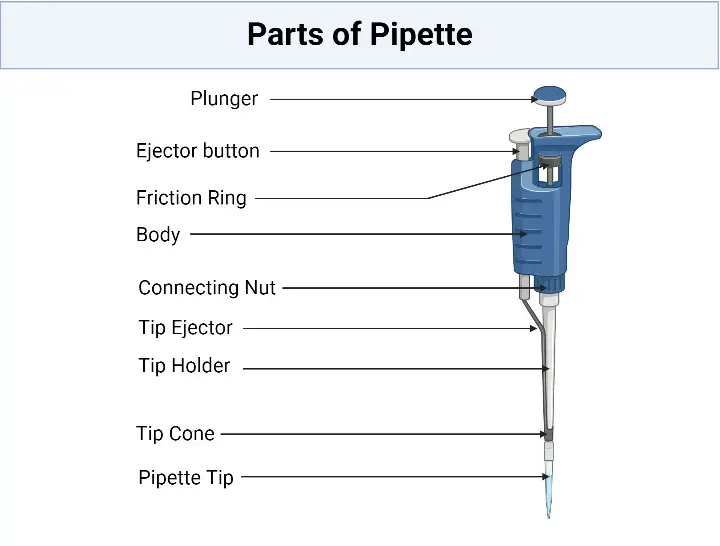
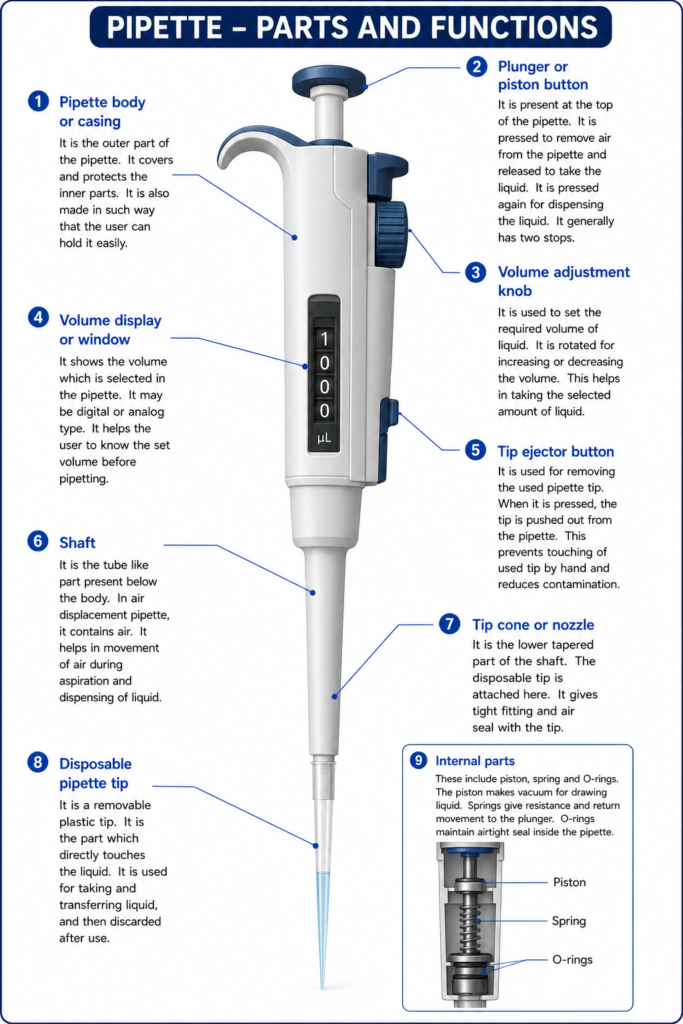
The main parts of pipette and their functions are as follows-
- Pipette body or casing
It is the outer part of the pipette. It covers and protects the inner parts. It is also made in such way that the user can hold it easily. - Plunger or piston button
It is present at the top of the pipette. It is pressed to remove air from the pipette and released to take the liquid. It is pressed again for dispensing the liquid. It generally has two stops. - Volume adjustment knob
It is used to set the required volume of liquid. It is rotated for increasing or decreasing the volume. This helps in taking the selected amount of liquid. - Volume display or window
It shows the volume which is selected in the pipette. It may be digital or analog type. It helps the user to know the set volume before pipetting. - Tip ejector button
It is used for removing the used pipette tip. When it is pressed, the tip is pushed out from the pipette. This prevents touching of used tip by hand and reduces contamination. - Shaft
It is the tube like part present below the body. In air displacement pipette, it contains air. It helps in movement of air during aspiration and dispensing of liquid. - Tip cone or nozzle
It is the lower tapered part of the shaft. The disposable tip is attached here. It gives tight fitting and air seal with the tip. - Disposable pipette tip
It is a removable plastic tip. It is the part which directly touches the liquid. It is used for taking and transferring liquid, and then discarded after use. - Internal parts
These include piston, spring and O-rings. The piston makes vacuum for drawing liquid. Springs give resistance and return movement to the plunger. O-rings maintain airtight seal inside the pipette.
Types of Pipette
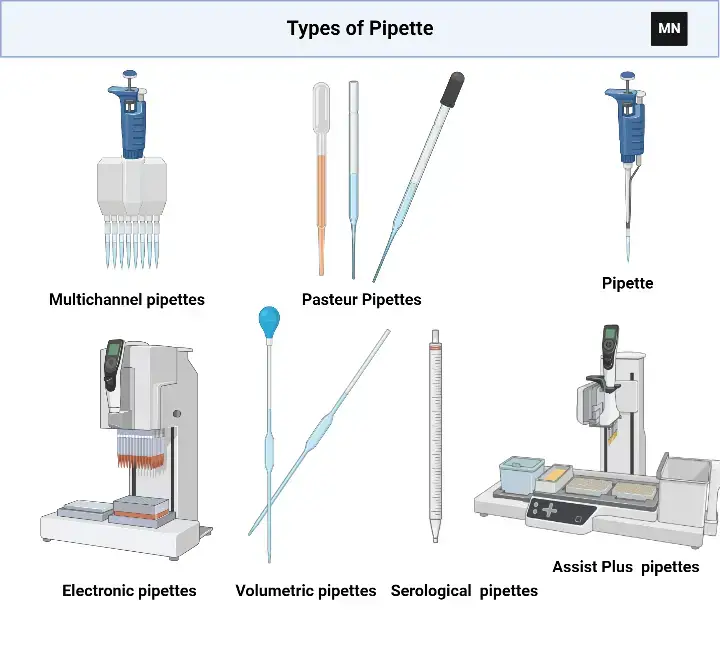
Pipettes are classified according to design, working principle, operation, volume setting and special use. The types are as follows-
A. Standard or Macropipettes
- Volumetric pipette
Volumetric pipette is also called bulb pipette or belly pipette. It is used to measure and deliver one fixed volume of liquid. It is very accurate for a particular volume. - Graduated pipette
Graduated pipette is a straight tube having marking on the side. These markings are used to measure different volume of liquid. - Serological pipette
Serological pipette has graduation up to the tip. It is designed to blow out the last drop. It is used for measured transfer of liquid. - Mohr’s pipette
Mohr’s pipette has graduation marks which ends before the tip. It is not made for complete draining. The liquid is delivered only up to last graduation mark. - Pasteur pipette
Pasteur pipette is a simple glass or plastic dropper. It has no graduation. It is used for transferring unmeasured amount of liquid. - Transfer or Beral pipette
Transfer pipette is similar to Pasteur pipette. It is made from single piece of plastic with built-in bulb. It is used for simple transfer of liquid.
B. Micropipettes Based on Working Principle
- Air displacement pipette
Air displacement pipette works by piston and air cushion. The air cushion draws and releases the liquid. It is mainly used for normal aqueous solutions. - Positive displacement pipette
Positive displacement pipette has piston which directly touches the liquid. It has no air cushion. It is used for viscous, volatile and hazardous samples.
C. Pipettes Based on Operation and Features
- Single-channel pipette
Single-channel pipette has one tip. It is used to aspirate and dispense one sample at one time. - Multi-channel pipette
Multi-channel pipette has many channels. Commonly 8, 12 or 16 channels are present. It is used for transferring many samples at same time. - Manual pipette
Manual pipette is operated by thumb pressure. The plunger is pressed and released by the user. - Electronic pipette
Electronic pipette works by motor and microprocessor. It gives automatic dispensing. It reduces hand strain during repeated work. - Fixed volume pipette
Fixed volume pipette gives only one fixed volume. The volume cannot be changed. - Variable volume pipette
Variable volume pipette allows volume adjustment. The user can set the volume between minimum and maximum range. - Repeater pipette
Repeater pipette is used for repeated dispensing. Liquid is taken once and same volume is dispensed many times.
D. Specialized Pipettes
- Vacuum-assisted pipette
Vacuum-assisted pipette works by vacuum or suction device. It does not use piston. - Pipetting syringe
Pipetting syringe is hand held tool. It works like volumetric pipette, burette and graduated pipette. - Glass micropipette
Glass micropipette is very fine glass tube. It is used for microscopic samples and single-cell microinjection. - Microfluidic pipette
Microfluidic pipette is made up of polymer material like PDMS. It is used for controlling nanolitre amount of liquid. - Van Slyke pipette
Van Slyke pipette is a graduated pipette. It is used in medical volumetric analysis. - Ostwald-Folin pipette
Ostwald-Folin pipette is used for viscous fluids. Blood and serum can be measured by this pipette. - Winkler-Dennis gas combustion pipette
This pipette is used for controlled liquid reaction involving electricity and oxygen. - Extremely low-volume pipette
This pipette is used for very small amount of liquid. It can handle volume up to zeptolitre level.
Operating Procedure of Pipette
- The required volume is first set in the pipette. The volume adjustment dial is turned slowly. The exact amount of liquid which is needed is selected.
- A proper disposable tip is attached to the pipette. The pipette is pressed gently into the tip box. The tip should not be touched by hand.
- The pipette is held in vertical position. The plunger is pressed down up to the first stop. This is the first resistance point.
- The tip is dipped slightly below the surface of liquid. It is kept about 3 to 4 mm deep. The tip should not be dipped too much inside.
- The plunger is released slowly and smoothly. Liquid enters into the tip. Sudden release should be avoided because air bubble may form.
- If the liquid is viscous, then small pause is given after aspiration. This helps the liquid to settle properly inside the tip.
- For dispensing, the tip is touched to the inner wall of receiving tube or container. The pipette is kept at slanting position.
- The plunger is pressed down to the first stop. After one second, it is pressed to the second stop. This removes the remaining liquid from the tip.
- The pipette tip is taken out from the receiving vessel before releasing the plunger. Then the plunger is released slowly.
- The used tip is discarded by pressing the tip ejector button. It is thrown into proper waste container. The used tip should not be touched by hand.
Applications of Pipette
- Pipette is used in molecular biology and genetics. It is used for DNA and RNA extraction. It is also used during PCR setup and DNA sequencing work.
- It is used in molecular screening. Very small amount of sample can be transferred by pipette. It is also used in single-cell genomics and nanobiopsy work.
- In cell and tissue culture, pipette is used for cell seeding. It is also used for media exchange in T-flask culture. Different cell culture media are prepared by using pipette.
- In clinical and medical diagnosis, pipette is used for blood testing and urinalysis. It is also used in immunology work and ELISA test.
- It is used for measuring whole blood. It is also used in ABO/Rh blood grouping and cross matching.
- In analytical chemistry and biochemistry, pipette is used for preparing standard solutions. It is also used in titration, protein assay and dissolution study.
- It is used for measuring special types of liquids. Volatile, dense and viscous liquids can be measured by suitable pipette.
- In forensic science, pipette is used for handling very small amount of DNA evidence. It is important for human identification work.
- In pharmaceutical and drug discovery work, pipette is used for drug development and stability testing. It is also used in monoclonal antibody production and CAR-T cell manufacturing.
- In food and environmental testing, pipette is used for analysis of food and chemicals. It is also used in food safety testing and environmental monitoring.
- Pipette is used in special scientific procedures. It is used in microinjection, patch-clamp work, transferring radioactive substances and thin film deposition by spin coating.
Advantages of Pipette
- Pipette gives accurate measurement of liquid. It is used to take and dispense exact volume. This helps to get same result in experiment.
- It is safer than old liquid transfer methods. Hazardous, corrosive, toxic and infectious liquids can be handled more safely by pipette.
- It saves time in laboratory work. Liquid transfer becomes fast and easy. Many tests can be done in less time.
- Modern pipettes are easy to use. They are made for comfortable holding. Hand fatigue becomes less during long time use.
- Pipette can be used for different types of liquids. Positive displacement pipette is useful for viscous, dense, foaming and volatile liquids.
- It is useful for repeated pipetting work. Air displacement pipette, multichannel pipette and repeater pipette can transfer many samples quickly.
- Disposable tips can be changed fast. This helps to reduce contamination between samples. It also makes the work more clean.
- Volumetric pipette gives very high accuracy. Its narrow neck helps in proper reading of liquid meniscus. It can give precision up to four significant figures.
- Graduated pipette is economical and useful. It can measure different volume of liquid. It is used when very extreme accuracy is not needed.
- Electronic and automated pipettes reduce human error. They also reduce repeated strain injury. These are useful for high number of samples and continuous laboratory work.
Limitations of Pipette
- Air displacement pipette is affected by temperature, pressure and humidity. If these conditions change, the accuracy may change. It depends on air cushion inside the pipette.
- It is not much suitable for viscous, volatile, dense and foaming liquids. These liquids affect the air cushion. So correct volume may not be taken.
- Positive displacement pipette needs special capillary-piston tips. These tips are costly. Changing these tips may also take more time.
- Positive displacement pipette is not available in many automated systems. So its use is limited in some laboratories.
- Volumetric pipette can measure only one fixed volume. For different volumes, different pipettes are needed. So more pipettes have to be stored and purchased.
- Volumetric pipettes may be costly. It is not useful when many variable volumes are required.
- Graduated pipette is less precise than volumetric pipette. Reading and delivery of liquid depends on the user. So human error may occur.
- Pasteur pipette has no graduation and no calibration. So it cannot measure accurate volume. It is used only for non-quantitative transfer.
- Acoustic liquid handler is very costly. It is used only for low volume transfer. It also cannot do in-well mixing.
- Manual pipetting depends on operator technique. Different users may get different results. So the result may not be always same.
- Long time manual pipetting may cause hand strain. Repeated pressing of plunger and ejecting tips may cause RSI.
- Pipettes need regular calibration and maintenance. Their internal parts are delicate and may fail. If not checked, wrong volume may be delivered without knowing.
Precautions of Pipette
- The volume should not be set above or below the pipette range. It may damage the pipette. It may also disturb the calibration.
- The pipette should be kept vertical during use. It should not be pointed upward when liquid is present in the tip. The liquid may enter into the internal part and damage it.
- Pipette should not be kept flat with liquid in the tip. Liquid may flow back into the shaft. This can spoil the mechanism.
- The plunger should be pressed and released slowly. Sudden release may form air bubbles. It may also pull liquid into the shaft.
- The tip should be attached gently. The pipette should not be pressed too hard into the tip box. It may damage the tip cone and airtight seal.
- The pipette should not be held in hand for long time unnecessarily. Heat from hand may expand the air cushion. This may give wrong volume.
- Mouth pipetting should never be done. Mechanical pipette or rubber bulb should be used. Mouth pipetting is dangerous.
- New sterile tip should be used for each different liquid. The tip should not touch skin, clothes or laboratory bench. This prevents cross contamination.
- The pipette should be stored upright on pipette stand. It should not be kept lying on the table after use.
- The outer surface of pipette should be cleaned after use. This is needed after handling corrosive, infectious or sticky solution.
- Reusable glass pipettes are kept in disinfectant after use. They are placed horizontally in a pan and fully covered with liquid disinfectant.
- Good posture should be maintained during pipetting. Elbows are kept close to the body and wrist twisting is avoided.
- During long pipetting work, short rest should be taken. About 1 to 2 minutes break after every 20 minutes helps to prevent RSI.
References
- 3CR Bioscience. (n.d.). Manual pipetting vs automatic: Advantages of automated pipetting.
- ALWSCI. (2025). Understanding “TD” and “TC” in laboratory glassware.
- Analytics-Shop. (n.d.). Pipette types, materials and areas of application.
- Arguinchona, B. (2017). What to do when your pipette is leaking. Pipette.com.
- ATO.com. (2026). Troubleshooting of pipettes.
- Basavarajegowda, A., Zubair, M., & Shastry, S. (2026). Pretransfusion testing. StatPearls Publishing. NCBI Bookshelf.
- Behera, D. (2026). Components and parts of a micropipette. Ossila.
- Benefits of using a liquid handler over manual pipetting. (n.d.).
- Biofargo. (n.d.). Different types of pipettes: Guide to selection and uses.
- Biology Stack Exchange. (2016). Difference between pipette and pipettor.
- Biosero. (n.d.). What are the benefits of automated liquid handling?
- Biotix. (2025). Pipette without pain: A guide to repetitive strain injury from pipetting. Bitesize Bio.
- Blood cross matching activity guide equipment: • 6 x Salad spinners (set up with Velcro inside). (n.d.). [PDF].
- BRAND GMBH + CO KG. (n.d.). Working with volumetric instruments.
- BRANDTECH Scientific. (n.d.). Pipette maintenance guide for reliable lab performance.
- BT Labs. (n.d.). Positive displacement pipettes – what you need to know.
- Bulbul, G., Chaves, G., Olivier, J., Ozel, R. E., & Pourmand, N. (2018). Nanopipettes as monitoring probes for the single living cell: State of the art and future directions in molecular biology. Cells, 7(6), 55. MDPI.
- Calibrating a pipette. (n.d.). [PDF].
- Calibration check – How to calculate the accuracy and precision of a pipette. (n.d.).
- Chang, Y. C. (2007). Pipette calibration. Taipei Veterans General Hospital. [PDF].
- Chemistry Teaching Labs. (n.d.). Types of pipettes. University of York.
- Cole-Parmer. (n.d.). Understanding pipettes and pipettes. Antylia Scientific Blog.
- Cole-Parmer. (n.d.). What are the different types of pipettes?
- Comparison between conventional and automated techniques for blood grouping and crossmatching: Experience from a tertiary care centre. (n.d.). PMC.
- Corning Life Sciences. (n.d.). Pipetting best practices to prevent hand strain.
- Crystalgen. (2024). The fascinating history of pipettes.
- Eppendorf. (n.d.). Calibration ISO 8655.
- Gilson. (n.d.). Updated ISO 8655 guidelines for pipette calibration and testing. Learning Hub.
- Gilson. (n.d.). What are the benefits of positive-displacement versus air-displacement pipettes?
- Hawach. (2024). Pipette common problem solving method.
- Hawach. (n.d.). Pipette troubleshooting and analysis.
- Heller, S., & Friedrich, K. (2023). Air displacement pipette or repetitive pipette? BRAND GMBH + CO KG. [PDF].
- Hossain, K. R. (2021). What are TC and TD on the pipette? 3D Printing.
- How to choose the right pipette for your application. (n.d.). Biocompare.
- INTEGRA Biosciences. (n.d.). How to use a serological pipet.
- Karki, P. (2024). Guide to pipettes: Principle, types & key uses. Microbe Notes.
- Klingenberg, M. (2005). When a common problem meets an ingenious mind. EMBO Reports, 6(9), 797-800. PMC.
- MasterControl. (n.d.). ISO 8655.
- Microlit. (n.d.). Micropipettes guide. [PDF].
- MRC Laboratory Instruments. (n.d.). What is a pipette?
- Nanoscale integration of single cell biologics discovery processes using optofluidic manipulation and monitoring. (n.d.). PMC.
- National Institute of Justice. (2023). Laboratory orientation and testing of body fluids and tissues for forensic analysts | Pipettes.
- NC DEQ. (2023). Calibration of mechanical volumetric liquid-dispensing devices procedure. [PDF].
- NYC.gov. (n.d.). PROTOCOLS FOR FORENSIC PCR ANALYSIS. [PDF].
- Office of Public Safety & Emergency Management. (n.d.). Pipetting. University of Pittsburgh.
- Pipette.com. (n.d.). How do pipettes work?
- Pipette.com. (n.d.). The evolution of micropipettes in the lab.
- Pipette.com. (n.d.). The evolution of micropipettes in the lab. (Note: Included twice in original notebook sources)
- Pipette.com. (n.d.). What is a micropipette?
- Pobel. (2025). Parts of a micropipette.
- Precision delivery using nanopipette for single-cell studies. (n.d.). PMC.
- Reagecon Diagnostics Ltd. (2003). Volumetric glassware. [PDF].
- Sankar, S. (2017). Micropipette types in pharmaceutical microbiology laboratory: ISO 8655 calibration, accuracy limits & GMP audit guide. Pharmaceutical Microbiology.
- Sartorius. (n.d.). ISO 8655 – Pipette calibration and verification.
- Simple Business Help LLC. (2021). Differences between volumetric pipettes and graduated pipettes: Pros, cons and limitations. Lab Pro Inc.
- SPT Labtech. (n.d.). Automated pipetting systems – comparison guide.
- SPT Labtech. (2026). Automated liquid handling for next-gen genomics. SelectScience.
- Taube, A., Ake, J., Hage, E., & Wallbaum, L. (2023). Pipette calibration and compliance: A practical guide to ISO 8655. Sartorius Lab Instruments. [PDF].
- Technical advancements in volumetric metrology: A comprehensive analysis of pipetting systems, procedural rigor, and laboratory standards. (n.d.). [Markdown].
- The uncertainty of volume calibration using A&D pipette accuracy testers. (n.d.). [PDF].
- Thermo Fisher Scientific. (2006-2026). Air vs. positive displacement pipettes.
- Thermo Fisher Scientific. (2022). Emphasizing accuracy and precision of pipette systems for human identification applications. [PDF].
- Thermo Fisher Scientific. (n.d.). Pipette types for different applications.
- Transcat Pipettes. (n.d.). ISO 8655 procedures.
- TYPES OF PIPETTES Beral pipette (commonly called a disposable pipette). (n.d.). [PDF].
- UCLA. (n.d.). How to use a micropipette. [PDF].
- Understanding pipettes: Essential tools for precision in the lab. (n.d.).
- University Health Services. (n.d.). Ergonomic pipettes. UC Berkeley.
- Volumetric and graduated glassware. (n.d.).
- Wake Forest University. (n.d.). Laboratory ergonomics. Environmental Health & Safety.
- WebAssign. (n.d.). Volumetric glassware.
- Westlab. (2017). What is the difference between TD & TC pipettes?
- What’s the difference between pipettes calibrated TD, TC, blow-out and related terms? (n.d.).
- Wikipedia. (2025). Blood compatibility testing.
- Wikipedia. (2026). Pipette.
- Wiltronics. (2022). What are pipettes: Pipetting for precision and accuracy.
- Yammi. (2025). Pipettes – principles, components, types, operation. Scitek Global.
- Yedowitz, M. (n.d.). Pipette technology over the years. BRANDTECH Scientific.
Describe the correct pipetting technique when using a pipette.