

Laboratory Incubator is a laboratory instrument which is used to grow and maintain microbial culture and cell culture.
It is an insulated chamber. It maintain fixed temperature and other suitable condition for growth. Humidity and gases like carbon dioxide (CO₂) and oxygen (O₂) are also controlled in it.
It gives contamination free environment to the culture. Bacteria, yeast, fungi and mammalian cells are grown in this instrument.
It is used in microbiology laboratory, molecular biology, pharmaceutical work, food testing and clinical research.
Incubator definition
A laboratory incubator is a heated, insulated device used to grow and maintain cell or microbiological cultures by controlling temperature, humidity, and CO2 levels.
Principle of Incubator
Principle of Incubator is based on the control of temperature and other surrounding conditions inside the chamber.
When electric current is passed, the heating element becomes hot. The heat is produced inside the incubator. This heat increases the temperature of the chamber.
The thermostat is used to maintain fixed temperature. When required temperature is reached, the heater becomes off. When temperature falls down, the heater becomes on again.
The fan helps to spread the warm air inside the chamber. Humidity and gases like carbon dioxide (CO₂) and oxygen (O₂) may also be maintained.
Thus a closed and suitable condition is maintained inside the incubator. This condition helps in growth of microorganisms, cells and other living materials.
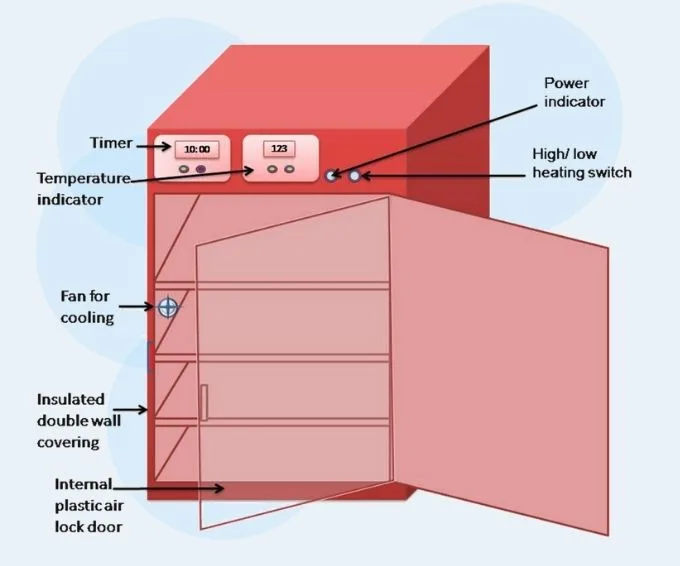
Parts/Components of Incubator
The following are the important parts of incubator–
- Cabinet
It is the main body of the incubator. It is double walled and insulated to prevent heat loss from the chamber. - Outer body
It is made up of mild steel or stainless steel. It gives support to the whole instrument and protect the inner parts. - Inner chamber
It is the working space of the incubator. It is generally made up of stainless steel and samples are kept inside it. - Insulation layer
It is present between outer wall and inner wall. It is made up of glass wool or polyurethane foam and it helps to maintain uniform temperature. - Door
The door is used to close the incubator chamber. It prevents the entry of outside air and helps to maintain the internal condition. - Viewing window
It is a transparent glass window present in the door. It is used to observe the culture without opening the door. - Door gasket
It is a rubber or silicone seal present around the door. It makes the chamber air tight and prevents heat loss. - Shelves or trays
Shelves are present inside the chamber. Culture plates, tubes, flasks and other materials are kept on these shelves. - Heating element
It is used to produce heat inside the incubator. Electric current passes through it and the chamber becomes warm. - Thermostat or temperature controller
It is used to control the temperature of the incubator. When the required temperature is reached, it stops the heater and when temperature falls it starts again. - Thermometer or display panel
It shows the temperature inside the incubator. In some incubators digital display is present for temperature, humidity and CO₂. - Air circulation fan
The fan is used to circulate warm air inside the chamber. It helps in equal distribution of temperature. - Humidity control system
It is used to maintain moisture inside the chamber. Water tray or humidifier is used in this system. - CO₂ inlet system
It is present in CO₂ incubator. It supplies carbon dioxide (CO₂) inside the chamber and helps in maintaining proper condition for mammalian cell culture. - HEPA filter
It is present in some advanced incubators. It filters the air and helps to reduce contamination. - Control panel
It is present on the outer side of incubator. It contains switches, indicators and knobs for setting temperature and other conditions. - Safety devices
Over-temperature cut off, fuse and alarm are fitted in the incubator. These protect the culture and instrument from damage. - Power supply
It supplies electric current to the incubator. Voltage stabilizer may be used to maintain proper working of the instrument. - Drain or outlet port
It is present at the lower part of the incubator. It is used to remove water or cleaning fluid after cleaning. - Shaking platform
It is present in shaking incubator. It gives continuous movement to the culture and helps in proper mixing and aeration.
Types of Incubator in laboratory
Different types of incubator are mentioned below-
- Standard incubator
It is also called microbiological incubator. It is used for normal incubation work. Bacteria, yeast and fungi are grown in it at fixed temperature. - CO₂ incubator
This type of incubator maintains carbon dioxide (CO₂), temperature and humidity. It is used for mammalian cell culture, tissue culture and stem cell culture. - Refrigerated incubator
It is used to maintain temperature below room temperature. It is used in biochemical study, food testing, protein crystallization and environmental work. - Shaking incubator
It is an incubator with shaking platform. It gives temperature and continuous shaking to liquid culture. It is used for E. coli, yeast, fermentation and protein expression. - BOD incubator
BOD incubator is used for biochemical oxygen demand test. It maintains low and fixed temperature. It is mainly used in water testing and waste water analysis. - Anaerobic incubator
This incubator maintains oxygen free condition inside the chamber. It is used for growth of anaerobic bacteria. - Lighting incubator
It is also called plant growth incubator. It has light and temperature control system. It is used for seed germination, plant tissue culture and insect rearing. - Constant temperature and humidity incubator
This type of incubator maintains both temperature and humidity. It is used for stability test, material testing and environmental testing. - Hybridization oven
It is a special type of incubator used in molecular biology. It maintains suitable temperature for DNA and RNA hybridization. - Dry bath incubator
It has heating block for small tubes. It is used for heating small liquid samples at fixed temperature. - Mould incubator
It is used for cultivation of moulds and other eukaryotic microorganisms. It may have heating, cooling, humidity and sterilization system. - Portable incubator
It is small size incubator. It is used in small laboratory, field work and remote microbiological testing.
Operating Procedure of an incubator
The following are the operating procedure of incubator–
- The incubator chamber is cleaned first. Any dust, water drop or remaining material from previous work is removed.
- The incubator is connected with proper electric supply. The plug and switch are checked before starting the instrument.
- The main switch is turned on. The power indicator glows and the incubator starts working.
- The required temperature is set by temperature controller. The incubator is allowed to reach the fixed temperature before keeping the samples.
- In special incubator, CO₂, humidity and other condition are also set according to the need of culture.
- The door is kept closed during preheating. Samples are not placed before the chamber reaches the required temperature.
- All culture plates, tubes or flasks are labelled properly. It helps to identify the sample after incubation.
- The plates are sealed properly when incubation is done for long time. It prevents contamination and drying of the medium.
- The culture plates are placed on the shelves. Petri plates are generally kept in inverted position, so that water drops do not fall on the medium.
- The samples are not placed very close to each other. Space is kept between them for proper circulation of warm air.
- Sterile water may be kept inside the incubator when incubation is for long period. It helps to prevent drying of culture medium.
- The door is closed properly after placing the samples. The door should not be opened again and again.
- Date, time, temperature and sample details are written in the log book. The incubation period is also noted.
- The temperature is checked during incubation. Any change in temperature or other condition is observed.
- After the required incubation time, the samples are removed carefully. The door is closed again after taking out the samples.
Application of Incubator
The following are the applications of incubator–
- It is used for growing and maintaining bacterial culture, fungal culture, yeast culture and other microbial culture.
- It is used for maintaining mammalian cell culture and plant cell lines under suitable condition.
- It is used in clinical laboratory for identification of pathogens from blood, urine, sputum and other body fluids.
- It is used in IVF work for keeping embryo and reproductive cells at proper temperature.
- It is used in pharmaceutical laboratory for cultivation of viruses and bacteria during vaccine development.
- It is used for drug testing, stability testing and shelf-life study of medicines.
- It is used in tissue engineering for growing stem cells, organoids and other tissue culture materials.
- It is used in food testing laboratory for detection of food borne organisms like Salmonella.
- It is used for shelf-life study and spoilage study of food and beverage materials.
- It is used in fermentation work for growth of useful microorganisms.
- BOD incubator is used for biochemical oxygen demand test of water and waste water.
- It is used in environmental study for testing water quality and aquatic ecosystem condition.
- It is used in zoology and veterinary laboratory for hatching eggs, insect breeding and diagnosis of animal diseases.
- It is used in biochemistry for enzyme study, protein crystallization and other controlled temperature work.
- It is used in genetics for gene expression study, genetic cloning and culture based experiments.
- It is used in cosmetic testing for stability, toxicity and effectiveness study of cosmetic products.
Advantages of Incubator
The following are the advantages of incubator–
- It maintains stable and controlled condition inside the chamber by controlling temperature, humidity and gases.
- It gives suitable environment for growth and survival of microorganisms and cell culture.
- It helps to prevent contamination of sensitive biological materials by closed chamber, HEPA filter, UV sterilization and clean surface.
- The temperature, humidity and gas level can be changed according to the need of culture or experiment.
- It helps to increase the growth rate of organisms which grow slowly in normal environmental condition.
- It is used for safe keeping of culture and samples before further laboratory processing.
- Advanced incubator has automatic control, data logging and remote monitoring system for smooth running of experiment.
- It reduces repeated manual checking during incubation.
- Modern incubator uses less electric power and helps to reduce laboratory running cost.
Limitations of Incubator
The following are the limitations of incubator–
- There is chance of contamination in incubator, because suitable growth condition is also suitable for unwanted microorganisms.
- If the door is kept open for long time, outside air enters inside and samples may be contaminated.
- A single incubator can maintain only one fixed condition of temperature, humidity and CO₂ at a time.
- Different cultures need different condition, so they cannot be incubated together in same incubator.
- Incubator is costly instrument and its maintenance cost is also high.
- Filters, cleaning agents and other parts are required for proper maintenance of incubator.
- It needs trained person for proper operation, cleaning and maintenance.
- Repeated opening of door changes the temperature and humidity inside the chamber.
- Incubator depends on continuous electric supply for its working.
- During power failure, fixed temperature is not maintained and culture may be affected.
- Small battery backup is not sufficient for long working of incubator.
- Overloading of samples blocks the air circulation inside the chamber and unequal temperature is formed.
Precautions
The following are the precautions of incubator–
- The incubator door should not be opened repeatedly, because temperature and humidity inside the chamber may be changed.
- The required temperature, humidity and gas level should be maintained first, then culture plates are kept inside it.
- Culture plates are kept in inverted position, so that condensed water does not fall on the culture medium.
- The inner chamber, shelves and corners are cleaned regularly to avoid dust and unwanted microbial contamination.
- Sterile water is kept below the shelves during long incubation, so that culture medium does not become dry.
- Culture plates, tubes and flasks are labelled before placing inside the incubator.
- The samples are kept with proper space between them for circulation of warm air.
- Incubator should not be overloaded with many samples, because unequal heating may occur.
- Temperature is checked during incubation to maintain the fixed condition.
- Door gasket should be checked, because leakage may change the inside condition.
- After keeping or removing the samples, the door is closed properly.
References
- Rahman, Z. S. A., & Hussain, F. S. A. (2017). Smart incubator based on PID controller. International Research Journal of Engineering and Technology (IRJET), 4(3), 2501-2509.
- OpenStax. (2016). 5.6 Heat transfer methods – conduction, convection and radiation introduction. Douglas College Physics 1207.
- Purina Animal Nutrition. (n.d.). A 21-day incubation guide to hatch eggs at home.
- American Laboratory Trading. (2024, March 15). A comprehensive guide to incubator maintenance.
- Prolifics. (2026, January 12). AI technology trends 2026: A strategic roadmap for enterprise growth.
- BINDER GmbH. (n.d.). All you need to know about CO2 incubators.
- Oklahoma State University Extension. (n.d.). Artificial incubation.
- Institutional Biosafety Committee (IBC), The University of Utah. (n.d.). Best practices for CO2 incubator maintenance.
- Wikipedia. (2026, April 5). Business incubator.
- Thermoline Scientific. (2025, March 24). Choosing the right incubator: A simple guide for your lab.
- Memmert USA. (n.d.). Common applications of incubating laboratory equipment.
- TotalTemp Technologies. (n.d.). Conduction v. convection for thermal testing.
- Hagler, G. (2019). Convection and conduction. EBSCO Research Starters.
- Bundl. (n.d.). Corporate startup incubators: The expert guide.
- Weithöner, F. (n.d.). Frank’s infant incubators.
- GE HealthCare. (n.d.). Giraffe omnibed carestation for maternal infant care.
- Biocompare. (n.d.). Guide to laboratory incubators: Types, uses, and leading products.
- Wikipedia. (2026, April 25). Heat transfer.
- Strombergs. (n.d.). How does a chicken incubator work?
- Hoyt, C. (2019, May 1). How to use and maintain your lab incubator. Laboratory Supply Network.
- Poultry Hub Australia. (n.d.). Incubation.
- Kamil, S. (n.d.). Incubator [PDF]. Al-Mustaqbal University College.
- Wikipedia. (2024, December 4). Incubator (culture).
- Vacc-Safe. (2026, April 27). Incubators for laboratories – types, uses and features.
- Pędich, M. (2026, February 18). Industrial Internet of Things (IoT) trends for 2026. Fabrity.
- Telefónica Tech. (n.d.). IoT trends 2026: Physical AI, autonomous mobility, IoMT and smart drones.
- Biocompare. (n.d.). Lab incubator maintenance and care.
- Yammi. (2024, January 12). Lab incubator: Parts, working, types, uses, precautions. Scitek Global.
- Karki, P. (2023, August 3). Laboratory incubator: Principle, procedure, examples. Microbe Notes.
- Amerigo Scientific. (n.d.). Laboratory incubators.
- MRC Lab. (n.d.). Laboratory incubators: Definition, purpose & functionality.
- Lakshmi N., B. (2011, March 2). Maintaining microbial precision: Crafting an SOP for operating and cleaning BOD incubators in the microbiology department. PharmaMax.
- Dräger. (n.d.). NICU incubators for premature babies.
- Ersa Electronics. (n.d.). PID control system explained: Principles, ICs, and applications.
- RealPars. (n.d.). PID controller explained.
- UNC Lineberger Comprehensive Cancer Center. (n.d.). Prevention & maintenance procedures.
- Chavez, M., Vanden Plas, B., & Glass, S. (2008, September 10). WQL SOP 206 biochemical oxygen demand [PDF]. Albuquerque Bernalillo County Water Utility Authority.
- Lab Manager. (n.d.). Stability chambers and ICH guidelines: Choosing the right equipment for pharmaceutical stability testing.
- The evolution and systematic engineering of controlled incubation environments: A comprehensive analysis of biological, medical, and economic systems. (n.d.).
- National Instruments. (2025, March 7). The PID controller & theory explained.
- Spherical Insights. (2025, September). Top 35 companies in infant incubator market 2025: Strategic overview and future trends (2024–2035).
- IMD Business School. (2025, September). 6 emerging technologies that will impact your business in 2026.
- Capgemini. (n.d.). Top tech trends of 2026.
- PHCbi. (n.d.). Understanding lab incubators: Types, features, and uses.
- WebMD Editorial Contributor. (2025, April 18). What is a baby incubator (M. Juber, Rev.). WebMD.
- Excedr. (2023, October 31). What is an incubator used for in the lab?
- Abhishek, K. S. (2025, July 16). What is an incubator? A beginner’s guide to startup success. Salesforce.
- Labonce. (2024, November 22). What is a stability chamber and how does it work?
- BDC. (n.d.). What is a business incubator?
- British Business Bank. (n.d.). What is a business incubator?
- Chauhan, A. (2025, June 6). Why incubators are essential in clinical and pathology labs. Flabs.
- Fakhri, M. T. (2023). Infant incubator [PDF]. Al-Mustaqbal University College.