

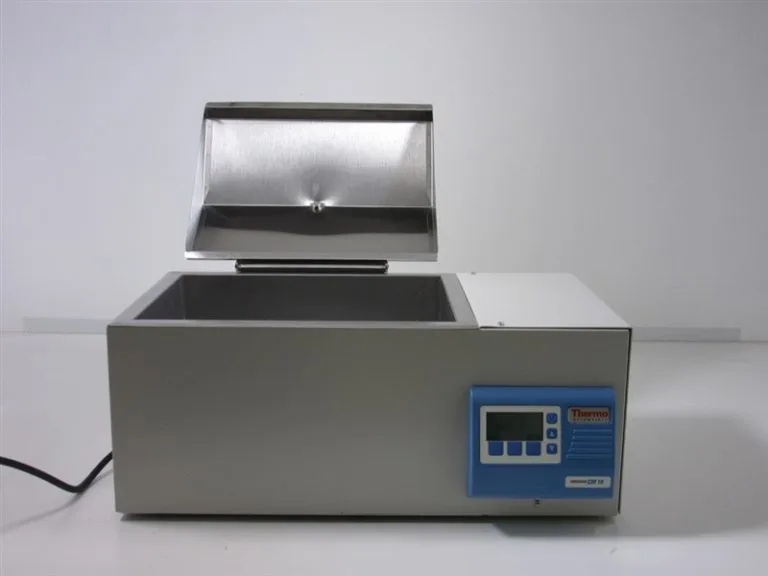
Laboratory Water Bath is a temperature controlled laboratory instrument that is used to heat and incubate samples at constant temperature for long time.
It consists of a container or reservoir filled with heated water. The water acts as a heat medium and gives uniform heating to the sample. It is mainly used when direct flame or direct heating is not suitable for the chemical or biological materials.
It works by indirect transfer of heat from the heated water to the test tubes, flasks or sample containers. The common parts of water bath include stainless steel reservoir, heating element, temperature sensor, and thermostat or digital controller.
It is used for warming reagents, melting substrates, incubating cell cultures and carrying out temperature sensitive reactions. Different types of water bath are basic water bath, circulating water bath, shaking water bath and refrigerated water bath.
Working Principle of a Laboratory Water Bath
Laboratory Water Bath is based on the principle of indirect transfer of heat through water medium.
In this instrument, the electric heating element heats the water present in the reservoir. The heat is first transferred by conduction to the nearby water layer. Then the hot water becomes less dense and moves upward, while the cold water moves downward.
This movement of water produces convection current. Due to this convection current, heat is distributed equally in all parts of the water bath. The sample tubes or containers kept in the water absorb this heat slowly and uniformly.
The temperature sensor continuously detects the temperature of water. This signal is given to the thermostat or digital controller. Then the controller regulates the heating element and maintains the required constant temperature.
Thus, the sample is heated without direct flame or direct contact with heating surface. It prevents overheating, hot spots and thermal damage of delicate chemical or biological samples.
Parts of laboratory Water Bath

The following are the parts of Laboratory Water Bath–
- Outer body / Chamber
Outer body is the outside part of water bath. It is usually made of stainless steel or mild steel with paint. It gives support to the instrument and protect the inner part from damage. - Inner tank / Reservoir
Inner tank is the water holding part. It is made of stainless steel (SS). Water is filled in this tank and the samples are kept in the water. - Heating element
Heating element is present at the bottom or side of the tank. It is an electric coil or rod. It heats the water by changing electric energy into heat energy. - Thermostat / Temperature controller
Thermostat is used for control of temperature. It keep the water at required temperature. It switches the heater ON and OFF according to temperature. - Temperature sensor / Thermometer
Temperature sensor is used to know the temperature of water. It may be thermistor, thermocouple or RTD probe. It give signal to the controller. - Lid or cover
Lid is the upper covering of water bath. It is used to reduce loss of heat and evaporation of water. It also prevent entry of dust in water. - Control panel / Display panel
Control panel is present on front side. It has switch, knob, display and indicator lights. It is used for setting temperature and showing temperature reading. - Indicator lamp
Indicator lamp is a small light. It show whether power is ON or heating is going on. In some water bath it also show alarm condition. - Sample rack / Platform
Sample rack is placed inside the tank. It holds test tubes, bottles and flasks. It keep the sample container above the heating element. - Circulating pump / Stirrer
Circulating pump is found in some water bath. It circulate the water inside the tank. This helps to make the temperature uniform in all part of water. - Drain plug / Valve
Drain plug is present at the lower side of tank. It is used for removing water after work and cleaning. - Insulation layer
Insulation layer is present between outer body and inner tank. It reduce heat loss from water bath. It helps to keep temperature constant. - Power switch and cable
Power switch is used to ON and OFF the water bath. Cable gives electric supply to the instrument. - Safety fuse / Cut-out
Safety fuse is used for protection. It cut the power supply during over heating or short circuit. It protect the heating element and sample.
Types of laboratory Water Bath
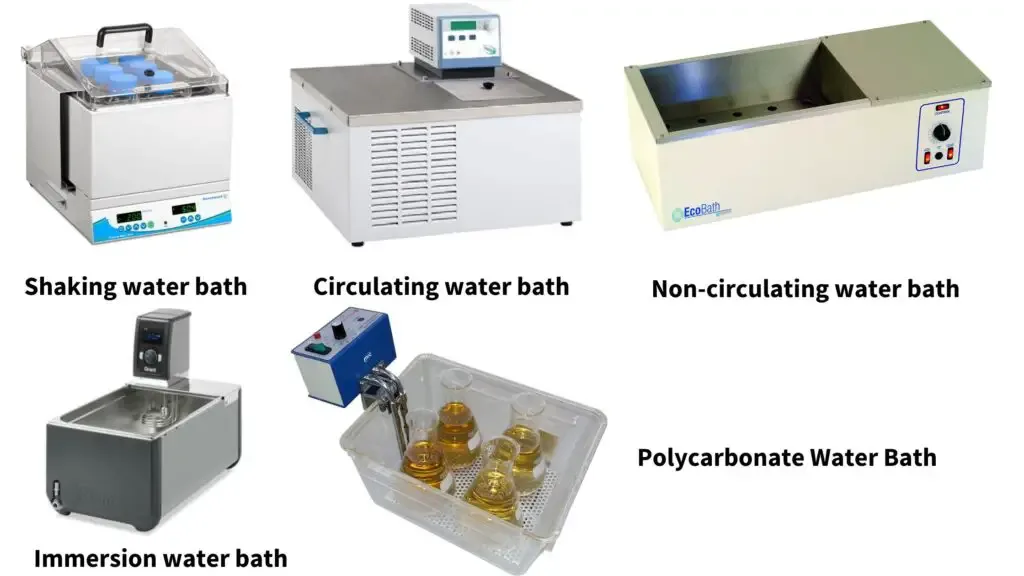
The following are the types of Laboratory Water Bath–
- General purpose water bath
It is also called non-circulating water bath. In this type water is heated by natural convection. It is used for simple heating work where very high accuracy is not needed. - Circulating water bath
Circulating water bath has a pump or stirrer. It circulate the water inside the tank. Due to this, same temperature is maintained in all part of the bath. - Shaking water bath
Shaking water bath has heating system and shaking system. It heat the sample and also shake the sample at same time. It is used for cell culture, extraction and solubility work. - Refrigerated water bath
Refrigerated water bath has both heating and cooling system. It is used to maintain low temperature or below room temperature. It is used in enzyme study, protein crystallization and other cold condition work. - Digital water bath
Digital water bath has digital controller and display. Temperature is set by button and reading is shown on display. It gives more accurate control of temperature. - Analog water bath
Analog water bath has mechanical knob or thermostat. It is simple and cheaper type. It is less accurate than digital water bath. - Polycarbonate water bath
Polycarbonate water bath is made with transparent polycarbonate tank. The sample can be seen from outside during heating. It is used in demonstration and some chemical reaction work. - Immersion water bath / Circulator
Immersion water bath is a separate heating circulator. It is placed inside any tank or vessel containing water. It heats and circulates the water to maintain required temperature.
Operating Procedure of a Laboratory Water Bath
The following are the operating procedure of Laboratory Water Bath–
- The water bath is placed on a stable and level surface. The surface should be heat resistant. Some space is kept around the instrument for air movement and easy working. The inner chamber is cleaned before use.
- The reservoir is filled with distilled water. It is used to prevent salt deposit and scaling. The water level should cover the heating element properly. But water should not be filled upto the top because it may overflow after keeping samples.
- The plug is connected to electric supply. Then the main switch is made ON. The required temperature is set by using digital button or analog knob.
- The lid is placed on the water bath. The water is allowed to heat till the required temperature is reached. It may take about 30 to 60 minutes for making the temperature stable.
- The temperature of water is checked by calibrated thermometer. It is done to know that the actual temperature and set temperature are same or not. After this the samples are kept inside.
- The sealed sample tubes, bottles or flasks are placed carefully in the water bath. Rack, float or weight is used to keep them in proper position. The containers should not touch the side wall or each other.
- The samples are kept in the water bath for required time. During this period temperature is checked from time to time. If the temperature is above 60°C, the lid is kept closed to reduce evaporation and heat loss.
- After completion of work, the samples are taken out carefully. Hot samples are handled by forceps or gloves. If needed, the samples are cooled after removing from the bath.
- The power switch is made OFF. Then the plug is removed from the electric socket. The instrument is allowed to cool.
- The water is allowed to cool below safe temperature. Then water is removed through drain valve or by emptying the tank. The inner tank is wiped and dried properly. The lid is placed again to protect the chamber from dust.
Analog Water Bath Vs Digital Water Bath
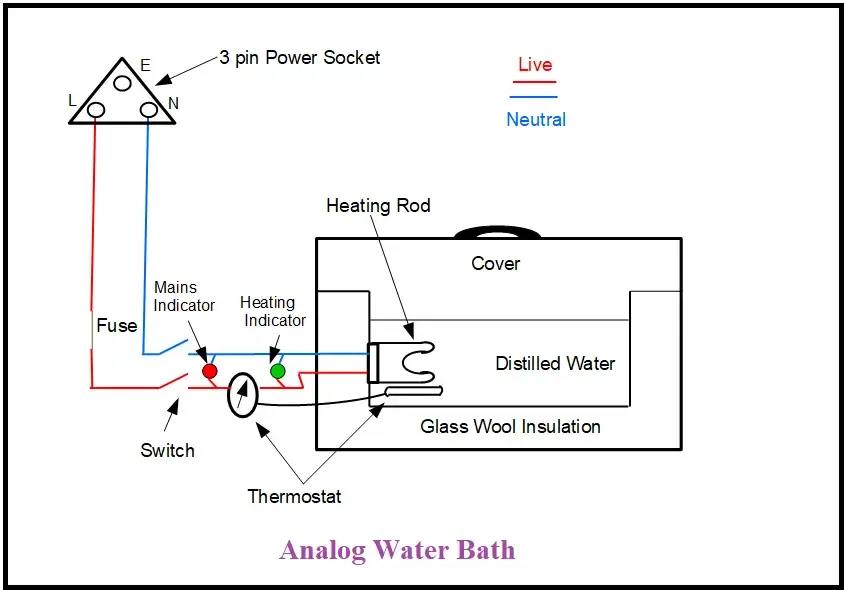
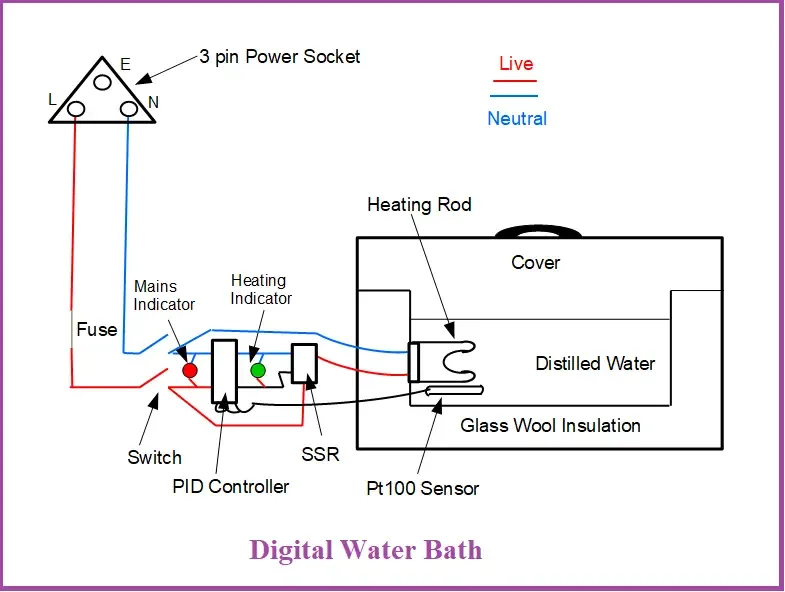
The following are the differences between Analog Water Bath and Digital Water Bath–
- Analog Water Bath uses a simple mechanical thermostat for control of heat. Digital Water Bath uses microprocessor based controller for control of heating element.
- Analog Water Bath has manual dial or knob for setting temperature. Digital Water Bath has digital display and buttons for setting temperature.
- In Analog Water Bath, actual temperature is checked by separate thermometer in many cases. In Digital Water Bath, temperature reading is shown directly on display.
- Analog Water Bath is less accurate. It is difficult to maintain exact temperature. Digital Water Bath is more accurate and it can maintain temperature more closely.
- Analog Water Bath is used for simple heating work. It is used where very strict temperature control is not needed. Digital Water Bath is used for molecular biology, precision assay and other sensitive experiment.
- Analog Water Bath is cheaper and simple in use. Digital Water Bath is costly than analog type because it has controller, display and other advanced parts.
- Analog Water Bath has less facility. Digital Water Bath may have timer, alarm, memory setting and programmable temperature condition.
- Analog Water Bath is mostly suitable for teaching laboratory and routine heating. Digital Water Bath is suitable where same temperature is needed again and again with better reproducibility.
| Basis | Analog Water Bath | Digital Water Bath |
|---|---|---|
| Control system | It uses simple mechanical thermostat for control of heat. | It uses microprocessor based controller for control of heating element. |
| Temperature setting | Temperature is set by manual dial or knob. | Temperature is set by button or digital control panel. |
| Temperature reading | Actual temperature is checked by separate thermometer in many cases. | Temperature reading is shown directly on digital display. |
| Accuracy | It is less accurate. Exact temperature control is difficult. | It is more accurate and maintain temperature more closely. |
| Use | It is used for simple heating work. | It is used for sensitive and accurate heating work. |
| Cost | It is cheaper and economical type. | It is costly than analog type. |
| Facilities | It has less facility and simple working system. | It may have timer, alarm, memory and programmable setting. |
| Suitable for | It is suitable for teaching laboratory and routine work. | It is suitable for molecular biology, precision assay and reproducible experiment. |
Advantages of laboratory Water Bath
The following are the advantages of Laboratory Water Bath–
- Laboratory Water Bath gives uniform and gentle heating to the samples. Water spread the heat equally around the sample container and hot spots are not formed easily.
- It is safer than direct flame heating. As open flame is not used, it is suitable for heating flammable chemicals and solvents.
- It maintain constant temperature for long time. Water has high heat holding capacity, so sudden change of temperature is reduced.
- It protects delicate biological materials from sudden heat shock. The samples get heat slowly and uniformly from surrounding water.
- It gives faster and efficient heat transfer than many direct heating methods. The sample container remains surrounded by warm water from all side.
- It gives better reproducibility in experiment. Same temperature can be maintained again and again for repeated work.
- It is used for many laboratory works. It is used for thawing samples, warming reagents, melting substrates, solubility test and incubation of cultures.
- It is simple to use and easy to clean. The working process is not complicated and maintenance is also less.
- It is economical for routine laboratory work. It can be used in teaching laboratory, microbiology laboratory, biochemical laboratory and research work.
Limitation of laboratory Water Bath
The following are the limitations of Laboratory Water Bath–
- Laboratory Water Bath cannot be used for very high temperature work. The temperature is limited by the boiling point of water. It can usually heat up to about 99.9°C or 100°C only.
- It takes more time for heating. The water need time to reach the required temperature, so it is slower than direct heating method.
- There is chance of contamination in water bath. Warm and moist condition may support growth of algae, fungi and other microorganisms.
- Water level decreases during use due to evaporation. So the water level has to be checked again and again. If water become too low, heating element may get damaged.
- Tap water may form mineral deposit and scale inside the tank. This may affect heating and cleaning of the water bath.
- In simple non-circulating water bath, temperature may not be equal in all part of the tank. Some area may become little hot or cold.
- It is not suitable for moisture sensitive chemicals. It is also not used for water reactive or pyrophoric materials.
- Sample containers must be closed properly before placing in water bath. Otherwise water may enter into sample and contaminate it.
- Some tubes or bottles may float or fall during heating. So rack, float or weight are required for holding the samples properly.
Application of laboratory Water Bath
The following are the applications of Laboratory Water Bath–
- Laboratory Water Bath is used for incubation of samples. It maintain suitable temperature for growth of cell culture, bacterial culture and other microbial culture.
- It is used for thawing frozen samples. Frozen blood plasma, enzymes, DNA and other biological samples are thawed slowly and safely.
- It is used for warming of reagents. Chemical solutions, buffers, culture media and other laboratory fluids are heated to required temperature before use.
- It is used for melting of solid substances. Agar, gelatin and paraffin wax are melted gently without direct burning.
- It is used in chemical reactions which need constant temperature. The reaction mixture is heated by indirect heat and not by direct flame.
- It is useful for heating flammable chemicals. Since open flame is not used, the chance of fire is less.
- It is used in enzyme assay and enzyme kinetic study. It maintain fixed temperature required for enzyme activity.
- It is used for protein analysis and some molecular biology works. The temperature sensitive samples can be heated under controlled condition.
- It is used for gentle evaporation of solvents. The sample can be concentrated without strong direct heating.
- It is used in analytical and material testing work. Constant thermal condition is given for viscosity test, food testing and other physicochemical study.
Precautions
The following are the precautions of Laboratory Water Bath–
- Wear heat resistant gloves, lab coat and safety goggles during working with water bath. It protect from hot water splash and steam.
- Do not operate the water bath without water. The water level should cover the heating element properly. If water level is low, the heating element may burn.
- Do not fill water upto the top of tank. Some space should be kept because water level increase after placing sample tubes or flasks.
- Distilled water should be used in the water bath. Tap water may form scale and salt deposit inside the tank.
- Do not use flammable liquid inside the water bath. Only water should be used as heating medium.
- The instrument should be properly grounded. This is required to prevent electric shock during operation.
- Hands should be dry before touching switch, plug and control panel. Wet hand may cause electric shock.
- Do not spill water near electric cord, socket and switch. If water spill occurs, the instrument should be switched OFF and cleaned.
- The sample containers should be closed properly before keeping in water bath. Otherwise water may enter into the sample and contaminate it.
- Sample tubes or flasks should be kept in rack, tray or float. They should not touch the bottom of tank directly.
- Hot samples should be removed by using tong, forceps or sample holder. Hot glassware should not be touched directly by hand.
- If temperature is above 60°C, the lid should be used. The lid should be opened slowly and away from face because hot steam may come out.
- Water should be allowed to cool before draining or cleaning. Generally it should be cooled below 50°C before emptying.
- The plug should be removed before cleaning, draining or maintenance of the water bath.
- If any fumes are produced from the sample, the water bath should be used in fume hood or well ventilated area.
- Water bath should not be used for moisture sensitive, water reactive or pyrophoric substances. These materials may react with water or moisture.
References
- Addgene. (n.d.). Water bath protocol. https://www.addgene.org/protocols/water-bath/.
- AELAB. (2024, October 21). Water bath in laboratory principle. https://aelabgroup.com/water-bath-in-laboratory-principle/.
- Amtrol Inc. (n.d.). Guardian CP (DC2) error codes – Amtrol tech takes [Video]. YouTube. https://www.youtube.com/watch?v=x0JqRxdr12c.
- Anachem Lab Solutions Pvt. Ltd. (n.d.). Water bath applications in laboratory: Features, uses & benefits. https://www.anachemlab.com/water-bath-applications-in-laboratory-features-uses-benefits/.
- Boekel Scientific. (n.d.). How to maintain a laboratory water bath. https://www.boekelsci.com/news/lab-water-bath-maintenance.html.
- Chemicals.co.uk. (n.d.). Can I use deionised water instead of distilled water? https://www.chemicals.co.uk/blog/deionised-water-or-distilled-water.
- Comprehensive analysis of laboratory water bath instrumentation: Theory, engineering, and disciplinary applications. (n.d.)..
- Delta Faucet Company. (2026, March 6). Steamist generators, TSSH shower valve, and control error codes. https://support.deltafaucet.com/s/article/Steamist-TSG-Generators-SMP-Generators-TSSH-Showervalve-and-Control-Error-Codes.
- DwyerOmega. (n.d.). What is a PID controller? https://www.dwyeromega.com/en-us/resources/pid-controllers.
- ECHEMI. (n.d.). Corrosiveness of deionized vs distilled water for use in laboratory water bath. https://www.echemi.com/community/corrosiveness-of-deionized-vs-distilled-water-for-use-in-laboratory-water-bath_mjart2208041357_751.html.
- EMIN Viet Nam. (2025, November 11). Error E1, E2, E3 when using air quality meter and how to fix it. http://fluke.com.mm/error-e1-e2-e3-when-using-air-quality-meter-and-how-to-fix-it-1229/ne.html.
- Eurotherm. (n.d.). Principles of PID control and tuning. Watlow Electric Manufacturing Company. https://www.eurotherm.com/us/temperature-control-us/principles-of-pid-control-and-tuning/.
- Fakhri, M. T. (n.d.). Medical instrumentations: Third lecture. Al-Mustaqbal University College. https://uomus.edu.iq/img/lectures21/MUCLecture_2022_102236316.pdf.
- Grant Instruments. (2009, July 20). Shaking water bath OLS200 / refrigerated immersion cooler CS200G: Operating manual. https://keith-larson-h7ze.squarespace.com/s/Grant-OLS2000-Shaking-Water-Bath-Operating-Instructions.pdf.
- Grant Instruments. (2010, January). SUB universal water baths, SBB boiling baths, JB, PB unstirred water baths: Operating instructions. https://www.ous-research.no/regenerative/docs/Grant%20SUB-%20SBB-%20JB-%20PB%20Waterbath%20manuals.pdf.
- Grant Instruments. (n.d.). Unstirred water baths SUB Aqua Plus, JB Aqua Plus & SBB Aqua Plus: Operating manual. https://sitefiles.camlab.co.uk/Grant%20SUB%20JB%20SBBAqua%20Plus%20Operating%20Manual.pdf.
- Grant Instruments UK. (2026, January 14). Which water should you use in your bath? https://www.grantinstruments.com/blogs/knowledge-base/which-water-should-you-use-in-your-bath.
- Hameed, L. H. (n.d.). Water bath device in medical laboratories. Al-Mustaqbal University College. https://uomus.edu.iq/img/lectures21/MUCLecture_2024_1278246.pdf.
- Hopper, J. (n.d.). ISO 17025 lab equipment requirements: The complete guide to compliance. Lab Equipment Direct. https://labequipmentdirect.com/blogs/regulatory-and-compliance/iso-17025-lab-equipment-requirements.
- Hot-Giraffe-1476. (2025). Water bath vs bead bath [Online forum post]. Reddit. https://www.reddit.com/r/labrats/comments/1l39rv4/water_bath_vs_bead_bath/.
- igetmywaterfrombeer. (2024). Friendly reminder: DI/ultrapure water can corrode stainless steel! [Online forum post]. Reddit. https://www.reddit.com/r/labrats/comments/1bkgz0a/friendly_reminder_diultrapure_water_can_corrode/.
- JULABO USA. (n.d.). What is PID temperature control, and how does it enhance laboratory applications? https://julabo.us/what-is-pid-temperature-control-and-how-does-it-enhance-laboratory-applications/.
- Lab Armor. (n.d.). Labs are better waterless. Sheldon Manufacturing. https://www.sheldonmanufacturing.com/lib/sitefiles/pdf/brochures/0740531-Lab-Armor-Products.pdf.
- Lasic, Z. (2025, June 26). The difference between distilled water and deionized water. Pro+Aqua. https://proaquawater.com/blogs/protips/deionized-vs-distilled-water-guide.
- Malhotra, V. (2025, May 15). Complete guide to water bath: Principle, diagram, and applications. Presto Group. https://www.prestogroup.com/blog/complete-guide-to-water-bath-principle-diagram-and-applications/.
- McDonald, K. (2023, June 27). Water bath or bead bath: Which one is better? Laboratory Supply Network. https://labsup.net/blogs/blog/water-bath-or-bead-bath-which-one-is-better.
- Mishra, R. (2025, March 25). What is a water bath? Principle, diagram, types, and applications. Testronix Instruments. https://www.testronixinstruments.com/blog/water-bath/.
- Munro Instruments. (n.d.). The complete guide to working in a laboratory water bath. https://www.munroscientific.co.uk/the-complete-guide-to-working-in-a-laboratory-water-bath.
- NBCHAO. (n.d.). What does water bath E-2 mean? https://en1.nbchao.com/w/11843/.
- National Instruments. (2025, March 7). The PID controller & theory explained. https://www.ni.com/en/shop/labview/pid-theory-explained.html.
- Nuvio. (n.d.). Troubleshooting error codes on your chiller pro. https://help.nuviorecovery.com/hc/en-us/articles/38306512854417-Troubleshooting-Error-Codes-on-Your-Chiller-Pro.
- PHC Corporation. (n.d.). Water bath science: Ensuring precision in your lab work. https://www.phchd.com/apac/biomedical/service-downloads/evolving-science-for-the-future/laboratory-water-bath-science.
- Precision Scientific Inc. (n.d.). Instructions TS-66518 AZ-1: General purpose water baths. https://www.lebonheur.org/research/investigator-resources/manuals/Precision%20Scientific%20180%20Series%20Water%20Bath%20manual.pdf.
- Presto Group. (n.d.). Step-by-step guide to water bath: Working principle, diagram, and uses. https://www.testing-instruments.com/blog/step-by-step-guide-to-water-bath-working-principle-diagram-and-uses/.
- Revolutionary Science. (n.d.). 5 essential tips for maintaining a clean and contamination-free lab water bath. https://www.revsci.com/blogs/water-baths/5-essential-tips-for-maintaining-a-clean-and-contamination-free-lab-water-bath.
- Revolutionary Science. (n.d.). Water baths: Types, uses, and maintenance tips. https://www.revsci.com/blogs/water-baths/water-baths-types-uses-and-maintenance-tips.
- SIMCO Electronics. (2026, February 23). ISO/IEC 17025 calibration audit guide: Requirements and common pitfalls. https://www.simco.com/blog/iso-17025-calibration-audit-guide/.
- Scientific Laboratory Supplies. (n.d.). Unstirred water baths. https://www.scientificlabs.co.uk/handlers/libraryFiles.ashx?filename=Manuals_B_BAT3316.pdf.
- Simson Chemtech. (2025, August 2). Water bath uses in laboratory: Working principle | types | maintenance | safety precautions. https://www.simsonchemtech.com/blog-details/water-bath-laboratory-uses-types-maintenance-safety.
- Stellar Staff. (2020, November 8). How do I decide if a water bath or bead bath is best for my lab? Stellar Scientific. https://www.stellarscientific.com/blog/how-do-i-decide-if-a-water-bath-or-bead-bath-is-best-for-my-lab/.
- Terra Universal. (n.d.). Laboratory waterbath features comparison. Laboratory-Equipment.com. https://www.laboratory-equipment.com/blog/laboratory-waterbath-features-comparison.
- The Lab Depot. (n.d.). All you need to know about general purpose water baths. https://www.labdepotinc.com/articles/an-extensive-guide-to-general-purpose-water-baths.html.
- Thermo Fisher Scientific. (n.d.). Thermal beads look like a great alternative to water – what are the differences? https://assets.fishersci.com/TFS-Assets/LPD/Scientific-Resources/ThermalBeads-SmartNote-Global-FHR.pdf.
- Thermoline Scientific. (2025, July 1). How to clean a lab water bath: A step-by-step guide. https://www.thermoline.com.au/blog/how-to-clean-a-lab-water-bath-a-step-by-step-guide.
- Transcat, Inc. (2025). ISO standards. https://www.pipettes.com/calibration-services/pipettes-university/iso-standards.
- US Environmental Protection Agency. (2014, September 26). Standard operating procedure for calibration and maintenance of thermometers and thermometer/hygrometers (SOP No. EQ-02-07). https://19january2017snapshot.epa.gov/sites/production/files/2014-12/documents/eq-02-07.pdf.
- Wikipedia. (2024, November 26). Laboratory water bath. https://en.wikipedia.org/wiki/Laboratory_water_bath.
- Yelimeshyn, S. (2025, December 24). What are laboratory water baths? Types, functions, and best practices. Boston MedSupply. https://bostonmedsupply.com/what-are-laboratory-water-baths-types-functions-and-best-practices/.
- Zhuge, S. (2020). PID control theory. Crystal Instruments. https://www.crystalinstruments.com/pid-control-theory.