

Gel Filtration Chromatography (GFC) is a chromatographic technique used for separation of molecules on the basis of their size and shape.
It is also called size exclusion chromatography when water based buffer is used for the separation. It is mainly used for separation of biological molecules like proteins, nucleic acids and polysaccharides.
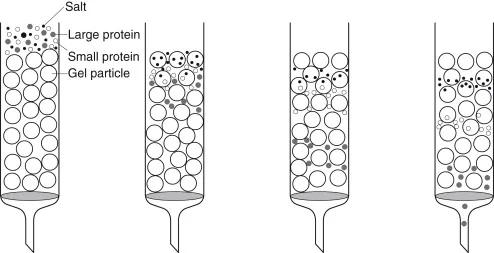
In this technique, the column is packed with small porous gel beads. The large molecules cannot enter inside the pores of the beads and so they pass quickly through the column. Thus, larger molecules are eluted first.
The small molecules enter into the pores of gel beads. So, they move through a longer path inside the column and come out later. This is the main basis of separation in gel filtration chromatography.
It is a mild technique because it does not denature the molecules. It is used for purification of molecules, estimation of molecular weight, desalting of sample and buffer exchange.
Principle of Gel Filtration Chromatography
Gel filtration chromatography is based on the separation of molecules by their size and shape.
In this method, the column is filled with porous gel beads. The sample is passed through the column with aqueous buffer. The molecules are separated according to their movement through the pores of the beads.
Large molecules do not enter into the pores of gel beads. They move through the spaces between the beads. So they pass rapidly through the column and elute first.
Small molecules enter into the pores of gel beads. They take a longer path through the column. So they move slowly and elute later.
Very small molecules enter more into the pores. They remain inside the column for longer time and elute last.
Thus, separation in gel filtration chromatography is due to physical size only. There is no chemical or electrostatic binding with the matrix. So it is a mild method and it preserves the native structure and activity of biological molecules like proteins and nucleic acids.
Components of Gel Filtration Chromatography
The following are the main components of gel filtration chromatography–
- Chromatography column
It is a vertical glass or plastic cylinder which holds the gel matrix. At the bottom, a porous disc or frit is present. It holds the packing material inside the column and allows the liquid to pass. - Stationary phase or matrix
It is made up of small porous beads. These beads are packed inside the column. It acts as a molecular sieve and separates the molecules according to their size. - Mobile phase or elution buffer
It is the aqueous buffer solution which flows through the column. It carries the sample mixture through the gel matrix. - Pump
Pump is used to pass the mobile phase through the column. It maintains a proper and controlled flow rate of buffer and sample. - Sample injection system
It is used to introduce the sample into the column. It may be manual or automated type and often has a sample loop. - Detectors
Detectors are used to detect the separated molecules when they come out from the column. UV/Vis absorbance, conductivity or refractive index detectors are commonly used. - Fraction collector
It is used to collect the eluted liquid into separate tubes or wells. The separated fractions can be used for further analysis. - Software interface
It is a computer program which controls the system. It is also used to set the purification method and analyse the chromatographic data.
Types of Gel Filtration Chromatography
The following are the main types of gel filtration chromatography–
- Group separation– In this type, the molecules are separated into two main groups according to a fixed size limit. It is mainly used for desalting, buffer exchange and removal of small impurities like salts, nucleotides and dyes from large molecules.
- High resolution fractionation– In this type, different molecules are separated more clearly according to small difference in their molecular size. It is used for separation of specific biomolecules, protein monomers from aggregates and study of molecular weight distribution.
- Analytical gel filtration chromatography– This type is used in small amount of sample. It is mainly used to know the purity of protein, molecular weight and molecular interaction. The main aim is analysis of sample, not collection of large amount.
- Preparative gel filtration chromatography– This type is used for separation and recovery of molecules from large amount of sample. The separated molecules are collected in different fractions and used for further experiment or production.
- Size exclusion chromatography (SEC)– Gel filtration chromatography is a type of size exclusion chromatography. In this method, aqueous buffer is used for separation of biological molecules.
- Gel permeation chromatography (GPC)– Gel permeation chromatography works on the same principle of size separation. But it uses organic solvents and is mainly used for synthetic polymers and plastics.
Steps of Gel Filtration Chromatography
The following are the steps of gel filtration chromatography–
- The column is selected according to the size range of target molecules. It is packed with porous gel beads. Then the column is washed and equilibrated with aqueous running buffer for maintaining proper pH and ionic strength.
- The sample is completely dissolved in suitable buffer. It is then centrifuged or filtered through 0.22 μm filter to remove dust and particulate matter. This prevents blocking of the column.
- The prepared sample is loaded on the top of the column bed. It may be loaded by syringe, sample loop or autosampler. For good separation, the sample volume is kept small, generally 0.5% to 2% of total column volume.
- The aqueous buffer is passed continuously through the column. In gel filtration chromatography, same buffer is used throughout the process and this is called isocratic elution. Large molecules pass outside the beads and come out first. Small molecules enter into the pores and come out later.
- The liquid coming out from the column is detected continuously. UV absorbance detector is commonly used for proteins and nucleic acids. Conductivity and refractive index detectors may also be used according to the sample.
- The eluted liquid is collected in separate tubes or wells. It may be collected manually or by fraction collector. Fractions are collected according to fixed volume or according to the peaks.
- The chromatogram is analysed after separation. The peaks are used to know identity, concentration, purity or molecular weight of separated molecules. The collected fractions may be further tested by SDS-PAGE or spectrophotometry.
Factors affection on Resolution of gel filtration
The following are the factors affecting on resolution of gel filtration chromatography–
- Particle size or bead size affects the resolution. Smaller bead size gives better resolution because the molecules have to diffuse through shorter distance to enter into the pores.
- Column length also affects the resolution. Longer column gives better separation because molecules get more space and time for separation through the gel bed.
- Flow rate should be proper during the process. If the flow rate is very high, molecules do not get enough time to enter into the pores. If the flow rate is very low, peak broadening takes place due to diffusion.
- Sample volume is an important factor for resolution. For high resolution separation, small volume of sample is loaded on the column. Generally 0.5% to 2% of total column volume is used to prevent overlapping of peaks.
- Column packing should be proper. Over packing of column may collapse the pores of beads. Under packing or presence of gaps in the column causes diffusion of sample and broadening of peaks.
- System dead volume should be minimum. Extra volume in tubing, injection valve and detector causes early band broadening and reduces sharpness of separated peaks.
- Sample viscosity also affects the resolution. If the sample is more viscous than elution buffer, irregular flow pattern is formed. This disturbs the shape of peak and lowers the resolution.
- Pore size of the gel beads should be suitable for the target molecules. If pore size is not suitable, molecules may be totally excluded or completely included and proper separation does not occur.
Applications of Gel Filtration Chromatography
The following are the applications of gel filtration chromatography–
- It is used for fractionation and purification of biomolecules such as proteins, enzymes, nucleic acids and polysaccharides from complex mixture according to their size.
- It is used for desalting of samples. Small salts, nucleotides, primers and unreacted dyes are removed from larger molecules.
- It is used for buffer exchange. In this process, the sample is transferred from one buffer solution to another buffer solution.
- It is used for determination of molecular weight of unknown proteins or polymers. Their elution time is compared with known standard molecules.
- It is used for removal of protein aggregates. Dimers, trimers and other soluble aggregates are removed during final purification of therapeutic proteins and monoclonal antibodies.
- It is used in quality control of pharmaceutical biological products. It helps to study purity, stability and oligomeric state of the sample.
- It is used in protein refolding. Denatured proteins are refolded by changing the buffer condition during passage through the column.
- It is used for separation of labelled compounds. Bound macromolecules are separated from free radioisotopes or free fluorescent labels.
Advantages of Gel Filtration Chromatography
The following are the advantages of gel filtration chromatography–
- It is a mild chromatographic technique. It is carried out in aqueous condition, so the natural structure and biological activity of sensitive molecules like proteins are maintained.
- In this method, separation occurs only according to size of molecules. There is no chemical binding or electrostatic binding between the sample and stationary phase.
- The recovery of sample is high. The molecules do not bind with the column matrix, so loss of sample is very less.
- It can be used with different buffer conditions. As the molecules are not bound with resin, the buffer can be selected according to stability of sample and further use.
- The method is simple and predictable. A single continuous buffer is used in the process. Binding, washing and gradient elution steps are not required.
- It gives fast and efficient separation. The separation time is short and the elution bands are narrow.
- It can be used in both small and large scale. It is used for analytical laboratory samples and also for preparative and industrial purification.
Limitations of Gel Filtration Chromatography
The following are the limitations of gel filtration chromatography–
- It cannot separate molecules properly when their molecular size is very similar. For clear separation, the molecules should have sufficient difference in their molecular weight.
- The sample volume should be very small for good separation. Generally 0.5% to 4% of the total column volume is used. So the loading capacity of the column is low.
- It is a slow process because the molecules diffuse into and out of the pores of matrix. The flow rate cannot be very high, otherwise peak broadening occurs.
- Sometimes unwanted interaction may occur between the sample and column matrix. Due to this, delayed elution and poor recovery may be observed.
- Very large and highly branched molecules may be trapped or anchored inside the pores of beads. Very large molecules may also be damaged by shear force during passage through the column.
- Molecular weight determination depends on calibration standards. If the standards are not pure or not suitable, the result may not be accurate.
- It does not give chemical information about the molecules. It separates molecules only by physical size, shape and hydrodynamic volume.
FAQ
- MilliporeSigma. (n.d.). Affinity chromatography troubleshooting.
- Gilson. (n.d.). Analytical vs. preparative chromatography: What’s the difference? Learning Hub.
- Aijiren. (2024, August 30). Analytical vs. preparative HPLC: Understanding key differences.
- MetwareBio. (n.d.). Analytical vs. semi-preparative vs. preparative HPLC: A strategic guide to precision, scale, and efficiency.
- Wu, T. (2011, April 1). Are SEC/GFC/GPC nomenclature interchangable? Chromatography Forum.
- Spears, M. W., Jr., & Podzimek, S. (2016). Beyond GPC: Using light scattering for absolute polymer characterization.
- Thermo Fisher Scientific. (n.d.). Bioprocessing chromatography techniques.
- Bio-Rad Laboratories. (n.d.). Chromatography column performance and data analysis success guide.
- Thermo Fisher Scientific. (n.d.). Chromatography troubleshooting guides-gas chromatography.
- Thermo Fisher Scientific. (n.d.). Chromatography troubleshooting guides-liquid chromatography.
- Drevland, R., McLaughlin, K., Pratt, C., & Thomas, L. (2019). Column length effect on separation and resolution. Bio-Rad Laboratories.
- Cytiva. (2010). Column efficiency testing.
- Comprehensive analysis of gel filtration chromatography: Theory, instrumentation, and applications in macromolecular science. (n.d.).
- Determination of the absolute molar mass of [Fe-S]-containing proteins using size exclusion chromatography-multi-angle light scattering (SEC-MALS). (n.d.). PMC.
- Difference Between. (n.d.). Difference between gel filtration and gel permeation chromatography.
- GMI. (n.d.). FPLC system purchasing guide: GMI certified knowledge.
- Center for Macromolecular Interactions. (n.d.). Fast protein liquid chromatography (FPLC). Harvard Medical School.
- Tamang, S. (2026, March 11). Fast protein liquid chromatography (FPLC): Principle, steps, uses. Microbe Notes.
- Bio-Rad Laboratories. (n.d.). Fast protein liquid chromatography.
- Polymer Characterization, S.A. (n.d.). GPC vs SEC vs GFC: Understanding the difference and when to use each term.
- Sinha, A. (2025, November 28). GPC vs SEC: Breaking down the terminology in size-based chromatography. ResolveMass Laboratories Inc..
- Agilent Technologies. (n.d.). GPC/SEC troubleshooting guide.
- Cytiva. (2021). Gel filtration calibration kit.
- Cytiva. (n.d.). Gel filtration calibration kit LMW.
- Bio-Rad Laboratories. (n.d.). Gel filtration chromatography.
- Alfa Chemistry. (n.d.). Gel filtration chromatography – GELS.
- Bio-Rad Laboratories. (n.d.). Gel filtration chromatography.
- Gel-filtration chromatography. (n.d.). PMC.
- Gel-filtration chromatography. (n.d.). PMC.
- Chrom Tech, Inc. (n.d.). HPLC column pore size vs particle size explained.
- Danaher Life Sciences. (n.d.). Impact of column length on chromatographic resolution.
- Bio-Rad Laboratories. (n.d.). Introduction to size exclusion chromatography.
- Arnett, K. (2025, September 15). AKTA Pure: CMI getting started guide to fast-protein liquid chromatography. Harvard Medical School.
- Instituto de Biomedicina de Valencia. (n.d.). Multi-angle light scattering (SEC-MALS).
- Tosoh Bioscience GmbH. (n.d.). Performance parameters for chromatography columns.
- Matson, J. B., Steele, A. Q., Mase, J. D., & Schulz, M. D. (2023). Polymer characterization by size-exclusion chromatography with multi-angle light scattering (SEC-MALS): A tutorial review. Polymer Chemistry.
- MilliporeSigma. (n.d.). Principles and standard conditions for different purification techniques.
- EDVOTEK, Inc. (2011). Principles of gel filtration chromatography.
- Cytiva. (n.d.). Protein and peptide purification.
- Abcam. (n.d.). Protein purification: Methods, techniques, and applications.
- Protocol. (n.d.). Squarespace.
- MilliporeSigma. (2022). Resins selection guide.
- ResolveMass Laboratories Inc. (n.d.). SEC calibration curve Kav.
- Wyatt Technology. (n.d.). SEC-MALS for absolute molar mass and size measurements.
- Wyatt Technology. (n.d.). SEC-MALS for absolute molar mass and size measurements.
- Agilent Technologies. (2015). Size exclusion chromatography for….
- Purolite. (2024). Scaling protein purification.
- Cytiva. (2020). Selection guide.
- Cytiva. (n.d.). Selection guide.
- Waters Corporation. (n.d.). Significance of small particles in chromatographic performance.
- Shimadzu Scientific Instruments. (n.d.). Size exclusion chromatography.
- Cytiva. (n.d.). Size exclusion chromatography.
- Tayyab, S., Qamar, S., & Islam, M. (1991). Size exclusion chromatography and size exclusion HPLC of proteins. Biochemical Education, 19(3), 149-152.
- Abcam. (n.d.). Size exclusion chromatography: Fundamentals and applications.
- Cytiva. (n.d.). Size exclusion resins.
- Cytiva. (n.d.). Size exclusion.
- Size-exclusion chromatography: A twenty-first century perspective. (n.d.). PMC.
- Warwick, T. (2022, October). How to measure molecular weight using size-exclusion chromatography (SEC). Bitesize Bio.
- Chrom Tech, Inc. (n.d.). Tackling common challenges in chromatography.
- Shimadzu Corporation. (n.d.). Theoretical plate number and symmetry factor.
- ResearchGate. (n.d.). What is the difference between the SEC and GPC?.
- The Bumbling Biochemist. (n.d.). “Preparative” vs “analytical” techniques & examples of when you might use what.