

Gel Permeation Chromatography (GPC) is a chromatographic technique used to separate polymers and other large molecules according to their size in solution.
It is also known as Size Exclusion Chromatography (SEC). In this technique, the polymer sample is dissolved in a suitable solvent and then passed through a column which contains porous gel beads.
These porous gel beads behave as molecular sieve. Large molecules are not able to enter into the pores, so they pass directly through the column and come out first. Small molecules enter into the pores of gel beads and take more time to come out.
Thus, separation takes place because molecules of different size move through different path in the column. The larger molecules elute first and smaller molecules elute later.
The time required by the molecule to come out from the column is called retention time. From this, molecular weight and molecular weight distribution of polymer can be known.
Gel Permeation Chromatography is mainly used in polymer analysis. It is useful to study strength, brittleness, flexibility and processing behaviour of polymer materials.
Gel Permeation Chromatography Principle
Gel Permeation Chromatography (GPC) is based on the molecular sieving property of porous gel beads. In this method, the molecules are separated according to their size or hydrodynamic volume present in solution.
The polymer sample is dissolved in a suitable solvent and then introduced into a column. The column is filled with porous gel beads. These beads contain pores of different size and they act as a sieve for the dissolved polymer molecules.
The separation is not based on chemical reaction or ionic interaction. It is only a physical separation. The molecule which has large hydrodynamic volume cannot enter the small pores of the gel beads and so it passes through the spaces between the beads.
So, large molecules travel through a short path in the column and comes out first. This is called elution of large molecules. The small molecules can enter into the pores of gel beads and they move in and out through these pores.
For this reason small molecules follow longer path inside the column and they remain in the column for more time. So, small molecules are eluted later than the large molecules.
Thus in GPC, the large molecules have low retention time and small molecules have high retention time. From this retention time, molecular weight and molecular weight distribution of the polymer sample is determined.
Instrumentation of Gel Permeation Chromatography
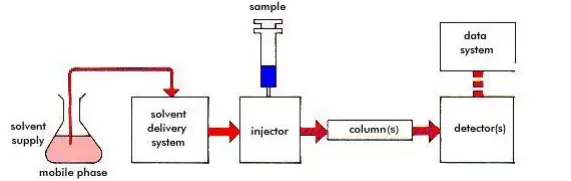
The following are the important instrumentation of Gel Permeation Chromatography (GPC)–
- Solvent reservoir– It contains the mobile phase or solvent which is required to carry the polymer sample through the system.
- Degasser– It is used to remove dissolved air and gases from the solvent. This prevents bubble formation and helps in maintaining proper flow and detector baseline.
- Pump– It is used to pump the solvent through the system at constant flow rate. In GPC, isocratic high pressure pump is generally used for smooth and reproducible flow.
- Injector or autosampler– It is used to introduce a fixed volume of dissolved sample into the mobile phase. It may be manual injector or automatic sampler.
- Column– It is the main part of GPC. The column is packed with porous gel beads, where separation of molecules takes place according to their hydrodynamic size.
- Stationary phase– It consists of microporous polymer or inorganic gel beads. The pores of gel beads allow small molecules to enter, but large molecules are excluded from the pores.
- Column oven– It is used to maintain constant temperature of the column. It helps in reproducible separation and also useful for viscous solvents or polymers which need high temperature to remain dissolved.
- Detector– It is used to detect the separated polymer molecules after elution from the column. Common detector used is Refractive Index (RI) detector. Other detectors are UV-Visible detector, Light Scattering detector and Viscometer.
- Data system or software– It records the detector signal and gives chromatogram. It also calculates the molecular weight and molecular weight distribution of the polymer sample.
- Waste bottle– It is kept at the end of flow path. It collects the used solvent and analysed sample after passing through the detector.
Steps in Gel Permeation Chromatography
The following are the steps involved in Gel Permeation Chromatography (GPC)–
- In this step, suitable column is selected according to the molecular weight range of the sample. The column is washed and equilibrated with the mobile phase. The mobile phase is filtered through membrane filter and degassed properly.
- Polymer standards of known molecular weight are injected under the same chromatographic condition. Then calibration curve is prepared by plotting log of molecular weight against retention time or elution volume.
- The polymer sample is dissolved in a suitable solvent which is compatible with the mobile phase. Some polymer samples dissolve slowly and may take long time. Heating may also be required for complete dissolution of some polymers.
- The dissolved sample is filtered through syringe filter to remove insoluble particles, aggregates and impurities. This prevents blocking of the column. The sample solution is also degassed to remove air bubbles.
- A fixed volume of prepared sample is injected into the flowing mobile phase. The concentration of sample should be proper, because high concentration can overload the column and affect the separation.
- The sample is carried through the column by mobile phase. In the column, molecules are separated according to their hydrodynamic volume. Large molecules cannot enter the pores and elute first, while small molecules enter the pores and elute later.
- After separation, the molecules come out from the column and pass through detector. Detectors such as Refractive Index (RI) detector, UV detector or Light Scattering detector may be used. The detector measures the amount of material coming out with time.
- The detector response is recorded as chromatogram. It shows intensity against retention time or elution volume. By comparing this chromatogram with calibration curve, molecular weight distribution and average molecular weights such as Mn, Mw and PDI are calculated.
Applications of Gel Permeation Chromatography
The following are the important applications of Gel Permeation Chromatography (GPC)–
- GPC is used for polymer characterization. It is used to find molecular weight average and molecular weight distribution of synthetic and natural polymers. It is also used for checking polymerization reaction and batch to batch similarity of plastics, polyolefins and elastomers.
- It is used in pharmaceutical field. The molecular weight and stability of polymer excipients are studied by this method. Polymeric carriers used in controlled drug delivery system, such as PLGA, are also analysed. It is also used to study shelf-life and degradation of polymer.
- It is used in food and beverage industry. Food additives, polysaccharides and gums are characterized by this method. Pectin, starch and gum arabic are some examples. It is useful for checking texture and quality of food products.
- It is used for coatings and adhesives. Molecular weight of pre-polymers and resins like epoxies and phenolics are determined by this method. It gives idea about curing time, strength and working quality of these materials.
- It is used in biotechnology. Biopolymers such as proteins and nucleic acids are analysed by GPC. It is used to check purity, structure and aggregation of biological molecules.
- It is used in environmental science. Polymer degradation in environmental samples is studied by this method. Flocculants and coagulants used in water treatment are also analysed. Toxic pesticide residues from contaminated food or environmental samples can also be separated.
- It is used for sample clean up and fractionation. Complex mixture can be separated into different fractions. It can separate polymers from oligomers, monomers and non-polymeric additives. Large interfering molecules are also removed before other testing.
Advantages of Gel Permeation Chromatography
The following are the advantages of Gel Permeation Chromatography (GPC)–
- GPC is a non-destructive method. The separation takes place mainly according to molecular size and not by chemical interaction with the column material. So the sample is not damaged and loss of sample is also less.
- It is a gentle separation method. Delicate molecules can be separated without changing their native structure. Biological activity of some sensitive samples can also be maintained by this method.
- It gives molecular weight information of polymers. Molecular weight average and molecular weight distribution can be obtained from one analysis. So it gives more complete information than only average molecular weight value.
- The analysis time is generally fixed and predictable. The molecules come out within a definite elution volume. Most samples can be analysed in short time, usually within one hour or less.
- GPC can be used for wide range of molecular size. Molecules from low molecular weight to very high molecular weight polymers can be analysed. It is useful for molecules having size from hundreds to millions of Daltons.
- It can be carried out with different types of solvents. Aqueous solvents and non-polar organic solvents both can be used according to the nature of sample. It can also be used at normal temperature or at high temperature.
- It is useful for separation of complex mixtures. Polymers can be separated from oligomers, monomers and other non-polymeric additives in a single run. So it is also used for fractionation of mixtures.
- GPC can be connected with different detectors. Refractive Index (RI), UV detector, Light Scattering detector and viscometer can be used with it. These detectors give more information about molecular mass and structure.
- It can be used for both analytical and preparative purpose. Small amount of sample can be analysed and larger amount of sample can also be purified by preparative method.
- It is useful in industrial and regulatory work. It gives reproducible data and helps to check batch to batch consistency of polymer products. It is also useful in quality control and safety assessment of materials.
Limitations of Gel Permeation Chromatography
The following are the limitations of Gel Permeation Chromatography (GPC)–
- GPC has low resolution than some other chromatographic methods. Molecules having very similar size are not separated properly. Generally, about 10% difference in molecular weight is needed for clear separation.
- It does not measure true molecular weight directly. The result depends on calibration standards. If the standard polymer and sample polymer are not same type, then the molecular weight obtained is only relative value.
- Calibration is time consuming in this method. For each polymer and solvent system, separate calibration curve is required. So it becomes repetitive work when different samples are analysed.
- Sample preparation must be done carefully. The sample should be completely dissolved in suitable solvent and filtered before injection. If undissolved particles are present, they can block the column.
- During filtration, some high molecular weight polymer part may be removed with impurities. So the actual sample composition may change before entering into the column.
- GPC has limited peak capacity. In a normal run, only limited number of peaks can be separated. Broad peaks are commonly obtained when the sample contains molecules of close molecular size.
- Some fragile or very high molecular weight polymers may get degraded during analysis. Shear force inside the column, high temperature or hydrolytic condition can damage the polymer chain.
- In this method, there should be no chemical interaction between sample and column material. But sometimes adsorption or other interaction may occur between polymer and stationary phase. This gives wrong retention time and distorted result.
- Many polymers require organic solvents for dissolution. Solvents like THF or TCB may be used in GPC. These solvents are toxic, flammable and need careful handling.
- It is not suitable for all types of samples. The sample must be soluble in the mobile phase and stable during the analysis condition. Insoluble or unstable polymers cannot be analysed properly by this method.
References
- Phenomenex. (n.d.). Gel Permeation Chromatography (GPC). https://www.phenomenex.com/techniques/hplc-gpc
- Polymer Char. (n.d.). Introduction to Gel Permeation and Size Exclusion Chromatography. https://polymerchar.com/library/learning-center/introduction-to-gpc-sec
- Chrom Tech, Inc. (n.d.). Understanding Gel Permeation Chromatography Basics. https://chromtech.com/blog/understanding-gel-permeation-chromatography-basics/
- Agilent. (n.d.). An Introduction to Gel Permeation Chromatography and … https://www.agilent.com/cs/library/primers/public/5990-6969EN%20GPC%20SEC%20Chrom%20Guide.pdf
- Polymer Char. (n.d.). Molecular Weight Distribution in Polymers: Averages, Dispersity, and How to Calculate Them. https://polymerchar.com/library/learning-center/molecular-weight-distribution-averages-dispersity
- Agilent. (n.d.). Polymer Molecular Weight Distribution and Definitions of MW Averages. https://www.agilent.com/cs/library/technicaloverviews/public/5990-7890EN.pdf
- Shimadzu. (n.d.). Measurement of Molecular Weight by using GPC method. https://www.shimadzu.com/an/service-support/technical-support/analysis-basics/basic/55/55intro.html
- ResearchGate. (n.d.). 1 Comparison of HPLC and GPC chromatograms (raw data). (a) Isocratic… https://www.researchgate.net/figure/Comparison-of-HPLC-and-GPC-chromatograms-raw-data-a-Isocratic-HPLC-separation-with_fig1_236969818
- Polymer Char. (n.d.). GPC vs SEC vs GFC: understanding the difference and when to use each term. https://polymerchar.com/library/learning-center/gpc-vs-sec-vs-gfc-what-is-the-difference
- LCGC International. (n.d.). Tips & Tricks GPC/ SEC: What Are the Differences Between GPC, SEC, and GFC, and How Do You Get Started with the Technique? https://www.chromatographyonline.com/view/tips-tricks-gpc-sec-what-are-differences-between-gpc-sec-and-gfc-and-how-do-you-get-started-techniqu
- ResolveMass Laboratories Inc. (n.d.). GPC vs SEC: A Simple Comparison. https://resolvemass.ca/gpc-vs-sec-a-simple-comparison/
- Wikipedia. (n.d.). Gel permeation chromatography. https://en.wikipedia.org/wiki/Gel_permeation_chromatography
- AIMPLAS. (n.d.). Determination of Molecular Weight Distribution (GPC/SEC). https://www.aimplas.net/blog/determination-molecular-weight-distribution/
- Malvern Panalytical. (n.d.). GPC/SEC & HPLC & UHPLC, oh my! https://www.malvernpanalytical.com/en/learn/knowledge-center/insights/gpc-sec-hplc-uhplc-oh-my
- Jordi Labs. (n.d.). Gel Permeation Chromatography (GPC) or Size Exclusion Chromatography (SEC). https://jordilabs.com/wp-content/uploads/2017/01/White_Paper_Gel_Permeation_Chromatography.pdf
- Waters Corporation. (n.d.). GPC & Gel Filtration Chromatography Columns. https://www.waters.com/nextgen/us/en/products/columns/gpc-columns.html
- Malvern Panalytical. (n.d.). Basic components of a GPC/SEC system. https://www.malvernpanalytical.com/en/learn/knowledge-center/insights/basic-components-of-a-gpc-sec-system
- Waters Corporation. (n.d.). GPC Basic Chemistry. https://www.waters.com/nextgen/us/en/education/primers/beginners-guide-to-size-exclusion-chromatography/gpc-basic-chemistry.html
- TA Instruments. (n.d.). Introduction to GPC. https://www.tainstruments.com/wp-content/uploads/GPC_GAP_APC_Workshop.pdf
- Microbe Notes. (n.d.). Gel Permeation Chromatography: Principle, Parts, Steps, Uses. https://microbenotes.com/gel-permeation-chromatography/
- Instrument Solutions. (n.d.). Theory and Practice of GPC Troubleshooting. https://www.instrument-solutions.com/wp-content/uploads/GPC_S16-M7_GPC-Sources-of-error.pdf
- Wyatt. (n.d.). What causes a “ghost” peak and what can I do to prevent this … https://www.wyatt.com/ask-the-expert/ask-the-expert-what-causes-a-ghost-peak-and-what-can-i-do-to-prevent-this.html
- Instrument Solutions. (n.d.). Calibration methods and absolute determination of the polymer mass. https://www.instrument-solutions.com/wp-content/uploads/GPC_S8_A1_Calibration.pdf
- Wikipedia. (n.d.). Mark–Houwink equation. https://en.wikipedia.org/wiki/Mark%E2%80%93Houwink_equation
- Waters Corporation. (n.d.). Calibration of the GPC System. https://www.waters.com/nextgen/us/en/education/primers/beginners-guide-to-size-exclusion-chromatography/calibration-of-the-gpc-system1.html
- Malvern Panalytical. (n.d.). Confirmation of Polymer Structure Using GPC. https://www.malvernpanalytical.com/en/learn/knowledge-center/insights/gpc-using-polymer-structure-confirmation
- EAG Laboratories. (n.d.). Gel Permeation Chromatography | GPC. https://www.eag.com/techniques/chromatography/gel-permeation-chromatography-gpc/
- Polymer Char. (n.d.). High Temperature GPC (HT-GPC): A Complete Guide. https://polymerchar.com/library/learning-center/high-temperature-gpc-a-complete-guide
- Brookhaven Instruments. (n.d.). Optimizing GPC performance: Multi-Angle Static Light Scattering detection using the BI-MwA. https://www.brookhaveninstruments.com/optimizing-gpc-performance-multi-angle-static-light-scattering-detection-using-the-bi-mwa/
- Agilent. (n.d.). GPC/SEC Detection – What You Should Know When You Need To Analyze Polymers, Biopolymers, and Proteins. https://lcms.cz/labrulez-bucket-strapi-h3hsga3/br_gpc_sec_polymers_biopolymers_proteins_5994_5937en_agilent_1caa8d478e.pdf
- Henry Royce Institute. (n.d.). High temperature GPC (HT-GPC). https://www.royce.ac.uk/equipment-and-facilities/high-temperature-gpc-ht-gpc/
- TA Instruments. (n.d.). Introduction to GPC. https://www.tainstruments.com/wp-content/uploads/GPC_GAP_APC_Workshop_ver_5a.pdf
- Ingenieria Analitica Sl. (n.d.). Optimal Analysis of Epoxy Resins by GPC with ELSD. https://www.ingenieria-analitica.com/en/attachment/pdf/print/optimal-analysis-of-epoxy-resins-by-gpc-with-elsd-pdf-2743
- Waters Corporation. (n.d.). Analysis of Polylactic-co-Glycolic Acid (PLGA) by Gel Permeation Chromatography (GPC) using the Arc™ HPLC System with a Refractive Index (RI) Detector. https://www.waters.com/nextgen/us/en/library/application-notes/2024/analysis-of-polylactic-co-glycolic-acid-plga-by-gel-permeation-chromatography-gpc-using-the-arc-hplc-system-with-a-refractive-index-ri-detector.html
- Malvern Panalytical. (n.d.). What is a dn/dc value and why is it important for GPC/SEC? https://www.malvernpanalytical.com/en/learn/knowledge-center/insights/what-is-a-dndc-value-and-why-is-it-important-for-gpcsec
- LCGC International. (n.d.). Tips & Tricks GPC/SEC: How to Determine dn/dc Values. https://www.chromatographyonline.com/view/tips-tricks-gpcsec-how-determine-dndc-values
- Intertek. (n.d.). Polymer Molecular Weight Determination. https://www.intertek.com/polymers-plastics/molecular-weight-gpc/
- ATA Scientific. (n.d.). STATIC LIGHT SCATTERING TECHNOLOGIES FOR GPC/SEC EXPLAINED. https://www.atascientific.com.au/wp-content/uploads/2017/02/MRK1919-03_Static-light-scattering-technologies-for-GPC-SEC-explained-lr5.pdf
- Malvern Panalytical. (n.d.). What is the Mark-Houwink equation – and how do you use it for polymer characterization? https://www.malvernpanalytical.com/en/learn/knowledge-center/insights/what-is-the-mark-houwink-equation-and-how-do-you-use-it-for-polymer-characterization
- AZoM. (n.d.). How Gel Permeation Chromatography Works. https://www.azom.com/article.aspx?ArticleID=19092
- LCGC International. (n.d.). Tips & Tricks GPC/SEC: Finding the Right Standards. https://www.chromatographyonline.com/view/tips-tricks-gpcsec-finding-right-standards
- LSU. (n.d.). What Is The Mark-Houwink Equation? https://macro.lsu.edu/HowTo/MALVERN/PDF/MALVERN_FAQ_OTHER/What%20is%20the%20Mark-Houwink%20equation.pdf
- Agilent. (n.d.). Analysis of Epoxy Resins by GPC Viscometry using the Agilent 390-MDS Multi Detector Suite. https://www.agilent.com/cs/library/applications/5991-5840EN.pdf
- Standard Reference Data. (n.d.). The Mark-Houwink-Sakurada Relation for Poly(Methyl Methacrylate). https://srd.nist.gov/JPCRD/jpcrd316.pdf
- Biointerface Research in Applied Chemistry. (n.d.). Parameter Estimation of Mark-Houwink Equation of Polyethylene Glycol (PEG) Using Molecular Mass and Intrinsic Viscosity in Water. https://biointerfaceresearch.com/wp-content/uploads/2021/06/20695837122.17781790.pdf
- Scribd. (n.d.). Mark-Houwink Parameters for Polymers | PDF. https://www.scribd.com/document/328487181/American-Polymer-Standards-Corporation-Mark-Houwink
- Standard Reference Data. (n.d.). The Mark–Houwink–Sakurada Relation for Poly(Methyl Methacrylate). https://srd.nist.gov/jpcrdreprint/1.555776.pdf
- Korea Polymer Testing & Research Institute, Ltd. (n.d.). GPC Principle. https://polymer.co.kr/eng/sub/gpc_2_1.jsp
- ResolveMass Laboratories Inc. (n.d.). GPC Analysis of Polymers: A Comprehensive Guide to Molecular Weight Characterization. https://resolvemass.ca/gpc-analysis-of-polymers/
- ResolveMass Laboratories Inc. (n.d.). GPC Molecular Weight Analysis. https://resolvemass.ca/gpc-molecular-weight-analysis-2/
- Intertek. (n.d.). High-Temperature Gel Permeation Chromatography (HT-GPC) Analysis of Polyolefins. https://www.intertek.com/polymers-plastics/testing-ht-gpc/
- PMC. (n.d.). Recent Applications of PLGA in Drug Delivery Systems. https://pmc.ncbi.nlm.nih.gov/articles/PMC11435547/
- Polymer Solutions. (n.d.). The Key to Analyzing Polyolefins: High-temperature GPC Testing. https://www.polymersolutions.com/analyzing-polyolefins-high-temperature-gpc/
- Agilent. (n.d.). Analysis of Polymers by GPC/SEC Energy & Chemical Applications. https://lcms.cz/labrulez-bucket-strapi-h3hsga3/5991_2517_EN_Chemicals_Enery_By_GPC_SEC_May13_Lo_cd798f6cd9/5991-2517EN-Chemicals_Enery-By-GPC-SEC-May13-Lo.pdf
- Polymer Char. (n.d.). Poster: GPC analysis at different flow rates to overcome shear degradation. https://polymerchar.com/library/publications/gpc-analysis-at-different-flow-rates-to-overcome-shear-degradation
- Polymer Char. (n.d.). High Temperature GPC versus Ambient GPC: Choosing the Right System for Your Polymer Analysis. https://polymerchar.com/blog/high-temperature-vs-ambient-gpc
- ResolveMass Laboratories Inc. (n.d.). PLGA Microsphere Case Study. https://resolvemass.ca/plga-microsphere-case-study/
- ResolveMass Laboratories Inc. (n.d.). Analytical Testing of PLGA Poly(lactic-co-glycolic acid): NMR, GPC, DSC, and Residual Monomer Analysis. https://resolvemass.ca/plga-characterization-methods/
- SciSpace. (n.d.). Gums—Characteristics and Applications in the Food Industry. https://scispace.com/pdf/gums-characteristics-and-applications-in-the-food-industry-2ql616iij7.pdf
- eJurnal UNG. (n.d.). Roles of Polysaccharide Gums in the Food and Beverage Industries: A Review. https://ejurnal.ung.ac.id/index.php/jjc/article/download/16001/pdf
- Ingenieria Analitica Sl. (n.d.). Analysis of food additives by GPC/SEC. https://www.ingenieria-analitica.com/attachment/pdf/print/analysis-of-food-additives-by-gpc-sec-pdf-888
- Agilent. (n.d.). Analysis of food by GPC/SEC. https://www.agilent.com/cs/library/applications/ApplicationCompendium_GPC_Food_5991-2029EN.pdf
- American Laboratory. (n.d.). Exploring the Value of GPC/SEC in Polysaccharide Characterization. https://www.americanlaboratory.com/914-Application-Notes/191847-Exploring-the-Value-of-GPC-SEC-in-Polysaccharide-Characterization/
- ACS Sustainable Chemistry & Engineering. (n.d.). Microwave-Assisted Synthesis of Solid Epoxy Resins: Study of Molecular Weight by GPC and MALDI-TOF/MS. https://pubs.acs.org/doi/10.1021/acssuschemeng.5b01786
- Lab Manager. (n.d.). HPLC vs GC: Choosing the Right Chromatography Technique. https://www.labmanager.com/hplc-vs-gc-choosing-the-right-chromatography-technique-33689
- Contract Laboratory. (n.d.). What Are the Different Types of Chromatography? A Complete Guide. https://contractlaboratory.com/what-are-the-different-types-of-chromatography/
- Khan Academy. (n.d.). A closer look at types of chromatography (article). https://www.khanacademy.org/test-prep/mcat/chemical-processes/separations-purifications/a/chromatography-for-protein-separation
- Danaher Life Sciences. (n.d.). Synthetic Polymer Columns in Chromatography. https://lifesciences.danaher.com/us/en/products/chromatography-columns/topics/synthetic-polymer-columns-chromatography.html
- Thermo Fisher Scientific – US. (n.d.). Overview of Affinity Purification. https://www.thermofisher.com/us/en/home/life-science/protein-biology/protein-biology-learning-center/protein-biology-resource-library/pierce-protein-methods/overview-affinity-purification.html
- Patsnap Synapse. (n.d.). Affinity vs. Ion Exchange Chromatography: Which One to Choose? https://synapse.patsnap.com/article/affinity-vs-ion-exchange-chromatography-which-one-to-choose
- LCGC International. (n.d.). LC Troubleshooting Essentials: A Guide to Common Problems and Solutions for Peak Tailing, Ghost Peaks, and Pressure Spikes. https://www.chromatographyonline.com/view/lc-troubleshooting-essentials-a-guide-to-common-problems-and-solutions-for-peak-tailing-ghost-peaks-and-pressure-spikes