

Magnetic Stirrer is a laboratory device used to mix liquid solutions automatically without direct manual contact. It is also known as magnetic mixer. It works by producing a rotating magnetic field below the top plate of the instrument.
The rotating magnetic field is produced either by a motorized spinning magnet or by stationary electromagnets. A small magnetized rod called stir bar or flea is placed inside a flat-bottomed vessel containing liquid. When the vessel is kept on the plate, the magnetic field rotates the stir bar rapidly.
During this process, the rotating stir bar forms a vortex in the liquid. This vortex helps in proper and uniform mixing of the contents. The mixing takes place without touching the liquid by hand or by any external stirring rod.
The stir bar is generally covered with chemically inert material such as PTFE (Teflon) or glass. This covering prevents the bar from reacting with the sample. It also prevents contamination of the solution during mixing.
Magnetic stirrer is useful because it can mix liquid in closed or sterile vessels. No mechanical shaft is needed to enter into the container. Therefore, it is suitable for sterile solution and chemical work where contamination should be avoided.
Many magnetic stirrers have built-in hot plate. These are used to heat and stir the sample at the same time. It is useful in endothermic reactions, chemical synthesis and preparation of different solutions.
Magnetic stirrer is quiet, efficient and easy to clean. It is generally used for small to medium volume of low-viscosity liquid. It works better for water-like liquids and usually up to about 5 litres.
Magnetic stirrer has some limitations also. It is not suitable for highly viscous liquid or very large volume. In such condition, the stir bar may decouple from the magnetic field and spin irregularly. For heavy-duty mixing work, motor-driven overhead stirrer is more suitable.
Magnetic Stirrer Principle
Magnetic stirrer principle is based on the use of rotating magnetic field to rotate a small magnetized stir bar inside the liquid. The stir bar is submerged in the liquid and it rotates continuously with the magnetic field.
The magnetic field is produced from below the stirring plate. It may be produced by an electric motor attached with a rotating permanent magnet or by a stationary arrangement of electromagnets. This field acts on the stir bar placed inside the vessel.
When the magnetic field rotates, the stir bar aligns itself with the field. Then it starts rotating at the same speed without any direct physical connection with the driving part. Thus stirring is done without inserting any mechanical shaft into the liquid.
During this process, the rotating stir bar transfers kinetic energy into the liquid. This produces a vortex in the liquid. The vortex continuously turns the liquid and helps in uniform mixing of the solution.
Thus, magnetic stirrer works on the principle of magnetic coupling between the rotating magnetic field and the stir bar. The movement of the stir bar produces agitation and the liquid becomes mixed properly.
Types of Magnetic Stirrers
Different types of magnetic stirrers are used in laboratory according to volume of liquid, heating requirement, number of samples and working condition. The following are the important types of magnetic stirrers-
1. Mini Magnetic Stirrers
Mini magnetic stirrers are small and compact type of magnetic stirrers. These are used to stir small volume of liquid. It occupies very less space on laboratory bench and generally used for single vessel stirring.
2. Hot Plate Magnetic Stirrers
Hot plate magnetic stirrers are magnetic stirrers having a built-in heating element. It is used to heat and stir the liquid sample at the same time. These are useful for dissolving solids and for carrying out chemical reactions where heating is required.
3. Multi-Position Magnetic Stirrers
Multi-position magnetic stirrers contain many stirring positions in one instrument. Several vessels can be placed and stirred at the same time. These stirrers are operated by synchronized motor or electromagnetic arrangement and are used for high-throughput laboratory work.
4. Heavy-Duty Magnetic Stirrers
Heavy-duty magnetic stirrers are strong and durable type of stirrers. These are used for demanding applications and continuous use. It has powerful mixing capacity and chemical resistant body, so it can be used for larger volume of liquid.
5. Magnetic Stirrers with Timers
Magnetic stirrers with timers have an in-built timer system. The timer helps to stop the stirring motor automatically after a fixed time. It is useful to prevent overmixing and overheating of the sample.
6. Battery-Powered Magnetic Stirrers
Battery-powered magnetic stirrers are light weight and portable stirrers. These are operated by batteries and do not require direct electrical supply. It is useful for field work, incubators and places where electrical access is not present.
7. Air-Operated Turbine Magnetic Stirrers
Air-operated turbine magnetic stirrers are operated by low pressure compressed air. These stirrers do not use electricity for working. Therefore, there is no risk of electrical sparking and it is suitable for working with flammable solvent vapours.
8. Submersible Magnetic Stirrers
Submersible magnetic stirrers are sealed magnetic stirrers which can work under water or high humidity condition. These are specially made to operate safely inside water baths or in CO2 incubators. The sealed structure protects the internal parts from moisture.
9. Digital and Analog Magnetic Stirrers
Digital and analog magnetic stirrers are classified according to their control system. Analog magnetic stirrers use simple mechanical knobs for speed control. Digital magnetic stirrers use microcontroller, touch panel and electronic sensors for more accurate control of speed and temperature.
Parts of a Magnetic Stirrer
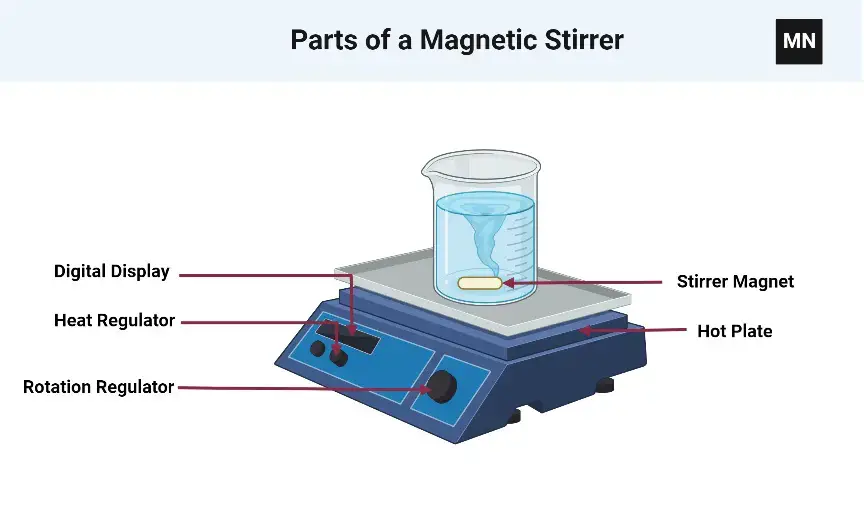
Parts of a Magnetic Stirrer
- Top plate
It is the flat surface where the liquid container is placed. It is also called stir plate or hot plate. It is generally made up of ceramic, aluminium or stainless steel. - Base unit
It is the main body of the magnetic stirrer. It encloses the internal electronics and moving parts. It also protects the internal parts from chemical spills. - Internal drive system
It is present below the top plate. It consists of electric motor with permanent magnet or stationary array of electromagnets. This part produces the rotating magnetic field. - Magnetic stir bar
It is a small magnetized rod placed directly inside the liquid sample. It is also called flea. It rotates with the magnetic field and helps in mixing the liquid. - Stir bar coating
The stir bar is usually coated with PTFE (Teflon) or glass. This coating is chemically inert. It prevents reaction with the solution and also prevents contamination. - Control panel
It is the operating part of the magnetic stirrer. It is used to control speed, temperature and other settings of the instrument. - Speed control knob
It is used to control the rotation speed of the magnetic field. It also controls the speed of the stir bar. The speed is generally measured in RPM. - Temperature control knob
It is present in magnetic stirrers having hot plate. It is used to adjust the heat output during heating and stirring. - Indicators and displays
These are used to show power, speed and heat setting. They may be digital or analog. Warning lights are also present in some stirrers for safe use. - Cooling vents
These are openings present in the body of the stirrer. It helps to remove heat from inside. It prevents overheating of the internal motor and electronic parts. - Stir bar retriever
It is a separate accessory used to remove the stir bar after mixing. It has a permanent magnet inside a long Teflon-coated rod. It helps to collect the stir bar safely from the liquid.
Magnetic Stirrer operating procedure
- Prepare the liquid solution in a clean container. The container should be suitable for stirring.
- Put the magnetic stir bar into the liquid. It should be placed near the centre of the vessel.
- Place the vessel on the top plate of the magnetic stirrer.
- Connect the instrument with main power supply. Then switch on the stirrer.
- If heating is needed, set the temperature in hot plate stirrer.
- Start the stirring at low speed first. This prevents sudden splashing of liquid.
- Increase the speed slowly by rotating the speed knob clockwise. If speed is more, reduce it by rotating the knob counter-clockwise.
- The stirring process is observed during working. Very high turbulence should be avoided.
- Allow the solution to stir until the liquid is mixed properly.
- After mixing, remove the magnetic stir bar from the vessel.
- Switch off the magnetic stirrer. Then disconnect it from the main power supply.
- If the plate or vessel is hot, use heat resistant hand protection for removing the container.
- Clean the stirrer and stir bar after use. This prevents contamination and keeps the instrument ready for next use.
Magnetic Stirrer Calibration
- For temperature calibration, a clean beaker is filled with reference liquid such as water or silicone oil and then it is placed at the centre of the top plate of magnetic stirrer. The liquid should be enough to dip the thermometer or temperature probe properly.
- A magnetic stir bar is placed inside the liquid and the stirring function is switched on. The stirring is kept at low or moderate speed so that heat is distributed uniformly in the whole liquid without splashing.
- A certified external thermometer or calibrated temperature probe is dipped into the liquid. The probe should remain inside the liquid but it should not touch the bottom or side wall of the beaker because it may give wrong temperature reading.
- The hot plate is then set at a required temperature. The instrument is allowed to heat the liquid for some time until the temperature becomes stable. During this time, the liquid should be stirred continuously.
- The temperature shown on the display of magnetic stirrer is compared with the temperature shown by the certified external thermometer. If both readings are same or within accepted limit, the temperature calibration is considered correct.
- If difference is present between the stirrer display and external thermometer, the calibration mode of the instrument is opened. The internal temperature reading is adjusted according to the verified external thermometer reading.
- After adjustment, the temperature is again allowed to stabilize and the readings are checked again. This process is repeated until the displayed temperature matches with the external standard.
- For speed calibration, a beaker containing suitable liquid is placed on the centre of the stirrer plate and a magnetic stir bar is kept inside it. The stirring function is switched on and the stirrer is set at a selected RPM.
- The stir bar is allowed to rotate for some time until the vortex becomes stable. The speed should not be increased suddenly because it may cause splashing or decoupling of stir bar.
- A calibrated digital optical tachometer or laser tachometer is used to measure the actual rotational speed of the stir bar. The tachometer is pointed towards the spinning stir bar and the true RPM is recorded.
- The RPM shown by the tachometer is compared with the RPM set or displayed on the magnetic stirrer. If both readings are same or within acceptable range, the speed calibration is considered correct.
- If difference is observed, the speed calibration mode of the magnetic stirrer is used. The internal speed setting is adjusted to remove the difference between displayed RPM and actual measured RPM.
- After correction, the stirrer is again run at the same speed and the RPM is measured again with the tachometer. The checking is continued until the actual speed matches with the set speed.
- After completion of calibration, the heating and stirring functions are switched off. The instrument is disconnected from main power supply after use.
- The stir bar is removed from the beaker and the beaker, stir bar and top plate are cleaned properly. This prevents contamination and keeps the magnetic stirrer ready for next use.
Precautions of Magnetic Stirrer
- Always wear personal protective equipment before using magnetic stirrer. Lab coat, gloves and safety goggles are used to protect from chemical splash and accidental spilling of solution.
- The magnetic stirrer should be connected with properly grounded electrical outlet. Extension cord and multi-plug adapter should be avoided because it may cause electrical hazard during working.
- The instrument should be kept dry during use. Solution should not be allowed to enter into the internal housing of the stirrer because it may damage electrical parts.
- The vessel used for stirring should be glass or non-magnetic container. It should have smooth, flat and thin bottom so that the magnetic field can act properly on the stir bar.
- The container should be large enough for the volume of liquid. It prevents spilling of liquid when vortex is formed during stirring.
- The vessel should be placed at the centre of the stirrer plate. This helps the stir bar to align properly with the internal drive magnet and prevents bouncing or irregular movement.
- Stirring should always be started at low speed. Then the speed is increased slowly according to the need. This prevents sudden splashing and uncontrolled rotation of stir bar.
- The magnetic stirrer should not be overloaded. Liquid volume should not be more than the maximum capacity of the stirrer. Highly viscous liquid should also not be used if the stirrer is not suitable for it.
- The instrument should be observed during operation. It should not be left unattended when it is running. If the stir bar starts bouncing or stops mixing, the speed should be reduced or the power is turned off.
- Continuous running at very high speed should be avoided. It may produce excessive vibration and may reduce the life of the motor. The stirrer should not be run at highest speed for more than four hours continuously.
- The magnetic stirrer should be kept away from external heat source and open flame. This prevents overheating of the instrument and reduces hazard during laboratory work.
- In hot plate magnetic stirrer, hot top warning indicator should be checked carefully. Heat resistant hand protection should be used while removing the hot vessel from the plate.
- The top plate should be cleaned after each use. Chemical spills should not be allowed to remain on the plate because corrosive chemicals may damage the surface.
- Magnetic stir bars should be checked regularly. If PTFE or glass coating is chipped, cracked or damaged, the stir bar should be replaced because it may contaminate the sample.
- Stir bars should be stored properly after use. They should be kept away from strong external magnetic field because it may slowly reduce their magnetism.
Applications of Magnetic Stirrer
- Magnetic stirrer is used for blending and dissolving low-viscosity liquids. It is also used to dissolve powders, salts and other soluble materials into solution and to maintain homogeneous suspension.
- It is used in preparation of reagents and buffer solutions. Standard chemical solutions and laboratory buffers are prepared by continuous mixing with magnetic stirrer.
- It is used in analytical chemistry work. During titration and pH testing, the solution is stirred continuously so that proper and uniform mixing is obtained.
- It is used in microbiology and cell culture laboratory. Nutrient media are prepared by using magnetic stirrer and it also helps in aeration of bacterial culture.
- Magnetic stirrer is used for gentle mixing of fragile cell suspension. Mammalian cell suspension can be mixed slowly without strong mechanical disturbance.
- It is used for sterile mixing of liquid samples. The liquid can be mixed inside completely closed or sealed vessel, so contamination from air is prevented.
- It is used in chemical synthesis. During chemical reaction, refluxing and preparation of polymers or nanoparticles, the reaction mixture is kept uniformly mixed.
- Hot plate magnetic stirrer is used where heating and stirring are needed together. It helps in heat transfer and maintains required temperature during experiment.
- It is used in pharmaceutical laboratory. Active compounds are mixed with excipients during drug formulation and it is also used in dissolution testing.
- Magnetic stirrer is used in environmental science work. It is used for soil extraction, water quality analysis and mixing of environmental samples.
- It is used in food science laboratory. Food emulsions and liquid food samples are prepared and mixed by using magnetic stirrer.
- It is used in industrial testing. Low-viscosity materials such as adhesives, coatings, paints and solvents are mixed by magnetic stirrer.
Advantages of Magnetic Stirrer
- Magnetic stirrer reduces the risk of contamination during mixing. Only the small stir bar comes in contact with the liquid and it can be sterilized easily.
- It is useful for sterile condition and closed system. No external shaft is needed to enter inside the vessel, so the sample remains protected from outside contamination.
- Magnetic stirrer is compact and light weight. It occupies less space on laboratory bench and it can be handled easily.
- It works quietly during operation. It produces less noise than mechanical overhead stirrer.
- Magnetic stirrer needs low maintenance. It has no external moving shaft, gear or seal which may wear out easily.
- It is durable and reliable for routine laboratory work. The simple working system makes it suitable for repeated use.
- It gives automated and hands-free mixing. The solution can be stirred at a constant speed without manual stirring.
- It saves time of laboratory worker. During stirring, other laboratory work can also be done.
- Magnetic stirrer is cost effective. It is generally cheaper than overhead stirrer for small and low-viscosity mixing work.
- It consumes less electrical energy for minor laboratory mixing. So it is useful for routine low volume solution preparation.
- It produces low shear stress on the sample. Therefore, it is suitable for fragile materials such as cell culture and delicate suspension.
- It is easy to use with different vessels. The stir bar can be dropped directly into narrow-necked vessels where overhead stirrer is difficult to use.
- Hot plate magnetic stirrer can heat and mix the sample at the same time. It reduces the need of separate heating system.
- It is safer than open flame heating. Built-in hot plate can reach high temperature and heating is done without flame or oil bath.
Limitations of magnetic stirrer
- Magnetic stirrer is generally used for small and medium volume of liquid. It is not very suitable for large industrial batch size because its mixing capacity is limited.
- The working volume of magnetic stirrer is usually limited up to 4 to 20 litres depending on the model. Above this volume, proper stirring becomes difficult.
- It cannot stir highly viscous liquids properly. Thick liquids, dense materials, emulsions and heavy suspensions need more mechanical force which magnetic stirrer cannot provide.
- Magnetic stirrer works by indirect magnetic coupling. So, it has less torque than mechanical overhead stirrer.
- Stir bar may decouple from the magnetic field during stirring. This happens when the liquid is too thick, speed is too high or vessel is not placed at the centre.
- During decoupling, the stir bar starts bouncing or rotating irregularly inside the vessel. This reduces proper mixing and may cause splashing of liquid.
- Magnetic stir bar may lose its magnetic strength after long use. It may also happen due to improper storage, dropping or exposure to excessive heat.
- The protective coating of stir bar may get damaged with time. If PTFE or glass coating is cracked or chipped, it may contaminate the sample.
- Metallic container cannot be used with magnetic stirrer. Metal can interfere with magnetic field and proper rotation of stir bar is not obtained.
- Vessel shape also affects the working of magnetic stirrer. Thick bottom, uneven bottom or arched bottom vessels increase the distance between stir bar and drive magnet.
- When the distance between stir bar and drive magnet is increased, magnetic coupling becomes weak. Then the stir bar cannot rotate properly.
- Samples containing large solids or crystals are difficult to stir. The particles may get trapped between the rotating stir bar and bottom of vessel.
- Trapped solids may grind against the vessel surface during stirring. This can damage the stir bar, vessel and also affect the sample quality.
References
- 2mag-USA. (n.d.). Stirology 101: Stir bar bounce – 2mag-USA. [URL]
- BAILUN. (n.d.). Bioprocess equipment, bioreactors, fermenters for biotech engineering – BAILUN. [URL]
- Bioreactors.net. (n.d.). Industrial bioreactors. [URL]
- Borosil Scientific. (n.d.). Magnetic stirrer: Working principle, types & uses in labs. [URL]
- Caframo Lab Solutions. (n.d.). Magnetic stirrer or overhead stirrer? – Caframo Lab Solutions. [URL]
- Campwala, M. (n.d.). Magnetic stirrer: Uses & types | Learn more – Science Equip. Science Equip. [URL]
- Gonzalez, S. (2024, May 14). How does a magnetic stirrer work? – Pipette.com. Pipette.com. [URL]
- Gonzalez, S. (2024, May 14). How does a magnetic stirrer work? | Pipette.com. Pipette.com. [URL]
- HINOTEK. (n.d.). How does a magnetic stirrer work? Types & uses explained | HINOTEK. [URL]
- Kahn, S. (2025, September 22). Magnetic vs. overhead stirring: Which saves more energy? – AZ Big Media. AZ Big Media. [URL]
- KEWLAB. (2021, February 25). Magnetic stirrer: Working principle and uses – Blog – KEWLAB. [URL]
- Lab Wale. (2024, May 21). Magnetic stirrer diagram: Understanding its mechanism – Lab Wale. [URL]
- MedSolut AG. (2024, October 1). Magnetic stirrers: Functions, uses & buying guide. [URL]
- MyAdviceIsBetter. (2024). Magnetic stir magnet is weak? : r/chemistry – Reddit. Reddit. [URL]
- O’Driscoll, A. (2019, June 6). Deciding between a magnetic stirrer and an overhead stirrer – Laboratory Supply Network. Laboratory Supply Network. [URL]
- O’Driscoll, A. (2019, August 22). Troubleshooting issues with magnetic stirrers | Blog – Laboratory Supply Network. Laboratory Supply Network. [URL]
- O’Driscoll, A. (2020, January 11). Factors to consider when choosing a magnetic or hotplate stirrer | Blog. Laboratory Supply Network. [URL]
- OHAUS. (n.d.). Products: Lab balance & industrial scales | Lab equipment | Lab …. [URL]
- Pailakian, A. (2026, March 12). Understanding the differences of magnetic stir bars and its top uses – Lab Pro Inc. Lab Pro Inc. [URL]
- Pobel. (2025, October 21). What is a magnetic stirrer used for – Pobel. [URL]
- QuestPair. (n.d.). VWR large capacity magnetic laboratory stirrer for bioprocess mixing – QuestPair. [URL]
- Sartorius. (n.d.). Bioreactors & fermenters – Sartorius eShop. [URL]
- Sysbiotech. (n.d.). Industrial-scale bioreactor 500-1000L – Sysbiotech. [URL]
- The Lab Depot. (n.d.). What should I look for in a hot plate or hot plate stirrer? – The Lab Depot. [URL]
- Thermo Fisher Scientific. (n.d.). Magnetic stirrers | Thermo Fisher Scientific – US. [URL]
- Thermo Fisher Scientific. (2019). Thermo Scientific hotplates and stirrers – Thermo Fisher Scientific. [PDF]
- Titas. (n.d.). The ultimate guide to magnetic stirrers: Everything you need to know – Labtex Bangladesh. Labtex Bangladesh. [URL]
- Unknown. (n.d.). Magnetic stirrer 1. Definition A magnetic stirrer, also known as a magnetic mixer, is a widely used laboratory device that rev. [PDF]
- Unknown. (n.d.). Technical evolution and comprehensive analysis of magnetic stirring systems: Principles, engineering, and multi-disciplinary applications. [Markdown]
- Wei, L. (n.d.). Magnetic stirrers vs. overhead stirrers: Choosing the right tool for your laboratory. Drawell. [URL]
- Wikipedia. (2026, February 10). Magnetic stirrer – Wikipedia. [URL]
- Wu, E. (2025, August 21). Magnetic stirrer vs. overhead stirrer: Which is right for your lab? – AELAB. AELAB. [URL]
- Yan, J., Wang, Z., Li, Z., Wu, D., Liu, J., Jin, Q., & Gong, Z. (2025). Theoretical analysis and experimental study on the magnets’ structure of magnetic stirrer. Journal of Magnetics, 30(4), 533-543. https://doi.org/10.4283/JMAG.2025.30.4.533 [PDF]