

Centrifuge is a laboratory device that is used to separate different components of liquid or gas mixture on the basis of their density.
It is commonly operated by an electric motor. The sample tubes are placed inside a rotor and the rotor rotates very rapidly around a fixed central axis. This rapid rotation produces centrifugal force.
The centrifuge works on the principle of sedimentation. During this process, the heavier and denser particles move outward and settle at the bottom or side of the tube. The lighter particles remain near the centre or upper part of the liquid.
This process is faster than normal gravitational settling. So centrifuge is used for quick and accurate separation of materials from a mixture.
Centrifuge is used in medical, scientific and industrial fields. It is used for separation of blood components, extraction of DNA, purification of protein and removal of solid impurities from wastewater and crude oil.
Types of Centrifuges
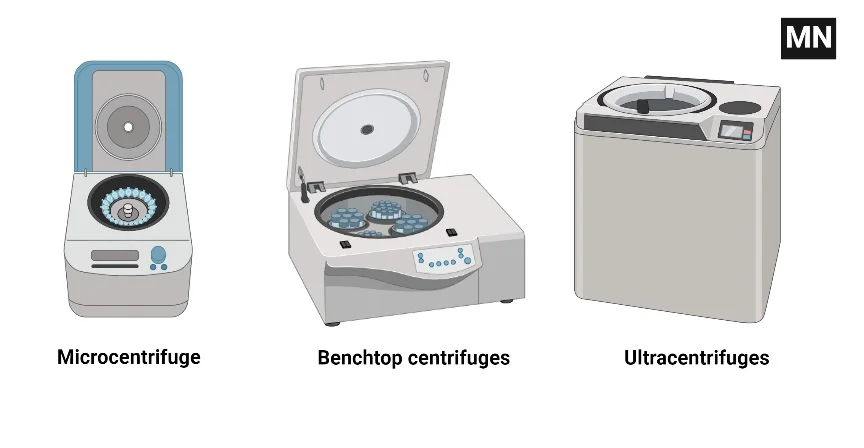
Different types of centrifuges are as follows-
- Clinical Centrifuges
- Benchtop centrifuges
- Floor-standing centrifuges
- High-speed centrifuges
- Refrigerated centrifuges
- Microcentrifuges
- Industrial centrifuges
- Haematocrit centrifuge
- Low-speed centrifuges
- Continuous flow centrifuges
- Ultracentrifuges
- Basket Centrifuge
- Decanter Centrifuge
- Filtration centrifuges
- Tubular bowl centrifuge
- Disc stack separator
- Gas centrifuge
- Cytocentrifuge
1. Clinical Centrifuges
- Clinical centrifuge is a laboratory centrifuge used for routine diagnostic work in hospital and clinical laboratory.
- It is based on the principle of sedimentation by centrifugal force.
- In this centrifuge, liquid samples are rotated at high speed in sample tubes.
- During rotation, centrifugal force is produced inside the tubes.
- This force separates the substances according to their density, mass and size.
- The denser and heavier particles move towards the bottom or side of the tube.
- The lighter part remains towards the upper region or near the centre of the tube.
- In blood sample, the cellular components are separated from the liquid part.
- Serum or plasma can be obtained after centrifugation of whole blood.
- In urine sample, the suspended cells, crystals or other particles are settled at the bottom.
- The clear upper liquid can be separated for further examination.
- Clinical centrifuge is usually simple and easy to use because it is needed for daily laboratory diagnosis.
- It is used for routine diagnostic work, blood sample processing, separation of serum and plasma from whole blood, urine sediment analysis, separation of components from body fluids, diagnosis of diseases, monitoring of drug effect and checking of patient health condition in clinical laboratory.
2. Benchtop centrifuges
- Benchtop centrifuges are based on the principle of sedimentation by centrifugal force.
- In this process, the liquid samples are rotated at high speed in tubes or containers.
- The speed of benchtop centrifuge is usually about 300 to 15,000 rpm.
- Due to high speed rotation, strong centrifugal force is produced inside the centrifuge.
- This force separates the particles of the sample according to their size and density.
- The denser and heavier particles are pushed towards the bottom or sides of the sample container.
- The lighter particles remain near the upper part or towards the centre of the tube.
- After centrifugation, the separated components can be collected easily from the sample.
- Benchtop centrifuge is compact type centrifuge which is kept directly on the laboratory workbench.
- It is used for routine sample preparation, separation of blood and urine components in clinical laboratory, cell culture pelleting, minipreps, preparation of biological materials, separation of contaminants from soil and water samples, and also used in different laboratory works because it can use fixed-angle, swing-out and microplate rotors with different tube sizes from 1.5 ml to 750 ml.
3. Floor-standing centrifuges
- Floor-standing centrifuges are based on the principle of sedimentation by centrifugal force.
- In this process, the samples are rotated at very high speed and strong centrifugal force is produced.
- This centrifugal force pushes the denser and heavier particles outward towards the bottom or sides of the container.
- The lighter particles or liquid part remain nearer to the upper part or centre of the container.
- Floor-standing centrifuges are specially designed for large volume sample processing.
- They have powerful drive system and good mechanical strength for handling heavy load.
- These centrifuges can produce very high centrifugal force, often up to 100,000 × g or more.
- They contain large rotors which can hold bulk volume sample, such as 8 × 2,000 ml bottles or more than 72 sample tubes in one run.
- They also have vibration control system and built-in refrigeration system to protect heat sensitive samples from damage during high speed centrifugation.
- Floor-standing centrifuges are used for large scale cell harvesting, bioprocessing, isolation of subcellular organelles, harvesting microorganisms, protein purification, vaccine production, blood component separation in blood banks, clarification of large volume liquids, juice clarification, separation of food and beverage components, processing lubricants, separation of oils and large volume separation of water or soil pollutant samples.
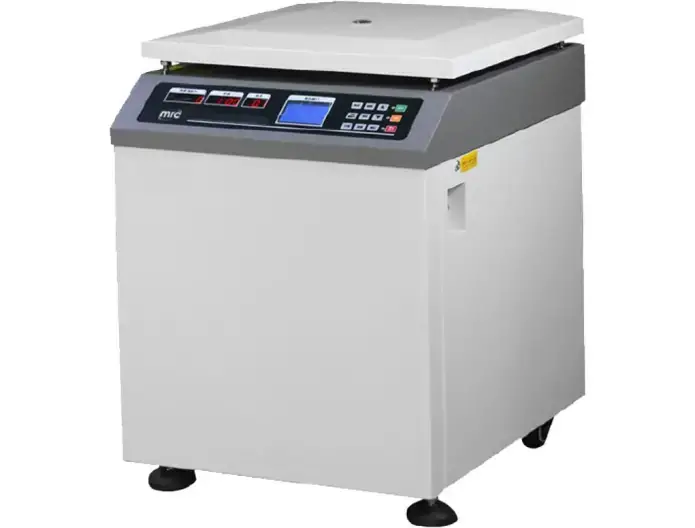
4. High-speed centrifuges
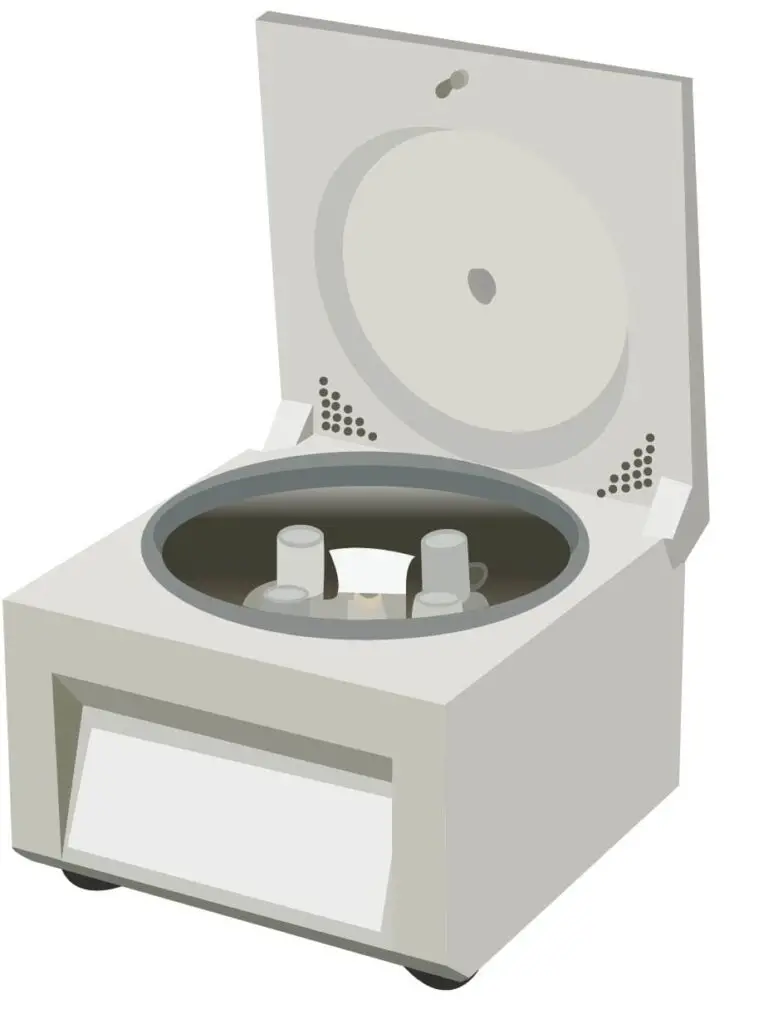
- High-speed centrifuges are based on the principle of sedimentation by centrifugal force.
- In this process, the samples are rotated at very high speed and strong centrifugal field is produced.
- This centrifugal force pushes the denser and heavier particles outward towards the bottom or sides of the tube.
- The lighter components remain nearer to the upper part or towards the centre of the tube.
- High-speed centrifuges are used between the ordinary benchtop centrifuge and ultracentrifuge.
- These centrifuges usually rotate at high speed, about 15,000 to 30,000 rpm.
- Due to high rotational speed, very high relative centrifugal force is produced.
- The centrifugal force may reach up to about 110,500 × g.
- This high force helps to separate microscopic particles which do not settle easily under normal gravity.
- High-speed centrifuges are used for subcellular fractionation, isolation of cell organelles, protein purification from biological mixtures, bacterial cell pelleting and harvesting, large scale cell harvesting in bioprocessing, concentration of virus particles, DNA and RNA extraction, protein precipitation, PCR preparation and preparation of biological samples for sensitive works like mass spectrometry.
5. Refrigerated centrifuges
- Refrigerated centrifuges are based on the principle of separation by centrifugal force.
- In this process, the samples are rotated at high speed inside the centrifuge.
- Due to high speed rotation, centrifugal force is produced.
- This force separates the materials according to their mass and density.
- The heavier and denser particles move towards the bottom or sides of the tube.
- The lighter components remain near the upper part or centre of the tube.
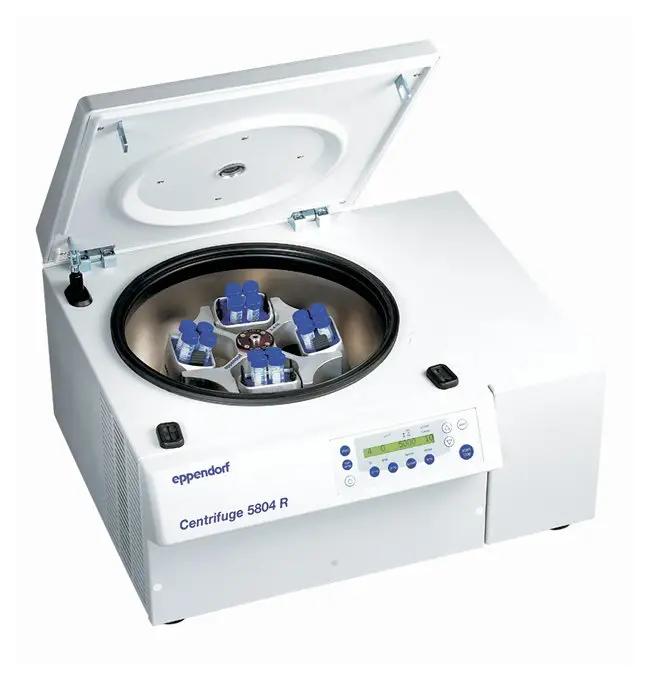
- Refrigerated centrifuge has a built-in cooling system.
- This cooling system maintains the temperature inside the centrifuge chamber.
- The temperature is usually maintained from about -20°C to +40°C.
- During high speed rotation, heat is produced due to friction.
- The refrigeration system prevents this heat rise during pre-cooling, acceleration, high speed spinning and deceleration.
- Refrigerated centrifuges are used for separation of temperature sensitive biological samples like proteins, enzymes, live cells, DNA and RNA, separation of plasma and serum from whole blood, preservation of heat sensitive biomarkers, cell fractionation, viral vector purification, plasmid isolation, drug stability study, vaccine processing and analysis of water and soil samples containing temperature sensitive pollutants and microorganisms.
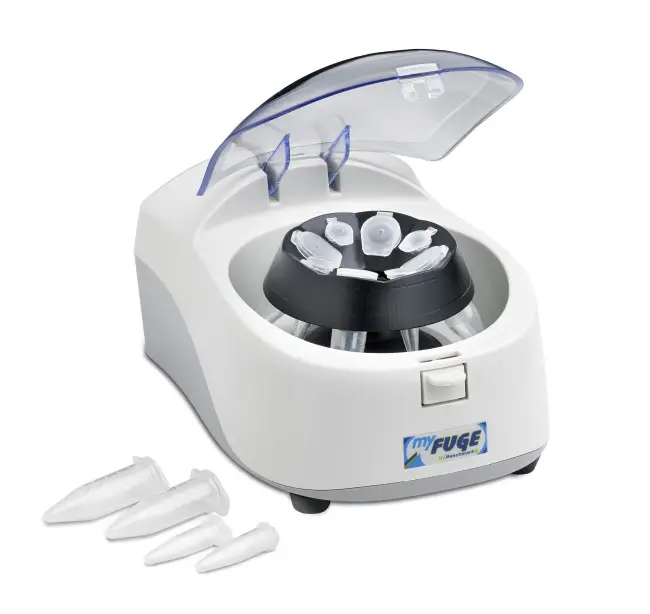
6. Microcentrifuges
- Microcentrifuges and mini centrifuges are based on the principle of sedimentation by centrifugal force.
- In this process, the sample tubes are rotated at high speed and strong centrifugal force is produced.
- This force separates the particles present in the sample according to their size and density.
- The heavier and denser particles move towards the bottom or side of the microcentrifuge tube and form a pellet.
- The lighter liquid part remains above the pellet. This liquid part is called supernatant.
- After centrifugation, the supernatant can be separated easily from the pellet.
- Mini centrifuges are small and simple centrifuges used for quick spin and low speed separation, usually up to about 7,000 rpm.
- Microcentrifuges are more powerful centrifuges and can rotate at very high speed, up to about 21,000 rpm.
- They are used for centrifugation of very small sample volume, usually in 0.2 ml to 2.0 ml microtubes.
- They are used in DNA and RNA extraction, protein precipitation and purification, PCR reaction preparation, quick spin of small samples, pelleting of cells, microorganisms and cell debris, forensic processing of trace biological evidence, and refrigerated centrifugation of temperature sensitive samples like enzymes and proteins at about 4°C.
7. Industrial centrifuges
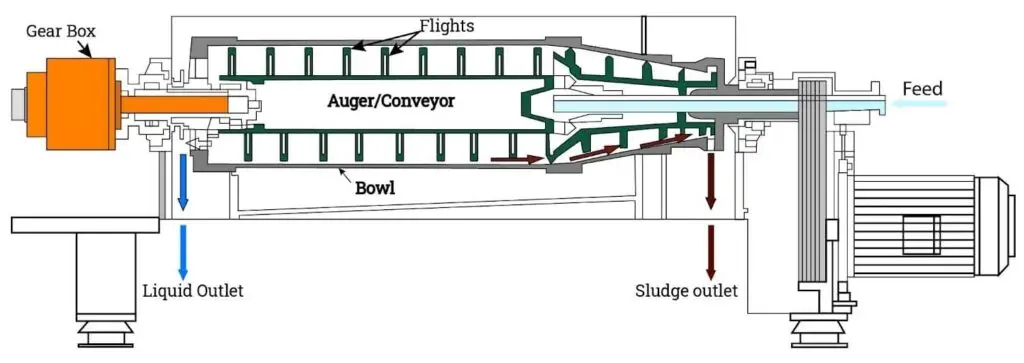
- Industrial centrifuge is a large scale machine used for separation of solid-liquid mixture or separation of two immiscible liquids.
- It is based on the principle of separation by very high centrifugal force.
- In this centrifuge, a rotor or bowl is rotated at high speed.
- Due to this rotation, force many thousand times greater than gravity is produced.
- This force increases the settling of particles inside the rotating bowl.
- The denser and heavier particles move towards the outer wall of the bowl.
- The lighter liquid or lighter phase remains nearer to the centre region.
- In many industrial centrifuges, the feed slurry is passed continuously into the rotating chamber.
- During the process, the compacted solids are removed continuously by scroll or screw conveyor.
- The clarified liquid is removed through separate outlet.
- Industrial centrifuges are made for high throughput and they can process large amount of material with less manual work.
- They have high separation efficiency because strong centrifugal force quickly concentrates the solid or heavy phase.
- This helps to reduce product loss and improves the quality of separated material.
- Many industrial centrifuges have automatic control system for controlling rotor speed, feed rate and differential speed.
- Proper control of these factors helps in better separation and less stoppage during operation.
- These centrifuges are costly and their mechanical design is also complex.
- They need regular maintenance because noise, vibration and heat may be produced during working.
- Proper installation and vibration control is needed for safe and long time operation.
- Industrial centrifuges are used in wastewater treatment for sludge dewatering and reduction of disposal volume, in oil and gas industry for separation of oil from drilling fluid, fuel refining and recovery of by-products, in food and beverage industry for clarification of liquids, separation of cream from milk and extraction of edible oils, in pharmaceutical and biotechnology industry for purification of proteins, nucleic acids and cells, and also in mining, recycling and environmental remediation where rapid and effective separation of materials is required.
8. Haematocrit centrifuge
- Hematocrit centrifuge is a special type of centrifuge used for determination of hematocrit value of blood.
- It is based on the principle of separation of blood components by centrifugal force.
- In this centrifuge, whole blood is filled in a capillary tube.
- The capillary tubes are rotated at very high speed.
- The speed is generally about 11,000 to 12,000 rpm.
- During rotation, strong centrifugal force is produced inside the capillary tube.
- This force separates the blood components according to their density.
- The heavier red blood cells move towards the lower end of the capillary tube.
- The lighter plasma remains at the upper part of the tube.
- A thin buffy coat may be present between plasma and red blood cells.
- After centrifugation, the packed red blood cell column is measured.
- The percentage volume of packed red blood cells in total blood volume is called hematocrit value.
- It gives result in short time, such as 60 to 90 seconds or 3 to 5 minutes depending on the instrument and method.
- Hematocrit centrifuge is used for measurement of hematocrit value or packed cell volume (PCV), determination of red blood cell volume percentage, rapid blood testing in hematology laboratory, diagnosis of anemia and dehydration, and clinical examination where small amount of blood sample is used in capillary tube.
9. Low-speed centrifuges
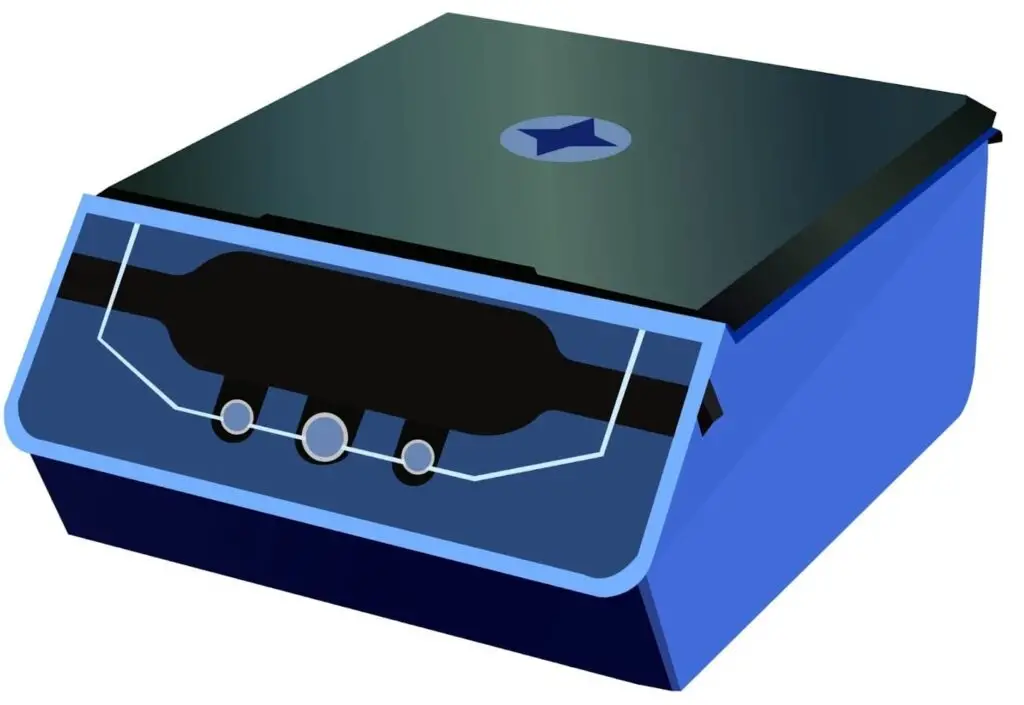
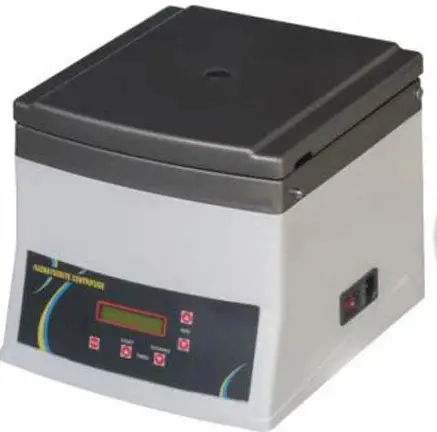
- Low-speed centrifuge is a laboratory centrifuge used for regular separation of samples at low rotating speed.
- It is based on the principle of sedimentation by mild centrifugal force.
- In this centrifuge, the samples are placed in tubes and rotated in a rotor.
- The speed is generally about 4,000 to 5,000 rpm.
- During rotation, centrifugal force is produced but it is not very strong.
- This force makes the heavier particles to settle at the bottom of the tube.
- The lighter liquid part remains in the upper region of the tube.
- It is useful for samples which may be damaged by high centrifugal force.
- Low-speed centrifuge produces less heat during operation.
- It also gives less mechanical stress on the sample.
- Due to this, it is suitable for delicate biological samples and routine diagnostic work.
- It consumes less energy than high-speed centrifuges.
- The separation time may be longer when the difference in density of particles is less.
- It is not suitable for separation of very small particles or molecules.
- Many low-speed centrifuges do not have good temperature control system.
- Low-speed centrifuge is used in clinical laboratory for separation of blood cells from plasma, in food and beverage industry for clarification of juices and dairy products, and in wastewater treatment for removal of coarse particles from liquid suspension.
10. Continuous flow centrifuges
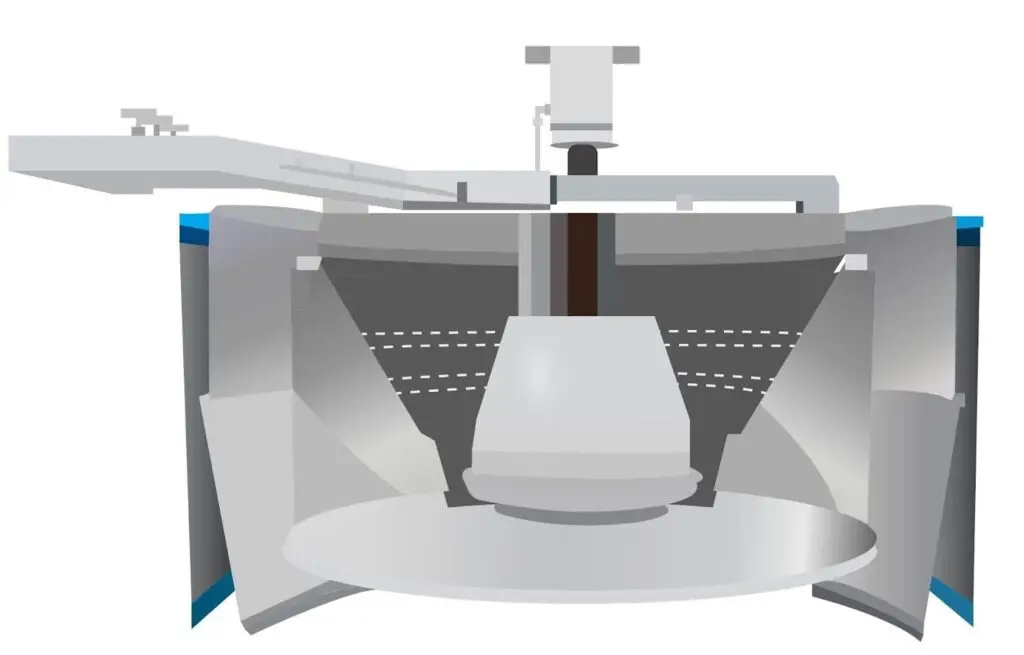
- Continuous flow centrifuge is a special type of centrifuge used for continuous processing of liquid or slurry sample.
- It is based on the principle of separation by centrifugal force in continuous manner.
- In this centrifuge, the feed material is continuously introduced into the rotating chamber.
- The chamber rotates at high speed and centrifugal force is produced inside it.
- This force makes the denser particles or heavy phase to move towards the wall of the chamber.
- The lighter liquid remains nearer to the centre region.
- The separated components are removed at the same time while the feed is still entering.
- The concentrated solid or heavy phase is discharged continuously by screw conveyor, scroll or other discharge system.
- The clarified liquid comes out through separate outlet.
- Thus, loading and unloading of sample again and again is not needed.
- This makes the process faster and useful for large scale separation.
- Continuous flow centrifuge has high processing capacity.
- It can run for long time and gives less downtime during operation.
- The separation performance remains more uniform when feed rate and speed are properly controlled.
- It needs proper balancing and control because vibration, product loss and uneven separation may occur.
- It is more costly than simple batch centrifuge and its maintenance is also more complex.
- Continuous flow centrifuge is used in wastewater treatment, dairy and beverage processing, chemical manufacture, petroleum refining, solid-liquid separation, separation of immiscible liquid phases, and other industrial processes where large amount of material must be separated continuously.
11. Ultracentrifuges
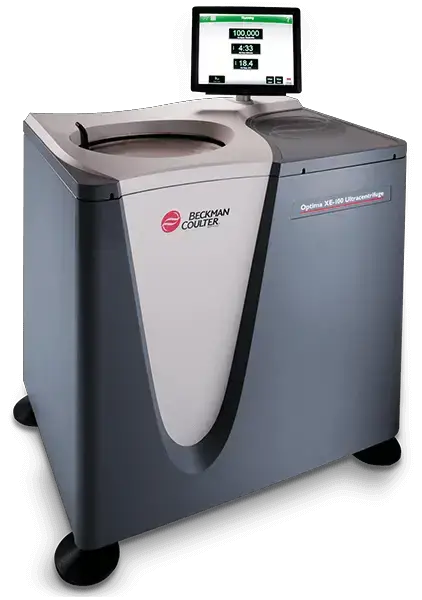
- Ultracentrifuges are based on the principle of sedimentation by very high centrifugal force.
- In this process, the samples are rotated at extremely high speed.
- Ultracentrifuges usually rotate at about 40,000 to 150,000 rpm.
- Due to this high speed rotation, very large relative centrifugal force is produced.
- The centrifugal force may be about 300,000 to more than 1,000,000 × g.
- This force is used to separate very small particles which cannot be separated by ordinary centrifuges.
- In ultracentrifuge, the rotor is placed inside a vacuum chamber.
- Vacuum chamber reduces air friction and also prevents excess heat production during high speed rotation.
- It also helps to maintain proper temperature for sensitive biological samples.
- Preparative ultracentrifuge is used to separate particles according to their density and collect them as pellet.
- Analytical ultracentrifuge is used to observe the sample during centrifugation with optical system like visible or ultraviolet scanner.
- Specialized rotors like vertical rotors are used in ultracentrifuge, where the sample tubes remain upright and separation distance becomes short.
- Ultracentrifuges are used for isolation of very small cellular components like organelles, ribosomes and membranes, concentration and study of viruses, purification and analysis of DNA, RNA, proteins and lipoproteins, density gradient separation of exosomes and nucleic acids, separation and characterization of nanoparticles, study of drug delivery systems, and molecular analysis of shape, mass, conformational change and protein complex stoichiometry.
12. Basket Centrifuge
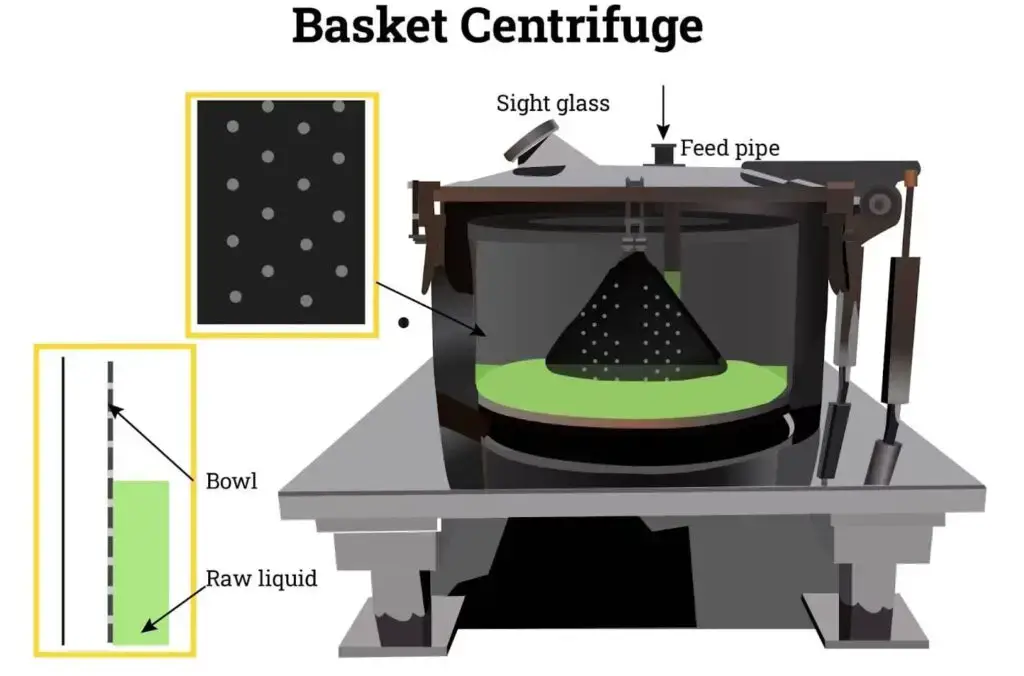
- Basket centrifuge is a type of filtration centrifuge used for separation of solid particles from liquid.
- It works on the principle of centrifugal filtration.
- It has a basket like bowl with perforated screen or mesh.
- This basket rotates at high speed during the process.
- When the slurry is placed inside the basket, centrifugal force is produced.
- This force pushes the liquid phase through the perforations of the basket.
- The solid particles which are larger than the mesh size are retained inside the basket.
- Thus, the separation is based on size of solid particles and passage of liquid through the screen.
- Basket centrifuge generally works at lower centrifugal force than many other centrifuges.
- It usually produces less than about 2,000 × g centrifugal force.
- It works in batch process.
- During operation, the retained solids collect on the inner side of the basket.
- These retained solids form a solid cake.
- The liquid which passes through the perforated basket collects in the outer casing.
- This liquid is then discharged from the vessel by gravity.
- After the process, the solid cake is removed periodically from the basket.
- The removal of cake may be done by scraper or manually depending on the type of basket centrifuge.
- Basket centrifuge is used for batch type solid-liquid separation, recovery of solid material from slurry, washing of solid cake before removal, dewatering of crystals or precipitates, and in industrial processes where solid cake is retained inside the basket and liquid is allowed to drain out.
13. Decanter Centrifuge
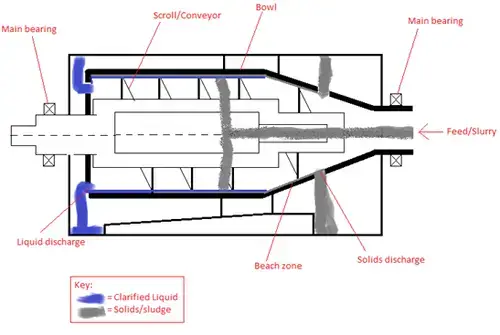
- Decanter centrifuge is a centrifuge used for separation of solid particles from liquid slurry in continuous manner.
- It is based on the sedimentation of particles by centrifugal force.
- It has a horizontal solid cylindrical bowl, which rotates at high speed.
- In the inner side of this bowl, a screw conveyor is present.
- This screw conveyor is also known as scroll.
- The screw conveyor rotates in the same direction with the bowl, but at a little different speed.
- The slurry is entered into the centrifuge continuously through the feed tube.
- During this rotation, heavy centrifugal force is developed inside the bowl.
- This force makes the heavier solid particles to move towards the wall of the bowl.
- The lighter liquid remains towards the centre side of the bowl.
- The solids which are deposited on the wall of the bowl are moved by the screw conveyor.
- These solids are discharged from one end of the centrifuge.
- The clarified liquid is discharged from the other end.
- The centrifugal force of decanter centrifuge is generally about 2,000 to 6,000 × g.
- It is useful for bulk materials and thick slurry where solid content is high.
- It can run continuously without stopping again and again for removing the deposited solid.
- Decanter centrifuge is used in wastewater treatment for sludge dewatering and volume reduction, in oil and gas industry for drilling fluid treatment, tank bottom sludge cleaning and recovery of crude oil from waste, in food industry for starch extraction, edible oil separation and animal protein recovery, and in chemical industry for separation of chemical slurry, dewatering of solid matter and treatment of industrial effluent.
14. Filtration centrifuges
- Filtration centrifuges are based on the principle of solid-liquid separation through centrifugal filtration.
- These centrifuges have a perforated bowl or screen bowl instead of a solid bowl.
- The bowl is fitted with perforated media, screen or mesh for passage of liquid.
- When the machine rotates, centrifugal force is produced inside the bowl.
- Due to this force, the liquid part of the sample is forced out through the perforations or mesh.
- The solid particles which are larger than the mesh size are retained inside the bowl.
- Thus, separation is mainly based on the size of solid particles and passage of liquid through the screen.
- Filtration centrifuges usually work at lower speed because only enough force is required to push the liquid through the screen.
- They generally produce less than about 2,000 × g centrifugal force.
- The retained solids collect on the inner surface of the bowl and form a solid cake.
- This solid cake is removed periodically by scraper, blade or by gravity discharge.
- Basket centrifuge is a batch operated filtration centrifuge used for solid-liquid separation and washing of retained solid cake.
- Pusher centrifuge has slotted bowl and a mechanical pusher arm which continuously pushes the collected solid material out of the centrifuge.
- Peeler centrifuge is a large industrial filtration centrifuge in which a scraper or plow is used to peel or remove the solid cake from the inner surface of the bowl.
- Filtration centrifuges are used for separation of solid from liquid, recovery of crystalline products, washing of solid cake, dewatering of precipitates, continuous removal of solids in industrial process and large scale separation where solid particles must be retained and liquid must pass out.
15. Tubular bowl centrifuge
- Tubular bowl centrifuge is a type of industrial centrifuge used for separation of very fine particles from liquid.
- It is based on the principle of separation by centrifugal force.
- It is also classified as rotary or moving wall centrifuge.
- In this centrifuge, the bowl rotates at very high speed and the liquid sample is passed through it.
- During rotation, centrifugal force is developed inside the bowl.
- This force makes the heavier fine particles to move towards the wall of the bowl.
- The clarified liquid remains towards the inner side and comes out from the outlet.
- Tubular bowl centrifuge is mainly used for materials having very low solid concentration.
- The solid content of feed is generally about 0% to 4%.
- It is useful where the amount of solid is less but the separation must be fine and clear.
- It has high efficiency for separation.
- The efficiency factor is generally about 0.90 to 0.98.
- Tubular bowl centrifuge is usually used in semi-continuous process.
- It is more suitable for small throughput where continuous large scale handling is not needed.
- Tubular bowl centrifuge is used for separation of very fine particles from liquid, in pharmaceutical industry for precise and delicate separation work, and in specialty chemical industry for manufacturing, purification and fine separation of chemical products.
16. Disc stack separator
- Disc stack separator is a type of centrifuge used for fine separation of solid and liquid or two liquid phases with solid impurities.
- It is based on the principle of separation by centrifugal force and increased settling surface.
- In this separator, a number of closely arranged conical plates are present inside the rotating bowl.
- These conical plates are known as disc stack.
- The disc stack gives large surface area for settling of particles in a small space.
- When the bowl rotates at very high speed, strong centrifugal force is produced.
- This centrifugal force may be up to about 12,000 × g.
- Due to this force, heavier particles move outward and lighter liquid phase moves towards the inner side.
- The narrow space between the discs helps in quick separation of very fine particles from the liquid.
- It can separate microscopic particles, generally about 0.1 to 100 micrometer in size.
- Disc stack separator gives clear liquid because fine suspended particles are removed efficiently.
- It is mainly suitable for liquids having low amount of solid content.
- The solid content of feed is generally less than 3%, and about 1% is more suitable for better working.
- It can be used for two phase separation like solid-liquid separation.
- It can also be used for three phase separation where two immiscible liquids like oil and water are separated along with solid residues.
- Due to very narrow gap between the discs, it may be affected by change in feed composition and flow rate.
- The discs may be clogged if solid content is high, so cleaning is required from time to time.
- Disc stack separator is used in food and beverage industry for clarification of juice, beer and wine, separation of fat from milk, in pharmaceutical and biotechnology work for harvesting sterile cell culture, clarification of fermentation broth and extraction of plant or animal proteins, and in petrochemical and heavy industry for dehydration and desalting of crude oil, purification of turbine lubricating oil and clarification of edible vegetable oil.
17. Gas centrifuge
- Gas centrifuge is a highly special type of centrifuge used for separation of isotopes present in gaseous form.
- It is based on the principle of isotope separation by very high centrifugal force.
- In this centrifuge, the substance to be separated must be converted into gas.
- Uranium hexafluoride (UF₆) gas is commonly used in this type of centrifuge.
- The separation depends on very small difference in mass of the isotopes.
- A long cylindrical rotor is rotated at extremely high speed inside a vacuum casing.
- The speed of rotor may be more than 300 meter per second.
- During this rotation, very strong centrifugal force is produced inside the rotor.
- Due to this force, the heavier isotope moves more towards the outer wall of the rotor.
- The lighter isotope remains more towards the central axis of the rotor.
- In case of uranium hexafluoride gas, heavier uranium-238 containing molecules move towards the wall and lighter uranium-235 containing molecules remain more near the centre.
- Zippe-type gas centrifuge has a tall and thin-walled cylindrical rotor.
- This rotor rotates on a vertical axis at very high speed.
- To reduce friction, the lower end of the rotor is supported on a needle point bearing.
- The upper end is stabilized by magnetic bearing.
- Inside the rotor, countercurrent gas flow is produced by scoops or by temperature difference.
- This flow helps to increase the separation effect along the height of the rotor.
- The rotor is made from strong and light materials because the speed and mechanical stress is very high.
- Materials like maraging steel, aluminium alloys or carbon fibre may be used for making the rotor.
- One gas centrifuge cannot give required separation alone, so many centrifuges are connected together in series and parallel arrangement.
- This arrangement is called cascade.
- Gas centrifuge is used for enrichment of uranium-235 for nuclear fuel in power reactors, production of stable isotopes like zinc-64 and xenon-129 for medical imaging and scientific research, and for isotope separation work where high efficiency and less energy use is required.
- Gas centrifuges use much less energy than older gaseous diffusion method.
- They are also compact and modular, so more centrifuge units can be added according to the need.
18. Cytocentrifuge
- Cytocentrifuge is a special type of centrifuge used for preparing cell smear on microscopic slide.
- It is based on the principle of deposition of cells from liquid suspension by centrifugal force.
- Unlike ordinary centrifuge, it does not collect the cells as pellet at the bottom of tube.
- It deposits the cells directly on a glass slide in a small marked area.
- During centrifugation, the liquid sample is placed in a special chamber attached with slide.
- When the rotor rotates, the suspended cells or microorganisms move towards the slide surface.
- The cells are deposited on the slide as a thin single layer.
- This single layer is called monolayer.
- The remaining fluid is absorbed by filter card or retained in the chamber.
- The process is arranged in such a way that the shape and structure of the cells are maintained.
- It is useful for samples where the number of cells is very low.
- It helps to concentrate the cells on one area of the slide for easy staining and microscopic study.
- Cytocentrifuge is used for preparation of slides for cell staining, cytology study, microbiology and hematology work, examination of cerebrospinal fluid (CSF), Pap test sample, bronchial secretion, pleural fluid, pericardial fluid and other body fluid samples where cells are present in liquid suspension.
References
- GN Separation. (n.d.). 2 phase disc stack separator – Decanter centrifuge & vibrating screen manufacturer. https://www.gnseparation.com/2-phase-disc-separator
- Pipette.com. (n.d.). 8 types of laboratory centrifuges & the purposes they serve. https://pipette.com/blog/types-of-centrifuges
- MKE Lab. (2026, February 12). 8 types of laboratory centrifuges & the purposes they serve. Hunan Michael Laboratory Instrument Co., Ltd. https://www.mke-lab.com/blog/8-types-of-laboratory-centrifuges-the-purposes-they-serve/
- Eppendorf US. (2019, July 22). Basics in centrifugation – Calculating relative centrifugal force and selecting a centrifuge and rotors. https://www.eppendorf.com/us-en/lab-academy/life-science/cell-biology/basics-in-centrifugation/
- TOMY. (n.d.). Benchtop vs. floor centrifuges: How to choose the right format for your lab. Amuza Inc. https://tomy.amuzainc.com/centrifuges/floor-vs-benchtop-centrifuges/
- Shanghai Luxiangyi Centrifuge Instrument Co., Ltd. (n.d.). Big price differences among centrifuges? A buyer’s guide for medical and laboratory use—understand these key points to avoid wasting your money! https://www.bioridgecentrifuge.com/News_detail/124.html
- Corning. (n.d.). Centrifugation: Lab techniques, examples and types. https://www.corning.com/worldwide/en/products/life-sciences/resources/stories/at-the-bench/unveiling-centrifugation-techniques-theory-and-applications.html
- Thermo Fisher Scientific. (n.d.). Centrifuge buying guide [PDF]. https://documents.thermofisher.com/TFS-Assets/LPD/Handbooks/centrifuge-buying-guide.pdf
- osapiens. (n.d.). Centrifuge maintenance checklist – Tasks, safety & digital execution. https://osapiens.com/maintenance/maintenance-checklist/centrifuge-maintenance-checklist/
- Beckman Coulter. (n.d.). Centrifuge maintenance and care. https://www.beckman.com/resources/technologies/centrifugation/principles/maintenance-care
- National Academies of Sciences, Engineering, and Medicine. (2016). Chapter 2: Medical isotope production and utilization. In Molybdenum-99 for medical imaging. The National Academies Press. https://www.nationalacademies.org/read/23563/chapter/5
- Wei, L. (n.d.). Comparing different types of medical centrifuges – Pros and cons. Drawell. https://www.drawellanalytical.com/comparing-different-types-of-medical-centrifuges-pros-and-cons/
- Comprehensive technical analysis of centrifugal systems: Principles, taxonomies, and industrial applications. (n.d.). [Unpublished manuscript].
- GEA Group. (n.d.). Crude oil. https://www.gea.com/en/oil-gas-energy/upstream/crude-oil/
- GEA Group. (n.d.). Crude oil desalting. https://www.gea.com/en/oil-gas-energy/downstream/crude-oil-desalting/
- ZK SEPARATION. (n.d.). Decanter centrifuge vs filter press: Complete comparison guide. https://www.zkcentrifuge.com/blog/decanter-vs-filter-press.html
- Shenzhou. (2025, July 30). Decanter separator vs. disc stack centrifuge: Selecting the right technology. https://www.lnszjx.com/a-news-decanter-separator-vs-disc-stack-centrifuge-selecting-the-right-technology.html
- Zippe, G. (1991). Development and status of gas centrifuge technology [PDF]. Atomic Reporters. http://www.atomicreporters.com/wp-content/uploads/2015/10/zippe-story-1_upside.pdf
- Westlab. (2023, May 2). Differences between RCF & RPM in centrifugation. https://www.westlab.com/blog/difference-between-rcf-and-rpm-in-centrifugation
- Wei, L. (n.d.). Effective strategies for noise reduction and vibration control in floor centrifuges. Drawell. https://www.drawellanalytical.com/effective-strategies-for-noise-reduction-and-vibration-control-in-floor-centrifuges/
- GN Separation. (n.d.). Food & beverage industry – Decanter centrifuge & vibrating screen …. https://www.gnseparation.com/food-beverage-industry
- Centrus Energy Corp. (n.d.). Gas centrifuge. https://www.centrusenergy.com/learn-more/uranium-enrichment/gas-centrifuge/
- Wikipedia. (2026, February 14). Gas centrifuge. https://en.wikipedia.org/wiki/Gas_centrifuge
- GMI – Trusted Laboratory Solutions. (n.d.). Guide to the perfect centrifuge for your application. https://www.gmi-inc.com/guide-to-the-perfect-centrifuge-for-your-application/
- Labtop Instruments. (n.d.). High volume refrigerated centrifuge manufacturers in Mumbai, suppliers in India. https://www.labtopinstruments.com/high-volume-refrigerated-centrifuge/
- Excedr. (n.d.). How much does a centrifuge cost in 2024? https://www.excedr.com/blog/centrifuge-cost
- Markovska, N. (2025, August 15). How noise control improves accuracy in laboratory testing. Decibel-Acoustic. https://www.decibelinternational.co.uk/blog/how-noise-control-improves-accuracy-in-laboratory-testing-30/
- Kantawala, H. (n.d.). How to choose the right centrifuge: Fixed-angle vs swing-bucket rotors explained. Hindustan Scale Company. https://www.hindustanscale.com/blog/how-to-choose-the-right-centrifuge-fixed-angle-vs-swing-bucket-rotors-explained/
- Kantawala, H. (2025, December 22). How to cut down on noise and vibration in centrifuges. Hindustan Scale Company. https://www.hindustanscale.com/blog/how-to-cut-down-on-noise-and-vibration-in-centrifuges/
- Sabbagh, R., Lipsett, M. G., Koch, C. R., & Nobes, D. S. (2015). Hydrocyclone performance and energy consumption prediction: A comparison with other centrifugal separators [PDF]. Separation Science and Technology, 50(6), 788-801. https://sites.ualberta.ca/~ckoch/open_access/Sabbagh-SST-2015-postprint.pdf
- CbS Separators. (n.d.). Industrial centrifuge separator | High-performance industrial separators. https://cbsseparators.com/industrial-centrifuge-separator
- Trucent. (n.d.). Industrial centrifuge systems. https://www.trucent.com/products/industrial-centrifuge-systems/
- Dolphin Centrifuge. (n.d.). Industrial centrifuge | Types, applications, cost & benefits. https://dolphincentrifuge.com/industrial-centrifuge/
- Doupu (Sichuan) Biotechnology Co., Ltd. (n.d.). Industrial centrifuges | Decanter & disc stack separators. https://www.doupubio.com/industrial-centrifuge.html
- welso. (n.d.). Is low noise better? Discussion of noise impact on centrifuge. https://www.welsomed.com/vi/blog/show-146.html
- Atomic Heritage Foundation. (2014, June 5). Isotope separation methods. Nuclear Museum. https://ahf.nuclearmuseum.org/ahf/history/isotope-separation-methods/
- Thermo Fisher Scientific – US. (n.d.). Lab centrifuges models. https://www.thermofisher.com/us/en/home/life-science/lab-equipment/lab-centrifuges/models.html
- Esco Lifesciences. (n.d.). Laboratory centrifuge. https://www.escolifesciences.com/products/centrifuge
- Molecular Biology Products. (n.d.). Laboratory centrifuge: Types, benefits, and applications. https://mbpinc.net/laboratory-centrifuge-types-benefits-and-applications
- 4E’s Scientific. (2026, March 6). Laboratory centrifuges: Types, applications, and how to choose the right one. https://www.4esci.com/laboratory-centrifuges-types-applications-and-how-to-choose-the-right-one.html
- Lab Manager. (n.d.). Laboratory noises and what to do about them. https://www.labmanager.com/laboratory-noises-and-what-to-do-about-them-23691
- Szepessy, S., & Thorwid, P. (2018). Low energy consumption of high‐speed centrifuges. Chemical Engineering & Technology, 41(12), 2375-2384. PMC. https://pmc.ncbi.nlm.nih.gov/articles/PMC6472591/
- Department of Energy. (1996, April). Medical isotopes production project: Molybdenum-99 and related isotopes environmental impact statement [PDF]. https://www.energy.gov/sites/prod/files/2018/06/f52/EIS-0249-Vol1.pdf
- National Research Council (US) Committee on Medical Isotope Production Without Highly Enriched Uranium. (2009). Molybdenum-99/Technetium-99m production and use. In Medical isotope production without highly enriched uranium. National Academies Press. https://www.ncbi.nlm.nih.gov/books/NBK215133/
- OSHA. (n.d.). OSHA factsheet laboratory safety noise [PDF]. https://nps.edu/documents/111291366/111353788/OSHAfactsheet-laboratory-safety-noise.pdf/d7265845-9fba-4f6a-8c33-ffb9270a1b6f
- Centrisys/CNP. (n.d.). Oilfield decanter centrifuges: Drilling fluids & crude oil separation …. https://www.centrisys-cnp.com/oilgas
- Enrichment Technology Company Limited (ETC). (n.d.). Our gas centrifuge technology for uranium enrichment. https://www.enritec.com/technology/centrifuge-technology/
- Eppendorf US. (n.d.). Reduce the noise in your lab. https://www.eppendorf.com/us-en/lab-academy/life-science/cell-biology/reduce-the-noise-in-your-lab/
- Eppendorf. (n.d.). Refrigerated centrifuges. https://www.eppendorf.com/us-en/Products/Centrifugation/Refrigerated-Centrifuges-c-WebPSub-H-12106798
- TOMY. (n.d.). Refrigerated centrifuges: Essential tools in modern laboratories. Amuza Inc. https://tomy.amuzainc.com/centrifuges/refrigerated-centrifuges-guide/
- Beckman Coulter. (n.d.). Rotor types – Centrifugation. https://www.beckman.com/resources/technologies/centrifugation/principles/rotor-types
- Beckman Coulter. (n.d.). Rotors for density gradient centrifugation. https://www.beckman.com/resources/technologies/centrifugation/density-gradient-centrifugation/dguc-rotors
- Schroeder, S. (2018). Routine maintenance of centrifuges [PDF]. Eppendorf. https://www.eppendorf.com/product-media/doc/en/64426/Eppendorf_Centrifugation_White-Paper_014_Centrifuges_Routine-Maintenance-Centrifuges.pdf
- Cryostar Industries. (n.d.). Simple ways to maintain a centrifuge: Expert tips for performance. https://cryostarindustries.com/lab-equipment-repair-blog/3-simple-ways-to-maintain-your-centrifuge/
- IOW Group. (n.d.). The physics of centrifugal oil separation, explained. https://www.iowgroup.com/the-physics-of-centrifugal-oil-separation-explained
- Marshall Scientific. (n.d.). Thermo Scientific ST40R refrigerated centrifuge. https://www.marshallscientific.com/Thermo-Scientific-ST40R-Refrigerated-Centrifuge-p/tsst40r.htm
- Karwan, C. (2025, May 22). Types of centrifuge rotors. New Life Scientific. https://newlifescientific.com/blogs/new-life-scientific-blog/centrifuge-rotor-types
- Department of Energy. (n.d.). Uranium enrichment, explained. https://www.energy.gov/ne/articles/uranium-enrichment-explained
- SHINE Technologies. (n.d.). What is Molybdenum-99 (Mo-99)? https://www.shinefusion.com/blog/what-is-molybdenum-99-mo-99
- AHN Biotechnologie GmbH. (2025, November 29). What you need to know about high-speed cooling centrifuges: The complete user-focused guide. https://ahn-bio.com/what-you-need-to-know-about-high-speed-cooling-centrifuges-the-complete-user-focused-guide/
- Wei, L. (n.d.). What are common centrifuge maintenance mistakes – How to prevent them. Drawell. https://www.drawellanalytical.com/what-are-common-centrifuge-maintenance-mistakes-how-to-prevent-them/
- The Lab Depot. (n.d.). What to consider before purchasing a centrifuge | Scilogex. https://www.labdepotinc.com/articles/what-to-consider-before-purchasing-a-centrifuge.html
- Eppendorf US. (2016, June 27). When to use a fixed-angle rotor or a swing-bucket rotor? https://www.eppendorf.com/us-en/lab-academy/topics-methods-technology/centrifugation/when-to-use-a-fixed-angle-rotor-or-a-swing-bucket-rotor
- Wikipedia. (2026, April 4). Zippe-type centrifuge. https://en.wikipedia.org/wiki/Zippe-type_centrifuge
- Alfa Laval. (2001, April). Disc stack centrifuge technology [PDF]. https://www.alfalaval.us/globalassets/documents/local/united-states/daf/alfa-laval-disc-stack-centrifuge-technology.pdf
- UNTERM. (n.d.). Gas centrifuge. https://unterm.un.org/unterm2/view/d8e8b837-8dbb-4537-954f-9911529280f6