

Stage micrometer is a special type of microscopic glass slide which is used for calibration and measurement of microscopic objects. It acts like a small ruler on the microscope stage. It has a fine scale marked or engraved on its surface.
The scale of stage micrometer has a known measurement. Generally, the total scale is 1 mm or 2 mm long. This scale is divided into small divisions, usually 0.1 mm and 0.01 mm. The 0.01 mm division is equal to 10 µm.
Stage micrometer is used with ocular micrometer for measuring microorganisms, cells and other small specimens. The ocular micrometer scale has no fixed value by itself. So it is calibrated with the help of stage micrometer before actual measurement.
During calibration, the stage micrometer is placed on the microscope stage and focused under the microscope. Then its scale is matched with the scale of ocular micrometer. From this, the value of one ocular division is calculated for each objective lens.
It is an important tool in microscopy, because the size of the specimen changes when objective lens is changed. So calibration is needed separately for low power, high power and oil immersion objective. This helps to measure the real size of microscopic specimen in micrometer (µm).
Before proper calibrated measurement, microscope was mainly used only for observation. But with the use of stage micrometer, microscopic study became more quantitative. It is used in microbiology, pathology, morphology and material study where accurate measurement of small structure is required.
Method of Calibrating a Microscope

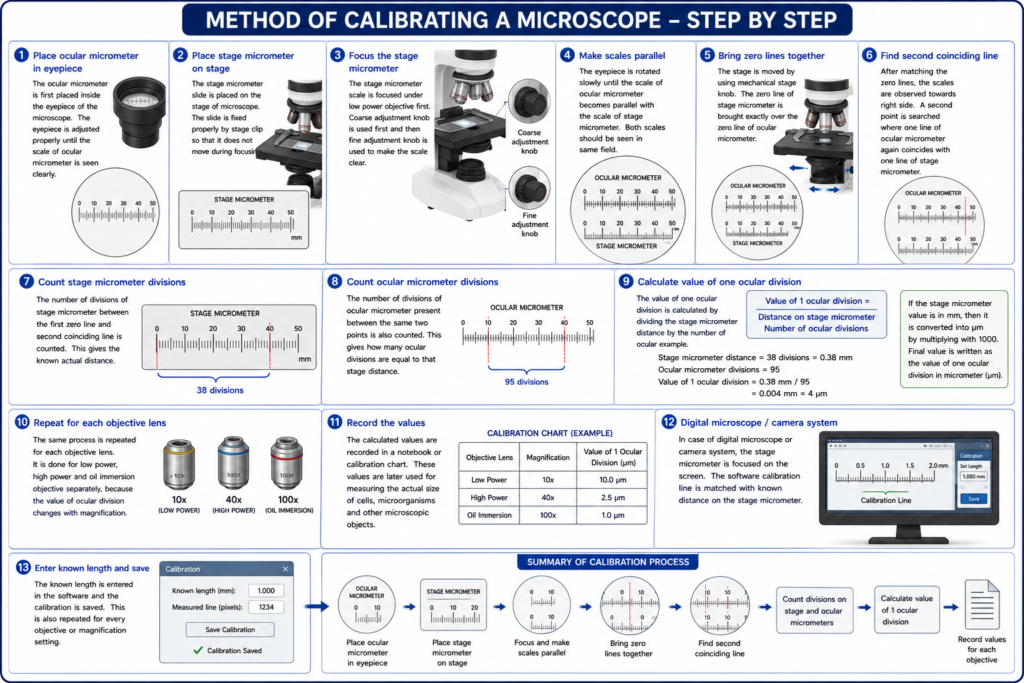
- The ocular micrometer is first placed inside the eyepiece of the microscope. The eyepiece is adjusted properly until the scale of ocular micrometer is seen clearly.
- The stage micrometer slide is placed on the stage of microscope. The slide is fixed properly by stage clip so that it does not move during focusing.
- The stage micrometer scale is focused under low power objective first. Coarse adjustment knob is used first and then fine adjustment knob is used to make the scale clear.
- The eyepiece is rotated slowly until the scale of ocular micrometer becomes parallel with the scale of stage micrometer. Both scales should be seen in same field.
- The stage is moved by using mechanical stage knob. The zero line of stage micrometer is brought exactly over the zero line of ocular micrometer.
- After matching the zero lines, the scales are observed towards right side. A second point is searched where one line of ocular micrometer again coincides with one line of stage micrometer.
- The number of divisions of stage micrometer between the first zero line and second coinciding line is counted. This gives the known actual distance.
- The number of divisions of ocular micrometer present between the same two points is also counted. This gives how many ocular divisions are equal to that stage distance.
- The value of one ocular division is calculated by dividing the stage micrometer distance by the number of ocular divisions. Value of 1 ocular division = Distance on stage micrometer / Number of ocular divisions
- If the stage micrometer value is in mm, then it is converted into µm by multiplying with 1000. The final value is written as the value of one ocular division in micrometer (µm).
- The same process is repeated for each objective lens. It is done for low power, high power and oil immersion objective separately, because the value of ocular division changes with magnification.
- The calculated values are recorded in a notebook or calibration chart. These values are later used for measuring the actual size of cells, microorganisms and other microscopic objects.
- In case of digital microscope or camera system, the stage micrometer is focused on the screen. The software calibration line is matched with known distance on the stage micrometer.
- The known length is entered in the software and the calibration is saved. This is also repeated for every objective or magnification setting.
Importance of Microscope Calibration
- Microscope calibration is important to get correct measurement of microscopic objects. Without calibration, the size of cells, microorganisms or other small structures may be measured wrongly.
- It makes the microscope more accurate and reliable. The value obtained after calibration is close to the true measurement value.
- It changes the microscope from only a magnifying instrument into a measuring instrument. So it is used for quantitative study in microbiology, pathology and material science.
- It reduces error during measurement. The difference between observed value and actual value becomes less after proper calibration.
- It helps to get same result again and again. When the same microscope is used by different persons, calibration helps to keep the measurement uniform.
- It is needed because the value of ocular micrometer changes with each objective lens. So calibration gives separate value for low power, high power and oil immersion objective.
- It helps in proper comparison of specimen size. Different samples can be compared only when their measurement is taken by calibrated microscope.
- It is important in laboratory quality control. In diagnostic and research laboratory, wrong measurement may affect the final result and interpretation.
- It helps to follow standard laboratory rules and guidelines. Many laboratories need calibrated instruments for maintaining proper record and certification.
- It gives traceable measurement data. The measured value can be related with accepted national or international standard.
- It helps in correct decision making. In quality testing, failure analysis and diagnostic work, small measurement error may change the final decision.
- Regular calibration is also important because microscope parts may shift or change slightly with time. This may produce error if the instrument is not calibrated again.
References
- Humpage Technology Ltd. (2024). A calibration manager’s guide to GLP. [URL]
- National Center for Biotechnology Information. (n.d.). A comparative analysis of interpupillary distance measurement techniques evaluation in modern times: From rulers to apps. PubMed Central (PMC). [URL]
- LECO Corporation. (2021, March 26). Calibrating microscopes for metallographic analyses. [URL]
- Microscope World. (2025, December 11). Calibrating a stereo microscope for precision measurement: Methods, standards, and error sources. [URL]
- Centers for Medicare & Medicaid Services (CMS). (n.d.). Calibration and calibration verification (CLIA Brochure). [PDF]
- Cid del Prado, I. (2021, March 29). Calibration of microscope for nematode morphometrics. [URL]
- WJEC CBAC (Eduqas). (n.d.). Calibration of microscope. [PDF]
- Centers for Disease Control and Prevention (CDC). (n.d.). Calibration of the ocular micrometer. [PDF]
- Parry-Hill, M., Fellers, T. J., & Davidson, M. W. (n.d.). Eyepiece reticle calibration. Nikon’s MicroscopyU. [URL]
- National Institute of Standards and Technology. (2003, March). Good laboratory practice for the quality assurance of the measurement process (GLP 1). [PDF]
- National Center for Biotechnology Information. (n.d.). Guidelines on good clinical laboratory practice. PubMed Central (PMC). [URL]
- Meiji Techno America. (2026). How to install eyepiece micrometer into MA502 & MA520. [URL]
- Microscope World. (n.d.). How to parfocal microscope objectives. [URL]
- Graticules Optics Ltd. (n.d.). How to use a stage micrometer. [PDF]
- Wilkinson, S. (2022, October 24). How to use microscope immersion oil. Microscopes.com.au. [URL]
- Wilson, M., DeRose, J., & Greb, C. (2023, February 27). Immersion objectives. Leica Microsystems. [URL]
- New York Microscope Company. (n.d.). Installation of a micrometer or reticle into an eyepiece. [URL]
- New York Microscope Company. (n.d.). Installing a micrometer or microscope reticle into an eyepiece. [URL]
- Microchem Laboratory. (n.d.). Introduction to GLP regulations. [URL]
- Pharmko. (2025, September 1). Lab requirements for GLP compliance. [URL]
- Caprette, D. R. (2012, August 10). Measuring with the microscope. Rice University. [URL]
- Metrological principles of microscope calibration: A definitive guide to optical scaling and precision micrometry. (n.d.). [Markdown]
- MicroscopeGenius. (2021, March 2). Microscope 101: Oil immersion lens technique. [URL]
- Barbero, D. R., DeRose, J., & Baker, N. (n.d.). Microscope calibration for measurements: Why and how you should do it. Leica Microsystems. [URL]
- Microscope World. (n.d.). Microscope calibration. [URL]
- National Center for Biotechnology Information. (n.d.). Microscope calibration protocol for single-molecule microscopy. PubMed Central (PMC) – NIH. [URL]
- Abramowitz, M., Parry-Hill, M. J., & Davidson, M. W. (2018, September 10). Molecular expressions microscopy primer: Anatomy of the microscope – Köhler illumination – eyepiece diopter adjustment: Interactive tutorial. [URL]
- Ocular and stage micrometers. (n.d.). [PDF]
- Life Technologies / Thermo Fisher Scientific. (n.d.). Oil-immersion objective design and use. [PDF]
- Wikipedia Contributors. (2026, May 12). Parallax. Wikipedia, The Free Encyclopedia. [URL]
- MBF Bioscience. (2026). Parcentric/parfocal calibration. [URL]
- MBF Bioscience. (n.d.). Parcentric/parfocal calibration. [URL]
- Microscope Central. (n.d.). Proper technique for 100x oil immersion objective. YouTube. [Youtube]
- Potts, C. (2025, February 17). Step by step guide to installing a microscope eyepiece micrometer. Microscope Marketplace. [URL]
- Leica Microsystems GmbH. (2026, February 19). Why microscope calibration matters for measurement accuracy. AZoM. [URL]