

What is Orientation in Animal Behaviour?
Orientation in animal behaviour is the process by which an animal finds and maintains a particular direction or position in its environment.
This orientation response may be innate or learned. It helps the animal to move properly in relation to environmental stimuli such as light, gravity, chemicals, water current and the earth magnetic field. Animals detect these environmental stimuli through different sensory receptors, which help in producing the proper orientation response.
This behaviour is very important for survival. It helps in searching of food and water, escaping from predator, finding mate and also in migration. During this process animal first gets a general direction and then correct its movement according to the surrounding condition.
The main orientation patterns are taxis and kinesis.
Taxis is a directional movement of animal towards or away from a stimulus. Movement towards the stimulus is called positive taxis and movement away from the stimulus is called negative taxis. Example, insect moving towards light shows positive phototaxis.
Kinesis is a non-directional movement. In this case the animal does not move directly towards or away from stimulus. The speed of movement or rate of turning changes according to intensity of stimulus. Example, woodlouse moves randomly in bright light until it reaches a dark and safe place.
Types of Orientation Patterns of Behaviour
The orientation patterns of behaviour are mainly classified as follows-
A. Broad Categories of Orientation
1. Primary Orientation
Primary orientation is the basic and general direction taken by an animal. It is based on major cue of environment like sun, stars, wind, light or earth magnetic field.
2. Secondary Orientation
Secondary orientation is the small correction of path after primary direction is taken. It helps the animal to maintain the correct direction during movement.
B. Taxis
Taxis is a directional movement of an animal towards or away from a stimulus. Movement towards the stimulus is called positive taxis and movement away from stimulus is called negative taxis.
Taxis is again classified in two ways-
I. Taxis based on type of stimulus
1. Phototaxis
Phototaxis is the orientation movement in response to light. Example, insects moving towards lamp light.
2. Geotaxis
Geotaxis is the orientation movement in response to gravity. The movement may be towards or away from gravitational force.
3. Chemotaxis
Chemotaxis is the orientation movement in response to chemical stimulus. The animal may move towards useful chemical and away from harmful chemical.
4. Thermotaxis
Thermotaxis is the movement in response to temperature. It helps animal to find suitable temperature condition.
5. Rheotaxis
Rheotaxis is the orientation movement in response to water current. It is common in aquatic animals.
6. Anemotaxis
Anemotaxis is the movement in response to air current or wind. Some insects use wind direction during movement.
7. Phonotaxis
Phonotaxis is the orientation movement in response to sound waves. Example, female cricket moves towards sound of male cricket.
8. Hygrotaxis
Hygrotaxis is the movement in response to humidity. The animal may move towards moist place.
9. Astrotaxis
Astrotaxis is the orientation by using sun, moon and stars. It is used in navigation of some animals.
10. Magnetotaxis
Magnetotaxis is the orientation by using earth magnetic field. It helps in long distance migration.
II. Taxis based on navigational mechanism
1. Klinotaxis
Klinotaxis is a type of taxis where the animal compares stimulus intensity by moving side to side. The movement is zigzag type.
2. Tropotaxis
Tropotaxis is the orientation by using paired receptors. Both side receptors compare the stimulus at same time and animal moves in proper direction.
3. Telotaxis
Telotaxis is a goal directed movement. In this type animal fixes one stimulus source and moves towards it.
4. Menotaxis
Menotaxis is the movement by keeping a constant angle with the stimulus. It is also called light compass orientation when light is used.
5. Mnemotaxis
Mnemotaxis is the orientation by memory. It is related to learning behaviour, where the animal uses previous routes, experience and landmarks for reaching a place.
C. Kinesis
Kinesis is a non-directional movement. In this type animal does not move directly towards or away from stimulus. Only activity rate changes according to intensity of stimulus.
1. Orthokinesis
Orthokinesis is the type of kinesis where speed of movement changes. The animal may move fast or slow according to stimulus intensity.
2. Klinokinesis
Klinokinesis is the type of kinesis where rate of turning changes. The animal turns more in unfavourable condition until it reaches favourable place.
The main difference between orthokinesis and klinokinesis is that orthokinesis changes the speed of movement, while klinokinesis changes the rate or frequency of turning.
D. Other Complex Orientation Methods
1. Landmark-based Orientation
Landmark-based orientation is the orientation by using visible object of environment. Example, tree, mountain, river, nest or other fixed structure.
2. Hydrodynamic Orientation
Hydrodynamic orientation is the orientation by using water flow pattern. Aquatic animals use it to know direction and position in water.
Primary and Secondary Orientation in Animal Behaviour
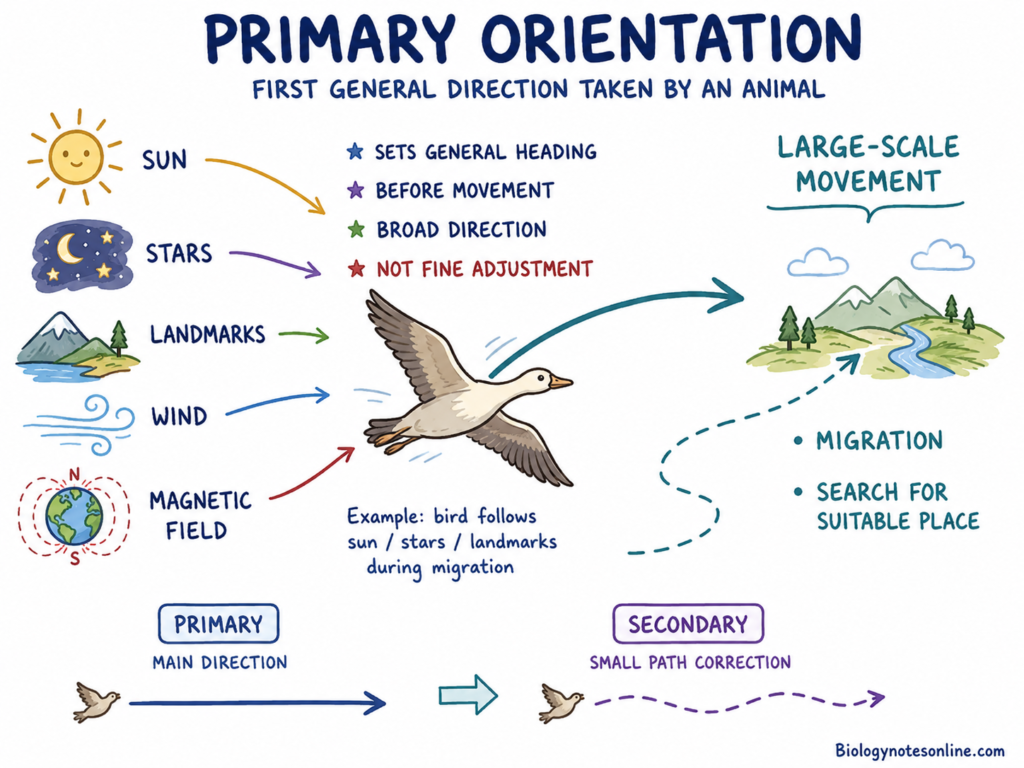
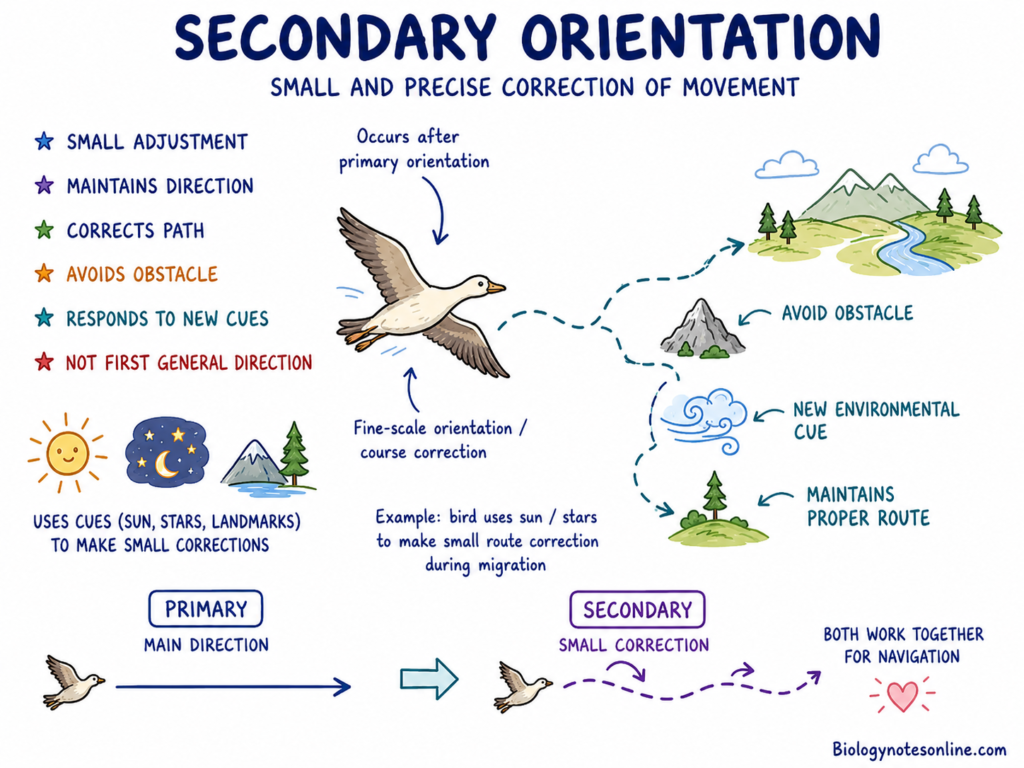
Primary and secondary orientation in animal behaviour work together during navigation. Primary orientation gives the animal a general direction, while secondary orientation makes small corrections in the selected path.
Primary Orientation
Primary orientation is the first general direction taken by an animal in relation to its environment or any stimulus.
- Primary orientation gives a broad direction to the animal before starting movement.
- It is not a fine and exact adjustment of movement.
- It is mainly used in large scale movement of animals.
- In this type, the animal first fixes a general path or general heading.
- This direction may be guided by sun, stars, landmarks, light, wind direction or earth magnetic field.
- It helps the animal to move in correct general direction during migration and searching of suitable place.
- Primary orientation works with secondary orientation.
- Primary orientation gives the main direction and secondary orientation makes small correction in the path.
- Example, when a bird starts migration, it first follows a general direction by using sun, stars or landmark.
- This first setting of direction during movement is called primary orientation.
Secondary Orientation
Secondary orientation is the small and precise correction of movement after the animal has already taken a general direction.
- Secondary orientation is also known as fine-scale orientation or course correction.
- It occurs after primary orientation has been established by the animal.
- In this type, the animal makes small adjustment in its movement to maintain a particular direction.
- It does not give the first general direction to the animal.
- It helps to correct the path when the animal moves away from the proper direction.
- It helps the animal to avoid obstacle during movement.
- It also helps to respond to new environmental cue during travelling.
- Primary orientation gives the main direction and secondary orientation corrects that direction.
- Both primary orientation and secondary orientation work together for proper navigation.
- Example, after a migrating bird takes a general path, it uses position of sun or stars for making small correction in its route.
- This continuous small correction of route is called secondary orientation.
Difference Between Klinotaxis and Tropotaxis
Tropotaxis commonly depends on paired eyes, antennae or other sensory receptors of insects.
The following table shows the important differences between klinotaxis and tropotaxis.
| Basis of Difference | Klinotaxis | Tropotaxis |
|---|---|---|
| Definition | Klinotaxis is an orientation movement in which an organism compares the intensity of a stimulus by moving its head or body from side to side. | Tropotaxis is an orientation movement in which an organism compares the intensity of a stimulus by using paired receptors present on both sides of the body. |
| Method of stimulus detection | The stimulus is detected one after another from different directions. | The stimulus is detected from both sides at the same time. |
| Type of comparison | It involves successive or sequential comparison of the stimulus. | It involves simultaneous comparison of the stimulus. |
| Number of receptors | It may occur with a single receptor or closely placed receptors. | It generally requires two paired receptors, such as two eyes, antennae or other sensory organs. |
| Movement pattern | The organism usually moves in a zigzag or curved path. | The organism generally moves in a more direct and straight path. |
| Head movement | Side-to-side movement of the head or body is commonly present. | Repeated side-to-side movement is generally not required. |
| Direction finding | The organism finds the direction by checking the stimulus at different positions. | The organism finds the direction by comparing the stimulus received on the left and right sides. |
| Accuracy of orientation | It is comparatively less accurate because the stimulus is compared at different times. | It is comparatively more accurate because both receptors compare the stimulus at the same time. |
| Speed of response | The response may be slower because repeated movements are required for comparison. | The response is usually faster because simultaneous comparison gives the direction quickly. |
| Body organization | It is common in simple organisms or animals without well-developed paired sensory receptors. | It is common in animals having bilateral symmetry and paired sensory receptors. |
| Response to unequal stimulus | The organism turns its body and checks whether the stimulus intensity increases or decreases. | The organism turns towards the side receiving the stronger stimulus or away from it during negative taxis. |
| Effect of covering one receptor | Orientation may still occur because the organism can compare the stimulus by successive movements. | Proper orientation may be disturbed when one receptor is covered or damaged. |
| Nature of movement | Movement continues with repeated correction of the path. | Movement becomes straight after the direction of the stimulus is detected. |
| Common examples | It is seen in Euglena, earthworm, maggots and some other simple organisms. | It is seen in planaria, insects and other animals having paired eyes or antennae. |
| Example of movement | A maggot moves its head from side to side and compares light intensity before moving away from light. | Planaria compares light received by its two eyespots and moves away from the stronger light source. |
| Main difference | Klinotaxis depends on successive comparison by side-to-side movement. | Tropotaxis depends on simultaneous comparison by paired receptors. |
In simple words, klinotaxis uses movement for comparing the stimulus at different times, while tropotaxis uses paired receptors for comparing the stimulus at the same time.
Taxis (Directional Movement)
Taxis is a directed movement or orientation of an animal in response to a particular environmental stimulus.
- In taxis, the animal moves directly towards the stimulus or away from the stimulus. Movement towards stimulus is called positive taxis and movement away from stimulus is called negative taxis.
- Taxis is different from kinesis, because in taxis the movement is directional but in kinesis the movement is random and not fixed towards the stimulus.
- Taxis are mainly classified into two groups, one is based on the type of stimulus and another is based on the navigational mechanism.
A. Based on type of stimulus
- Phototaxis – Phototaxis is the movement of animal in response to light, such as insects moving towards lamp light.
- Chemotaxis – Chemotaxis is the directional movement of an organism in response to a chemical gradient. The mechanism is commonly observed during bacterial chemotaxis, where bacteria move towards nutrients or away from harmful chemicals.
- Geotaxis – Geotaxis is the movement of organism in response to gravity, such as root moving downward.
- Thermotaxis – Thermotaxis is the movement of animal in response to temperature.
- Hygrotaxis – Hygrotaxis is the movement of animal in response to humidity.
- Rheotaxis – Rheotaxis is the movement of animal in response to water current.
- Anemotaxis – Anemotaxis is the movement of animal in response to air current or wind.
- Phonotaxis – Phonotaxis is the movement of animal in response to sound waves, such as female cricket moving towards sound of male cricket.
- Astrotaxis – Astrotaxis is the orientation by using celestial bodies like sun, moon and stars.
- Magnetotaxis – Magnetotaxis is the orientation by using the earth magnetic field.
B. Based on navigational mechanism
- Klinotaxis – Klinotaxis is the movement in which organism moves in zigzag pattern or moves head from side to side for comparing stimulus intensity, and it is seen in Euglena, earthworm and fly larvae.
- Tropotaxis – Tropotaxis is the movement in which organism uses paired receptors like two eyes or two antennae to compare stimulus from both side at the same time and then moves in a straight line.
- Telotaxis – Telotaxis is a goal directed movement in which animal fixes one particular stimulus source and moves directly towards it, such as honey bees selecting one light source.
- Menotaxis – Menotaxis is the movement in which animal maintains a constant fixed angle with the stimulus, such as moth flying at fixed angle to wind or bees and birds using position of sun.
- Mnemotaxis – Mnemotaxis is the orientation by using memory and familiar landmarks, and this type is seen in digger wasps, salmon, birds and human being.
- Taxistropotaxis – Taxistropotaxis is a special spiral type movement in which organism gradually comes near the target, and it is seen in bacteria searching food and sperm cells moving towards egg. Sperm cells may move towards the egg by following chemical attractants released around it during fertilization.
Kinesis (Non-Directional Movement)
Kinesis is a non-directional and random movement of an animal in response to environmental stimulus.
- In kinesis, the animal does not move directly towards or away from the stimulus.
- It depends on the intensity of stimulus and not on the direction of stimulus.
- In this behaviour, the speed of movement or rate of turning changes according to the strength of stimulus.
- Kinesis helps the animal to come out from unfavourable area and remain in favourable area.
- It also makes the movement of animal less predictable, so predator cannot easily follow the prey.
- Kinesis is different from taxis, because taxis is directional movement but kinesis is random movement.
A. Types of Kinesis based on navigational mechanics
- Orthokinesis – Orthokinesis is a type of kinesis where the speed of locomotion changes according to the intensity of stimulus, and whole body movement helps the animal to leave unfavourable place quickly. A common example of Orthokinesis is – cockroach moving fast from bright area to dark area and Ammocoete larvae moving away from light in sand.
- Klinokinesis – Klinokinesis is a type of kinesis where the rate or frequency of turning changes according to stimulus intensity. A common example of klinokinesis is the human body louse, which changes its turning rate according to the surrounding temperature.
B. Types of Kinesis based on stimulus
- Hygrokinesis – Hygrokinesis is a non-directional response to humidity, such as woodlice move faster in dry air and slow down with more turning when they reach moist area.
- Photokinesis – Photokinesis is a non-directional response to light intensity, where the animal changes its activity according to bright or dark condition.
- Chemokinesis – Chemokinesis is a non-directional response to chemical stimulus, where the speed or activity of organism changes according to chemical concentration in the environment.
Importance of Orientation
The following are the important points of orientation.
- Orientation helps animals to find essential resources like food, water and suitable habitat.
- It helps animal to avoid predator and move away from dangerous place.
- Orientation is important for finding mate and it increases the chance of reproduction.
- It helps organism to remain in favourable environmental condition and avoid unfavourable condition.
- It helps in maintaining normal body condition by keeping the animal within suitable range of temperature, humidity, light and other stimulus.
- Orientation is particularly important during migration in birds, because birds use the sun, stars, magnetic field and landmarks to maintain the proper direction.
- It helps birds, fishes and insects to return back to nest, shelter or breeding place.
- It helps animal to use memory and landmark for finding the same place again.
- In human being, orientation helps to understand position, direction and surrounding condition.
- It also helps in goal directed behaviour, because individual can select proper way and act according to need.
Examples of Orientation
The following are some important examples of orientation behaviour.
- Bacteria – Aquaspirillum bacteria use the earth magnetic field for orientation and move downward into mud. It is an example of magnetotaxis.
- Other bacteria – Some bacteria use spiral type movement for finding food source. This type of movement is called taxistropotaxis.
- Euglena – Euglena detects light through its eyespot apparatus and moves by comparing the intensity and direction of light. It is an example of phototaxis and klinotaxis.
- Woodlice – Woodlice show kinesis by moving faster in dry place and moving slowly in moist place, so they can remain in favourable humid condition.
- Woodlice in bright light – Woodlice also show klinokinesis because they turn more irregularly when exposed to bright light.
- Earthworm – Earthworm uses klinotaxis during movement in soil. It moves head side to side and detects chemical cue for finding food and mate.
- Cockroach – Cockroach shows orthokinesis by moving very fast from bright area to dark area.
- Fly larvae – Fly larvae or maggots show klinotaxis. They move their head side to side and compare light intensity to move away from light.
- Planaria – Planaria uses paired eye receptors for comparing light from both side. It is an example of tropotaxis.
- Honey bee – Honey bee uses menotaxis by maintaining a constant angle with the sun. The direction and distance of a food source are communicated through the waggle dance of honey bees.
- Ants – Ants use menotaxis by following polarized light of sky. It helps them to return back to nest.
- Silkworm moth – Silkworm moth flies at fixed angle to wind. It is an example of menotaxis and it helps to detect scent trail.
- Digger wasp – Digger wasp uses mnemotaxis by remembering local landmarks around the nest. It helps the wasp to return to nest correctly.
- Migrating birds – Migrating birds use primary orientation for taking general flight direction and secondary orientation for making small correction by using sun and stars.
- Monarch butterfly – Monarch butterfly shows long distance orientation during migration from Canada to Mexico. It can travel very long distance by keeping proper direction.
- Salmon fish – During migration in fishes, salmon uses visual landmarks and the specific smell of its natal stream for returning from sea to freshwater. It is an example of memory and chemical based orientation.
- Human being – Human being uses mnemotaxis during movement in complex places. They use memory, familiar building, road sign and landmark for finding the path.
Difference Between Orthokinesis and Klinokinesis
The following table shows the important differences between orthokinesis and klinokinesis.
| Basis of Difference | Orthokinesis | Klinokinesis |
|---|---|---|
| Definition | Orthokinesis is a type of kinesis in which the speed of movement changes according to the intensity of a stimulus. | Klinokinesis is a type of kinesis in which the rate or frequency of turning changes according to the intensity of a stimulus. |
| Main response | It mainly affects the speed of locomotion. | It mainly affects the rate of turning. |
| Type of movement change | The organism may move faster or slower. | The organism may turn more frequently or less frequently. |
| Direction of movement | The movement is non-directional and does not occur directly towards or away from the stimulus. | The movement is also non-directional and does not occur directly towards or away from the stimulus. |
| Stimulus detection | The organism responds to the intensity of the stimulus by changing its speed. | The organism responds to the intensity of the stimulus by changing its turning frequency. |
| Movement in unfavourable condition | The organism generally moves faster in an unfavourable condition. | The organism generally turns more frequently in an unfavourable condition. |
| Movement in favourable condition | The organism generally moves slowly after reaching a favourable condition. | The organism generally turns less frequently and remains within the favourable area. |
| Effect on locomotion | It changes the distance travelled by the organism in a particular time. | It changes the direction and path of movement by repeated turning. |
| Movement path | The path may remain relatively straight, but the speed changes. | The path becomes more irregular or curved because the rate of turning changes. |
| Role in habitat selection | It helps the organism to leave an unfavourable area quickly and remain longer in a favourable area. | It helps the organism to search the surrounding area and remain within a favourable zone. |
| Response mechanism | A change in stimulus intensity directly changes the locomotory speed. | A change in stimulus intensity directly changes the frequency of turning. |
| Body movement | Whole-body movement becomes faster or slower. | The organism repeatedly changes its direction by turning its body. |
| Measurement | It is measured by the speed or distance travelled per unit time. | It is measured by the number of turns made per unit time. |
| Example in cockroach | A cockroach moves rapidly when exposed to bright light and slows down after reaching a dark place. | Klinokinesis is not commonly used to describe the main response of cockroach to light. |
| Example in woodlice | Woodlice move faster in dry conditions and slow down after reaching a moist area. | Woodlice turn more frequently in dry conditions and turn less after reaching a moist area. |
| Other examples | It is seen in cockroach, woodlice and ammocoete larvae. | It is seen in woodlice, human body louse and several small invertebrates. |
| Main difference | Orthokinesis involves a change in the speed of movement. | Klinokinesis involves a change in the rate or frequency of turning. |
In simple words, orthokinesis changes how fast an organism moves, while klinokinesis changes how frequently the organism turns.
References
- ACCESS Virtual Learning. (n.d.). 3.01 Defining and Explaining Deviance.
- Yorzinski, L., et al. (n.d.). 6 The role of animal sensory perception in behavior-based management.
- YouTube. (n.d.). 6.4 – Head Direction Cells, Grid Cells, and Border Cells.
- Yılmaz, D., & Kılıcoglu, G. (n.d.). A Study on Teachers’ Perception About Organizational Socialization | EERA.
- Huber, D. E. (2024). A memory model of rodent spatial navigation in which place cells are memories arranged in a grid and grid cells are non-spatial | eLife.
- Lamino, P., Diaz, J., Valencia, L., & Ahn, J. (2025). AEC819/WC481: Intercultural Competencies: Value Orientation Theory – Ask IFAS.
- Raftery, P. J., & Delgado, J. (2023). All onboard! An Exploration of Perceived Organizational Support in Onboarding Best Practices of Academic Librarians.
- PMC. (n.d.). An Exploratory Case Study: Effects of a Physician Organizational Socialization (Enculturation) Program – PMC.
- CT-STEM Project. (2026). Animal Behavior Experimental Lab: Part 1 Preview CT-STEM.
- SparkNotes. (2026). Animal Behavior: Orientation and Navigation: Movement: Taxis and Kinesis | SparkNotes.
- Holdsambeck, R. D., & Pennypacker, H. S. (Eds.). (n.d.). BEHAVIORAL SCIENCE:.
- Drechsler, I., Bruner, D., & Kreitler, S. (1987). Cognitive antecedents of coronary heart disease – PubMed.
- Kreitler, S., Chaitchik, S., Kreitler, H., Rapoport, Y., & Algor, R. (1996). Cognitive orientation and quality of life in cancer survivors – Tel Aviv University.
- DOI. (n.d.). Cognitive orientation is predictive of posttraumatic growth after secondary exposure to trauma.
- Konrad Lorenz Institute. (1999). Contents – Konrad Lorenz Institute.
- Elsevier. (2020). Current Opinion in Psychology – Squarespace.
- Da Silva, N., Borlongan-Conway, M. D., & Tokunaga, H. (2010). Employee Goal Orientation in Relation to Creative Performance – SJSU ScholarWorks.
- Nicolaou, N., & Kilduff, M. (2022). Empowerment Mitigates Gender Differences in Tertius Iungens Brokering – PubsOnLine.
- Sarwary, K. R., Azimi, A. W., Afzali, R., & Rasooly, S. P. (2025). Examining the Relationship Between Organizational Socialization and Organizational Commitment in the National Disaster Preparedness and Response Authority.
- Wikipedia. (2026). Goal orientation – Wikipedia.
- PMC. (n.d.). Grid Cells and Place Cells: An Integrated View of their Navigational and Memory Function – PMC.
- Stensola, T., & Moser, E. I. (2016). Grid Cells and Spatial Maps in Entorhinal Cortex and Hippocampus – Micro-, Meso – NCBI.
- Klarreich, E. (2026). Hippocampus’ Navigation System Goes Beyond Spatial Mapping – Simons Foundation.
- CDC Stacks. (n.d.). How do We get new entrants ‘On Board’? Organizational socialization, Psychological contracts, and realistic Job Previews – CDC Stacks.
- Joas, H., & Knöbl, W. (2014). IV Parsons and the elaboration of normativist functionalism – Cambridge University Press & Assessment.
- VandeWalle, D., Cron, W. L., & Slocum, J. W. Jr. (2001). Journal of Applied Psychology 2001. Vol. 86, No. 4, 629-640 – The Role of Goal Orientation Following Performance Feedback.
- Hills, M. D. (2002). Kluckhohn and Strodtbeck’s Values Orientation Theory – ScholarWorks@GVSU.
- Wikipedia. (2025). Kluckhohn and Strodtbeck’s values orientation theory – Wikipedia.
- McLeod, S., & Nickerson, C. (n.d.). Merton’s Strain Theory of Deviance in Sociology – Simply Psychology.
- ReviseSociology. (2016). Merton’s Strain Theory of Deviance – A Level Sociology Explained.
- Study.com. (n.d.). Merton’s Strain Theory | Definition, Typology & Examples – Lesson – Study.com.
- Badarnee, M., Aslih, B., Goldman, S., & Kreitler, S. (2020). Motivation for Sport: The Cognitive Orientation – Scirp.org..
- CDC Stacks. (n.d.). New-Employee Organizational Socialization – CDC Stacks.
- Hall, M., & Paul, M. (2020). Organizational Socialization – UNL Digital Commons.
- Hall, M. (n.d.). Organizational Socialization | Quality Improvement Center for Workforce Development.
- Bargues, E. (n.d.). Organizational socialization practices and organizational socialization tactics. Contents and interplays. Emilie Bargues (Groupe – Cereq.
- IASZoology.com. (n.d.). Orientation, Navigation and Homing in Animals | Zoology for IAS, IFoS and other competitive exams – IASZoology.com.
- Triumph IAS. (n.d.). Parsons’ Comprehensive Sociological Theory: Unifying Culture, Social Systems, and Personalities – Triumph IAS.
- Kiehn, O., & Forssberg, H. (2014). Scientific Background – The Brains Navigational Place and Grid Cell System – Nobel Prize.
- Wikipedia. (2026). Sensory ecology – Wikipedia.
- Jones, G. R. (1986). Socialization Tactics, Self-Efficacy, and Newcomers’ Adjustments to Organizations.
- Saks, A. M., Uggerslev, K. L., & Fassina, N. E. (2007). Socialization tactics and newcomer adjustment: A meta-analytic review and test of a model – Free.
- Tutor2u. (n.d.). Strain Theory | Topics | Sociology – Tutor2u.
- Systemic Taxonomy. (n.d.). Systemic Taxonomy of Behavioral Orientation: A Transdisciplinary Synthesis of Spatial, Cognitive, Social, and Institutional Adaptation.
- INPACT. (2020). THE COGNITIVE ORIENTATION OF INTUITIVE THINKING.
- LotusArise IAS. (n.d.). Talcott Parsons (1902-82): Social system, Pattern variables – UPSC Notes » LotusArise IAS.
- Testbook. (n.d.). Talcott Parsons and His Contributions in Sociology for UPSC Notes – Testbook.
- MyEdSpace. (n.d.). Taxes and Kineses – AQA A-Level Biology – MyEdSpace.
- PMC. (n.d.). The Olfactory Landscape Concept: A Key Source of Past, Present, and Future Information Driving Animal Movement and Decision-making – PMC.
- Scribd. (n.d.). Understanding Parsons’ Action System Theory | PDF – Scribd.
- Pardo-Cebrián, R., Calero-Elvira, A., & Guerrero-Escagedo, M. C. (2022). Verbal Behavior Analysis of Expert and Inexperienced Therapists Applying the Socratic Method | The Spanish Journal of Psychology | Cambridge Core.
- Hunter, S. S. (n.d.). Wayfinding Design – IDEA Center – University at Buffalo.
- Hunter, S. S. (n.d.). Wayfinding Design – mltpa.
- AHF Contract. (n.d.). Wayfinding: A Guide to Commercial Flooring Design – AHF Contract.
- Building Research Information Knowledgebase. (n.d.). Wayfinding: Design for Understanding – Building Research Information Knowledgebase.
- Skedda. (2026). What Is Wayfinding? Practical Guide to Effective Design – Skedda.
- PMC. (n.d.). When Learning Goal Orientation Leads to Learning From Failure: The Roles of Negative Emotion Coping Orientation and Positive Grieving – PMC.
- Dominoni, D. M., Halfwerk, W., et al. (2020). Why conservation biology can benefit from sensory ecology – ceres | ens psl.