

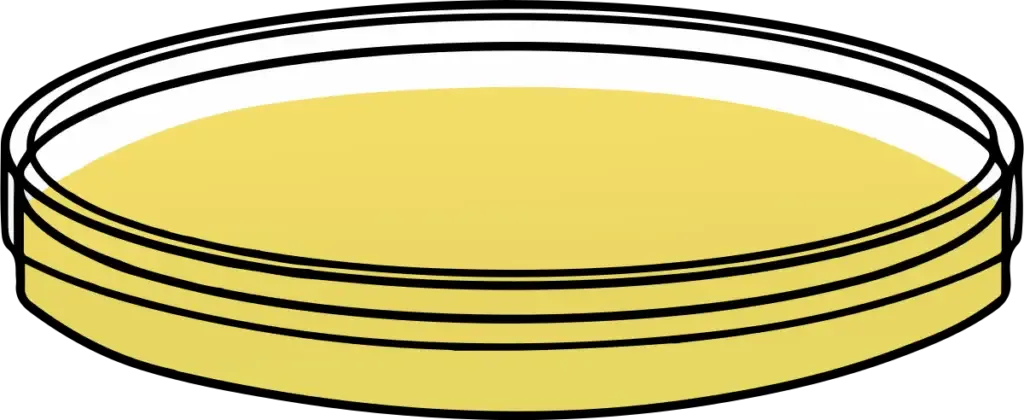
Petri dish is a shallow, flat-bottomed, circular laboratory container with a loose fitting lid. It is used to cultivate, isolate and study microorganisms like bacteria, fungi and cells under controlled sterile conditions.
It is designed to hold nutrient rich growth media, such as agar. Agar gives a supportive base for microbial and cellular growth. It is made of transparent glass or plastic, and the growing colonies are observed without removing the lid.
It was invented by German bacteriologist Julius Richard Petri in 1887. Petri dishes are present in different sizes. The standard size is 90 millimeters in diameter and 15 millimeters in depth.
Petri dish is an essential laboratory apparatus. It is used in microbiology, clinical diagnostics, pharmacology and environmental science.
Purpose of Petri Dish
The following are the important purpose of Petri dish-
- Petri dish is used to grow microorganisms like bacteria, fungi, yeast and viruses. It gives a sterile and flat surface for growth, isolation and observation.
- It is used for growing mammalian cells, plant tissues and embryos. It is useful in biological research and tissue engineering.
- Petri dish is used to identify disease causing microorganisms from patient samples. Blood, urine and wound swabs are cultured in it for detection of pathogens.
- It is used to study the effect of antibiotics on bacteria. Antibiotic discs are placed on the cultured medium and the bacterial resistance is observed.
- It is used to detect microbial contamination in air, water and soil. It is commonly used in hospitals, cleanrooms and laboratory areas.
- Petri dish is used to test food and beverage samples. Harmful bacteria like Salmonella, E. coli and Listeria can be detected by culturing.
- It is used to observe germination of seeds. Moisture and temperature can be controlled and early sprouting is studied.
- Petri dish is used to culture genetically modified organisms. It helps in studying gene expression and DNA manipulation.
- It is used as a small transparent container for insects. Insect behaviour and forensic insect samples can be observed safely.
- Petri dish is used for temporary storage of small liquid, granular or powdered samples. It is also used for evaporation of solvents and drying of precipitates.
- It is used in classroom and laboratory teaching. Microbial growth and hygiene concept can be shown easily to students.
History of Petri Dish
The following are the history of Petri dish-
- Before 1881, early microbiologists including Robert Koch used flat glass slides coated with gelatin. These slides were covered by large glass bell jars called moist chambers. This method was difficult and contamination was common.
- In this method, microscope observation was not easy. Airborne contamination also entered easily and made the bacterial culture impure.
- In 1881, Fanny Angelina Hesse suggested the use of agar instead of gelatin. She was the wife of one of Koch’s researchers.
- Agar is a seaweed derived jelly. It did not melt at high incubation temperature and bacteria also did not easily degrade it. So it became a stable solid medium for microbial growth.
- In 1887, Julius Richard Petri invented the Petri dish. He was a German physician and assistant in Robert Koch’s laboratory.
- Petri modified Koch’s plating technique. He designed a shallow, round and flat-bottomed glass dish with a slightly larger overlapping lid.
- Agar was poured directly into this dish. This removed the need of large bell jars and gave a sterile place for growing microorganisms.
- The overlapping lid helped to protect the culture from airborne contaminants. It also allowed direct microscopic observation of the culture.
- Petri published this invention in 1887. The paper was titled “A minor modification of Koch’s plating technique”.
- In 1929, the Petri dish became important in the discovery of penicillin. Alexander Fleming observed that a mold had contaminated a bacterial culture inside his Petri dish.
- In 1960s, disposable plastic Petri dishes were introduced. These were usually made of polystyrene.
- Plastic Petri dishes became popular because they were light weight, convenient and single-use. They also helped to prevent cross-contamination in many laboratories.
- In modern time, the basic design of Petri dish is almost same for more than 135 years. But some new forms have venting mechanism, compartmentalized parts and special treated surfaces.
- These modern Petri dishes are used in cell culture, tissue culture, genetic research and other advanced laboratory works.
Features of Petri dish
The following are the important features of Petri dish-
- Petri dish is a shallow and flat-bottomed container. It is generally circular in shape, but square Petri dishes are also made.
- It has two main parts. One is the base and other is the lid. The base holds the culture medium and the lid covers the base.
- The lid is slightly larger than the base. It fits loosely over the dish and helps in covering the culture medium.
- The loose fitting lid allows gas exchange. It also prevents dust and airborne contaminants from falling into the culture.
- Some Petri dishes have non-vented lid. This type helps to reduce evaporation and is used for long term or anaerobic work.
- Some Petri dishes have single or triple vents. These vents are small ridges that increases air flow and gas exchange.
- Petri dishes are transparent. So the content and colonies can be observed without opening the lid.
- It is traditionally made of borosilicate glass. Glass Petri dish is durable, heat resistant and can be reused after sterilization.
- Modern disposable Petri dishes are made of clear plastic like polystyrene or polypropylene. Polystyrene is generally single-use and polypropylene can be autoclavable.
- Petri dishes are available in different sizes. Common sizes are 35 mm, 60 mm, 100 mm and 150 mm.
- The standard size of Petri dish is 90 mm in diameter and 15 mm in depth.
- Many Petri dishes have stacking rings or rimmed design. This helps to stack many dishes safely inside incubators.
- Some Petri dishes are divided into two, three or four internal compartments. These are used to test many samples at same time without cross-contamination.
- Some Petri dishes have gridded base. This helps in easy counting of colonies.
- Some Petri dishes have tissue-culture treated surface. This helps in attachment of adherent cells during cell culture work.
Petri dish sizes
The following are the common sizes of Petri dish-
- 35 mm Petri dish is generally 10 mm deep. It holds about 3-5 ml of media. It is used for individual colonies, small scale testing and space saving work.
- 60 mm Petri dish is generally 15 mm to 20 mm deep. It holds about 10-20 ml of media. It is used for cell cultures, small experiments and educational demonstration.
- 70 mm Petri dish is an alternative round size. It is supplied by some manufacturers.
- 90 mm Petri dish is the universal standard size. It is mostly used in microbiology and bacterial culture. It is generally 15 mm to 20 mm deep and holds about 25-30 ml of media.
- 100 mm Petri dish is generally 15 mm to 20 mm deep. It holds about 30-50 ml of media. It is used for larger colonies, tissue cultures, mammalian cell cultures and drug testing.
- 120 mm Petri dish is a larger round dish. It is used when more culture surface is required.
- 150 mm Petri dish is generally 20 mm to 25 mm deep. It holds about 70-150 ml of media. It is used for large scale microbial culture, high-throughput screening and environmental testing.
- Square Petri dishes are also available. Common sizes are 100 × 100 mm, 130 × 130 mm and 250 × 250 mm.
Parts of Petri Dish
A standard Petri dish consists of two main parts. It also has some special parts according to the design and laboratory use.
The following are the parts of Petri dish-
- Base
Base is the bottom part of Petri dish. It is a shallow, flat-bottomed circular container. It holds the culture medium such as agar and biological sample. - Lid
Lid is the cover of Petri dish. It is circular and slightly larger than the base. It sits loosely on the base and protects the culture from airborne contamination. - Vents
Vents are small plastic ridges or protrusions present inside the lid. They lift the lid slightly and allow air flow. It also helps to limit condensation. - Dividers
Dividers are internal walls present in the base. They divide the dish into two, three or four compartments. It is used to test different samples at same time without cross-contamination. - Stacking rings
Stacking rings are rings or slots present in the lid and base. They interlock with each other. It prevents the dishes from sliding and tipping over when stacked in incubator. - Grids
Grids are measurement lines printed on the bottom of base. It helps in measuring density and counting colonies easily.
Types of Petri dishes
Petri dishes are of different types. They are classified according to material, venting design, compartments, shape, surface treatment and handling features.
The following are the types of Petri dishes-
- Glass Petri dishes
Glass Petri dishes are made of borosilicate or soda-lime glass. It is heat resistant, reusable and autoclavable. It is used for long term studies and experiments with harsh chemicals. - Plastic Petri dishes
Plastic Petri dishes are light weight, cheap and mostly disposable. It is used for high-throughput work and single-use laboratory work. - Polystyrene Petri dishes
Polystyrene Petri dishes are clear and low cost. It is used as single-use Petri dish. It cannot be autoclaved because it melts at high temperature. - Polypropylene Petri dishes
Polypropylene Petri dishes are chemical resistant. It can withstand high heat of autoclaving. It is used where sterilization by autoclave is needed. - Vented Petri dishes
Vented Petri dishes have raised ridges on the lid. It allows air exchange. It is used for short term work and aerobic cultures like molds and soil bacteria. - Single vented Petri dishes
Single vented Petri dish lifts the lid at one point only. It allows limited air flow. It reduces evaporation and dehydration during long term aerobic work. - Non-vented Petri dishes
Non-vented Petri dishes have lid which sits flat on the base. It reduces evaporation and external contamination. It is used for anaerobic work and long term observation. - Single chamber Petri dishes
Single chamber Petri dish is the standard open dish. It is used for growing a single culture. - Divided Petri dishes
Divided Petri dishes have internal dividers. It may be bi-plate, tri-plate or quad-plate. It is used to test different samples or different conditions at the same time without cross-contamination. - Round Petri dishes
Round Petri dish is the common and universal form. It is generally used in 90 mm or 100 mm diameter. - Square Petri dishes
Square Petri dishes are also available. It may have grid markings. It is used in automated systems and colony counting works. - Untreated Petri dishes
Untreated Petri dishes have normal unmodified surface. It is used for routine microbial work where cell attachment is not required. - Tissue culture treated Petri dishes
Tissue culture treated Petri dishes have chemically modified plastic surface. The surface becomes hydrophilic. It helps mammalian or plant cells to attach and grow. - Protein-coated Petri dishes
Protein-coated Petri dishes are coated with proteins or synthetic polymers. Collagen, fibronectin, laminin or Poly-D-Lysine are used. It supports sensitive cells like neurons and stem cells. - Stackable Petri dishes
Stackable Petri dishes have raised rims. It helps to stack many dishes safely in incubator and saves space. - Slideable Petri dishes
Slideable Petri dishes have smooth edges. It is used in automated plate filling and streaking system. The machine can slide one dish from a large stack easily.
How to use Petri dishes effectively in a laboratory?
The following are the steps for using Petri dishes effectively in laboratory-
- The lab bench is cleaned and disinfected before starting the work. The work is done inside laminar flow hood or near a Bunsen burner. It helps to create sterile environment.
- Gloves and lab coat are worn during the work. This helps to reduce the risk of introducing contamination.
- The bottom of the Petri dish is labelled clearly with permanent marker. Date, sample type and initials are written on it.
- Agar media is poured carefully under sterile condition. About 15-20 ml agar is added slowly into the dish, so bubbles are not formed.
- The agar plate is kept undisturbed for 20-30 minutes. During this time the agar becomes completely solid.
- Sterilized tools are used for inoculation. Flamed loop or sterile swab is used to streak or spread the microbial sample on the agar surface.
- The lid of Petri dish is lifted as little as possible. It is held at an angle during inoculation to prevent airborne contamination.
- Talking or breathing over the open dish should be avoided. This prevents contamination from mouth and air.
- The dishes are sealed properly with Parafilm tape or other special wrapping. It maintains sterility and protects the culture during long term incubation or storage.
- Petri dishes are incubated upside down at suitable temperature. The temperature is generally 25-37°C according to the microorganism.
- In inverted position, condensation forms on the lid. It does not drip on the culture and the growing colonies are not disturbed.
- Unused sterile dishes are stored upside down. They are kept in sealed plastic bags or airtight containers in dark and dry place between 4-25°C.
- Used Petri dishes are sterilized before disposal. They are autoclaved at 121°C for 15-20 minutes to kill all microorganisms.
- After sterilization, the used dishes are placed in designated biohazard waste bins.
How to grow bacteria in a petri dish?
The following are the steps for growing bacteria in a Petri dish-
- The lab bench is first cleaned and disinfected. The work is done near a Bunsen burner or inside laminar flow hood. Gloves and lab coat are worn during the work.
- Sterile molten agar is taken for pouring. About 15-20 ml nutrient media is poured into the base of Petri dish.
- The agar plate is kept undisturbed at room temperature for 20-30 minutes. During this time the agar becomes solid and forms about 3-4 mm layer.
- The bacterial sample is inoculated on the agar surface. Sterile loop, swab or pipette is used for streaking or spreading the sample.
- During inoculation, the lid is lifted only little. It is held at an angle. This protects the culture from airborne contamination.
- The bottom of the Petri dish is labelled with permanent marker. Experiment details, date and sample name are written on it.
- The lid is closed properly. The edges are taped with Parafilm to maintain sterile condition.
- The Petri dish is incubated upside down. This prevents condensation water from dripping on the agar culture.
- The incubation temperature is kept suitable for the bacteria. Generally 25-37°C is used for many bacteria.
- The plate is kept for 24 to 48 hours. During this time the bacterial colonies grow and become visible.
- The colonies are observed through the transparent lid. The lid should not be opened unnecessarily.
- The growth pattern, colony size and appearance are studied without exposing the culture to outside air.
Why is the petri dish placed upside down during incubation?
The following are the reasons for placing Petri dish upside down during incubation-
- Petri dish is placed upside down to prevent condensation drops. During incubation, water vapour may form on the lid. If the dish is kept normal, these drops fall on the agar surface.
- The falling drops can disturb the growing colonies. It may spread the culture over the agar and make the colonies mixed.
- In inverted position, the condensation remains on the lid. It does not drip down on the agar medium.
- It also prevents excess moisture on the agar surface. Too much water can help unwanted microorganisms to spread.
- Petri dish is inverted to reduce contamination. Airborne spores and dust particles cannot easily settle on the culture surface.
- So, inverted incubation helps to keep the culture clean. It also helps to get clear and separate colonies.
Maintenance of petri dishes
The following are the important points for maintenance of Petri dishes-
- Petri dishes should be held by the edges. This prevents scratches, chips or cracks on the dish. Microbes can hide easily in these damaged places.
- Reusable glass dishes should be washed properly after use. Warm water and mild detergent are used to remove debris and organic residue.
- Glass dishes should be checked regularly before use. Dishes with chips, cracks or scratches should be discarded.
- Damaged Petri dishes should not be used. They may cause contamination and also creates safety problems.
- Reusable glass or polypropylene plastic dishes are sterilized in autoclave. The autoclave is kept at 121°C and 15 psi for 15-20 minutes.
- Glass Petri dishes can also be sterilized by dry heat. They are kept in hot air oven at 160-180°C for 1-2 hours.
- Polystyrene Petri dishes should not be autoclaved. They can melt and become deformed at high temperature.
- After autoclaving, the dishes are allowed to cool and dry completely. This prevents unwanted condensation inside the dish.
- The lid edges are sealed with Parafilm or special tape. This helps to maintain sterility during storage or incubation.
- Petri dishes are stored at 4-25°C. It may be kept in refrigerator or at room temperature.
- Laboratory humidity should be maintained between 30-50%. Petri dishes should not be frozen because freezing may damage the packing and integrity.
- Unused and sterilized plates are kept in original sealed packing, plastic bags or airtight containers. They are stored in dark and dust free cabinet.
- Protection from light is important because light can degrade agar. Protection from dust prevents contamination.
- Petri dishes are stored and incubated upside down. The lid remains facing down, so moisture or condensation does not drip on agar or culture surface.
Precautions of Petri dishes
The following are the important precautions of Petri dishes-
- Polystyrene Petri dishes should not be autoclaved. These are disposable plastic dishes and they melt or deform at high temperature.
- Autoclave is used only for reusable glass Petri dishes or polypropylene Petri dishes. These can tolerate high temperature and pressure.
- Gloves, lab coat, safety glasses and closed-toe shoes should be worn during handling of biological samples. It protects the worker and also protects the sample from contamination.
- Microbial culture or cell culture should be done in sterile area. Laminar flow hood, biosafety cabinet or near Bunsen burner flame are used for maintaining sterility.
- The lid should be opened as little as possible. It is held at an angle during work.
- Talking or breathing over the open Petri dish should be avoided. Airborne dust and contaminants may enter into the culture.
- The bottom part of Petri dish should be labelled. The lid should not be labelled because it may be exchanged or removed.
- Petri dishes are incubated and stored upside down. This prevents condensation drops from falling on the agar or culture surface.
- The edges of Petri dish should be sealed properly with Parafilm or special wrap. It helps to maintain airtight condition, moisture and prevents contamination.
- Sterile dishes should be stored at stable temperature. Generally 4-25°C temperature is used.
- Petri dishes should not be frozen. Freezing can damage the packaging and integrity of the dish.
- Plastic Petri dishes should not be exposed to temperature above 40°C during storage. Overheating may damage the plastic dish.
- Glass Petri dishes should be handled carefully. They are held by the edges and checked for chips, scratches or cracks.
- Damaged glass dishes should not be used. Microbes can stay in cracks and scratches and cause contamination.
- Broken glass Petri dishes should be discarded in dedicated sharps container. It should not be mixed with normal waste.
- During autoclaving, dishes should be arranged loosely. Overcrowding should be avoided because steam may not enter properly.
- Slow exhaust cycle is used for glass dishes in autoclave. It helps to prevent cracking of glass dishes.
- Used Petri dishes should not be thrown directly. They are first decontaminated by autoclaving at 121°C for 15-20 minutes.
- After decontamination, the used dishes are discarded safely in biohazard waste bins.
Applications of Petri Dish
The following are the important applications of Petri dishes-
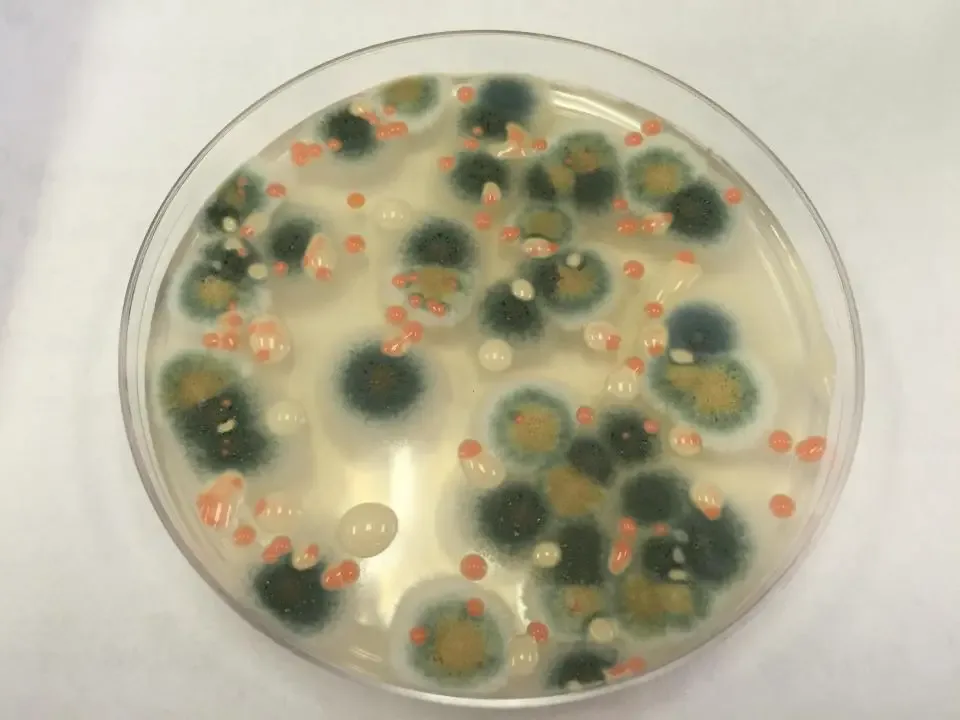
- Petri dishes are used for growing, isolating and identifying microorganisms. Bacteria, fungi, yeast and molds are commonly studied in it.
- It is used in clinical diagnosis. Disease causing pathogens are identified from patient samples like blood, urine, wound swab and throat swab.
- Petri dishes are used for antibiotic susceptibility testing. Different antibiotics or antimicrobial compounds are tested to see their effect on bacterial growth.
- It is used for cell and tissue culture. Mammalian cells, stem cells, cancer cells and plant tissues are cultured in it.
- Petri dishes are used in advanced biological research, regenerative medicine and tissue engineering. It gives a controlled surface for growth of cells and tissues.
- It is used in environmental monitoring. Microbial contamination in air, water and soil are tested by using Petri dishes.
- It is also used to monitor surface hygiene in hospitals and cleanrooms. Microorganisms present on surfaces can be detected.
- Petri dishes are used in food and beverage safety testing. Harmful bacteria like E. coli and Salmonella are detected from food and water samples.
- It is used in drug and vaccine development. New drugs and chemical compounds are tested and cellular immune responses are observed.
- Petri dishes are used in botanical and agricultural studies. Seed germination and plant response to environmental stress are observed in it.
- It is also used in micropropagation. Identical plants can be produced in large number under controlled condition.
- Petri dishes are used in entomology and forensic studies. Insect behaviour, fly larvae and beetle larvae are observed in transparent enclosed dish.
- It is used for evaporation and storage. Solvents are evaporated, precipitates are dried and small liquid, granular, powdered or seed samples are stored temporarily.
- Petri dishes are used in educational demonstration. Microbial growth, hygiene and microbial ecosystem can be shown easily to students.
Advantages of Petri dishes
The following are the important advantages of Petri dishes-
- Petri dishes are transparent. So microbial colonies can be seen, counted and observed clearly without opening the lid.
- The colonies can also be observed directly under microscope. The lid remains closed and the sample is protected from outside air.
- The loose fitting lid prevents dust, spores and airborne particles from falling into the culture.
- The lid also allows air and gas exchange. This is needed for the growth of many organisms.
- Petri dish has flat bottom. So agar or other nutrient media spreads in a uniform layer.
- The even layer of medium helps in equal growth of colonies. It gives more reliable and reproducible experimental result.
- Petri dishes are made in standard sizes. So experiments and results can be compared easily in different laboratories.
- Petri dish is simple and easy to use. It is also low cost and can be used for many biological works.
- Glass Petri dishes are reusable and durable. They are also more environment friendly.
- Glass dishes have good chemical resistance. They can tolerate high heat during autoclave sterilization.
- Plastic Petri dishes are light weight and affordable. They are also shatterproof and easy to handle.
- Plastic dishes are often available as pre-sterilized and single-use form. So cleaning is not needed and cross-contamination is reduced.
- Petri dishes are available in different shapes and sizes. Small dishes like 35 mm save incubator space and reduce the use of culture media.
- Divided Petri dishes have internal walls. They allow testing of many samples at same time without cross-contamination.
Limitations of Petri Dish
The following are the important limitations of Petri dishes-
- Petri dishes have high risk of contamination. Airborne and environmental contaminants may enter if it is not handled by strict aseptic technique.
- The lid gives protection, but it does not make the dish completely free from contamination. Opening of lid during work can introduce dust and microbes.
- Petri dish gives only limited natural condition. It cannot fully show the complex biological condition present in living tissues or natural environment.
- For many modern studies, 3D cell culture and special coated surface are required. Petri dish alone is not sufficient to mimic real tissue condition.
- Petri dishes have space limitation. Their physical size can reduce the efficiency of very large scale experiments.
- Glass Petri dishes are fragile. They can break or shatter easily if dropped.
- Glass dishes are heavier than plastic dishes. They also have higher initial cost.
- Glass Petri dishes need washing and sterilization after every use. This takes more time and labour.
- Some strong alkaline solutions can slowly damage glass surface. This process is called etching.
- Polystyrene Petri dishes have low heat tolerance. They cannot be sterilized in autoclave because they melt and deform.
- Plastic dishes can be damaged by strong organic solvents. Acetone and chloroform may degrade the plastic.
- Plastic Petri dishes are not completely inert. They may release plasticizers or petrochemicals into the culture medium.
- These chemicals may affect sensitive experiments. Cell assays and assisted reproductive works like IVF may be disturbed.
- Most plastic Petri dishes are single use. So they produce large amount of laboratory plastic waste.
- Vented Petri dishes allow gas exchange, but they also cause evaporation. The culture media may dry out within 2 to 3 weeks.
- Long term experiments are difficult in normal vented Petri dishes. Special sealing is required to prevent dehydration.
References
- Three species, three labs, three experiments: testing the reproducibility of ecological studies on insect behaviour in a multi-laboratory setting. (n.d.). ResearchGate.
- 150 mm Petri Dish. (n.d.). Cotaus.
- Dees, J. (2024, October 14). Angelina Fanny Hesse: The story of agar and microbiology. Joyful Microbe.
- Autoclave use and waste validation. (n.d.). Environmental Health and Safety – Virginia Tech.
- Bates, C. (2025, December 25). Borosilicate glass vs. polypropylene labware: Benefits, drawbacks & how to choose. TN LAB Supply.
- Bulk discounts on petri dishes: Polystyrene vs. glass. (2025, April 29). Patsnap Synapse.
- CELLCOAT® Protein coated cell culture vessels. (n.d.). Greiner Bio-One.
- Hall, M., & Whitaker, A. (n.d.). Collection of entomology samples to assist in the investigation of wildlife crime. Natural History Museum.
- Yelimeshyn, S. (2026, April 15). Choosing petri dishes & centrifuge tubes for lab work. Boston Med Supply.
- Choosing the right culture dish coating. (n.d.). World Precision Instruments.
- Byrd, J. H. (n.d.). Collection – Forensic Entomology. Forensic-entomology.com.
- Yelimeshyn, S. (2025, June 2). Complete guide to petri dishes: Types, sizes, and scientific uses. Boston Med Supply.
- Corona and plasma treatment equipment | Medical and pharma. (n.d.). 3DT LLC.
- Do petri dishes always need to be sterilized? (n.d.). Cotaus.
- Ginori, J., Wilson, S. B., Handoyo, W., & Huo, H. (2026, February 10). ENH1397/EP662: A beginner’s guide to begonias: Micropropagation and tissue culture. UF/IFAS Extension.
- Smith, A. J. (2023). FIRS TM5 entomology (3rd ed.). Colorado Mesa University.
- Bozdogan, H. (Ed.). (2023, October). Forensic entomology. Iksad Publishing House.
- Nai, C. (2025, March 12). Fanny Angelina Hesse. Science History Institute.
- Fanny Hesse. (2026, February 15). Wikipedia.
- Fanny Hesse – the woman who made microbiology possible. (n.d.). Transmissible.
- Tsang, J. (2018, May 31). Fanny Hesse, the woman who introduced agar to microbiology. The Microbial Menagerie.
- Singh, A. (2020, December 31). Four stages of micropropagation. Plant Cell Technology.
- How big is a standard petri dish? Sizes, uses & best options. (2025, February 10). Siny Medical.
- How to sterilize plastic petri dishes and agar plates in an autoclave. (2025, December 24). Amuza Inc.
- Yelimeshyn, S. (2025, May 25). How to use and maintain petri dishes in the lab: Storage, sterilization, and disposal. Boston Med Supply.
- Insect rearing protocols in forensic entomology: Benefits from … (n.d.). PMC.
- Instructions for germinating botanical seeds for tissue culture media. (n.d.). USDA ARS.
- Nai, C., & Kaplan, J. (2025, November 24). Julius Richard Petri. Science History Institute.
- Laminin coating protocol for cell culture. (n.d.). Sigma-Aldrich.
- Micropropagation. (n.d.). RHS Advice.
- Campwala, M. (n.d.). Petri dish function and their uses in laboratory. Science Equip.
- Yelimeshyn, S. (2026, April 9). Petri dish meaning: Definition, function & uses in lab. Boston Med Supply.
- Petri dish selection guide. (n.d.). CELLTREAT Scientific Products.
- Roberts, E. F. S. (2014, March 31). Petri dish. Somatosphere.
- Petri dish: Types, facts, uses, care & guide. (2025, October 9). Simson Chemtech.
- Petri dishes. (n.d.). Sigma-Aldrich.
- Petri dishes explained: Everything you need to know. (2025, September 27). AHN Biotechnologie GmbH.
- Petri dishes. (n.d.). Fisher Scientific.
- Petri dishes. (n.d.). Thomas Scientific.
- Petri dish. (2026, April 28). Wikipedia.
- Petri dish 60 x 15 mm fibronectin-coated cellcoat. (n.d.). Dutscher.
- Petri dishes, polystyrene. (n.d.). Sigma-Aldrich.
- Petri plate botanical seed germination protocol. (n.d.). USDA ARS.
- Plasma surface treatment process and mechanism. (n.d.). PIE Scientific LLC.
- Seeds_student procedures. (n.d.).
- Testing the reproducibility of ecological studies on insect behavior in a multi-laboratory setting identifies opportunities for improving experimental rigor. (n.d.). PMC.
- Bios, L. (2025, April 22). The invention and evolution of petri dish. Ucallmlabs.
- The petri dish: Evolution, technical architecture, and multidisciplinary applications in modern science. (n.d.).
- Three species, three labs, three experiments: testing the reproducibility of ecological studies on insect behaviour in a multi-laboratory setting. (n.d.). bioRxiv.
- Hernandez, K. B. (2025, October). Tissue culture. USDA ARS PGRU Hemp Germplasm Laboratory.
- Understanding TC-treated flasks: How plasma surface modification enhances adherent cell culture. (2025, September 9). Stellar Scientific.
- Gifford, D. (2016, April 13). Vented versus non-vented petri dishes. Danna Gifford.
- What is a petri dish? Definition, uses & importance. (n.d.). Borosil Scientific.
- Brudenell, S. (n.d.). What’s the difference between a single vent and triple vent petri dish? Camlab.