

Laminar flow hood or cabinet is a specialized enclosed laboratory workstation which is used to create a sterile and contamination free working area. It is also known as clean bench. It protects the sample and product from dust, bacteria, fungal spores and other airborne particles.
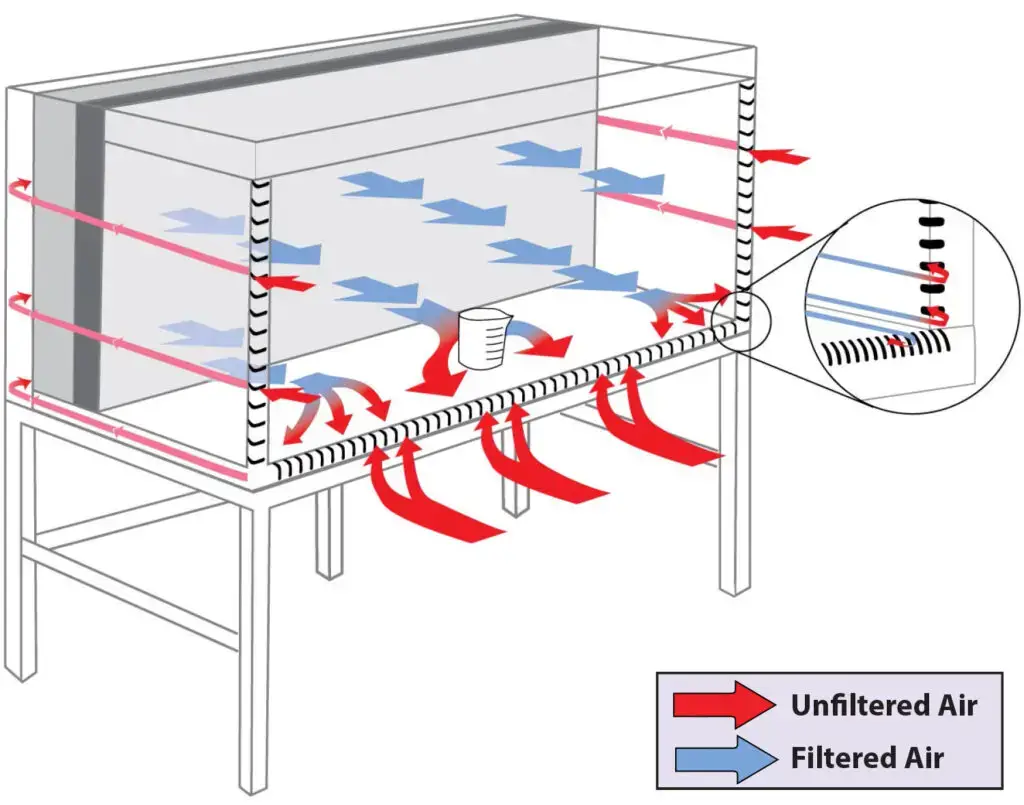
It works by drawing the room air inside the cabinet and passing it through High Efficiency Particulate Air (HEPA) filter. The HEPA filter removes about 99.99% of small particles from the air. The filtered air then passes over the working surface in a continuous and unidirectional flow.
The flow of air is smooth and parallel, so it does not create turbulence inside the cabinet. This type of air movement is called laminar flow. It acts like an invisible barrier and continuously removes the contaminants from the working area before they can settle on the sample.
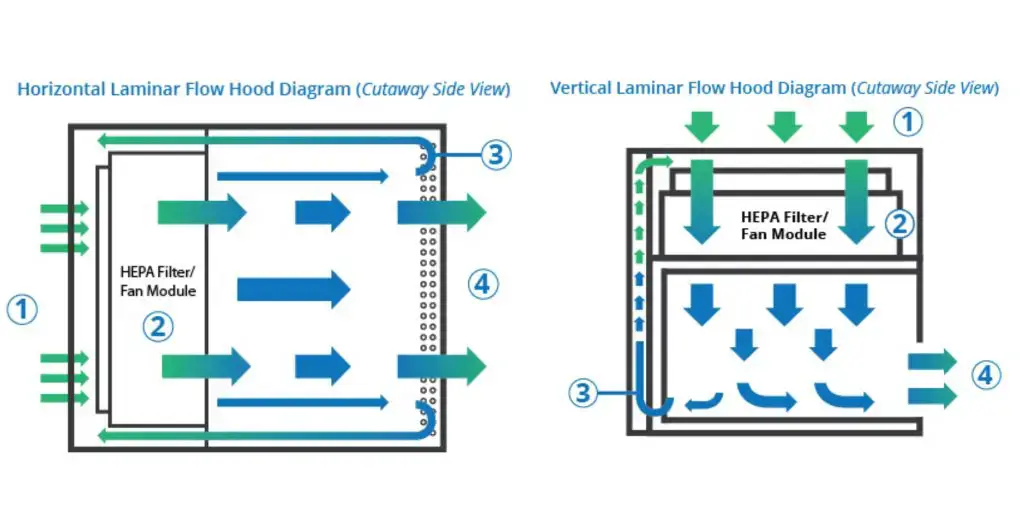
Laminar flow hoods are mainly of two types depending on the direction of air flow. In horizontal laminar flow hood, the filtered air moves from the back side of the cabinet towards the operator. In vertical laminar flow hood, the filtered air moves downward from the upper part of the cabinet to the work surface.
These cabinets are used for non-hazardous works where product protection is important. It is used in pharmaceutical compounding, preparation of sterile media, plant tissue culture, microbiological work with non-infectious material and assembling of sensitive electronic parts.
Laminar flow cabinet gives protection only to the product or sample. It does not protect the worker and surrounding environment. The air from the cabinet may pass towards the operator or into the room.
So, laminar flow hood should not be used for hazardous chemicals, infectious microorganisms and volatile substances. For these materials, biosafety cabinet or fume hood is required.
Principle of Laminar flow hood
The working principle of laminar flow hood is based on the continuous flow of filtered air in one direction. It is used to maintain a sterile and particle free working area. The filtered air removes the dust particles and microorganisms from the working surface.
In this process, the blower motor first draws the room air into the cabinet. The air is passed through a pre-filter. The pre-filter removes the large particles like dust, hair and other debris from the air. It also helps to increase the life of main filter.
After this, the air is forced into a pressurized chamber called plenum. The plenum distributes the air equally towards the High Efficiency Particulate Air (HEPA) filter. Then the air passes through the HEPA filter.
The HEPA filter traps very small contaminants like bacteria, fungal spores and fine dust particles. So, the air becomes clean and sterile. This sterile air then moves over the working surface in smooth and parallel lines.
This smooth and parallel movement of air is called laminar flow. The air flow is unidirectional and continuous. It sweeps away the particles produced during the work and prevents their settling on the sample.
The cabinet also maintains positive pressure inside the working area. This positive pressure prevents the entry of contaminated room air into the cabinet. Thus, laminar flow hood protects the sample and maintains a sterile working environment.
Components/ Parts of Laminar flow hood

The following are the important components of laminar flow hood-
- Cabinet/ Enclosure– Cabinet is the outer body of the laminar flow hood. It is generally made up of stainless steel. It protects the inner clean area from the outside environment. The cabinet has minimum gaps and joints. This prevents the collection of dust, spores and other particles. It also gives support to all the parts of the laminar flow hood.
- Working station/ Work surface– Working station is the flat surface present inside the cabinet. It is the area where sterile work is performed. All sterile materials, media, culture plates and instruments are placed on this surface. It is commonly made up of stainless steel. It is non-porous and easy to clean. It also prevents rusting and reduces the chance of contamination.
- Pre-filter– Pre-filter is present at the air intake region of the cabinet. It removes large particles from the incoming room air. These particles include dust, hair, lint and other large debris. It prevents the entry of large contaminants into the filter system. It also increases the working life of HEPA filter by reducing the particle load.
- Blower/ Fan– Blower is the motorized part of laminar flow hood. It sucks the room air into the cabinet. Then it pushes the air through the filter system. The blower maintains a continuous flow of air inside the cabinet. It helps in creating uniform and steady air movement across the working area.
- HEPA filter– HEPA filter means High Efficiency Particulate Air filter. It is the most important part of laminar flow hood. It removes microscopic contaminants from the air. It traps about 99.97% of very small particles like bacteria, fungal spores, fine dust and other airborne particles. The sterile air from HEPA filter enters the working area and protects the sample from contamination.
- Diffuser screen– Diffuser screen is present near or behind the HEPA filter. It helps to distribute the filtered air evenly. It makes the air flow smooth and uniform. This screen prevents uneven flow of air inside the cabinet. It helps to maintain unidirectional laminar flow over the working surface.
- Front sash/ Glass shield– Front sash is the transparent glass or acrylic shield present at the front side of cabinet. It separates the working area from outside room air. It may be fixed or movable. It protects the sterile materials from external contamination. It also limits direct exposure of operator to the airflow from the cabinet.
- UV lamp– UV lamp is an ultraviolet germicidal lamp present inside the cabinet. It is used to sterilize the inner surface of laminar flow hood before starting the work. UV light kills or inactivates microorganisms present on the working surface and inner walls. It should be switched off during working because it is harmful to eyes and skin.
- Fluorescent or LED lamp– Fluorescent or LED lamp is used to provide proper light inside the cabinet. It illuminates the working area during the procedure. It helps the operator to clearly see the materials and instruments during sterile work. This light does not sterilize the cabinet, it is only used for visibility.
Procedure for running the laminar flow cabinet
The following are the steps to be followed for operating laminar flow cabinet-
- Before starting the work, the cabinet and the surrounding area is checked properly.
- The front opening, air inlet and air outlet should be free from any obstruction.
- The operator should wear laboratory coat, face mask and gloves.
- The gloves are disinfected with 70% alcohol before handling sterile materials.
- If UV lamp is present, the sash is closed and UV light is switched on.
- The UV light is allowed to remain on for 15-20 minutes for sterilization of the working chamber.
- After sterilization, the UV light is switched off.
- The sash is opened up to the required working height.
- The blower and fluorescent light are switched on.
- The cabinet is allowed to run for 15-30 minutes before starting the work.
- During this time, the inside air is removed and proper laminar air flow is established.
- The working surface and inner walls are wiped with 70% isopropyl alcohol.
- Wiping is done from clean area to dirty area, generally from back to front and top to bottom.
- Alcohol or disinfectant should not be sprayed directly on the HEPA filter.
- All required materials are wiped from outside before placing inside the cabinet.
- Only necessary materials should be kept inside the working area.
- The materials are arranged in a clean to dirty manner.
- The working space should not be overcrowded because it may disturb the air flow.
- The air grilles should be kept open and should not be blocked by any bottle or instrument.
- All work is performed inside the cabinet, at least 6 inches away from the front edge.
- The hands should be moved slowly and carefully during the work.
- Sudden hand movement should be avoided because it may break the smooth laminar flow.
- The clean air coming from HEPA filter should directly reach the sterile material.
- Hands, bottles or other objects should not be kept between the HEPA filter and the sterile sample.
- Petri plates, tubes and bottles are opened only when required.
- The lids are kept slightly open and within the sterile air stream.
- After completion of work, all materials and instruments are removed from the cabinet.
- The wastes are discarded in proper waste container.
- The working surface is again wiped with 70% alcohol or suitable disinfectant.
- After cleaning, the blower and light are switched off.
- The sash is closed properly.
- If required, the UV light may be switched on again for sterilization of empty cabinet.
- The gloves and other PPE are removed carefully.
- Hands are washed properly with germicidal soap or hand wash.
Types of laminar flow cabinet

The laminar flow cabinets are mainly classified on the basis of direction of air flow. The following are the types of laminar flow cabinet-
1. Vertical laminar flow cabinet

Vertical laminar flow cabinet is a type of laminar flow hood in which the air flow is from top to bottom.
In this cabinet, the room air is drawn from the upper part of the cabinet. Then the air is passed through HEPA filter and filtered air is forced downward towards the working surface.
The clean air moves vertically over the working area and then goes out through the front opening of the cabinet.
This type of cabinet is suitable for working with large and tall equipment. It requires less depth and less floor space as compared to horizontal laminar flow cabinet.
In vertical laminar flow cabinet, the filtered air is not blown directly towards the face of the operator. So, it gives slightly better safety than horizontal type, but it does not give complete operator protection.
It is commonly used in sterile media preparation, plant tissue culture, pharmaceutical work and other non-hazardous sterile work.
2. Horizontal laminar flow cabinet
Horizontal laminar flow cabinet is a type of laminar flow hood in which the air flow is from back to front.
In this cabinet, the room air is drawn from the back side of the working bench. The air is passed through pre-filter and HEPA filter. Then the filtered air moves forward in horizontal direction over the working surface.
The air flow is parallel to the work surface. So, it gives uniform cleaning effect and less turbulence inside the cabinet.
This type of cabinet gives very good product protection. It is useful for delicate work where contamination of sample must be avoided.
But the filtered air moves directly towards the operator. So, it does not protect the operator from aerosols, fumes, powders or infectious materials.
Horizontal laminar flow cabinet is used in sterile product handling, electronic parts assembly, pharmaceutical compounding and laboratory work with non-hazardous materials.
3. Mobile laminar air flow unit
Mobile laminar air flow unit is a portable type of laminar flow cabinet.
It is provided with wheels or casters, so it can be moved from one place to another inside the laboratory or production area.
This unit gives clean filtered air around the sterile product during transfer. It helps to protect the sterile materials from outside air and contamination.
It is useful for transporting sterile products between different rooms, filling areas or working stations.
Mobile laminar air flow unit is used in pharmaceutical industries, hospitals, clean rooms and other places where sterile material is needed to move safely.
Vertical vs Horizontal Laminar Airflow Hoods
The following are the differences between vertical and horizontal laminar airflow hoods-
- Airflow direction-
Vertical laminar flow hood- Top to bottom.
Horizontal laminar flow hood- Back to front. - Position of HEPA filter-
Vertical laminar flow hood- HEPA filter is present at the top of the cabinet.
Horizontal laminar flow hood- HEPA filter is present at the back wall of the cabinet. - Movement of clean air-
Vertical laminar flow hood- The clean air moves downward on the working surface.
Horizontal laminar flow hood- The clean air moves horizontally across the working surface. - Working space-
Vertical laminar flow hood- It gives more height inside the cabinet.
Horizontal laminar flow hood- It gives more depth and open front working space. - Large equipment-
Vertical laminar flow hood- It is suitable for tall and bulky equipment.
Horizontal laminar flow hood- Large equipment may block the airflow and form stagnant air pocket. - Product protection-
Vertical laminar flow hood- It gives good product protection.
Horizontal laminar flow hood- It gives highest product protection with less turbulence. - Operator protection-
Vertical laminar flow hood- It gives slight safety advantage by pushing non-hazardous aerosols downward.
Horizontal laminar flow hood- It does not protect the operator because air comes towards the face. - Turbulence-
Vertical laminar flow hood- Turbulence may occur when air strikes the work surface.
Horizontal laminar flow hood- Turbulence is less when small materials are used. - Contamination risk-
Vertical laminar flow hood- Downstream contamination may occur if hand or tool is kept above sterile sample.
Horizontal laminar flow hood- Contamination may occur behind large object because airflow is blocked. - Space requirement-
Vertical laminar flow hood- It requires less depth and less floor space.
Horizontal laminar flow hood- It requires more depth and more floor space. - Suitable uses-
Vertical laminar flow hood- It is used for sterile pharmaceutical compounding, PCR preparation, cell culture and work with bulky instruments.
Horizontal laminar flow hood- It is used for electronics assembly, optics work, sterile media preparation and delicate small scale work. - Main disadvantage-
Vertical laminar flow hood- The main disadvantage is downstream contamination.
Horizontal laminar flow hood- The main disadvantage is absence of operator protection.
| Aspect | Vertical laminar flow hood | Horizontal laminar flow hood |
|---|---|---|
| Airflow direction | Clean air flows from top to bottom. | Clean air flows from back to front. |
| Position of HEPA filter | HEPA filter is present at the top of the cabinet. | HEPA filter is present at the back wall of the cabinet. |
| Movement of clean air | The clean air moves downward on the working surface. | The clean air moves horizontally across the working surface. |
| Working space | It gives more height inside the cabinet. | It gives more depth and open front working space. |
| Large equipment | It is suitable for tall and bulky equipment. | Large equipment may block the airflow and form stagnant air pocket. |
| Product protection | It gives good product protection. | It gives highest product protection with less turbulence. |
| Operator protection | It gives slight safety advantage by pushing non-hazardous aerosols downward. | It does not protect the operator because air comes towards the face. |
| Turbulence | Turbulence may occur when air strikes the work surface. | Turbulence is less when small materials are used. |
| Contamination risk | Downstream contamination may occur if hand or tool is kept above sterile sample. | Contamination may occur behind large object because airflow is blocked. |
| Space requirement | It requires less depth and less floor space. | It requires more depth and more floor space. |
| Suitable uses | It is used for sterile pharmaceutical compounding, PCR preparation, cell culture and work with bulky instruments. | It is used for electronics assembly, optics work, sterile media preparation and delicate small scale work. |
| Main disadvantage | The main disadvantage is downstream contamination. | The main disadvantage is absence of operator protection. |
Uses of Laminar flow hood
The following are the uses of laminar flow hood-
- Laminar flow hood is used for preparing non-hazardous sterile medicines.
- It is used in pharmaceutical compounding such as IV admixtures, parenteral nutrition and ophthalmic drops.
- It is used for preparation of sterile media plates.
- It is used for handling and transferring non-pathogenic microorganisms.
- It is used for working with DNA and other non-hazardous biological samples.
- It is used in cell culture work where sterile condition is required.
- It is used in mycology for handling fungal spores, liquid cultures and agar plates.
- It is used in mushroom cultivation to keep mushroom strains pure and free from other molds.
- It is used in plant tissue culture for transferring plant tissues under sterile condition.
- It is used in micropropagation and cloning of plant species.
- It is used in biotechnology work where contamination free environment is needed.
- It is used in electronics and semiconductor industries.
- It is used for inspection of semiconductor wafers and assembling of microchips.
- It is used for handling optical lenses and other dust sensitive parts.
- It is used in medical device assembly.
- It provides particle free area for assembling sterile medical equipment such as pacemakers.
- It is used in clinical laboratories for pathology diagnostic work.
- It is used in IVF laboratories for handling and culturing fragile embryos.
- It is used where product protection is required from dust, spores and airborne particles.
- It is not used for hazardous chemicals, infectious pathogens and volatile materials.
Disadvantages of Laminar flow hood
The following are the disadvantages of laminar flow hood-
- Laminar flow hood gives protection only to the product.
- It does not give protection to the operator and surrounding environment.
- The air from the cabinet is released into the room or towards the operator.
- It should not be used for infectious pathogens and biohazard materials.
- It should not be used for volatile chemicals and toxic substances.
- It is unsafe for hazardous materials because the user protection is absent.
- Large instruments or bulky materials may block the clean air flow.
- Blocking of air flow causes turbulence inside the cabinet.
- Stagnant air pockets may be formed behind large objects.
- This disturbed air flow can contaminate the sterile working area.
- In vertical laminar flow hood, downstream contamination may occur.
- If hand or non-sterile tool is kept above the sample, particles may fall on the sterile site.
- The working space is limited in some types of laminar flow hood.
- Materials cannot be stacked one above another because it disturbs the laminar air flow.
- In horizontal laminar flow hood, HEPA filter may become saturated more quickly.
- The filter needs replacement after some period of continuous use.
- Laminar flow hood consumes more electricity for maintaining continuous air flow.
- The blower fan runs continuously and may produce high noise.
- High noise may create difficulty in communication inside the laboratory.
- Improper use of cabinet may increase the chance of contamination instead of preventing it.
Advantages of Laminar flow hood
The following are the advantages of laminar flow hood-
- Laminar flow hood gives excellent protection to the product.
- It provides clean and sterile working environment for sensitive samples.
- It protects cultures, sterile materials and electronic parts from dust and airborne contaminants.
- It reduces the chance of cross contamination during sterile work.
- It gives continuous filtered air over the working surface.
- The HEPA filtered air removes bacteria, fungal spores and fine dust particles.
- Laminar flow hood is less costly than biological safety cabinet.
- Its maintenance cost is also comparatively low.
- It provides large and clear working area.
- The operator can easily see and handle the materials inside the cabinet.
- Large flasks, culture bottles and other instruments can be used easily.
- It provides unobstructed working space for sterile procedure.
- The working zone does not become too hot during operation.
- Delicate materials like plant tissue culture can be kept inside for longer time.
- It is easy to clean and disinfect after the work.
- The inner surface is generally made up of stainless steel or smooth durable material.
- The smooth surface does not allow easy accumulation of dust and spores.
- It is resistant to many disinfectants and cleaning agents.
- It can be placed on standard laboratory workbench.
- Some laminar flow hoods are compact and portable.
- It is convenient for different laboratory spaces and sterile work areas.
- It is useful for many non-hazardous works like media preparation, plant tissue culture and sterile product handling.
Precautions
The following are the precautions of laminar flow hood-
- Laminar flow hood should not be used for infectious agents, biohazards, potent powders, volatile chemicals and hazardous drugs.
- It should be used only for protection of sample and not for protection of operator.
- UV germicidal lamp should be switched off before working inside the cabinet.
- UV light and air flow blower should not be used at the same time.
- The hood should be placed away from doors, windows, HVAC vents and high traffic areas.
- The blower should be switched on for 15 to 30 minutes before starting the work.
- Clean lab coat, face mask and sterile gloves should be worn before working.
- Hands, arms and large objects should not be placed between HEPA filter and sterile sample.
- First air should not be blocked because it produces turbulence and increases contamination.
- All works should be done at least 6 inches inside from the front edge of the work surface.
- Hand and arm movements should be slow and deliberate inside the cabinet.
- Rapid movement should be avoided because it disturbs the unidirectional air flow.
- Only necessary items should be placed inside the hood.
- Overcrowding should be avoided because it blocks the air grilles and disturbs smooth air flow.
- Cleaning solution should not be sprayed directly on HEPA filter or protective grille.
- The cleaner should be sprayed on lint-free wipe first and then cleaning is done.
- Paper towels should not be used because they shed particles.
- The hood should be cleaned from cleanest area to dirtiest area.
- Wiping should be done from top to bottom and then from back to front.
- The work surface should be kept clean before and after the work.
How to Clean a Laminar Flow Hood
- Purge the cabinet
- The blower of laminar flow hood is switched on.
- It is allowed to run for 15 to 30 minutes before cleaning.
- During this process, airborne contaminants are removed and stable air flow is formed.
- Prepare the supplies
- Cleanroom PPE like gloves and face mask are worn.
- Lint-free cleanroom wipes are collected.
- Mild disinfectant or 70% isopropyl alcohol is taken.
- Apply cleaner on wipe
- The cleaner is sprayed directly on the wipe.
- It should not be sprayed directly on the HEPA filter grille.
- Moisture can damage the delicate filter media.
- Clean from clean to dirty area
- The wiping is done from the cleanest area to the dirtiest area.
- It is wiped in one direction only.
- The wipe is moved from the filter side towards the front exit plane.
- The wipe is folded frequently or changed when it becomes dirty.
- Clean the top portion
- In horizontal hood, the ceiling is wiped from back to front.
- It is moved from left to right.
- In vertical hood, the protective filter grille is wiped gently from left to right.
- It is also moved from back to front.
- Clean the back and side walls
- The rear wall and side walls are wiped after the top portion.
- The cleaning is started from top and continued downward.
- The wiping is done from back side towards the front side.
- Clean the work surface
- The work surface is cleaned at last.
- It is wiped from back towards the front.
- The wiping strokes are overlapped from left to right.
- Final sterilization
- After initial cleaning, the wiping sequence is repeated.
- Sterile 70% isopropyl alcohol is used for final sterilization.
- It helps to remove remaining microorganisms and makes the hood ready for aseptic work.
Do’s and Don’ts When Using Laminar Flow Cabinets
The following are the do’s and don’ts when using laminar flow cabinet-
Do’s
- Do switch on the blower before starting the work.
- Do allow the cabinet to run for 15-30 minutes before use.
- Do purge the cabinet to remove settled airborne contaminants.
- Do remove jewelry before working inside the cabinet.
- Do wash hands and arms properly up to the elbows.
- Do wear proper PPE during the work.
- Do wear sterile gloves, laboratory coat and face mask.
- Do disinfect the inner surface before starting the work.
- Do use 70% isopropyl alcohol or approved disinfectant for cleaning.
- Do use lint free wipes for wiping the surface.
- Do clean from clean area to dirty area.
- Do wipe from top to bottom and from back to front.
- Do wipe all tools, containers and materials before placing inside the cabinet.
- Do keep only required materials inside the working area.
- Do arrange materials from clean side to dirty side.
- Do keep small materials near the HEPA filter side.
- Do keep larger materials away so that air flow is not blocked.
- Do perform all work at least 6 inches inside from the front edge.
- Do move hands and arms slowly inside the cabinet.
- Do open petri plates, tubes and bottles only when required.
- Do keep the lids slightly above the plates or samples during handling.
- Do keep the sterile materials in the direct path of clean air.
- Do clean the cabinet again after completing the work.
- Do discard waste materials in proper waste container.
Don’ts
- Don’t use laminar flow cabinet for hazardous materials.
- Don’t handle infectious pathogens and biohazards inside the cabinet.
- Don’t use toxic, volatile chemicals or hazardous drugs in laminar flow hood.
- Don’t forget that laminar flow hood protects the sample, not the operator.
- Don’t spray disinfectant directly on the HEPA filter or filter grille.
- Don’t wet the HEPA filter because it may damage the filter media.
- Don’t block the first air coming from HEPA filter.
- Don’t place hands, arms, bottles or tools between HEPA filter and sterile sample.
- Don’t overcrowd the working surface with unnecessary materials.
- Don’t use the cabinet as storage place for supplies and instruments.
- Don’t block the air grilles with bottles, racks or waste container.
- Don’t use paper towels for cleaning.
- Don’t use cloth or wipes which can release particles.
- Don’t put head inside the working zone.
- Don’t talk, cough or sneeze towards the open sterile materials.
- Don’t make fast hand movement inside the cabinet.
- Don’t keep non-sterile objects near the sterile critical area.
- Don’t remove lids completely for long time during handling of plates or samples.
- Don’t work when UV light is on.
- Don’t look directly at UV light because it can damage eyes and skin.
- Don’t start work immediately after switching on the blower.
- Don’t leave materials inside the cabinet after finishing the work.
References
- Labs USA. (2026, February 6). A complete guide to the vertical laminar flow hood. [URL]
- GoToPac. (n.d.). A comprehensive guide to updated USP 795, 797, and 800 requirements. [URL]
- Air Science. (2026, March 26). A step-by-step guide to safely using laminar flow cabinets. [URL]
- Kewaunee. (n.d.). Advancements in laminar flow hood technology for enhanced lab safety. [URL]
- RavenclawMD. (2025). Advice needed: Horizontal laminar flow hood (LFH) vs. Class II A2 biosafety cabinet (BSC) for non-pathogenic plant tissue cultures? Reddit. [URL]
- CriticalPoint. (2020, April 8). Air flow smoke pattern testing. Wolters Kluwer. [URL]
- Russell, J. (2025, February 19). Annex 1 and “first air”: What is it and how is it used? Cleanroom Technology. [URL]
- Germfree. (n.d.). Best practices for designing a USP 797 / 800 compliant drug compounding facility. [URL]
- Ossila. (n.d.). Biological safety cabinet vs laminar flow hood. [URL]
- Administration for Strategic Preparedness and Response. (n.d.). Biosafety cabinets: Protection in biological labs. U.S. Department of Health & Human Services. [URL]
- Wikipedia contributors. (2026, March 13). Cleanroom. Wikipedia. [URL]
- GMP Insiders Expert Team. (2025, August 24). Cleanroom classification according to ISO 14644-1. GMP Insiders. [URL]
- ASHP. (n.d.). Compounding sterile preparations, 3rd edition – Sample chapter 21. [URL]
- East West Manufacturing. (n.d.). EC motor vs PSC: Why choose an ECM? [URL]
- Cavallo, C. (2023, December 5). ECM motors vs. PSC motors – What’s the difference? Thomasnet. [URL]
- Engineering and operational analysis of laminar flow systems: Principles, components, and strategic applications in controlled environments. (n.d.). [Markdown]
- CP Lab Safety. (n.d.). FLOW series laminar flow hood, 24″ wide, with HEPA filter. [URL]
- Occupational Services, Inc. (n.d.). Fume hood certifications. [URL]
- Mississippi State University Environmental Health and Safety. (2023, October 20). Fume hood performance certification EH&S SOP. [PDF]
- Liu, B. (2025, July 19). Future of laminar flow | Emerging technologies & trends. YOUTH Clean Tech. [URL]
- Labs USA. (2026, February 5). Guide to the horizontal laminar flow hood. [URL]
- Stoecken, J. (2025, October 2). HEPA grade comparison: How to choose between HEPA 12, HEPA 13, and HEP. Airthereal. [URL]
- CSI Testing. (2025, February 17). HEPA vs ULPA filters in cleanrooms. [URL]
- Lab Supply Network. (n.d.). Horizontal vs vertical laminar flow hoods. [URL]
- Price, F. (2017, November 23). Horizontal vs vertical laminar flow hoods. SelectScience. [URL]
- Baker Co. (2025, January). Horizontal vs. vertical flow clean benches: Choosing the right protection for your work. [URL]
- Monmouth Scientific. (2026, February 26). How biological safety cabinets differ from laminar flow cabinets. News-Medical.Net. [URL]
- Terra Universal. (n.d.). How to clean a laminar flow hood. [URL]
- Clean Air Products. (n.d.). ISO cleanroom requirements guide | Classes & standards. [URL]
- igus. (n.d.). ISO classifications and standards for cleanrooms. Engineer’s Toolbox. [URL]
- Mikropor. (2019). Laminar air flow solutions for cleanroom applications. [PDF]
- University of Michigan Environment, Health & Safety. (n.d.). Laboratory hoods – What’s the difference? [PDF]
- Mishra, R. (2026, January 29). Laminar air flow hood: Working principle, types & uses. Testronix Instruments. [URL]
- Sharma, R. (2026, April). Laminar airflow hoods market research report 2034. Dataintelo. [URL]
- Hinotek. (n.d.). Laminar flow cabinet: The ultimate guide to principles, types … [URL]
- Market Reports World. (n.d.). Laminar flow cabinets market size, share & analysis 2033 report. [URL]
- Allometrics. (n.d.). Laminar flow hood certification | A2LA accredited lab est 1976. [URL]
- O’Kane, M. (n.d.). Laminar flow hood cleaning procedure. Ossila. [URL]
- Bartholomäus, F. (2026, January 1). Laminar flow hood maintenance checklist. osapiens HUB. [URL]
- Sharma, R. (n.d.). Laminar flow hood velocity sensor market research report 2033. Growth Market Reports. [URL]
- Sapkota, A. (2024, May 26). Laminar flow hood/cabinet: Parts, principle, types, uses. Microbe Notes. [URL]
- Simmons, J. (2024, December 31). Laminar flow hood: Essential cleaning tips and best practices. Plant Cell Technology. [URL]
- Cleanroom World. (n.d.). Laminar flow hoods. [URL]
- Terra Universal. (n.d.). Laminar flow hoods and clean benches. [URL]
- Terra Universal. (n.d.). Laminar flow hoods for mushroom cultivation, horticulture, mycology, micropropagation. [URL]
- Thermo Fisher Scientific. (n.d.). Laminar flow hoods vs biosafety cabinets for cell culture (TR). [URL]
- Thermo Fisher Scientific. (n.d.). Laminar flow hoods vs biosafety cabinets for cell culture (US). [URL]
- DFMZ. (n.d.). Laminar flow hoods. [URL]
- ASHP Publications. (n.d.). Mastering hand technique. [URL]
- Perceptiv. (n.d.). Maximize your service calls: ECMs vs. PSCs in residential HVAC. [URL]
- California Attic & Build. (n.d.). PSC vs ECM motor for whole house fans. [URL]
- Quality Solutions, LLC. (n.d.). Services | USP<797>/<800> | Certification and testing. [URL]
- Redwood Mushroom Supply. (n.d.). Still air box vs. flow hood in mushroom cultivation. [URL]
- CSI Testing. (2024, January 3). The different cleanroom types (ISO 1 to ISO 9). [URL]
- Elscolab. (n.d.). The impact of airflow: horizontal versus vertical flow in the laboratory. [URL]
- UNIT IV 4.1: Designing of aseptic area, laminar flow equipment’s 4.2. (n.d.). [PDF]
- Chambre, A. (2016, October). USP 797 compliance in the laminar flow workstation. Air Science. [PDF]
- AirClean Systems. (n.d.). USP 800 non sterile compounding. [URL]
- USP <797> pharmaceutical compounding – sterile preperations. (2008). SEFH. [PDF]
- PMC. (n.d.). USP <800>: Key considerations and changes for health systems. [URL]
- USP General Chapter <797> pharmaceutical compounding – sterile preparations. (2019). [PDF]
- Air Science. (2018, December 19). Vertical laminar flow hoods vs. biological safety cabinets. [URL]
- Airkey. (n.d.). What you need to know about laminar air flow. [URL]
- The Pharmaceutics and Compounding Laboratory. (n.d.). Working in a laminar air flow workbench. [URL]
- Griffith Energy Services. (n.d.). Your furnace replacement: The ECM motor vs. the PSC. [URL]
- CharmingPhoneAd. (2021). [Technique] Laminar flow and HEPA are memes and unnecessary. Reddit. [URL]
- Sea-Example-8070. (2024). [general] Laminar flow hoods – overhead or horizontal flow? Reddit. [URL]
- VA Pharmacy Benefits Management. (n.d.). 〈797〉 Pharmaceutical compounding—sterile preparations. [PDF]