

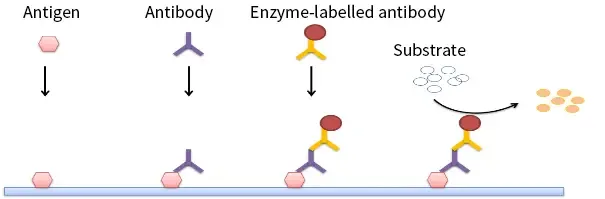
Indirect ELISA (Enzyme-Linked Immunosorbent Assay) is a sensitive laboratory method used to detect specific antibody present in a biological sample like serum. It is called indirect because the enzyme is not attached with the primary antibody. The enzyme is attached with the secondary antibody, which detects the primary antibody.
In this test, a known antigen is first coated on the surface of microplate well. Then patient sample is added. If the specific antibody is present in the sample, it binds with the coated antigen. After washing, enzyme linked secondary antibody is added, which binds with the primary antibody. Then substrate is added and the enzyme acts on the substrate to produce colour.
The colour formed is measured by ELISA reader. More colour means more amount of specific antibody present in the sample. So the result is directly related with the concentration of antibody in patient serum. This makes Indirect ELISA useful for antibody detection.
Indirect ELISA is highly sensitive because more than one enzyme linked secondary antibody can bind with one primary antibody. So the signal becomes amplified. It is also flexible because same secondary antibody can be used for many primary antibodies from same host species. But it takes more time due to extra washing and incubation steps. It may also show cross reaction and false positive result sometimes.
It is mainly used in diagnosis of infectious diseases like HIV, Lyme disease and Hepatitis. It is also used in autoimmune disease diagnosis, allergy testing and vaccine response checking.
Principle of Indirect ELISA
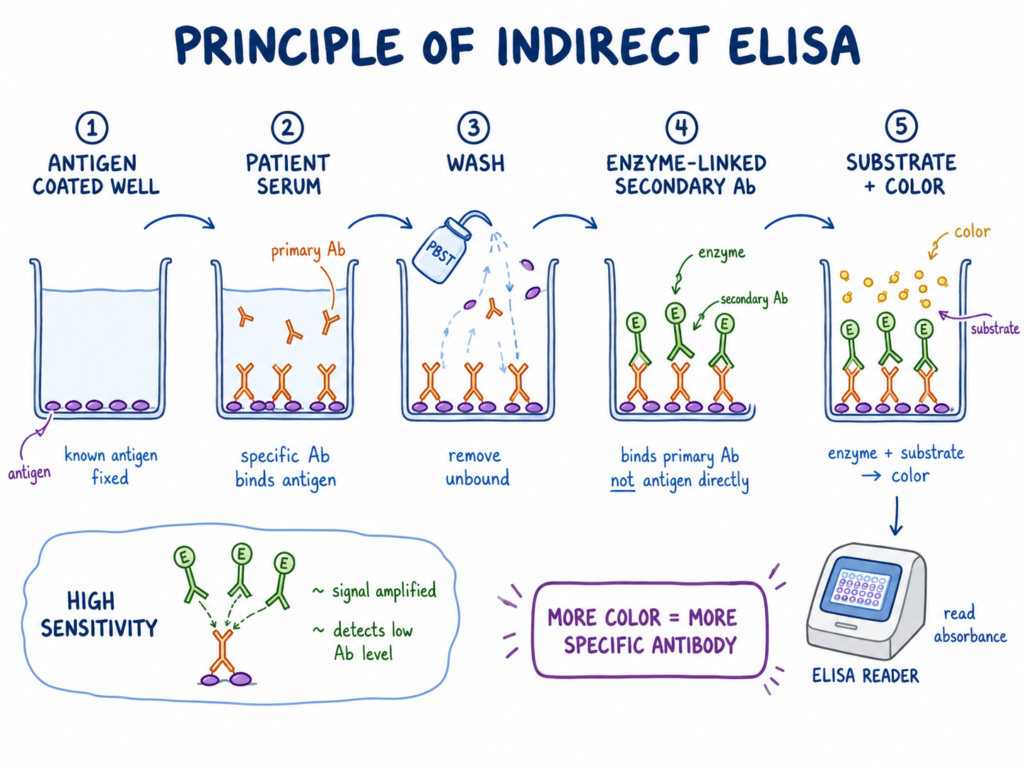
Principle of Indirect ELISA is based on the specific binding between known antigen and specific antibody present in the test sample. In Indirect ELISA, the known antigen is first fixed on the surface of microtiter plate well. Then patient serum is added and the specific primary antibody, if present, binds with that antigen.
After this, washing is done to remove unbound substances. Then enzyme-linked secondary antibody is added. This secondary antibody does not bind with antigen directly. It binds with the primary antibody which is already attached with the antigen.
Then substrate is added into the well. The enzyme present on the secondary antibody acts on the substrate and forms coloured or fluorescent product. The colour formed is measured by ELISA reader. More colour indicates more amount of specific antibody present in the sample.
The sensitivity of Indirect ELISA is high because many enzyme-linked secondary antibodies can bind with one primary antibody. So the signal becomes amplified. This helps to detect even very low amount of antibody in the sample.
Materials and Reagents Required for Indirect ELISA
The following are the important materials and reagents required for Indirect ELISA–
- 96-well microtiter plate
It is used for coating the known antigen. Usually high binding polystyrene or PVC plates are used. - Microplate reader
It is used to measure the colour intensity or optical density of each well. Generally reading is taken at 450 nm or 405 nm according to the substrate used. - Micropipettes and tips
These are used for adding accurate amount of antigen, sample, antibody, buffer and substrate. Multichannel pipette is used when many wells are handled. - Plate sealer or adhesive plastic film
It is used to cover the plate during incubation. It prevents evaporation of liquid from the wells. - Incubator and refrigerator
Incubator is used for maintaining temperature like 37°C during reaction. Refrigerator is used for storage of antigen, antibodies and other reagents at low temperature. - Centrifuge tubes
These are used for preparation of sample dilution, antibody dilution and reagent mixing. - Target antigen
It is the known antigen which is coated on the microtiter plate well. It binds with specific antibody present in the test sample. - Test sample
The test sample is generally patient serum. It may contain specific primary antibody against the coated antigen. - Primary antibody
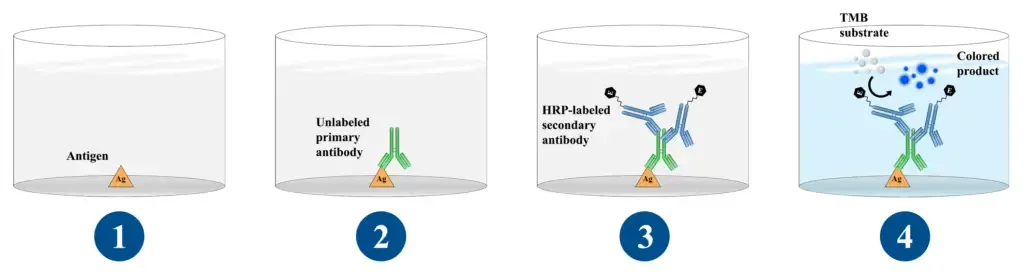
It is an unlabelled antibody present in the sample or taken from specific animal host. It binds specifically with the coated antigen. - Enzyme-conjugated secondary antibody
It is the antibody linked with enzyme such as Horseradish Peroxidase (HRP) or Alkaline Phosphatase (AP). It binds with the primary antibody and helps in colour formation. - Antibody control
It is used to check the accuracy of test result. Species matched or isotype matched non-specific immunoglobulin may be used as control. - Coating buffer
It is used for coating the antigen on the plate surface. Usually carbonate-bicarbonate buffer of pH 9.6 is used. - Phosphate Buffered Saline (PBS)
It provides suitable ionic condition for antigen-antibody reaction. It is used for dilution and washing purpose. - Blocking buffer
It is used to block the empty binding sites on the plate. Bovine Serum Albumin (BSA), non-fat dry milk, casein or gelatin are commonly used in blocking buffer. - Washing buffer (PBST)
It contains PBS with mild detergent like Tween-20. It is used to remove unbound antigen, antibody and other substances after each incubation step. - Substrate solution
It reacts with the enzyme attached to the secondary antibody and produces coloured product. TMB or OPD is used for HRP, and pNPP is used for AP enzyme. - Stop solution
It is used to stop the enzyme-substrate reaction before reading the plate. Sulfuric acid (H₂SO₄) or Hydrochloric acid (HCl) is used for HRP system, and Sodium hydroxide (NaOH) is used for AP system.
Step-by-Step Procedure of Indirect ELISA
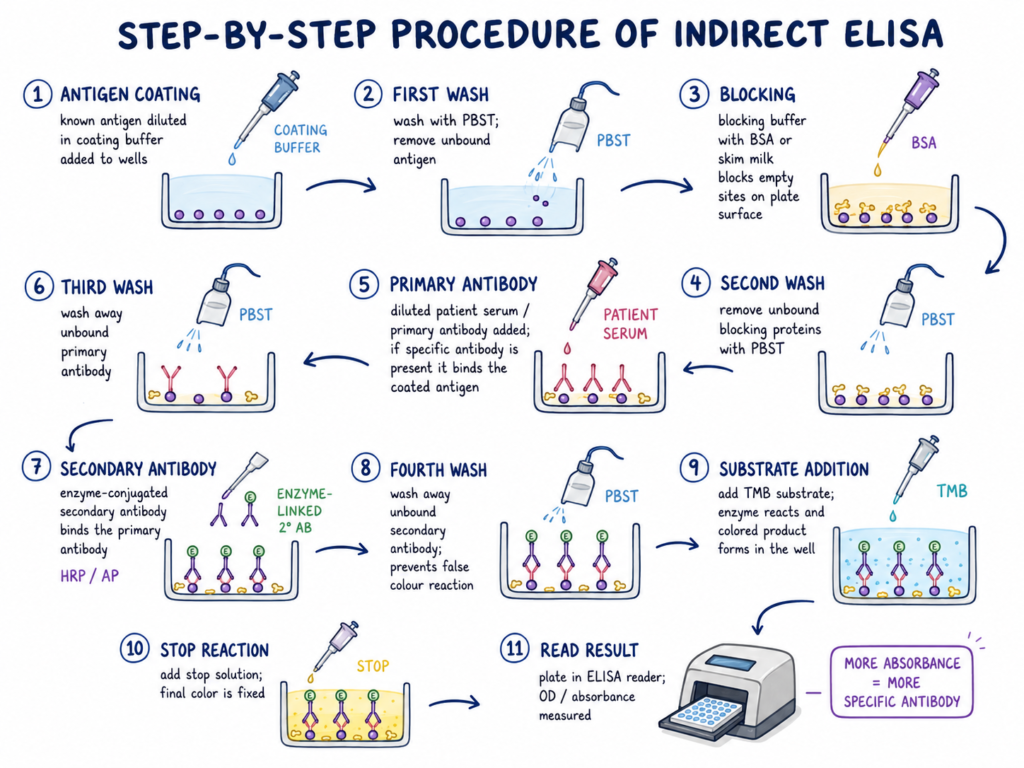
- Antigen coating
The known antigen is diluted in coating buffer. Then it is added into the wells of microtiter plate. The plate is incubated so that antigen attach to the bottom surface of the well. - First washing
The wells are emptied. Then the plate is washed with washing buffer (PBST) for removing unbound antigen from the wells. - Blocking
The blocking buffer is added into each well. It contains inert protein like BSA or skim milk. It blocks the empty sites present on the plate surface and prevents non-specific binding. - Second washing
After incubation, the blocking buffer is removed. The wells are washed again with PBST to remove unbound blocking proteins. - Addition of primary antibody
The diluted patient serum or primary antibody is added into the wells. If specific antibody is present, it binds with the coated antigen. Then the plate is incubated for proper antigen-antibody binding. - Third washing
The plate is washed properly with washing buffer. In this step, unbound primary antibodies and other substances are removed from the wells. - Addition of secondary antibody
The enzyme-conjugated secondary antibody is added into the wells. It binds with the primary antibody already attached with antigen. The secondary antibody usually contains enzyme like HRP or AP. - Fourth washing
The wells are washed again for removing unbound secondary antibody. This washing step is important because free enzyme-linked antibody can give false colour reaction. - Substrate addition
The substrate solution like TMB is added into each well. The enzyme present on secondary antibody reacts with substrate. A coloured product is formed during this reaction. - Stopping the reaction
The stop solution is added to stop the enzyme-substrate reaction. It fixes the final colour formed in the well. - Reading of result
The plate is placed in ELISA reader. The optical density or absorbance is measured at proper wavelength. More absorbance indicates more amount of specific antibody present in the sample.
Role of Primary and Secondary Antibodies in Indirect ELISA
A. Primary Antibody
- Primary antibody is the antibody which binds with the coated antigen on the microtiter plate.
- It is generally present in the patient serum sample. It is not labelled with any enzyme.
- Its main function is to recognize the specific antigen. If the specific antibody is present, it attach with the antigen.
- After binding, it works as the binding site for secondary antibody.
- In Indirect ELISA, the amount of primary antibody is detected. So it is the main antibody of the test.
B. Secondary Antibody
- Secondary antibody is added after the primary antibody binding.
- It does not bind with the coated antigen. It binds with the primary antibody.
- It binds mainly with the Fc region of primary antibody.
- This antibody is linked with enzyme like Horseradish Peroxidase (HRP) or Alkaline Phosphatase (AP).
- After adding substrate, this enzyme act on the substrate and produces colour.
- The colour formed indicates the presence of specific primary antibody in the sample.
- More than one secondary antibody can bind with one primary antibody. So the colour reaction becomes more strong.
- This is why Indirect ELISA is more sensitive.
- But sometime secondary antibody may bind with other proteins. This gives background colour or false positive result. So washing and blocking is important.
Data Analysis and Result Interpretation of Indirect ELISA
- First the OD or absorbance value is taken from sample, standard and control wells. These wells are usually kept in duplicate or triplicate. Then average value is calculated.
- The reading of blank well is subtracted from all sample and standard readings. This gives corrected OD value. It removes background colour and non-specific reaction.
- For quantitative analysis, standard curve is prepared. Known concentration of standard is plotted on X-axis and corrected OD value is plotted on Y-axis.
- The unknown sample OD value is compared with the standard curve. From this, the concentration of specific antibody present in the sample is calculated.
- In many cases, Four Parameter Logistic (4-PL) or Five Parameter Logistic (5-PL) curve is used. Because antigen-antibody reaction gives sigmoid shaped curve. The curve is good when R² value is more than 0.99.
- In clinical test, result is also interpreted by P/N ratio. It is obtained by dividing OD value of patient sample by OD value of negative control.
- If P/N ratio is less than 1.5, the result is taken as negative. It means specific antibody is absent or present in very low amount.
- If P/N ratio is between 1.5 to 2.09, the result is doubtful. In this condition, the test is repeated or confirmed by other method like PCR or Western blot.
- If P/N ratio is 2.1 or more, the result is positive. It indicates that specific antibody is present in the sample.
- The result can also be seen by colour intensity. Dark colour indicates high amount of specific antibody. Light colour indicates low amount. No colour or very faint colour indicates negative reaction.
Advantages of Indirect ELISA
- Indirect ELISA is highly sensitive test. More than one enzyme-linked secondary antibody can bind with one primary antibody. So the colour signal becomes strong.
- It gives signal amplification. Because many enzyme molecules are present with the secondary antibodies. This helps to detect very low amount of specific antibody also.
- It is more flexible method. One labelled secondary antibody can be used for many different primary antibodies of same host species.
- It is cost effective. There is no need to label each primary antibody separately with enzyme. Commercially available labelled secondary antibody can be used.
- The primary antibody remains unchanged because enzyme is not attached with it. So its antigen binding capacity is not much affected.
- It gives better immunoreactivity. The primary antibody can bind properly with the coated antigen.
- It is useful for antibody detection in many samples. Mainly it is used when specific antibody has to be detected in patient serum.
Limitations of Indirect ELISA
- Indirect ELISA may show cross reaction. Because secondary antibody is not specific for the antigen. It may bind with other immunoglobulins present in the sample.
- Sometimes secondary antibody can also bind with blocking proteins or other unwanted proteins on the plate surface. This may give false positive result.
- It may produce high background colour. This happens due to non-specific binding of secondary antibody. So the actual colour signal become difficult to read.
- The procedure is longer than Direct ELISA. Because one extra step of secondary antibody addition is present.
- More washing and incubation steps are needed. If washing is not proper, unbound antibody remains in the well and gives wrong colour reaction.
- It is more complex than direct method. Small mistake in dilution, washing or incubation can affect the final result.
- False positive result may occur if secondary antibody reacts with unwanted sample proteins. So proper blocking and washing is very important in this test.
Applications of Indirect ELISA
The following are the important applications of Indirect ELISA–
- It is used for detection of specific antibody in serum sample.
- It is used in diagnosis of infectious diseases like HIV, Hepatitis B, Hepatitis C, Lyme disease, Syphilis, COVID-19, Measles and Influenza.
- It is used in blood bank for screening of donated blood. This is done before blood transfusion.
- It is used to detect blood borne infections. So infected blood can be rejected.
- It is used in diagnosis of autoimmune diseases. In this case autoantibodies are detected.
- It is used in Systemic Lupus Erythematosus (SLE), Rheumatoid Arthritis and Multiple Sclerosis.
- It is used in allergy testing. The test detects allergen specific Immunoglobulin E (IgE).
- It is used to detect allergy against milk, egg, peanut, dust, pollen and other allergens.
- It is used for checking vaccine response. After vaccination the level of specific antibody is measured.
- It is used to know whether the vaccine has produced immune response or not.
- It is used in cancer marker study. Some tumour associated marker like Prostate Specific Antigen (PSA) can be detected.
- It is used in food safety testing. Hidden food allergens like milk, peanut and egg are detected.
- It is used for detection of food borne pathogens like Escherichia coli.
- It is used in veterinary disease screening. Antibody against infection in animals can be detected.
- It is used in environmental monitoring. Pesticides, heavy metals and other contaminants can be detected in soil and water.
- It is used in toxicology and drug screening. It is also used in forensic sample testing.
- It is used in laboratory research for studying immune response and antibody formation.
References
- Abcam. (n.d.). How to deal with high background in ELISA. https://www.abcam.com/en-us/technical-resources/troubleshooting/high-background-elisa
- Abcam. (n.d.). In-cell ELISA protocol. https://www.abcam.com/en-us/technical-resources/protocols/in-cell-elisa
- Abcam. (n.d.). Indirect & direct ELISA protocol. https://www.abcam.com/en-us/technical-resources/protocols/indirect-and-direct-elisa
- Abcam. (n.d.). What is an ELISA? https://www.abcam.com/en-us/technical-resources/guides/elisa-guide/what-is-an-elisa
- Assay Genie. (2024). 101 ELISA troubleshooting tips for research in 2024. https://www.assaygenie.com/101-elisa-troubleshooting-tips
- Bio-Rad Antibodies. (n.d.). Indirect ELISA protocol. https://www.bio-rad-antibodies.com/indirect-elisa-protocol.html
- Bio-Techne. (n.d.). ELISA troubleshooting guide. https://www.bio-techne.com/resources/protocols-troubleshooting/elisa-troubleshooting
- Comprehensive analysis of the indirect enzyme-linked immunosorbent assay: Historical evolution, biophysical foundations, standardized methodologies, and clinical-industrial utility. (n.d.). [Markdown file].
- Creative Biolabs. (n.d.). Troubleshooting of indirect ELISA. https://www.antibody-creativebiolabs.com/troubleshooting-of-indirect-elisa.htm
- Cusabio. (n.d.). ELISA protocol. https://www.cusabio.com/m-264.html
- Frank, D. (n.d.). A brief history of enzyme testing: ELISA. HistoryCentral. https://www.historycentral.com/BookReviews/Elisha.html
- Lequin, R. M. (2005). Enzyme immunoassay (EIA)/enzyme-linked immunosorbent assay (ELISA). Clinical Chemistry, 51(12), 2415–2418. https://doi.org/10.1373/clinchem.2005.051532
- Lewis, M., & Easthope, E. (2023, May 31). ELISA guide; Part 4: Troubleshooting. Jackson ImmunoResearch. https://www.jacksonimmuno.com/secondary-antibody-resource/immuno-techniques/elisa-guide-part-4-troubleshooting/
- Lumen Learning. (n.d.). EIAs and ELISAs. Microbiology. https://courses.lumenlearning.com/suny-microbiology/chapter/eias-and-elisas/
- Maharjan, S. (2026, April 23). Indirect ELISA: Principle, steps, protocol, applications. Microbe Notes. https://microbenotes.com/indirect-elisa-introduction-steps-advantages-and-protocol/
- Molecular Devices. (n.d.). History of ELISA. [PDF]. https://www.moleculardevices.com/sites/default/files/en/assets/infographics/br/history-of-elisa.pdf
- Molecular Devices UK Ltd. (2023, December 11). Exploring the history behind ELISA. News-Medical.Net. https://www.news-medical.net/whitepaper/20231211/Exploring-the-history-behind-ELISA.aspx
- MyBiosource Editorial Team. (2024, July 12). Applications of Elisa. MyBioSource Learning Center. https://www.mybiosource.com/learn/applications-of-elisa/
- Olsen, C. (2020, December 14). The history of ELISA from creation to COVID-19 research. Molecular Devices. https://www.moleculardevices.com/lab-notes/microplate-readers/the-history-of-elisa
- Pandey, A. (n.d.). ELISA assays – Methods, formats, and applications. NorthEast BioLab. https://www.nebiolab.com/elisa-assays-methods-formats-applications/
- Proteintech. (n.d.). INDIRECT ELISA. [PDF]. https://www.ptglab.com/media/1604/protocols-for-web_indirect-elisa.pdf
- R&D Systems. (n.d.). ELISA troubleshooting guide1: Common questions, tips & tricks. https://www.rndsystems.com/resources/protocols/troubleshooting-guide-elisa-development
- Sigma-Aldrich. (n.d.). ELISA procedures. https://www.sigmaaldrich.com/US/en/technical-documents/protocol/protein-biology/elisa/elisa-procedures
- Sigma-Aldrich. (n.d.). ELISA troubleshooting guide. https://www.sigmaaldrich.com/US/en/technical-documents/technical-article/protein-biology/elisa/elisa-troubleshooting-guide
- Sino Biological Inc. (n.d.). ELISA applications. http://www.elisa-antibody.com/ELISA-applications.html
- Sino Biological. (n.d.). Indirect ELISA protocol. https://www.sinobiological.com/category/indirect-elisa-protocol
- Solv Editorial Team. (2026, June 3). Elisa test: How it works, types, and what your results mean. Solv Health. https://www.solvhealth.com/health/understanding-elisa-enzyme-linked-immunosorbent-assay
- Surmodics. (n.d.). What is the difference between direct and indirect … https://shop.surmodics.com/what-is-the-difference-between-direct-and-indirect-elisa
- Surmodics IVD. (n.d.). Elisa troubleshooting – technical issues. https://shop.surmodics.com/elisa-troubleshooting-guide
- Thermo Fisher Scientific. (n.d.). ELISA troubleshooting guide. https://www.thermofisher.com/us/en/home/life-science/protein-biology/protein-biology-learning-center/protein-biology-resource-library/pierce-protein-methods/overview-elisa/elisa-troubleshooting-guide.html