

Immunogenicity is the inherent ability of a substance to produce an immune response inside the body. It may be a vaccine, biotherapeutic drug, therapeutic protein, or any foreign substance. It is mainly related with the recognition of that substance by the immune system.
During this process, the body can form antigen-specific humoral response and cellular response. Humoral response is mainly antibody based response. Cellular response is mediated by immune cells against the antigen.
Immunogenicity may be useful or harmful. In case of vaccines, it is a desirable property because it helps the body to build protection against a particular pathogen. So here immunogenicity is the main clinical aim.
In case of therapeutic proteins and biologic drugs, immunogenicity is mostly unwanted. The immune system may identify the biologic drug as a foreign substance. Then it produces anti-drug antibodies (ADAs) against the drug.
These ADAs can neutralize the activity of the drug. They may also change the clearance of the drug from systemic circulation. In some cases, it may cause safety problems and adverse clinical outcome in the patient.
Properties of Immunogen
The following are some important properties of immunogen–
- An immunogen should be foreign to the host body. More difference from host protein, more strong immune response is produced.
- The molecular structure of immunogen is important. Its amino acid sequence, physical structure and chemical nature help in recognition by immune system.
- The protein molecule may form aggregates. These protein aggregates are large and repeated structure, so they can stimulate immune system strongly.
- Some changes may occur after protein formation. These are called post-translational modifications (PTMs). Non-human glycans are easily recognized as foreign by immune system.
- During storage or manufacturing, protein may get chemically degraded. Oxidation and deamidation can change protein shape and form new foreign region called neoepitopes.
- Some impurities may also increase immunogenicity. Host cell proteins, trace chemicals and leachables may act as danger signals and stimulate immune response.
Factors affects Immunogenicity
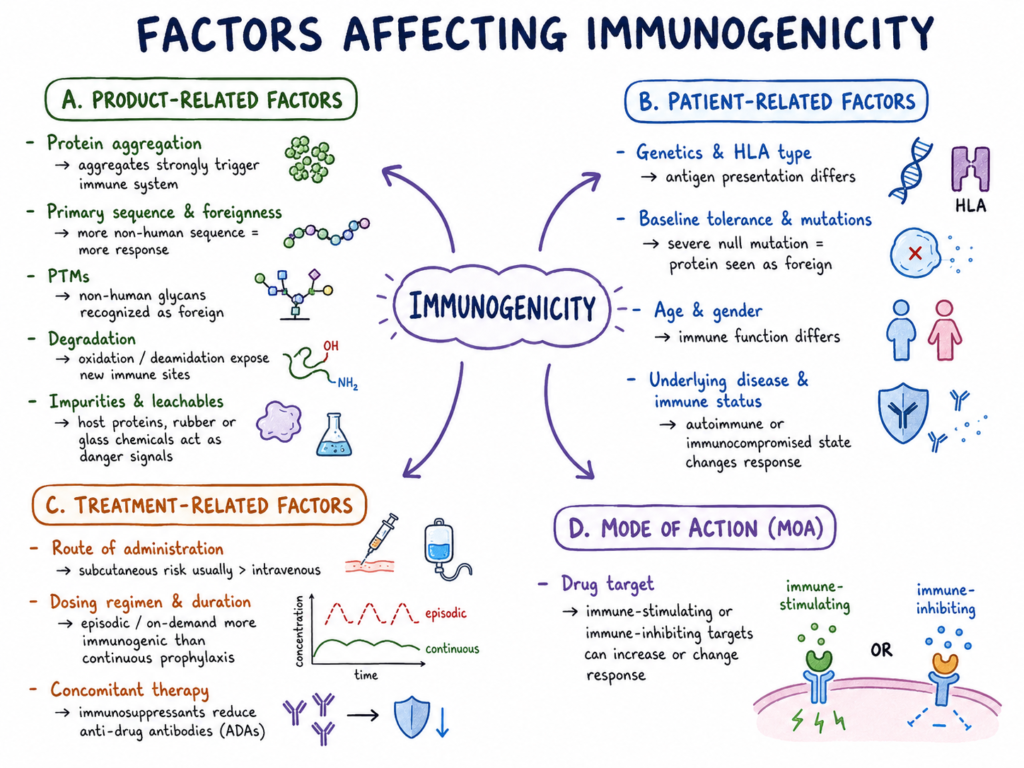
The factors affecting immunogenicity are grouped as follows-
A. Product-related factors
- Protein aggregation– The protein molecules may clump together and form large multimeric structure. These aggregates can strongly trigger the immune system.
- Primary sequence and foreignness– The amino acid sequence of therapeutic protein may differ from normal human protein. More foreign sequence can produce more immune response.
- Post-translational modifications (PTMs)– Some structural changes occur during manufacturing. Non-human sugar structure or glycans may be added and it is recognized as foreign by immune system.
- Degradation– The protein may be chemically changed during production or storage. Oxidation and deamidation can change the protein shape and expose new immune stimulating sites.
- Impurities and formulation leachables– Trace contaminants, host cell proteins, and chemicals from rubber stopper or glass syringe may be present. These act as danger signals and stimulate immune response.
B. Patient-related factors
- Genetics and HLA type– The genetic nature of patient affects immunogenicity. Human Leukocyte Antigen (HLA) alleles decide how drug fragments are bind and presented to immune cells.
- Baseline tolerance and mutations– Some patients produce the target protein naturally, so tolerance is present. But in severe null mutation, the protein is absent and therapeutic protein may be recognized as foreign.
- Age and gender– Age and sex of patient affects immune function. Hormone signalling and number of naive and memory immune cells may be different in different patient.
- Underlying disease and immune status– The disease condition also affects immunogenicity. In autoimmune disease, immunocompromised condition or other immune disorder, immune response may be changed.
C. Treatment-related factors
- Route of administration– The way of drug entry into the body affects immune response. Subcutaneous injection generally has more immunogenic risk than intravenous infusion.
- Dosing regimen and duration– Dose amount, frequency and treatment period affects immunogenicity. Episodic or on-demand dosing is usually more immunogenic than continuous prophylactic treatment.
- Concomitant therapy– Other drugs given with therapeutic protein may change immune response. Immunosuppressant drugs can suppress immune response and reduce formation of anti-drug antibodies (ADAs).
D. Mode of action (MOA)
- Drug target– The working mechanism of biologic drug also affects immunogenicity. If the drug target, stimulate or inhibit immune system components, then immune response may be increased or changed.
Significance of Immunogenicity
The following are some important significance of immunogenicity–
- Vaccine efficacy– In vaccines, immunogenicity is useful property. It shows that body can produce protective immune response against an infectious disease. So it is taken as main clinical end point in vaccine study.
- Therapeutic effect– In biopharmaceuticals, immunogenicity is usually unwanted. Anti-drug antibodies (ADAs) may bind with the therapeutic protein. As a result drug action become low or sometimes it is completely blocked.
- Drug clearance– ADAs may combine with the drug and form circulating immune complex. These complexes are cleared fast from the body. So the amount of drug present in blood become less.
- Drug behaviour– Immunogenicity can change pharmacokinetics and pharmacodynamics of drug. The drug may not remain in body for proper time. Its effect also become unpredictable.
- Adverse reaction– Immune response against therapeutic protein may cause local or systemic reaction. It may be mild allergy, hypersensitivity, infusion reaction or severe anaphylaxis.
- Autoimmune reaction– Sometimes ADAs may cross react with natural body proteins. This may block normal physiological function. It can cause serious condition like antibody mediated Pure Red Cell Aplasia (PRCA).
- Regulatory need– Immunogenicity assessment is needed for approval of biologic drugs and biosimilars. Authorities like FDA and EMA ask for risk based immunogenicity testing for safety and efficacy.
- Dose adjustment– Monitoring of immunogenicity helps to know how much immune response is produced and how long it remains. It helps in changing dose schedule and finding treatment failure in patient.
- Patient safety– Study of immunogenicity is important to reduce risk in patient. It helps to plan safer treatment and avoid serious immune related problems.
References
- Abzena. (n.d.). EpiScreen® 2.0 MAPPs: MHC Class II Associated Peptide Proteomics.
- Assessing MAPPs assay as a tool to predict the immunogenicity potential of protein therapeutics – PMC. (n.d.). PubMed Central (PMC).
- Assessment and Reporting of the Clinical Immunogenicity of Therapeutic Proteins and Peptides—Harmonized Terminology and Tactical Recommendations – PMC. (n.d.). PubMed Central (PMC).
- Carcao, M., & Goudemand, J. (2018). Inhibitors in Hemophilia: A Primer (5th ed.). World Federation of Hemophilia.
- Danaher Life Sciences. (n.d.). Regulatory Mechanisms in Antibody Production.
- (PDF) De-immunization of therapeutic protein by T-cell epitope modification – ResearchGate. (n.d.). ResearchGate.
- De-immunization of therapeutic proteins by T-cell epitope modification – PubMed. (n.d.). PubMed.
- Development of ImmTOR Tolerogenic Nanoparticles for the … (n.d.). PubMed Central (PMC).
- Efficacy, safety profile, and immunogenicity of alglucosidase alfa produced at the 4000-liter scale in US children and adolescents with Pompe disease: ADVANCE, a phase IV, open-label, prospective study – PubMed. (n.d.). PubMed.
- Epoetin-associated pure red cell aplasia: past, present, and future considerations – PMC. (n.d.). PubMed Central (PMC).
- European Medicines Agency. (2017). Guideline on immunogenicity assessment of biotechnology-derived therapeutic proteins – Revision 1.
- Factor VIII inhibitors in hemophilia A: rationale and latest evidence – PMC. (n.d.). PubMed Central (PMC).
- Factors That Influence the Immune Response to Vaccination – PMC. (n.d.). PubMed Central (PMC).
- Factors affecting the immunogenicity of influenza vaccines in human – PubMed. (n.d.). PubMed.
- Food and Drug Administration. (2011). Guidance for Industry: General Principles for the Development of Vaccines to Protect Against Global Infectious Diseases. U.S. Department of Health and Human Services.
- Food and Drug Administration. (2014). Immunogenicity Assessment for Therapeutic Protein Products. U.S. Department of Health and Human Services.
- Food and Drug Administration. (2019). Immunogenicity Testing of Therapeutic Protein Products—Developing and Validating Assays for Anti-Drug Antibody Detection. U.S. Department of Health and Human Services.
- Genoskin. (2024). Immunogenicity series: Defining immunogenicity.
- Guelcher, C. (2018). Inhibitor Development: Understanding the Immune System. National Hemophilia Foundation.
- Immunogenicity of Biotherapeutics: Causes and Association with … (n.d.). PubMed Central (PMC).
- Immunogenicity of Protein Pharmaceuticals – PMC – NIH. (n.d.). PubMed Central (PMC).
- Immunogenicity of protein therapeutics: The key causes … – PMC – NIH. (n.d.). PubMed Central (PMC).
- IQVIA. (n.d.). Immunogenicity.
- Karle, A. C., Kopp, K. L., Seward, R. J., Tourdot, S., Ackaert, C., Gutknecht, M., Cloake, E., Smith, N., & Ducret, A. (2025). MAPPs assays for non-clinical immunogenicity risk assessment: best practices recommended by the European immunogenicity platform. Frontiers in Immunology, 16, 1690101. https://doi.org/10.3389/fimmu.2025.1690101
- Lee, M. V., Saad, O. M., Wong, S., LaMar, J., Kamen, L., Ordonia, B., Melendez, R., Hassanzadeh, A., Chung, S., & Kaur, S. (2023). Development of a semi-automated MHC-associated peptide proteomics (MAPPs) method using streptavidin bead-based immunoaffinity capture and nano LC-MS/MS to support immunogenicity risk assessment in drug development. Frontiers in Immunology, 14, 1295285. https://doi.org/10.3389/fimmu.2023.1295285
- Lipidic Nanoparticles Comprising Phosphatidylinositol Mitigate Immunogenicity and Improve Efficacy of Recombinant Human Acid Alpha-Glucosidase in a Murine Model of Pompe Disease – PubMed. (n.d.). PubMed.
- Locatelli, F., Del Vecchio, L., & Pozzoni, P. (2007). Pure red-cell aplasia “epidemic”–mystery completely revealed?. Peritoneal Dialysis International, 27(Suppl 2), S303-S307.
- National Organization for Rare Disorders (NORD). (n.d.). Pompe Disease: Symptoms, Causes, and Treatment Options [Video]. YouTube.
- Parameters potentially affecting interpretation of immunogenicity and efficacy data in vaccine trials: are they adequately reported? – PubMed. (n.d.). PubMed.
- Rapamycin nanoparticles increase the therapeutic window of engineered interleukin-2 and drive expansion of antigen-specific regulatory T cells for protection against autoimmune disease – PubMed. (n.d.). PubMed.
- Recombinant human acid -glucosidase: Major clinical benefits in infantile-onset Pompe disease | Request PDF – ResearchGate. (n.d.). ResearchGate.
- Regulatory and strategic considerations for addressing immunogenicity and related responses in biopharmaceutical development programs – PMC. (n.d.). PubMed Central (PMC).
- Schellekens, H. (2002). Immunogenicity of therapeutic proteins: clinical implications and future prospects. Clinical Therapeutics, 24(11), 1720-1740. https://doi.org/10.1016/s0149-2918(02)80075-3
- Schellekens, H. (2005). Factors influencing the immunogenicity of therapeutic proteins. Nephrology Dialysis Transplantation, 20(suppl_6), vi3-vi9. https://doi.org/10.1093/ndt/gfh1092
- Scott, D. W., & Pratt, K. P. (2020). Factor VIII: Perspectives on Immunogenicity and Tolerogenic Strategies. Frontiers in Immunology, 10, 3078. https://doi.org/10.3389/fimmu.2019.03078
- Shadbar, S., Balu-Iyer, S. V., Auclair, J., & Dadon, D. (2025). Immunogenicity risk mitigation of therapeutic proteins with translational immunogenicity, analytical characterization, and regulatory insight. Journal of Pharmaceutical Sciences, 114(11), 103870. https://doi.org/10.1016/j.xphs.2025.103870
- Singapore Health Sciences Authority. (n.d.). Increase in antibody-mediated Pure Red Cell Aplasia (PRCA) cases with subcutaneous administration of Eprex® (epoetin alfa) in Singapore.
- Singh, S. K. (2011). Impact of product-related factors on immunogenicity of biotherapeutics. Journal of Pharmaceutical Sciences, 100(2), 354-387. https://doi.org/10.1002/jps.22276
- Symmetric. (2025). PK and ADA Assays: ICH M10, FDA & EMA Guidance Explained.
- Synergistic activity of IL-2 mutein with tolerogenic ImmTOR nanoparticles leads to massive expansion of antigen-specific Tregs and protection against autoimmune disease | bioRxiv. (n.d.). bioRxiv.
- Systemic Determinants of Biotherapeutic and Vaccine Immunogenicity: Molecular Mechanisms, Clinical Pathology, and Regulatory Validation Frameworks. (n.d.).
- T and B cell epitope analysis for the immunogenicity evaluation and mitigation of antibody-based therapeutics – PMC. (n.d.). PubMed Central (PMC).
- T-Cell Dependent Immunogenicity of Protein Therapeutics Pre … (n.d.). PubMed Central (PMC).
- The Increased Incidence of Pure Red Cell Aplasia With an Eprex Formulation in Uncoated Rubber Stopper Syringes – PubMed. (n.d.). PubMed.
- The WHO Algorithm for Causality Assessment of Adverse Effects Following Immunization with Genetic-Based Anti-COVID-19 Vaccines: Pitfalls and Suggestions for Improvement – PMC. (n.d.). PubMed Central (PMC).
- The unwanted defense: Immunogenicity in protein-based therapies | Drug Discovery News. (n.d.). Drug Discovery News.
- Wakshull, E. (2017). Overview of clinical immunogenicity: whys and wherefores. Bioanalysis Zone.
- World Health Organization. (2004). Guidelines on clinical evaluation of vaccines: regulatory expectations. WHO Technical Report Series, 924, Annex 1.
- World Health Organization. (2017). Annex 9: Guidelines on clinical evaluation of vaccines: regulatory expectations. WHO Technical Report Series, 1004.
- Zagórska-Fedoruk, K., & Szydłowska, M. (2025). Immunogenicity Assessment in Clinical Trials: Purpose, Principles, and Benefits. Medicover MICS.
- Zimmermann, P., & Curtis, N. (2019). Factors That Influence the Immune Response to Vaccination. Clinical Microbiology Reviews, 32(2), e00084-18. https://doi.org/10.1128/CMR.00084-18