

Thin Layer Chromatography (TLC) is an analytical technique used for separation and identification of components present in non-volatile mixtures. It is carried out on a TLC plate, which is made up of glass, plastic or aluminium sheet coated with thin layer of adsorbent material.
The adsorbent material is generally silica gel or alumina, which acts as stationary phase. A small spot of sample is applied near the lower end of the plate and the plate is placed in a closed chamber containing solvent. This solvent acts as mobile phase.
During this process, the solvent moves upward on the plate by capillary action and carries the sample components along with it. Different components move at different speed because their attraction towards stationary phase and mobile phase is different.
After separation, different components appear as separate spots on the plate. If the spots are colourless, then UV light or chemical staining reagent is used for their detection.
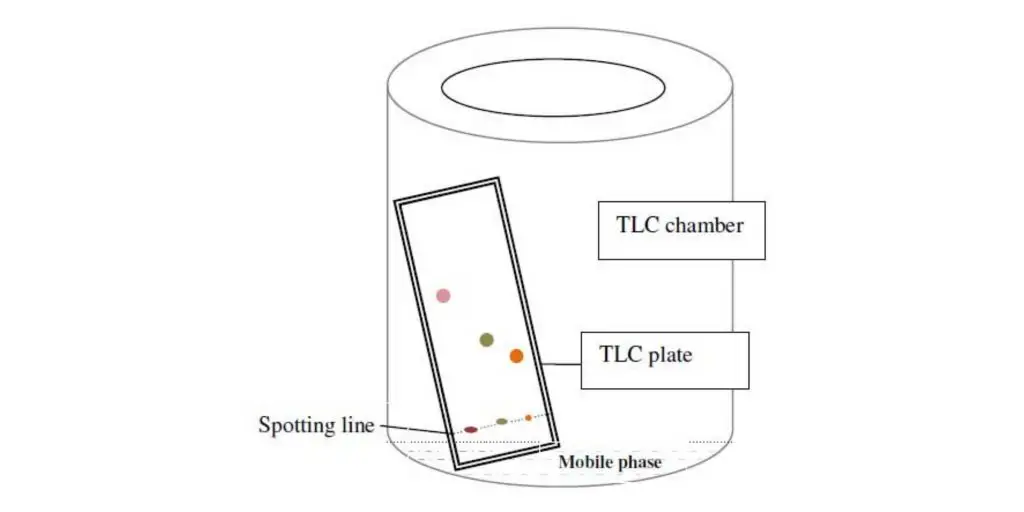
Principle of thin layer chromatography
Thin Layer Chromatography is based on the principle of differential adsorption and sometimes partition between stationary phase and mobile phase. In this method, a thin layer of adsorbent material such as silica gel or alumina coated on a plate acts as stationary phase.
The sample mixture is applied near the lower end of the TLC plate and the plate is placed in a chamber containing solvent. The solvent acts as mobile phase and moves upward through the adsorbent layer by capillary action carrying the sample components along with it.
The different components of mixture move at different speed because their affinity towards stationary phase and mobile phase is different. The compounds having more attraction towards stationary phase move slowly, whereas the compounds having greater solubility in mobile phase move faster and travel more distance on the plate.
Thus the components of mixture become separated as distinct spots on the TLC plate and can be identified after visualization.
Components of Thin Layer Chromatography (TLC)
The following are the components of Thin Layer Chromatography (TLC)–
- Stationary phase – It is the TLC plate made up of glass, aluminium or plastic sheet. It is coated with thin layer of adsorbent like silica gel, alumina or cellulose.
- Adsorbent layer – It is the layer where separation of mixture components takes place. Its thickness is about 0.1-0.25 mm in analytical TLC and 0.5-2 mm in preparative TLC.
- Binder – Sometimes calcium sulfate (CaSO₄·2H₂O) is added with adsorbent. It helps the adsorbent layer to stick properly on the plate surface.
- Mobile phase – It is the solvent or mixture of solvents which moves over the stationary phase by capillary action. Selection of solvent depends upon polarity of the compounds.
- Sample – It is the mixture which contains substances to be separated. It is spotted near the lower edge of TLC plate by capillary tube or micropipette.
- Developing chamber – It is a closed glass jar or tank used for developing the chromatogram. The chamber contains solvent and TLC plate during separation.
- Chamber saturation – The chamber is saturated with solvent vapour before development. It helps in proper movement of solvent and reduces evaporation error.
- Visualization system – It is used to detect separated spots after development. UV light, iodine vapour, ninhydrin reagent and sulfuric acid charring are commonly used.
Procedure of Thin Layer Chromatography (TLC)
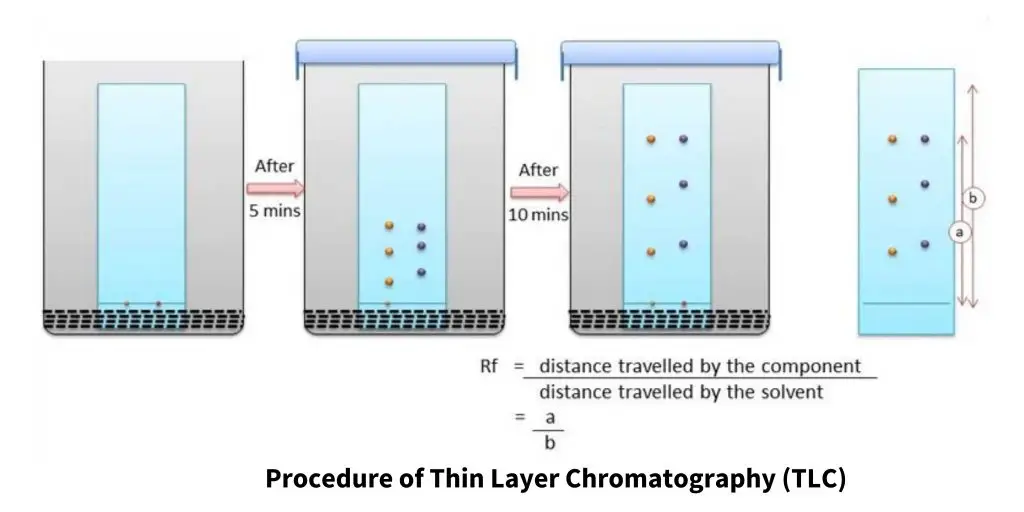
The following are the procedure of Thin Layer Chromatography (TLC)–
- The TLC plate is first cut into suitable size and a straight baseline is drawn with pencil about 1 to 1.5 cm above from the lower edge. Ink pen is not used because ink may move with solvent and disturb the result.
- The sample is dissolved in a suitable volatile solvent. A small concentrated spot of sample is applied on the pencil line with the help of fine capillary tube. The spot should be small and it is allowed to dry.
- The developing solvent or mobile phase is poured into the developing chamber in shallow amount. A filter paper may be kept inside the chamber and the chamber is closed for few minutes to saturate it with solvent vapour.
- The spotted TLC plate is placed vertically inside the chamber. The solvent level should be below the baseline, otherwise the sample spot may dissolve directly into the solvent.
- The solvent is allowed to move upward on the plate by capillary action. During this process, the sample components move with solvent and become separated according to their affinity.
- When the solvent front reaches near the upper edge of the plate, the plate is removed from chamber. The solvent front is immediately marked with pencil and plate is dried.
- The dried plate is observed under UV light if the spots are colourless. Iodine vapour, potassium permanganate or other staining reagents can also be used for visualization of spots.
- The distance travelled by each separated spot and solvent front are measured. Then Rf value is calculated by dividing distance travelled by compound with distance travelled by solvent front.
What is Retention Factor (Rf ) Value
The following are the important points of Retention Factor (Rf) value–
Retention Factor (Rf) is a measurement used in Thin Layer Chromatography (TLC) to show the movement of each separated compound on the chromatographic plate. It is also called retardation factor.
It is calculated by comparing the distance moved by the compound with the distance moved by the solvent front. Both distances are measured from the origin line.
The formula of Rf value is-
Rf = Distance travelled by compound / Distance travelled by solvent front
The value of Rf always lies between 0 and 1. If a compound does not move from the baseline, its Rf value is 0. If the compound moves along with solvent front, its Rf value is 1.
The Rf value shows the affinity of compound towards stationary phase and mobile phase. In normal TLC, polar compounds are held more strongly by the stationary phase, so they move slowly and give lower Rf value.
Non-polar compounds have more affinity for the mobile phase. So they move more distance with the solvent and show higher Rf value.
Rf value is used for identification of unknown compounds. The value is compared with known standard compound under same experimental conditions.
Applications of Thin Layer Chromatography (TLC)
The following are the applications of Thin Layer Chromatography (TLC)–
- TLC is used to check the progress of chemical reaction. The starting material spot slowly disappears and new product spot appears on the plate.
- It is used for checking purity of synthesized compound or any sample. A pure substance generally gives one clear spot on the TLC plate.
- It is used in drug analysis for checking stored drugs, raw materials and final formulations. The metabolic profile of drugs can also be studied by this method.
- In forensic work, TLC is used for identification of abused drugs and poisons in body fluids. Explosive residues, warfare agents and ink dyes of questioned documents are also analysed.
- It is used for detection of pollutants present in soil, water and air samples. Heavy metals, pesticides, herbicides, VOCs and petroleum products can be detected.
- It is used in food and cosmetic testing. Food additives, preservatives, sweetening agents, cosmetic colours and antibiotic residues in meat, milk and fish are separated and identified.
- It is used in plant analysis for identifying active constituents and metabolites of medicinal plants. Plant extracts, spices and oils are also checked by TLC.
- TLC is used for separation of biological molecules like amino acids, carbohydrates, lipids and nucleic acids. These may be separated from blood, serum and urine samples.
- It is used as a quick initial method before using advanced methods like HPLC or column chromatography. It helps to select proper solvent system.
- Preparative TLC is used for isolation and purification of small amount of compounds from a mixture. In this method, thicker layer of silica gel is used.
Advantages of Thin Layer Chromatography (TLC)
The following are the advantages of Thin Layer Chromatography (TLC)–
- TLC is simple method and easy to perform in laboratory. It does not need highly trained person or very complex instrument.
- It is an inexpensive technique as compared to advanced methods like HPLC and GC. The materials and reagents used in this method are also low cost.
- The separation process is fast. Result can be obtained in short time after development of the plate.
- Many samples can be applied on the same TLC plate at a time. So different samples are analysed under same condition.
- It is used for separation of many types of chemical substances. Different sample types can be studied by changing the solvent system.
- TLC has good sensitivity. Very small amount of compound, even in microgram or nanogram level can be detected.
- The separated spots can be seen easily by UV light, staining reagent or other chemical treatment. So interpretation is direct and simple.
- It requires less sample preparation than many other chromatographic methods. The plate is disposable, so chance of cross contamination is also less.
- Different detection methods can be used after development of chromatogram. Since the solvent is evaporated, the plate can be treated with different reagents for invisible compounds.
Limitations of Thin Layer Chromatography (TLC)
The following are the limitations of Thin Layer Chromatography (TLC)–
- TLC has limited separation power because the stationary phase is present only as a short thin layer on the plate. So highly complex mixtures are not separated very effectively by this method.
- It is mainly a qualitative or semi-quantitative technique. Accurate quantitative result is not obtained easily without special instrument like densitometer.
- The result of TLC is affected by environmental factors. Change in laboratory humidity and temperature can change the movement of solvent and reduce reproducibility.
- It is less sensitive than advanced methods like HPLC and GC. Very low amount of substance may not be detected properly.
- TLC is not suitable for highly volatile compounds. These compounds may evaporate during development and proper analysis is not obtained.
- The result depends much on the skill of the operator. Wrong spotting, overloading of sample and improper chamber saturation can affect the separation.
- Traditional TLC is mostly manual process. It has less automation, so accuracy and sensitivity are lower than modern chromatographic techniques.
References
- Akhila, B., Raju, P. T. N., Nagadeepthi, E., Dixit, D. C., & Yadav, P. A. K. (2024). An overview of HPTLC and HPLC: Theory, practice, and new advancements. Journal of Science and Technology, 9(07), 13-18. https://doi.org/10.46243/jst.2024.v9.i7.pp13-18
- Surat, P. (2023, January 17). Applications of thin layer chromatography. News-Medical.Net.
- Chemistry 4631. (n.d.). [PDF].
- Choice of solvent system in thin layer chromatography (TLC). (2018). BrainKart.
- Chromatography (HPLC, TLC). (n.d.). PharmDecks.
- Comparative study of densitometry and videodensitometry for quantitating the active pharmaceutical ingredients using thin layer chromatography. (n.d.). Journal of Universitas Airlangga.
- Complete guide to thin layer chromatography sample preparation. (2025). Organomation.
- Criteria for identification of synthetic drugs. (n.d.).
- Reich, E., & Schibli, A. (2007). Densitometry. In High-performance thin-layer chromatography for the analysis of medicinal plants. Georg Thieme Verlag.
- Marquardsen, I., Aguirre, K. A., Tshilombo, P. M., & Kozlovski, S. D. (2018). Detection of heavy metals with dithizone- cyclodextrin complex. Roskilde Universitet.
- Diphenylcarbazide indicator 0.5%. (n.d.). Rocky Mountain Reagents.
- Diphenylthiocarbazone (dithizone) solution. (n.d.). LabChem – The Lab Depot.
- Eluotropic series of solvents pdf 13. (n.d.).
- Coman, M.-V., & Herghelegiu, M.-C. (2025). Thin-layer chromatography in forensic analysis. JPC – Journal of Planar Chromatography – Modern TLC, 38, 247–333.
- Fundamentals and applications of thin layer chromatography (TLC …. (n.d.).
- Fundamentals and applications of thin layer chromatography (TLC). (2026). Environmental Studies (EVS) Institute.
- Hayward, M., Mader, & Trant. (n.d.). Giving preparative thin layer chromatography some tender loving care. ChemRxiv.
- Going back in time – Ternary and quaternary gradients. (2020). Crawford Scientific.
- HPLC-HPTLC comparison. (n.d.). Slideshare.
- HPTLC. (n.d.). Merck Millipore.
- High performance thin layer chromatography plates. (n.d.). MilliporeSigma.
- High-performance thin layer chromatography: A powerful analytical technique in pharmaceutical drug discovery. (n.d.). PMC.
- Brooks, J. L., & Spencer III, W. T. (n.d.). How to run prep TLC. Department of Chemistry: University of Rochester.
- How to optimize your mobile phase to improve selectivity and resolution in chromatography. (n.d.). Buchi.
- Mastering TLC chromatography: A comprehensive guide. (2024, November 20). Chrom Tech, Inc.
- PART III B Methods of analysis/drug identification. (n.d.). SWGDRUG.org.
- Snyder, L. R. (1978). Polarity and selectivity acc. Snyder. Stenutz.
- Sincerbeaux, D. (2011). Property of Idaho State Police Forensic Services uncontrolled internet copy OBSOLETE DOCUMENT.
- Quantitative thin-layer chromatographic method for determination of amantadine hydrochloride. (n.d.). PMC.
- Spangenberg, B., Poole, C. F., & Weins, C. (2011). Quantitative thin-layer chromatography – A practical survey. Springer.
- SWGDRUG categories of analytical techniques. (n.d.). Shimadzu Scientific Instruments.
- Smith, R. W. (2024). Separation tests. Research Starters – EBSCO.
- Snyder, L. R. (1978). Solvent classification according to Snyder (1978). Stenutz.
- Ramis-Ramos, G., García-Álvarez-Coque, M. C., & Navarro-Huerta, J. A. (2017). Solvent selection in liquid chromatography. Molnar-Institute.
- TLC adsorbents. (2026). Sorbent Technologies, Inc.
- TLC fundamentals – stationary & mobile phase choice (part 4). (n.d.). Interchim – Blog.
- TLC plate selection guide. (2026). MilliporeSigma.
- TLC visualization reagents. (n.d.). EPFL.
- TLC and paper chromatography. (n.d.). Organic Chemistry – Jack Westin.
- TLC-thin layer chromatography. (2026). OperaChem.
- The “PRISMA” mobile phase optimization model in thin-layer chromatography – separation of natural compounds. (n.d.). ResearchGate.
- The eluotropic series of solvents and solvent. (n.d.). ResearchGate.
- Cargill, K. (2013). The identification of controlled substances by TLC-SERS. University of New Haven.
- Thin layer chromatography. (n.d.). [PDF].
- Thin layer chromatography (TLC) explained. (2026). Veeprho.
- Flood, V. (2022, August 23). Thin layer chromatography. Chemistry LibreTexts.
- Thin layer chromatography. (n.d.). LCGC International.
- Thin layer chromatography. (n.d.). Vermont Forensic Laboratory.
- Hall, C. (2020, January 2). Thin layer chromatography: A complete guide to TLC. Chemistry Hall.
- Thin layer chromatography: A comprehensive technical analysis of principles, instrumentation, methodology, and industrial applications. (n.d.).
- Thin-layer chromatography. (2025). Merck Millipore.
- Thin-layer chromatography (TLC) for the separation and identification of drug components. (n.d.). Alfa Chemistry.
- Thin-layer chromatography. (2026, February 5). Wikipedia.
- Thin–layer chromatography (TLC). (2026). Analytical Toxicology.
- To perform thin layer chromatography of drugs. (n.d.).
- Understanding adsorption chromatography: Principles and uses. (2026). Chrom Tech, Inc.
- What is thin layer chromatography (TLC)?. (2026). Bachem.
- What are the applications of TLC plates in the environmental field?. (2026, January 12). Filter-Bio.
- Brooks, J. L., & Spencer III, W. T. (n.d.). How to run prep TLC. University of Rochester. Retrieved from http://www.chem.rochester.edu/notvoodoo/pages/how_to/run_prep_tlc.php
- Silicycle thin layer chromatography. (n.d.). Aga Analytical. Retrieved from https://aga-analytical.com.pl/wp-content/uploads/2024/03/silicycle_thin_layer_chromatography.pdf
- “PRISMA” model for computer-aided HPLC mobile phase optimization based on an automatic peak identification approach. (n.d.). Scilit.