

Nuclear Magnetic Resonance (NMR) spectroscopy is a non-destructive analytical method used for knowing the structure and composition of molecules. It is mainly used for organic compounds, biological molecules and chemical samples.
It is based on magnetic nature of some atomic nuclei. Mostly hydrogen (¹H) and carbon (¹³C) nuclei are studied in this method. When sample is kept in strong magnetic field, these nuclei become arranged in different energy levels.
Then radiofrequency (RF) energy is given to the sample. The nuclei absorb this energy and pass into higher energy level. This condition is called resonance.
After sometime the nuclei return to their normal state and give radiofrequency signals. These signals are detected and changed into NMR spectrum. The spectrum tells about position of atoms, nearby atoms and chemical environment. Thus, NMR spectroscopy is used for finding molecular structure.
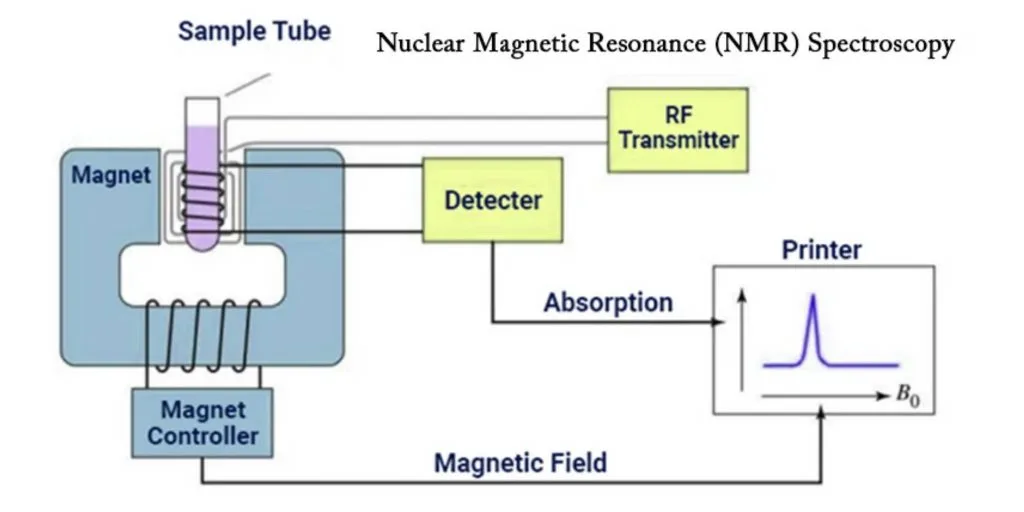
Principle of NMR Spectroscopy
NMR spectroscopy is based on the magnetic property of certain atomic nuclei. Some nuclei like hydrogen (¹H) and carbon-13 (¹³C) have nuclear spin, because they have odd number of protons or neutrons. Due to this spin, they behave like very small magnets.
When the sample is placed in a strong external magnetic field, these nuclei do not remain randomly arranged. They become arranged either parallel to the magnetic field or opposite to the magnetic field. The parallel arrangement has lower energy and the opposite arrangement has higher energy. This separation into energy levels is called Zeeman effect.
In this condition, the nuclei rotate or wobble around the direction of magnetic field. This movement is called precession. The rate of this precession is called Larmor frequency. When radiofrequency (RF) radiation of same frequency is supplied, the nuclei absorb energy and move from lower energy state to higher energy state. This absorption of energy is known as resonance.
After the RF pulse is removed, the excited nuclei return back to their original lower energy state. During this process they release energy in the form of weak radiofrequency signals. These signals are received by receiver coil and produce a signal called Free Induction Decay (FID).
The FID signal is then changed into a readable NMR spectrum by Fourier Transformation. The exact position of signal depends on the electronic environment around the nucleus. This change in resonance position is called chemical shift. Thus NMR spectroscopy gives information about structure, connectivity and chemical environment of atoms in a molecule.
Working of Nuclear Magnetic Resonance (NMR) Spectroscopy
Working of Nuclear Magnetic Resonance (NMR) Spectroscopy
- First the sample is placed in the strong magnetic field of NMR spectrometer. The nuclei like hydrogen (¹H) and carbon-13 (¹³C) have spin, so they behave as small magnetic particles.
- In this magnetic field, the nuclei are arranged in two ways. Some nuclei arrange with the magnetic field and some nuclei arrange opposite to the magnetic field. One is low energy state and other is high energy state.
- The arranged nuclei do not remain still. They move around the direction of magnetic field. This motion is called precession. The speed of this motion is called Larmor frequency.
- Then a short radiofrequency (RF) pulse is given to the sample. When this frequency matches with Larmor frequency, the nuclei absorb energy.
- After absorbing energy, the nuclei pass from low energy state to high energy state. This condition is known as resonance.
- When the RF pulse is stopped, the excited nuclei come back to their normal state. During this process, the absorbed energy is released again.
- The released energy gives weak signals in the receiver coil. These signals are called Free Induction Decay (FID).
- The FID signal is then changed into NMR spectrum by Fourier Transformation (FT). The spectrum shows different peaks for different nuclei.
- The position and splitting of peaks tell about the chemical environment, neighbouring atoms and structure of the molecule.
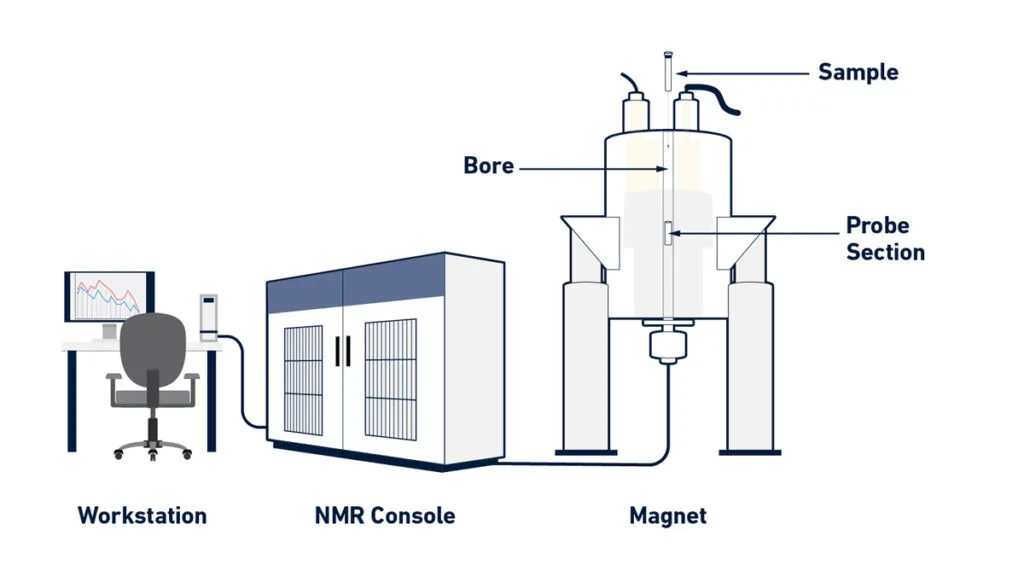
Instrumentation of Nuclear Magnetic Resonance (NMR) Spectroscopy
Instrumentation of Nuclear Magnetic Resonance (NMR) Spectroscopy
- Superconducting magnet
It produces strong and uniform magnetic field. This field is used to arrange the nuclei of sample in different energy state. - Shim coils
It is used to correct small irregularities in the magnetic field. It helps to give sharp and clear spectral lines. - NMR probe
It is the part where sample tube is placed inside the magnet. It has radiofrequency (RF) coils which gives RF pulse and also receives the signal from nuclei. - Sample tube
It is a thin glass tube used to hold the sample. The sample is generally dissolved in deuterated solvent. - Sample spinner
It rotates the sample tube during analysis. This helps to reduce magnetic field variation and gives narrow spectral lines. - RF transmitter
It produces short radiofrequency (RF) pulses. These pulses excite the nuclei from lower energy state to higher energy state. - Receiver
It detects the weak NMR signals released from the sample. These signals are amplified before further processing. - Analog to Digital Converter (ADC)
It converts the analog signal into digital signal. This digital data is stored and processed by computer. - Pulse programmer
It controls the time, length and gap of RF pulses. It runs the experiment in a fixed pulse sequence. - Computer or workstation
It controls the instrument and processes the recorded signal. It changes the signal into NMR spectrum by Fourier Transformation (FT).
Types of NMR Spectroscopy
Types of NMR Spectroscopy
A. Based on nuclei analysed
- Proton NMR (¹H NMR)
It is used for study of hydrogen atoms in a molecule. It is most commonly used NMR spectroscopy. - Carbon-13 NMR (¹³C NMR)
It is used for study of carbon atoms. The carbon skeleton of organic compound is known from this method. - Nitrogen-15 NMR (¹⁵N NMR)
It is used for nitrogen containing molecules. DNA, RNA, proteins and other nitrogen compounds are studied. - Fluorine-19 NMR (¹⁹F NMR)
It is used for fluorine containing compounds. Fluorinated drugs and fluorine compounds are analysed. - Phosphorus-31 NMR (³¹P NMR)
It is used for phosphorus containing compounds. Phosphorus molecules and biochemical pathways are studied.
B. Based on dimensionality
- One-dimensional NMR (1D NMR)
It gives signal on one frequency axis. Chemical shift, integration and splitting are obtained. - Two-dimensional NMR (2D NMR)
It gives signal on two frequency axes. It is useful when peaks are overlapped and relation between atoms is needed. - COSY NMR
It is used to show protons which are coupled with each other. The coupling occurs through bonds. - TOCSY NMR
It is used to show all protons of one spin system. It is useful for a continuous proton chain. - HSQC NMR
It shows the relation of proton with directly attached hetero atom. The hetero atom may be carbon or nitrogen. - HMBC NMR
It shows long range relation of proton with hetero atom. The relation is generally through two to four bonds. - NOESY NMR
It shows protons which are near to each other in three dimensional space. They may not be directly bonded. - Multidimensional NMR (3D and 4D NMR)
It is used for large molecules like proteins. It is used for signal assignment and three dimensional structure.
C. Based on sample state and application
- Solution-state NMR
It is used for samples dissolved in solvent. Molecules are studied in liquid state. - Solid-state NMR
It is used for solid samples which are not dissolved. Crystalline materials, amorphous solids and biological solids are studied. - Diffusion-ordered spectroscopy (DOSY)
It is used for studying diffusion rate of molecules in mixture. The signals are separated according to molecular movement. - Dynamic NMR spectroscopy
It is used for study of molecular changes with time. Conformational change, chemical exchange and phase transition are studied.
How to read an NMR spectrum and what it tells you?
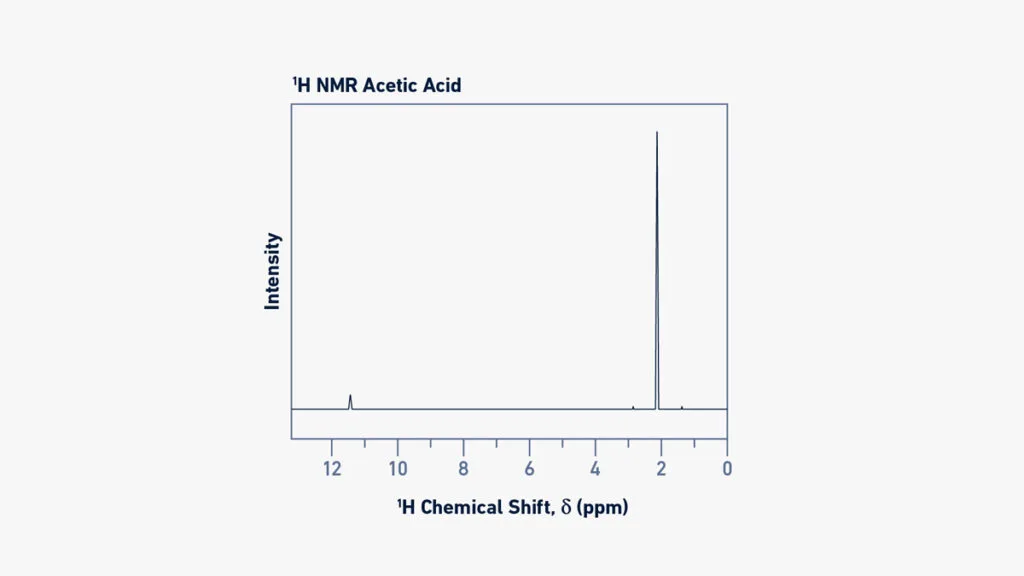
- Chemical shift
It is the position of signal on the horizontal line of NMR spectrum. It is measured in ppm with the help of reference compound like TMS. It tells about type of proton or carbon present and their chemical environment. - Peak area
It is also called integration. The area under the peak is related with number of nuclei giving that signal. In ¹H NMR, it tells the relative number of hydrogen atoms present in that environment. - Splitting pattern
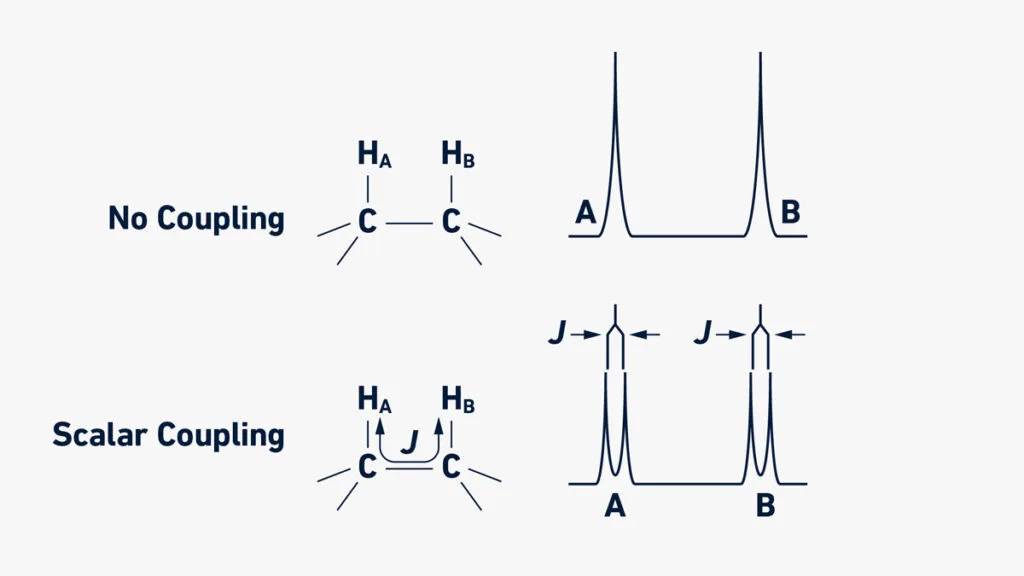
The signal may split into small peaks like doublet, triplet or quartet. This splitting is due to nearby nuclei. It tells about number of neighbouring hydrogen atoms present near the proton. - n+1 rule
This rule is used to read splitting in ¹H NMR. If a proton has n neighbouring protons, then the signal split into n+1 peaks. Thus it helps to know the connectivity of atoms in the molecule. - Coupling constant
It is the distance between split peaks of a multiplet. It is measured in Hertz (Hz). It gives idea about relation and arrangement between nearby atoms. - Peak width
The shape and width of peak also gives information. Broad peak may show exchangeable proton, impurity or molecular movement. Sharp peak generally gives clear and pure signal. - Final interpretation
By reading chemical shift, integration, splitting and coupling constant, the structure of molecule can be understood. It tells about functional group, number of atoms, neighbouring atoms and chemical environment.
Applications of NMR Spectroscopy
- It is used in geological study. Porosity, permeability and fluid content of rocks are determined.
- NMR spectroscopy is used for finding the molecular structure of organic compounds. The arrangement of atoms and bonding pattern are known by this method.
- It is used for the study of proteins, lipids and nucleic acids. These large molecules can be studied without destroying the sample.
- It is used to check the purity and composition of drugs. APIs, excipients and small impurities are detected by this technique.
- It is used in drug discovery. The joining of drug molecule with target protein is studied.
- The principle of NMR is used in MRI. It is used for seeing soft tissues and tumors inside the body.
- It is used for studying metabolites in blood and urine. These changes are useful in clinical and disease study.
- It is used for polymer analysis. Molecular weight, chain length, branching and monomer ratio are known.
- Solid-state NMR is used for solid materials. Crystalline substances, amorphous solids, nanomaterials and catalysts are studied.
- It is used for watching chemical and enzymatic reactions. The progress of reaction and change in molecule are studied.
- It is used in food testing. Food content, adulteration, contamination and water-fat ratio are checked.
- It is used in petroleum analysis. Hydrocarbon composition of crude oil and refined products are known.
Advanatges of NMR
- NMR spectroscopy is non-destructive method. The sample is not destroyed or changed during the analysis.
- It is non-invasive technique. The same sample can be used again for further study or repeated measurement.
- It gives detailed information about molecular structure. Bonding pattern, connectivity and arrangement of atoms are known.
- It gives information about stereochemistry and three dimensional shape of the molecule.
- It does not require crystallization of sample. Molecules can be studied in solution state and solid samples can also be studied by solid-state NMR.
- It needs very less sample preparation. Complex mixtures can also be studied without complete separation of all components.
- It is used for both qualitative and quantitative analysis. The compounds can be identified and their amount can also be measured.
- It is a versatile technique. Gases, liquids and solids can be analysed by this method.
- It can be used for small organic molecules and also for large biological molecules like proteins and nucleic acids.
- It is useful for studying biomolecules in aqueous condition. So proteins and other molecules can be observed in nearly natural environment.
- It is sensitive to small changes in chemical environment. So small structural and environmental changes can be detected.
Limitations of NMR’s
- NMR spectroscopy has low sensitivity. The difference between low and high nuclear energy state is very small, so strong signal is not easily obtained.
- It needs more amount of sample. Generally large sample volume and high concentration are required for getting clear spectrum.
- It takes more time for analysis. Many repeated scans are needed to improve the signal and make the spectrum useful.
- The instrument is very costly. High-field NMR spectrometer, cryogenic probe and other parts need high cost.
- Its maintenance is also difficult. Liquid helium and liquid nitrogen are required to keep the superconducting magnet in working condition.
- It is not very suitable for very large molecules. In large proteins and other macromolecules, peaks become broad and weak.
- Signal overlapping is a common problem. In complex molecules, many nuclei give signals near same position, so peaks become crowded.
- It depends on nuclei having non-zero spin. Some important nuclei like carbon-13 (¹³C) and nitrogen-15 (¹⁵N) are present in low natural amount.
- For studying such nuclei, concentrated sample or isotopic enrichment is often required. This makes the process more costly.
- The interpretation of NMR spectrum is difficult. Overlapping peaks and multi-dimensional spectra need experience and proper software for analysis.
References
- 2D- NMR what is the different between COSY and HSQC?? – ResearchGate. (n.d.). ResearchGate.
- 4 Fourier transformation and data processing – The James Keeler Group. (n.d.). The James Keeler Group.
- 4 Nuclear magnetic resonance. (n.d.).
- 5 How the spectrometer works – The James Keeler Group. (n.d.). The James Keeler Group.
- Reutenauer, L. (2023). 5.3: Instrumentation. Chemistry LibreTexts.
- Khashami, F. (2024). A mini review of NMR and MRI. arXiv.
- A52 Basics of NMR (The nuclear Zeeman effect). (n.d.).
- Autschbach, J., & Le Guennic, B. (n.d.). Analyzing and interpreting NMR spin-spin coupling constants using molecular orbital calculations. MRI Questions.
- Göbl, C., & Tjandra, N. (2012). Application of solution NMR spectroscopy to study protein dynamics. Entropy, 14(3), 581-598.
- Holmes, D. (2004). Basic practical NMR concepts: A guide for the modern laboratory. Michigan State University.
- Basic- NMR- experiments. (2000).
- Maciejewski, M. (2016). Basics of NMR spectroscopy. UConn Health.
- Comparing cryoprobe vs room-temperature NMR: Energy consistency. (2025). PatSnap Eureka.
- Comprehensive analysis of nuclear magnetic resonance spectroscopy: Fundamental principles, instrumental architecture, and multi-disciplinary applications. (n.d.).
- Cryoprobes. (n.d.). NMR Facility.
- Lindon, J. C., & Ferrige, A. G. (1980). Digitisation and data processing in Fourier transform NMR. Progress in NMR Spectroscopy, 14.
- Chill Vibes. (2026). Exploring 2D NMR techniques: COSY, HSQC, and HMBC. Prezi.
- Fourier transform – Nuclear magnetic resonance. (n.d.).
- HSQC and HMBC. (n.d.). NMR Core Facility – Columbia University.
- HSQC-TOCSY analysis understanding 2D NMR application in comparison with TOCSY. (n.d.). JEOL.
- How cryogenic NMR probes improve sensitivity for low-concentration samples. (n.d.). Creative Biostructure.
- How NMR works | NMR 101. (n.d.). Bruker.
- How to read NMR spectra from the basics (chemical shift, integration ratio, coupling). (n.d.). JEOL.
- Magnetic resonance imaging. (2026). In Wikipedia.
- NMR (OC) | Relaxation measurements. (n.d.). Weizmann Institute of Science.
- NMR basic operation – Bruker NMR spectrometer. (n.d.). University of Wyoming.
- NMR basics for the absolute novice. (n.d.). JEOL USA.
- Morris, G. A. (n.d.). NMR data processing. Manchester NMR Methodology Group.
- NMR and MRI: Applications in chemistry and medicine. (2011). American Chemical Society National Historic Chemical Landmarks.
- LeClerc, M. (n.d.). Spin-spin coupling – Beyond multiplicity. Nanalysis.
- Kay, L. E. (2005). NMR studies of protein structure and dynamics. Journal of Magnetic Resonance, 173, 193-207.
- Hu, Y., Cheng, K., He, L., Zhang, X., Jiang, B., Jiang, L., Li, C., Wang, G., Yang, Y., & Liu, M. (2021). NMR-based methods for protein analysis. Analytical Chemistry, 93(4), 1866-1879.
- Nuclear magnetic resonance (NMR). (n.d.). MilliporeSigma.
- Kapoor, A. S. (2025). Nuclear magnetic resonance (NMR) spectroscopy: Principles, applications, and advances in analytical chemistry. Journal of Pharmaceutical Analysis, 14.
- Nuclear magnetic resonance spectroscopy of proteins. (2026). In Wikipedia.
- Performance of cryogenic probes as a function of ionic strength and sample tube geometry. (n.d.).
- Rial, L. P. (2023). Principles and applications of nuclear magnetic resonance (NMR) spectroscopy in analytical chemistry. Pharmaceutical Analytical Chemistry, 8.
- Pulse sequences and the vector model. (n.d.).
- Stoltenberg, J., Pengra, D., Van Dyck, R., & Vilches, O. (2006). Pulsed nuclear magnetic resonance. UCSB Physics.
- Bruker BioSpin Group. (2025). Pushing boundaries in solid-state NMR research. AZoM.
- Reading: NMR spectroscopy short course 2016. (2016).
- Relaxation (NMR). (2025). In Wikipedia.
- Solid state NMR. (n.d.). Biological Magnetic Resonance Bank (BMRB).
- Solid-state NMR spectroscopy. (n.d.). PMC – NIH.
- Solid-state NMR: A uniquely powerful analytical tool and interactions. (n.d.). Bruker.
- Spin-spin splitting. (2021). Oregon State University.
- Spin-lattice and spin-spin relaxation: Spin-lattice relaxation mechanisms. (n.d.).
- Elster, A. D. (2026). T1 and T2 relaxation causes. MRI Questions.
- Hornak, J. P. (1997-2017). The basics of NMR.
- Understanding 2D NMR spectra: How to read and interpret them. (n.d.). Creative Biostructure.
- What is NMR? (n.d.).
- What is a cryoprobe? (n.d.). NMR and Chemistry MS Facilities, Cornell University.
- Reddit. (n.d.). When would you use solid-state NMR over solution NMR?
- Zeeman effect. (2026). In Wikipedia.
- ssNMR services. (n.d.). KU NMR Lab, The University of Kansas.