

Infrared (IR) Spectroscopy is an analytical technique used to study and identify chemical substances by using infrared light.
In this technique, the chemical bonds present in a molecule absorb infrared radiation. The bonds are not rigid, they behave like spring and show stretching and bending vibrations. When the absorbed frequency matches with the natural vibration frequency of the bond, vibration increases.
Different chemical bonds and functional groups absorb infrared light at particular frequency. This gives a special absorption pattern, which is called IR spectrum. It is used to know the molecular structure and chemical composition of unknown substance.
Principle of IR Spectroscopy
Infrared (IR) spectroscopy is based on the interaction between infrared radiation and chemical bonds present in a molecule.
The atoms present in the molecule are not fixed, they remain in continuous vibration. These vibrations may be stretching and bending type. When infrared radiation is passed through the sample, only particular frequency is absorbed by the molecule.
The absorption takes place when the frequency of infrared radiation becomes equal to the natural vibrational frequency of the bond. During this process, change in dipole moment also occurs. Different chemical bonds and functional groups absorb infrared radiation at different characteristic frequencies.
The absorbed and transmitted radiations produce a characteristic IR spectrum. This spectrum acts as molecular fingerprint and is used for identification of chemical structure and functional groups present in the compound.
Instrumentation of Infrared Spectroscopy (IR Spectroscopy )
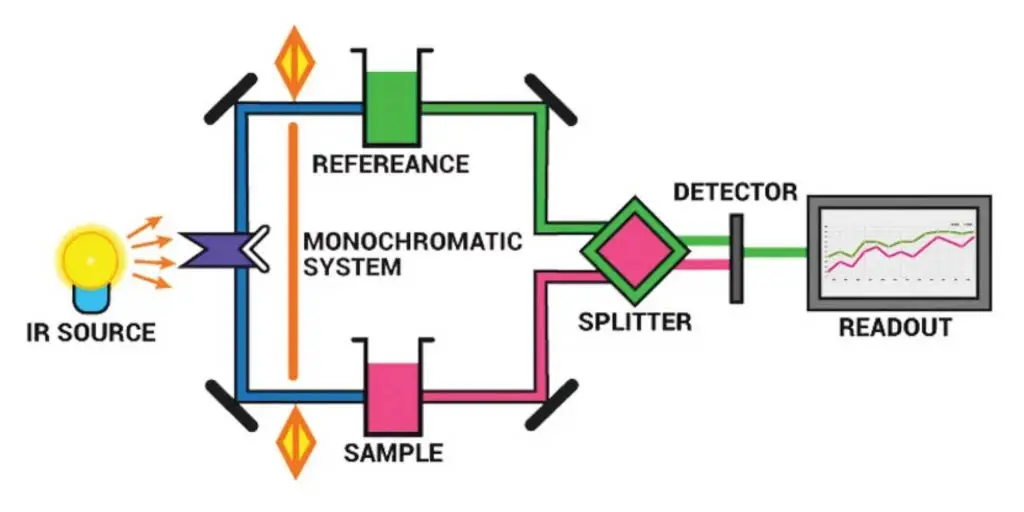
- Light source– It is used to produce infrared radiation. Globar and Nernst glower are used in mid IR region. Tungsten-halogen lamp is used in near IR and mercury discharge lamp is used in far IR.
- Sample holder– It is used to keep the sample in the path of infrared beam. KBr pellet is used for solid sample. Salt plates are used for liquid sample. Gas cell is used for gaseous sample.
- Monochromator– It is used in old dispersive IR spectrometer. It separates the infrared radiation into different wavelength. It contains prism or diffraction grating and slit.
- Interferometer– It is used in modern FTIR spectrometer. It contains beam splitter, fixed mirror and moving mirror. It produces an interference pattern which is called interferogram.
- Detector– It is used to detect the infrared radiation coming from the sample. It converts the radiation into electrical signal. Thermocouple, bolometer, DLaTGS and MCT are common detectors.
- Computer system– It is used to process the signal coming from detector. In FTIR, it converts the interferogram into final IR spectrum by Fast Fourier Transform (FFT).
Types of Infrared Spectrophotometry (IR Spectroscopy)
Different types of Infrared Spectrophotometry (IR Spectroscopy) are as follows-
- Fourier Transform Infrared (FTIR) Spectroscopy– It is modern type of IR spectroscopy in which interferometer is used. In this technique, all infrared wavelengths are measured at same time. It is faster method and gives better signal-to-noise ratio than older methods.
- Dispersive Infrared Spectroscopy– It is a traditional type of IR spectroscopy. In this method, prism or diffraction grating is used for separation of infrared radiation into different wavelengths. These wavelengths are measured one by one in sequence.
- Near Infrared (NIR) Spectroscopy– It is a type of IR spectroscopy which uses near infrared region. The range is about 14,000–4,000 cm⁻¹. It is used for overtone vibration and combination vibration. It is mostly used for rapid and non-destructive quantitative analysis in agriculture, pharmaceutical and food processing industries.
- Mid Infrared (MIR) Spectroscopy– It is the most common type of IR spectroscopy. The range is about 4,000–400 cm⁻¹. It is used for studying fundamental molecular vibrations. It is also used for identification of functional groups and chemical structure.
- Far Infrared (FIR) Spectroscopy– It is a type of IR spectroscopy which uses low energy infrared region. The range is about 400–10 cm⁻¹. It is used for rotational spectroscopy and low-frequency group vibrations.
- Transmission FTIR Spectroscopy– In this method, infrared light beam is passed directly through the sample. The sample may be liquid, gas, powder or thin film. The transmitted light is detected from other side.
- Attenuated Total Reflectance (ATR) Spectroscopy– It is based on total internal reflection. In this method, infrared beam is passed into a crystal of high refractive index. An evanescent wave is formed which slightly enters into the sample. The sample is kept in direct contact with the crystal surface.
- Reflectance FTIR Spectroscopy– In this method, spectrum is obtained by reflection of infrared radiation from solid sample. It is used for reflective surface, rough surface and powder sample. It includes specular reflection, diffuse reflection and grazing angle FTIR for thin film analysis.
- Photoacoustic Spectroscopy– It is a type of IR spectroscopy which requires less sample preparation. In this method, sample is placed in a sealed cell. The sample absorbs IR radiation and thermal change is produced. Due to this thermal change, sound waves are formed and measured by detector.
- Two Dimensional (2D) IR Spectroscopy– It is an advanced type of IR spectroscopy. It uses femtosecond infrared laser pulses. In this method, spectrum is spread in two dimensions. It is used to observe coupling between different vibrational modes and very fast molecular dynamics.
Types of Samples used in Infrared Spectroscopy
Different types of samples used in Infrared Spectroscopy are as follows-
- Solid samples– Solid samples are used in the form of finely powdered material. They may be pressed into solid halide pellet such as potassium bromide (KBr) pellet. They are also used as thick paste called mull by using mineral oil such as Nujol. Thin films of solid samples can also be used.
- Solid samples in ATR method– In Attenuated Total Reflectance (ATR) method, solid samples can be analyzed directly. Large rigid solids, crystalline materials, work pieces and finished products are used with little or no sample preparation. The sample is placed on the ATR crystal and spectrum is taken.
- Liquid samples– Liquid samples are used as pure liquid or neat sample. In this method, thin capillary film of liquid is placed between two IR-transparent salt plates. Liquid samples may also be analyzed in special liquid cell or directly on ATR crystal.
- Gaseous samples– Gaseous samples are analyzed in special gas cells. These cells have infrared-transparent windows. Since gases have low molecular density, long optical path length is required. Sometimes internal mirrors are used so that infrared beam passes many times through the gas.
- Semi-solid and pastes– Semi-solid samples include viscous materials like pastes and gels. These samples are analyzed easily by ATR method. A small drop or smear of sample is placed directly on the ATR sampling module.
- Solutions– In this method, solid or liquid sample is dissolved in suitable IR-transparent solvent. Common solvents are carbon tetrachloride (CCl₄) and methylene chloride (CH₂Cl₂). The solution is placed in liquid cell. The absorption of solvent is subtracted or compensated to get actual spectrum of sample.
Infrared vs Raman spectroscopy
The following are the differences between Infrared (IR) spectroscopy and Raman spectroscopy–
| Basis of comparison | Infrared (IR) spectroscopy | Raman spectroscopy |
|---|---|---|
| Mechanism of light interaction | In IR spectroscopy, direct absorption of infrared light takes place by molecule. | In Raman spectroscopy, inelastic scattering of light takes place. Molecule takes some part of incident photon energy and remaining energy is scattered. |
| Energy measurement | The measured energy difference is related with vibrational energy of molecule. | The measured energy difference is also related with vibrational energy of molecule. |
| Selection rule | Vibration is observed when there is change in dipole moment of molecule. This is called IR active vibration. | Vibration is observed when there is change in polarizability of molecule. |
| Symmetrical vibration | Symmetrical vibration is generally not observed when there is no dipole change. | Symmetrical vibration can be observed due to Raman effect. |
| Complementary nature | Some vibrations are not seen in IR spectrum. | Those vibrations may be seen in Raman spectrum. So both are complementary techniques. |
| Diatomic molecules | Symmetrical diatomic molecules such as N₂ do not show vibrational band in IR spectrum. Asymmetrical molecule such as carbon monoxide (CO) absorbs IR radiation. | Symmetrical diatomic molecules such as N₂ show vibrational band in Raman spectrum. |
| Main use | It is used for vibrations which cause dipole moment change. | It is used for symmetrical molecules and bonds where polarizability change occurs. |
Applications of Infrared (IR) Spectroscopy
The following are the important applications of Infrared (IR) Spectroscopy–
- IR spectroscopy is used for identification of raw materials in pharmaceutical industries. It is used to check impurities and to determine concentration of active pharmaceutical ingredients (APIs). It is also used to study drug stability.
- It is used for studying structure of proteins, enzymes and other macromolecules. It also helps to study interaction between different biomolecules.
- It is used in clinical diagnosis by analysis of biological fluids and tissues. It helps in early detection of diseases and monitoring of metabolites present in the body.
- In forensic science, IR spectroscopy is used for identification of small evidences from crime places. It is used to identify clothing fibres, paint chips, plastics and other trace materials.
- It is used for rapid identification of illegal drugs and narcotics. It can also differentiate between different forms of drugs such as crack cocaine and powder cocaine.
- It is used for analysis of paper, ink and printer toner. This helps to detect whether a document is changed or forged.
- It is used to detect organic components present in gunshot residue (GSR). It is also used for identification of explosive materials and type of explosive used.
- IR spectroscopy is used for detection of greenhouse gases and atmospheric pollutants. It is used to measure gases such as sulfur dioxide (SO₂), nitrogen dioxide (NO₂) and volatile organic compounds (VOCs).
- It is used for detection of pollutants in water and soil. Petroleum hydrocarbons, pesticides and heavy metals can be detected by this method.
- It is used for identification and mapping of microplastic pollution. It is used in ocean water, soil and biological tissues.
- It is used for monitoring flue gases from industries. Harmful air pollutants can be detected by this method. It also helps to check industrial emission level.
- IR spectroscopy is used to verify raw materials used in industries. It is used to measure different components in complex mixtures and to find defects in manufactured products.
- It is used for monitoring curing process of adhesives. The mechanism of adhesive hardening can be studied in real-time.
- It is used for study of semiconductors, meta-materials and advanced materials. It is also used in lithium-ion battery research to study different components.
- It is used to measure composition of food materials. Fat, protein and sugar content can be measured by IR spectroscopy.
- It is used for detecting adulterants and cheap fillers in food products. For example, high-fructose corn syrup mixed in honey can be detected.
- It is used for analysis of soil health and soil composition. It helps to optimize fertilizer use and also used for monitoring plant stress.
Advantages of Infrared (IR) Spectroscopy
The following are the important advantages of Infrared (IR) Spectroscopy–
- IR spectroscopy can be used for analysis of different types of materials. It can analyze solid, liquid and gaseous samples.
- It is a rapid analytical technique. Modern FTIR instruments can record all infrared frequencies at same time. So the analysis is completed within short time.
- It requires very little sample preparation. In many cases, sample can be analyzed directly. It also does not need much consumable materials.
- It is a non-destructive technique. The sample is not damaged after analysis. It can be used again for other tests.
- It is a safe technique. It does not use toxic chemicals and harmful radiation. It also produces very less waste.
- It has high sensitivity. Very small amount of sample is required for analysis. Few micrograms to milligrams of sample can give suitable spectrum.
- It can detect low concentration of substances. This is useful for trace level analysis of different compounds.
- IR spectroscopy gives characteristic molecular fingerprint of compounds. This helps in identification of unknown substances.
- It gives both qualitative and quantitative information from a single spectrum. It can identify compound and also measure its concentration.
- It can detect more than one chemical compound at same time. Different components present in mixture can be studied in a single measurement.
- The instrument cost is comparatively low than many other analytical instruments like GC, LC and XRD.
- IR spectroscopy instrument requires less laboratory space. The instrument has small size and can be kept easily in laboratory.
Limitations of Infrared (IR) Spectroscopy
The following are the important limitations of Infrared (IR) Spectroscopy–
- IR spectroscopy cannot detect homonuclear diatomic molecules. Molecules such as nitrogen (N₂), oxygen (O₂) and hydrogen (H₂) do not show net change in dipole moment during vibration. So they are not observed in IR spectrum.
- It cannot analyze purely ionic compounds properly. Compounds such as sodium chloride (NaCl) do not have IR-active vibrational modes. Their ionic crystal lattice does not show change in dipole moment during vibration.
- Water gives strong absorption in infrared region. So wet samples and aqueous solutions may hide the important absorption bands of the sample.
- Moisture also affects the sample preparation. Potassium bromide (KBr) is hygroscopic and absorbs moisture from air. This gives distorted O-H peaks in the spectrum.
- It is difficult to analyze complex mixtures by IR spectroscopy. Mixtures and large complex molecules give many overlapping absorption peaks. So interpretation of spectrum becomes difficult.
- It is not always suitable for accurate quantitative analysis. Careful calibration is required. The result may be affected by sample condition and thickness of sample.
- Solid samples need proper preparation. If sample is not ground finely, it scatters the IR radiation and gives distorted baseline. This effect is called Christiansen effect.
- Too much sample should not be used in IR spectroscopy. It may give saturated or flat-topped peaks. Such peaks are not useful for quantitative measurement.
- In ATR-FTIR, penetration depth is limited. The infrared wave enters only about 0.5 to 5 µm into the sample surface. So it may not show the full bulk composition of heterogeneous sample.
- Hard samples may not make proper contact with ATR crystal. Sometimes hard sample can damage or puncture the crystal.
- Some ATR crystals have physical and chemical limitations. Zinc selenide (ZnSe) crystal is easily scratched and works only in limited pH range about 5–9.
- Zinc selenide (ZnSe) may produce toxic gas when it is exposed to strong acids. So it should be handled carefully during analysis.
References
- Abo, H. (2010, July). The ABCs of measurement methods: KBr pellet method. FTIR Talk Letter, 14. Shimadzu.
- Agilent Technologies. (n.d.). ATR-FTIR spectroscopy, FTIR sampling techniques.
- Agilent Technologies. (n.d.). What is Fourier transform infrared spectroscopy?
- Al-Mustaqbal University College. (n.d.). Beer Lambert law: It is the relationship between the absorbance of light is directly proportional to the thickness of the media.
- Anton Paar GmbH. (n.d.). Attenuated total reflectance (ATR).
- Apex Instrument. (n.d.). FT-IR spectroscopy for raw material identification guide.
- Barnett Technical Services. (n.d.). Greenhouse gas monitoring: A complete guide to accurate environmental measurement.
- Bruker. (n.d.). Atmospheric pollutants & greenhouse gases.
- Bruker. (n.d.). Attenuated total reflectance (ATR).
- Bruker. (n.d.). Difference IR vs FTIR.
- Bruker. (n.d.). Guide to applications of IR spectroscopy.
- Bruker. (n.d.). Guide to applications of IR spectroscopy [Duplicate Source].
- Chemistry Steps. (n.d.). Interpreting IR spectra.
- Clark, J. (2014). Infra-red spectra – the fingerprint region. Chemguide.
- Das, A. (n.d.). Chapter-18 Infrared spectroscopy (fingerprint region). WikiEducator.
- Dent, G. (1996). Preparation of samples for IR spectroscopy as KBr disks. Internet Journal of Vibrational Spectroscopy, 1(1).
- Environmental Protection Agency. (2024, March 1). EPA Method 320-Measurement of vapor phase organic and inorganic emissions by extractive Fourier transform infrared (FTIR) spectroscopy. Federal Register.
- Environmental Studies (EVS) Institute. (2026, January 11). How IR spectrometry aids in environmental monitoring.
- European Pharmacopoeia. (2008). 2.2.24. Absorption spectrophotometry, infrared.
- Excedr. (2024, January 31). What is infrared spectroscopy? Fundamentals & applications.
- FindLight. (2024, December 18). Beer-Lambert’s law: Principles and applications in daily life.
- Gable, K. P. (2019, December 27). Infrared spectra: Identifying functional groups. Oregon State University.
- Gable, K. P. (2020, December 28). FTIR instrumentation and theory. Oregon State University.
- Gasmet Technologies Oy. (2013, October 8). Gasmet FTIR application note – Stack testing according to US EPA methods.
- Hamamatsu Photonics. (n.d.). Infrared (IR) spectroscopy.
- HH. (2007, May). FT-IR sample preparation. Northern Illinois University.
- Jankowski, P. (n.d.). Infrared spectroscopy in forensics: Definition & uses – Video. Study.com.
- JASCO. (n.d.). Understanding an IR spectrometer: A complete guide.
- JASCO. (2020, October 6). Principles of infrared spectroscopy (1) Molecular vibrations and infrared absorption.
- JASCO. (2020, October 6). Principles of infrared spectroscopy (1) Molecular vibrations and infrared absorption [Duplicate Source].
- Kapoor, R. V. (2025, December 29). Spectrophotometry in pharmaceutical and chemical analysis: Principles, techniques, and applications. Journal of Pharmaceutical Analysis, 14(019).
- Kintek Press. (n.d.). What are the key steps in preparing a KBr pellet for IR spectroscopy? Master solid sample analysis.
- Kintek Solution. (n.d.). How do you prepare samples for infrared spectroscopy? Master solid, liquid & gas techniques.
- Lancashire, R. J. (2019, January 19). Infrared spectroscopy and modes of vibrations. Jmol.
- Mark, P. (2023, September 12). Why use MCT over bolometers, thermopiles or pyroelectric sensors? AZoSensors.
- Nanjing Cngeir Technology Co., Ltd. (n.d.). Custom optics solutions for environmental infrared monitoring.
- National Institute of Standards and Technology (NIST). (2025, March 4). How do you measure greenhouse gases?
- Onterris / Sensible EDP. (n.d.). FTIR + real-time air quality measurement: A dynamic combination for continuous emissions monitoring.
- PERSEE. (2025, August 8). The ultimate guide to infrared spectroscopy in forensic science.
- Phlux Technology. (2026, March 31). Thermal vs. photoelectric detectors: What’s the difference?
- PIKE Technologies. (n.d.). ATR – Theory and applications.
- Priyamstudycentre. (n.d.). Infrared (IR) spectroscopy instrumentation is designed to analyze the interaction between infrared radiation and a sample.
- Reading Scientific Services Ltd (RSSL). (n.d.). Spectroscopy techniques | NMR spectroscopy.
- ResearchGate. (n.d.). (PDF) Infrared thermal detectors parameters: Semiconductor bolometers versus pyroelectrics [Access Error].
- Reusch, W. (2013, May 5). Infrared spectroscopy. MSU Chemistry.
- rmladmin. (2023, December 31). Difference between FTIR and dispersive IR. Rocky Mountain Laboratories.
- Sherban-Kline, M. (1999). 99.05.07: Infrared spectroscopy: A key to organic structure. Yale-New Haven Teachers Institute.
- Specac Ltd. (n.d.). Everything you need to know about ATR-FTIR spectroscopy.
- Specac Ltd. (n.d.). Explainer: The difference between IR, FTIR, and ATR-FTIR.
- Specac Ltd. (n.d.). Interpreting infrared spectra.
- Spectroscopy Online. (n.d.). Spectroscopy and spectroscopic analytical techniques in the United States Pharmacopeia–National Formulary [Access Error].
- Steele, D. (2006). Infrared spectroscopy: Theory. In Handbook of Vibrational Spectroscopy. John Wiley & Sons, Ltd.
- Steve. (2025, March 29). The infrared spectrometer – Part 2. Science Projects and Ideas for Amateur Experimenters.
- Thermo Electron Corporation. (2004). FT-IR vs. dispersive infrared.
- Unknown Author. (n.d.). 2.3 The modes of stretching and bending.
- Unknown Author. (n.d.). Technical advancements and analytical methodologies in infrared spectroscopy: A comprehensive framework of principles, instrumentation, and multidisciplinary applications.
- U.S. Environmental Protection Agency. (2024, April 29). April 29, 2024 U.S. Environmental Protection Agency RE: US EPA Method 320 [Access Error]. Regulations.gov.
- U.S. Environmental Protection Agency. (2026, April 2). Method 320 – Vapor phase organic and inorganic emissions by extractive FTIR.
- Whyte, B. (2021, July 8). Beer-Lambert law | Transmittance & absorbance. Edinburgh Instruments.
- Whyte, B. (2024, September 20). Monochromator vs. spectrometer. BMG LABTECH.
- Wikipedia. (2026, May 8). Fourier-transform infrared spectroscopy.
- Wikipedia. (2026, May 10). Infrared spectroscopy.