

Solid State Fermentation (SSF) is a bioprocess in which microorganisms are grown on moist solid substrate. It is done in absence or near absence of free flowing water.
The solid substrate acts as physical support for microbes. It also works as nutrient source. It gives carbon, nitrogen and essential minerals for growth of microorganisms.
In SSF, three phases are present. These are solid phase, liquid phase and gas phase. The solid phase is substrate matrix. Liquid phase is the thin moisture film adsorbed on particles. Gas phase is present between the particle spaces.
This type of condition is close to natural habitat of many microorganisms. It is more suitable for filamentous fungi. Yeast and bacteria can also grow in this process.
The substrates used are mostly cheap agricultural wastes. These include wheat bran, rice husk, corn cob, sugarcane bagasse and fruit peels. These materials are used as nutrient and support both.
SSF is eco-friendly and economical process. It needs less water and less energy. It produces less wastewater. Contamination chance is also less as compared to submerged fermentation.
It is used for production of industrial enzymes, biofuels, organic acids, antibiotics and biopesticides. It is also used in preparation of traditional fermented foods like tempeh and soy sauce. It is used for improving animal feed by breaking complex fibres and removing anti-nutritional factors.
Substrates are used for Solid State Fermentation (SSF)
The following are the important substrates used for Solid State Fermentation (SSF)–
- Cereal grains and brans– These are commonly used substrate in SSF. It includes rice, wheat, barley and corn. Wheat bran and rice bran are also used as good substrate.
- Agro-industrial byproducts and plant residues– These are cheap and easily available substrate for SSF. It includes sugarcane bagasse, rice husk, corn cob, corn stalk, corn stover, wheat straw and rice straw. Sawdust and wood shavings are also used.
- Legumes, seeds and oil cakes– These materials are used as nutrient rich substrate. It includes soybeans, soybean meal and legume seeds. Sunflower seeds, rapeseed meal and different de-oiled oil seed cakes are also used.
- Fruit and vegetable wastes– These wastes are used as low cost substrate in SSF. It includes fruit peels such as orange peel and pineapple waste. Cassava peels, pomegranate seeds and vegetable wastes are also used.
- Other organic materials– Some other organic materials are also used in SSF. It includes coffee husks, paper pulp and different plant and animal materials.
- Inert supports– Inert supports are materials which gives support for microbial growth. These are not always nutrient source by itself. Polyurethane foam and carbonized rice husk are used by adding liquid nutrient medium into them.
Features of Solid Substrate Fermentation
The following are the important features of Solid Substrate Fermentation–
- Solid Substrate Fermentation is carried out in low moisture condition. It is done in absence or near absence of free flowing water. The moisture content is generally about 20% to 70%.
- It is a tri-phasic system. It contains solid phase, liquid phase and gas phase. Solid phase is the support matrix. Liquid phase is the thin film of moisture on particles. Gas phase is present in the spaces between solid particles.
- The solid substrate has two main functions. It acts as physical support for microbial attachment. It also acts as nutrient source by giving carbon, nitrogen and minerals.
- Cheap agro-industrial residues are mostly used as substrate. Some examples are wheat bran, rice bran, sugarcane bagasse, rice husk and fruit peels.
- It is more suitable for filamentous fungi. These fungi can grow well in low water activity condition. Some actinomycetes, yeasts and bacteria are also used.
- In this process, oxygen transfer takes place through gas phase. Oxygen diffuses through void spaces present between the solid particles. Mechanical agitation in liquid medium is not required.
- Heat removal is difficult in this process. Organic solid substrates have low thermal conductivity. Due to this, metabolic heat may be accumulated and temperature gradient is formed.
- High temperature inside the bed can inhibit microbial growth. So heat management is an important problem in Solid Substrate Fermentation.
- The chance of contamination is less in this process. Low water activity does not support many common bacteria and yeasts. So strict aseptic condition is not always required.
- It is economical process. It needs less capital investment and less energy. Cheap waste materials can be used as substrate.
- It is environmentally useful process. It produces very less liquid effluent or wastewater. Agro-industrial wastes are also utilized properly.
- Monitoring and control is difficult in this process. Because the bed is solid and heterogeneous. Parameters like pH, moisture, biomass concentration and gas level are difficult to measure and control.
Organisms Used in Solid State Fermentation (SSF)
Fungi
- Aspergillus species (e.g., A. niger, A. oryzae, A. ibericus, A. carbonarius, A. uvarum).
- Rhizopus species (e.g., R. oligosporus, R. oryzae).
- Trichoderma species (e.g., T. viride, T. reesei).
- Penicillium species (e.g., P. roqueforti, P. charlesii).
- Pleurotus ostreatus.
- Beauveria bassiana.
- Phanerochaete chrysosporium.
- Monascus purpureus.
- Agaricus bisporus, Helvella lacunose, and Fomitiporia yanbeiensis.
Bacteria
- Bacillus species (e.g., B. subtilis, B. thuringiensis, B. velezensis, B. amyloliquefaciens).
- Lactobacillus species (e.g., L. plantarum, L. brevis, L. fermentum, L. rhamnosus).
- Streptococcus species.
- Enterococcus, Pediococcus, Staphylococcus, and Weissella.
- Streptomyces species.
- Micrococcus luteus.
- Acetobacter aceti.
- Propionibacterium species.
- Corynebacterium glutamicum and Brevibacterium.
- Burkholderia cenocepacia.
- Escherichia coli.
Yeasts
- Saccharomyces cerevisiae.
- Candida utilis.
- Kluyveromyces marxianus.
Viruses
- Granulovirus (cultivated for biopesticide production).
Solid State Fermentation (SSF) Steps
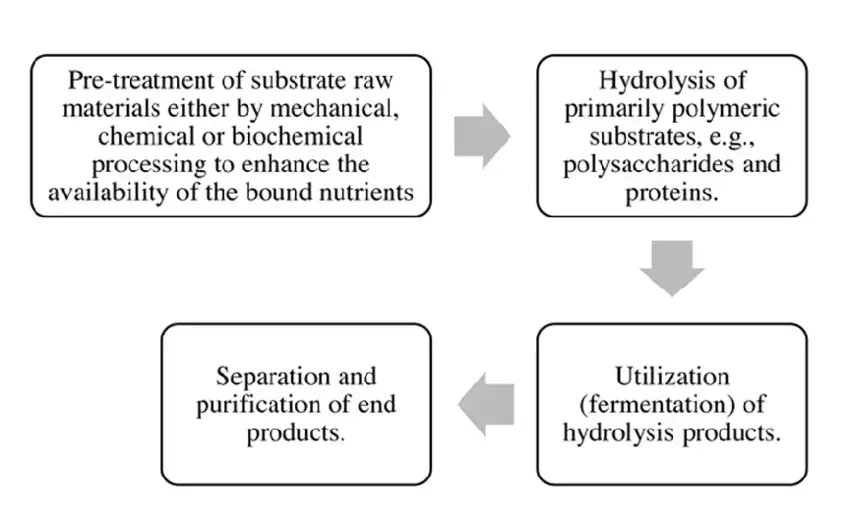
The following are the steps of Solid State Fermentation (SSF)–
- Substrate selection and preparation– The first step is selection of suitable solid substrate. It may be agricultural waste or agro-industrial residue. The substrate is cut or ground into small pieces. Moisture is adjusted. Nutrients are also adjusted. Then sterilization is done.
- Inoculum preparation– In this step, selected microorganism is cultivated separately. Fungi, yeast or bacteria may be used. The culture should be active and viable. This culture is used as inoculum.
- Bioreactor preparation– The bioreactor is cleaned first. Then sterilization of vessel is carried out. After this, prepared substrate is added into it.
- Inoculation and loading– In this step, inoculum is added to the prepared solid substrate. It is mixed with substrate. Then the mixture is loaded into the bioreactor.
- Incubation– The inoculated substrate is kept for incubation. Temperature, humidity, moisture and aeration are maintained. During this process, microorganism grows on the solid substrate and product is formed.
- Harvesting– After incubation, fermented solid material is taken out from the bioreactor. This material contains microbial product with the fermented substrate.
- Downstream processing– The required product is extracted from fermented mass. Then separation and purification is done. Enzymes, biofuels, antibiotics and other products are obtained.
- Waste disposal– The remaining solid residue is removed after extraction. It is disposed safely. Sometimes it is used for other purpose.
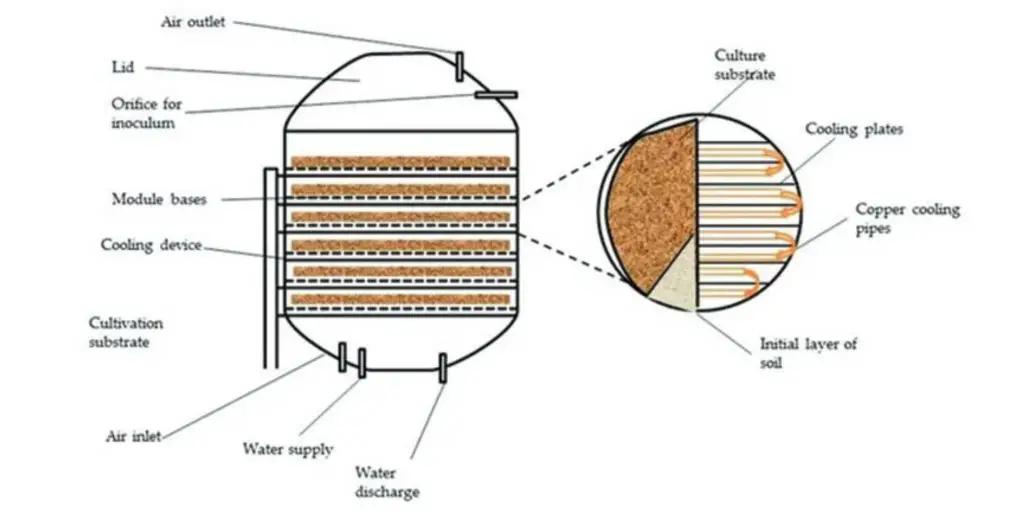
Types of Solid state bioreactors
The following are the types of Solid State Bioreactors–
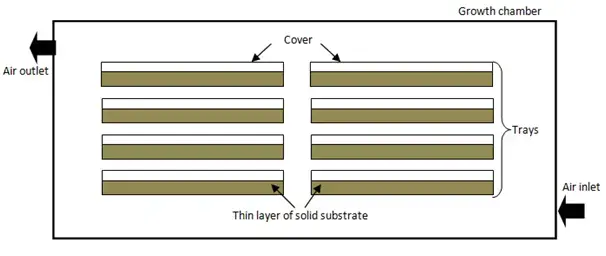
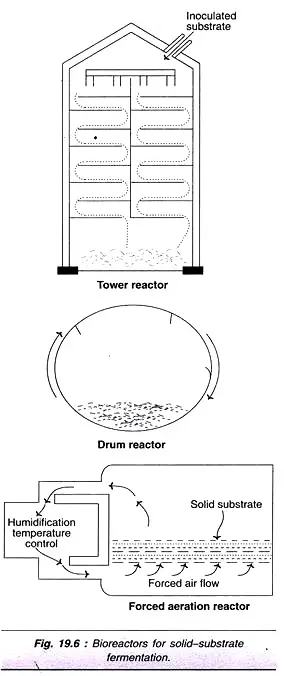
- Tray bioreactor– It is the simplest type of solid state bioreactor. In this type, solid substrate is spread in shallow trays. Trays are kept one above another. Air passes around the surface by natural convection or low velocity fan.
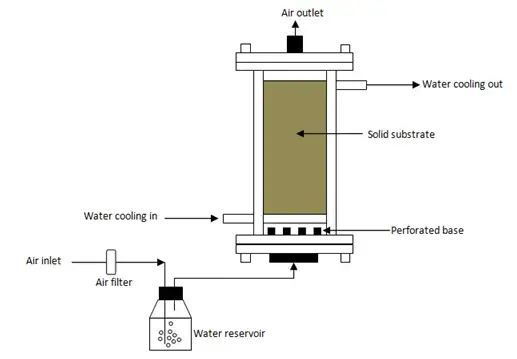
- Packed-bed bioreactor– It is a column type bioreactor. The solid substrate is packed inside vertical or horizontal column. Air is blown through the substrate bed. It helps in oxygen supply and removal of heat.
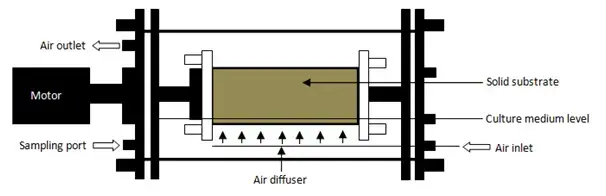
- Rotating drum bioreactor– It is made up of horizontal or slightly inclined cylinder. The cylinder rotates slowly. Due to rotation, substrate bed is mixed. Heat and mass transfer becomes better.
- Stirring drum bioreactor– It is similar to rotating drum bioreactor. But the cylinder remains stationary. A stirring device is present inside on central axis. This stirrer mixes the solid bed.
- Stirred-bed bioreactor– It is similar to packed-bed bioreactor. But an internal stirrer is present in it. The stirrer agitates the solid substrate continuously or at intervals. It prevents clump formation and distributes heat.
- Shaking drum bioreactor– It is made up of concentric cylinders. The outer cylinders rotate around the central cylinder. This gives shaking movement. The loosely arranged substrate is mixed by this movement.
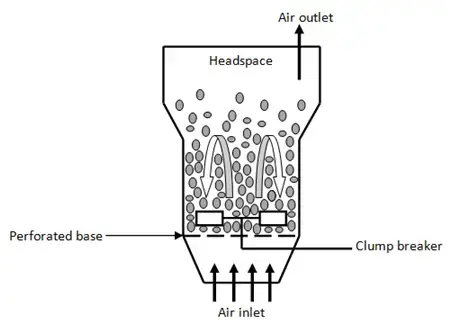
- Fluidized-bed bioreactor– It is an advanced type of solid state bioreactor. High velocity air is passed from bottom side. Solid particles become suspended in gas stream. The substrate behaves like fluid and heat and mass transfer becomes high.
Applications of Solid State Fermentation (SSF)
The following are the applications of Solid State Fermentation (SSF)–
- Solid State Fermentation (SSF) has wide use in food industries. Traditional fermented foods like tempeh, koji, miso, soy sauce, sake and idli are prepared by this method.
- In food products it helps in development of flavour and aroma. Some food additives are also obtained. The nutritive value of food materials also increases.
- Probiotics and nutraceuticals are prepared by SSF. Bio-preservatives are also obtained from this method, mainly bacteriocins and lactic acid.
- One of the important use of SSF is enzyme production. The enzymes are amylases, proteases, lipases, cellulases, pectinases and tannases. These have application in food, baking, brewing, textile and detergent industries.
- Animal feed can be improved by this process. Complex fibres present in feed are broken down. Anti-nutritional factors are removed and the feed become more digestible.
- In agriculture, SSF is used for biological control products. Biopesticides, bioinsecticides and bioherbicides are produced. These are useful against insects, weeds and plant pathogens.
- Biofertilizers are also produced by this method. Plant growth hormone like gibberellic acid is obtained by Solid State Fermentation.
- In pharmaceutical field, antibiotics are produced. Penicillin and oxytetracycline are the important examples. Antifungal compounds, anticancer agents, vitamins and cyclosporine are also produced.
- SSF is used in biofuel production. Bioethanol, biogas and biohydrogen are generated from agricultural wastes, lignocellulosic biomass and other organic residues.
- Organic acids like citric acid, lactic acid, acetic acid and butyric acid are produced by this process. Amino acids like L-glutamic acid and L-lysine are also produced.
- Bioplastics are also synthesized by SSF. The important example is polyhydroxyalkanoates (PHAs). These are biodegradable microbial products.
- Solid State Fermentation is used in environmental biotechnology. Microorganisms degrade pollutants like heavy metals, pesticides, hydrocarbons and phenols.
- It has application in bio-pulping, bio-bleaching and dye decolorization. This is useful in paper and textile industries.
Advantages of Solid State Fermentation (SSF)
The following are the advantages of Solid State Fermentation (SSF)–
- Solid State Fermentation (SSF) is a cost effective fermentation process. It uses cheap raw materials like agro-industrial residues. So the cost of substrate becomes low.
- The bioreactor used in SSF is simple in design. It does not need very complex vessel and heavy mechanical system. So capital investment is less.
- Less amount of water is required in this process. The substrate remains in moist solid condition. Thus it is useful where water requirement should be reduced.
- Energy requirement is also less in Solid State Fermentation. Continuous stirring and strong agitation are not required like submerged fermentation. Due to this power consumption becomes low.
- SSF produces very less liquid waste. Wastewater formation is minimum in this process. So it is considered as more eco-friendly fermentation method.
- Agricultural wastes, domestic wastes and industrial residues can be converted into useful products by SSF. Thus waste materials are utilized and value added products are obtained.
- Chance of contamination is comparatively low. The moisture content is low and water activity is also reduced. So many bacteria and yeasts cannot grow easily.
- Strict aseptic condition is not always required in SSF. Due to low water activity, growth of unwanted microbes are naturally restricted. This makes the process easier.
- Oxygen transfer is better in Solid State Fermentation. Microorganisms grow on the surface of solid particles. The particles are surrounded by air phase and oxygen reaches easily.
- SSF gives natural growth condition for many microorganisms, specially fungi. Fungi grow well on moist solid substrate. So their metabolism and product formation becomes better.
- Product yield is high in many cases. The products are formed in concentrated form in the solid matrix. Less dilution occurs because large liquid phase is absent.
- The products obtained by SSF are generally more stable. Low moisture condition helps in maintaining the stability of some bio-products.
- Downstream processing becomes simpler in many cases. Since the product is concentrated and less liquid is present, extraction and purification become easier.
- Solid State Fermentation is useful for large number of bio-products. Enzymes, organic acids, antibiotics, biofertilizers and other microbial products can be produced by this method.
Limitations of Solid State Fermentation (SSF)
The following are the limitations of Solid State Fermentation (SSF)–
- Scaling up of Solid State Fermentation (SSF) is difficult. In laboratory it can be done easily, but in industrial scale it becomes complicated. When thickness of solid bed is increased, pressure drop and heat accumulation also increases.
- Heat removal is a serious problem in SSF. The solid organic substrate has low thermal conductivity. So the heat formed by microbial metabolism is not dissipated properly and temperature may increase.
- In the solid bed, temperature does not remain uniform. Some region may become more hot than other region. This may overheat the microorganisms and their growth may be inhibited.
- Monitoring of the process is difficult in Solid State Fermentation. The substrate bed is heterogeneous. So pH, moisture, biomass concentration, O₂ and CO₂ level are not measured accurately.
- Control of moisture is also difficult. Microorganisms need proper amount of water for their growth. But aeration can dry the substrate very fast and the growth may stop.
- In SSF, microorganisms are exposed to continuous air phase. Because of this desiccation may occur. Fungal hyphae are delicate and they are affected more by drying.
- Oxygen is available on the surface of particles. But inside the particles oxygen diffusion is restricted. So the internal biomass may not get sufficient oxygen for proper metabolism.
- Nutrient availability is not same in all parts of the substrate. Large nutrient gradient may occur inside the solid particles. Due to this the microorganisms do not get uniform nutrient.
- Product recovery is difficult in Solid State Fermentation. In liquid fermentation product remains in broth. But in SSF, product is present with the solid matrix and first it has to be extracted.
- Downstream processing is costly. Extraction, recovery and purification needs more effort. This step may contribute very high part of the total processing cost.
- Microbial growth is slow in SSF. Only those microorganisms which can tolerate low moisture condition are generally used. These organisms usually grow slowly and product formation also becomes slow.
- In dynamic SSF bioreactors, mixing and agitation may be required. The movement of solid particles can damage microbial structures. Fungal hyphae may be damaged by impact and shear.
- The substrate quality is not always uniform. SSF mostly uses agro-industrial wastes as substrate. These wastes vary in composition, particle size and moisture content.
- Due to variable substrate and difficult control of moisture, aeration and temperature, process consistency becomes low. Uniform product result is not obtained in every batch.
References
- Advanced Bioprocessing Paradigms: A Comprehensive Technical Analysis of Solid State Fermentation. (n.d.). [Markdown].
- Álvarez, A., Rodríguez, A., Chaparro, S., Borrás, L. M., Rache, L. Y., Brijaldo, M. H., & Martínez, J. J. (2025). Solid-State Fermentation as a Biotechnological Tool to Reduce Antinutrients and Increase Nutritional Content in Legumes and Cereals for Animal Feed. Fermentation, 11(7), 359. https://doi.org/10.3390/fermentation11070359
- Álvarez, A., Rodríguez, A., Chaparro, S., Borrás, L. M., Rache, L. Y., Brijaldo, M. H., & Martínez, J. J. (2025). Solid-State Fermentation as a Biotechnological Tool to Reduce Antinutrients and Increase Nutritional Content in Legumes and Cereals for Animal Feed. R Discovery. https://doi.org/10.3390/fermentation11070359
- A novel method to assess heat transfer and impact of relevant … (n.d.). PubMed Central (PMC). https://pmc.ncbi.nlm.nih.gov/articles/PMC9516386/
- Aryal, S. (2022). Solid State Fermentation (SSF). Microbe Notes. https://microbenotes.com/solid-state-fermentation-ssf/
- Atlas Scientific. (2025). 6 Types Of Bioreactors. https://atlas-scientific.com/blog/types-of-bioreactors/
- BaiLun Biotechnology Co., Ltd. (n.d.). Everything You Should Know About the Solid State Fermentation (SSF) Process. https://fermentorchina.com/solid-state-fermentation-ssf-process/
- BaiLun Biotechnology Co., Ltd. (n.d.). Seven types of closed solid-state fermentation systems. https://fermentorchina.com/seven-types-of-closed-solid-state-fermentation-systems/
- BOC Sciences. (n.d.). Biopesticides Fermentation Production. https://bio-fermen.bocsci.com/news-blogs/biopesticides-produced-by-fermentation.html
- BOC Sciences. (n.d.). Solid State Fermentation: Definition, Process and Application. https://bio-fermen.bocsci.com/news-blogs/solid-state-fermentation-definition-process-and-application.html
- Casciatori, F. P., Bück, A., Thoméo, J. C., & Tsotsas, E. (2016). Two-phase and two-dimensional model describing heat and water transfer during solid-state fermentation within a packed-bed bioreactor. Chemical Engineering Journal, 287, 103–116. https://doi.org/10.1016/j.cej.2015.10.108
- Celignis. (n.d.). Downstream-Processing in Bioprocesses – A Critical But Often Overlooked Aspect. https://www.celignis.com/bioprocess-downstream.php
- Chapter 10 – The recovery and purification of fermentation products. (2017). In Principles of Fermentation Technology. Elsevier Ltd. http://www.uop.edu.pk/ocontents/Lec%20no%203.pdf
- Comparison of Liquid and Solid-State Fermentation Processes for the Production of Enzymes and Beta-Glucan from Hulled Barley. (n.d.). PubMed Central (PMC). https://pmc.ncbi.nlm.nih.gov/articles/PMC9628851/
- Creative Biogene. (n.d.). Fermentation Downstream Processing. https://microbiosci.creative-biogene.com/fermentation-downstream-processing.html
- Deng, C., Zhu, C., Zhang, Y., Tian, Y., & Ye, J. (2018). The preparation method of beauveria bassiana wettable powder (Patent No. CN108739804A). Google Patents. https://patents.google.com/patent/CN108739804A/en
- Gea, T., Eras-Muñoz, E., Carrasco-García, A., Font, X., Moral-Vico, J., Artola, A., Sánchez, A., Oiza, N., Bueno-Mancebo, J., & Barrena, R. (2024). Unlocking the Potential of Solid-state Fermentation with Insights Into Organic Waste Selection and Thermal Dynamics for Sustainable Sophorolipids Production. Chemical Engineering Transactions, 109, 409-414. https://doi.org/10.3303/CET24109069
- Heat transfer simulation in solid substrate fermentation. (n.d.). PubMed. https://pubmed.ncbi.nlm.nih.gov/18592581/
- Insecticidal potential of Bacillus thuringiensis, Beauveria bassiana and Metarhizium anisopliae individually and their synergistic effect with barazide against Spodoptera litura. (n.d.). PubMed Central (PMC). https://pmc.ncbi.nlm.nih.gov/articles/PMC11408058/
- Kalaiselvan, P., Devi, N. C., Deepti, M., Devi, A. A., Akamad, K., Dheeran, P., Debbarma, S., Vadivel, D., & Rajesh, D. (2025). Solid-state fermentation—a sustainable future technology in aquafeeds?. Frontiers in Marine Science, 12, 1669719. https://doi.org/10.3389/fmars.2025.1669719
- KNIK BIO. (n.d.). Industrial Solid-State Fermentation Systems for High Efficiency. https://knikbio.com/seven-closed-solid-state-fermentation-systems/
- Mass Production of Beauveria bassiana. (n.d.). ResearchGate. https://www.researchgate.net/publication/386339664_Mass_Production_of_Beauveria_bassiana
- Nsayef, S. (n.d.). Separation of bioproducts (Downstream). https://uomustansiriyah.edu.iq/media/lectures/6/6_2018_12_22!12_48_55_AM.pdf
- NutriNews. (n.d.). Solid-State Fermentation in Animal Feed: Unlocking Nutritional Value in Cereals and Legumes. https://nutrinews.com/en/solid-state-fermentation-in-animal-feed-unlocking-nutritional-value-in-cereals-and-legumes/
- Peng, Z. (2024). Exploring Solid-State Fermentation: Principles, Applications, and Challenges. Fermentation Technology, 13(174). https://www.walshmedicalmedia.com/open-access/exploring-solidstate-fermentation-principles-applications-and-challenges.pdf
- Pettersson, J. K. (2024). Solid State Fermentation – Part 1: Processes and Application. NIRAS. https://www.niras.com/insights/solid-state-fermentation-part-1/
- Pettersson, J. K. (2024). Solid State Fermentation – Part 2: Technology Design and Process Utilisation. NIRAS. https://www.niras.com/insights/solid-state-fermentation-part-2/
- Pettersson, J. K. (2024). Solid State Fermentation – Part 3: Application and Future Research. NIRAS. https://www.niras.com/insights/solid-state-fermentation-part-3/
- Production of proteases from organic wastes by solid-state … (n.d.). PubMed Central (PMC). https://pmc.ncbi.nlm.nih.gov/articles/PMC5876165/
- Rawat, P. (n.d.). IEM Unit3-Fermentation- Downstream Processing. Deshbandhu College. https://www.deshbandhucollege.ac.in/pdf/resources/1587179880_BT(H)-VI-Industrial_and_Environmetal_Microbiology-I.pdf
- Scilit. (n.d.). Solid-State Fermentation as a Biotechnological Tool to Reduce Antinutrients and Increase Nutritional Content in Legumes and Cereals for Animal Feed. https://www.scilit.com/publications/bc7f34f8d62158c2795b8f355612a43b
- SciSpace. (n.d.). Solid-State Fermentation: An Overview. https://scispace.com/pdf/solid-state-fermentation-an-overview-41phnsmd1w.pdf
- Shroff S. R. Rotary Institute of Chemical Technology. (n.d.). Solid State Fermentation. https://srict.in/UploadedFiles/131916763058776000.pdf
- Solid state fermentation (SSF): diversity of applications to valorize … (n.d.). PubMed Central (PMC). https://pmc.ncbi.nlm.nih.gov/articles/PMC5428094/
- Solid-State Fermentation: Applications and Future Perspectives for Biostimulant and Biopesticides Production. (n.d.). PubMed Central (PMC). https://pmc.ncbi.nlm.nih.gov/articles/PMC10304952/
- Tech4Biowaste. (2023). Solid state fermentation. https://www.tech4biowaste.eu/w/index.php?title=Solid_state_fermentation&mobileaction=toggle_view_desktop
- Upstream and Downstream Bioprocessing in Enzyme Technology. (n.d.). PubMed Central (PMC) – NIH. https://pmc.ncbi.nlm.nih.gov/articles/PMC10818583/
- Zhang, Y., Xie, Y., Ma, J., Hu, D., & Zhang, X. (2025). Mechanisms of anti-nutritional factor degradation and quality enhancement in soybean meal via Rpf-mediated microbiota synergy and Bacillus reinforcement during solid-state fermentation. Frontiers in Animal Science, 6, 1707154. https://doi.org/10.3389/fanim.2025.1707154