

Incinerator is a special type of furnace used for burning waste materials. It is used for hazardous and non-hazardous wastes. The burning is done in a controlled combustion chamber at very high temperature.
The process is called incineration. In this process, different wastes like solid garbage, soil, sludge, liquids and gases are burned. After burning, ash, flue gas and heat are formed.
Incinerator works by complete oxidation of combustible materials. It reduces the solid mass of waste by about 80% to 85%. It also reduces the volume of waste up to 96%. So less space is needed for landfill.
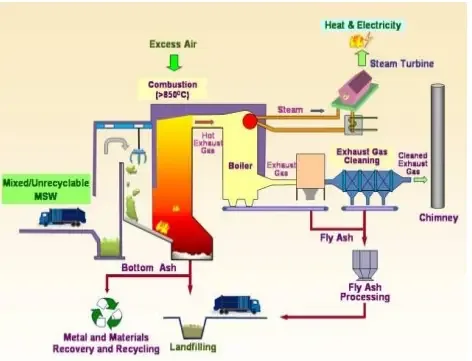
Modern incinerators are also used as waste-to-energy (WtE) plants. The heat produced during burning is collected. This heat is used to boil water and produce steam. The steam runs turbines and electricity is produced.
The history of waste burning is very old. Around 1000 BCE, open burning was done in Jerusalem to reduce waste and disease. But at that time, energy was not produced from waste.
The first modern waste incinerator was tried in London around 1870, but it was not successful. The first successful incinerator was called Destructor. It was made in Nottingham, UK, in 1874 by Manlove, Alliott & Co. Ltd.
The design of Destructor was patented by Alfred Fryer. Later in 1885, first incinerator of United States was made on Governors Island in New York. Waste-to-energy unit was also developed in Copenhagen, Denmark in 1903.
Early incinerators had no proper emission control. They caused pollution of air, soil and water. Later in 1970s, air pollution control systems were developed. These systems reduced hazardous emissions by more than 99% and made modern incinerators cleaner and more useful.
Working principle of Incinerator
Working Principle of Incinerator is based on thermal destruction. In this process, waste materials are burned at very high temperature. It destroys contaminants and reduces the volume of waste.
The waste is first fed into the primary combustion chamber. Here heat is applied to the waste. Moisture present in the waste is evaporated first.
After removal of moisture, the organic part of waste starts to break down. It changes into gases and vapours by heat. The remaining solid material burns and gets oxidized.
After burning, the solid residue is left behind. This residue is called bottom ash. It is the incombustible part of the waste.
The gases and unburned vapours then move into secondary combustion chamber. In this chamber, more air is supplied. The temperature is also kept higher than primary chamber.
In secondary chamber, remaining gases, volatile organic compounds and fine particles are burned completely. This makes the exhaust gas more safe before release.
The hot flue gases are then passed through air pollution control system. Here the gases are cooled and harmful pollutants are removed. Acid gases, heavy metals and dust particles are filtered before the gases go out through chimney stack.
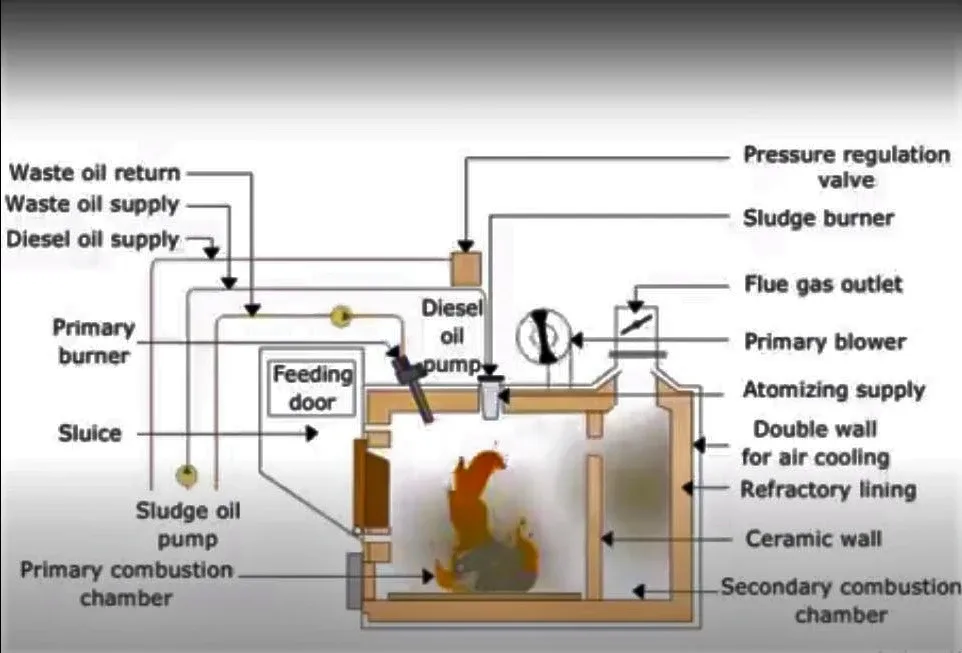
Parts of Incinerator
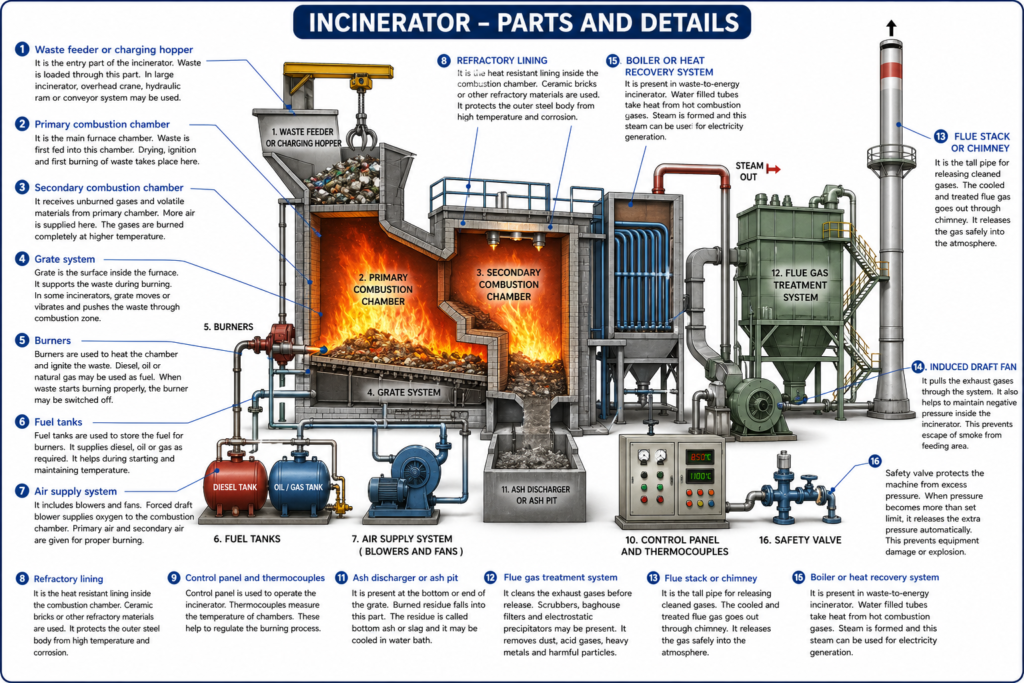
The main parts of incinerator are as follows-
- Waste feeder or charging hopper
It is the entry part of the incinerator. Waste is loaded through this part. In large incinerator, overhead crane, hydraulic ram or conveyor system may be used. - Primary combustion chamber
It is the main furnace chamber. Waste is first fed into this chamber. Drying, ignition and first burning of waste takes place here. - Secondary combustion chamber
It receives unburned gases and volatile materials from primary chamber. More air is supplied here. The gases are burned completely at higher temperature. - Grate system
Grate is the surface inside the furnace. It supports the waste during burning. In some incinerators, grate moves or vibrates and pushes the waste through combustion zone. - Burners
Burners are used to heat the chamber and ignite the waste. Diesel, oil or natural gas may be used as fuel. When waste starts burning properly, the burner may be switched off. - Fuel tanks
Fuel tanks are used to store the fuel for burners. It supplies diesel, oil or gas as required. It helps during starting and maintaining temperature. - Air supply system
It includes blowers and fans. Forced draft blower supplies oxygen to the combustion chamber. Primary air and secondary air are given for proper burning. - Induced draft fan
It pulls the exhaust gases through the system. It also helps to maintain negative pressure inside the incinerator. This prevents escape of smoke from feeding area. - Refractory lining
It is the heat resistant lining inside the combustion chamber. Ceramic bricks or other refractory materials are used. It protects the outer steel body from high temperature and corrosion. - Control panel and thermocouples
Control panel is used to operate the incinerator. Thermocouples measure the temperature of chambers. These help to regulate the burning process. - Ash discharger or ash pit
It is present at the bottom or end of the grate. Burned residue falls into this part. The residue is called bottom ash or slag and it may be cooled in water bath. - Flue gas treatment system
It cleans the exhaust gases before release. Scrubbers, baghouse filters and electrostatic precipitators may be present. It removes dust, acid gases, heavy metals and harmful particles. - Flue stack or chimney
It is the tall pipe for releasing cleaned gases. The cooled and treated flue gas goes out through chimney. It releases the gas safely into the atmosphere. - Boiler or heat recovery system
It is present in waste-to-energy incinerator. Water filled tubes take heat from hot combustion gases. Steam is formed and this steam can be used for electricity generation.
Operating procedure of Incinerator
- The incinerator is first started by auxiliary burner. Diesel or natural gas may be used as fuel. The chamber is preheated before adding waste.
- Waste should not be added during cold condition. The secondary chamber should first reach the required temperature. It is generally about 850°C to above 1000°C.
- When proper temperature is reached, waste is loaded into the primary combustion chamber. Solid or liquid waste may be added through feeding door, hopper or ram feeder.
- Safety interlock should be working during feeding. If the door is open or temperature becomes low, the waste feeding stops automatically. This prevents unsafe burning.
- After entering the hot chamber, moisture present in the waste starts to evaporate. This step dries the waste. Dry waste burns more easily.
- The heated waste then starts to break down. Organic materials release volatile vapours and gases. This is called volatilization.
- The remaining solid part of waste burns in the primary chamber. Primary air is supplied in controlled amount. Fixed carbon or char is oxidized in this chamber.
- The unburned gases and vapours go to secondary combustion chamber. Fine particles also move with these gases. Here secondary air is supplied.
- In secondary chamber, gases and vapours are burned completely at high temperature. This destroys volatile compounds and makes the exhaust more safe.
- Hot flue gas may pass through boiler. Heat is transferred to water and steam may be formed. This can be used for energy recovery.
- The flue gas is then passed through pollution control equipment. Toxic pollutants, dust and harmful gases are removed. Then cleaned gas is released through chimney.
- The burned solid residue falls into ash pit or water trap. This residue is called bottom ash. It is cooled and removed safely from the system.
- During shutdown, auxiliary burners are kept on for some time. This maintains high temperature in secondary chamber. The remaining waste on grate is completely burned into ash before stopping.
Types of Incinerator
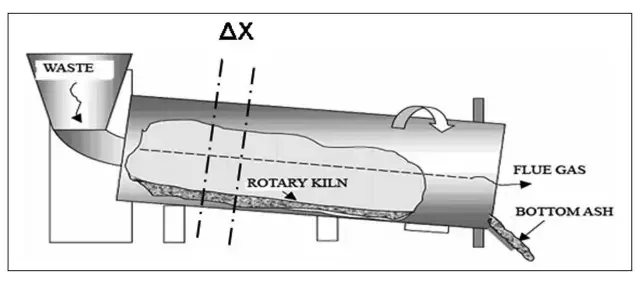
The types of incinerator are as follows-
- Rotary kiln incinerator
Rotary kiln incinerator has inclined rotating cylindrical tube. The waste moves slowly inside the rotating chamber. It is used for hazardous, industrial and medical wastes. - Fluidized bed incinerator
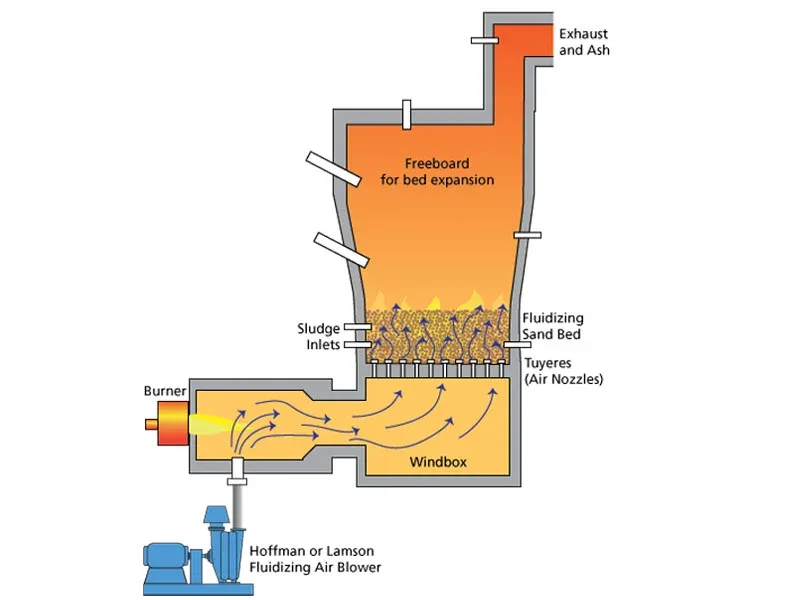
Fluidized bed incinerator uses air passing through granular material like sand. The bed becomes agitated and fluid like. It is useful for sewage sludge, liquid waste and similar type industrial wastes. - Moving grate incinerator
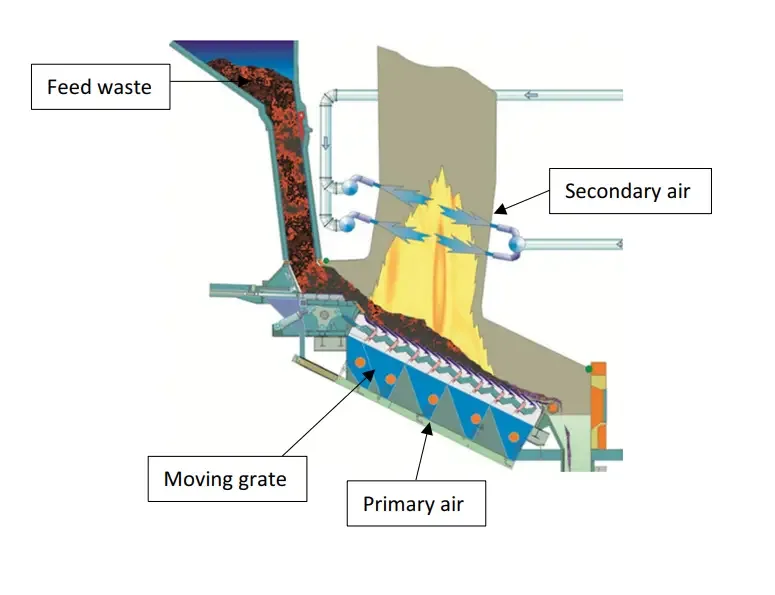
Moving grate incinerator is commonly used for municipal solid waste. The waste is kept on grate and the grate moves it through the combustion chamber. Reciprocating, travelling, rocking and roller grates are its types. - Fixed grate or direct-flame incinerator
It is an older and simple type of incinerator. It has fixed metal grate. Waste is burned by direct flame with supply of fuel and oxygen. - Multiple hearth incinerator
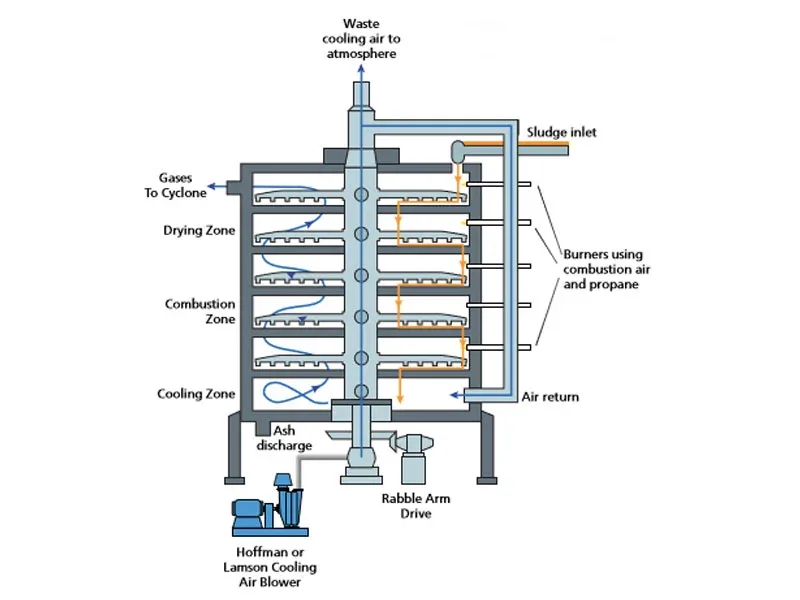
Multiple hearth incinerator has many circular hearths arranged in a column. Rotating arms move the waste downward from one hearth to another. It is mainly used for sludge incineration. - Liquid injection incinerator
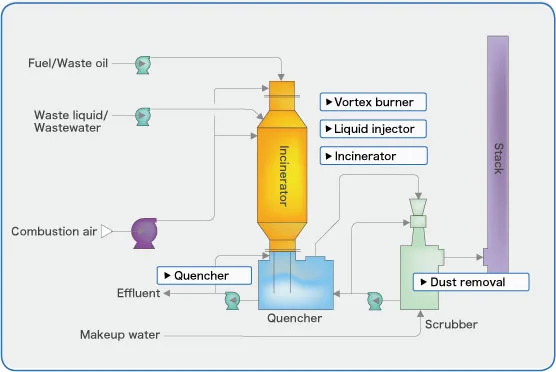
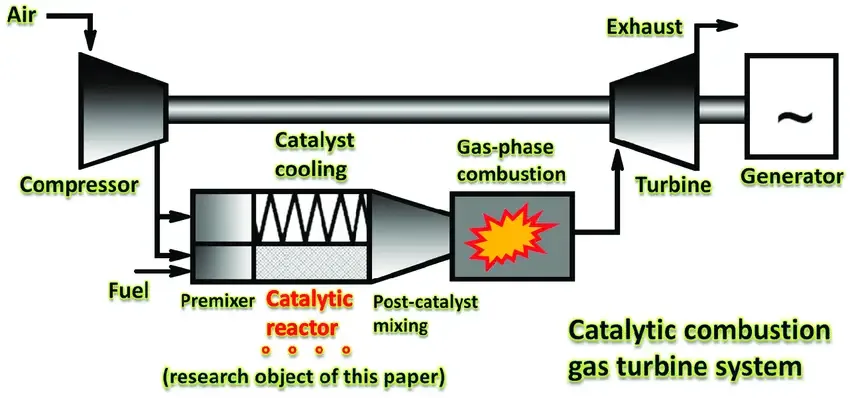
Liquid injection incinerator is used for liquid wastes. The liquid waste is sprayed under high pressure into small droplets. This helps in fast and complete burning. - Catalytic combustion chamber
It uses catalyst for increasing oxidation reaction. It helps to reduce polluting gases like nitrogen oxide. It is used for waste having low organic concentration. - Waste-gas flare incinerator
It is used for burning unwanted gases and liquids. It is mostly used in oil extraction, refineries and chemical plants. Excess gases are burned safely. - Circulating bed incinerator
Circulating bed incinerator uses high velocity air. It makes a turbulent combustion zone. It can destroy toxic hydrocarbons at lower temperature than normal incinerator. - Infrared combustion incinerator
It uses electrical resistance heating elements or radiant U-tubes. Waste passes through the chamber on conveyor belt. Heat is given by infrared radiation. - Stepped and static hearth furnace
These are refractory lined furnace boxes. In static hearth, waste burns on fixed base. In stepped hearth, hydraulic ram pushes waste over steps for better burning. - Modular system
Modular incinerators are smaller special systems. Starved air or two-stage incinerators are included in this type. They are used for specific or pretreated waste streams. - Cycloid incineration chamber
It is a special hopper shaped furnace. Fine fuel granules move in tangential flow field. It is used for old coke and dried sewage sludge.
Applications of Incinerator
- Incinerator is used for medical and healthcare waste. Infectious materials, used sharps, contaminated protective equipments and pharmaceutical waste are burned safely.
- It is used in hospitals, clinics and laboratories. The waste having microorganisms are destroyed by high temperature. This prevents spread of infection.
- It is used for municipal solid waste. Household waste, commercial waste and general garbage are burned in it. This reduces the amount of waste going to landfill.
- In waste-to-energy (WtE) plants, incinerator is used for producing heat and electricity. The heat from burning waste is used for making steam and running turbine.
- It is used for hazardous and industrial waste. Toxic chemicals, solvents and paints are destroyed by high temperature.
- It is used for destroying strong chemical wastes like PCBs and pesticides. These wastes need very high temperature for complete destruction.
- Incinerator is used for animal and agricultural waste. Animal carcasses, slaughterhouse waste and farm by-products are burned. This helps to prevent infectious disease spread.
- It is used for sewage sludge treatment. Semi-solid sludge from wastewater treatment plant is burned. It reduces volume and kills pathogens.
- It is used in remote places and camps. Military bases, mining sites, construction areas and disaster places use incinerator for on-site waste disposal.
- It reduces the need of carrying waste for long distance. This is useful where transport facility is difficult.
- It is used in soil remediation. Contaminated soil having explosives or chlorinated organic compounds can be treated by incineration.
- It is used by law enforcement agencies. Illegal drugs and contraband materials are destroyed completely by burning.
- It is used for nanomaterial wastes. Waste from nanotechnology research and some consumer products are disposed by incinerator.
- It is also used for pet cremation. Animal remains are disposed in veterinary practices and pet crematoriums.
Advantages of Incinerator
- Incinerator reduces the volume of waste very much. The volume may be reduced up to 95% to 96%. So less land is needed for dumping waste.
- It also reduces the solid mass of waste. The mass may be reduced by about 80% to 85%. Only ash remains after complete burning.
- Modern incinerator can recover energy from waste. The heat produced during burning is used for making steam. This steam can produce electricity or used for heating.
- It is useful for destroying pathogens. High temperature kills infectious bacteria and viruses. So medical, agricultural and biological wastes can be disposed safely.
- It also destroys hazardous chemicals. The combustion chamber gives very high temperature. This helps in safe destruction of dangerous waste materials.
- Incineration reduces methane formation from landfill. Organic waste in landfill produces methane during decomposition. Methane is a strong greenhouse gas.
- Incinerator needs less land than sanitary landfill. It can process large amount of waste in smaller area. This is useful in urban places.
- It reduces waste transport distance in many cases. Incineration plant can be placed closer to city area with safety control. So waste collection trucks need not travel long distance.
- It gives better odour control than landfill. Waste is burned inside enclosed chamber. So bad smell is less than open waste decomposition.
- Incinerator can work in different weather condition. The burning process is done inside closed system. Rain and weather change do not stop the process easily.
Disadvantages of Incinerator
- Incinerator is costly to build and operate. It needs expensive plant, emission control system and trained workers. So it is a high cost waste management method.
- It needs more energy for working. Gas emission rules are also strict. Because of this, the total running cost becomes high.
- Incinerator may release toxic gases and pollutants. Dioxins, furans, heavy metals and fine particles may come out if control is not proper.
- Heavy metals like lead, mercury and cadmium may be present in emission. Fine particulate matter like PM2.5 may also affect air quality.
- It may cause health risk to nearby people. Long time exposure may cause breathing problems. Some reports also relate it with congenital defects and cancer risk.
- Incineration produces bottom ash and fly ash. These ashes may contain toxic heavy metals. So they should not be disposed like normal waste.
- The ash needs careful handling and treatment. It is usually disposed in special hazardous waste landfill. This again increases the cost.
- Public opposition is common for incinerator. People do not want it near their houses. This is called NIMBY or Not in My Back Yard problem.
- Incinerator may reduce recycling. Some useful materials are burned instead of reused or recycled. This affects zero waste and circular economy plan.
- It creates long term dependency. Incinerator plants usually need 25 to 30 years of operation for recovering cost. This may stop the use of newer waste treatment methods.
- Centralized incinerator needs transport of waste from different places. Hazardous or contaminated waste has to be moved through communities. This increases transport related risk.
- Truck movement near incinerator may increase noise and traffic. It may also reduce nearby property value due to fear and pollution concern.
Precautions of Incinerator
- Proper PPE should be worn by the operator. Incinerator works at very high temperature. So careless handling may cause serious injury.
- Heavy duty gloves should be used during waste handling. Full body apron is also used. This prevents cross contamination, cuts and puncture from sharp materials.
- Safety glasses should be worn during operation. It protects the eyes from strong heat and bright light. This is more needed during long time work near the incinerator.
- Waste should be sorted before burning. Medical waste should be separated according to colour coding. This reduces handling time and lowers chance of infection and injury.
- Operators should be trained properly before using incinerator. Training should include fire safety, explosion prevention and chemical hazard handling.
- Fire extinguisher method should be known to the operator. If fire accident occurs, the person should know how to control it. Toxic material handling should also be learned.
- Waste should not be loaded before proper temperature is reached. The secondary chamber should reach safe minimum temperature first. This helps to destroy gases and harmful materials properly.
- Safety interlock should not be bypassed. It stops waste charging when the condition is unsafe. This prevents incomplete burning and accident.
- Fire control system should be present near the incinerator. Automatic fire detector, water cannon or foam nozzle may be used. These help to control fire in waste storage and loading area.
- Waste loading area should be kept clean and arranged. Extra waste should not be kept near the hot part. This reduces chance of accidental fire and explosion.
References
- U.S. Environmental Protection Agency. (2001). A citizen’s guide to incineration. EPA-542-F-01-018.
- CN Boilers. (n.d.). Chain grate vs reciprocating grate boilers: Key differences, advantages & applications.
- Reihane. (2024, July 16). Chemical reaction mechanisms of scrubbers. AIMEQUIP.
- Crane, G. K., Brasowski, L., & Craig, C. (1996, April 17). Comparison between the Clean Air Act (American standard) and the European directive. WtERT.
- EPCB Boiler. (n.d.). Differences between chain grate boilers and reciprocating grate boilers.
- Sodimate Inc. (n.d.). Dioxin & furan treatment.
- Lechler. (n.d.). Effective NOx reduction | SNCR process overview.
- U.S. Environmental Protection Agency. (2026, March 19). Energy recovery from the combustion of municipal solid waste (MSW).
- Castillo-Leon, N. Y., Tarazona-Romero, B. E., Ascanio-Villabona, J. G., & Lenguerke-Perez, O. (2025). Energy and economic analysis of waste-to-energy plants with government incentives in Colombia. Heritage and Sustainable Development, 7(2), 885-898. https://doi.org/10.37868/hsd.v7i2.1282
- Themelis, N. J. (2006). Energy recovery from global waste-to-energy. Earth Engineering Center, Columbia University.
- Pierrel, F. (2025, October 31). Evaluating flue gas cleaning systems in industrial incinerators: A comprehensive guide. Enertherm Engineering.
- Inciner8. (2024, February 8). Everything you need to know about thermal treatment.
- Public Services and Procurement Canada. (2019, March 22). Fact sheet: Incineration — Guidance and orientation for the selection of technologies — Contaminated sites.
- Puragen. (n.d.). Flue gas & stack emissions solutions | Activated carbon filtration.
- Kanadevia Inova. (n.d.). Flue gas treatment | Waste to X.
- Kanadevia Inova. (n.d.). Grate combustion systems | Waste to X.
- Climate Action Accelerator. (2024, September 27). Incineration.
- Wikipedia contributors. (2026, May 6). Incineration. In Wikipedia, The Free Encyclopedia.
- The MBR Site. (n.d.). Incineration of sludge.
- Waste Spectrum. (n.d.). Incinerator technology guide.
- Karki, P. (n.d.). Incinerator- Principle, procedure, parts, types, uses, examples. Microbe Notes.
- Guyer, J. P. (2011). Introduction to solid waste incineration. CEDengineering.com.
- U.S. Environmental Protection Agency. (n.d.). MACT EEE training.
- Ram, C., Kumar, A., & Rani, P. (2021). Municipal solid waste management: A review of waste to energy (WtE) approaches. BioResources, 16(2), 4275-4320.
- Valmet. (n.d.). NOx reduction with SCR, SNCR and scrubber methods.
- Veolia Water Technologies. (n.d.). Pyrofluid™.
- Taishan Group. (n.d.). Reciprocating grate boiler: Structure and working principle.
- Detroit Stoker Company. (n.d.). Reciprograte.
- U.S. Environmental Protection Agency. (2021, December). Regulation No. 10 – Infectious waste incinerators.
- Ohio Laws. (n.d.). Rule 3745-570-202 | Incineration.
- Hoffman & Lamson. (n.d.). Sewage sludge incineration blower solutions.
- Cambi. (2024, January 9). Sludge incineration and the thermal hydrolysis advantage.
- RACO Manufacturing & Engineering Co. (n.d.). Sludge incineration: Wastewater treatment explained.
- Mitsubishi Heavy Industries Environmental & Chemical Engineering Co. (2021, February). State-of-the-art stoker-type waste incinerator begins commercial operation.
- Technical comprehensive analysis of industrial incineration: Thermal principles, system architecture, and environmental mitigation strategies. (n.d.).
- Environmental Protection Department, Hong Kong. (2009). Thermal treatment technologies for municipal solid waste.
- Inciner8. (n.d.). Types of incinerator.
- Zhengzhou Firebird New Material Co., Ltd. (n.d.). Types of waste incinerators and their implications for furnace lining design.
- CIRS Group. (n.d.). US EPA releases 2026 PFAS disposal guidance: High-temperature incineration and underground injection listed as low-risk options.
- LDX Solutions. (2026, March 2). Understanding SCR and SNCR for NOx control.
- Bru.Impianti group S.r.l. (n.d.). Waste incineration flue gas cleaning.
- European Commission. (2006, August). Integrated pollution prevention and control reference document on the best available techniques for waste incineration.
- EPCM Holdings. (n.d.). Waste incineration basics.
- Database of Waste Management Technologies. (n.d.). Waste to energy 1-2: Grate incineration technology.
- Kanadevia Corporation. (n.d.). Waste to energy plants.
- Appiah, H., Asamoah, P., & McDonald, A. G. (2026). Waste-to-energy technologies and their role in municipal solid waste management. Recycling, 11(3), 56. https://doi.org/10.3390/recycling11030056
- U.S. Energy Information Administration (EIA). (2019, November 12). Waste-to-energy (MSW) in depth.
- Wikipedia contributors. (2026, April 13). Waste-to-energy. In Wikipedia, The Free Encyclopedia.
- Damelin, D. (2007). Writing chemical equations. Chemistry 2.
- Degrémont® – SUEZ Water Handbook. (n.d.). Flue gas treatment types.