

Laboratory hot plate is a portable table top instrument used for heating samples, chemicals and reagents. It gives heat slowly and safely. It is used instead of open flame.
It has a flat heating surface. The surface may be made up of ceramic, aluminium, polypropylene or stainless steel. A heating element is present below the flat surface.
The working of hot plate is based on Joule heating or electrical resistance heating. In this process, electric current passes through the heating element. Then heat is produced and transferred to the upper surface.
Many laboratory hot plates also have magnetic stirrer. It helps to mix the liquid during heating. So the liquid is heated and stirred at the same time.
Laboratory hot plate was developed to improve safety in laboratory. It was used as safer option than Bunsen burner and other open flame sources. It also helps to repeat experiments under more controlled condition.
Earlier hot plates were simple resistance heaters. Now modern hot plates are more advanced. They have microprocessor control, digital feedback, safety temperature limit and remote monitoring system.
Principle of Hot Plate
Principle of Hot Plate is based on electrical resistance heating. It is also called Joule heating. In this process, electrical energy is changed into heat energy.
In hot plate, heating element is present below the flat top surface. When electric current passes through this element, heat is produced. This heat is formed due to resistance of the heating element.
During this process, the moving electrons collide with atoms of the heating material. The atoms start vibrating more. This vibration produces heat inside the element.
The heat then moves upward to the top surface by conduction. The top surface is made up of aluminium, ceramic or stainless steel. These materials help in proper transfer of heat.
The upper surface becomes warm and stable. Laboratory vessels and samples are kept on this surface. Heat is then transferred to the sample in a safe and uniform way.
Types of Hot Plates
The types of hot plates are as follows-
A. Based on Design and Function
- Standard hot plate
Standard hot plate has only heating system. It does not have stirring facility. It is used for simple heating of samples and reagents. - Magnetic stirrer hot plate
Magnetic stirrer hot plate has heating system and magnet below the plate. The magnet makes rotating magnetic field. It rotates the stir bar kept inside the liquid. - Stirring hot plate
Stirring hot plate has both heating and stirring arrangement. It may have magnetic or overhead stirring system. It is used for uniform heating of large volume and viscous samples.
B. Based on Surface Material
- Ceramic hot plate
Ceramic hot plate can tolerate high temperature up to 550°C. It is resistant to acids, bases and organic solvents. Its white surface helps to see colour change in sample. - Aluminium hot plate
Aluminium hot plate gives fast and even heating. It has good thermal conductivity. It is also strong against mechanical impact. - Stainless steel hot plate
Stainless steel hot plate gives stable and controlled heating. It is resistant to corrosion. It is useful in sterile places like ISO cleanrooms and cGMP facilities. - Polypropylene hot plate
Polypropylene hot plate cannot reach very high temperature. But it is highly resistant to harsh chemicals and solvents. It is useful in wet chemistry with methanol and acetonitrile.
C. Based on Controller Type
- Digital hot plate
Digital hot plate has digital display. It gives proper control of temperature and speed. It may also have programmable setting and safety alarm. - Analog hot plate
Analog hot plate has simple dial system. Temperature and stirring speed are adjusted manually. It is low cost and useful for simple work.
D. Specialty Hot Plates
- Explosion-proof hot plate
Explosion-proof hot plate is used in hazardous areas. It is used where explosive liquid, gas or powder may be present. - Incubator-safe hot plate
Incubator-safe hot plate is made to resist moisture corrosion. It maintains required temperature for prokaryotic and eukaryotic cell culture. - Remote-controlled hot plate
Remote-controlled hot plate can be operated from a distance. It is useful when hot plate is kept inside fume hood or wet processing deck. - Compact hot plate
Compact hot plate is small in size. It saves bench space. It is useful in crowded or shared laboratories. - Multi-position hot plate
Multi-position hot plate has many heating and stirring positions on one surface. Each position may be controlled separately. It is used for many experiments at same time.
Parts of Laboratory Hot Plate
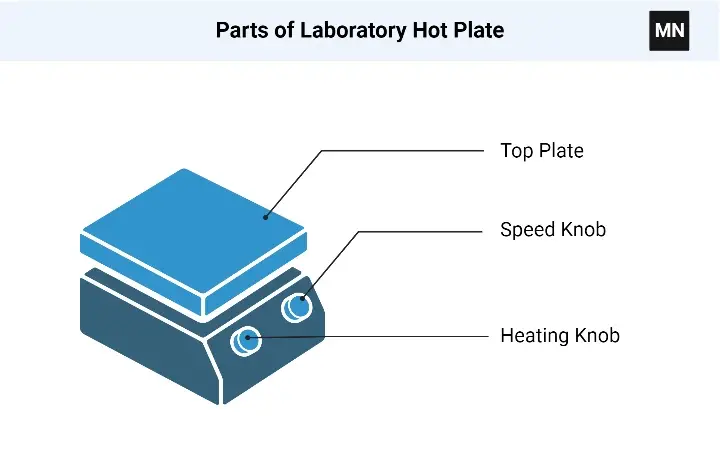
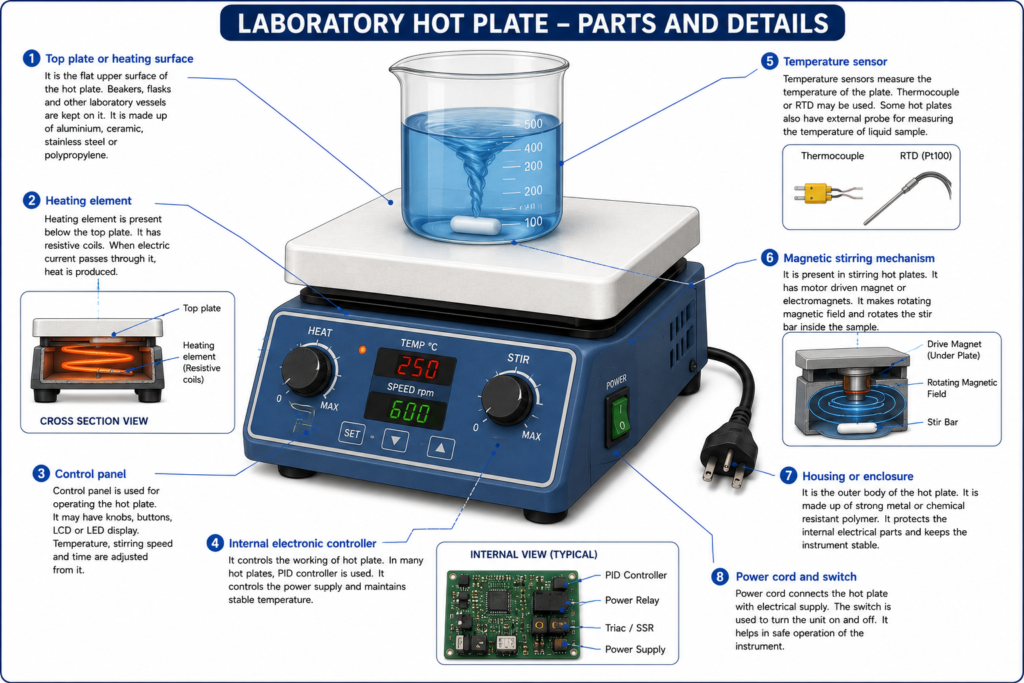
The main parts of laboratory hot plate are as follows-
- Top plate or heating surface
It is the flat upper surface of the hot plate. Beakers, flasks and other laboratory vessels are kept on it. It is made up of aluminium, ceramic, stainless steel or polypropylene. - Heating element
Heating element is present below the top plate. It has resistive coils. When electric current passes through it, heat is produced. - Control panel
Control panel is used for operating the hot plate. It may have knobs, buttons, LCD or LED display. Temperature, stirring speed and time are adjusted from it. - Internal electronic controller
It controls the working of hot plate. In many hot plates, PID controller is used. It controls the power supply and maintains stable temperature. - Temperature sensor
Temperature sensors measure the temperature of the plate. Thermocouple or RTD may be used. Some hot plates also have external probe for measuring the temperature of liquid sample. - Magnetic stirring mechanism
It is present in stirring hot plates. It has motor driven magnet or electromagnets. It makes rotating magnetic field and rotates the stir bar inside the sample. - Housing or enclosure
It is the outer body of the hot plate. It is made up of strong metal or chemical resistant polymer. It protects the internal electrical parts and keeps the instrument stable. - Power cord and switch
Power cord connects the hot plate with electrical supply. The switch is used to turn the unit on and off. It helps in safe operation of the instrument.
Operating Procedure of Hot Plate
- The hot plate is checked before use. Power cord and plug are also checked. If any damage, crack or loose wire is present, the hot plate should not be used.
- The working area is cleaned before heating. Flammable liquids, paper towels and combustible materials are removed from nearby place. This is more important when hot plate is used in fume hood.
- Proper glassware is selected for heating. Heat resistant borosilicate glassware like Pyrex is used. Cracked glassware or glassware with star mark should not be heated.
- The vessel should be smaller than the hot plate surface. If the vessel is larger, spilling may occur. It also gives uneven heating.
- Boiling stones or boiling sticks are added when liquid is heated. This helps in even boiling. It also prevents sudden bumping and boiling over.
- The hot plate is placed in such way that the power cord does not touch the hot surface. Cord should also not come near hot vessel.
- The hot plate is switched on. Heat is increased slowly. Medium or medium high setting is used for most liquids.
- Highest heat setting should be avoided. Low boiling liquids may boil suddenly. Surface temperature may also become very high.
- Temperature is monitored during heating. Thermometer or thermocouple probe is fixed properly in the sample or heating bath. It shows the actual temperature.
- Solvents or reagents are added carefully to hot system. If addition is needed, dropping funnel or closed system is used. Open addition may cause flash fire.
- Heating reaction should not be left unattended. The process is watched continuously until required temperature becomes stable.
- After the work is completed, the hot plate is switched off. Then it is unplugged from the power supply.
- Hot glassware is removed carefully. Heat resistant gloves, silicone rubber heat protector or thermal tongs are used.
- The hot plate is allowed to cool completely. It should come to room temperature before cleaning spills or keeping it inside cabinet.
Applications of Hot Plate
- Hot plate is used for heating laboratory samples. Chemicals and reagents are heated slowly and safely. It is used in daily laboratory work.
- It is used for chemical reactions. Heat helps to start and increase the reaction. It is used in synthesis reactions like esterification and polymerization.
- It is used for evaporation of liquid samples. The liquid is heated and solvent is removed slowly. This helps to concentrate the sample.
- It is used in acid digestion process. Samples are heated with acid for analytical chemistry work. This helps to break down the sample.
- It is used for dissolving solid compounds. Agar and other solids can be dissolved in medium by heating. Stirring helps the solution to mix properly.
- It is used in titration work. Proper temperature and stirring are maintained. This helps to get more correct result.
- It is used in solubility studies. The sample is heated at controlled temperature. It helps to see how much substance dissolves.
- In biological work, hot plate is used for preparing nutrient media. It is also used for culturing cells and microorganisms. It gives controlled heat to biological samples.
- It is used in enzymatic studies. Enzyme activity tests are done at required temperature. It is also used in protein denaturation work.
- It is used in PCR related work. Stable temperature is needed for amplification of DNA. Hot plate helps to maintain controlled heating condition.
- It is used in precipitation reactions. Heat and stirring help in formation of solid precipitate. It makes the precipitate formation more uniform.
- It is used in pharmaceutical and quality control testing. It is also used in teaching laboratories for simple heating experiments.
Advantages of Hot Plate Stirrer
- Hot plate is safer than open flame. It does not use flame like Bunsen burner. So chance of fire and accidental burn becomes less.
- It gives controlled heating. Temperature can be increased slowly. This helps to maintain same heating condition during experiment.
- It gives more stable heat. The sample can be heated for required time. So repeated experiments can be done in similar condition.
- It is safer than hot bath in many cases. There is less chance of spilling and overheating. It can also hold different sizes of flasks easily.
- Many hot plates have magnetic stirrer. Heating and stirring can be done together. This saves time and gives uniform mixing of solution.
- Magnetic stirring reduces manual work. The sample is mixed continuously without touching it. So chance of contamination becomes less.
- Hot plate is small and portable. It can be kept on laboratory bench. It also saves working space in the laboratory.
- It is used with different glasswares. Beakers, flasks and other vessels can be heated on it. It can also be used with oil bath or sand bath.
- Different surface materials are available. Ceramic surface is useful for harsh chemicals. Aluminium surface gives fast and even heating.
Limitations of Hot Plate Stirrer
- Standard hot plate is not explosion-proof. It should not be used for heating flammable materials and low boiling solvents. Ether and carbon disulfide vapours may catch fire.
- Internal parts of hot plate may ignite vapours. So ordinary hot plate is dangerous when flammable solvent is heated. Explosion-proof hot plate is needed for such work.
- Some hot plates measure the temperature of plate only. They do not measure the actual temperature of sample. So the sample temperature may be different from set temperature.
- Temperature error may occur during heating of large volume. It may also occur in thick or viscous liquids. External temperature probe is needed for more proper reading.
- Heat resistant glassware should be used on hot plate. Borosilicate glass like Pyrex is suitable. Soft glass or soda-lime glass may crack during heating.
- Thick walled glass vessels may heat unevenly. This can cause breaking or shattering of glassware. Cracked glassware should not be used.
- Metal pans and aluminium foil should not be placed directly on hot plate. It may damage the plate surface. It may also produce spark and hazard.
- Ceramic plate may break easily. It can crack by thermal shock. If cold liquid falls on hot ceramic surface, cracking may occur.
- Ceramic hot plate may not heat uniformly at all places. The edges may remain cooler than the middle part. So heating may be uneven.
- Aluminium plate can be damaged by harsh chemicals. Corrosion may occur. Its surface may also get cosmetic damage.
- Polypropylene hot plate cannot give high temperature. It has low melting point. So it is used only for limited temperature work.
- Stainless steel hot plate gives less uniform heating than aluminium. So it may not be suitable when very even heating is needed.
- Old hot plates are more risky. Hot plates made before 1984 or having old analog bimetallic thermostat may not have feedback control.
- In old thermostat, the contact may fuse shut. Then the hot plate may heat continuously up to maximum temperature. This can cause laboratory fire.
References
- ResearchGate. (n.d.). (PDF) Hot Plate Temperature Controller.
- Asynt. (n.d.). A Guide to Safety & Best Practices for Laboratory Hotplates.
- MRC Laboratory Instruments. (n.d.). All types of baths for labs- guide.
- Shepherd University. (n.d.). CSTEM Laboratory Safety.
- MightyOhm. (n.d.). DIY PID Controlled Soldering Hotplate.
- Hogentogler & Co. Inc. (n.d.). Digital Stirring Hot Plates.
- Frontier, A. (2026). Elevating Reaction Temperature. University of Rochester, Department of Chemistry.
- University of Pennsylvania Environmental Health and Radiation Safety. (2026, April 23). Hot Plate Malfunctions and Misuse.
- UC San Diego Blink. (2025, March 25). Hot Plate Usage and Heating Reactions.
- Chandra, T. (2013, December). Hot Plate Use and Safety in Laboratory. University of Wisconsin-Madison Office of Chemical Safety.
- Camlab. (n.d.). Hotplate Maintenance: Tips and Troubleshooting.
- Xu, S. (2024, November 12). How To Wire A Pid Temperature Controller: A Comprehensive Guide. Lorentzzi.
- Hogentogler & Co. Inc. (n.d.). How to Choose the Right Digital Hot Plate.
- Anees, A. (2026, February 15). Induction Heating vs Resistance Heating. Axiom HT.
- Canroon. (2026, May 13). Induction Heating vs Resistance Heating: Key Differences.
- Vivid Metrawatt. (2025, May 20). Induction Heating vs. Resistance Heating | Comparison.
- Wikipedia. (2026, May 4). Joule heating.
- Wikipedia. (2026, May 4). Joule heating.
- Thermo Fisher Scientific. (n.d.). Lab Hot Plates.
- Thomas Scientific. (n.d.). Lab Hotplates & Stirrers.
- Wayne State University Office of Environmental Health & Safety. (n.d.). Laboratory Hot Plate Safety.
- Terra Universal. (n.d.). Laboratory Hot Plates and Magnetic Stirrer Features Comparison Chart.
- ConductScience. (2022, August 4). How To Choose the Right Laboratory Hot Plates.
- MachineQ. (n.d.). Life Sciences: IoT-Powered Temperature Monitoring.
- Yelimeshyn, S. (2025, December 24). Magnetic Stirrer Hot Plate: Essential Laboratory Tool for Heating and Stirring. BostonMed Supply.
- The University of Iowa Environmental Health and Safety. (n.d.). Oil Baths in Laboratories.
- EEVblog. (n.d.). PID heater control with SSR – Page 1.
- All About Circuits. (2013, September 22). PID to open a Triac?
- Thermo Fisher Scientific. (n.d.). Remote Monitoring Systems.
- Beaty, B. (n.d.). Repairing IKA heat/stir plate RTC-b Basic. University of Washington Department of Chemistry.
- Dongguan Zhifa Power Technology Co., Ltd. (2025, January 21). Resistance vs. Induction Heat Treatment: Pros and Cons.
- Lopez, G. (2016, February 18). Standard Operating Procedure Torrey Pines Scientific Hotplate Calibration. Quattrone Nanofabrication Facility.
- Structural and Operational Analysis of Laboratory Hot Plate Systems: A Technical Treatise on Thermal Management, Electronic Control, and Safety Engineering. (n.d.).
- Elektro-mag. (2025, January 1). How to Understand the Working Principles of Laboratory Hot Plates.
- COMSOL. (2017, February 21). The Joule Heating Effect.
- Flores, N. C., & Boyle, E. A. E. (2000, January). Thermometer Calibration Guide. Kansas State University Agricultural Experiment Station and Cooperative Extension Service.
- Elektro-mag. (2024, December 17). Top 3 Types of Laboratory Hot Plates: Ceramic, Aluminium, and Stainless Steel.
- Thermoline. (2025). Troubleshooting and Repair | Platelet Shaker.
- Meltric. (n.d.). Understanding Joule Heating: Why Resistance Makes Wires Hot.
- Carrillo, M. (2024, November 19). Using Sand in a Bath. Laboratory Supply Network.
- SimScale. (2023, November 20). What Is Joule Heating (Joule Effect)?
- Lab Depot Inc. (n.d.). What Should I Look for in a Hot Plate or Hot Plate Stirrer?
- Chemistry Stack Exchange. (2019, April 27). What considerations are made in determining whether to use a sand bath or oil bath?
- Keysight. (n.d.). What is Joule Heating?
- HINOTEK. (n.d.). What is a Laboratory Hot Plate? Uses, Types & Safety.
- Texas Department of Transportation. (2022, January). Test Procedure for Thermometer Calibration Using Controlled Temperature Baths (TxDOT Designation: Tex-926-K).