

Fermentation media are nutrient preparations which are used for the growth and metabolic activity of microorganisms. It gives proper environment for bacteria, yeasts and fungi during fermentation. In this medium, microbes convert raw materials into useful products like cell biomass, antibiotics, enzymes, organic acids and pharmaceutical products.
Fermentation media may be solid or liquid. In solid state fermentation, moist solid substrate is used. But in most industrial fermentation, liquid medium is used. This liquid medium is called broth. It is easy to handle in large scale and also helps to control pH, temperature, aeration and other conditions in the fermenter.
The medium must contain all necessary nutrients in proper amount. Water is the major component of liquid media and acts as solvent. It helps in transport of nutrients, removal of waste materials and biochemical reactions. Carbon source is the most important nutrient because it gives energy and carbon skeleton for cell growth. Some common carbon sources are glucose, sucrose, molasses and starch.
Nitrogen source is required for the synthesis of proteins, amino acids and nucleic acids. It may be supplied as inorganic nitrogen like ammonium salts or as organic nitrogen like yeast extract, peptone and corn steep liquor. Along with these, minerals, trace elements, vitamins and growth factors are also needed. These are specially important for those microorganisms which cannot synthesize all nutrients by themselves.
Fermentation media also contain some special substances. Buffers are used to maintain the pH. Antifoaming agents are used to reduce foam formed during aeration and agitation. Precursors and inducers are added to increase the formation of desired product. Inhibitors are used to stop unwanted metabolic pathway and reduce by-product formation.
The design of fermentation medium is important for both growth and product formation. In laboratory scale, pure and costly chemicals are often used to make uniform media. But in industrial fermentation, cheap and complex raw materials are used. Agricultural wastes and by-products are mostly used because they reduce cost and make the process more economical.
Importance of Fermentation Media
- Fermentation media is important for growth and survival of microorganisms. It supply carbon, nitrogen, water, minerals, vitamins and energy source to the microbial cells.
- It gives suitable environment for bacteria, yeasts and fungi during fermentation. In this medium, microorganisms grow, multiply and maintain their cellular activity.
- It is used for production of useful products. Microbes use the nutrients present in the medium and form antibiotics, enzymes, organic acids, alcohols and cell biomass.
- The quality and quantity of product depends on the composition of media. If nutrient balance is proper, then product formation is high. If media is poor, then yield also become low.
- It helps to control the metabolic activity of microorganisms. Precursors and inducers increase desired product formation. Inhibitors stop unwanted pathway and reduce by-product formation.
- It helps to maintain proper condition during fermentation. Buffers control the change of pH. Antifoaming agents reduce foam which is produced during aeration and agitation.
- It also reduces the cost of industrial fermentation. Cheap raw materials, agricultural wastes and by-products are used in media. So production becomes economical and suitable for large scale process.
Characteristics of an Ideal Fermentation Medium
- Ideal fermentation medium should give maximum yield of desired product. It should produce high amount of cell biomass or product from per gram of substrate used.
- It should give high rate of product formation. The microorganism should grow properly and product should be formed in less time.
- It should produce minimum unwanted by-products. The formation of impurities and useless metabolites should be very low.
- The raw materials used in the medium should be cheap and easily available. It should be available throughout the year for industrial use.
- It should have constant quality. The medium should give same result in every batch of fermentation.
- It should be nutritionally complete. It must contain proper amount of carbon source, nitrogen source, minerals, trace elements and necessary precursors.
- It should not create problem during fermentation process. It should not disturb aeration, agitation, mixing and growth of microorganism.
- It should be easy to sterilize. The medium should not get damaged by heat and should not form any toxic or inhibitory substances during sterilization.
- It should not interfere with product recovery. The medium should allow easy extraction and purification of final product.
- It should be non-toxic to the production organism. The components of medium should not inhibit microbial growth and metabolic activity.
- It should produce less foam during fermentation. If foam is less, then aeration and agitation become easy and contamination chance also decrease.
- It should have good buffering capacity. It helps to control acidic or alkaline changes produced during microbial metabolism.
- It should not create much problem in waste treatment. The used medium and effluent should be easy to treat and safe for environment.
Components of Fermentation Media
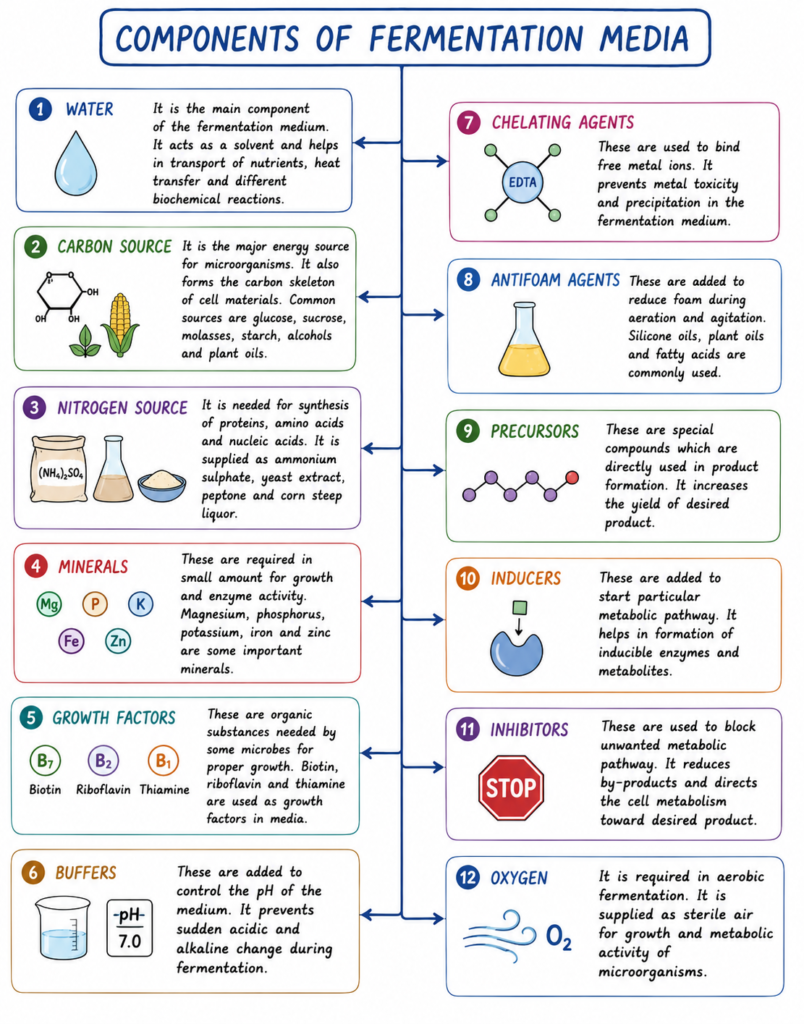
The following are the main components of fermentation media–
- Water-It is the main component of the fermentation medium. It acts as a solvent and helps in transport of nutrients, heat transfer and different biochemical reactions.
- Carbon source-It is the major energy source for microorganisms. It also forms the carbon skeleton of cell materials. Common sources are glucose, sucrose, molasses, starch, alcohols and plant oils.
- Nitrogen source-It is needed for synthesis of proteins, amino acids and nucleic acids. It is supplied as ammonium sulphate, yeast extract, peptone and corn steep liquor.
- Minerals-These are required in small amount for growth and enzyme activity. Magnesium, phosphorus, potassium, iron and zinc are some important minerals.
- Growth factors-These are organic substances needed by some microbes for proper growth. Biotin, riboflavin and thiamine are used as growth factors in media.
- Buffers-These are added to control the pH of the medium. It prevents sudden acidic and alkaline change during fermentation.
- Chelating agents-These are used to bind free metal ions. It prevents metal toxicity and precipitation in the fermentation medium.
- Antifoam agents-These are added to reduce foam during aeration and agitation. Silicone oils, plant oils and fatty acids are commonly used.
- Precursors-These are special compounds which are directly used in product formation. It increases the yield of desired product.
- Inducers-These are added to start particular metabolic pathway. It helps in formation of inducible enzymes and metabolites.
- Inhibitors-These are used to block unwanted metabolic pathway. It reduces by-products and directs the cell metabolism toward desired product.
- Oxygen-It is required in aerobic fermentation. It is supplied as sterile air for growth and metabolic activity of microorganisms.
Classification of Fermentation Media
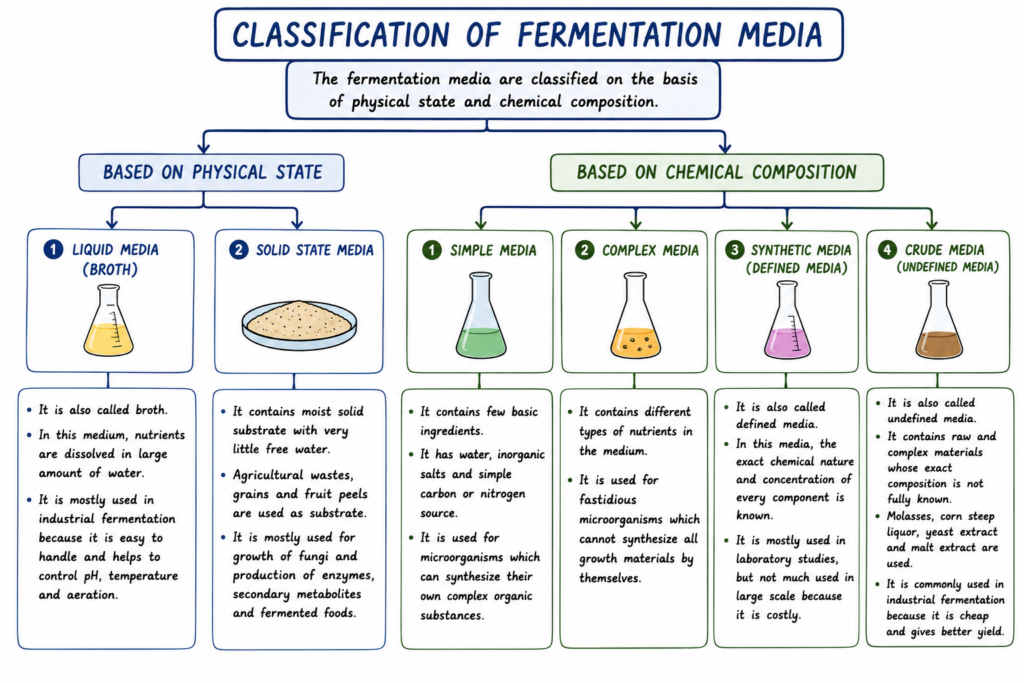
The fermentation media are classified on the basis of physical state and chemical composition-
Based on Physical State
- Liquid media-It is also called broth. In this medium, nutrients are dissolved in large amount of water. It is mostly used in industrial fermentation because it is easy to handle and helps to control pH, temperature and aeration.
- Solid state media-It contains moist solid substrate with very little free water. Agricultural wastes, grains and fruit peels are used as substrate. It is mostly used for growth of fungi and production of enzymes, secondary metabolites and fermented foods.
Based on Chemical Composition
- Simple media-It contains few basic ingredients. It has water, inorganic salts and simple carbon or nitrogen source. It is used for microorganisms which can synthesize their own complex organic substances.
- Complex media-It contains different types of nutrients in the medium. It is used for fastidious microorganisms which cannot synthesize all growth materials by themselves.
- Synthetic media-It is also called defined media. In this media, the exact chemical nature and concentration of every component is known. It is mostly used in laboratory studies, but not much used in large scale because it is costly.
- Crude media-It is also called undefined media. It contains raw and complex materials whose exact composition is not fully known. Molasses, corn steep liquor, yeast extract and malt extract are used. It is commonly used in industrial fermentation because it is cheap and gives better yield.
Natural Raw Materials Used in Fermentation Media
The following are the natural raw materials used in fermentation media–
- Molasses-It is a cheap viscous syrup obtained from sugarcane and sugar beet industry. It contains sucrose, vitamins and trace minerals. It is used as common carbon source in fermentation.
- Malt extract-It is prepared from malted barley grains. It contains carbohydrates like glucose, fructose and maltose. It also gives proteins, amino acids and vitamins to the medium.
- Starch and dextrin-These are complex carbohydrate materials obtained from cereals and root crops. Maize starch is mostly used. It is sometimes hydrolysed into sugar syrup before use.
- Cellulosic materials-These are plant based structural materials. Wood hydrolysate, rice straw, wheat bran and corn bagasse are used as cheap raw materials.
- Corn steep liquor-It is a dark and viscous liquid obtained during maize starch production. It is rich in amino acids, peptides, lactic acid and minerals. It is used as important nitrogen source.
- Whey-It is the liquid by-product of dairy and cheese industry. It contains lactose and milk proteins. It is used as cheap carbon and nutrient source.
- Yeast extract-It is prepared from hydrolysed baker’s or brewer’s yeast cells. It contains amino acids, peptides and water soluble vitamins. It is used for growth of many microorganisms.
- Plant oils-These are high energy carbon sources. Oils of soya, sunflower, maize, olive and cotton seed are used. It gives slow and continuous carbon supply.
- Animal fats-These are also used as carbon and energy source. Fish oil and hard animal fats are used in some fermentation process.
- Seed meals-These are residues left after oil extraction from seeds. Soya bean meal, peanut meal and cotton seed meal contain proteins and carbohydrates.
- Fruit wastes-These are cheap agricultural wastes. Fruit pomace, citrus peels, banana peels and pineapple waste are used as nutrient source.
- Vegetable wastes-These include potato peels, yam peels and other vegetable residues. These materials contain starch, sugars and minerals.
- Agro-industrial wastes-These are unrefined by-products from different industries. Sugarcane bagasse, coffee pulp, spent brewing grains and slaughterhouse wastes are used to reduce medium cost.
Media Optimization for Fermentation Processes
The following are the methods used for media optimization in fermentation process-
- OFAT-It means One-Factor-at-a-Time method. In this method, only one nutrient or one physical factor is changed at a time. Other factors are kept constant. It includes removal, supplementation and replacement type experiments. It is simple method, but it takes more time and does not show interaction between nutrients.
- DoE-It means Design of Experiments. It is a statistical method. In this method, many factors are studied together. It shows the effect of two or more factors on product yield.
- Plackett-Burman design-It is used for screening of many variables. It helps to find the important factors affecting fermentation.
- Box-Behnken design-It is used to find optimum level of selected factors. It gives mathematical model for better growth and product formation.
- Central composite design-It is used for finding proper concentration of medium components. It also helps to select suitable fermentation condition.
- Taguchi design-It is used to improve medium composition. It reduces unnecessary number of experiments.
- RSM-It means Response Surface Methodology. It is used to study interaction between different variables. Product yield is plotted as response surface and optimum condition is selected.
- Orthogonal test-It is a statistical method used for selecting significant factors. It helps to improve microbial viability and product yield with less number of experiments.
- Uniform design-It is used when many factors and many levels are present. It selects proper experimental combination for fermentation media optimization.
- ANN-It means Artificial Neural Network. It is a computer based method. It uses large data and finds hidden relation between medium components and product formation.
- GA-It means Genetic Algorithm. It is used for complex optimization problem. It uses mathematical model and selects best concentration of medium components.
- ML workflow-It means Machine Learning workflow. In this method, large data are produced by screening. Then computer model checks many media combinations in silico and selects best nutrient concentration and physical condition.
Factors Affecting the Selection of Fermentation Media
The following are the factors affecting the selection of fermentation media–
- Cost-The raw materials should be cheap and economical. It should not increase the total cost of fermentation process.
- Availability-The materials should be easily available throughout the year. It helps to continue industrial production without shortage.
- Consistency-The quality of medium components should be same in every batch. If quality changes, then microbial growth and product yield also changes.
- Handling-The raw materials should be easy to handle and transport. Solid and liquid materials need different type of handling and storage.
- Storage-The materials should be stable during storage. Some media components may need low temperature or dry condition for proper storage.
- Sterilization-The medium components should be easily sterilized. It should not get damaged by heat and should not form inhibitory substances.
- Viscosity-The medium should not be too viscous. High viscosity creates problem in mixing, aeration and agitation inside the fermenter.
- Foam formation-The selected medium should produce less foam. Excess foam disturb aeration and may increase chance of contamination.
- Product yield-The medium should support high production of desired product. It should give more product from less amount of substrate.
- Impurities-The raw material should not contain high amount of impurities. Impurities may produce unwanted by-products and affect microbial metabolism.
- Downstream process-The medium should not create problem in product recovery. Extraction and purification of final product should be easy and less costly.
- Waste treatment-The used medium should be easy to treat after fermentation. It should produce less effluent and should not increase waste treatment cost.
- Safety-The raw materials should be safe for handling and use. It should not create health problem and environmental pollution during fermentation.
Examples of Fermentation Media
The following are some examples of fermentation media–
- Synthetic media-These media contain pure chemicals and exact amount of every component is known. It is used in laboratory study for nutritional and metabolic work.
- Czapek’s Dox medium-It is a synthetic medium containing inorganic salts, sugar and nitrate source. It is used for growth study of fungi and other microorganisms. 1
- Richard’s solution-It is also a synthetic medium. It contains purified nutrients and is used for exact nutritional studies.
- M9 minimal medium-It is a defined medium. It contains simple salts, carbon source and nitrogen source. It is commonly used for bacterial research.
- Chu medium-It is a defined medium used for specific microbial and algal culture work.
- Krainsky’s glucose medium-It is a synthetic glucose containing medium. It is used when exact composition of media is required.
- Simple media-These media contain only few basic ingredients. It is mainly used for autotrophic microorganisms which can synthesize complex organic substances by themselves.
- Allen medium-It is a simple medium containing inorganic salts. It is used for growth of autotrophic organisms.
- Chu medium-It is also used as simple medium in some fermentation and algal culture studies.
- Complex media-These media contain many complex nutrients. Exact composition is not fully known. It is used for organisms which need rich nutrients.
- MRS medium-It means De Man, Rogosa and Sharpe medium. It is a complex medium used for fastidious organisms, mainly lactic acid bacteria.
- LB medium-It means Lysogeny broth. It is a rich medium used for bacterial culture. It is commonly used for Escherichia coli growth and recombinant protein work.
- YEPD medium-It means Yeast Extract Peptone Dextrose medium. It is used for growth of yeast and fungal biomass.
- Crude media-These media are prepared from natural and unrefined materials. It is cheap and used for general microbial cultivation.
- Potato dextrose agar-It is a crude medium used for fungi and yeast growth.
- Oat-meal agar-It is used for cultivation of fungi and other microorganisms.
- Malt-extract agar-It contains malt extract as nutrient source. It is used for fungal and yeast culture.
- Waksman’s medium-It is used as non-synthetic medium for microbial cultivation.
- Cell culture media-These media are used for growth of animal or mammalian cells. It contains glucose, salts, vitamins and amino acids.
- Eagle’s medium with serum-It is a complex cell culture medium. Serum gives growth factors, attachment factors and other unknown nutrients.
- Eagle’s medium without serum-It is used as defined medium for some cell culture work. In this medium, animal serum is not added.
- Industrial optimized media-These media are prepared for high product formation. It is designed by changing carbon source, nitrogen source and precursor.
- Bacillus amyloliquefaciens medium-It contains semolina flour, beef extract and magnesium sulphate. It is used to increase antagonistic peptide production.
- Bacillus siamensis medium-It contains lactose, yeast extract and L-sodium glutamate. It is used for production of gamma-polyglutamic acid.
Limitations of Fermentation Media
- High cost-Synthetic media are costly because pure chemicals are used. So it is not suitable for large scale industrial fermentation.
- Low yield-Synthetic media may give low biomass and product yield than crude media.
- Batch variation-Crude and complex media have variable composition. So result may change from one batch to another batch.
- Impurities-Natural raw materials contain many impurities. These impurities may affect microbial growth and product formation.
- Product recovery problem-Complex media make extraction and purification difficult. The final product may mix with unwanted substances.
- Waste treatment problem-Used medium may contain high organic waste. So effluent treatment become costly.
- Foam formation-Proteins, peptides and starch may produce more foam. Foam disturbs aeration and mixing.
- Antifoam problem-Antifoam agents are used to reduce foam. But it may reduce oxygen transfer in the fermenter.
- Viscosity problem-Some media become thick due to complex substrates. It creates problem in agitation, heat transfer and oxygen transfer.
- Sterilization problem-Solid particles and clumps may not be sterilized properly. Microorganisms inside these particles may survive.
- Poor control in solid media-In solid state media, pH, temperature and moisture are difficult to control.
- Heat and mass transfer problem-Solid media has less free water. So heat, oxygen and nutrient movement become poor.
- Product extraction problem-In solid state fermentation, product remains mixed with solid substrate. So separation become difficult.
- Pre-treatment need-Waste based raw materials need hydrolysis or detoxification before use. It increases time and cost.
- Toxic substances-Some wastes may contain heavy metals, pesticides and chemicals. These may inhibit microorganisms.
- Contamination risk-Animal serum based media may contain viruses and prions. It can contaminate animal cell culture.
- Serum sterilization problem-Serum contains heat sensitive substances. So it cannot be sterilized by normal heat method.
- Maillard reaction-During heat sterilization, reducing sugars react with amino acids and proteins. It may destroy nutrients and form toxic products.
Advantages of Fermentation Media
- Precise control-In synthetic media, exact amount and chemical nature of every component is known. So one nutrient can be changed, added or removed easily.
- Easy optimization-It helps to study the effect of carbon source, nitrogen source, minerals and other nutrients on growth and product yield.
- Easy product recovery-Defined media contain less complex organic matter. So extraction and purification of final product become easy.
- No foaming-Synthetic media do not contain much proteins and large peptides. So foam formation is very less or absent during fermentation.
- High yield-Complex and crude media contain many nutrients. So they support better biomass and product formation than simple synthetic media.
- Fast growth-Complex media contain ready-made amino acids, peptides and vitamins. Microorganisms use them directly and growth become faster.
- Low cost-Crude media use cheap raw materials like molasses, corn steep liquor and agricultural by-products. So large scale fermentation become economical.
- Good nutrient supply-Fermentation media gives required carbon, nitrogen, minerals and growth factors. It helps in normal metabolism of microorganisms.
- Use of waste materials-Solid state media and crude media use fruit peels, wheat bran and other agro-wastes. It reduces waste accumulation.
- Less water use-Solid state media need very less free water. So less water is required and waste water production is also low.
- Less energy use-In solid state fermentation, less energy is needed for mixing and heating. So operation cost become low.
- Useful residue-After solid fermentation, the remaining substrate may be used as animal feed or biofertilizer. It gives extra value to the process.
- Waste reduction-Waste-stream media use liquid effluents and spent media from other process. It reduces industrial waste and also gives nutrient source for fermentation.
References
- Unknown Author. (n.d.). 2 FERMENTATION:PRINCIPLESANDTECHNOLOGY. Microbiology.
- Cytiva. (2024, August 27). 7 factors that affect oxygen transfer to cells in bioreactors.
- Unknown Author. (n.d.). A next generation, pilot-scale continuous sterilization system for fermentation media. PMC.
- Yıkmış, S., Petlenkov, E., Ates, A., Levent, O., & Aktar, T. (Eds.). (n.d.). AI-driven modeling and optimization in food formulation and emerging processing technologies. Frontiers in Food Science and Technology.
- Unknown Author. (n.d.). Advanced engineering of industrial fermentation media: Raw material selection, mass transfer kinetics, thermal sterilization dynamics, and computational optimization paradigms.
- Dhiman, S., Mukherjee, G., Kumar, A., & Krishan, B. (2026). Alternative proteins from waste streams: A circular economy roadmap for sustainable food systems. Sustainable Food Technology, 4, 2266-2294. https://doi.org/10.1039/d5fb00829h
- Dhiman, S., Mukherjee, G., Kumar, A., & Krishan, B. (2026). Alternative proteins from waste streams: A circular economy roadmap for sustainable food systems. Sustainable Food Technology, 4, 2266-2294. https://doi.org/10.1039/d5fb00829h
- Pavan, K. J. (n.d.). Anti-foaming agents, inducers, precursors and inhibitors in fermentation technology [PowerPoint slides]. SlideShare.
- Miles, J. (2013, May 1). Applying continuous-flow pasteurization and sterilization processes. Pharmaceutical Technology, 2013 Supplement(3).
- Alkalbani, N., Shahin, L., Benzeghiba, H., Obaid, R. S., Osaili, T., Cheik Ismail, L., Al qasssimi, G., Rauf, M., Abdulrahim, K., Almashgouni, A., Ashuweihi, F., & AL-Fuqaha, D. (2026). Artificial intelligence in functional food innovation: Bioactive enhancement and formulation optimization: A quasi-systematic review. Food Chemistry: X, 34, 103628. https://doi.org/10.1016/j.fochx.2026.103628
- Pavan, K. J. (n.d.). Batch and continuous sterilization of media in fermentation industry [PowerPoint slides]. SlideShare.
- Kapoore, R. V., Padmaperuma, G., Maneein, S., & Vaidyanathan, S. (2021). Co-culturing microbial consortia: Approaches for applications in biomanufacturing and bioprocessing. Critical Reviews in Biotechnology, 42(1), 46-72. https://doi.org/10.1080/07388551.2021.1921691
- Unknown Author. (n.d.). Continuous sterilization of fermentation media. ResearchGate.
- Unknown Author. (n.d.). Corn steep liquor as an efficient bioresource for functional…. PMC.
- The Good Food Institute. (n.d.). Deep dive: Fermentation upstream bioprocess design.
- BYJU’S. (n.d.). Design and composition of media for fermentation.
- Agriculture.Institute. (n.d.). Essential requirements for successful industrial fermentation.
- Microbiology Class. (2022, December 31). Fermentation media: Composition, function, and industrial applications.
- Creative Biogene. (n.d.). Fermentation medium optimization.
- Dongo, D. (2026, March 2). Fermentation as a route for agri-food waste upcycling. FoodTimes.
- Unknown Author. (n.d.). Fermentation design and process optimization strategy based on machine learning. ResearchGate.
- Booma, K. (n.d.). Fermentation media & raw materials used in industrial fermentation [PowerPoint slides]. SlideShare.
- Isomerase. (n.d.). Fermentation optimization.
- Unknown Author. (n.d.). From waste to worth: The role of fermentation in a sustainable future. PMC.
- Wikipedia contributors. (2026, June 4). Industrial fermentation. In Wikipedia, The Free Encyclopedia.
- Unknown Author. (n.d.). Lec. 3 fermentation technology raw material: Medium formulation…
- Praveen, M., & Brogi, S. (2025). Microbial fermentation in food and beverage industries: Innovations, challenges, and opportunities. Foods, 14(1), 114. https://doi.org/10.3390/foods14010114
- Shi, Y., Niu, X., Yang, H., Chu, M., Wang, N., Bao, H., Zhan, F., Yang, R., & Lou, K. (2024). Optimization of the fermentation media and growth conditions of Bacillus velezensis BHZ-29 using a Plackett–Burman design experiment combined with response surface methodology. Frontiers in Microbiology, 15, 1355369. https://doi.org/10.3389/fmicb.2024.1355369
- Unknown Author. (n.d.). Pharma 4.0: Digital integration, LIMS, and AI in the lab. Technology Networks.
- Caşcaval, D., Oniscu, C., & Galaction, A.-I. (2003). Rheology of fermentation broths. 2. Influence of the rheological behavior on biotechnological processes. Revue Roumaine de Chimie, 48(5), 339–356.
- Jaisinghani, R. (n.d.). Raw materials in fermentation [PowerPoint slides]. SlideShare.
- Norberg, A. (2022). Real time estimations of kLa and viscosity in a fermentation pilot plant [Master’s thesis, Lund University]. Lund University Publications.
- Cano-González, C. N., Cárdenas-Hernández, E., Herrera-Estrada, M. L., Aguilar Gonzalez, M. A., Martínez-Hernández, J. L., Sandoval-Cortes, J., & Aguilar, C. N. (2026). Solid-state fermentation towards sustainability and circularity in the bioprocessing of agri-food industrial wastes. Foods, 15(9), 1482. https://doi.org/10.3390/foods15091482
- Singh, V., Haque, S., Niwas, R., Srivastava, A., Pasupuleti, M., & Tripathi, C. K. (2017). Strategies for fermentation medium optimization: An in-depth review. Frontiers in Microbiology, 7, 2087. https://doi.org/10.3389/fmicb.2016.02087
- Johnson, S. (2025, March 6). Achieving consistent oxygen transfer: The impact of kLa on fermentation scale-up. H.E.L Group.
- Joshi, A. (n.d.). Sterilization methods in fermentation process. Deogiri College.
- Infors AG. (n.d.). What the kLa tells you about the oxygen transfer in your bioreactor. INFORS HT.