

Capillary Electrophoresis (CE) is a separation technique. It is used for separation of ions and molecules present in a sample mixture. The separation is done inside a narrow tube called capillary. The capillary is filled with electrolyte buffer solution.
In this method high voltage is applied at the two ends of the capillary. Due to this electric field, charged molecules starts to move through the capillary. The movement is not same for all molecules. It depends on their size, charge and electrophoretic mobility.
Small and highly charged molecules move faster. Large molecules move slowly. In this way the components are separated from each other. The buffer solution also moves inside the capillary and this is known as electroosmotic flow (EOF). It helps the separated components to move towards the detector.
The instrument of Capillary Electrophoresis is simple. It consists of fused silica capillary, two buffer reservoirs, electrodes, high voltage power supply, sample injection system and detector. The internal diameter of capillary is very small, generally 20-200 μm. So heat produced during high voltage is removed easily. This heat is called Joule heating.
Capillary Electrophoresis needs very small amount of sample and reagent. It gives rapid separation with high resolution. It is used in scientific and pharmaceutical laboratories. It is used for analysis of amino acids, proteins, peptides, chiral drugs and nucleic acids. It is also used in DNA fingerprinting and genome sequencing.
Principle of Capillary Electrophoresis
Principle of Capillary Electrophoresis is based on the movement of charged molecules through a buffer filled narrow capillary under high voltage electric field. When electric field is applied, the ions and molecules of sample migrate towards the opposite charged electrode. Their movement is not same because each molecule have different charge, size and charge to size ratio.
The separation mainly depends on electrophoretic mobility. Molecules having small size and more charge moves faster through the buffer. Large molecules or less charged molecules moves slowly. Due to this different molecules reach the detector at different time.
In Capillary Electrophoresis, electroosmotic flow (EOF) also occurs. It is the bulk movement of the buffer solution inside the capillary. The inner wall of fused-silica capillary has negative charge. So it attracts positive ions from the buffer and forms a double layer.
When voltage is applied, this positive layer moves towards the cathode. Due to this the whole buffer solution also moves in the same direction. This flow act like a pump and carries positive, neutral and negative molecules towards the detector.
Thus separation in Capillary Electrophoresis occurs by the combined effect of electrophoretic mobility and electroosmotic flow. The molecules show different migration time and this produces clear separation of the sample components.
Instruments Required for Capillary Electrophoresis
The following are the important instruments required for Capillary Electrophoresis.
- Fused-silica capillary tube – It is a narrow tube where separation of sample components takes place. Its internal diameter is very small, generally 20-200 μm.
- High voltage power supply – It is used to apply strong electric field across the capillary. The voltage may be upto about 30 kV.
- Buffer reservoirs – These are the containers present at both ends of the capillary. They contain electrolyte buffer solution.
- Electrodes – Two electrodes are used, one anode and one cathode. They are dipped into the buffer reservoirs and complete the electric circuit.
- Sample injection system – It is used to introduce very small amount of sample into the capillary. The sample may be injected by pressure, vacuum, gravity or electrokinetic method.
- Detector – It is placed near the outlet end of the capillary. It is used to detect the separated molecules when they pass through it. UV-Visible detector, fluorescence detector and mass spectrometry detector may be used.
- Data acquisition system – It is a computer or recorder which collects the signal from detector. It shows the result as a graph called electropherogram.
- Thermostatic system – It is used for maintaining the temperature of capillary. It also removes heat produced by high voltage, which is called Joule heating.
Types of Capillary Electrophoresis Method
The following are the important types of Capillary Electrophoresis method.
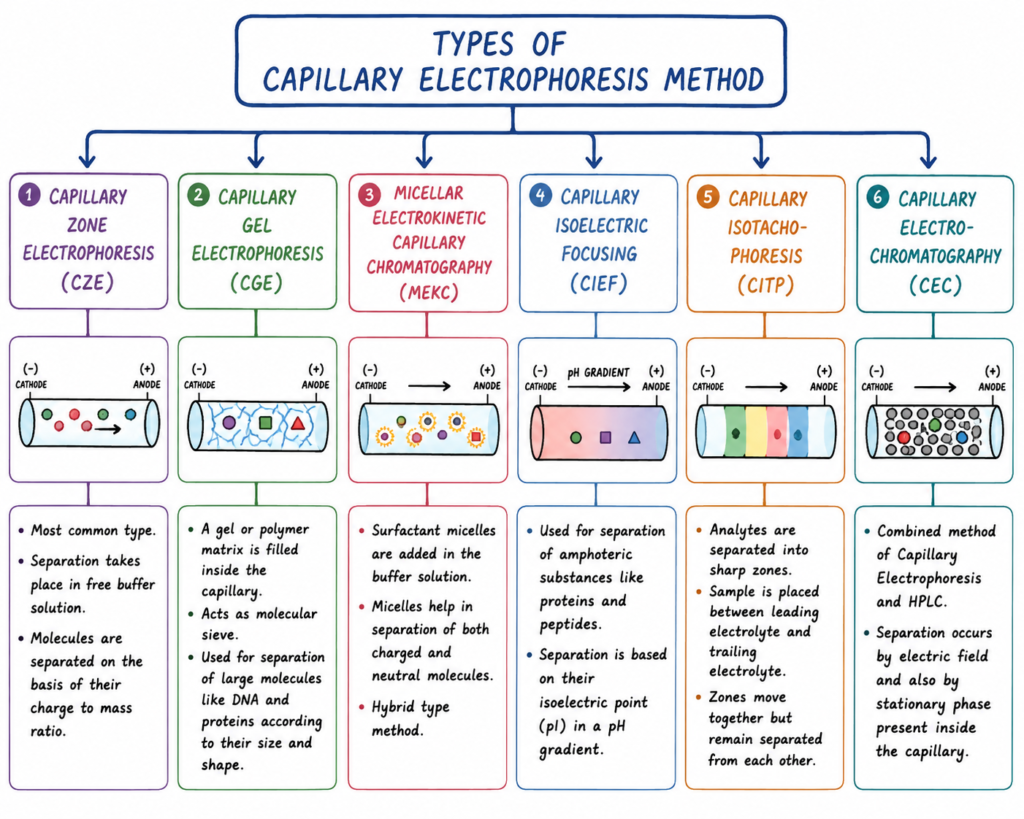
- Capillary Zone Electrophoresis (CZE) – It is the most common type of Capillary Electrophoresis. In this method separation takes place in free buffer solution. The molecules are separated on the basis of their charge to mass ratio.
- Capillary Gel Electrophoresis (CGE) – In this method a gel or polymer matrix is filled inside the capillary. It acts as molecular sieve. It is used for separation of large molecules like DNA and proteins according to their size and shape.
- Micellar Electrokinetic Capillary Chromatography (MEKC) – In this method surfactant micelles are added in the buffer solution. These micelles help in separation of both charged and neutral molecules. So it is a hybrid type method.
- Capillary Isoelectric Focusing (CIEF) – This method is used for separation of amphoteric substances like proteins and peptides. The separation is based on their isoelectric point (pI) in a pH gradient.
- Capillary Isotachophoresis (CITP) – In this method analytes are separated into sharp zones. The sample is placed between leading electrolyte and trailing electrolyte. The zones move together but remain separated from each other.
- Capillary Electrochromatography (CEC) – It is a combined method of Capillary Electrophoresis and HPLC. In this method separation occurs by electric field and also by stationary phase present inside the capillary.
Procedure of Capillary Electrophoresis
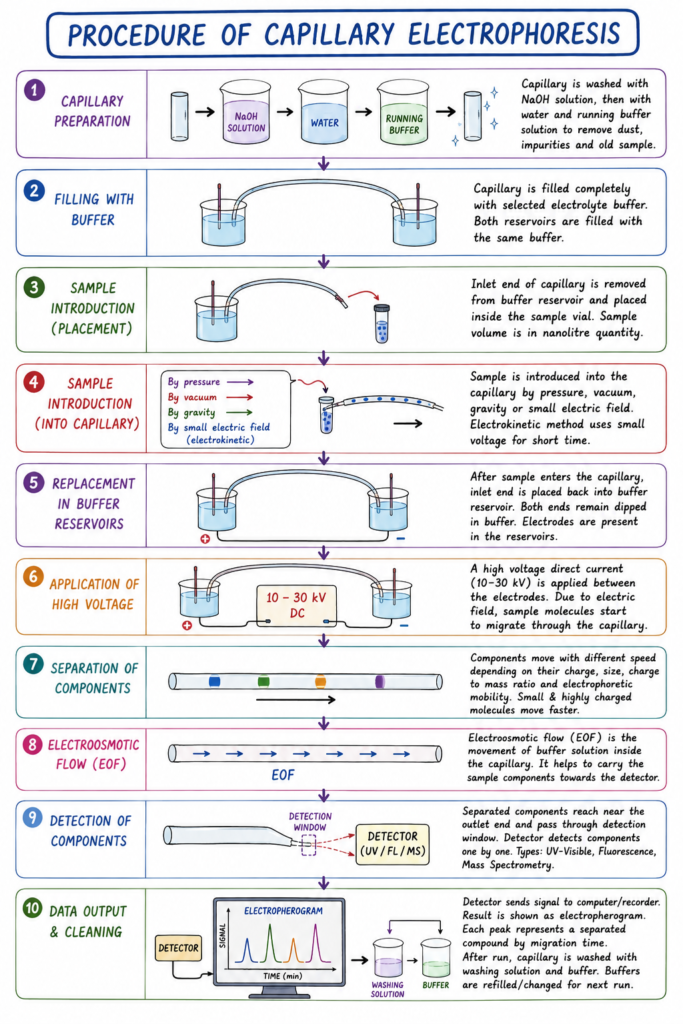
- First the fused-silica capillary is prepared before starting the experiment. It is washed with sodium hydroxide (NaOH) solution. After this it is washed with water and then with running buffer solution. This removes the dust, impurities and any old sample present inside the capillary.
- The capillary is then filled completely with selected electrolyte buffer solution. The two reservoirs are also filled with same buffer. This buffer helps in movement of current and maintains proper pH during the process.
- The inlet end of the capillary is removed from the buffer reservoir and placed inside the sample vial. The sample is taken in very small amount. Usually the sample volume is in nanolitre quantity.
- The sample is introduced into the capillary by using pressure, vacuum, gravity or small electric field. In pressure method, sample is pushed inside the capillary. In electrokinetic method, a small voltage is applied for short time and charged molecules enter into the capillary.
- After sample enters into the capillary, the inlet end is again placed back into the buffer reservoir. Then both ends of capillary remain dipped in the buffer reservoirs. The electrodes are also present in these reservoirs.
- A high voltage direct current is applied between the two electrodes. The voltage is generally about 10-30 kV. Due to this electric field, the molecules of the sample starts to migrate through the capillary.
- The sample components move with different speed. This movement depends on their charge, size, charge to mass ratio and electrophoretic mobility. Small and highly charged molecules move faster. Large molecules or less charged molecules move slowly.
- During this process electroosmotic flow (EOF) also occurs. It is the movement of the buffer solution inside the capillary. This flow helps to carry the sample components towards the detector.
- As the separated components reach near the outlet end of capillary, they pass through the detection window. The detector detects the components one by one. Common detectors are UV-visible detector, fluorescence detector and mass spectrometry detector.
- The detector gives signal to the computer or recorder. The result is shown as a graph called electropherogram. In this graph, separated compounds appear as separate peaks. Each peak is formed according to the migration time of that component.
- After completion of the run, the capillary is washed again with washing solution and buffer. This removes remaining sample from the capillary. The buffer reservoirs are also refilled or changed. This step is important for getting same and proper result in the next run.
Applications of Capillary Electrophoresis
The following are the important applications of Capillary Electrophoresis.
- It is used in DNA fingerprinting for identification of human samples. It is also used in Short Tandem Repeat (STR) profiling. This is very useful in forensic science.
- It is used in forensic toxicology for detection of drugs and poisonous substances. It is also used for chemical analysis of counterfeit ink and printing materials.
- It is used in pharmaceutical industry for quality control of drugs and raw materials. It helps to check purity and also the presence of drug impurities.
- It is used for pharmacokinetic studies. In this study the movement, absorption and removal of drug from body is studied.
- It is used for chiral separation of drugs. It separates different enantiomers of a drug, because these forms may have different action in the body.
- It is used in genome sequencing. It helps in separation and analysis of DNA fragments and also RNA fragments.
- It is used for separation and study of biomolecules like proteins, peptides, recombinant proteins and monoclonal antibodies.
- It is used in clinical diagnosis for analysis of body fluids like blood serum, plasma, urine and saliva. These samples are tested for disease markers and other important substances.
- It is used for detection of amino acids, vitamins and different forms of human haemoglobin. It can also be used for study of metabolites from single cell.
- It is used in food and beverage industries to check food adulteration. It is also used for analysis of food dyes, pigments, additives, fatty acids and vitamins.
- It is used to detect contamination in food samples. Bacteria, viruses and other harmful materials can be checked by this method.
- It is used in environmental monitoring. Soil and water samples are tested for organic pollutants, heavy metals, pesticides and herbicides.
- It is also used for detection of inorganic ions like nitrates and sulphates in water and soil samples.
- It is used in nanotechnology for characterization of nanoparticles. It is also used for analysis of complex colloidal systems.
Advantages of Capillary Electrophoresis
- Capillary Electrophoresis (CE) gives very high separation efficiency. The flow inside the capillary is more uniform and plug like. So band broadening is less and clear separation is obtained.
- It gives high resolution of sample components. Closely related ions and molecules can also be separated. The separation may be equal or sometimes better than HPLC and capillary gas chromatography.
- The analysis is completed in short time. The capillary has very small diameter, so heat produced during electric current is removed quickly. Due to this high electric field can be used without much disturbance.
- It requires very small amount of sample. Usually only 1-50 nanolitre sample is needed for injection. So it is useful when sample amount is very limited.
- It also needs less amount of buffer and reagents. So the cost of analysis becomes low. Waste production is also very less.
- It can be used for many types of substances. Small inorganic ions, DNA, proteins, peptides, polar compounds and chiral drugs can be separated by this method.
- A single capillary can be used for different separation methods. Only the buffer composition is changed according to the need. So costly special column is not always required.
- The method is easy to automate. Sample injection, voltage application, detection and data recording can be done by automated system. It gives more accurate and reproducible result.
- It is environment friendly method. Mostly aqueous buffer is used and large amount of organic solvent is not needed. So it produces less chemical waste.
Limitations of Capillary Electrophoresis
- Capillary Electrophoresis (CE) uses very small amount of sample. The sample volume is generally in nanolitre range. So detection of very low concentration substances becomes difficult.
- The optical path length is very short because the capillary diameter is very small. Due to this UV-visible detector may not detect some analytes properly when their amount is very low.
- High voltage is used in this method. Due to this heat is produced inside the capillary. This heat is called Joule heating.
- If Joule heating is not removed properly, then temperature difference occurs inside the capillary. It changes viscosity of buffer and causes band broadening. So separation resolution decreases.
- Some heat sensitive samples may get damaged due to increase in temperature. This is a problem for thermally labile compounds.
- Some biomolecules may stick to the inner wall of fused-silica capillary. Mainly proteins and peptides show this problem because they may have positive charge or hydrophobic part.
- Adsorption of molecules on capillary wall causes peak tailing and broad peak. The migration time also becomes irregular. So the result may not be reproducible.
- In normal Capillary Zone Electrophoresis (CZE), neutral molecules are not separated properly. They move with the electroosmotic flow (EOF) at same speed.
- For separation of neutral molecules, another system like Micellar Electrokinetic Capillary Chromatography (MEKC) is needed. So normal method is not suitable for all type of compounds.
- The capillary has very narrow internal diameter. So it can be blocked easily by dust particles, precipitate or suspended materials present in sample or buffer.
- The capillary is fragile and can break easily. It is more weak near the detection window where the outer coating is removed for passing light.
- If sample concentration is too high than background electrolyte, then the electric field becomes disturbed. This causes electrodispersion.
- Due to electrodispersion, peaks may become asymmetrical. Peak fronting or tailing can occur. So large amount of sample cannot be loaded without loss of resolution.
- The buffer levels in both reservoirs should be same. If levels are not equal, then gravity causes siphoning effect.
- Siphoning effect produces pressure-driven flow inside capillary. This causes band broadening and decreases the efficiency of separation.
References
- United States Pharmacopeia. (n.d.). 1053 Capillary electrophoresis.
- Beckman Coulter. (n.d.). Introduction to capillary electrophoresis. SCIEX.
- Cao, P., & Moini, M. (1997). A novel sheathless interface for capillary electrophoresis/electrospray ionization mass spectrometry using an in-capillary electrode. Journal of the American Society for Mass Spectrometry, 8(5), 561–564.
- A three-step stacking capillary electrophoresis of field-amplified sample injection, sweeping, and micellar collapse for determination of dabigatran and its active metabolite in human plasma. (n.d.). PMC.
- A three-step stacking capillary electrophoresis of field-amplified sample injection, sweeping, and micellar collapse for determination of dabigatran and its active metabolite in human plasma. (n.d.). PubMed.
- MicroSolv. (n.d.). Achieving efficiency in CE.
- MicroSolv. (n.d.). Achieving efficiency in CE.
- Advances in capillary electrophoresis and the implications for drug discovery. (n.d.). PMC.
- Carreras, H. Z. (2023). An introduction to capillary electrophoresis: Theory, practice, and applications. Technology Networks.
- Xuan, X., & Li, D. (2005). Analytical study of Joule heating effects on electrokinetic transportation in capillary electrophoresis. Journal of Chromatography A, 1064, 227–237.
- Bio-Rad Laboratories. (n.d.). Capillary electrophoresis products (Bulletin 1955).
- Capillary electrophoresis. (2017). Chemistry LibreTexts.
- Gordon, M. J., Huang, X., Pentoney, S. L., Jr., & Zare, R. N. (1988). Capillary electrophoresis. Science, 242(4876), 224–228.
- Aurora Biomed. (2024). Capillary electrophoresis in focus: A solution for characterization and quality control.
- Excedr. (2023). Capillary electrophoresis: Overview & applications.
- Patsnap Eureka. (2025). Capillary electrophoresis: Principles, techniques & applications.
- Lasky, J. (2024). Capillary electrophoresis (CE). EBSCO Research Starters.
- Wikipedia contributors. (2026). Capillary electrophoresis. Wikipedia, The Free Encyclopedia.
- Kaljurand, M. (2004). Capillary electrophoresis in contemporary analytical chemistry. Proceedings of the Estonian Academy of Sciences Chemistry, 53(1), 3–5.
- Capillary electrophoresis using copolymers of different composition as physical coatings: A comparative study. (n.d.). PubMed.
- Wikipedia contributors. (2025). Capillary electrophoresis–mass spectrometry. Wikipedia, The Free Encyclopedia.
- Agilent Technologies. (2009). Capillary thermostatting in capillary electrophoresis.
- Clinical analysis by microchip capillary electrophoresis. (n.d.). PMC – NIH.
- Clinical applications of capillary electrophoresis-based immunoassays. (n.d.). PMC.
- Kele, Z., Ferenc, G., Klement, E., Tóth, G. K., & Janáky, T. (2005). Design and performance of a sheathless capillary electrophoresis/mass spectrometry interface by combining fused-silica capillaries with gold-coated nanoelectrospray tips. Rapid Communications in Mass Spectrometry, 19, 881–885.
- Lauer, H. H., & Rozing, G. P. (2009). High performance capillary electrophoresis: A primer (2nd ed.). Agilent Technologies.
- High-performance capillary electromigration separations: Theoretical mechanics, system optimization, and advanced multidimensional methodologies. (n.d.).
- Dunn Research Group. (2020). High-speed capillary electrophoresis (HSCE). The University of Kansas.
- In-capillary sample concentration in CE. (n.d.). LCGC International.
- Revvity. (n.d.). LabChip GX Touch Nucleic Acid Analyzer.
- Lecture 20: Capillary electrophoresis. (n.d.).
- Low-flow sheathless capillary electrophoresis-mass spectrometry for sensitive glycoform profiling of intact pharmaceutical proteins. (n.d.). PubMed.
- Palm, A., & Novotny, M. V. (1997). Macroporous polyacrylamide/poly(ethylene glycol) matrixes as stationary phases in capillary electrochromatography. Analytical Chemistry, 69(22), 4499–4507.
- Master CE sample stacking: Advanced capillary electrophoresis… (n.d.).
- Greenspoon, S. A., Yeung, S. H. I., Ban, J. D., & Mathies, R. A. (2007). Microchip capillary electrophoresis: Progress toward an integrated forensic analysis system. Profiles in DNA. Promega Corporation.
- Hassan, S.-u. (2021). Microchip electrophoresis. Encyclopedia, 1(1), 30–41. MDPI.
- Gordon, M. T., et al. (2013). Microchip-capillary electrophoresis device. LabSmith.
- Córdova, E., Gao, J., & Whitesides, G. M. (1997). Noncovalent polycationic coatings for capillaries in capillary electrophoresis of proteins. Analytical Chemistry, 69(9), 1370–1379.
- Creative Proteomics. (n.d.). Principles of capillary electrophoresis technology.
- Chiari, M., Cretich, M., Stastna, M., Radko, S. P., & Chrambach, A. (2001). Rapid capillary coating by epoxy-poly-(dimethylacrylamide): Performance in capillary zone electrophoresis of protein and polystyrene carboxylate. Electrophoresis, 22(4), 656–659.
- Gackowski, M., Przybylska, A., Kruszewski, S., Koba, M., Mądra-Gackowska, K., & Bogacz, A. (2021). Recent applications of capillary electrophoresis in the determination of active compounds in medicinal plants and pharmaceutical formulations. Molecules, 26(14), 4141.
- Reproducible capillary electrophoresis–mass spectrometry–based top‐down proteomics of complex proteomes enabled by an advanced cationic polymer coating. (n.d.). PMC.
- Troubleshooting capillary electrophoresis systems. (n.d.). Promega.
- Tutorial: Capillary electrophoresis. (n.d.).
- Wilson, D. J. (2019). Types of capillary electrophoresis. News-Medical.net.