

Coomb’s test is a serological blood test which is used to detect antibodies or complement proteins attached with red blood cells (RBCs) or present freely in serum. It is also called antiglobulin test.
Coomb’s test is a serological blood test which is used to detect antibodies or complement proteins present on the surface of red blood cells (RBCs) or present freely in the serum. It is also known as antiglobulin test. This test is mainly used to detect immune reaction which causes destruction of red blood cells or hemolysis.
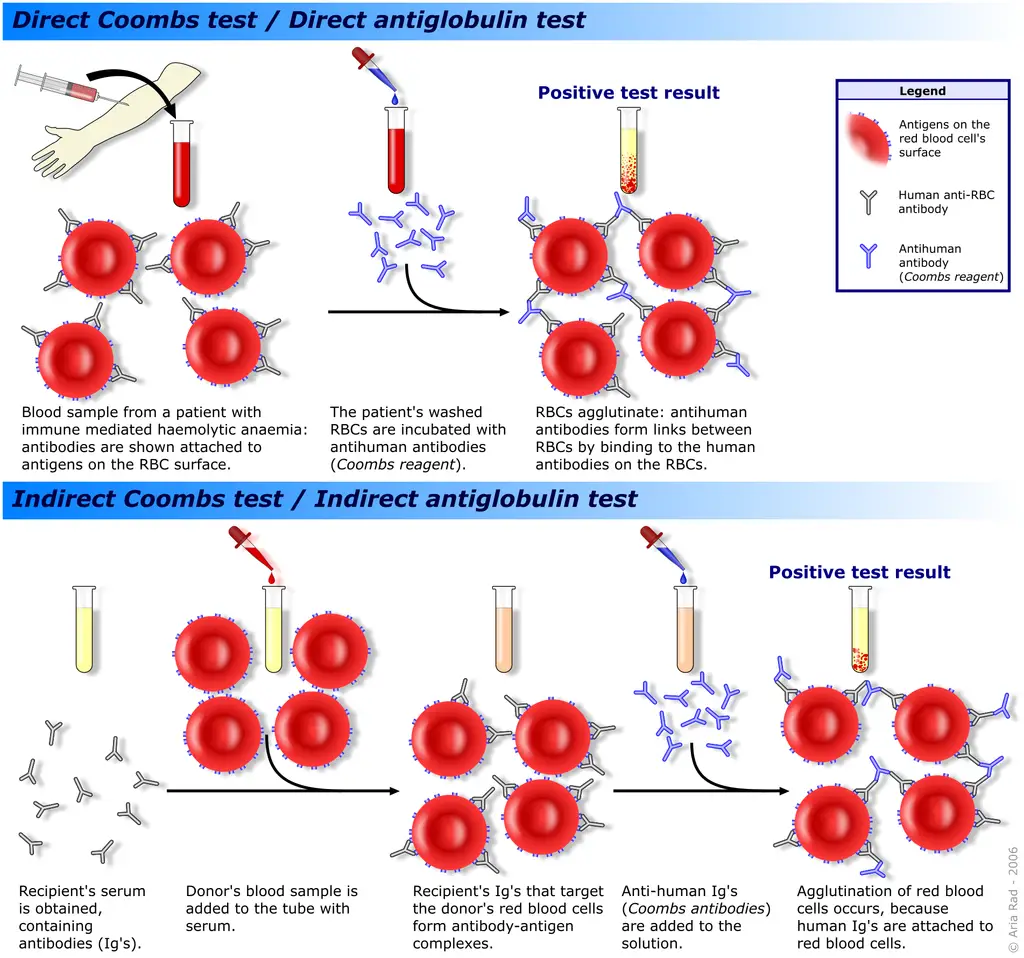
This test was developed by Coombs, Mourant and Race in 1945. In this test, anti-human globulin (AHG) or Coomb’s reagent is used. The reagent binds with human antibodies or complement proteins attached on red blood cells. As a result, red blood cells become cross-linked and visible clumping occurs. This clumping is called agglutination.
Coomb’s test is of two types, Direct Coomb’s test (DAT) and Indirect Coomb’s test (IAT). Direct Coomb’s test detects antibodies or complement which are already attached with patient’s red blood cells inside the body. It is used in autoimmune hemolytic anemia, drug-induced hemolysis and hemolytic disease of newborn. Indirect Coomb’s test detects free antibodies present in the serum which can react with foreign red blood cells. It is mainly used in blood transfusion testing and pregnancy screening.
Types of Coomb’s Test
The following are the two main types of Coomb’s test–
- Direct Coomb’s Test (Direct Antiglobulin Test or DAT)
Direct Coomb’s test is used to detect antibodies or complement proteins which are already attached to the surface of red blood cells (RBCs) inside the body. It shows that red blood cells are coated with immune proteins. This test is mainly useful in immune mediated hemolysis. - Indirect Coomb’s Test (Indirect Antiglobulin Test or IAT)
Indirect Coomb’s test is used to detect free or unbound antibodies present in the blood serum. These antibodies are not attached with red blood cells but can react with foreign RBCs. It is mostly used before blood transfusion and during pregnancy screening.
Requirements for Coomb’s Test
The following are the important requirements for Coomb’s test–
- Blood sample
Venous blood sample is used for Coomb’s test. The blood is collected in EDTA tube when red blood cells are needed and in clotted tube when serum is required. - Coomb’s reagent
Coomb’s reagent is also called anti-human globulin (AHG) serum. It is the main reagent used in the test. It reacts with human IgG antibody or complement proteins present on red blood cells. - Isotonic saline
Isotonic saline (0.9% NaCl) is used for washing the red blood cells. It removes free antibodies and other unwanted serum proteins from the cell suspension. - Reagent red blood cells
Prepared reagent red blood cells are used mainly in Indirect Coomb’s test (IAT). These cells help to detect antibodies present in the patient serum. - Check cells
Check cells are red blood cells already sensitized with IgG or C3. These are used as control cells to check that the negative result is true and the test system is working properly. - Enhancement media
Enhancement media like Bovine Serum Albumin (BSA), Low Ionic Strength Solution (LISS) or Polyethylene Glycol (PEG) may be used. These substances increase the reaction between antibody and red blood cells. - Test tubes or cards
Glass test tubes or special gel cards are used to perform the test. In tube method, small glass test tubes are generally used and in gel method, plastic gel cards with microtubes are used. - Centrifuge
Centrifuge is used to spin the blood cells and reagents. It helps in bringing the red cells together, so agglutination can be seen clearly. - Incubator or water bath
Incubator, heating block or water bath is used to maintain 37°C temperature. It is needed for proper antibody reaction during incubation. - Pipettes and droppers
Pipettes and droppers are used for taking and transferring exact amount of blood, serum and reagents. - Timer
Timer is used to maintain proper incubation and centrifugation time. This is important because over time or less time may affect the result. - Microscope or optical aid
Microscope or optical aid is used to observe agglutination properly. It helps to detect weak clumping of red blood cells. - Test tube rack
Test tube rack is used to hold the tubes during the test procedure. It keeps the tubes in proper order and prevents mixing of samples.
Procedure of Coomb’s Test
The procedure of Coomb’s test is done separately for Direct Coomb’s Test (DAT) and Indirect Coomb’s Test (IAT). The steps are as follows-
A. Procedure for Direct Coomb’s Test (DAT)
- First, collect the patient blood sample and separate the red blood cells (RBCs).
- Prepare 3% to 5% red blood cell suspension of patient’s red cells in isotonic saline (0.9% NaCl).
- Take a clean and labelled glass test tube.
- Add 1 drop of prepared patient RBC suspension into the test tube.
- Wash the red cells with normal saline for 3 to 4 times. This washing is done to remove free and unbound serum proteins.
- After every washing, centrifuge the tube and discard the supernatant carefully.
- After the final washing, completely decant the supernatant. The cell button should be dry and no extra saline should remain in the tube.
- Add 2 drops of Anti-Human Globulin (AHG) or Coomb’s reagent to the washed red cells.
- Mix the content of the tube properly.
- Centrifuge the tube for 1 minute at about 1000 to 1500 rpm.
- After centrifugation, gently shake the tube to dislodge the red cell button.
- Observe the tube macroscopically for agglutination. If agglutination is present, the test is positive.
- If no agglutination is seen, add 1 drop of IgG coated check cells into the same tube.
- Mix it properly and again centrifuge the tube.
- Agglutination must occur after adding check cells. It shows that Coomb’s reagent is active and the negative result is valid.
B. Procedure for Indirect Coomb’s Test (IAT)
- Take three clean test tubes and label them as T (Test), PC (Positive Control) and NC (Negative Control).
- Add 2 drops of patient serum into the tube labelled T.
- Add 1 drop of anti-D serum into the tube labelled PC.
- Add 1 drop of normal saline or bovine albumin into the tube labelled NC.
- Add 1 drop of 5% pooled group O reagent red blood cell suspension into each of the three tubes.
- Mix the contents of all tubes gently.
- Incubate all the tubes at 37°C for 15 to 60 minutes. During this process, if free antibodies are present in serum, they bind with reagent red cells.
- After incubation, wash the cells with normal saline for 3 to 4 times. This removes unbound antibodies from the tubes.
- After the final wash, completely decant the supernatant from each tube.
- Add 2 drops of Anti-Human Globulin (AHG) or Coomb’s reagent into each tube.
- Mix the contents of all tubes properly.
- Centrifuge the tubes for 1 minute at 1000 to 1500 rpm.
- Gently shake each tube to dislodge the red cell button.
- Examine the tubes macroscopically for agglutination. Agglutination in test tube indicates the presence of antibody in patient serum.
- If the test tube shows negative result, add 1 drop of IgG coated check cells.
- Mix and centrifuge again. Agglutination after adding check cells confirms that the AHG reagent is working properly and test result is valid.
Result Interpretation of Coomb’s Test
The result of Coomb’s test is interpreted by observing the presence or absence of agglutination of red blood cells (RBCs). Agglutination means visible clumping of red cells. It indicates that antibodies or complement proteins are present on red cells or in serum.
Negative Result
No clumping of red blood cells is observed in negative result. The red cells remain smooth and separate from each other.
In Direct Coomb’s test (DAT), negative result means that there are no antibodies or complement proteins attached on the patient’s red blood cells. In Indirect Coomb’s test (IAT), negative result means that no free antibodies are present in the serum which can react with foreign red blood cells.
So, negative result is considered as normal result. It shows that immune destruction of red blood cells is not detected by this test.
Positive Result
Visible clumping or agglutination of red blood cells is observed in positive result. This shows that antibodies or complement proteins are present.
In Direct Coomb’s test, positive result means that patient red blood cells are already coated with IgG antibody or complement inside the body. In Indirect Coomb’s test, positive result means that free antibodies are present in serum and they can attach with reagent red blood cells.
Positive result is abnormal. It may indicate immune mediated hemolysis, where red blood cells are destroyed before their normal life span.
Causes of Positive Coomb’s Test
Some of the important causes of positive Coomb’s test are-
- Autoimmune hemolytic anemia.
- Drug-induced hemolytic anemia.
- Hemolytic disease of newborn or erythroblastosis fetalis.
- Incompatible blood transfusion reaction.
- Chronic lymphocytic leukemia.
- Systemic lupus erythematosus (SLE).
- Infections like infectious mononucleosis, syphilis and mycoplasmal infection.
Reaction Grading of Coomb’s Test
The positive reaction is graded according to strength of agglutination. It is generally graded from 1+ to 4+.
0 – No clumping is seen. It is negative reaction.
1+ – Weak reaction is seen. Small clumps are present and many free red blood cells are also seen.
2+ – Moderate reaction is seen. Medium sized clumps are present and some free red blood cells remain.
3+ – Strong reaction is seen. Several large clumps are present with clear background.
4+ – Very strong reaction is seen. All red blood cells form one large clump or solid mass.
Mixed field – Some clumps are seen but many non-clumped red cells are also present around them. This type of reaction may be seen in transfusion related condition or mixed red cell population.
Thus, the interpretation of Coomb’s test depends mainly on agglutination. Agglutination indicates positive result and absence of agglutination indicates negative result. Positive result should be correlated with clinical condition of the patient.
Applications of Coomb’s Test
- Coomb’s test is used to diagnose autoimmune hemolytic anemia (AIHA). It detects IgG antibodies or complement proteins which are attached on the surface of patient red blood cells.
- It is used to detect drug-induced immune hemolytic anemia. Some drugs may bind with RBCs and produce immune reaction which causes destruction of red blood cells.
- It is used to investigate hemolytic transfusion reaction. It helps to know whether the patient body is attacking recently transfused donor red blood cells.
- It is used to diagnose hemolytic disease of newborn (HDN) or erythroblastosis fetalis. In this condition, maternal antibodies attach with newborn RBCs and causes hemolysis.
- It is used to evaluate suspected hemolytic anemia in patients having Systemic Lupus Erythematosus (SLE), chronic lymphocytic leukemia, infectious mononucleosis, syphilis and mycoplasma infection.
- Indirect Coomb’s test (IAT) is used before blood transfusion to detect unexpected free antibodies in patient serum. It helps to select compatible donor blood and prevent transfusion reaction.
- It is used in cross matching of blood between donor red cells and recipient serum. If agglutination occurs, blood is incompatible and should not be transfused.
- It is used in antenatal screening of pregnant women. It detects maternal antibodies like anti-D antibody which may cross the placenta and destroy fetal red blood cells.
- It is used for identification of specific red blood cell antibodies in blood serum. This is important in blood bank and transfusion medicine.
- It is used for antibody titration. It measures the concentration and strength of incomplete antibodies present in serum.
- It is used in antigen typing of red blood cells. It helps to identify specific red cell phenotype and antibody reaction.
- It is used to check compatibility before organ transplantation or hematopoietic stem cell transplantation.
- It is used to investigate recurrent pregnancy loss where maternal RBC alloimmunization may be involved.
Limitations of Coomb’s Test
- Inadequate washing of red blood cells may give false negative result. Free unbound antibodies may remain in the tube and neutralize the Coomb’s reagent, so agglutination is not seen.
- Very high amount of antibodies on RBCs may cause prozone effect. In this condition, Coomb’s reagent becomes saturated and red cells are not cross-linked properly.
- Low affinity antibodies may detach from red blood cells during washing. It may also occur when there is delay in adding Anti-Human Globulin (AHG) reagent.
- Standard Coomb’s reagent mainly detects IgG antibodies and C3d complement. So, hemolysis caused only by other antibodies like IgA or IgM may not be detected.
- If very low amount of antibodies or complement proteins are attached on red cells, the test may not detect it. So weak sensitization can be missed.
- Bacterial contamination, chemical contamination, dirty glassware or small fibrin clot may give false positive result. These can produce nonspecific clumping like true agglutination.
- Improper blood sample may affect the result. In Direct Coomb’s test, clotted blood sample may activate complement in the test tube and it may appear as positive reaction.
- Cold autoantibodies may interfere with the test. These antibodies can make red cells clump at low temperature and give wrong result.
- High serum proteins, paraproteins or Wharton’s jelly in cord blood sample may cause false positive reaction.
- Improper centrifugation can affect the test. Over centrifugation may force the cells to come together and may look like agglutination.
- In manual tube method, reading of result depends on visual observation. So, grading of agglutination may vary from person to person.
- Coomb’s test does not give exact amount of antibodies. It gives only qualitative or semi-quantitative result like 0, 1+, 2+, 3+ and 4+.
- Positive result does not always mean active hemolysis is going on. It only shows that antibodies or complement are present on red blood cells.
- Some patients with clinical autoimmune hemolytic anemia may show negative Direct Coomb’s test. So, negative result cannot always exclude immune hemolysis.
Advantages of Coomb’s Test
- Coomb’s test is used to detect hidden or incomplete antibodies. These antibodies, mainly IgG, do not produce visible agglutination directly but can be detected by Anti-Human Globulin (AHG) reagent.
- It detects complement proteins attached on the surface of red blood cells. This helps to identify immune reaction against RBCs.
- It increases safety of blood transfusion. Indirect Coomb’s test (IAT) detects unexpected antibodies in patient serum before transfusion and helps to prevent hemolytic transfusion reaction.
- It helps in proper cross matching of donor blood with patient serum. So incompatible blood can be rejected before transfusion.
- It is useful in pregnancy screening. It detects maternal antibodies like anti-D antibody which may cross placenta and damage fetal red blood cells.
- It helps to prevent hemolytic disease of newborn (HDN) by detecting sensitized mother early. This helps in giving preventive treatment like RhoGAM.
- It helps in early diagnosis of immune mediated red blood cell disorders. So treatment can be started early in conditions like autoimmune hemolytic anemia.
- It is useful to detect drug-induced immune hemolytic anemia. Some drugs can cause antibody formation against red blood cells and this test helps in their detection.
- Gel card method of Coomb’s test does not require repeated cell washing. So it saves time and reduces washing related error.
- Gel card method is more sensitive for detecting IgG coated red blood cells. It also gives clear and stable reaction.
- In gel card method, result interpretation is more standardized. The agglutination pattern remains trapped in gel and can be read more uniformly.
- The result of gel card method can be preserved for some time. So it can be checked again if verification is needed.
- Gel card method requires small amount of blood sample. So it is useful when sample volume is less.
- Conventional tube method is cost effective. It needs simple reagents and common laboratory instruments.
- Conventional tube method is widely available. It can be done in many routine blood bank and resource limited laboratories without costly instruments.
References
- ResearchGate. (n.d.). (PDF) Saline-indirect antiglobulin test.
- Nathalang, O., Bejrachandra, S., Sthabunswasdigarn, S., Saipin, J., & Sriphaisal, T. (1997). A comparative study of three techniques for eluting red cell antibodies. JMAT, 80(1), S5-S8.
- Kerkar, A. S., Bhagwat, S. N., & Sharma, J. H. (2022). A study of clinical and serological correlation of positive direct antiglobulin test in blood bank at a tertiary care center. Journal of Laboratory Physicians, 14(3), 223-230.
- Kharshandi, C., & Mane, V. P. (2023). A comparative study between gel card method and manual method for Coomb’s test. Indian Journal of Pathology and Oncology, 10(1), 34-39.
- Alba Bioscience Limited. (2017). Anti-Human Globulin Anti-IgG,-C3d; Polyspecific. FDA.
- Regan, D. M., & Markowitz, M. A. (2016). Association Bulletin #16-02: Mitigating the anti-CD38 interference with serologic testing. AABB.
- Gerber, G. F. (2026). Autoimmune hemolytic anemia. Merck Manual Professional Edition.
- PathLabTalk. (n.d.). C3 DAT using buffered gel cards.
- Chaffin, J. (2023). Check cells. Blood Bank Guy Glossary.
- Slideshare. (n.d.). Check cell, preparation and importance.pptx.
- Clinical and analytical treatise on the antiglobulin test: Molecular principles, laboratory methodologies, and pathological correlations. (n.d.).
- Shaheen, S. S. I., Rahman, A., Mahmood, A., & Khatun, A. (2025). Comparison between conventional tube technique and column agglutination technique for red blood cell antibody testing. Scholars Journal of Applied Medical Sciences, 13(3), 772-777.
- PMC. (n.d.). Comparison between the manual method of indirect Coombs via gel technology and solid phase red cell adherence.
- Spada, E., Perego, R., Baggiani, L., & Proverbio, D. (2020). Comparison of conventional tube and gel-based agglutination tests for AB system blood typing in cat. Frontiers in Veterinary Science, 7(312).
- Theis, S. R., & Hashmi, M. F. (2022). Coombs test. In StatPearls. StatPearls Publishing.
- Aryal, S. (2022). Coombs test- principle, types, procedure and result interpretation.
- Aryal, S. (2022). Coombs test- principle, types, procedure and result interpretation. Microbiology Info.
- Mehmood. (n.d.). Coombs test: Interpretation. Haematology Watch, 5(2).
- Essange Reagents. (n.d.). Coombs sera & potentiators.
- Grokipedia. (n.d.). Coombs test.
- Wikipedia. (n.d.). Coombs test.
- eClinpath. (n.d.). Coombs test.
- Park, S., Shim, J. R., & Kim, K. H. (2025). Correlation between direct antiglobulin test positivity and in vivo hemolysis in a Korean tertiary hospital population. Korean Journal of Blood Transfusion, 36(2), 82-92.
- Bobr, A. (2020). Daratumumab interference in pre-transfusion testing. myadlm.org.
- Canadian Blood Services. (n.d.). Direct antiglobulin test (DAT).
- The Blood Project. (n.d.). Direct antiglobulin test (DAT).
- Cornell University College of Veterinary Medicine. (n.d.). Direct Coombs testing.
- PubMed. (n.d.). Distinct effects of daratumumab on indirect and direct antiglobulin tests: a new method employing 0.01 mol/L dithiothreitol for negating the daratumumab interference with preserving K antigenicity (Osaka method).
- SciSpace. (n.d.). Donath-Landsteiner test.
- Moses, S. (2026). Drug-induced hemolytic anemia. FPnotebook.
- Mazur, U., Kunysz, M., & Pacyna, K. (2025). Drug-induced immune hemolytic anemia — the influence of selected drugs on immunohematology testing. Journal of Transfusion Medicine and Hemostasis, 18, 17-22.
- Mazur, U., Kunysz, M., & Pacyna, K. (2025). Drug-induced immune hemolytic anemia — the influence of selected drugs on immunohematology testing. Journal of Transfusion Medicine and Hemostasis, 18, 17-22.
- Chaffin, J. (n.d.). Elution. Blood Bank Guy Glossary.
- New York Blood Center Enterprises. (n.d.). NYBCe quick lesson: Elution and eluates.
- Taksali, R., Somani, S., Jivrag, A., & Bhale, C. P. (2016). Gel tube method and manual method for Coomb’s test- study of pros and cons. International Journal of Current Medical and Applied Sciences, 10(1), 11-14.
- Alba Bioscience Limited. (2025). ALBAcyte IgG sensitized red blood cells II. AliveDx.
- To, M., & Villatoro, V. (2019). Immune-mediated hemolytic anemias – a laboratory guide to clinical hematology. Open Education Alberta.
- Shannon Medical Center. (n.d.). Indirect antiglobulin.
- Transfusion Services. (n.d.). Lab Dept: Transfusion Services test name: TYPE AND DIRECT COOMBS.
- Sukorini, U. (2021). Monospecific Coombs test overview. Scribd.
- Nivedita, K., Prakash, S., Sahu, A., Mukherjee, S., & Mishra, D. (2026). Overcoming pre-transfusion testing challenges with dithiothreitol to optimize transfusion support in multiple myeloma patients on daratumumab therapy. Journal of Laboratory Physicians, 18(1), 30-34.
- Micro Typing Systems, Inc. (2020). Package insert – MTS anti-IgG card. FDA.
- Wikipedia. (n.d.). Paroxysmal cold hemoglobinuria.
- PubMed. (n.d.). Positive indirect antiglobulin test in adult patients with primary warm autoimmune hemolytic anemia: Clinical significance and prognostic effect on response to corticosteroids.
- Basavarajegowda, A., Zubair, M., & Shastry, S. (2026). Pretransfusion testing. In StatPearls. StatPearls Publishing.
- Reddit. (n.d.). QC question for blood bankers… r/medlabprofessionals.
- PMC. (n.d.). Recurrent Donath-Landsteiner hemolytic anemia: a pediatric case report.
- Learn Serology. (n.d.). Serological endpoints: Agglutination – additional notes on Coombs testing.
- Learn Serology. (n.d.). Serological endpoints: Hemolysis – additional notes on Donath-Landsteiner testing.
- Stanford Medicine. (n.d.). The Coombs’ test | Newborn nursery.
- SciSpace. (n.d.). The direct antiglobulin test: Indications, interpretation, and pitfalls.
- PMC. (n.d.). The indirect antiglobulin (Coombs’) test is specific but less sensitive than the direct antiglobulin test for detecting anti-erythrocytic autoantibodies and thereby immune-mediated hemolytic anemia in dogs.
- Zantek, N. D., Koepsell, S. A., Tharp, D. R., & Cohn, C. S. (2012). The direct antiglobulin test: A critical step in the evaluation of hemolysis. American Journal of Hematology, 87(7), 707-709.
- PubMed. (n.d.). The direct antiglobulin test: a critical step in the evaluation of hemolysis.
- Learn Serology. (n.d.). Warm-reactive autoantibodies – confirmation: Eluate testing.
- ACP Journals. (n.d.). When cold meets hemolysis: A unique case of paroxysmal cold hemoglobinuria in an adult | Annals of Internal Medicine.
- Louis Pasteur PeloLaboratory. (n.d.). Operating procedures on performing direct coombs [Standard Operating Procedure].