

Two-Dimensional Immunoelectrophoresis is a technique used for the analysis and quantitation of mixture of proteins or antigens in a complex sample. It is also called Crossed Immunoelectrophoresis (CIE). It is mostly used for serum, tissue extract, microbial homogenate and other biological sample.
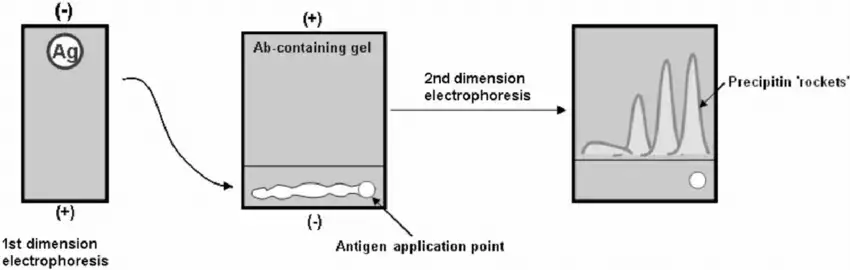
In this technique the separation is done in two directions. In the first dimension, the protein mixture is loaded on agarose gel and electrophoresis is done. The proteins move according to their charge, size and electrophoretic mobility.
After the first electrophoresis, the gel strip is placed on another agarose gel which contains a known amount of antiserum or polyvalent antibody. Then second electrophoresis is done at right angle to the first run. So, the separated antigen bands move into antibody containing gel.
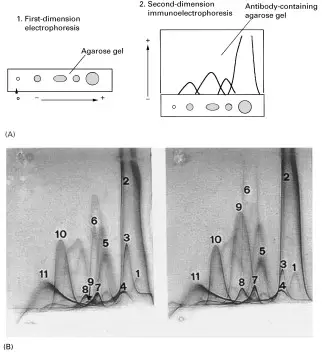
During this migration, antigen-antibody reaction takes place. At the zone of equivalence, visible precipitin arcs are formed. These arcs are usually bell shaped. Each precipitin arc represents one antigen present in the mixture.
The result is a two-dimensional pattern called immunoelectropherogram. The position of the arc depends on the mobility of antigen. The size and area of the arc depends on the amount of antigen present in the original sample and also on the antibody concentration in the gel.
This method gives better resolution than simple immunoelectrophoresis because the antigens are first separated and then reacted with antibody. It also helps in relative quantitation of antigen in one assay.
It is useful for studying antigen heterogeneity, isoforms, fragments, complexes and polymorphism in protein sample. It is also used in clinical diagnosis, immune disorder study, monoclonal gammopathy and microbial research.
This technique is carried out mostly under native condition. So the natural structure and antigenic property of proteins remain preserved. But it is more labour intensive than simple immunoassays and requires good antisera, controlled electrophoresis and careful reading of precipitation pattern.
Principle of Two-Dimensional lmmunoelectrophoresis
Principle of Two-Dimensional Immunoelectrophoresis is based on the separation of protein antigens by electrophoresis and their reaction with specific antibodies in an agarose gel. It combines electrophoretic separation with antigen-antibody precipitation reaction.
In the first dimension, the antigen mixture is placed in agarose gel and electric current is applied. The different proteins migrate in a straight line according to their charge, size and electrophoretic mobility.
After this separation, the second electrophoresis is carried out at right angle to the first direction. The separated antigens now migrate into another gel which contains specific antiserum or antibodies.
During this process, the antigen comes in contact with antibody present in the gel. At the zone of equivalence, antigen and antibody combine in proper proportion and form insoluble antigen-antibody lattice. This produces visible precipitin arcs or bell shaped peaks.
The position of each peak depends on the mobility of antigen in the first electrophoresis. The area under the peak is directly proportional to the amount of antigen present in the sample. Thus, Two-Dimensional Immunoelectrophoresis is used for identification and quantitative estimation of different proteins in a complex mixture.
Reagents and Equipment
The following are the important reagents and equipment used for Two-Dimensional Immunoelectrophoresis–
- Agarose gel
Agarose is used as the supporting medium for electrophoresis. It is generally prepared in about 1.0% to 1.2% concentration. It has large pore size and does not react much with proteins. - Buffer solution
An alkaline buffer is used for maintaining proper pH during electrophoresis. Tris-barbital buffer of about pH 8.6 is commonly used. At this pH most proteins become negatively charged and migrate towards anode. - Antiserum
Antiserum is the most important biological reagent used in the second dimension gel. It contains specific or polyvalent antibodies. These antibodies react with separated antigens and form visible precipitin peaks. - Protein sample
The sample contains mixture of protein antigens which are to be separated and identified. Serum, tissue extract, microbial homogenate or other biological fluid can be used as sample. - Washing solution
Normal saline solution is used for washing the gel after electrophoresis. Usually 0.85% sodium chloride (NaCl) is used. It removes unreacted and unprecipitated proteins from the agarose gel. - Staining reagent
Protein staining reagent is used to make the precipitin pattern clearly visible. Coomassie Brilliant Blue R-250 or silver stain may be used. After staining, the arcs and peaks can be observed properly. - Glass plates
Clean glass plates are used for preparing and supporting the agarose gel slab. The gel is poured on the plate and allowed to solidify before electrophoresis. - Electrophoresis apparatus
Electrophoresis apparatus is used to apply electric current through the gel. In the first run current is applied in one direction. In the second run current is applied at right angle to the first direction. - Power supply
A regulated power supply is required for giving controlled voltage during electrophoresis. It helps in proper migration of proteins and formation of precipitin arcs. - Cooling system
Cooling system is used to maintain low and constant temperature during electrophoresis. It prevents excess heat production in the gel. This heat may distort the precipitin bands. - Gel cutting tools
Gel cutter or scalpel is used for cutting the first dimension gel strip. This strip is then placed on the second antibody containing gel. - Drying and staining tray
Drying and staining trays are used for washing, drying and staining of the gel. These are required after completion of electrophoresis. - Imaging system
Scanner or gel documentation system is used for recording the precipitin pattern. In quantitative work, computer image analysis software is used for measuring peak area and migration distance.
Protocol/Procedure of Two-Dimensional lmmunoelectrophoresis
The following are the steps of Two-Dimensional Immunoelectrophoresis–
- At first agarose gel is prepared on a clean glass plate. Generally 1.0% to 1.2% agarose is used. It acts as supporting medium for the movement of protein antigens.
- Small wells are made in the agarose gel. The antigen sample is then added into the well. The sample may be serum, tissue extract, microbial extract or any protein mixture.
- Electric current is applied in one direction through the gel. The proteins move lengthwise according to their charge, size and electrophoretic mobility. This first run separates the antigens into different bands.
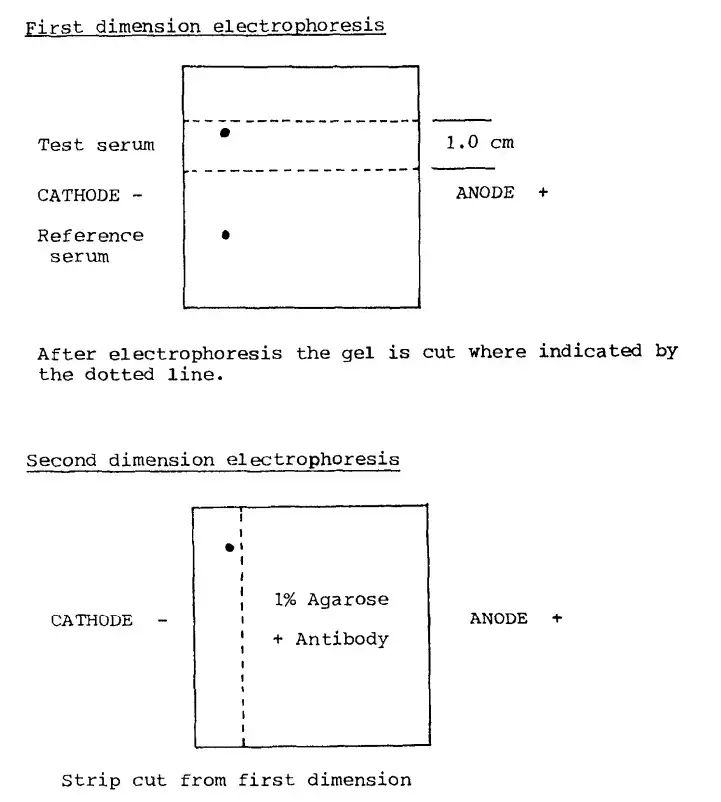
- After the first electrophoresis, the gel strip containing separated antigens is cut carefully. This strip is used for the second dimension run. Sometimes the same glass plate is used after removing extra gel portion.
- Fresh agarose is prepared and cooled to about 55-60°C. Then specific antiserum or polyvalent antibodies are mixed with the agarose. This temperature is maintained because high heat may damage the antibodies.
- The antibody containing agarose is poured beside the first-dimension gel strip. It is allowed to solidify properly. This gel contains antibodies which will react with separated antigens.
- Electrophoresis is carried out at right angle to the first run. The separated antigens migrate from the gel strip into the antibody containing gel. This run is usually done slowly and for longer time.
- During migration, antigen-antibody reaction takes place inside the gel. At the zone of equivalence, antigen and antibody combine and form insoluble precipitate. These precipitates appear as bell shaped arcs or peaks.
- After electrophoresis, the gel is washed with 0.85% sodium chloride (NaCl) solution. It removes unreacted proteins and extra soluble materials from the gel. This makes the background clear.
- The washed gel is dried carefully. Drying helps in fixing the precipitin pattern on the gel and makes it ready for staining.
- The dried gel is stained with protein stain such as Coomassie Brilliant Blue R-250 or silver stain. The precipitin arcs become visible after staining.
- The stained gel is observed for precipitin pattern. Each arc represents a particular antigen. The position of arc shows mobility of antigen and the area of arc indicates the amount of antigen present in the sample.
Applications of Two-Dimensional lmmunoelectrophoresis
The following are the applications of Two-Dimensional Immunoelectrophoresis–
- It is used in clinical diagnosis for detection of abnormal serum proteins. It helps in identifying monoclonal gammopathies like multiple myeloma and Waldenström’s macroglobulinemia by showing abnormal immunoglobulin arcs.
- It is used for studying immune system disorders. Deficiency of complement proteins, hypogammaglobulinemia and other antibody related abnormality can be detected by change or absence of precipitin arcs.
- It is used in autoimmune disease study. In diseases like systemic lupus erythematosus (SLE) and rheumatoid arthritis, it helps to detect specific autoantibodies or abnormal antigen-antibody pattern.
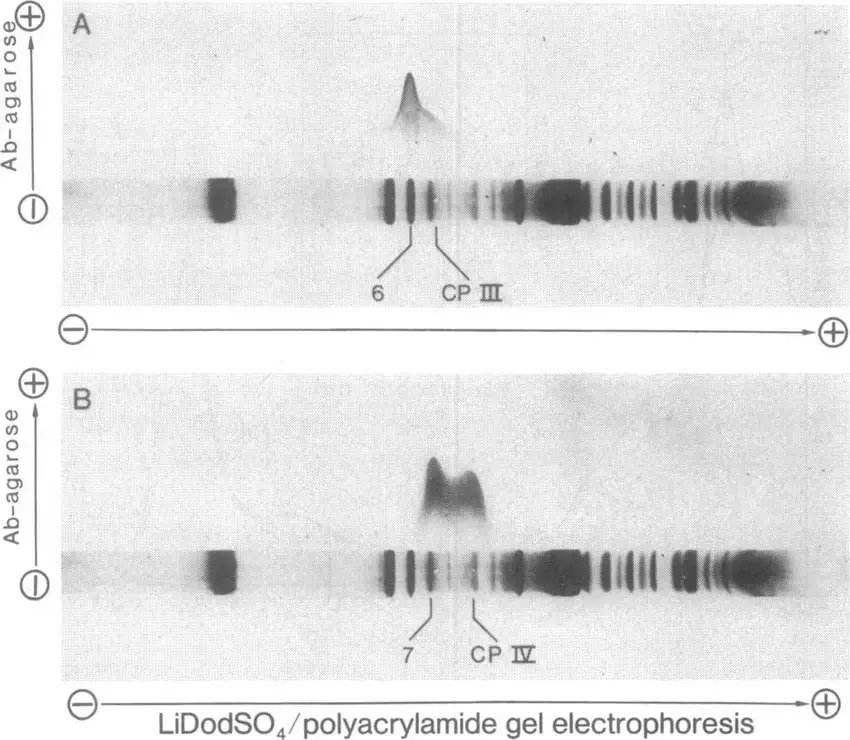
- It is used in microbiology for studying antigenic structure of microorganisms. Different microbial antigens can be separated and identified from bacterial, viral and parasitic samples.
- It is used for pathogen diagnosis. Bacterial and viral antigens may be detected from infected samples in diseases like meningitis and pneumonia.
- It is used for studying Legionella pneumophila, Mycobacterium bovis BCG and Leishmania species. The different antigenic components of these organisms can be compared and characterized.
- It is used in toxicological study of venoms. Different antigenic components of bee venom and snake venom can be separated. Components like melittin, phospholipase A and hyaluronidase may be detected.
- It is used for testing cross reaction between venom toxins and antivenom. This helps in checking the neutralizing capacity of antivenom against particular venom components.
- It is used in biopharmaceutical research for protein characterization. As the proteins remain in native condition, their natural antigenic properties can be studied properly.
- It is used in quality control of vaccines and therapeutic antibodies. It helps to check antigen purity, antibody profile and unwanted protein contamination during production and purification.
- It is used for quantitative estimation of proteins in biological fluids. The area of precipitin peak gives amount of antigen present in the sample.
- It is used for measuring proteins like prealbumin, albumin and transferrin in human aqueous humor and other biological fluids where protein amount may be low.
Advantages of Two-Dimensional lmmunoelectrophoresis
The following are the advantages of Two-Dimensional Immunoelectrophoresis–
- It has high resolving power. The proteins are first separated by electrophoresis and then reacted with specific antibodies. So, many antigens present in a complex mixture can be separated and identified in one gel.
- It gives better separation than simple immunoelectrophoresis. Different protein antigens which are close to each other can also be separated because two different directions are used.
- It is useful for quantitative estimation of antigens. The area of each precipitin peak is directly proportional to the amount of antigen present in the sample.
- It gives more accurate result than passive diffusion method. In this technique the antigen is actively moved into antibody containing gel by electric field, so the peak formation is more clear and measurable.
- It is carried out under non-denaturing condition. So, the native structure and natural conformation of proteins are preserved.
- It helps to study natural antigenic epitopes of proteins. These antigenic sites may be damaged in denaturing methods like SDS-PAGE or western blotting.
- It is useful for studying functional protein and antibody reaction. The antigen-antibody reaction occurs without destroying the natural structure of the protein.
- It has good sensitivity. It can detect small amount of antigen and minute abnormal protein pattern in serum and other biological samples.
- It can detect many antigens from a single sample. So, it is useful for complex biological mixtures like serum, tissue extract and microbial homogenate.
- It is useful for studying immunological cross-reaction. Different related antigens and antibody reactions can be compared by their precipitin pattern.
Limitations of Two-Dimensional lmmunoelectrophoresis
The following are the limitations of Two-Dimensional Immunoelectrophoresis–
- It is a labour intensive technique. Many steps are involved like gel preparation, first run, second run, washing, drying and staining.
- It is a time consuming method. The complete procedure may take long time and sometimes several days are needed for proper result.
- It is not suitable for rapid testing. Methods like ELISA and LC-MS are faster than this method.
- It requires good quality antiserum. If antibody is weak or not specific, the precipitin arcs may not form clearly.
- Large amount of specific or polyvalent antisera may be required. So, the method becomes limited when proper antibodies are not available.
- The result depends on antibody concentration in the gel. Too much or too little antibody may change the size and shape of precipitin peak.
- It is less sensitive than some modern techniques like immunofixation electrophoresis. Small amount of protein may not be detected properly.
- Small monoclonal M-proteins may be masked by other immunoglobulins present in high concentration. So, sometimes small abnormal bands remain unnoticed.
- The method is affected by heating during electrophoresis. Excess heat or Joule heating may cause uneven migration and curved precipitin bands.
- It needs proper buffer pH and ionic strength. Wrong buffer concentration may cause irregular migration and poor precipitation pattern.
- High salt concentration in the sample may disturb the electric field. This may produce smearing of bands and unclear arcs.
- Proteases present in the sample may degrade proteins during the run. This can produce extra false peaks and make the result confusing.
- Interpretation of result is difficult. The precipitin arcs may be complex and needs experienced person for correct reading.
- Artifacts may be confused with true protein variation. So, careful control of electrophoresis condition is needed.
References
- ‘Crossed immunoblotting’: Identification of proteins after crossed immunoelectrophoresis and electrotransfer to nitrocellulose membranes. (n.d.). PubMed. [URL]
- (PDF) Comparison of Two Egyptian Isolates of Spiroplasma citri by Crossed Immunoelectrophoresis and Polyacrylamide Gel Electrophoresis of Cell Proteins. (n.d.). ResearchGate. [URL]
- Thermo Fisher Scientific. (n.d.). 2D Gel Electrophoresis. [URL]
- Advanced Quantitative Bioanalytics: The Principles, Mechanisms, and Evolutionary Applications of Two-Dimensional Crossed Immunoelectrophoresis. (n.d.).
- Hygiena. (n.d.). Allergen Detection in Food Safety – Analysis & Application.
- Normec Group. (n.d.). Allergen analysis: Best practices. [URL]
- Chan, A. C., Lo, S. C., Chau, F. T., & Leung, A. K. (1999). Application of image analysis techniques to two-dimensional crossed immunoelectrophoresis study. Comput Chem, 23(6), 577-86. https://doi.org/10.1016/s0097-8485(99)00037-6
- Common artifacts and mistakes made in electrophoresis. (n.d.). PMC – NIH. [URL]
- Leon, L. L., Van Hoegaerden, M., & Galvao-Castro, B. (1986). Comparative studies of Leishmania soluble antigens by crossed-immunoelectrophoresis: Demonstration of specific antigens to L. mexicana and L. braziliensis. Bulletin of the World Health Organization, 64(1), 113-119.
- Crossed Immunoelectrophoresis analysis of bee venom. Enzymatic identification of antigens. (n.d.). PubMed. [URL]
- Crossed immunoelectrophoresis. (n.d.). PubMed. [URL]
- Crossed immunoelectrophoresis | PPTX. (n.d.). SlideShare. [URL]
- Crossed immunoelectrophoresis: Qualitative and quantitative considerations. (n.d.). PMC. [URL]
- Crossed immunoelectrophoresis: Qualitative and quantitative considerations. (n.d.). PubMed. [URL]
- Crossed immunoelectrophoretic analysis of Legionella pneumophila serogroup 1 antigens. (n.d.). [URL]
- Detection of Rickettsia rickettsii antibodies in human sera by crossed immunoelectrophoresis. (n.d.). PMC. [URL]
- Stastna, M., Radko, S. P., & Chrambach, A. (2001). Discrimination between peak spreading in capillary zone electrophoresis of proteins due to interaction with the capillary wall and due to protein microheterogeneity. Electrophoresis, 22(1), 66-70. https://doi.org/10.1002/1522-2683(200101)22:1<66::AID-ELPS66>3.0.CO;2-9
- admin. (2015, September 2). Electrophoresis Techniques. Clinical Gate. [URL]
- admin. (2016, June 12). Electrophoresis Techniques. Oncohema Key. [URL]
- Estimating Resolution for Marginally Separated Peaks. (n.d.). LCGC International. [URL]
- Buel, E., LaFountain, M., Schwartz, M., & Walkinshaw, M. (n.d.). Evaluation of Capillary Electrophoresis Performance Through Resolution Measurements. Vermont Forensic Laboratory.
- General Tests / Liquid Chromatography 49 – Procedure. (n.d.).
- How to manually calculate peak asymmetry and resolution for a single peak in hplc chromatogram? (n.d.). ResearchGate. [URL]
- Immunoelectrophoresis. (2025, May 26). In Wikipedia. [URL]
- Aryal, S. (2024, December 30). Immunoelectrophoresis: Principle, Procedure & Applications. Microbe Notes. [URL]
- Sinha, S. (2025, October 17). Immunoelectrophoresis: Principle, Techniques & Applications. DPMI India. [URL]
- Sinha, S. (2025, October 17). Immunoelectrophoresis: Principle, Techniques & Applications. DPMI India. [URL]
- Isolation from a polyvalent antivenom of antibodies to a myotoxin in Bothrops asper snake venom. (n.d.). PubMed. [URL]
- Quantitative determination of human aqueous proteins by crossed immunoelectrophoresis. (n.d.). [URL]
- Aryal, S. (2022, September 5). Rocket Immunoelectrophoresis- Objectives, Principle, Procedure, Results, Uses. Microbe Notes. [URL]
- Troubleshooting Common Electrophoresis Problems and Artifacts. (n.d.). LabX. [URL]
- Creative Proteomics scientist. (2018, March 13). Two dimensional gel electrophoresis (2-DE). Creative Proteomics Blog. [URL]
- Two-dimensional (crossed) immunoelectrophoresis. (n.d.). PubMed. [URL]