

Flash chromatography is a rapid preparative chromatographic technique used for separation and purification of mixture of organic compounds. It separates compounds mainly on the basis of their polarity and their different interaction with stationary phase and mobile phase.
It is a modified form of column chromatography. In normal column chromatography, the solvent moves slowly by gravity. But in flash chromatography, compressed air or nitrogen gas is used to push the solvent through the column. So, the separation occurs in short time.
In this technique, a short column is packed with fine adsorbent material, generally silica gel. The silica gel particles are small in size, usually about 40-63 µm or 250-400 mesh. Because of small particle size, more surface area is available for interaction with compounds and better separation is obtained.
The solvent is passed through the column under pressure, generally about 10-15 psi. The compounds move at different speed through the column according to their polarity. Less strongly adsorbed compound comes out first and more strongly adsorbed compound comes out later.
Flash chromatography was introduced by W. Clark Still and his group in 1978. It was developed to overcome the slow process of traditional gravity column chromatography. In this method, the separation which normally takes many hours can be completed within few minutes.
It is commonly used in organic chemistry laboratory for purification of reaction mixture. It gives faster separation, better recovery and less band broadening than simple column chromatography. Modern flash chromatography may also use pre-packed cartridges, automatic solvent system and detectors for collection of purified compounds.
Principle of Flash column chromatography
Principle of Flash Column Chromatography is based on the principle of adsorption chromatography. In this technique the compounds are separated due to their different affinity towards the stationary phase and mobile phase.
The stationary phase is usually a solid adsorbent like silica gel. The mobile phase is a liquid solvent or solvent mixture. When the sample mixture is added on the column, different compounds bind with silica gel in different strength.
The compounds which have more affinity for stationary phase are adsorbed strongly. So they move slowly through the column. The compounds which have more affinity for mobile phase are weakly adsorbed and move faster with the solvent.
In flash chromatography, the solvent is not allowed to pass only by gravity. Compressed air or nitrogen gas is used to apply positive pressure on the column. This pressure pushes the solvent rapidly through the packed silica gel column.
Due to this pressurized flow, the compounds pass through the column in less time and separation is completed very fast. The compounds are eluted one by one according to their polarity and adsorption capacity. This is why it is called flash column chromatography.
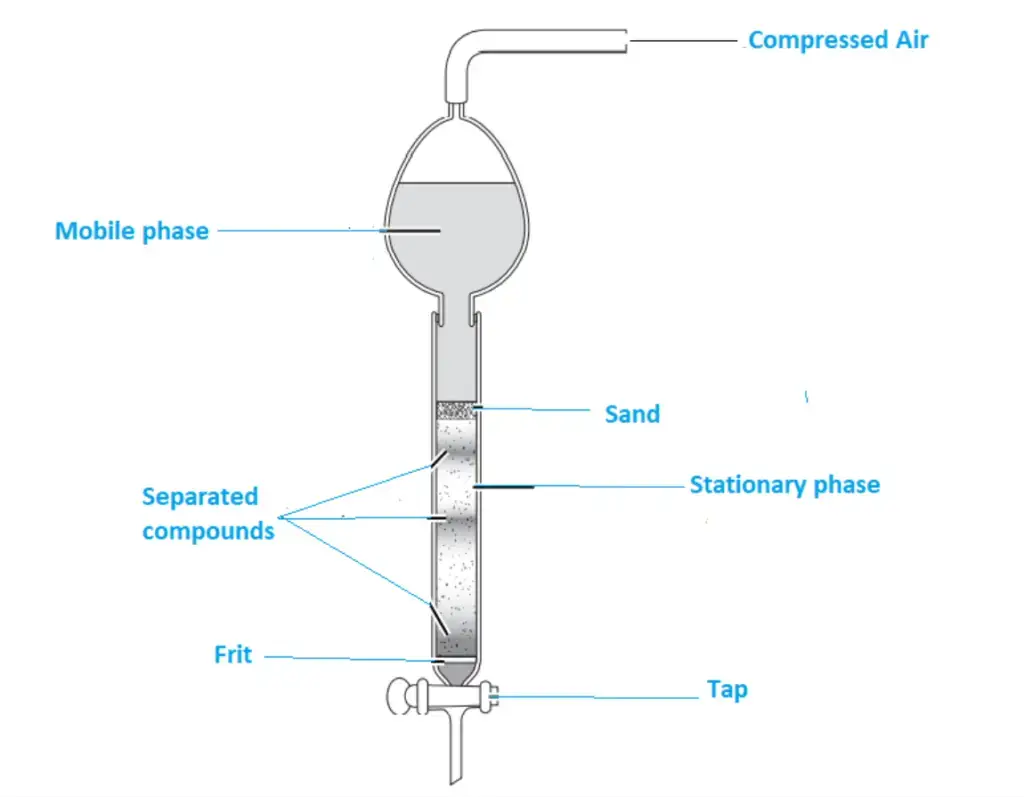
Parts of Flash column chromatography
The following are the main parts of Flash Column Chromatography–
- Pump system
It is used to push the mobile phase through the column. It gives controlled flow rate and pressure during the separation. - Sample injector
It is used to introduce the sample into the column. It may contain injection valve or sample loading chamber. - Column
It is the main part where separation of compounds takes place. It may be a glass column or pre-packed plastic cartridge filled with silica gel. - Precolumn
It is a small column placed before the main column. It traps impurities and protects the main column from contamination. - Filling set
It is used for packing glass column with adsorbent material. The column may be packed by dry filling method or wet slurry method. - Stationary phase
It is the solid adsorbent present inside the column. Generally silica gel is used as stationary phase because it adsorbs compounds according to their polarity. - Mobile phase
It is the solvent or mixture of solvents which passes through the column. It carries the compounds and helps in their elution. - Fraction collector
It is used to collect the separated compounds in different tubes or fractions. It may collect fractions according to time, volume or peak detection. - Detector
It is used to detect the compounds coming out from the column. Common detectors are UV-Visible detector, refractive index detector, ELSD and mass spectrometer. - Recorder
It is used to record the detector response. It gives chromatogram or signal pattern of the eluted compounds. - Display unit
It is used to control and observe the separation process. It shows pressure, flow rate, solvent use and other running condition. - Pressure source
It is used to give positive pressure in the system. Compressed air or nitrogen gas is commonly used in manual flash chromatography.
Types of Elution/Techniques of mobile phase
The following are the types of elution used in Flash Column Chromatography–
- Isocratic elution
In this technique the composition of mobile phase remains same throughout the separation. The same solvent or same solvent mixture is passed through the column from starting to end. It is used for simple mixture of compounds. It is more useful when the compounds have nearly similar polarity and can be separated with one solvent system. - Gradient elution
In this technique the composition of mobile phase is changed during the run. Usually the strength or polarity of solvent is increased slowly, so that compounds of different polarity can come out from the column. It is used for complex mixture containing compounds of different polarity. It improves separation and also decreases the time required for elution.- Linear gradient elution
In this method the amount of stronger solvent is increased continuously and evenly with time. The solvent strength rises slowly in a regular manner during the chromatographic run. It is simple and gives efficient separation. But sometimes it may use more solvent than step gradient method. - Step gradient elution
In this method the solvent composition is increased in fixed steps. The mobile phase is changed from one solvent strength to another solvent strength after a certain time or volume. It is useful for saving solvent and for better loading of sample on the column. It can give good separation, but the proper solvent steps must be selected carefully.
- Linear gradient elution
Detection techniques in Flash chromatography
The following are the detection techniques used in Flash Chromatography–
- UV-Visible detector
It is the most commonly used detector in flash chromatography. It is used for compounds which absorb UV or visible light. Aromatic compounds and conjugated compounds are detected easily by this method. - Diode array detector
It is an advanced type of UV detector. It can observe more than one wavelength at the same time. It helps to detect overlapping peaks and different compounds in the same run. - Evaporative light scattering detector
ELSD is used for compounds which do not absorb UV light. It is useful for carbohydrates, lipids, surfactants and other non-chromophoric compounds. - Working of ELSD
In this method the eluent from column is converted into fine droplets. Then the solvent is evaporated and the remaining particles scatter light. This scattered light is measured for detection. - Mass spectrometer
Mass spectrometry (MS) is used for accurate detection of compounds according to their molecular weight. It helps to identify desired product and impurities in the collected fractions. - Mass directed collection
In this technique fractions are collected according to selected mass value. So, the required compound can be collected even when two compounds elute very close to each other. - Refractive index detector
RI detector is used for substances having low UV absorbance. It is useful for sugars, polymers and other compounds which are not detected properly by UV detector. - All-wavelength collection
In this technique compounds can be collected even when their absorbance wavelength is not known. It is also useful when solvent absorbance creates interference in detection. - TLC image reader
Some modern flash systems contain TLC image reader. It takes image of TLC plate under UV light and calculates Rf value of compound. - Use of TLC image reader
It helps in selecting proper solvent system and making optimized flash chromatography method. The target compound is selected from TLC image and the system gives suitable running condition.
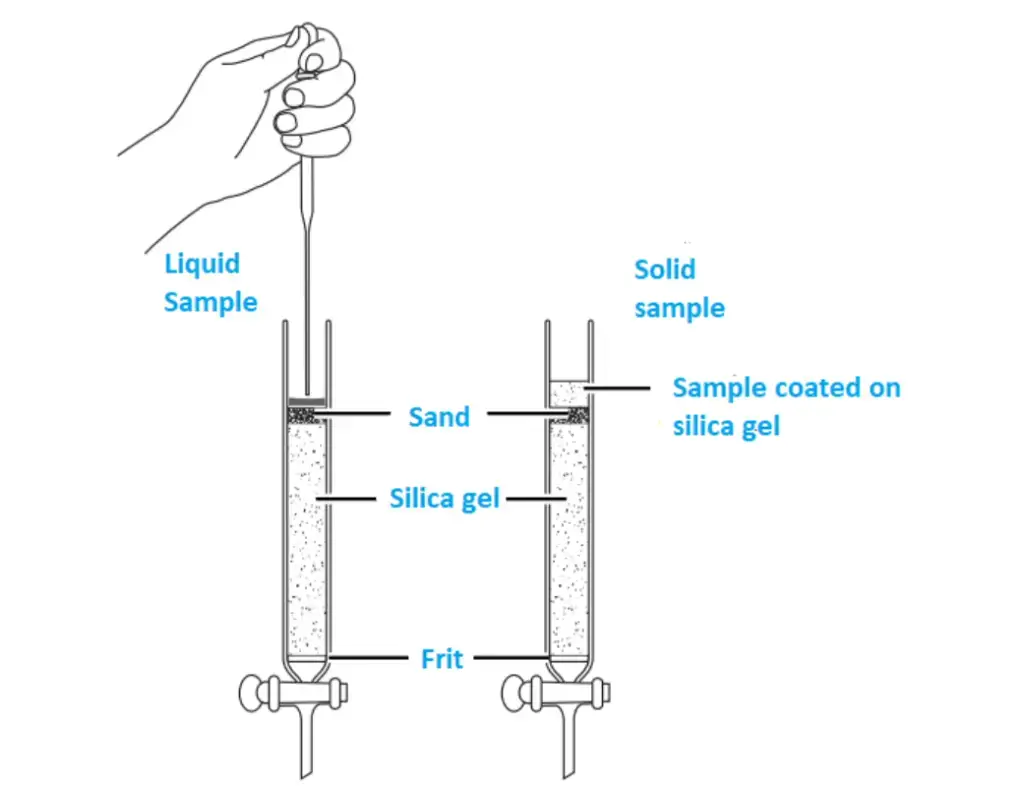
Types of Flash Chromatography
The following are the types of Flash Chromatography–
- Normal phase flash chromatography
It is the most common type of flash chromatography. In this method polar stationary phase is used, such as silica gel or alumina. The mobile phase is mostly non-polar solvent like hexane, ethyl acetate or their mixture. - Reversed phase flash chromatography
In this method non-polar stationary phase is used. The stationary phase may be C18, C8 or C4 bonded silica gel. The mobile phase is polar, such as water, methanol or acetonitrile. - Ion exchange flash chromatography
This type is used for separation of charged or ionizable compounds. Strong anion exchange (SAX) and strong cation exchange (SCX) phases are used. Acidic and basic compounds can be separated by this method. - Cyano phase flash chromatography
In this method cyano bonded phase is used as stationary phase. It has intermediate polarity. It is used for separation of compounds which are not separated properly on normal silica gel. - Amino phase flash chromatography
In this type amino bonded phase is used. It is useful for separation of carbohydrates, nitrogen containing compounds and some isomers. - Chiral phase flash chromatography
This method uses chiral stationary phase. It is used for separation of enantiomers or optical isomers. It is important in pharmaceutical work because one enantiomer may show better biological activity. - Specialty phase flash chromatography
This type uses chemically modified stationary phases for special separation purpose. Different bonded phases are selected according to nature of the compound. - Green flash chromatography
It is an improved and eco-friendly type of flash chromatography. In this method solvent use is reduced by selecting proper flow rate, run time and fraction volume. Automated software may be used for this purpose.
Step by Step Procedure of Flash Chromatography
The following are the steps of Flash Chromatography–
- Column packing
At first cotton wool plug or glass frit is placed at the bottom of the column. This prevents the loss of silica gel from the column. Then a thin layer of clean sand is added above it. - Addition of adsorbent
The column is filled with silica gel adsorbent. Generally 230-400 mesh silica gel is used. It may be filled by dry powder method or wet slurry method. - Settling of gel bed
The column is tapped gently after adding silica gel. This helps the silica gel to settle properly and form a uniform bed. A top layer of sand or sodium sulfate is then added to protect the silica surface. - Solvent addition
The selected elution solvent is added into the column. The solvent must wet the silica gel completely. The solvent level should not fall below the top of silica bed. - Equilibration of column
Compressed air or nitrogen gas is applied to pass the solvent through the silica gel. This removes air bubbles and packs the bed tightly. The column becomes ready for sample loading. - Sample loading
The sample is loaded carefully on the top of the column. It should form a narrow band. Broad sample band gives poor separation. - Wet loading
In this method the sample is dissolved in very small amount of solvent. Then it is added slowly on the top of the column without disturbing the sand layer. - Dry loading
In this method the sample is dissolved in solvent and mixed with small amount of silica gel or Celite. Then the solvent is evaporated and dry powder is formed. This powder is added on the top of the column. - Elution
The column is filled with mobile phase and pressure is applied. The solvent moves through the column at steady flow rate. The compounds move at different speed according to their adsorption and polarity. - Fraction collection
The liquid coming from the bottom of the column is collected in separate tubes or beakers. Equal volume fractions are usually collected one after another. - Analysis of fractions
The collected fractions are tested by thin layer chromatography (TLC). It is done to find which fraction contains the desired compound. - Combining of fractions
The fractions containing same pure compound are combined together. Fractions containing impurities are not mixed with pure fraction. - Recovery of compound
The solvent is evaporated from the combined fractions. After evaporation the purified compound is obtained. - Cleaning of column
Remaining solvent is flushed out by applying air or nitrogen gas. Used silica gel is removed safely and the glass column is washed properly.
Factors Affecting Flash Chromatography
The following are the factors affecting Flash Chromatography–
- Solvent system
The mobile phase is very important in flash chromatography. Solvent polarity controls the movement of compounds through the column. More polar solvent elutes the compounds faster. - Solvent ratio
The ratio of solvents affects separation of compounds. If wrong solvent ratio is used, compounds may come out together or may not elute properly. - Stationary phase
The type of stationary phase affects the adsorption of compounds. Silica gel, alumina or reversed phase material are selected according to nature of the sample. - Particle size
Small particle size of adsorbent gives more surface area. Usually 40-63 µm or 230-400 mesh silica gel is used. It gives better interaction and better resolution. - Flow rate
Flow rate affects both time and separation. If flow is too fast, compounds may not separate properly. If flow is too slow, the run takes more time and band may broaden. - Pressure
Pressure is used to push the mobile phase through the column. Generally air or nitrogen gas pressure is used. Proper pressure gives steady flow and good separation. - Sample amount
The amount of sample loaded on the column affects result. Too much sample causes overloading and gives broad band or poor separation. - Sample to silica ratio
Proper amount of silica gel is needed for sample separation. Usually 30 to 100 g silica gel may be used for 1 g of sample, depending on the sample nature. - Sample loading method
Wet loading and dry loading both affect separation. In wet loading, sample should be dissolved in minimum weak solvent. Strong solvent may disturb the band. - Dry loading
Dry loading is useful for poorly soluble sample. The sample is mixed with silica gel or Celite and dried before loading. It gives narrow band and better separation. - Column packing
The packing of column should be uniform. Void space, cracks and loose packing can disturb the flow of solvent. - Channeling
Channeling occurs when solvent passes through one side or crack in the adsorbent bed. This gives poor separation and distorted peaks. - Temperature
Temperature can affect interaction between compound, mobile phase and stationary phase. Change in temperature may change retention time and separation pattern.
Applications Of Flash Chromatography
The following are the applications of Flash Chromatography–
- It is used for purification of active pharmaceutical ingredients (APIs) in pharmaceutical industry. Drug intermediates and synthetic compounds are also separated by this method.
- It is used in drug discovery work. Newly prepared compounds are purified quickly and then used for biological testing.
- It is used in organic synthesis for purification of reaction mixture. The desired product is separated from starting material, by-products and catalyst residue.
- It is used for isolation of natural products. Plant extracts, marine sample and microbial sample may contain many compounds, which are separated by flash chromatography.
- It is used for purification of flavonoids, essential oils, ginsenosides and catechins. These compounds are obtained from natural source.
- It is used in food and beverage industry. Flavours, fragrances and food additives are purified by this method for getting better quality.
- It is used in environmental analysis. Pollutants and contaminants present in soil and water sample can be separated before their identification.
- It is used for lipid purification. Fatty acid methyl esters (FAMEs), sterols and glycerides are separated according to their polarity.
- It is used for purification of carbohydrates and related compounds. Amino sugars and aminoglycoside antibiotics can also be separated.
- It is used as a preparative method in laboratory. Small and medium quantity of compound can be purified in short time.
- It is used for sample clean up before instrumental analysis. The purified compound is then analysed by NMR, mass spectrometry (MS) and IR spectroscopy.
Advantages of Flash chromatography
The following are the advantages of Flash Chromatography–
- It gives rapid separation of compounds. The purification is completed in few minutes instead of many hours.
- It saves time in laboratory work. Many samples can be purified in less time than simple gravity column chromatography.
- It uses less amount of solvent. So the cost of solvent and total running cost becomes less.
- It is more economical because labour time is also reduced. The work is completed faster with less manual handling.
- It produces less solvent waste. So it is comparatively more safe and environment friendly method.
- It gives good separation of compounds. Target compound can be obtained in more pure fraction.
- It gives better resolution because fine silica gel is used in the column. The compounds interact more properly with stationary phase.
- It is useful for sensitive compounds. The compounds remain in contact with silica gel for short time, so degradation is less.
- It can be automated in modern instruments. This reduces manual work and gives better control of flow rate, pressure and fraction collection.
- It can be used for small scale and also gram scale purification. So it is useful in both research and preparative work.
- The column or cartridge may be reused after proper cleaning in some cases. This saves laboratory materials.
- It reduces exposure to harmful solvent and silica dust. Because the separation is fast and handling time is less.
Limitations of Flash chromatography
The following are the limitations of Flash Chromatography–
- It gives lower resolution than prep HPLC and some conventional column methods. So, very complex mixture may not be separated properly.
- It is not always suitable when very high purity is required. Closely related compounds may come out together or very close to each other.
- The instrument cost is high. Automated flash chromatography system needs more initial cost than simple gravity column set up.
- The column bed may get disturbed during packing or running. Void space, channeling and uneven flow can affect separation.
- Blocked frit may occur in the column. This can disturb solvent flow and may give split peak or poor peak shape.
- Many pre-packed flash columns are disposable type. They cannot always be reused for different samples like simple glass columns.
- Wet loading may create problem if more strong solvent is used for dissolving sample. It may cause band broadening and poor separation.
- Some compounds may degrade on normal silica gel. For these compounds deactivated silica, alumina or magnesium silicate may be required.
- Modern flash systems need trained person for operation. Software control, pump setting, detector setting and fraction collection must be handled properly.
- The instrument needs regular maintenance. Sensors, pumps and tubing must be checked and calibrated from time to time.
- It depends on electricity and working instrument condition. If power or software problem occurs, the run may be affected.
- Glass columns cannot tolerate very high pressure. Borosilicate glass columns are mostly used at lower pressure and not suitable for high pressure system.
Precautions of Flash Chromatography
The following are the precautions of Flash Chromatography–
- The gas inlet should not be fixed tightly with glass column without pressure relief valve. High pressure may build up and it can break or explode the glass column.
- High pressure should not be applied suddenly. Plastic cartridge may rupture if the frit or column becomes blocked.
- Dry silica gel powder should be handled carefully. Its dust should not be inhaled because it is harmful for respiratory tract.
- Pre-packed cartridge may be used to reduce contact with dry silica gel. It is safer than handling loose silica powder.
- The column should never be allowed to run dry. The solvent level must always remain above the top of silica gel bed.
- If the column becomes dry, air enters into the silica bed. This gives poor flow and bad separation.
- The mobile phase should be filtered before use. Dust particles and insoluble matter may block the frit or tubing.
- The solvent should be degassed properly. Dissolved air may form bubbles under pressure and disturb the flow.
- After loading the sample, elution should not be stopped in between. If the run is paused, the sample band diffuses and becomes broad.
- Compressed air should be clean and free from oil. Oil or other contaminant may enter the solvent and affect the separation.
- During column packing, pressure should be maintained until trapped air is removed from the silica gel. Otherwise the silica bed may break or fragment.
- Suitable glassware should be used according to pressure. Normal borosilicate glass column should not be used at pressure above 10 bar.
- Tubing and capillary connections should be fitted properly. Loose connection may cause leakage and pressure fluctuation.
- Glass columns should be cleaned carefully after use. Abrasive brush and strong soap should not be used because these may scratch and weaken the glass.
- Solvent and waste should be handled safely. Most organic solvents are volatile and inflammable, so proper ventilation should be maintained.
Flash chromatography video
References
- Advion, Inc. (2020). puriFlash-CMS: Mass directed purification.
- Advion Interchim Scientific. (n.d.). Mass spectrometer & MS splitter.
- Agilent Technologies, Inc. (2009). Tips and tricks of HPLC system troubleshooting.
- Amerigo Scientific. (n.d.). Specialty chiral columns.
- Ayare, P., Khanvilkar, V., & Chalak, N. (2014). Flash chromatography: Area & applications. PharmaTutor, 2(5), 89-103.
- Bickler, B. (2023, January 23). Why are my flash column chromatography peaks splitting? Biotage.
- Bickler, B. (2023, February 10). How do I create an efficient gradient flash chromatography method? Biotage.
- Bickler, B. (2023, February 10). How to optimize TLC to enhance purification by flash chromatography. Biotage.
- Buchi. (n.d.). Flash chromatography vs prep HPLC: You want speed or precision?
- Buchi. (n.d.). Separation of natural compounds by flash chromatography.
- Chromatography Direct. (2023, July 3). Flash chromatography: A speedy solution for separation & purification.
- Chromatography Direct. (n.d.). Applications of flash chromatography.
- Chromatography Direct. (n.d.). Flash chromatography vs. traditional methods: Which is more efficient?
- Chromatography Online. (n.d.). LC troubleshooting essentials: A guide to common problems and solutions for peak tailing, ghost peaks, and pressure spikes.
- Cytiva. (n.d.). Troubleshooting peak tailing and peak fronting in chromatography.
- Hawach. (2025, November 13). Difference between flash column and conventional column.
- Hitachi High-Tech Corporation. (n.d.). 8. Principle and feature of various detection methods (2).
- Ismail, B., & Nielsen, S. S. (2010). Basic principles of chromatography. In S. S. Nielsen (Ed.), Food analysis (pp. 473-498). Springer.
- JASCO Inc. (n.d.). Detectors.
- National Institutes of Health. (n.d.). General methods for flash chromatography using disposable columns. PubMed Central.
- NCI Manufactures. (n.d.). Hi-Purit™ cyano phase, spherical 40-63ums. National Chromatography Inco.
- PatSnap Eureka. (2025, August 21). Comparing manual vs automated column chromatography systems — Throughput, cost and data quality.
- Peeraer, Y. (n.d.). The eyes of high-performance liquid chromatography (HPLC): Strategic use of detectors in drug development and quality control. QbD Group.
- Phenomenex Team. (2025, June 6). Flash chromatography: Principles, mechanisms, and practical applications. Phenomenex.
- Phinney, K. W., Sander, L. C., & Wise, S. A. (1998). Coupled achiral/chiral column techniques in subcritical fluid chromatography for the separation of chiral and nonchiral compounds. Analytical Chemistry, 70(11), 2331-2335.
- Pharma Now. (n.d.). Basics of chromatography: A complete guide for pharmaceutical applications.
- Process Chemistry Portal. (n.d.). TLC to gradient chromatography separation simulator (column volumes).
- ResearchGate. (n.d.). FLASH CHROMATOGRAPHY.
- ResearchGate. (n.d.). FLASH CHROMATOGRAPHY. (Note: Included twice to reflect the two separate ResearchGate source entries in the notebook).
- Senzer, B. D., Varongchayakul, C., Danheiser, R. L., Daniels, B., & Dong, V. M. (2025). OS techniques: Purification of organic compounds by flash column chromatography. Organic Syntheses, 102, 276-302.
- Sorbent Technologies, Inc. (2025). Automated flash chromatography systems.
- Still, W. C., Kahn, M., & Mitra, A. (1978). Rapid chromatographic technique for preparative separations with moderate resolution. Journal of Organic Chemistry, 43(14), 2923-2925.
- Swathi, C. A., Santhi, O. K., Supriya, V., Sandhya, T., Shakirunnissa, M., & Padmalatha, K. (2021). An overview on flash chromatography. Indo American Journal of Pharmaceutical Sciences, 8(4), 38-58.
- Teixeira, J., Tiritan, M. E., Pinto, M. M. M., & Fernandes, C. (2019). Chiral stationary phases for liquid chromatography: Recent developments. Molecules, 24(5), 865.
- Teledyne ISCO. (n.d.). Improve flash chromatography method development with matching TLC plates.
- Teledyne ISCO. (n.d.). Optimized flash chromatography purification: From TLC to large scale in three steps.
- Teledyne Labs. (n.d.). Information rich flash chromatography I: Mass directed fractionation.
- Teledyne Labs. (n.d.). Manual vs automated flash chromatography.
- Thermo Fisher Scientific. (n.d.). HPLC troubleshooting.
- Torontech Team. (2025, August 1). Compare different HPLC detector types. Torontech.
- Unknown Author. (n.d.). High-efficiency flash chromatography: Comprehensive analysis of principles, instrumentation, and preparative methodologies in contemporary chemical purification.
- Warang, R. (n.d.). Chromatography detectors: UV, RI, MS, and fluorescence explained. Pharma Now.
- Wikipedia. (2026, March 23). W. Clark Still.