

Pipette filler is a handheld laboratory device used to aspirate (draw up) and dispense a required volume of liquid using a glass or plastic pipette. It is also called pipette controller or pipette gun. It is used to handle liquids safely and accurately during routine lab work.
It works by creating a controlled suction (vacuum) for drawing liquid into the pipette and a controlled pressure for dispensing the liquid. In this way mouth pipetting is avoided, and the risk of chemical exposure and accidental infections is reduced. A steady and uniform filling and releasing of liquid can be done with better control.
Pipette fillers are available as manual types and electronic types. Manual type includes rubber bulb fillers with valve system for suction, release and blow out. Electronic pipette filler is battery operated with motorized pump, and it reduces hand fatigue during repeated pipetting. These devices are commonly used in chemistry, biology and diagnostic laboratories for consistent and safe liquid transfer.
Components of a Pipette Filler
- Main rubber bulb. It is a flexible rubber bulb (natural rubber or synthetic elastomer). It is compressed to create vacuum.
- Valve A (Air). It is located at the top of the bulb. This valve is pressed while compressing the bulb to expel air and prepare vacuum.
- Valve S (Suction). It is located at the bottom stem. It is pressed to draw the liquid up into the attached pipette.
- Valve E (Empty). It is located on a side tube. It is pressed to drain or dispense the liquid from the pipette.
- Internal glass balls. Small glass balls are present inside the valves. It maintains hermetic seal and controls the air or liquid flow when the rubber part is pinched.
- Pipette insertion point. It is the bottom opening or adapter. The glass or plastic pipette is inserted and held tightly to make vacuum tight fitting.
- Small blowout bulb (in some models). It is a small secondary bulb at the end of valve E. It is squeezed to purge the final drop of liquid from blow-out type pipettes.
- Components of an Electronic Pipette Filler (Pipette Controller)
- Housing or casing. It is the main outer body. It is made for grip and handling.
- Aspirating and dispensing buttons. These are the triggers pressed by the operator. It is used for drawing liquid and releasing liquid.
- Speed and mode controls. These are buttons or switches. It is used to change motor speed and select dispensing mode (gravity delivery or motor assisted blowout).
- Nose cone or nose piece. It is the front assembly of the device. It is removable in many models.
- Silicone adapter or pipette holder. It is a flexible internal gasket inside the nose cone. It grips the pipette and forms a vacuum tight seal.
- Hydrophobic membrane filter. It is a replaceable safety filter (0.2 µm or 0.45 µm). It is placed behind the nose cone to protect the motor from liquid over aspiration.
- LCD display. It shows settings like speed level, dispense mode and remaining battery life.
- Rechargeable battery and charging socket. It is the internal power source (Li-ion or NiMH). The charging socket is used to connect AC adapter for charging.
Types of Pipette Fillers
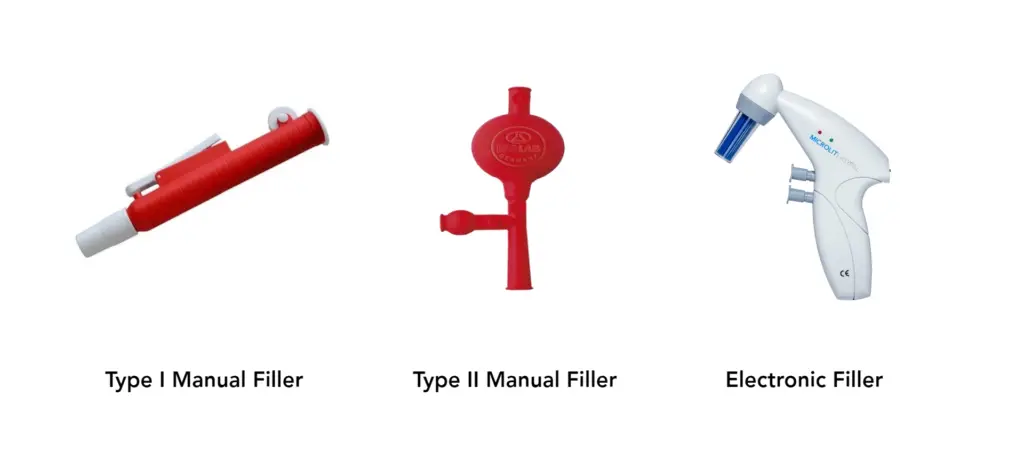
A. Manual suction devices
- Simple safety bulbs. These are basic single chamber rubber bulbs. Vacuum is created by manual compression of the bulb. It is cheap and simple but meniscus control is limited.
- Three valve rubber fillers (propipettes). These are classic rubber bulbs with three pinch valves. A valve is for air release. S valve is for suction. E valve is for empty or delivery. Air is first removed, then liquid is sucked and later it is dispensed without removing the filler from the pipette.
- Pipette pumps. These are manual aspirators with thumbwheel and internal piston. Suction is created by turning the wheel. Liquid level control is more progressive and linear.
- Lever style controllers. These are ergonomic manual devices using trigger or lever to operate piston. A quick release system is present in many models for fast dispensing.
- Safety aspirators and fine control systems. These are manual systems with safety parts like filters, check valves etc. Back flow of liquid into bulb is prevented and exposure risk is reduced.
B. Electronic (motorized) pipette controllers
- Electronic pipette controller. It is battery operated device with internal motorized pump. Aspiration and dispensing is controlled by buttons and speed controls. Hand fatigue is reduced and variable speed, gravity dispense and other modes are given. Single channel and multi channel types are available for high throughput work.
Operating Procedure of Pipette Fillers
Operating Procedure for a Manual 3-Valve Rubber Bulb
- Attach the pipette. The top end of the pipette is inserted into the bottom opening of the rubber filler. It should be fitted gently. It should not be pushed too deep because the internal valves can be damaged.
- Create a vacuum. The valve “A” (Air) is pressed at the top. At the same time the main rubber bulb is squeezed to expel air. The “A” valve is released first before releasing the bulb, so that the vacuum is trapped inside.
- Aspirate the liquid. The pipette tip is dipped into the liquid. The valve “S” (Suction) is pressed to draw the liquid upward. The liquid is allowed to rise slightly above the required graduation mark.
- Adjust the meniscus. The pipette is kept vertical. The valve “E” (Empty) is pressed gently to release liquid slowly. The bottom of the meniscus is brought exactly to the target volume line.
- Dispense the liquid. The pipette is moved to the receiving container. The “E” valve is pressed again to deliver the liquid.
Operating Procedure for an Electronic Pipette Controller
- Attach the pipette. The pipette is pushed into the nose cone and silicone adapter. It is fitted firmly so that vacuum tight seal is formed.
- Set the speed. Aspiration and dispensing speed is selected using speed buttons or switches. Required mode can be selected depending on work.
- Aspirate the liquid. The pipette tip is immersed in the liquid. The aspirating button is pressed to draw liquid slightly above the required mark.
- Adjust the meniscus. The dispensing button is pressed lightly. Excess liquid is drained until the meniscus rests exactly on the calibration line.
- Dispense the liquid. The pipette is moved to the target container and the dispensing button is pressed. In gravity mode liquid flows out naturally. In motor assisted mode the liquid is expelled by blow out depending on the setting and how far the button is pressed.
Applications of Pipette Fillers
- Safe liquid transfer. It is used to eliminate mouth pipetting. Laboratory workers are protected from accidental infections and chemical exposure.
- Routine liquid handling. It is used to move measured volumes of liquids (about 0.1 mL to 100 mL) between test tubes, sample tubes, beakers, flasks and multi well plates.
- Cell culture and microbiology. It is used for media change in T flasks. It is used for cell seeding, resuspending cell or bacterial pellets. It is also used for aspirating layers from gradients (e.g. Ficoll gradient).
- Solution preparation and chemical analysis. It is used to measure and mix chemicals, buffers and reagents. It is used in titration work and colorimetric assay handling.
- Serial dilutions. It is used to dilute samples step by step with consistency. It is done in pharmacology, microbiology and molecular biology experiments.
- Molecular biology work. It is used to handle DNA, RNA and enzymes. It is used during PCR, qPCR, NGS sample handling and protein analysis work.
- Clinical diagnostics and pathology. It is used in processing patient samples (blood, serum, urine). It is used for plasma separation, cell counting, blood typing and immunoassays like ELISA.
- Pharmaceutical quality control. It is used in formulation testing, toxicology studies, impurity profiling and molecular screening.
- Industrial, food and environmental testing. It is used in water and soil testing for trace pollutants. It is also used in quality control screening for ingredients and microbial contaminants in food and beverage samples.
- High throughput screening. It is used for loading reagents and samples into 96 well or 384 well microplates for rapid processing.
Advantages of Pipette Fillers
- Enhanced safety. It eliminates mouth pipetting. It protects the lab worker from toxic, corrosive and infectious materials exposure.
- Improved ergonomics. Less effort is needed for aspiration and dispensing. Hand strain and fatigue is reduced. Risk of repetitive strain injury (RSI) is lowered during long work.
- Greater precision and accuracy. It gives more consistent volume measurement. Human error is reduced and reproducibility of results is improved.
- Increased speed and efficiency. Work becomes faster in routine liquid transfer. Electronic types help in repetitive dispensing and saves time.
- High versatility. It can be used with different glass and plastic pipettes. It generally covers volumes from about 0.1 mL to 100 mL.
- Controlled liquid handling. Suction and dispensing speed can be adjusted. Meniscus can be controlled and splashing or over aspiration is prevented.
- Contamination prevention. Many fillers have hydrophobic filter and some parts are autoclavable. Liquid entry into device is blocked and sterile handling and cross contamination prevention is supported.
Limitations of Pipette Fillers
- Physical and ergonomic strain. Manual pipette fillers need more hand effort. It depends on user hand speed and skill. Hand fatigue can occur and precision becomes inconsistent in repeated work.
- Chemical incompatibility. It should not be used to draw strong acids or alkalis above 1 mol/L. Internal rubber or plastic parts can be damaged by some organic solvent vapours.
- Temperature restriction. It is generally restricted for solutions above 50°C. Hot liquids can affect the filler parts and sealing.
- Safety and environmental risks. It must not be operated in explosive environment. Highly flammable liquids with flash point below 0°C (acetone, ether) should not be handled.
- Vulnerability to liquid damage (over aspiration). If liquid is drawn into the filler body it can damage internal mechanism. Filters can get wet, airflow is blocked and the device stops working.
- Material degradation. Rubber bulb and elastomer parts can harden and crack with time. Elasticity is lost and vacuum leaks occurs, suction is reduced.
- Battery dependency and high cost. Electronic controllers are costlier than manual type. It depends on battery and battery failure can disturb work. Frequent incomplete charging can reduce battery life.
- Size and insertion limits. Some manual bulb fillers do not work properly with 1 mL and smaller plastic pipettes. If pipette is pushed too deep it can block pressure valves and filler will not work.
References
- Biocompare. (n.d.). Preserving pipette performance.
- BrandTech Scientific, Inc. (n.d.). Pipette maintenance guide for reliable lab performance.
- ChemScience Inc. (n.d.). Ultimate guide to pipettes: Everything you need to know.
- Cole-Parmer. (n.d.). Electronic pipette controller.
- Corning Incorporated. (2023, February). Falcon pipet controller instruction manual.
- Department of Chemistry, University of York. (n.d.). Using pipettes.
- Drummond Scientific Company. (2025, February). Operation manual for the Drummond Pipet-Aid XP.
- Eppendorf. (n.d.). All pipettes, dispensers & automated liquid handlers.
- Eppendorf. (n.d.). Easypet 3 – Motorized pipette controller.
- Eppendorf. (n.d.). Electronic pipettes.
- Fisher Biotec. (n.d.). Manual vs electronic pipettes – Here’s what you should know. FB Australia.
- Globe Scientific Inc. (n.d.). Pipette filler bulb, with adapter, synthetic rubber, red.
- Hach. (n.d.). Pipet filler, 3-valve.
- HINOTEK. (n.d.). What is a pipette? A complete guide to types & uses.
- Home Science Tools. (n.d.). Pipette filler instructions.
- Huhmann, S. (2026, January 12). Pipetting made easy – Part 1: Best practice guide. KNAUER Wissenschaftliche Geräte GmbH.
- Kolstad, C. (2020, February 4). Ball valve basics. The Engineering Mindset.
- Leo Bios. (2025, July 25). What are the key uses of pipettes in scientific experiments? Ucallmlabs.
- Mettler Toledo. (2014, April). E4 XLS+ electronic pipettes.
- mylabBRAND. (n.d.). Pipette controller accu-jet® S – dispensing modes [Video]. YouTube.
- National Center for Biotechnology Information. (n.d.). Revisiting the micropipetting techniques in biomedical sciences: A fundamental prerequisite in good laboratory practice. PMC.
- OER Commons. (n.d.). Pipette aids and pipet – Biotech lab techniques manual.
- Sartorius. (2024, September). Cleaning and decontamination guide for Sartorius pipettes.
- Sartorius. (n.d.). How to choose between electronic and mechanical pipettes?
- Sartorius. (n.d.). Pipetting applications in the lab.
- Scilogex. (n.d.). How do I maintain my pipettes? A crash course in caring for the details in your lab.
- Shaoxing Shangyu Mingji Plastic Industry Co., Ltd. (2025, March 10). What are some common applications of serological pipettes in the laboratory.
- Simson Chemtech. (2025, August 2). Top 10 common uses of pipettes in scientific laboratories.
- Söderholm, S., & Artimo, P. (2021, November 26). Techniques for pipetting challenging liquids. Sartorius Biohit Liquid Handling.
- Stokie Science. (n.d.). How to use a pipette bulb filler [Video]. YouTube.
- Technical analysis of pipette filling systems: Engineering, operational mechanics, and strategic laboratory integration. (n.d.).
- The Scientist. (n.d.). Best pipetting practices.
- Thermo Fisher Scientific. (n.d.). 10 steps to improve pipetting accuracy.
- Thermo Fisher Scientific. (n.d.). Pipette types for different applications.
- Thermo Scientific. (2022, April). Addressing the ergonomics of pipetting by hand. Fisher Scientific.
- United Scientific. (n.d.). United Scientific PinPoint pipette controller user manual.
- Universal Medical. (n.d.). Pipette controller.
- University Health Services, UC Berkeley. (n.d.). Ergonomic pipettes.
- University Pipette Service, Inc. (2024, October 16). Optimal storage practices for pipettes after use.
- Vidrio Industrial Pobel. (2026, February 10). Rubber pipette bulbs and pipette aspiration devices: Types and how to use them.
- Yelimeshyn, S. (2025, December 24). Best pipette controllers & fillers: Manual, electronic & serological options compared. BostonMed Supply.
- Yelimeshyn, S. (2025, December 24). Types of pipettes in the laboratory: Names, functions, and how to choose the most accurate one. BostonMed Supply.