

Volumetric pipette is a slender laboratory glass or plastic pipette used to measure and transfer one fixed volume of liquid with high accuracy. It is also called bulb pipette or belly pipette. It is mainly used when an exact volume is required in analytical works.
It has a long narrow tube with an expanded bulb at the middle portion. A single calibration mark is present on the upper stem. The volume is adjusted up to this mark, and then it is allowed to deliver the liquid up to the tip.
Most volumetric pipettes are calibrated as TD (to deliver). It means the pipette is made to deliver the exact stated volume, while a small residual drop remains inside the tip. This residual should not be blown out by mouth or any force, as it is already accounted during calibration.
Volumetric pipette gives very high precision, sometimes up to four significant figures in measurement. It is used in preparation of standard solutions, in titration works, and for making accurate dilutions. It is commonly used in analytical chemistry, pharmaceutical quality control, and clinical laboratory works.
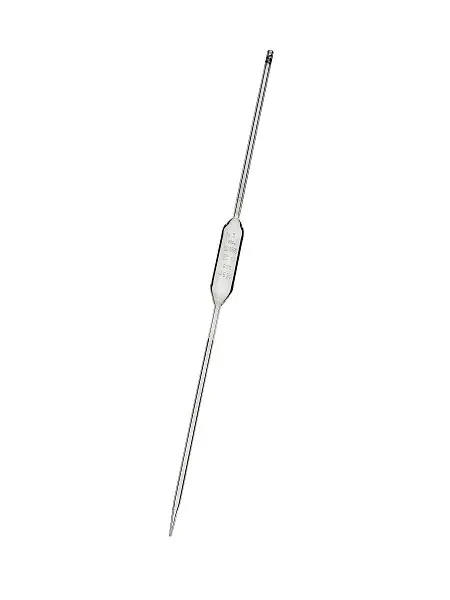
Principle of Volumetric Pipette
Volumetric pipette principle is based on its TD (to deliver) calibration to dispense a single fixed volume accurately. The liquid is allowed to flow out by gravity, and a thin film of liquid remains adhered to the inner wall and also in the tip due to surface tension and viscosity. This residual is already mathematically accounted during calibration, so the volume delivered is equal to the stated volume without blowing out the last drop. The narrow neck and single sharp mark helps to align the meniscus exactly at the calibration mark, and then the measured volume is delivered.
Parts of a Volumetric Pipette
The volumetric pipette is made up of following parts that help in measuring and delivering a fixed volume accurately.
- Suction stem (upper stem)
It is the narrow upper tube. Pipette bulb or filler is attached here for suction. - Graduation mark (capacity line)
It is a single sharp horizontal line present on the upper stem. The lower meniscus is adjusted exactly to this mark for taking the fixed volume. - Bulb (reservoir or belly)
It is the expanded middle portion of the pipette. It holds the major quantity of the liquid volume. - Delivery stem (lower stem)
It is the lower narrow portion below the bulb. It helps in controlled flow of liquid during delivery. - Tapered tip (delivery tip)
It is the terminal end with a fine opening. It controls the drainage time and helps to deliver the measured volume properly. - Pipette filler or bulb (accessory)
It is used to create suction for drawing liquid. Mouth suction is avoided and safer filling is done.
Operating Procedure of Volumetric Pipette
The following are the steps to be followed for operating a volumetric pipette.
- Preparation and conditioning
First the pipette is checked for any crack, chip or damaged tip. If the outer surface is wet, it is wiped dry with tissue or paper. The pipette is then conditioned (wet down) by taking small amount of the same sample solution inside. The top is closed with index finger and the pipette is rotated in horizontal position so that inner wall gets coated. This rinse is drained into waste beaker. The conditioning is repeated one more time. - Filling of pipette
The pipette tip is dipped straight into the sample liquid. With a bulb or pipette filler, the liquid is sucked up above the calibration mark (around 20 mm above the line). The pipette is removed from the liquid and the outside of lower stem is wiped with lint free tissue to remove sticking drops. - Setting of meniscus
The bulb is removed and the upper end is closed tightly with index finger (if filler is not a 3-way type). The pipette is held vertical and the calibration mark is kept at eye level. The finger pressure is released slowly and the liquid is allowed to come down. The lower meniscus is adjusted exactly on the calibration line. If any drop is hanging outside the tip, the tip is touched to the inside wall of a waste beaker to remove it. - Delivery of liquid
The pipette is taken to the receiving flask or vessel. The tip is placed against the wet inner wall of the vessel, usually keeping the vessel at around 45° angle. The liquid is allowed to drain completely by gravity. After the flow stops, around 2 seconds is waited while still touching the wall. The pipette is removed. The last drop remaining inside the tip is not blown out because it is TD (to deliver) type and the residual is already accounted.
Applications of Volumetric Pipette
Volumetric pipette is used in laboratory works where a fixed volume is to be taken with high accuracy. Some of its applications include:
- Used for preparing standard solutions and working standards in analytical laboratory.
- Used in titration and volumetric analysis for delivering exact volume of reagent or analyte.
- Used for making accurate dilution and serial dilution, and for preparing stock solutions.
- Used in pharmaceutical quality control work for routine testing and batch analysis where accuracy is maintained.
- Used in clinical laboratory for transferring exact volume of sample and reagent in diagnostic tests.
- Used in quantitative and gravimetric analysis where exact volume measurement is required.
Advantages of Volumetric Pipette
Volumetric pipette has some advantages because it is made for delivering one fixed volume with high precision. The following are the advantages.
- It gives extreme accuracy. It can deliver the fixed volume with very high precision (up to four significant figures in many cases).
- It reduces human error because the narrow neck and single mark makes meniscus reading easier and more correct.
- It gives better repeatability. The same volume can be delivered again and again with less variation, so it is preferred for critical works.
- It is available in different fixed capacities, so different volumes can be selected as per requirement (small to large volumes).
- Some types are available with variable volume adjustment system, which helps in selecting volume quickly and reduces effort, with good accuracy.
Limitations of Volumetric Pipette
Volumetric pipette has some limitations because it is made only for one fixed volume and it is calibrated for water like drainage. The following are the limitations.
- It delivers only one fixed volume. For different volumes, separate volumetric pipettes are needed.
- It is comparatively costly than many other pipettes like graduated pipette.
- It is slow for routine works. For media preparation or repeated variable dispensing, it becomes inefficient.
- It is not suitable for viscous or highly volatile liquids. Viscosity and surface tension changes the residual film and then volume delivery becomes inaccurate if correction is not applied.
- It should not be used for hot solutions. Heat can expand the glass and can disturb the calibration permanently.
- It should not be used when solution contains undissolved particles. The narrow stem and tip can be clogged easily by solids.
Difference Between a Volumetric Pipette and a Volumetric Burette
The following are the differences between a volumetric pipette and a volumetric burette.
- Volumetric pipette is used to deliver one fixed volume only. It has a single calibration mark.
- Volumetric burette is used to deliver variable volume. It has graduation marks along the length.
- Volumetric pipette has an expanded bulb (belly) at the middle with narrow stems.
- Volumetric burette is a straight long tube without any central bulb.
- In volumetric pipette, suction is done by pipette bulb or filler and the flow is controlled by finger or valve of bulb.
- In volumetric burette, the flow is controlled by a stopcock or tap fitted at the lower end.
- Volumetric pipette is used mainly for taking exact measured volume for standard solution preparation, dilution, and transfer of analyte.
- Volumetric burette is used mainly in titration, where the reagent is added slowly and the volume delivered is read up to end point.
Difference Between Volumetric Pipette and Graduated Pipette
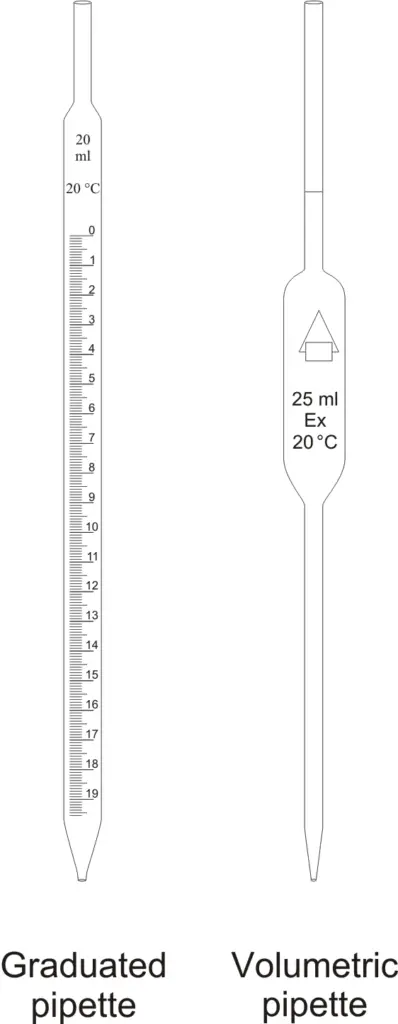
The following are the differences between volumetric pipette and graduated pipette.
- Volumetric pipette is used to measure and deliver one fixed volume only.
- Graduated pipette is used to measure and deliver different volumes because a scale is present.
- Volumetric pipette has a bulb (belly) at the middle with narrow neck and a single calibration mark.
- Graduated pipette is usually a straight tube without bulb and it has graduation markings throughout the length.
- Volumetric pipette gives more accuracy and precision because it is made with tight tolerance for exact volume.
- Graduated pipette gives less accuracy as compared to volumetric pipette and error is more in small readings.
- In volumetric pipette only one meniscus reading is done at one mark, so human error is less.
- In graduated pipette the meniscus is read against many fractional markings, so reading error chance increases.
- Volumetric pipette is used for high precision works like standard solution preparation, exact dilution and analytical work.
- Graduated pipette is used for general laboratory work like media preparation, stepwise addition of reagent and repeated dispensing of different volumes.
References
- ALWSCI. (n.d.). Understanding “TD” and “TC” in laboratory glassware.
- Arihantlab. (n.d.). Difference class A and class B glassware.
- ASTM International. (2019). ASTM E969 standard for glass pipets.
- BenchChem Technical Support Team. (2026). A comparative guide to chromic acid and its alternatives for laboratory glassware cleaning. BenchChem.
- Bioland. (n.d.). Graduated pipette vs volumetric pipette: Accuracy, uses, differences.
- BioSistemika. (n.d.). 12 easy tips to improve your pipetting technique (guide).
- Boston Med Supply. (n.d.). Pipette types explained: Lab uses, names & accuracy guide.
- BRANDTECH Scientific. (n.d.). Class A vs. Class B volumetrics – When to spend vs. save.
- Callandplay.com. (n.d.). Class A volumetric pipette – 25ml capacity, tolerance ±0.030ml, pack of 10.
- Comprehensive metrological analysis of the volumetric pipette: Principles, design, standards, and operational protocols. (n.d.).
- Crystalgen. (2024). The fascinating history of pipettes.
- Fisher Scientific. (n.d.). Volumetric pipets.
- Frontier, A. (2026). How to: Clean glassware. Department of Chemistry, University of Rochester.
- Glassco. (n.d.). Volumetric labware.
- INTEGRA Biosciences. (n.d.). Proper pipetting: 10 tips on how to pipette.
- Klingenberg, M. (2005). When a common problem meets an ingenious mind. EMBO Reports, 6(9), 797-800.
- Lab Pro Inc. (n.d.). Differences between volumetric pipettes and graduated pipettes: Pros, cons, and limitations.
- National Institute of Standards and Technology. (2014). The use of volumetric pipets with NIST handbook 133, checking the net contents of packaged goods.
- National Institute of Standards and Technology. (2019). GMP 7: Good measurement practice for cleaning precision glassware.
- Pham, V. (2025). 7: Precision in liquid handling of serological pipettes. In Biotechnology Techniques: From Theory to Practice. Biology LibreTexts.
- POBEL. (n.d.). Volumetric pipettes, class A.
- POBEL. (n.d.). What types of laboratory pipettes are there?
- Ricca Chemical. (n.d.). Volumetric glassware.
- Schurz, C. (n.d.). USP requirements for volumetric instruments. StedaLab.
- Seely, O. (2023). Use of a volumetric pipet. In General lab techniques. Chemistry LibreTexts.
- Singer Instruments. (n.d.). From innovation to repetition – a history of pipetting.
- Stabach, J. (2025). Comprehensive guide to laboratory glassware washer detergents. ARES Scientific.
- Thermo Fisher Scientific. (n.d.). 10 steps to improve pipetting accuracy.
- Thermo Fisher Scientific. (n.d.). Thermo Scientific good laboratory pipetting (GLP) practices.
- Transcat Pipettes. (n.d.). Pipetting best practices.
- University Pipette Service, Inc. (n.d.). Optimal storage practices for pipettes after use.
- University Pipette Service, Inc. (n.d.). Precision in a drop: A brief history of pipettes.
- Valencia College Science Resources. (n.d.). Chemistry lab technique 5: Using a volumetric pipet.
- Volumetric flasks and pipets. (2012).
- Westlab. (2017). What is the difference between TD & TC pipettes?
- Wickham, V. (2018). Laboratory glassware cleaning and storage. Nebraska Water Center.
- Wikipedia Contributors. (2025). Volumetric pipette. Wikipedia, The Free Encyclopedia.
- Wiltronics. (n.d.). What are pipettes: Pipetting for precision and accuracy.
- Yedowitz, M. (n.d.). Pipette technology over the years. BRANDTECH Scientific.