

Serological pipette is a long graduated pipette used in laboratory to measure and transfer liquid in ml range. It is commonly used for 1 ml to 50 ml volume transfer. It is mostly disposable plastic (polystyrene) and sometimes glass.
It has clear graduation markings on the body to monitor the liquid level during measuring. It is operated with a manual or electronic pipette controller (pipet-aid) attached at the top. By this, controlled vacuum is created and liquid is aspirated and dispensed.
Most serological pipette are calibrated as TD (to deliver). It acts as a blow-out pipette, so the last drop is also expelled to deliver exact volume. A hydrophobic filter plug is present at the top to reduce contamination and protect controller.
It is used in routine works like cell culture and microbiology work. It is used for mixing suspensions, transferring cells, and preparing culture media.
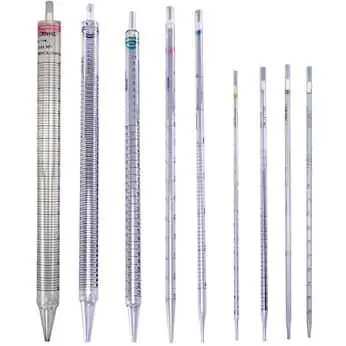
Parts of a Serological Pipette
- Mouthpiece (Top end)
It is the upper end of the pipette. It is the part which connects with manual bulb or electronic pipette controller. - Filter plug
It is present inside the top end. It acts as a barrier and prevents liquid or aerosol contamination entering into the controller. - Color code
Colored rings or bands are present near the top. It is used to identify the maximum volume capacity quickly. - Blow-out rings
One or two rings are printed or etched near the mouthpiece. It indicates that the last drop must be blown out to deliver exact calibrated volume. - Pipette body
It is the main tube portion of the pipette. Liquid is held inside this body during transfer. - Graduation markings (Scale lines)
These are measurement lines present on the pipette body. It is used to read and gauge the volume. Some pipettes show bidirectional scale and negative graduations after zero mark. - Aspiration area
It is the upper zone below the filter plug. It is the safe handling region during aspiration. - Delivery tip (Outlet opening)
It is the lower end of the pipette from where liquid is dispensed. It is usually tapered conical tip to control flow rate, and wide-bore/open-ended tip may be present for viscous liquids.
Types of Serological Pipettes
- Standard pipettes
These are the conventional elongated serological pipettes. It is used for routine liquid transfer in millilitre volume range. - Open-end (Wide-orifice) pipettes
It has a wide open tip. It is used for fast filling and dispensing of viscous liquids like oils, cosmetics, sludge, and also delicate cell suspensions. - Bacteriological (Milk) pipettes
These pipettes are designed for examination of milk and dairy products. It is calibrated to meet specific public health standards. - Aspirating pipettes
These are completely transparent and graduation marks are not present. It is used mainly for mixing liquids or vacuum aspiration procedures like removing waste or supernatant. - Shorty pipettes
It has a shorter body profile as compared to standard. It gives better handling and easy movement in confined work spaces like fume hood or Biological Safety Cabinet.
Operating Procedure for Serological Pipettes
- Working area is prepared first. Bench is disinfected and PPE is worn (gloves, lab coat, eyewear).
- Correct size serological pipette is selected. Smallest pipette which can hold required volume is taken for better accuracy.
- Sterile pack is opened aseptically. Banana peel method is used, wrapper is peeled from top mouthpiece side and body is kept covered. Pipette body is not touched with hand and it is not kept on bench.
- Pipette controller or bulb is attached. Top end of pipette is inserted carefully until airtight seal is formed.
- Pipette is held vertically. Tip is immersed inside the liquid properly.
- Pre-wetting is done if needed. Liquid is aspirated and expelled 2 to 3 times to equilibrate inside the pipette.
- Liquid is aspirated slowly. Liquid level is taken slightly above the required mark and it is not allowed to touch the filter plug.
- Pipette is removed from liquid. Tip is touched gently on inner wall of source container to remove outside droplets.
- Volume is read at eye level. Pipette is kept perfectly vertical to avoid parallax error.
- Excess liquid is released slowly back to source container. Bottom of meniscus is set exactly on the target graduation line.
- Pipette is moved to receiving vessel. Tip is placed against inner wall at about 30° to 45° angle.
- Liquid is dispensed slowly and steadily. Splashing and aerosol formation is avoided and delicate cells are not jetted.
- Blow out is done if required. If double rings are present it is blow-out type, after draining the last drop is expelled using controller. If dispensing point-to-point between two marks then blow out is not done.
- Pipette is discarded after use. Single use pipette is removed/ejected from controller and put immediately in proper biological waste container.
Applications of Serological Pipette
- It is used for liquid measurement and transfer. Accurate measuring, transferring and dispensing of millilitre volume liquids is done, usually 1 ml to 50 ml.
- It is used for mixing solutions. Chemical liquids, reagents and cell suspensions are mixed by aspirating and dispensing.
- It is used for reagent layering. Chemicals and reagents are layered carefully to make density gradients.
- It is used in cell and tissue culture works. Cells are transferred for expansion or analysis. Culture media, serum (FBS) are transferred, subculturing is done and antibiotics are dispensed.
- It is used for serial dilutions. Step-wise dilutions are made for microbiology testing like MIC. It is also used for preparing standard curves in ELISA and qPCR.
- It is used in microbiology and immunology. Broth culture inoculation is done and agar plates are prepared. Bacterial or viral suspensions are transferred and reagents are aliquoted for western blot and flow cytometry buffers.
- It is used for handling high viscosity liquids. Open-end serological pipette is used for thick fluids like oils, cosmetics, paint, sludge and food liquids.
- It is used in dairy examination. Bacteriological serological pipette is used for milk and dairy product examination.
- It is used for vacuum aspiration. Transparent non-graduated aspirating pipette is used to remove supernatant or waste liquid safely.
- It is used in clinical diagnostics and hematology. Patient samples like serum, plasma, urine, CSF are handled. Blood typing and antibody diagnostic tests are also done.
- It is used in molecular biology and biochemistry. Bulk reagent preparation is done, electrophoresis buffers are prepared. Large scale plasmid prep lysate is handled and ethanol is measured for nucleic acid precipitation.
Advantages of Serological Pipette
- It gives high accuracy for ml volume measuring and transferring. It is optically clear so reading becomes easy. Bidirectional graduations and negative graduations are present, so extra volume capacity and flexible dispensing is possible.
- Contamination risk is less. Mostly it is pre-sterilized and single use, so cleaning is not required and sample purity is maintained. It is also safer than glass pipette due to less breakage.
- Many polystyrene serological pipettes are seamless (no weld point or joint). Liquid is not trapped inside the tube, so flow is faster and complete delivery is obtained.
- Filter protection is present. Hydrophobic filter plug at top end prevents aerosol and vapour entering into the pipette controller and reduces cross contamination.
- Handling is easy due to light weight. Hand and arm fatigue becomes less during repeated works. Shorty pipette is also used for better movement inside biosafety cabinet or confined space.
- Universal fit is there. It fits with common manual bulb and electronic pipette controller, so compatibility issue is less.
- It can handle viscous liquids by special types. Open-end serological pipette has wider tip opening, so thick liquids and dense cell suspensions are transferred fast and clogging is less.
Limitations of Serological Pipette
- Accuracy and precision is lower as compared to volumetric pipette. Precision mainly depends on the smallest increment marked on the pipette.
- Human error chance is more. Meniscus can be misread (parallax error) due to low contrast markings, glare in lab, and user fatigue.
- Environmental conditions can affect the volume. Temperature changes can expand or contract the air cushion and volume can shift. Humidity and altitude also affects vacuum and accuracy.
- Fluid properties create problem. Dense liquids than water may give lower aspirated volume due to gravitational effect. Highly viscous liquids move slowly and leaves residue on inner wall, so measurement error can occur if wide-bore tip is not used.
- Shear stress risk is present. If liquid is dispensed fast or directly jetted on sample, turbulence and mechanical shear can damage fragile cells, disrupt membrane and denature proteins.
- It depends on controller. Manual bulb or electronic pipette controller is required for safe use, mouth pipetting is dangerous. Poor fit with controller can cause micro-leakage, wobble and unexpected volume deviation.
- Contamination issue can occur if handling is not proper. Fast aspiration can generate aerosol and it can contaminate controller and then cross contaminate next samples if filter plug and careful handling is not followed.
References
- Eppendorf AG. (2014). Instructions for use Eppendorf serological pipets English (EN).
- Foley, D. (2023, January 17). 1.18: Serial dilutions and standard curves with a microplate readers. Biology LibreTexts.
- Thermo Fisher Scientific. (n.d.). 10 steps to improve pipetting accuracy.
- Lab People, Inc. (2021, April 22). 3 different kinds of serological pipettes.
- Jaquith, K. (n.d.). 3 different types of serological pipettes. Universal Medical Inc. Blog.
- MBP INC. (2022, July 29). 3 types of serological pipettes every laboratory should have.
- Globe Scientific. (n.d.). 5mL, serological pipette, PS, open end, 310mm, STERILE, blue, individually wrapped.
- Molecular Biology Products. (2021, November 21). All you need to know about serological pipettes.
- MBP INC. (2021, December 5). All you need to know about serological pipettes.
- SelectScience. (2018, May 9). Analyzing the effect of pipette tip geometries on fluid velocity and shear strain rate.
- Batchelor, H., & Marriott, J. (2014). Aseptic laboratory techniques: Volume transfers with serological pipettes and micropipettors. Journal of Visualized Experiments, (84), e3941987. PMC.
- Biosigma. (n.d.). CLEARLine® serological pipettes.
- Valencia College. (n.d.). Chemistry lab technique 7: Using a graduated pipet.
- Sartorius Lab Instruments GmbH & Co. KG. (2024, September). Cleaning and decontamination guide for Sartorius pipettes.
- Gast, U. (2021). Cleaning and inspection of pipettes (Userguide No. 24). Eppendorf AG.
- Direct2Lab. (2026, January 23). Common serological pipette mistakes that disrupt cell culture workflows.
- Comprehensive analysis of serological pipettes: Engineering, volumetric calibration, operational protocols, and laboratory applications. (n.d.).
- Harclerode, C. (2024, September 5). Cutting laboratory plastic waste: The power of reusable consumables. My Green Lab.
- Welch. (2024, September 20). Everthing about WelchLab’s serological pipettes.
- Behind The Bench Staff. (2020, May 15). Help for difficult-to-pipette samples. Thermo Fisher Scientific.
- Boekel Scientific. (n.d.). How to read & use a pipette.
- Transcat, Inc. (n.d.). Pipette maintenance 101: Learn how to properly clean pipettes.
- Corning. (n.d.). How to reduce pipetting errors.
- Biofargo Team. (2022, February 24). How to use various types of serological pipettes. Biofargo.
- Integra Biosciences. (n.d.). How to clean pipettes [incl. decontamination and storage tips].
- Integra Biosciences. (n.d.). How to do serial dilutions (including calculations).
- Microlit USA. (n.d.). How to read serological pipette?
- Integra Biosciences. (n.d.). How to use a serological pipet.
- Zhejiang Peky Biotech Co., Ltd. (2025, April 15). Important considerations for using serological pipettes in the laboratory.
- Zhejiang Yikang Medical Technology Co., Ltd. (n.d.). Key considerations for choosing wide bore pipette tips.
- Corning. (n.d.). Laboratory waste disposal guide: Making lab waste disposal sustainable through collaboration.
- Filtration Group. (n.d.). POREX® serological pipet filters.
- Thermo Fisher Scientific. (n.d.). Pipette types for different applications.
- Kingston Health Sciences Centre. (2019, May 1). Standard operating procedure: Pipettes and pipet controllers (SOP-PPC-02).
- Kapuscinski, M., Staudenmaier, R., Alnakhli, N., & Owens, E. (2022). Recycling and waste reduction. In CVMBS green labs resource guide. Pressbooks.
- SARSTEDT. (n.d.). Refill & recycling: Sustainability in the laboratory.
- SEROLOGICAL PIPETTES. (n.d.).
- BPS Bioscience. (n.d.). Serial dilution protocol.
- Fisher Scientific. (n.d.). Serological pipets.
- PersonalTomatillo505. (2025). Serological pipette has TD and double bands. Blow out or not? [Online forum post]. Reddit.
- Edin. (2026, January 13). Serological vs manual pipettes: Finding the best fit for cell culture and molecular research. LabConsulting GmbH.
- Leo Bios. (2025, June 25). Structure, parts and usage methods of serological pipettes. Ucallmlabs.
- SDLABIO. (n.d.). The ultimate guide to serological pipettes.
- Gilson. (n.d.). The ultimate guide to cleaning and decontaminating your pipette.
- Seidman, L. A., & Moore, C. J. (2000). Basic laboratory methods for biotechnology: Textbook and laboratory reference. Prentice-Hall, Inc.
- BioNetwork. (n.d.). Understanding serological pipettes [Video]. YouTube.
- Annis, F. (n.d.). Understanding serological pipettes. Universal Medical Inc. Blog.
- Shaoxing Shangyu Mingji Plastic Industry Co., Ltd. (n.d.). What are some common applications of serological pipettes in the laboratory.
- Microlit USA. (n.d.). What is a serological pipette and how to use it?
- Westlab Canada. (2017, July 19). What is the difference between TD & TC pipettes?
- What’s the difference between pipettes calibrated TD, TC, Blow-out and related terms? (n.d.).
- Zhejiang Peky Biotech Co., Ltd. (2026, January 22). Why is a filter plug important in serological pipettes?
- Leo Bios. (2025, March 14). Wide orifice pipette tips for laboratory research. Ucallmlabs.
- Mettler Toledo. (n.d.). Wide bore pipette tips | Wide orifice pipette tips | Rainin.
- Ignacio. (2016, August 10). What’s the difference between pipettes calibrated “TD”, “TC”, “Blow-out” and related terms? [Online forum post]. Chemistry Stack Exchange.
- LABELIANS. (2024, April 16). Serological pipettes for all your applications!