

Multichannel pipette is a laboratory pipette used to measure and transfer multiple liquid volumes at the same time. It has more than one channel arranged in a straight row and each channel holds its own disposable tip. It is used when same volume is needed to be delivered into many tubes or wells in one action.
In a multichannel pipette, 8, 12, 16 or 24 channels are commonly present depending on model. All channels aspirate the liquid together and dispense together, so identical volume is delivered into multiple receptacles. It is mainly used for quick filling of microplates like 96-well plate and 384-well plate, where rows or columns are handled in one motion.
The use of multichannel pipette increases the lab throughput because many transfers are completed in less time and with less repeated steps. It also improves reproducibility as the time gap and volume variation between wells are reduced when compared to single channel pipetting. The number of pipetting steps become less which reduces operator fatigue and chances of repetitive strain injury (RSI).
Multichannel pipettes are available as manual and electronic types. Some advanced types have adjustable tip spacing which allows transfer between different labwares (example, from microcentrifuge tubes to a well plate) without doing individual pipetting.
Key Features of Multichannel Pipettes
The following are the key features of multichannel pipettes.
- Various channel configurations
They are available in 4, 6, 8, 12, 16, and 24 channel models. This helps in aligning with 96-well and 384-well microplates. Whole row or column can be processed in a single step. - Adjustable tip spacing
In many models, the distance between tips can be expanded or contracted. This is used to transfer multiple samples between different labwares (microcentrifuge tubes to microplate). Some types use tubeless system for spacing adjustment, which increases durability and precision. - Ergonomic design
They are designed to reduce hand, arm and shoulder fatigue. It helps in preventing repetitive strain injury (RSI). It includes lightweight body, low plunger resistance, contoured grips and 360° rotatable pipette head. - Advanced tip attachment and ejection
Spring-loaded tip cones are present in many pipettes. A haptic click is produced for proper tip seal and no rocking or banging is required. Successive tip ejection is also used (outer tips ejected before inner tips) to reduce ejection force up to about 50%. - Manual and electronic options
Multichannel pipettes are available as manual (mechanical) and electronic types. Electronic types are battery operated and uses motor for aspiration and dispensing. LCD display and keypad are present for setting volume and programs. - Programmable pipetting modes (electronic type)
Programmable functions are given to improve workflow. It includes multidispensing (one aspiration into multiple equal doses), serial dilution, automated mixing cycles and reverse pipetting. - Precision manifold system
An internal manifold system is present to distribute mechanical force and air displacement equally in all channels. Due to this, the aspirated and dispensed volume remains consistent from first tip to last tip. - Autoclavable components
Many multichannel pipettes are fully autoclavable or lower parts are autoclavable. It is used to maintain sterility and reduce cross-contamination.
Parts of Multichannel Pipettes
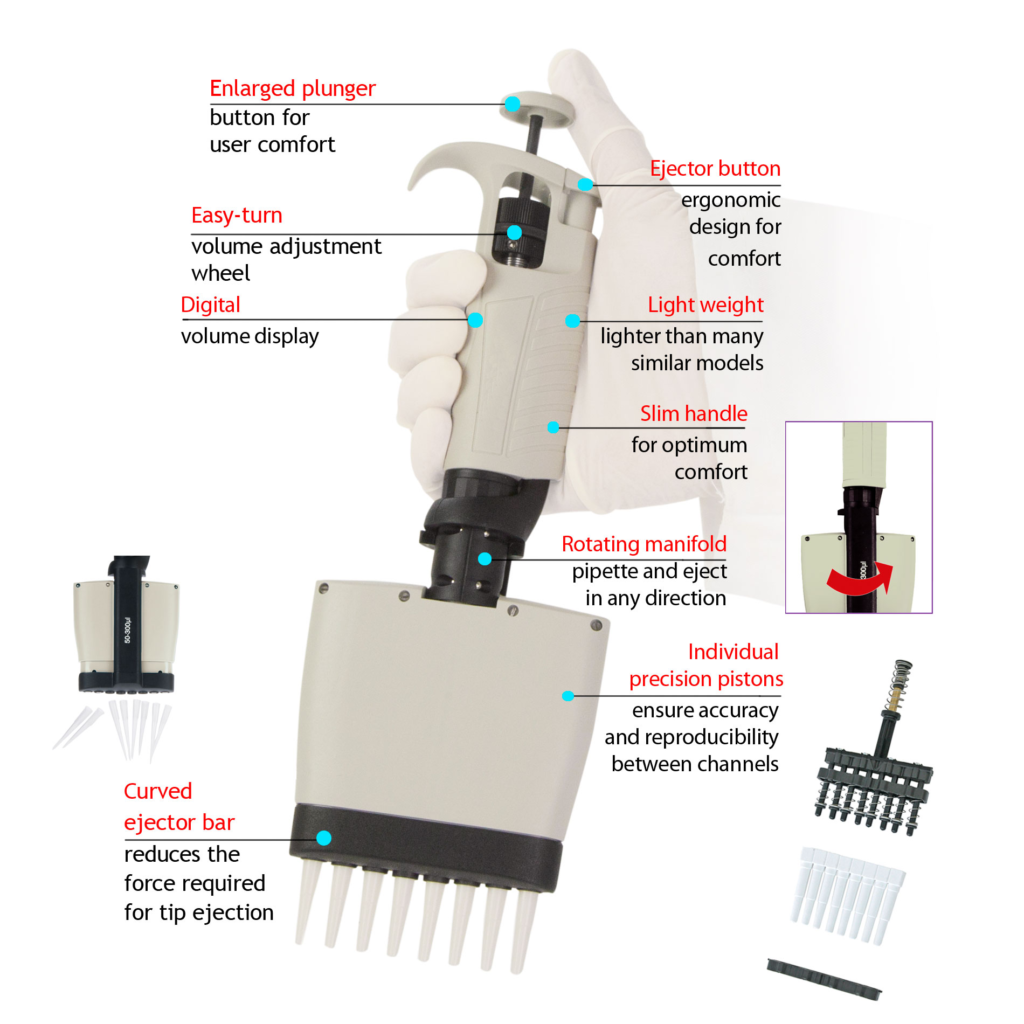
The following are the parts of multichannel pipettes.
- Plunger and piston assembly (pipetting trigger)
It is operated manually or electronically. It is used to create vacuum for aspiration and dispensing. During this action, air displacement is produced which helps in taking up and releasing liquid. - Volume adjustment mechanism (control knob)
It is used to set the required volume. It regulates the piston stroke length. By changing the stroke, the aspirated and dispensed volume is controlled. - Volume display
It can be a mechanical dial or a digital screen. In electronic type, LCD or LED display is present. It shows the set volume in a real-time manner. - Manifold and tip cones (nozzles)
It is the central hub part of multichannel pipette. It distributes air displacement and mechanical force equally to all channels. Tip cones act as attachment points for disposable pipette tips. - O-rings and seals
These parts maintain the vacuum integrity between piston and tip. They are usually made of silicone or fluoroelastomers. If it becomes loose or damaged, accuracy is affected. - Tip ejection system (ejector button)
It is used to remove tips without touching by hand. It reduces contamination and reduces repeated force during removal. In some models, the ejection force is reduced to prevent strain. - Pipette body
It is the outer housing that supports and protects internal mechanism. It provides a grip surface for holding the pipette. Mostly it is designed in ergonomic shape to reduce fatigue. - Electronic components (electronic models)
It includes keypad for programming. Rechargeable battery is present inside and a recharging port or power supply connection is given. These parts control aspiration and dispensing in automated way.
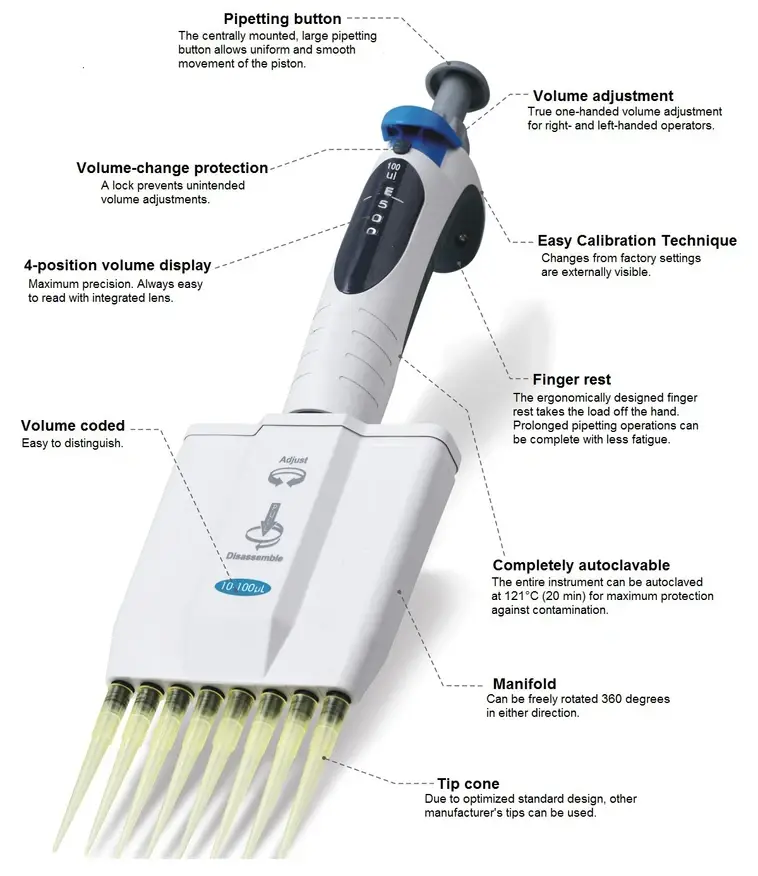
Types of Multichannel Pipettes
The following are the types of multichannel pipettes.
- Manual multichannel pipettes
It is operated by direct manual pressure on the plunger. User controls the speed and consistency of each pipetting stroke. It is commonly used for routine plate filling and repeated transfers. - Electronic multichannel pipettes
It is powered by battery and motor system. Aspiration and dispensing are done in automated way with digital controls. It may include functions like multi-dispensing and other programmable modes. - 8-channel and 12-channel pipettes
These are the standard multichannel pipettes used in most labs. It is designed to match 9 mm spacing of 96-well microplates. Whole row or column can be handled at a time. - 16-channel and 24-channel pipettes
These are high-density multichannel pipettes. It is designed for 384-well microplates. It reduces pipetting time as more wells are processed in a single step. - Fixed-spacing multichannel pipettes
In this type, the distance between tip cones is fixed and unchangeable. It is made to match a specific plate layout. It gives proper alignment and stable handling for that format. - Adjustable tip spacing multichannel pipettes
In this type, the distance between tips can be expanded or contracted (generally between 4.5 mm to 33 mm). It is used for quick transfer between different labwares like microcentrifuge tubes to microplates. This type is used when spacing change is needed in regular workflow.
Operating Procedure of Multichannel Pipettes
Steps/Procedure of Multichannel Pipette (Operating procedure)
- Preparation
Check the pipette body for dust or dirt. Outer surface can be wiped with 70% ethanol if required. Volume is set by turning the volume dial and it should be within the specified range of that pipette. - Tip acquisition
Hold the pipette with relaxed grip and wrist should be kept flat. Insert the nozzles into a row of disposable tips and press down gently till a click is felt (or indicator is hidden). Proper sealing of all tips is ensured in this step. Rocking and banging on the tip rack should be avoided as it can damage alignment of tip cones. - Pre-wetting of tips
Aspirate the target liquid and dispense it 1 to 3 times before doing actual transfer. This step humidifies the internal air cushion and equalizes temperature. It helps in preventing volume variation between channels. - Aspirating the liquid
Press the operating button to the first stop. Hold the pipette vertically (within 20 degree of 90°) and immerse the tips around 2 to 3 mm below the liquid surface. Deep immersion is not preferred as liquid can stick outside the tips. Release the operating button slowly and smoothly to draw liquid into all tips. Wait for 1 to 2 seconds for stabilization, then withdraw tips and touch the tips to the edge of reservoir to remove extra liquid. - Dispensing the liquid
Place the tips against the side wall of receiving vessel at slight angle (around 45°). Press the operating button gently to the first stop to dispense the liquid. Then press further to the second stop (blow-out) to expel remaining liquid completely. While removing, slide the tips up along the wall of the vessel. - Ejecting the tips
Release the operating button back to starting position. Keep the pipette over a waste container and press the tip ejector button. All tips are discarded together without direct hand contact.
Note
The above steps are for forward pipetting technique. For viscous, volatile or foaming liquids, reverse pipetting is used. In reverse pipetting, plunger is pressed to second stop before aspiration and during dispensing it is pressed only to first stop, leaving small residual liquid in the tips which is discarded later.
Applications of Multichannel Pipettes
Some of its applications include:
- Used for PCR and qPCR plate setup (adding master mix, primers, DNA/RNA templates).
- Used for DNA/RNA purification steps where multiple wells are handled together.
- Used for restriction digest setup and repeated reagent addition in rows/columns.
- Used for loading agarose gel samples in repeated way when many samples are there.
- Used for ELISA work (sample addition, reagent addition, substrate addition in multiwell plate).
- Used for antibody titration and plate coating steps.
- Used for washing steps in plate based immunoassays.
- Used for seeding cells uniformly into 96-well and 384-well plates.
- Used for rapid media change and treatment addition in cell based assays.
- Used for cell viability assays and dilution preparation during cell culture work.
- Used for inoculating 96-well plates in microbiology work.
- Used for preparing serial dilutions for MIC (antibiotic susceptibility testing).
- Used for enzyme assays and small volume transfers in biochemistry.
- Used for protein related assay plate preparation and titration works.
- Used for spectrophotometry plate setup and uniform reagent dispensing.
- Used for high-throughput blood/serum distribution into plates in clinical labs.
- Used for mouse genotyping sample preparation and reagent dispensing.
- Used for preparing many samples in screening workflows (serial dilution, master mix preparation).
Advantages of Multichannel Pipettes
Some of its advantages include:
- Saves time as whole row or column is pipetted together in one step.
- Number of pipetting steps become less during plate filling.
- Reproducibility is improved because aspiration and dispensing is done at same time in many wells.
- Equal starting condition is maintained in all wells, so result variation becomes less.
- Pipetting errors become less as chances of wrong well selection and sample mixing is reduced.
- Repetitive motions are reduced, so hand and arm fatigue is less.
- Risk of repetitive strain injury (RSI) is lowered in regular plate works.
- Adjustable tip spacing models helps in fast transfer between tubes and microplates.
- High-throughput works like ELISA, serial dilution, PCR setup and cell culture becomes faster and more uniform.
Drawbacks of Multichannel Pipettes
Some of its drawbacks include:
- Chance of channel defect is more because many piston and cylinder units are present.
- If one O-ring or seal becomes worn, vacuum is lost in that channel and uneven aspiration happens.
- One channel may fail to aspirate even when other channels are working.
- Tip attachment is difficult as airtight seal must be formed in all channels together.
- Users do rocking and banging to fit tips, which causes strain and can damage tip cone alignment.
- Misalignment of tip cones can become permanent after repeated forcing.
- Standard multichannel pipette has fixed spacing between tip cones.
- It cannot be used properly for labwares having different spacing (tubes to dense plates).
- For 384-well plates, 8 or 12 channel pipette becomes tedious due to alternate well pipetting.
- Only every second well is filled, and it becomes laborious and error prone.
- Tips may be too thick for small wells, so concentration is required.
- Calibration is time consuming in multichannel pipette by gravimetric method.
- Nominal, 50% and 10% volume checking in all channels takes many weighings and more time.
- Force needed for attaching and ejecting full row of tips is high in basic models.
- Thumb, hand and arm strain increases and RSI risk becomes more if ergonomic features are not present.
Rreferences
- Accucal LTD. (2025). Calibrating a pipette.
- Advanced metrology and strategic integration of multichannel liquid handling systems in high-throughput laboratory environments. (n.d.).
- Assessing variations in manual pipetting: An under-investigated requirement of good laboratory practice. (n.d.). PMC.
- Biocompare. (n.d.). Tips to improve your pipetting technique and accuracy.
- Carter, C. (2026, April 15). Rethinking ELISA pipetting routines in small-scale labs. Select Science.
- ChemScience. (2026). Ultimate guide to pipettes: Everything you need to know.
- Comparative analysis of manual ELISA and Ella, an automated instrument for ELISA, in measuring serum Galectin-3 levels in breast cancer patient samples. (n.d.). PMC.
- Emata, K. (2024, November 14). Understanding proper pipetting techniques. Pipette.com.
- Eppendorf. (2020). 384. Ready. Set. Pipette!
- Eppendorf. (2026). Move It ® adjustable tip spacing pipettes.
- Ewald, K. (2020). Calibration and adjustment of dispensing systems in the laboratory. Eppendorf AG.
- Fischer, M. (2026). For data reproducibility: Automation of ELISA test kit protocols wins. Tecan.
- Hamilton Company. (n.d.). SoftGrip™ multi-channel pipettes.
- Heimler, P. (2012). 384-well pipetting. Thermo Fisher Scientific.
- INTEGRA Biosciences. (n.d.). How to change O-rings: Manual and electronic pipettes [Video]. YouTube.
- INTEGRA Biosciences. (n.d.). Multichannel pipettes | Multichannel micropipettes.
- INTEGRA Biosciences. (n.d.). Proper pipetting: 10 tips on how to pipette.
- International Process Solutions. (2025). Best practices for pipette calibration | Accurate & reliable results.
- Lochner, K. H. (2005, May 2). Fast gravimetric testing of multichannel pipets. American Laboratory.
- Microlit. (2023, December 6). Maximising efficiency with multichannel pipettes – Applications & benefits.
- MilliporeSigma. (2026). Comparing liquid handling systems: Why flexible liquid handling matters for assay automation. Sigma-Aldrich.
- Multichannel Eppendorf pipettes – tip alignment issues? (n.d.). Reddit.
- Opentrons. (2023, February 24). Pipette troubleshooting guide.
- Pipette.com Team. (2025, December 11). How to choose the right pipette for your lab application. Pipette.com.
- Pobel. (2025, March 25). Parts of a micropipette.
- Rösel, S. (2019, September 24). Ergonomic pipetting of a 384-well plate – How to get the gain without the pain. Eppendorf US.
- Rösel, S. (2020, September 3). 384-well pipetting – Time to fire the rocket. Eppendorf US.
- Sartorius. (2026). Multichannel pipettes.
- Thermo Fisher Scientific. (2026). Pipette types for different applications [TV].
- Thermo Fisher Scientific. (2026). Pipette types for different applications [US].
- Transcat Pipettes. (n.d.). Pipetting best practices.
- Transferpette multichannel pipette tip-ring replacement [Video]. (n.d.). YouTube.
- VistaLab Technologies. (n.d.). Operator’s guide for multichannel pipettes: Introduction to the Ovation multichannel. Pipette.com.
- Yelimeshyn, S. (2025, December 24). Adjustable volume pipettes explained: Types, uses, and how to choose the right one. Boston Med Supply.