

Antiviral drugs are the drugs used for the treatment and prevention of viral infections.
They are not similar to antibiotics. Antibiotics kill or destroy bacteria but antiviral drugs generally do not kill the viruses. They mainly inhibit the multiplication of virus.
These drugs are mostly virustatic in nature. It means they suppress the virus and keep it in less active condition. The virus may remain viable in latent state.
Viruses do not contain their own metabolic machinery. They depend on the host cell for their multiplication. So antiviral drugs are made to act on some specific viral enzymes, viral proteins and some steps of viral life cycle.
The action of antiviral drugs is based on blocking the replication and spreading of virus. Some drugs block the attachment of virus with the host cell. Some drugs block the entry or fusion of virus with host cell membrane.
Entry inhibitors and fusion inhibitors prevent the penetration of virus into the host cell. Due to this, the virus cannot enter and cannot start the infection properly.
Some antiviral drugs inhibit uncoating. In this process, viral nucleic acid is released inside the host cell. When uncoating is stopped, the viral genetic material cannot take part in replication.
Some drugs inhibit viral enzymes. These enzymes include viral polymerase, reverse transcriptase and integrase. These enzymes are necessary for synthesis of viral DNA or RNA.
Protease inhibitors inhibit the maturation of newly formed viral particles. Without proper maturation, the virus particles do not become fully infectious.
Neuraminidase inhibitors inhibit the release of newly formed viruses from infected host cell. So the infection cannot spread easily to the other healthy cells.
Antiviral drugs are the drugs used to treat or prevent viral infections. They do not generally kill the virus directly. They inhibit viral multiplication inside the host cell.
History and Development of Antiviral Therapy
- 1950s–1960s: Early anti-herpesvirus drugs – The first antiviral drugs were developed in 1950s and 1960s. These were mainly used for herpesvirus infection. Idoxuridine (IDU) and trifluorothymidine (TFT) were the first drugs. These drugs were toxic when used in whole body. So they were used only as topical drugs. Later adenine arabinoside (Ara-A) was used as a less toxic systemic drug.
- 1976: First influenza antiviral drug – Amantadine was approved in 1976. It was used for treatment and prevention of influenza A virus. It was one of the early drug for influenza. It was not useful for influenza B.
- 1980s: First HIV drugs – In 1980s, first drugs for HIV were developed. The first class was nucleoside analogue reverse transcriptase inhibitors (NRTIs). Zidovudine (AZT) was the first approved antiretroviral drug. It was used for treatment of HIV infection. After this didanosine was also used.
- 1990s: More HIV and influenza drugs – In 1990s, non-nucleoside reverse transcriptase inhibitors (NNRTIs) were developed. These were another class of anti-HIV drugs. Rimantadine was approved in 1993 for influenza A. In 1996, highly active antiretroviral therapy (HAART) was introduced. It was a major change in HIV treatment. It made HIV as a chronic manageable disease. Ritonavir was also approved in 1996 as protease inhibitor. Now it is mainly used in low dose to increase activity of other drugs. In 1999, zanamivir and oseltamivir were approved as neuraminidase inhibitors. These drugs act on influenza A and influenza B.
- 2000s: Entry, fusion and nucleotide inhibitors – In 2000s, drugs were made to stop virus before using the host cell. Enfuvirtide was approved in 2003. It was first fusion inhibitor for HIV. It blocks fusion of HIV with host cell membrane. Nucleotide analogue reverse transcriptase inhibitors (NtRTIs) were also used in this period. Tenofovir is an important drug of this group.
- 2010s: Maturation and integrase inhibitors – In 2010s, maturation inhibitors were studied. These drugs were made to block final development of HIV particles. Bevirimat reached phase-two trial by 2010. But it had problem due to natural drug resistance. Dolutegravir was approved in 2013. It is a second generation integrase inhibitor used in HIV treatment.
- 2020s: COVID-19 antiviral drugs – In early 2020s, COVID-19 pandemic caused rapid development of antiviral drugs. These drugs were made against SARS-CoV-2. Paxlovid is oral drug containing nirmatrelvir with ritonavir. Lagevrio (molnupiravir) is another oral drug. Veklury (remdesivir) is an intravenous drug.
- Current and future development – Present antiviral drugs are developed by rational drug design and AI-driven drug discovery. These are used to find drugs against viral enzyme and viral protein. Long acting drugs are also under study. These include sub-dermal implants and long acting injections. CRISPR and gene-editing technology are also being studied. These may directly act on viral genome and help in chronic viral infections.
General Principles of Antiviral Drug Action
General principles of antiviral drug action is based on inhibition of viral multiplication inside the host cell.
Viruses do not have their own metabolic system. They use the host cell machinery for their survival and multiplication. So it is difficult to kill the virus without damaging the host cell.
Antiviral drugs are made to act on the difference between viral proteins and human cell proteins. They mainly act on viral enzymes, viral nucleic acid or some important stages of viral life cycle.
Antiviral drugs generally do not kill or destroy the virus directly. They are mostly virustatic in nature. It means they suppress the virus and inhibit its reproduction and spreading.
The virus may remain in dormant or latent state inside the body. But its active multiplication is reduced by the drug. This helps the immune system to control the infection.
Antiviral drugs may be direct-acting antiviral drugs or host-directed antiviral drugs. Direct-acting antiviral drugs act directly on viral protein, viral enzyme or viral nucleic acid. Host-directed antiviral drugs act on host cell factors which are needed for viral synthesis.
The most common action of antiviral drugs is inhibition of viral enzymes. These enzymes include viral polymerase, integrase and reverse transcriptase. These enzymes are needed for formation of viral DNA or RNA.
Many antiviral drugs act as nucleoside analogues or nucleotide analogues. These are false building blocks of viral nucleic acid. The virus uses them during replication.
When these analogues are added into viral genetic material, further chain formation is stopped. This is called chain termination. Due to this, synthesis of new viral DNA or RNA is inhibited.
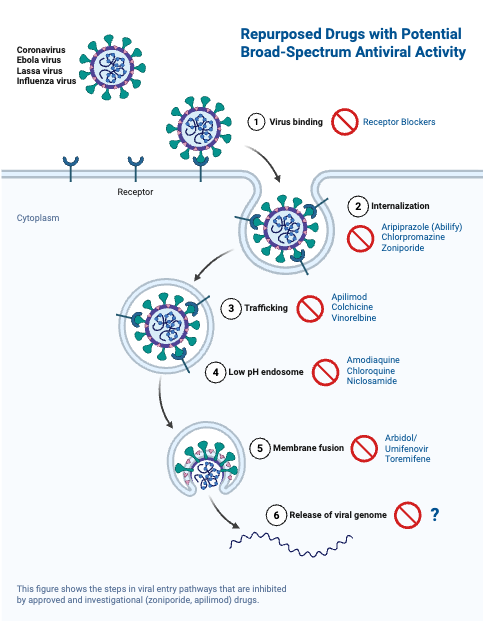
Some antiviral drugs act at early stage of viral life cycle. They prevent attachment of virus with host cell receptor. Some drugs inhibit fusion of virus with host cell membrane.
Some drugs inhibit uncoating. In this process viral genetic material is released inside the host cell. When uncoating is inhibited, viral nucleic acid cannot start replication.
Some antiviral drugs act at late stage of infection. Protease inhibitors prevent maturation of newly formed viral particles. So the new viruses do not become infectious.
Some drugs inhibit the release of virus from infected host cell. Neuraminidase inhibitors block release of influenza virus from the host cell. So the virus cannot spread easily to healthy tissues.
Viral Life Cycle as a Target for Antiviral Drugs
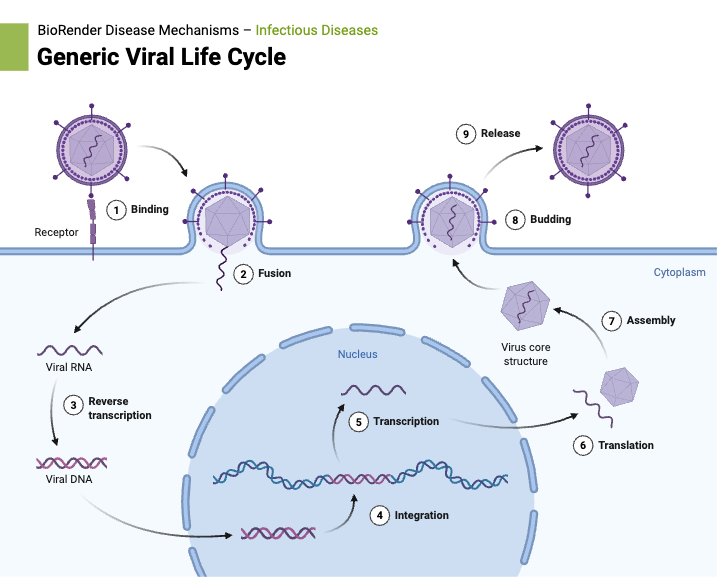
- Attachment and Entry – The viral infection starts when the virus binds with the receptor present on the surface of host cell. After attachment, the virus enters the cell by membrane fusion or by endocytosis. Entry inhibitors and fusion inhibitors act in this step. These drugs bind with viral spike protein or host cell co-receptor and prevent the penetration of virus into the host cell.
- Uncoating – After entry into the host cell, the virus removes its protective protein coat called capsid. This process releases the viral genetic material inside the cell. Uncoating inhibitors inhibit this step by preventing the required changes inside the viral particle, such as acidification. So the viral genome remains trapped and the infection is stopped at early stage.
- Genome Replication and Integration – In this step, the virus uses its enzymes to copy viral DNA or RNA. Polymerase inhibitors and reverse transcriptase inhibitors act on this stage. Some of these drugs act as false building blocks and are added into viral nucleic acid, causing early chain termination. Some drugs directly inhibit the replication enzyme. In retroviruses like HIV, integrase inhibitors block the enzyme which inserts viral DNA into the host cell genome.
- Protein Synthesis, Assembly and Maturation – The virus produces viral proteins and these proteins are processed to form new viral particles. Protease inhibitors act in this step by blocking the viral protease enzyme. This enzyme normally cuts large precursor proteins into functional viral proteins. Maturation inhibitors also act at this stage and prevent the final processing of the new virus. As a result immature and non-infectious viral particles are formed.
- Viral Release – This is the last step of viral life cycle. Newly formed viruses detach from the infected host cell and spread to other healthy cells. Release inhibitors act in this step. Neuraminidase inhibitors block the viral enzyme needed for release of virus from host cell. Due to this, the virus remains attached with the host cell and further spreading of infection is prevented.
Classification of Antiviral Drugs Based on Their Mechanism of Action
- Attachment, entry and fusion inhibitors – These drugs are used to stop the virus before its entry into the host cell. Virus first bind with the receptor of host cell. Then it enter by fusion or penetration. These drugs block this step. Fostemsavir is attachment inhibitor. Ibalizumab is post attachment inhibitor. Maraviroc is co-receptor antagonist. Enfuvirtide is fusion inhibitor.
- Uncoating inhibitors – These drugs are used to inhibit uncoating of virus. After entry, virus remove its protein coat or capsid. Then viral nucleic acid is released into the host cell. If this step is blocked, viral genome cannot come out. Amantadine and rimantadine inhibit M2 proton channel of influenza virus. Pleconaril is another drug of this type.
- Polymerase inhibitors – These drugs inhibit viral polymerase enzyme. This enzyme is needed for synthesis of viral DNA or RNA. Some drugs act as false nucleoside or nucleotide. Virus use them during nucleic acid formation. After their addition, the chain cannot grow more. This is called chain termination.
- DNA polymerase inhibitors – These drugs inhibit viral DNA polymerase. This enzyme forms viral DNA. These drugs are mainly used in herpesvirus infection. The examples are acyclovir, foscarnet and cidofovir.
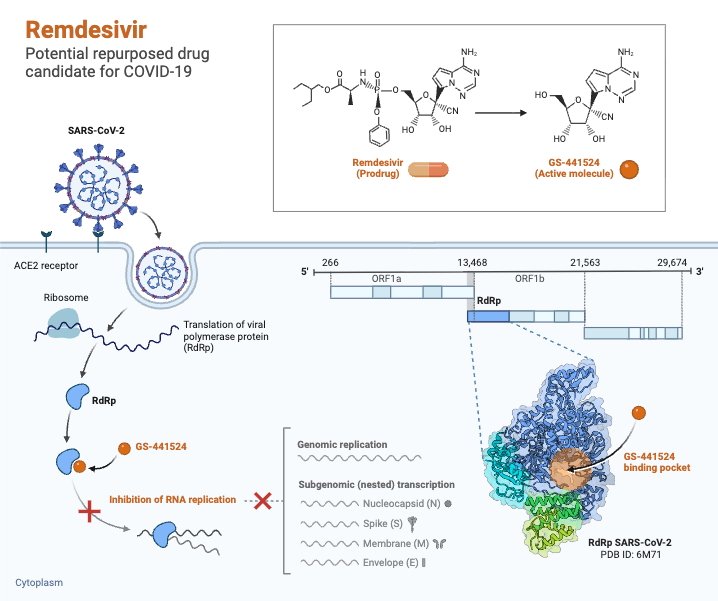
- RNA-dependent RNA polymerase inhibitors – These drugs inhibit RNA-dependent RNA polymerase (RdRp). This enzyme is present in many RNA viruses. It is required for formation of new viral RNA. The examples are remdesivir and molnupiravir. These are used against viruses like SARS-CoV-2.
- Reverse transcriptase inhibitors – These drugs inhibit reverse transcriptase enzyme. It is important enzyme of retrovirus like HIV. This enzyme converts viral RNA into viral DNA. When it is inhibited, viral DNA is not formed.
- Nucleoside and nucleotide reverse transcriptase inhibitors – These drugs are defective building blocks. They are used by reverse transcriptase during viral DNA synthesis. After their entry into the chain, further DNA chain formation stops. The examples are zidovudine and tenofovir.
- Non-nucleoside reverse transcriptase inhibitors – These drugs bind directly with reverse transcriptase enzyme. They do not enter into viral DNA chain. They inhibit the activity of enzyme by binding with it. Efavirenz is the example.
- Nucleoside reverse transcriptase translocation inhibitors – These drugs inhibit the movement of reverse transcriptase enzyme on the genetic template. Due to this, the enzyme cannot continue the synthesis of viral DNA. Islatravir is the example.
- Integrase inhibitors – These drugs inhibit integrase enzyme. This enzyme insert viral DNA into host cell chromosome. If integrase is blocked, viral DNA cannot join with host genome. The examples are raltegravir and dolutegravir.
- Protease inhibitors – These drugs inhibit viral protease enzyme. Protease cut large viral polyprotein into small functional proteins. These proteins are needed for formation of mature virus. If protease is inhibited, mature infectious virus is not formed. The examples are ritonavir and darunavir.
- Maturation inhibitors – These drugs act at the last stage of virus formation. They bind with viral structural protein like Gag polyprotein in HIV. This prevent final processing of viral core. So the virus particle remain immature and non-infective. Bevirimat is the example.
- Release or neuraminidase inhibitors – These drugs inhibit release of newly formed virus from host cell. Neuraminidase inhibitors block the neuraminidase enzyme of influenza virus. So the virus remain attached on host cell surface. It cannot spread to other healthy cells. Oseltamivir and zanamivir are examples.
Examples of Antiviral Drugs
- Entry inhibitors – Enfuvirtide, maraviroc, ibalizumab, fostemsavir and bulevirtide are examples. Enfuvirtide blocks fusion of HIV. Maraviroc blocks CCR5 co-receptor. Ibalizumab binds with CD4 receptor. Fostemsavir binds with gp120. Bulevirtide blocks NTCP receptor of liver cell.
- Uncoating inhibitors – Amantadine, rimantadine and pleconaril are examples. Amantadine and rimantadine block M2 proton channel of influenza virus. Pleconaril stabilizes viral capsid and prevents release of viral genome.
- NRTIs/NtRTIs – Zidovudine (AZT), tenofovir, lamivudine, abacavir and emtricitabine are examples. These drugs are used in HIV infection. They act as defective building blocks and cause chain termination during viral DNA synthesis.
- NNRTIs – Efavirenz, nevirapine, doravirine and rilpivirine are examples. These drugs bind directly with HIV reverse transcriptase enzyme. They do not enter into viral DNA chain. They inhibit the enzyme activity.
- NRTTIs – Islatravir is the example. It blocks the movement of reverse transcriptase on genetic template. So viral DNA synthesis is stopped.
- DNA polymerase inhibitors – Acyclovir, valacyclovir, ganciclovir, cidofovir and foscarnet are examples. These drugs are mainly used in herpesvirus infections. Foscarnet is pyrophosphate analogue and directly inhibits viral polymerase.
- RdRp inhibitors – Remdesivir, molnupiravir, sofosbuvir and favipiravir are examples. Remdesivir and molnupiravir are used in SARS-CoV-2 infection. Sofosbuvir is used in Hepatitis C virus infection. Favipiravir is used in influenza and other RNA virus infections.
- Integrase inhibitors – Dolutegravir, raltegravir, bictegravir and cabotegravir are examples. These drugs are used in HIV infection. They block insertion of viral DNA into the host genome.
- Protease inhibitors – Ritonavir, darunavir, atazanavir, lopinavir, boceprevir and nirmatrelvir are examples. These drugs inhibit viral protease enzyme. They prevent proper maturation of virus. Nirmatrelvir is used in SARS-CoV-2 infection as part of Paxlovid.
- Maturation inhibitors – Bevirimat and vivecon (MPC-9055) are examples. These drugs bind with HIV structural proteins. They block final processing of viral particle. So immature virus is formed.
- Neuraminidase inhibitors – Oseltamivir, zanamivir, peramivir and laninamivir are examples. These drugs inhibit release of influenza virus from host cell. So virus cannot spread easily.
- Cap-snatching inhibitors – Baloxavir marboxil is the example. It blocks stealing of host mRNA cap by influenza virus. So viral RNA synthesis is inhibited.
- Boosters – Cobicistat and ritonavir are examples. These drugs inhibit host liver enzymes. They increase the level of other antiviral drugs in the body.
Inhibition of Viral Attachment and Entry by Antiviral Drugs
- Binding with viral surface proteins – These drugs bind directly with the outer surface protein of virus. The viral surface protein is used for attachment with host cell receptor. When the drug bind with this protein, the virus cannot attach with the host cell. Fostemsavir is the example. It binds with gp120 glycoprotein present on the surface of HIV.
- Blocking host cell primary receptors – Some drugs act on the host cell receptor instead of viral protein. They bind with the main receptor present on the host cell surface. Due to this, a physical barrier is formed and virus cannot dock on the cell. Ibalizumab is the example. It binds with CD4 receptor of human immune cells and inhibits HIV entry.
- Blocking host cell co-receptors – Many viruses need secondary receptor or co-receptor for entry into the host cell. These drugs bind with the co-receptor and cover its binding site. Sometimes they change the shape of co-receptor. So the virus cannot recognize it. Maraviroc and PRO-140 block CCR5 co-receptor which is used by HIV.
- Preventing membrane fusion – Enveloped viruses enter by fusion of viral membrane with host cell membrane. Fusion inhibitors bind with viral fusion protein. It keeps the protein in inactive state. So viral membrane and host cell membrane cannot come close and fuse. Enfuvirtide is the example. It binds with gp41 protein of HIV and stops fusion.
- Targeting organ-specific host receptors – Some drugs block receptors which are present on specific organ cells. These receptors are used by particular viruses for entry. Bulevirtide is the example. It blocks NTCP receptor present on liver cells. Due to this Hepatitis B virus and Hepatitis D virus cannot enter into liver cells.
Inhibition of Viral Uncoating by Antiviral Drugs
- Viral uncoating – Viral uncoating is the process in which virus remove its protective protein coat or capsid after entry into the host cell. In this step, viral genetic material is released into the cytoplasm of host cell. After this the viral DNA or RNA can start replication. If uncoating is inhibited, the viral genome remain trapped inside the coat and infection does not proceed properly.
- Blocking viral ion channels – Some antiviral drugs inhibit viral ion channel which is needed for uncoating. In influenza A virus, the virus enters into the host cell endosome. The acidic condition of endosome opens the M2 proton channel. Then protons enter into the viral particle and decrease the internal pH of virus.
- Inhibition of M2 proton channel – The decrease in internal pH breaks the relation between M1 matrix protein and viral genetic material. This allows release of viral genome. Adamantanes like amantadine and rimantadine block the M2 proton channel. So protons cannot enter into the virus. The inside of virus remains neutral and the viral genome remain inside the intact coat.
- Stabilizing the viral capsid – Some drugs act by making the viral capsid more stable. This is mainly seen in non-enveloped viruses like picornaviruses. These viruses need to break their capsid for releasing the genome. When capsid becomes too stable, it cannot break properly. So the genome is not released into host cell.
- Capsid binding drugs – Pleconaril is the example of capsid binding drug. It binds with a hydrophobic pocket present on the major viral capsid protein VP1. This binding locks the capsid structure. Due to this, viral capsid becomes rigid and uncoating is inhibited.
- Result of uncoating inhibition – When uncoating is inhibited, viral nucleic acid cannot come out in the host cell cytoplasm. So replication of virus cannot start. The virus remains trapped at early stage of infection. This prevents formation of new viral particles.
Inhibition of Viral Nucleic Acid Synthesis by Antiviral Drugs
- Nucleoside and nucleotide analogues – These drugs act as false building blocks of viral nucleic acid. They compete with normal nucleotides and are used by viral polymerase enzyme. These drugs do not have proper 3’-hydroxyl group. So next nucleotide cannot be added. Due to this, viral DNA or RNA chain stops early. This is called chain termination. Acyclovir is used in herpesvirus infection. Zidovudine and tenofovir are used in HIV infection.
- Non-nucleoside polymerase inhibitors – These drugs do not act as false building blocks. They bind directly with a special pocket present on viral polymerase enzyme. This binding changes the shape of enzyme. So the enzyme becomes inactive and cannot synthesize viral nucleic acid. Efavirenz and nevirapine are non-nucleoside reverse transcriptase inhibitors (NNRTIs) used against HIV.
- Pyrophosphate analogues – These drugs bind with the pyrophosphate-binding site of viral enzyme. They do not allow proper removal of pyrophosphate from natural nucleotide. This step is required for elongation of viral DNA chain. Foscarnet is the important example. It inhibits herpesvirus DNA polymerase and HIV reverse transcriptase.
- Translocation inhibitors – These drugs inhibit the movement of viral polymerase enzyme on the genetic template. If the enzyme cannot move, the synthesis of viral nucleic acid cannot continue. Islatravir is the example of nucleoside reverse transcriptase translocation inhibitor (NRTTI). It binds with HIV reverse transcriptase and causes delayed chain termination.
- RNA-dependent RNA polymerase inhibitors – These drugs inhibit RNA-dependent RNA polymerase (RdRp) enzyme. This enzyme is needed for replication of RNA viruses. Remdesivir enters into the growing viral RNA chain and causes delayed chain termination. Favipiravir and molnupiravir cause formation of defective viral RNA copies. Due to many wrong bases, the new viruses become non-viable.
- Cap-snatching or endonuclease inhibitors – Some viruses need host mRNA cap for starting their own RNA synthesis. Viral endonuclease enzyme cut and steal this cap from host mRNA. Baloxavir inhibits this viral endonuclease enzyme. It blocks the metal ions present in the enzyme and prevents cap-snatching. So viral RNA synthesis is stopped.
Inhibition of Viral Genome Replication by Antiviral Drugs
- Intracellular activation of drug – Many antiviral drugs enter into the infected host cell in inactive form. These are called prodrugs. They are activated inside the cell by addition of phosphate groups. This process is called phosphorylation. Acyclovir and zidovudine are examples. Some drugs like non-nucleoside inhibitors and foscarnet do not need this activation.
- Blocking of viral polymerase enzyme – After activation, the drug acts on viral enzyme which is needed for copying of viral genome. These enzymes include DNA polymerase, RNA polymerase and reverse transcriptase.
- Competitive binding – Nucleoside analogues and nucleotide analogues act like normal nucleotides. They compete with natural building blocks and bind with the active site of viral polymerase.
- Allosteric binding – Non-nucleoside inhibitors bind with another pocket of the enzyme. This changes the shape of enzyme and makes it inactive.
- Pyrophosphate site binding – Foscarnet binds with pyrophosphate-binding site of viral enzyme. It blocks the normal processing of natural nucleotides.
- Incorporation into viral genetic chain – When the drug acts as false nucleotide, the viral polymerase add it into the growing viral DNA or RNA chain. The enzyme use it by mistake. After this the chain becomes defective.
- Stopping of genetic chain extension – After incorporation of drug, the viral genetic chain cannot extend normally.
- Immediate chain termination – Many analogues do not have proper 3’-hydroxyl group. So the next nucleotide cannot attach. The chain stops immediately.
- Delayed chain termination – Some drugs allow addition of few nucleotides after them. Then they produce physical block and enzyme cannot move further. Remdesivir and islatravir act in this way.
- Lethal mutagenesis – Some drugs cause wrong base pairing and many copying mistakes. The virus forms highly mutated genome. Molnupiravir and ribavirin act in this way.
- Blocking of integration into host genome – This step is mainly for retroviruses like HIV. Viral RNA is converted into viral DNA by reverse transcriptase. Then viral DNA must be inserted into host chromosome. Integrase inhibitors like raltegravir and dolutegravir inhibit integrase enzyme and prevent this insertion.
- Final result – When viral genome replication is inhibited, new viral DNA or RNA is not formed properly. The virus cannot make complete new viral particles. So viral multiplication is reduced inside the host cell.
Inhibition of Viral Nucleic Acid Synthesis by Antiviral Drugs
- Intracellular activation – Many antiviral drugs enter into the host cell in inactive form. These are mainly nucleoside analogues. They are called prodrugs. Inside the cell, phosphate groups are added to them. This process is called phosphorylation. Viral kinase or host cell kinase may take part in this step. After this, the drug become active triphosphate or diphosphate form. Some drugs like non-nucleoside inhibitors and pyrophosphate analogues do not need this activation step.
- Targeting and binding of viral polymerase – After activation, the drug acts on viral enzyme which is required for nucleic acid synthesis. These enzymes are DNA polymerase, RNA-dependent RNA polymerase (RdRp) and reverse transcriptase. These enzymes make new viral DNA or RNA.
- Competitive binding – Nucleoside analogues and nucleotide analogues act like natural nucleotides. They compete with normal nucleotides like ATP or dGTP for the active site of enzyme.
- Non-competitive binding – Some drugs do not bind with active site. They bind with another allosteric pocket or pyrophosphate-binding site. This changes the shape of enzyme or blocks the required cleavage step.
- Incorporation into genetic chain – If the drug acts as competitive decoy, the viral polymerase use it by mistake. The active drug molecule is added into the growing viral DNA or RNA chain. After this, the chain becomes abnormal and cannot continue normally.
- Halting of nucleic acid synthesis – After incorporation into genetic chain or after direct binding with enzyme, the synthesis of viral nucleic acid is inhibited by different mechanisms.
- Immediate chain termination – Many incorporated analogues do not have proper 3’-hydroxyl group. This group is required for formation of next 5’ to 3’ phosphodiester bond. So next nucleotide cannot attach and viral DNA or RNA synthesis stops.
- Delayed chain termination – Some drugs like remdesivir and islatravir may have 3’-hydroxyl group. So one or few nucleotides may be added after the drug. But their special structure produces physical block or steric hindrance. Sometimes it stops movement of polymerase on the template. This is called translocation inhibition. So further elongation is stopped.
- Lethal mutagenesis – Some drugs like molnupiravir and ribavirin enter into viral genome and cause wrong base pairing. Due to this, many copying errors are produced. The newly formed viral copies become highly mutated and non-viable.
- Direct polymerase blockade – Some drugs inhibit polymerase without becoming part of nucleic acid chain. Foscarnet blocks cleavage of pyrophosphate from natural nucleotides. NNRTIs lock reverse transcriptase enzyme in inactive form. Acyclovir after incorporation can also trap viral polymerase on the genetic chain.
- Final result – When viral nucleic acid synthesis is inhibited, new viral DNA or RNA is not formed properly. The viral genome remains incomplete or defective. So virus cannot complete replication and formation of new viral particles is reduced.
Inhibition of Reverse Transcriptase Enzyme by Antiviral Drugs
- Intracellular activation – Many reverse transcriptase inhibitors enter into the host cell in inactive form. These are mainly nucleoside reverse transcriptase inhibitors (NRTIs) and nucleoside reverse transcriptase translocation inhibitors (NRTTIs). Inside the cell, host enzymes called kinases add phosphate groups to the drug. This is called phosphorylation. Then the drug become active triphosphate form. Nucleotide reverse transcriptase inhibitors (NtRTIs) need less activation because they already contain phosphate like group. Non-nucleoside reverse transcriptase inhibitors (NNRTIs) do not need phosphorylation.
- Targeting of reverse transcriptase enzyme – After activation, the drug acts on reverse transcriptase enzyme. This enzyme is present in retroviruses like HIV. It converts single stranded viral RNA into double stranded viral DNA. So this enzyme is important for viral replication.
- Binding or incorporation of drug – The drug now interacts with reverse transcriptase enzyme. It may bind with active site or another pocket of enzyme.
- Competitive binding – NRTIs and NRTTIs act like natural deoxynucleotides. They compete with normal nucleotides for the active site. The enzyme use them by mistake and add them into growing viral DNA chain.
- Allosteric binding – NNRTIs do not act like building blocks. They are not added into viral DNA. They bind with separate hydrophobic pocket near the catalytic site of reverse transcriptase.
- Halting of viral DNA synthesis – After binding or incorporation, viral DNA synthesis is stopped by different mechanisms.
- Immediate chain termination – NRTIs lack proper 3’-hydroxyl group. This group is needed for formation of next 5’ to 3’ phosphodiester bond. So next nucleotide cannot attach and the DNA chain stops.
- Translocation inhibition – NRTTIs like islatravir are incorporated into viral DNA chain. They may retain 3’-hydroxyl group, but the 4’-ethynyl group make strong hydrophobic interaction with enzyme pocket. So the enzyme is anchored and cannot move on the genetic template. This stops elongation immediately or after some delay.
- Conformational locking – NNRTIs bind with allosteric pocket and distort the shape of enzyme. The movement of protein domains is inhibited. So the enzyme is locked in inactive form and cannot make viral DNA.
- Final result – When reverse transcriptase enzyme is inhibited, viral RNA cannot be converted into viral DNA. The viral DNA remains incomplete or it is not formed. So HIV replication is stopped at early stage.
Inhibition of Viral Integrase Enzyme by Antiviral Drugs
- Preparation of viral DNA – After reverse transcription, the viral RNA is converted into viral DNA. The integrase enzyme binds with this newly formed viral DNA. This forms a nucleoprotein complex called intasome. In the cytoplasm, integrase cuts two nucleotides from the ends of viral DNA. This exposes the required 3’-hydroxyl groups.
- Entry into nucleus – The viral DNA and integrase complex then enters into the nucleus of host cell. In normal condition, it binds with host cell DNA. This helps to form the target capture complex. After this, viral DNA is ready for insertion into host chromosome.
- Binding of integrase inhibitors – Integrase strand transfer inhibitors (INSTIs) bind with the active site of integrase enzyme. These drugs act as competitive inhibitors. They bind with the catalytic site where the strand transfer reaction normally occurs.
- Chelation of metal ions – The active site of integrase contains essential metal ions. These are mainly magnesium (Mg²⁺) or manganese (Mn²⁺) ions. The drug binds with these metal ions by chelation. These metal ions are needed for catalytic activity of integrase.
- Physical blocking of active site – After chelation, the shape and position of active site is changed. The drug-metal complex creates a physical block. Due to this, the binding pocket for host target DNA is displaced. Host DNA cannot bind properly with the integrase enzyme.
- Inhibition of strand transfer step – The final step of integration is called strand transfer. In this step, viral DNA is normally inserted into host chromosome. But due to drug binding, host DNA cannot attach. So the strand transfer reaction is stopped.
- Final result – When integrase enzyme is inhibited, viral DNA cannot enter into the host genome. The viral DNA remains outside the chromosome and cannot continue the replication cycle. So multiplication of HIV and other retroviruses is inhibited.
Inhibition of Viral Protease Enzyme by Antiviral Drugs
- Synthesis of viral polyproteins – In the late stage of viral life cycle, the virus forms large inactive protein chains. These are called polyprotein precursors. In HIV, the important polyproteins are Gag and Gag-Pol. These polyproteins contain structural proteins and enzymes in inactive joined form.
- Binding of protease inhibitor – Protease inhibitors are designed like the natural cutting site of viral polyprotein. They are also called peptide mimetic drugs. The drug competes with the normal polyprotein substrate. It binds tightly with the active site of viral protease enzyme.
- Blocking of cleavage step – After binding of drug, the active site of protease enzyme becomes occupied. So the enzyme cannot cut the polyprotein precursor. The large polyprotein is not cleaved into small functional proteins. Due to this, viral structural proteins and viral enzymes are not formed properly.
- Inhibition of viral maturation – When polyproteins are not cleaved, the newly formed virus particle cannot arrange its internal components. The capsid core cannot condense properly. So the virus does not get mature structure.
- Formation of immature virus – The virus particle may be released from the infected cell, but it remains immature. It is defective and non-infectious. The virion cannot attach, enter or infect other healthy host cells properly.
- Final result – When viral protease enzyme is inhibited, maturation of virus is stopped. New infectious virus particles are not produced. So spreading of viral infection is reduced.
Inhibition of Viral Assembly and Maturation by Antiviral Drugs
- Production of precursor proteins – In the late stage of viral infection, the virus makes large inactive protein chains. These are called polyprotein precursors. In HIV, the important polyproteins are Gag and Gag-Pol. These contain structural proteins and enzymes in joined form.
- Assembly and budding of virus – These precursor proteins move towards the host cell membrane. They assemble into a lattice like structure. Viral genetic material is also collected in this region. Then the new virus particle buds out from the host cell. At this stage, the virion is immature and non-infectious.
- Binding of antiviral drugs – For maturation, viral protease enzyme must cut the polyproteins into small functional proteins. Antiviral drugs inhibit this step by two main ways.
- Protease inhibitors – These drugs bind directly with the active site of viral protease enzyme. So the enzyme cannot act as molecular scissors.
- Maturation inhibitors – These drugs do not bind with protease enzyme. They bind with viral structural polyprotein itself. Bevirimat is the example. It covers the specific cutting site where protease should cut.
- Blockage of polyprotein cleavage – Due to drug action, large polyproteins are not cut into final active proteins. In protease inhibitors, the enzyme is blocked. In maturation inhibitors, the substrate cutting site is covered. So cleavage step does not occur properly.
- Halting of core reorganization – When cleavage is blocked, viral proteins remain in bulky precursor form. The internal components of virus cannot arrange properly. The mature condensed capsid core is not formed.
- Formation of immature virions – The newly released virus particles remain immature. These virions are defective and non-infectious. They cannot attach properly, enter into other host cells, or start new infection.
- Final result – When viral assembly and maturation are inhibited, infectious viral particles are not produced. The virus life cycle is stopped at late stage. So spreading of infection to healthy cells is reduced.
Inhibition of Viral Release from Host Cells by Antiviral Drugs
- Viral budding and anchoring – After replication and assembly, new virus particles come to the surface of host cell. They bud from the cell membrane. But they remain attached with the host cell surface. In influenza virus, hemagglutinin binds with sialic acid residues present on the host cell membrane. So the new virions remain anchored.
- Binding of release inhibitor – Release inhibitors are drugs which prevent the detachment of new virus from host cell. Oseltamivir and zanamivir are examples. These drugs are similar to sialic acid in structure. They bind reversibly and tightly with the active site of viral neuraminidase enzyme.
- Blocking of neuraminidase enzyme – Normally neuraminidase enzyme cuts the sialic acid connection between virus and host cell. It acts like molecular scissors. When drug occupy the active site of neuraminidase, the enzyme cannot cut terminal sialic acid residues.
- Trapping of new virus particles – When sialic acid is not cleaved, the new viral particles cannot detach from the host cell surface. Viral surface proteins remain bound with host receptors. So the virions are trapped on the infected cell membrane.
- Aggregation of virions – The trapped virions may clump together on the surface of infected cell. This is because their viral proteins remain attached with uncleaved receptors. The new viruses cannot move freely from the host cell.
- Prevention of infection spread – When progeny viruses cannot release, they cannot infect nearby healthy cells. The viral life cycle is stopped at release stage. So spreading of virus in the body is reduced.
Host-Targeted Antiviral Mechanisms
- Host-targeted antiviral mechanism – In this mechanism, the drug does not attack the virus directly. It acts on host cell factors which are used by the virus. So the virus cannot enter or multiply properly inside the host cell.
- Blocking host cell primary receptors – Some drugs bind with the main receptor present on human cell surface. This forms a physical barrier. So the virus cannot dock with the host cell. Ibalizumab and UB-421 are monoclonal antibodies. They bind with CD4 receptor of human immune cells and prevent HIV attachment.
- Blocking host cell co-receptors – Many viruses need a secondary receptor for completing entry. This is called co-receptor. Co-receptor antagonists bind with these receptors and cover the binding site. Sometimes they change the shape of receptor. So virus cannot recognize it. Maraviroc, cenicriviroc and PRO-140 (leronlimab) block CCR5 co-receptor used by HIV.
- Shielding organ-specific receptors – Some receptors are present mainly in particular organ cells. Some antiviral drugs block these receptors. Bulevirtide blocks sodium-taurocholate cotransporting polypeptide (NTCP) receptor present on liver cells or hepatocytes. Due to this Hepatitis B virus and Hepatitis D virus cannot enter into liver cells.
- Changing host receptor by gene editing – Some advanced methods use CRISPR and gene-editing technology. These methods are studied to change the host cell receptor permanently. If receptor is changed, the virus cannot bind with host cell easily. So the host cell becomes less suitable for viral entry.
- Final result – In host-targeted antiviral mechanism, the host cell factor is blocked or changed. The virus does not get proper receptor or cellular support. So viral entry and infection is reduced.
Mechanisms of Antiviral Drug Resistance
- Target site mutation – This is the most common mechanism of antiviral drug resistance. In this mechanism, the virus changes the enzyme or receptor where the drug normally binds. The shape or chemical nature of the binding site is changed. So the drug cannot bind properly. But the natural viral substrate can still work.
- Mutation in drug binding pocket – Some drugs bind with special pocket of viral enzyme. In NNRTI resistance, mutation may block the entrance of this pocket. It may remove important binding points or make steric crowding inside the pocket. So the drug is pushed out or cannot fit properly. In enfuvirtide resistance, mutation occurs in gp41 protein of HIV and the drug cannot attach.
- Reduced drug incorporation – Some antiviral drugs act like false building blocks. In resistance, the viral enzyme becomes able to differentiate between normal nucleotide and drug analogue. So it uses normal nucleotide but rejects the drug. In HIV, mutation in reverse transcriptase decreases incorporation of NRTIs into viral DNA. So chain termination does not occur properly.
- Drug excision – In this mechanism, the drug is first incorporated into the viral DNA chain. But the viral enzyme removes the drug from the chain. This process is called pyrophosphorolysis. After removal of the chain-terminating drug, the blocked DNA chain becomes open again. So viral replication can continue.
- Increased processing kinetics – Sometimes virus increases the speed of a step in its life cycle. So the drug does not get enough time to act. In resistance to maturation inhibitors, the virus may increase the rate of cleavage of its polyproteins by protease. So the maturation inhibitor cannot bind and stabilize its target properly.
- Compensatory mutation – Some primary resistance mutation make the virus weak. This reduces viral fitness. To correct this, the virus develops secondary mutation. These are called compensatory mutations. In protease inhibitor resistance, mutation may occur at cleavage sites of precursor proteins. So mutated protease can still cut them and virus can replicate.
- Overexpression of efflux pumps – In this mechanism, change occurs in infected host cell. The host cell produces more efflux pumps. These pumps remove antiviral drug out of the cell. So the amount of drug inside the cell becomes low. Due to low intracellular drug level, the virus is not inhibited properly.
- Final result – Due to these resistance mechanisms, antiviral drug cannot bind, cannot enter into viral chain, or cannot remain inside the cell in enough amount. So the virus continues its replication even in presence of drug.
Factors Affecting the Effectiveness of Antiviral Drugs
- Timing of treatment – Antiviral drugs are more effective when they are given at early stage of infection. In early stage, viral multiplication is less and can be controlled easily. Oseltamivir and zanamivir are used in influenza infection. These drugs work better when they are taken within 48 hours after starting of symptoms.
- Viral resistance and mutation – Viruses can change their genetic material very fast. Due to mutation, the shape of viral enzyme or viral protein may change. So the drug cannot bind with its target properly. This produces drug resistant virus and the antiviral drug becomes less effective.
- Combination therapy – If only one drug is used, the virus can develop resistance easily. So more than one drug is used together in many viral infections. These drugs act on different stages of viral life cycle. HAART is the example in HIV infection. It increases the effect of treatment and also decreases chance of resistance.
- Patient adherence – Antiviral drug must be taken in proper dose and proper time. If the patient miss doses, the drug level becomes low. Then virus can multiply again and resistance may develop. Simple once daily tablets and long acting injections help in better adherence.
- Pharmacokinetics and drug exposure – The drug must remain in the body in enough amount. If drug level is low, viral suppression is not proper. Some drugs are broken down quickly by the body. Ritonavir and cobicistat are used as pharmacokinetic enhancers. They slow down drug metabolism and maintain proper drug level.
- Viral tropism – Viral tropism means the type of receptor used by virus for entry into host cell. The drug works only when the virus use the correct receptor which is blocked by the drug. Maraviroc works against HIV strains which use CCR5 co-receptor. It does not work properly against strains which use CXCR4 co-receptor.
- Physiological changes in patient – Changes in the body of patient can change the drug level. During pregnancy, some metabolic enzymes like CYP3A4 may increase. These enzymes break down antiviral drugs faster. So drug concentration in blood may become low. In such condition, dose adjustment may be needed.
- Baseline viral load – Baseline viral load means amount of virus present in the body before starting treatment. If viral load is low, the drug can control infection more easily. If viral load is very high, response to treatment may be less. For example, fostemsavir shows better response when baseline viral load is less than 100,000 copies/ml.
Clinical Applications of Antiviral Drugs
- Human Immunodeficiency Virus (HIV) infection is treated with combination of antiviral drugs. The drugs used are reverse transcriptase inhibitors, protease inhibitors, integrase inhibitors and entry inhibitors. These drugs stop the multiplication of HIV. The immune function is improved. The disease remain controlled for long period.
- Influenza A and influenza B infection are treated with antiviral drugs. Oseltamivir and zanamivir are neuraminidase inhibitors. Baloxavir is cap-snatching inhibitor. These drugs reduce fever, body pain and respiratory symptoms. They are also used sometimes during outbreak for prevention.
- Herpes Simplex Virus (HSV) and Varicella Zoster Virus (VZV) infection are treated with nucleoside analogues. Acyclovir, famciclovir and valacyclovir are used. These drugs are used in cold sores, genital herpes, chickenpox and shingles.
- Cytomegalovirus (CMV) infection is treated with ganciclovir, valganciclovir, foscarnet and cidofovir. These drugs are mainly used in severe infection. CMV retinitis is one important condition. They are used mostly in immunocompromised patient, such as AIDS patient and bone marrow transplant patient.
- Hepatitis B virus (HBV) and Hepatitis C virus (HCV) infection are treated with specific antiviral drugs. Sofosbuvir is used in HCV infection. It is NS5B polymerase inhibitor. Protease inhibitors are also used in HCV. Entecavir and tenofovir are used in HBV infection. Bulevirtide blocks entry of hepatitis virus into liver cell.
- SARS-CoV-2 infection is treated with remdesivir, molnupiravir and Paxlovid. Remdesivir and molnupiravir inhibit viral polymerase. Paxlovid contains nirmatrelvir with ritonavir. These drugs are used to reduce severe COVID-19 disease.
- Viral hemorrhagic fever is treated with some specific antiviral drugs. Remdesivir inhibits RNA-dependent RNA polymerase (RdRp). It is used in severe infections caused by Ebola virus and Marburg virus.
- Respiratory Syncytial Virus (RSV) infection and Variola virus infection are also treated with antiviral drugs. Variola virus causes smallpox. These drugs are used in special clinical condition.
Limitations of Antiviral Therapy
- Antiviral drugs are mostly virustatic in nature. They inhibit viral replication but do not kill the virus directly. The viable virus may remain in latent state. So chronic infection like HIV cannot be completely removed by these drugs.
- Antiviral drugs may produce toxicity to host cell. Virus use host cell machinery for replication. So it is difficult to act only on virus without affecting human cell. Some drugs may cause mitochondrial damage, kidney toxicity and other adverse effects.
- Drug resistance develops rapidly in viral infection. Viruses mutate their genetic material very fast. Due to mutation, the drug binding site of viral enzyme may change. Then the drug cannot bind properly and treatment becomes less effective.
- Combination therapy is often needed due to resistance. Single drug treatment may fail easily. So more than one antiviral drug are used together. But this makes the treatment more complex.
- Many antiviral drugs work properly only when given early. In influenza infection, oseltamivir and zanamivir are more useful within first two days of symptoms. If treatment is started late, the effect becomes less.
- Some antiviral drugs have inconvenient route of administration. Remdesivir, peramivir and ibalizumab are given by intravenous route. Enfuvirtide is given by subcutaneous injection. These methods may reduce patient compliance and may cause injection site reaction.
- Many antiviral drugs depend on intracellular activation. Nucleoside analogues enter into the body as inactive prodrugs. They need phosphorylation by viral or host cell enzymes. If the virus does not have required activating enzyme, the drug remains inactive and ineffective.
- Drug-drug interaction is another limitation. Many antiviral drugs are metabolized by liver enzymes like CYP3A4. Some drugs need boosters like ritonavir or cobicistat to maintain drug level. These boosters may interact with other medicines and cause serious problems.
Advantages of Antiviral Therapy
- Antiviral therapy improves survival of patient. Some viral diseases which were fatal before can be controlled now. HIV infection is one important example. By using antiviral drugs, HIV is changed into chronic manageable disease. The patient can live longer and quality of life is improved.
- Antiviral drugs reduce severity of viral disease. They decrease fever, body pain and other symptoms. They also reduce the duration of illness. In COVID-19, antiviral drugs are used to reduce severe disease. In influenza, zanamivir and oseltamivir reduce symptoms when given early.
- Modern antiviral drugs are more specific in action. They act on viral protein, viral enzyme or viral entry step. They are made by using difference between viral and human cell components. So damage to host cell is less. Integrase inhibitors and entry inhibitors have good safety profile because they act on specific viral target or outside the host cell.
- Antiviral therapy helps in drug resistant infection. New drug classes are developed when old drugs are not working. Entry inhibitors and maturation inhibitors are useful in resistant viral infection. They give another treatment option for the patient.
- Combination antiviral therapy is very useful. More than one drug are used together. These drugs act on different steps of viral life cycle. In HIV, combination antiretroviral therapy (cART) is used. It suppress viral replication strongly and decreases viral load. It also reduces chance of resistance.
- Antiviral therapy is now easier to use than before. Some drugs are given once daily. Some drugs are combined in single tablet. This makes treatment simple for patient. When dosing is simple, patient take the medicine more regularly.
- Some antiviral drugs are used with pharmacokinetic boosters. Ritonavir and cobicistat are examples. These drugs slow down metabolism of other antiviral drugs. So drug level remain high for longer time. It reduces pill burden and helps in proper drug exposure.
- Long acting antiviral preparations are also important advantage. These include long acting injections and sub-dermal implants. They reduce the need of daily tablet. So patient adherence becomes better and treatment failure is reduced.
References
- A review: Mechanism of action of antiviral drugs. (n.d.). PMC.
- Activity of Human Immunodeficiency Virus Type 1 Protease Inhibitors against the Initial Autocleavage in Gag-Pol Polyprotein Processing. (n.d.). PMC.
- Alila Medical Media. (n.d.). Antiviral drugs mechanisms of action, animation [Video]. YouTube.
- Antiviral agents. (n.d.). PMC – NIH.
- Antiviral classification. (n.d.). PMC.
- Antiviral drugs. (n.d.). PMC.
- BOC Sciences. (2026). Enzyme inhibitors in antiviral therapy.
- Cobicistat versus ritonavir: Similar pharmacokinetic enhancers but some important differences. (n.d.). PMC.
- Dolutegravir: An integrase strand transfer inhibitor for the treatment of human immunodeficiency virus 1 in adults. (n.d.). PMC.
- EBSCO. (2024). Mechanisms of action of antiviral drugs. Health and Medicine | Research Starters.
- Hoey, N. M. V. (2025). Maturation inhibitors. Health and Medicine | Research Starters. EBSCO.
- Induced maturation of human immunodeficiency virus. (n.d.). PMC – NIH.
- Inhibition of Gag-Pol cleavage (cis and trans) by HIV-1 protease… (n.d.). ResearchGate.
- Inhibitors of virus replication: Recent developments and prospects. (n.d.). PMC.
- Interaction of CYP3A4 with the inhibitor cobicistat: Structural and mechanistic insights and comparison with ritonavir. (n.d.). PMC.
- International Association of Providers of AIDS Care. (2025). How entry inhibitors work.
- International Association of Providers of AIDS Care. (2025). How integrase inhibitors work.
- International Association of Providers of AIDS Care. (2025). How NRTIs work.
- Islatravir has a high barrier to resistance and exhibits a… (n.d.).
- Larson, K. B., Wang, K., Delille, C., Otofokun, I., & Acosta, E. P. (2014). Pharmacokinetic enhancers in HIV therapeutics. Clinical Pharmacokinetics, 53(10), 865–872. https://doi.org/10.1007/s40262-014-0167-9
- Molecular mechanisms of antiviral therapeutics: From selective toxicity to structural blockade. (n.d.).
- Moses, S. (2026). Antiviral medication. FPnotebook.
- PatSnap Synapse. (2024, July 17). What is the mechanism of enfuvirtide?
- PatSnap Synapse. (2024, July 17). What is the mechanism of remdesivir?
- Pharmacology 2000. (n.d.). Medical pharmacology: Antiviral drugs.
- Protease-mediated maturation of HIV: Inhibitors of protease and the… (n.d.). PMC.
- Reverse transcriptase inhibitors can selectively block the synthesis of differently sized viral DNA transcripts in cells acutely infected with human immunodeficiency virus type 1. (n.d.). ASM Journals.
- Ritonavir and cobicistat as pharmacokinetic enhancers in pregnant women. (n.d.). PMC – NIH.
- Role of Gag in HIV resistance to protease inhibitors. (n.d.). PMC – NIH.
- Seven classes of antiviral agents. (n.d.). PMC – NIH.
- SigutLabs. (2021, November 26). Islatravir.
- Structural biology of HIV integrase strand transfer inhibitors. (n.d.). PMC.
- The entry of entry inhibitors: A fusion of science and medicine. (n.d.). PMC.
- The prototype HIV-1 maturation inhibitor, bevirimat, binds to the CA-SP1 cleavage site in immature Gag particles. (n.d.). PMC.
- Underwood, M., Horton, J., Nangle, K., Hopking, J., Smith, K., Aboud, M., Wynne, B., Sievers, J., Stewart, E. L., & Wang, R. (2022). Integrase inhibitor resistance mechanisms and structural characteristics in antiretroviral therapy-experienced, integrase inhibitor-naive adults with HIV-1 infection treated with dolutegravir plus two nucleoside reverse transcriptase inhibitors in the DAWNING study. Antimicrobial Agents and Chemotherapy, 66(1), e01643-21. https://doi.org/10.1128/AAC.01643-21
- Urano, E., Timilsina, U., Kaplan, J. A., Ablan, S., Ghimire, D., Pham, P., Kuruppu, N., Mandt, R., Durell, S. R., Nitz, T. J., Martin, D. E., Wild, C. T., Gaur, R., & Freed, E. O. (2019). Resistance to second-generation HIV-1 maturation inhibitors. Journal of Virology, 93(6), e02017-18. https://doi.org/10.1128/jvi.02017-18
- Venanzi Rullo, E., Ceccarelli, M., Condorelli, F., Facciolà, A., Visalli, G., D’Aleo, F., Paolucci, I., Cacopardo, B., Pinzone, M. R., Di Rosa, M., Nunnari, G., & Pellicanò, G. F. (2019). Investigational drugs in HIV: Pros and cons of entry and fusion inhibitors (Review). Molecular Medicine Reports, 19(3), 1987-1995. https://doi.org/10.3892/mmr.2019.9840
- ViralZone. (n.d.). Integrase inhibitors. ExPASy.
- Wikipedia contributors. (2026, March 10). Entry inhibitor. In Wikipedia, The Free Encyclopedia.
- Wikipedia contributors. (2025, September 29). Maturation inhibitor. In Wikipedia, The Free Encyclopedia.
- Wikipedia contributors. (2026, May 24). Reverse-transcriptase inhibitor. In Wikipedia, The Free Encyclopedia.
- Winquist, A. G., Fukuda, K., Bridges, C. B., & Cox, N. J. (1999). Neuraminidase inhibitors for treatment of influenza A and B infections. Morbidity and Mortality Weekly Report (MMWR) Recommendations and Reports, 48(RR14), 1-9.
- World Health Organization. (2024). 6 What are the mechanisms of action of the antivirals? In Clinical practice guidelines for influenza. NCBI Bookshelf.
- Zalenski, N., Savoie, D. J., Gaur, A., Patel, N. A., Suo, D. J., Seay, T. W., Betancourt, D., & Suo, Z. (2025). Kinetic insights into the enhanced antiviral activity of islatravir against doravirine resistance-associated substitution mutations in HIV-1 reverse transcriptase. Biochemistry, 64(19), 4132-4141. https://doi.org/10.1021/acs.biochem.5c00397