

Immunofluorescence assay (IF) is a fluorescence based immunological technique used for detection and localization of specific antigen or protein in cells and tissues by using fluorescent labelled antibody.
Immunofluorescence assay (IF) is a technique used for detection of specific antigen or protein in the cells and tissues.
It is a microscopic method. In this method antibody is used for finding the target antigen. The antibody combines with the antigen because antigen and antibody reaction is highly specific.
Immunofluorescence assay is based on fluorescence produced by labelled antibody. The antibody is tagged with fluorescent dye, called fluorophore or fluorogen. When the sample is exposed to light of suitable wavelength, the dye absorbs the light.
After absorption of light, the dye emits light of longer wavelength. Thus the site where antigen-antibody reaction takes place becomes bright. This bright area is observed under fluorescence microscope.
There are two types of immunofluorescence assay-
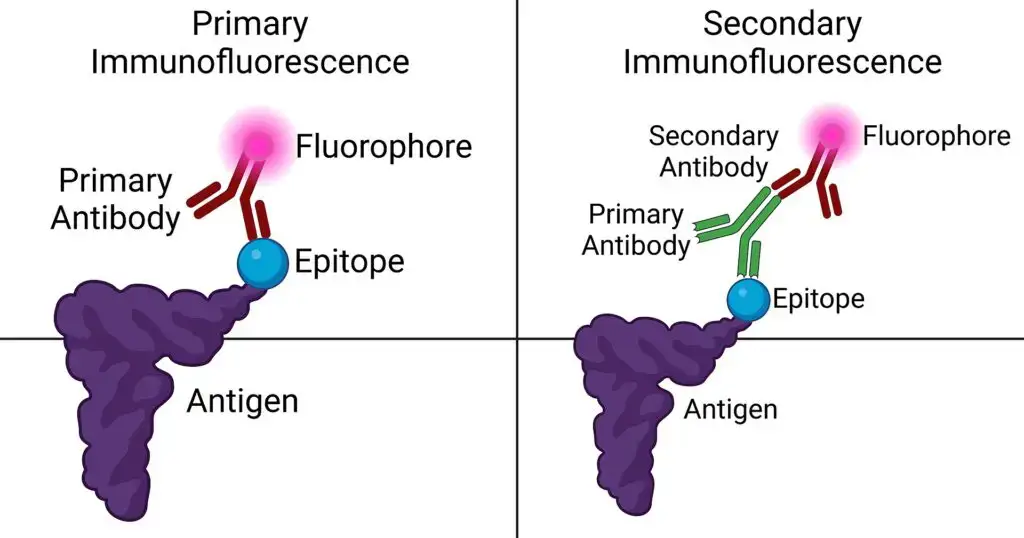
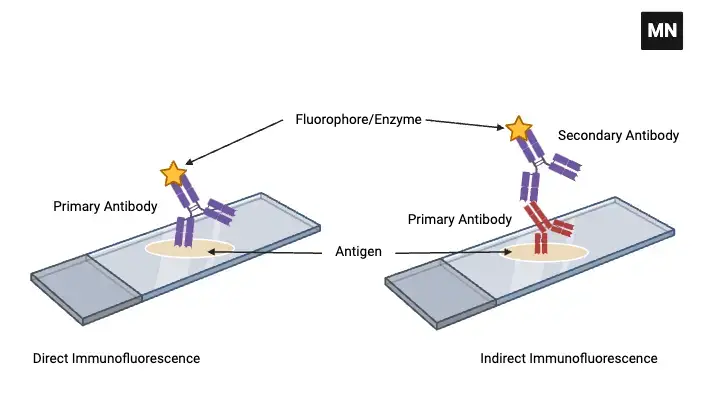
Direct immunofluorescence– In this method, fluorescent dye is directly attached with the primary antibody. The labelled primary antibody binds with the antigen. Fluorescence is produced at the site of antigen.
Indirect immunofluorescence– In this method, primary antibody is not labelled. First primary antibody binds with the antigen. Then fluorescent labelled secondary antibody binds with the primary antibody. This method gives more bright fluorescence signal.
Immunofluorescence assay is used to observe cellular arrangement and localization of antigen. It is also used for detection of protein expression in cells. It is used in diagnosis of autoimmune diseases, viral infections and bacterial diseases.
Principle of Immunofluorescence
Principle of Immunofluorescence is based on the specific reaction between antigen and antibody.
In immunofluorescence, the antibody is labelled with fluorescent dye. This dye is called fluorophore or fluorochrome. The labelled antibody binds with its specific antigen present in the cell or tissue.
Most of the cellular molecules do not give light by their own. So the fluorescent dye acts as a visible marker. When the antigen-antibody complex is formed, the sample is observed under fluorescence microscope.
In this process, light of specific wavelength is passed on the sample. The fluorophore absorbs this light energy. Due to this, the electrons of fluorophore goes to higher unstable energy state.
After short time, the electrons come back to their normal state. During this return, absorbed energy is released as emitted light. This emitted light has longer wavelength and lower energy than the absorbed light.
This change is called Stokes shift. Due to this emitted light, the target antigen containing structure becomes bright and glowing. Thus the location of protein or antigen can be detected in the cells and tissues.
Types of Immunofluorescence Assay
The following are the types of immunofluorescence assay–
- Direct Immunofluorescence (DIF)
Direct immunofluorescence is the simple type of immunofluorescence assay. In this method fluorescent dye is attached directly with the primary antibody. The labelled antibody binds with the specific antigen and the antigen site gives fluorescence. - Indirect Immunofluorescence (IIF)
Indirect immunofluorescence is a two step method. In this method primary antibody is not labelled. The primary antibody first binds with the target antigen. After this fluorescent labelled secondary antibody binds with the primary antibody and gives fluorescence. - Double Labelling or Multiplexing
Double labelling is used to detect more than one antigen in the same sample. In this method different antibodies are used with different fluorescent dyes. So different target proteins can be seen separately in same cell or tissue. - Flow Cytometry and Fluorescence Activated Cell Sorting (FACS)
In flow cytometry and FACS, fluorescent labelled antibodies are used to detect particular cells in a fluid sample. The cells pass one by one through laser light. The fluorescence is measured and the cells are counted or separated according to their fluorescence.
Direct Immunofluorescence Test
Principle of Direct Immunofluorescence Test
Principle of Direct Immunofluorescence Test is based on the use of fluorescent labelled primary antibody which directly reacts with the specific antigen.
In direct immunofluorescence test, the antibody is joined with fluorescent dye. This dye is called fluorophore. This labelled antibody is added on the smear or tissue section.
During incubation, the labelled antibody combines with the antigen present in the sample. If the antigen is absent, no specific binding takes place.
After this, the slide is washed. Unbound antibody is removed from the slide. The bound antibody remains attached with the antigen.
When the slide is observed under fluorescence microscope, the antigen site gives fluorescence. So the presence of antigen and its location in the cell or tissue can be detected directly.
Procedure of Direct Immunofluorescence Test
The following are the steps of direct immunofluorescence test–
- Sample preparation and fixation
The specimen is first prepared on clean glass slide or coverslip. The sample may be cultured cells, frozen tissue section or fixed tissue section. Then the sample is fixed by using suitable fixative such as 3-4% paraformaldehyde, cold methanol or ice cold acetone. Fixation is done to preserve the cellular structure and antigen position. After fixation, the sample is washed with PBS or TBS for removing excess fixative. - Permeabilization
This step is done when the antigen is present inside the cell. The cell membrane is made permeable by using detergent like Triton X-100, digitonin or saponin. The sample is incubated in this solution for few minutes. It helps the labelled antibody to enter inside the cell and bind with intracellular antigen. Samples fixed with cold methanol or acetone generally do not need this step because they already make cell permeable. - Washing
After permeabilization, the slide is washed again with PBS or TBS. Washing removes excess detergent from the sample. It also prevents damage of the cell and reduces background staining. - Blocking
The sample is treated with blocking buffer. The blocking buffer may contain Bovine Serum Albumin (BSA) or normal animal serum. This step is done for blocking the non-specific binding sites present in the sample. The slide is kept in blocking solution for about 30 minutes to 2 hours at room temperature. - Fluorescent labelled primary antibody incubation
The fluorophore conjugated primary antibody is diluted in antibody dilution buffer. Then it is added directly on the sample. The antibody should cover the tissue or cells properly. This labelled antibody binds directly with the specific antigen present in the sample. - Incubation in dark condition
The slide is incubated for 1 to 2 hours at room temperature or overnight at 4°C. The incubation is done in dark condition. It is because fluorescent dye can be damaged by light and the fluorescence may become weak. - Washing after antibody reaction
After incubation, the antibody solution is removed. The slide is washed three times with PBS, PBS-T or TBS, generally for 5 minutes each. This washing removes unbound labelled antibody. In this test, secondary antibody is not added because the primary antibody itself is already labelled with fluorescent dye. - Counter staining
This step is optional. A nuclear stain such as DAPI or Hoechst may be added to the sample. It stains the nucleus and helps to observe cell position. After staining, the slide is washed again with buffer. - Mounting
A drop of anti-fade mounting medium is added on the slide. It helps to preserve the fluorescence and prevents fading of the signal. Then coverslip is placed slowly over the sample. Air bubble should be avoided during placing of coverslip. - Observation and storage
The prepared slide is observed under fluorescence microscope by using suitable filter. The antigen site gives fluorescence where labelled antibody has bound. After observation, the slide is stored in dark at 4°C or -20°C to protect the fluorescence signal.
Uses of Direct Immunofluorescence Test
The following are the uses of direct immunofluorescence test–
- Direct immunofluorescence test is used for rapid diagnosis of bacterial infection. It is used for detection of Streptococcus pyogenes from throat swab and Mycoplasma pneumoniae or Legionella pneumophila from sputum sample.
- It is used for detection of bacteria which are difficult to grow in ordinary culture media. In this case the bacteria are detected directly from clinical sample.
- It is used for detection of highly expressed proteins in cells and tissues. The labelled antibody binds with the protein and the site gives fluorescence.
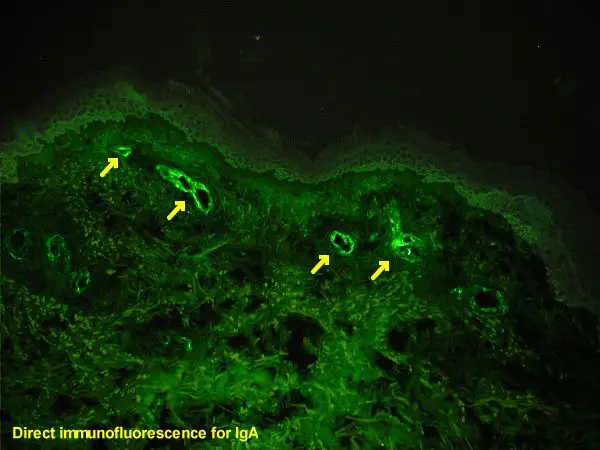
- It is used in diagnosis of autoimmune skin diseases. It is used in pemphigus, dermatitis herpetiformis and pemphigoid disorders. The immune deposits are seen as fluorescent pattern in the skin tissue.
- It is used in examination of kidney biopsy. It helps in diagnosis of glomerular diseases like lupus nephritis. In this test immune deposits such as IgA, IgG, IgM, C3 and C1q are detected in kidney tissue.
- It is used to know the location of antigen in the tissue. The antigen site becomes bright when the fluorescent labelled antibody binds with it.
Advantages of Direct Immunofluorescence Test
The following are the advantages of direct immunofluorescence test–
- Direct immunofluorescence test is a rapid method because only one labelled antibody is used. It has less number of steps and the result is obtained in short time.
- It is simple method than indirect immunofluorescence test. In this test secondary antibody is not required.
- It gives less background fluorescence. This is because there is no binding of secondary antibody in the sample.
- The chance of non-specific reaction is low. The fluorescent dye is directly attached with the primary antibody.
- It has low species cross reaction. It does not commonly react with other endogenous immunoglobulins present in the tissue.
- It is useful for detection of highly expressed proteins. The antigen site can be observed directly under fluorescence microscope.
- It is useful in rapid clinical diagnosis. It can be used for quick detection of bacterial diseases like strep throat.
- It is useful in multiplex study also. More than one labelled primary antibody can be used in same sample without much cross reaction problem.
Disadvantages of Direct Immunofluorescence Test
The following are the disadvantages of direct immunofluorescence test–
- Direct immunofluorescence test is less sensitive than indirect method. In this test only one labelled antibody binds with one antigen, so amplification of fluorescence does not take place.
- The fluorescence signal is weak in this method. This is because many secondary antibodies are not used for increasing the signal.
- It is costly method. The fluorescent labelled primary antibody is more expensive than fluorescent labelled secondary antibody.
- It has less flexibility. Specific fluorophore-conjugated primary antibodies are not always available for all antigens.
- Once the labelled antibody is selected, the fluorescent colour cannot be changed easily. So the same antibody is limited to its fixed fluorescence channel.
- It is less useful for detecting low amount of protein or antigen in the sample. Weak antigen may not give clear fluorescence.
- It has limited use in multiplexing. Detection of many targets in same sample becomes difficult because different labelled primary antibodies are needed.
Indirect Immunofluorescence Test
Principle of Indirect Immunofluorescence Test
Principle of Indirect Immunofluorescence Test is based on the binding of unlabelled primary antibody with the specific antigen, followed by binding of fluorescent labelled secondary antibody with the primary antibody.
In indirect immunofluorescence test, two antibodies are used. First one is primary antibody and second one is secondary antibody. The primary antibody is not labelled with fluorescent dye.
In the first step, primary antibody is added on the sample. It combines with the specific antigen present in the cell or tissue. After this the slide is washed, so unbound primary antibody is removed.
In the next step, fluorescent labelled secondary antibody is added. This secondary antibody does not bind with antigen directly. It binds with the primary antibody which is already attached with antigen.
More than one secondary antibody can bind with one primary antibody. So more fluorescent dye comes at the antigen site. Due to this the fluorescence signal becomes strong.
When the slide is observed under fluorescence microscope, the antigen site gives bright fluorescence. Thus even small amount of antigen or protein can be detected by this method.
Procedure of Indirect Immunofluorescence Test
The following are the steps of indirect immunofluorescence test–
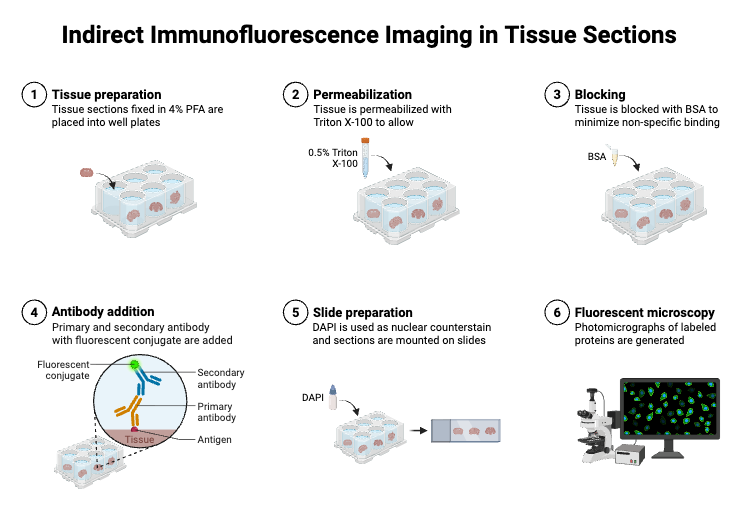
- Sample preparation and fixation
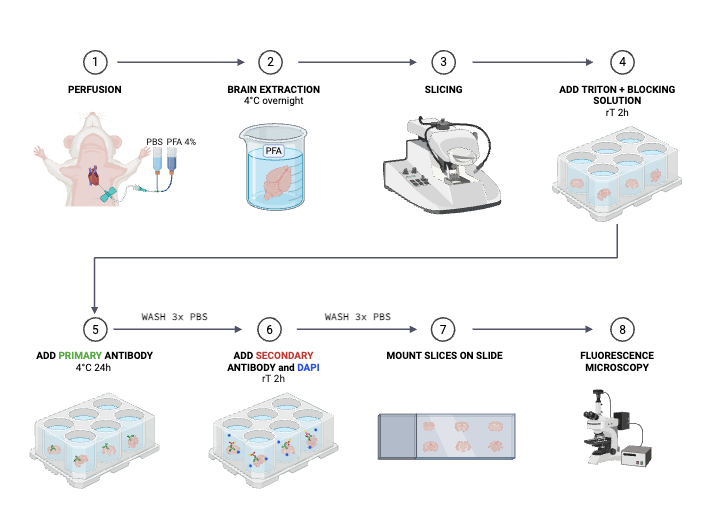
The sample is first prepared on clean slide or coverslip. The sample may be cells grown on coverslip or tissue section. Then the sample is fixed by using 4% paraformaldehyde, cold methanol or ice cold acetone. Fixation is done to keep the cell structure and antigen in proper place. - Washing after fixation
After fixation, the slide is washed with Phosphate Buffered Saline (PBS). Washing is done for removing excess fixative from the sample. It also helps to keep the sample clean before the next step. - Permeabilization
This step is done when the target antigen is present inside the cell. The sample is treated with detergent like Triton X-100, digitonin or saponin. It makes small pores in the cell membrane. So the antibody can enter inside the cell and bind with intracellular antigen. - Washing after permeabilization
After permeabilization, the sample is again washed with PBS. The extra detergent is removed from the slide. If the sample is fixed with cold methanol or acetone, this step may not be needed because they already make the cell permeable. - Blocking
The sample is treated with blocking buffer. The blocking buffer may contain Bovine Serum Albumin (BSA), gelatin or normal animal serum. This step blocks the non-specific binding sites. It prevents unnecessary binding of antibody and reduces background fluorescence. - Primary antibody incubation
The unlabelled primary antibody is diluted in antibody dilution buffer. Then it is added on the sample and the sample should be covered properly. The primary antibody binds with the specific antigen present in the sample. - Incubation of primary antibody
The slide is kept for 1 to 2 hours at room temperature or overnight at 4°C. During this time, antigen-antibody reaction takes place. The primary antibody becomes attached with the target antigen. - Washing after primary antibody
After incubation, the primary antibody solution is removed. The slide is washed three times with PBS or PBS-T for 5 to 10 minutes. This washing removes unbound primary antibody from the sample. - Secondary antibody incubation
The fluorophore conjugated secondary antibody is diluted in dilution buffer. This antibody should be against the species of the primary antibody. Then it is added on the sample. The secondary antibody binds with the primary antibody and not directly with the antigen. - Incubation in dark condition
The slide is incubated for 30 minutes to 2 hours at room temperature. This step is done in dark condition. It is because fluorescent dye is sensitive to light and light can reduce fluorescence. - Final washing
After secondary antibody incubation, the antibody solution is removed. The slide is washed again three times with PBS or PBS-T in dark condition. This removes unbound secondary antibody and reduces background staining. - Counter staining
This step is optional. A nuclear stain like DAPI or Hoechst may be added for staining the nucleus. It is kept for few minutes and then the slide is rinsed with PBS. - Mounting
A drop of anti-fade mounting medium is added on the sample. It prevents fading of fluorescence. Then coverslip is placed carefully over the sample. Air bubbles should be avoided. - Observation and storage
The slide is observed under fluorescence microscope by using suitable filter. The antigen site gives fluorescence because secondary antibody is labelled with fluorescent dye. The slide is stored in dark at 4°C or -20°C for protecting the fluorescence signal.
Uses of Indirect Immunofluorescence Test
The following are the uses of indirect immunofluorescence test–
- Indirect immunofluorescence test is used for detection of circulating antibodies in patient serum. These antibodies may be disease specific antibodies.
- It is used for diagnosis of systemic autoimmune diseases by detecting antinuclear antibodies (ANA). It is used in systemic lupus erythematosus (SLE), Sjögren’s syndrome, systemic sclerosis, polymyositis and dermatomyositis.
- It is used in autoimmune blistering diseases of skin. It detects circulating autoantibodies in pemphigus vulgaris, bullous pemphigoid, dermatitis herpetiformis and epidermolysis bullosa acquisita.
- It is used for detection of anti-neutrophil cytoplasmic antibodies (ANCA). These antibodies are important in granulomatosis with polyangiitis and microscopic polyangiitis.
- It is used for diagnosis of infectious diseases. It detects antibody against Treponema pallidum in syphilis and also viral antibodies in Zika, dengue and chikungunya infection.
- It is used for detection of autoimmune neurological disorders. It detects anti-neuronal autoantibodies in autoimmune encephalitis and paraneoplastic neurological syndromes.
- It is used for detection of low amount of antigen, protein or biomarker in cells and tissues. In this method the secondary antibody gives more fluorescence, so the weak antigen also can be detected.
Advantages of Indirect Immunofluorescence Test
The following are the advantages of indirect immunofluorescence test–
- Indirect immunofluorescence test is more sensitive method. In this method many fluorescent labelled secondary antibodies can bind with one primary antibody.
- It gives strong fluorescence signal. So small amount of antigen or protein also can be detected easily.
- It is useful for detection of rare biomarkers in cells and tissues. The signal becomes amplified due to secondary antibody binding.
- It is less costly than direct immunofluorescence test. Fluorescent labelled secondary antibodies are cheaper than fluorescent labelled primary antibodies.
- One labelled secondary antibody can be used with many primary antibodies of same host species. So same reagent can be used in different tests.
- It has more flexibility. Different primary antibodies and different fluorescent secondary antibodies can be selected according to the need of experiment.
- It is useful for multiplex detection. More than one target antigen can be detected in same sample by using different antibody combination.
- It is commonly used in research and diagnostic work because it gives clear and bright fluorescence signal.
Disadvantages of Indirect Immunofluorescence Test
The following are the disadvantages of indirect immunofluorescence test–
- Indirect immunofluorescence test takes more time. In this method two antibody steps are present, one for primary antibody and another for secondary antibody.
- More washing and incubation steps are required. So the procedure becomes longer than direct immunofluorescence test.
- It is more complex method. The secondary antibody must be selected according to the host species of the primary antibody.
- It may give more background fluorescence. This is due to non-specific binding of secondary antibody with other sites of the sample.
- There is more chance of cross reaction. The secondary antibody may react with endogenous immunoglobulins present in the tissue.
- Multiplexing is sometimes difficult in this method. Different primary antibodies should be raised in different host species, otherwise secondary antibody may bind wrongly.
- False positive fluorescence may occur if blocking and washing is not proper. So careful handling is required in this test.
Result Interpretation of Immunofluorescence Test
The following are the result interpretation of immunofluorescence test–
- Positive result
When the target area gives fluorescence under fluorescence microscope, it is considered as positive result. It indicates that specific antigen or antibody is present in the sample. - Negative result
When no fluorescence is seen in the sample, it is considered as negative result. It indicates that target antigen or antibody is not detected. Sometimes false positive and false negative result may occur due to sensitivity and specificity of the test. - Titre value
In antibody detection, the serum is diluted in different concentration. The highest dilution which still gives fluorescence is called titre. In ANA test, titre like 1:40 or more with clinical symptoms may indicate systemic lupus erythematosus (SLE). - Intercellular space (ICS) pattern
In skin biopsy, fluorescence of IgG or C3 is seen between epidermal cells. This pattern is called intercellular space pattern. Fluorescence in lower epidermis indicates pemphigus vulgaris and upper epidermis indicates pemphigus foliaceus. - Linear basement membrane zone (BMZ) pattern
In this pattern, a continuous linear fluorescence is seen at dermoepidermal junction. It may be due to deposition of IgG or C3. This pattern is found in bullous pemphigoid and epidermolysis bullosa acquisita. - Granular dermal pattern
In this pattern, granular fluorescence of IgA is seen in dermal papillae. This pattern is used for diagnosis of dermatitis herpetiformis. - Full house pattern
In kidney biopsy, deposition of many immune markers together is called full house pattern. These markers are IgG, IgA, IgM, C3, C1q, Kappa and Lambda light chains. This pattern is characteristic of lupus nephritis. - Dominant IgA or IgG pattern
Dominant IgA deposition in mesangium indicates IgA nephropathy. Granular IgG deposition in subepithelial space indicates membranous nephropathy. - ANA cellular pattern
In antinuclear antibody (ANA) test, different fluorescence pattern may be seen in the nucleus. These are homogeneous, speckled, nucleolar, nuclear dots and centromeric pattern. These patterns are used for classification of systemic autoimmune diseases. - ANCA pattern
In anti-neutrophil cytoplasmic antibody (ANCA) test, cytoplasmic fluorescence is called cANCA. It indicates antibody against proteinase-3 (PR3). Perinuclear fluorescence is called pANCA and it indicates antibody against myeloperoxidase (MPO).
Applications of Immunofluorescence Test
The following are the applications of immunofluorescence test–
- Immunofluorescence test is used for diagnosis of autoimmune diseases. It detects ANA and anti-dsDNA antibodies in systemic lupus erythematosus (SLE), Sjögren’s syndrome and polymyositis.
- It is used in kidney biopsy. The deposits of IgG, IgA, IgM and complement are seen in glomerulus. It is useful in lupus nephritis, IgA nephropathy and membranous glomerulonephritis.
- It is used in skin biopsy. It helps to diagnose pemphigus vulgaris, bullous pemphigoid and dermatitis herpetiformis. The fluorescence pattern is seen in intercellular space or basement membrane zone.
- It is used for detection of infectious agents directly from clinical sample. It is used for bacteria and viruses which are difficult to grow in culture. Example- Legionella pneumophila, Mycoplasma pneumoniae, Zika virus and dengue virus.
- It is used in cancer study. Multiplex immunofluorescence is used for detecting many tumour markers and immune cell markers in same tissue section.
- It is used for diagnosis of autoimmune vasculitis. It detects ANCA antibodies. These antibodies are found in granulomatosis with polyangiitis and microscopic polyangiitis.
- It is used for localization of proteins in cells. The protein may be present in nucleus, cytoplasm or cell membrane.
- It is used for study of two or more molecules in same sample. Different fluorescent dyes are used. This is referred to as colocalization study.
- It is used in live cell study. Fluorescent dyes and GFP are used to observe endocytosis, exocytosis and calcium changes.
- It is used in flow cytometry and FACS. Specific cells can be counted and separated from a mixed cell suspension. Example- CD4 T cells.
- It is used in neuroscience. It detects anti-neuronal antibodies in serum or CSF. It is useful in autoimmune encephalitis and paraneoplastic neurological syndromes.
- It is used for neural activity study. Fluorescent probes are used to observe neuronal signalling and calcium movement.
- It is used in drug screening. The effect of drug on cell shape, gene expression and molecular reaction can be observed.
- It is used in environmental study. Specific microbes, toxins and pollutants can be detected by fluorescent antibody method.
Limitations of Immunofluorescence Test
The following are the limitations of immunofluorescence test–
- Immunofluorescence test has problem of fading of fluorescence. The fluorescent dye may lose its light when it is exposed to light for long time. This is called photobleaching.
- The fluorescence may be reduced by some chemical and environmental factors. This is called quenching. Due to this the signal becomes weak.
- It is not very useful for thick tissue specimen. The light cannot pass deeply in thick sample. So the image may become blurred.
- The resolution is limited in ordinary fluorescence microscope. Very fine cellular structures cannot be seen clearly without special microscope.
- Some tissues show natural fluorescence. This is called autofluorescence. It may produce background light and interfere with the real signal.
- Non-specific binding of antibody may also give background fluorescence. So false signal may be seen in the sample.
- In multiplex staining, different fluorophores may have overlapping colour. This is called spectral overlap or crosstalk. It makes result interpretation difficult.
- Fixation and sample preparation may change the antigen structure. Sometimes the epitope becomes masked and antibody cannot bind properly.
- Some solvents used during preparation may damage cell membrane. It may also wash away the target molecule from the sample.
- It is mainly semi-quantitative method. It can show presence and location of protein but exact numerical amount is not measured properly.
- In indirect immunofluorescence, cross reaction may occur. The secondary antibody may bind with endogenous immunoglobulins or other non-target molecules.
- In direct immunofluorescence, the sensitivity is low. It also needs costly fluorescent labelled primary antibody.
- It has limited flexibility in direct method. Different labelled primary antibodies are not always available for all target antigens.
References
- Abcam. (n.d.). Immunocytochemistry (ICC) protocol.
- Abcam. (n.d.). Immunocytochemistry and immunofluorescence protocol.
- Alcalay, Y., Paran, Y., Gov, T., Aizenstein, O., David, H., & Gadoth, A. (2021). The importance and clinical significance of tissue based immunofluorescence antibody testing in the evaluation of autoimmune/paraneoplastic neurological syndromes (2070). Neurology, 96(15_supplement).
- BD Biosciences. (n.d.). Immunofluorescence | Immunostaining | Immunocytochemistry.
- Bioss Antibodies. (n.d.). Immunofluorescence protocol.
- Biotium. (n.d.). Protocol: Immunofluorescence staining of cells for microscopy.
- Charu, V., Andeen, N. K., Kain, R., & Adam, B. A. (2022). Renal biopsy: Clinical correlations cases. ASN Kidney Week 2022.
- Creative Diagnostics. (n.d.). Direct vs indirect immunofluorescence: Which is the better technique.
- Danaher Life Sciences. (n.d.). Fluorescence microscopy: Principles, types and techniques.
- Dr.Oracle. (2026, February 19). What peer-reviewed articles discuss the full-house immunofluorescence pattern in pediatric lupus nephritis?
- DSS Image. (2025, March 25). Understanding immunofluorescence and its diagnostic applications.
- Fortis Life Sciences. (n.d.). Direct vs. indirect staining for flow cytometry.
- Gosink, J. (2020, August 26). Computer-aided immunofluorescence microscopy in autoimmune diagnostics. Clinical Laboratory Int.
- HKU Facility. (n.d.). Protocol for immunofluorescence staining of adhesion cells.
- Hoang, M. P. (2017). Immunobullous disorders. In M. P. Hoang (Ed.), Immunohistochemistry in diagnostic dermatopathology (pp. 224-247). Cambridge University Press.
- Hoang, M. P. (2017). Immunobullous disorders – Immunohistochemistry in diagnostic dermatopathology. Cambridge University Press & Assessment.
- ibidi. (n.d.). Immunofluorescence staining: Principle, protocol workflow, controls, and troubleshooting.
- Keenleyside, W. (2019). 21.5 Fluorescent antibody techniques. In Microbiology: Canadian edition. eCampusOntario Pressbooks.
- MSHOT. (2025, November 11). Do you really understand excitation and emission wavelengths before performing immunofluorescence?
- Musa, R., Rout, P., & Qurie, A. (2025, January 16). Lupus nephritis. In StatPearls. StatPearls Publishing.
- National Center for Biotechnology Information. (n.d.). A manual multiplex immunofluorescence method for investigating neurodegenerative diseases.
- National Center for Biotechnology Information. (n.d.). Fluorescence microscopy.
- National Center for Biotechnology Information. (n.d.). Immunofluorescence staining of paraffin sections step by step.
- National Center for Biotechnology Information. (n.d.). Immunofluorescence use and techniques in glomerular diseases: A review.
- National Center for Biotechnology Information. (n.d.). Protocol for immunofluorescence staining of murine helminth-infected intestinal and lung tissues.
- National Center for Biotechnology Information. (n.d.). UNIT 4.3 immunofluorescence staining.
- National Center for Biotechnology Information. (n.d.). Utility of immunofluorescence in dermatology.
- Novus Biologicals. (n.d.). Fluorescent IHC staining of frozen tissue protocol.
- Ockenga, W., & DeRose, J. (2023, June 2). An introduction to fluorescence. Leica Microsystems.
- ResearchGate. (n.d.). Immunofluorescence in dermatology.
- ResearchGate. (n.d.). The use of C3d and C4d immunohistochemistry on formalin-fixed tissue as a diagnostic adjunct in the assessment of inflammatory skin disease.
- Slideshare. (n.d.). Immunofluorescence and its role in histopathology.
- Unknown Author. (n.d.). Immunofluorescence assay: Scientific principles, methodological workflows, and diagnostic applications in pathology.
- Xuan, R., Yang, A., & Murrell, D. F. (2017, December). Indirect immunofluorescence. DermNet.
🙂 Excellent Article, Excellent Blog , Excellent Site ✅✅✅
This is a really nice page. It’s very informative and well organized. I’ll come back from time to time for more posts like this one.