

Brown algae are the large group of mostly marine and multicellular algae. They are commonly called as brown seaweeds. They mostly grow in cold and shallow sea water, especially on rocky sea coast.
They are known as Phaeophyceae. Their body is not differentiated into true root, stem and leaves. The plant body is called thallus. It may be simple, branched, filamentous or large complex body like kelps.
The brown colour of these algae is due to the presence of fucoxanthin pigment. This pigment masks the green colour of chlorophyll a and chlorophyll c. Other pigments like carotenoids and xanthophylls are also present.
The reserve food material of brown algae is mainly laminarin and mannitol. Their cell wall contains cellulose and alginic acid. This alginic acid is commercially important and it is used in many industries.
The thallus of many brown algae shows differentiation into three parts. The holdfast helps in attachment with rock or other substratum. The stipe is stem-like part. The blade or frond is leaf-like part where photosynthesis takes place.
In many forms, air bladder or pneumatocyst is present. It is filled with gas and helps the thallus to float in water. It keeps the blade near the surface of water so that more sunlight can be absorbed.
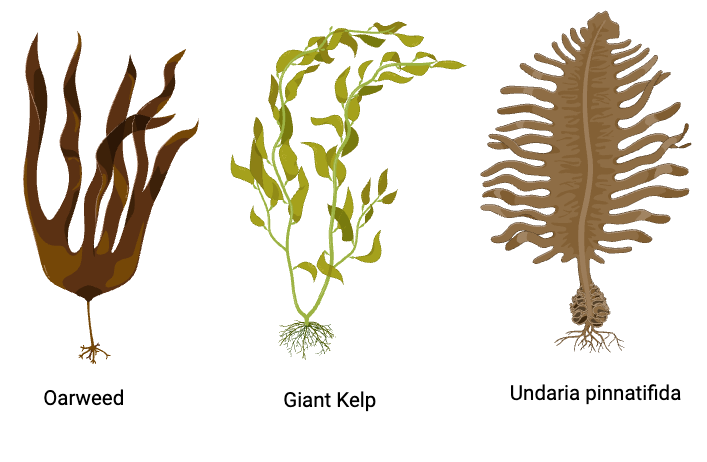
Brown algae show great variation in size and structure. Some forms are small and filamentous, while some forms are very large. The giant kelps may grow more than 50 meters long and form large underwater forest.
Some common examples of brown algae are Ectocarpus, Dictyota, Laminaria, Fucus and Sargassum. These are mostly marine forms. Laminaria and Macrocystis are large kelp forming members.
Reproduction in brown algae takes place by vegetative, asexual and sexual methods. Vegetative reproduction takes place by fragmentation. Asexual reproduction takes place by zoospores in many forms. Sexual reproduction may be isogamous, anisogamous or oogamous.
Brown algae are ecologically very important. They act as primary producers in marine ecosystem. Large kelps form dense underwater forest and provide food, shelter and breeding place for many marine animals.
Brown algae are also economically important. Algin is obtained from their cell wall and it is used as thickening and stabilizing agent in food, cosmetic and pharmaceutical industries. Some brown algae are also used as food because they contain minerals, especially iodine.
Habitats of Brown Algae
- Coastal and intertidal zones
Brown algae are mostly found in shallow coastal water. They remain attached with rocks, coral reefs and other hard substratum. They grow in intertidal, sub-tidal and tidal splash zones. - Deep ocean water
Some brown algae grow in deeper offshore water also. Large kelps like Laminaria and Macrocystis may form dense underwater forests. These forms can live in low light condition of deeper sea water. - Open ocean
Some brown algae are free floating in open ocean. Sargassum is the common example of this type. It does not attach with the sea bottom and forms large floating masses in sea water. - Cold and temperate regions
Most of the brown algae are found in cold and temperate marine water. They are very common in the colder sea of Northern Hemisphere. These conditions are suitable for large kelp growth. - Tropical and subtropical regions
Few brown algae also occur in warm tropical and subtropical water. Padina and Dictyota are important examples. These forms are adapted to survive in warm sea water. - Brackish water and freshwater
Brown algae are mainly marine forms. Some members are found in brackish water ecosystem. Very few forms have entered into freshwater habitat, so freshwater brown algae are very rare.
Characteristic Features of Brown Algae
- Multicellular nature
Brown algae are multicellular algae. There is no unicellular or colonial form in this group. Their plant body may be simple filamentous or highly complex. - Pigmentation
The brown or olive-green colour is due to the presence of fucoxanthin. It masks the green colour of chlorophyll a and chlorophyll c. Other pigments like carotenoids and xanthophylls are also present. - Thallus body
The plant body is called thallus. It is not divided into true root, stem and leaves. In many forms the thallus is differentiated into holdfast, stipe and blade. - Holdfast, stipe and blade
The holdfast is root-like structure and helps in attachment with rocks. The stipe is stem-like part. The blade is leaf-like part and it is the main photosynthetic region. - Pneumatocyst
Many brown algae possess gas filled bladder called pneumatocyst. It helps the thallus to float in water. It keeps the blade near the surface for receiving more sunlight. - Size variation
Brown algae show great variation in size. Some forms are very small and feathery. Some forms like kelps become very large and may grow more than 50 meters long. - Cell wall
The cell wall of brown algae has inner cellulose layer. The outer layer is gelatinous and contains alginic acid and fucoidan. Due to this, the thallus becomes flexible and slimy. - Reserve food
The reserve food material is not true starch. It is mainly stored as laminarin and mannitol. These are present in the cell as food reserve. - Life cycle
Most brown algae show alternation of generations. In this, sporophyte and gametophyte generations are present. The sporophyte produces spores and the gametophyte produces gametes. - Reproduction
Reproduction takes place by vegetative, asexual and sexual methods. Vegetative reproduction occurs by fragmentation. Asexual reproduction takes place by flagellated zoospores and sexual reproduction may be isogamous, anisogamous or oogamous. - Habitat
Brown algae are mostly marine algae. They are commonly found in cold and shallow sea water. They grow attached to rocky sea coast and form large seaweeds.
Classification of Brown Algae
| Brown Algae Classification | |
|---|---|
| Taxonomic Rank | Classification |
| Domain | Eukaryota |
| Kingdom | Chromista |
| Phylum | Ochrophyta |
| Class | Phaeophyceae |
| Orders | Fucales, Laminariales, Dictyotales |
| Families | Fucaceae, Laminariaceae, Dictyotaceae |
| Genera | Fucus, Laminaria, Dictyota |
| Species | Fucus vesiculosus, Laminaria digitata, Dictyota dichotoma |
Brown algae are classified mainly on the basis of their structure, reproduction and life cycle. The important orders of Phaeophyceae are as follows-
- Order Laminariales
This order includes the large brown algae which are commonly called kelps. They form large underwater forest in cold and temperate sea water. The common examples are Laminaria and Macrocystis. - Order Fucales
This order includes strong and well developed brown algae. They are mostly found attached with rocks in intertidal region. Some members like Sargassum may float freely in open sea water and form floating masses. - Order Ectocarpales
This order includes small and filamentous brown algae. They are commonly found in shallow water and intertidal zones. Ectocarpus is the common example of this order. - Order Dictyotales
This order includes small brown algae which are mostly found in tropical and subtropical sea water. Their thallus may be thin, flattened or filamentous. Dictyota and Padina are important examples. - Order Chordariales
This order includes mostly small brown algae. They are found in deeper sea water. These algae show some special structural adaptation for living in low light condition. - Order Tilopteridales
This is a less common group of brown algae. They are small coastal forms. Some members are used in scientific studies because they have some special biochemical characters.
Classification on the basis of life cycle
- Isogenerate type
In this type, the sporophyte and gametophyte are morphologically similar. Both generations look almost same. This type is found in Ectocarpales. - Heterogenerate type
In this type, the sporophyte and gametophyte are different in structure. The sporophyte is usually large and macroscopic, while the gametophyte is small or microscopic. This type is found in Laminariales. - Cyclosporea type
In this type, free living haploid generation is absent. The main plant body is diploid and it represents the dominant phase. This type is found in Fucales, such as Fucus and Sargassum.
Morphology and Structure of Brown Algae
Morphology and Structure of Brown Algae
- Thallus
The plant body of brown algae is called thallus. It is not divided into true root, stem and leaves. All brown algae are multicellular and no unicellular form is known in this group. - General form of thallus
The thallus may be simple, filamentous, branched or very large and complex. In higher forms, it becomes differentiated into holdfast, stipe and blade. These parts are only root-like, stem-like and leaf-like but not true plant organs. - Holdfast
The holdfast is a tough root-like structure present at the base of thallus. It helps in attachment with rocks, sea floor or other hard substratum. It only anchors the plant body and does not absorb water and minerals like true roots. - Stipe
The stipe is the stalk-like or stem-like part of brown algae. It connects the holdfast with the blade or frond. In large kelps, the stipe may contain conducting cells like sieve elements for transport of food materials. - Blade or Lamina
The blade or lamina is the flattened leaf-like part of the thallus. It is the main photosynthetic region. In some forms, the blade has a thick middle part like vein, which is called midrib. - Pneumatocyst
Pneumatocyst is the gas filled air bladder found in many brown algae. It is present near the blade or on the thallus. It helps in floating and keeps the blade near the water surface for proper sunlight. - Cell wall
The cell wall of brown algae is double layered. The inner layer is made up of cellulose and gives strength to the cell. The outer layer is gelatinous and contains alginic acid and fucoidan. - Tissue layers
In complex brown algae, the internal body shows tissue like differentiation. The outer layer is meristoderm and it is mainly photosynthetic. The middle layer is cortex which helps in storage and support. The inner part is medulla or pith. - Size and shape
Brown algae show wide variation in size and shape. Some forms are small and microscopic filamentous tufts. Some forms like giant kelps are very large and may grow more than 50 meters long. - Complex structure
Large brown algae show more advanced body organization than many other algae. Their thallus may look like higher plant body, but it has no true vascular tissue, true root, true stem and true leaves.
Modes of Reproduction in Brown Algae
The reproduction in brown algae takes place by three methods. These are vegetative reproduction, asexual reproduction and sexual reproduction.
1. Vegetative Reproduction
Vegetative reproduction takes place by fragmentation.
In this process, the thallus breaks into small pieces. Each broken part grows into a new plant body. This method is common in many simple brown algae.
2. Asexual Reproduction
Asexual reproduction takes place by zoospores.
The zoospores are motile spores. They are usually pear-shaped and have two unequal lateral flagella. These spores are formed inside the sporangia.
In many brown algae, the zoospores are formed inside plurilocular sporangia. After liberation, the zoospore swims in water for some time. Then it settles and germinates into new plant body.
3. Sexual Reproduction
Sexual reproduction takes place by fusion of gametes.
The gametes are generally haploid and motile. They usually have two lateral flagella. Sexual reproduction is of three types.
a. Isogamy
In isogamy, the male and female gametes are similar in size and shape.
Both gametes are motile and look almost same. They fuse together and form zygote.
b. Anisogamy
In anisogamy, the fusing gametes are unequal in size.
One gamete is smaller and more active. The other gamete is larger and less active. They fuse to form zygote.
c. Oogamy
In oogamy, the female gamete is large and non-motile.
The male gamete is small and motile. It swims and fuses with the egg. This is the common type in advanced brown algae.
4. Fertilization
Fertilization may be external or internal.
In some brown algae, both gametes are released into sea water and fertilization occurs outside the plant body. In some forms, fertilization takes place inside the reproductive organ.
In Fucus, the sex organs are present inside special cavities called conceptacles. Here the gametes are formed and fertilization takes place.
5. Alternation of Generations
Most brown algae show alternation of generations.
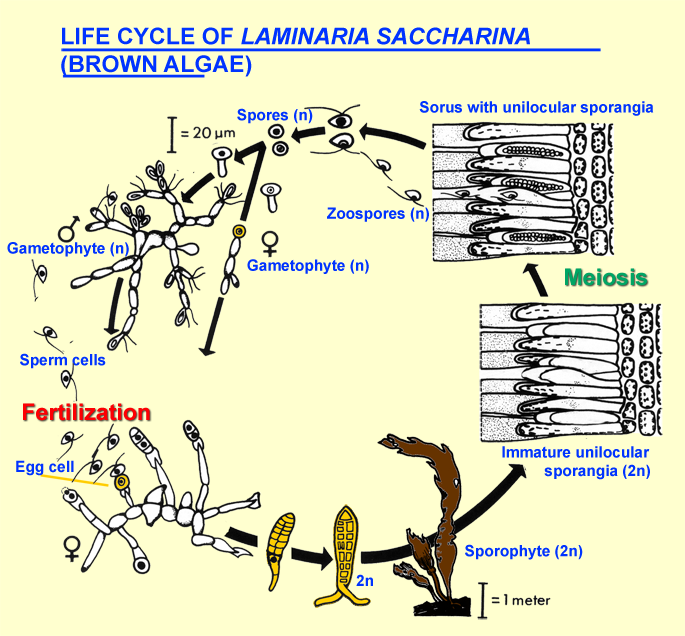
In this life cycle, two phases are present. These are diploid sporophyte and haploid gametophyte. The sporophyte produces spores by meiosis and gametophyte produces gametes.
6. Exception in Fucales
In Fucales, free living haploid gametophyte is absent.
The main plant body is diploid. It directly produces gametes. So, the life cycle is mainly diplontic.
Life Cycle of Brown Algae
The life cycle of brown algae is mainly complex. It shows alternation of generations in most members. In this life cycle, one phase is diploid sporophyte and another phase is haploid gametophyte.
1. Sporophyte Phase
The sporophyte is diploid and represented as 2n.
It is usually the larger and more visible plant body. In many brown algae, this phase is dominant. The sporophyte produces haploid spores by meiosis.
The spores are formed inside special structures called unilocular sporangia. These spores are released into water and they germinate to form gametophyte.
2. Gametophyte Phase
The gametophyte is haploid and represented as n.
It develops from the haploid spores. This phase produces male and female gametes. The gametes are formed by mitosis.
In many forms, gametes are produced inside plurilocular gametangia. The gametes may be similar or dissimilar depending on the species.
3. Fertilization
Fertilization takes place by fusion of male and female gametes.
It may occur in open sea water or inside the reproductive organ of the parent plant. After fusion, a diploid zygote is formed.
The zygote does not form embryo. It germinates directly and develops into a diploid sporophyte. Thus the life cycle is completed.
Types of Life Cycle in Brown Algae
1. Isomorphic Alternation
In this type, the sporophyte and gametophyte are similar in structure.
Both generations look almost same externally. This type is found in Ectocarpus. It is also called isogenerate type.
2. Heteromorphic Alternation
In this type, the sporophyte and gametophyte are different in structure.
The sporophyte is large and macroscopic. The gametophyte is small, microscopic and filamentous. This type is common in Laminariales, such as kelps.
3. Diplontic Life Cycle
In this type, free living haploid gametophyte is absent.
The main plant body is diploid. It directly produces gametes in reproductive cavities. This type is found in Fucales, such as Fucus.
In Fucus, reproductive structures are present in special cavities called conceptacles. The gametes are produced there and after fertilization zygote develops into new diploid plant.
Asexual Variation in Life Cycle
In some brown algae, sexual reproduction may be absent for some time.
The mature sporophyte may produce motile zoospores. These zoospores germinate directly and form new sporophyte.
Sometimes unfertilized gametes may also develop into haploid plant body. This condition is referred to as parthenosporophyte. It looks like sporophyte but it is haploid in nature.
Ecological Importance of Brown Algae
- Primary producer
Brown algae are important producer of sea water. They contain chlorophyll and prepare food by photosynthesis. This food is used by different marine organisms. - Food for animals
The thallus of brown algae is used as food by many sea animals. Fishes, molluscs, sea urchins and other small animals feed on it. Dead thallus also forms detritus and this is used by many organisms. - Kelp forest
Large brown algae form kelp forest in sea water. These forests are formed by kelps like Laminaria and Macrocystis. It is an important living place of many marine animals. - Shelter
The large thallus of kelps gives shelter to fishes and invertebrates. Small animals remain protected between the blades and stipes. It also protects them from strong water current. - Nursery place
Kelp forest is used as nursery place by many marine animals. Eggs and young stages remain there. This helps in their growth and survival. - Floating habitat
Sargassum is free floating brown algae. It forms large floating mass in open sea. Many fishes, crabs, turtles and small organisms live with this floating mass. - Carbon fixation
Brown algae absorb carbon dioxide from sea water. This takes place during photosynthesis. Thus they help in carbon fixation and storing of carbon in marine ecosystem. - Oxygen release
During photosynthesis brown algae release oxygen. This oxygen is used by aquatic animals for respiration. It also maintains oxygen content of sea water. - Protection of sea shore
Dense kelp forest reduces the force of sea waves. It acts as a natural barrier near the coast. In this way it helps in reducing erosion of sea shore. - Nutrient recycling
Brown algae absorb nutrients from sea water. After death the thallus is decomposed by microorganisms. The nutrients again return to sea water and used by other organisms.
Economic Importance of Brown Algae
- Used as food
Many brown algae are used as food by man. Laminaria is used as kombu and Undaria pinnatifida is used as wakame. These are eaten in soup, salad and other food preparation, mainly in coastal Asian countries. - Source of algin
The cell wall of brown algae contains alginic acid or algin. It is extracted commercially from large brown algae. It is used as thickening, stabilizing, emulsifying and gelling substance. - Use in food industry
Algin is used in many food materials. It is used in ice cream, jelly, beer and other processed food. It gives proper thickness and smooth texture to the food. - Use in other industries
Alginic acid is also used in cosmetics, toothpaste, paint, paper and textile industries. It is used because it can hold water and form gel like substance. Thus brown algae are important raw material for industry. - Source of iodine
Brown algae like Fucus and Laminaria contain high amount of iodine. So these are used in treatment of goitre and thyroid related diseases. Iodine is obtained from their dried thallus. - Medicinal use
Brown algae contain fucoidan and other useful compounds. These substances show antibacterial, antioxidant and anti-inflammatory properties. Some extracts are used in preparation of pills, wound dressing, surgical threads and anticoagulant materials. - Use as fertilizer
Brown algae are used as natural manure in agriculture. Sargassum and kelps contain nitrogen, potassium and many trace minerals. They increase soil fertility and help in plant growth. - Use as animal feed
Some brown algae are used as fodder for cattle and poultry. They contain minerals and other nutritive substances. So it is used as supplementary food for livestock. - Use in fish culture
Alginic acid obtained from brown algae is used in aquaculture. It helps to increase resistance and health of fishes. It is useful for young fishes in fish farming. - Biofuel production
Large brown algae grow very fast in sea water. They do not need agricultural land and fresh water. So they are studied as a source of biofuel and renewable energy. - Biodegradable products
Brown algae are also used in making biodegradable plastic like materials. These products can replace some petroleum based products. It is important for reducing pollution. - Use in modern technology
Alginic acid is used in some advanced materials. It is used in lithium-ion battery as stable anode material. Seaweed materials are also used in eco-friendly construction and ceramic clay preparation.
Examples of Brown Algae
- Macrocystis pyrifera
It is commonly known as giant kelp. It is the largest brown algae. The plant body is very long and may be more than 50 meter. It forms large forest under sea water. - Sargassum
Sargassum is a common brown algae. Some species are attached and some are free floating. Sargassum fluitans and Sargassum natans form large floating masses in open sea. It is common in Sargasso Sea. - Laminaria
Laminaria is a kelp found in cold sea water. The thallus has holdfast, stipe and blade. It is used as food and also used for obtaining algin. - Fucus vesiculosus
It is commonly called bladderwrack. It grows attached to rocks in intertidal region. The thallus has air bladders. These bladders help in floating of the thallus. - Undaria pinnatifida
It is also called wakame. It is edible brown algae. It is cultivated in Asian countries for food. In some places it spreads fast and becomes invasive. - Ectocarpus
Ectocarpus is small and filamentous brown algae. The thallus is much branched. It is used in laboratory studies, mainly for study of multicellular nature and genetics. - Nereocystis luetkeana
It is known as bull kelp or sea whip. The stipe is long and hollow. A large air bladder or pneumatocyst is present at the end. It keeps the blades near the water surface. - Postelsia palmaeformis
It is called sea palm. The plant body looks like a small palm. It has hard stipe. It grows in intertidal region where waves strike strongly. - Padina pavonica
Padina is a small brown algae. The thallus is fan shaped and flattened. It is one of the brown algae where calcium carbonate may be deposited. - Ascophyllum nodosum
It is a type of rockweed. It remains attached with rocks in coastal water. It is collected for commercial use and also used in industrial preparation. - Egregia menziesii
It is called feather boa kelp. The thallus is long and strap-like. Small air floats are present along the margin. These floats help the thallus to remain lifted in water.
References
- A bioactive substance derived from brown seaweeds: Phlorotannins. (n.d.). PMC.
- Biology LibreTexts. (n.d.). 2.4.3.2: Brown algae and diatoms.
- Boyer, J. (2025). Plant diversity – Brown algae.
- Brown algae (seaweeds) the main characteristics of Phaeophyta. (n.d.).
- BYJU’S. (n.d.). General characteristics of brown algae.
- Constitutive or inducible protective mechanisms against UV-B radiation in the brown alga Fucus vesiculosus? A study of gene expression and phlorotannin content responses. (n.d.). PMC.
- Denoeud, F., Godfroy, O., Cruaud, C., Heesch, S., Nehr, Z., Tadrent, N., Couloux, A., Brillet-Guéguen, L., Delage, L., McKeown, D., Motomura, T., Sussfeld, D., Fan, X., Mazéas, L., Terrapon, N., Barrera-Redondo, J., Petroll, R., Reynes, L., Choi, S.-W., & Jo, J. (2024). Evolutionary genomics of the emergence of brown algae as key components of coastal ecosystems. Cell, 187(24), 6943-6965.e39.
- Exploring Our Fluid Earth. (2011). Structure and function. University of Hawai’i.
- Fishing bans help kelp forests withstand marine heatwaves. (n.d.). Stanford Report.
- Fofonoff, P. W., Ruiz, G. M., Steves, B., Simkanin, C., & Carlton, J. T. (2018). Undaria pinnatifida. National Exotic Marine and Estuarine Species Information System.
- Induction of phlorotannins through mechanical wounding and radiation conditions in the brown macroalga Laminaria hyperborea. (n.d.). Taylor & Francis.
- Marine protected areas that preserve trophic cascades promote resilience of kelp forests to marine heatwaves. (n.d.). PMC.
- Mills, K. (2025, March). Undoing Undaria. Park Watch. Victorian National Parks Association.
- Monterey Bay Aquarium. (n.d.). Kelp forests: Underwater ecosystems full of life.
- Mouritsen, O. (2013). The science of seaweeds. American Scientist, 101(6), 458.
- Pickett, M., & Berwyn, B. (2021, March 16). In the Pacific, global warming disrupted the ecological dance of urchins, sea stars and kelp. Otters help restore balance. Inside Climate News.
- Radford, C. S. (2023). Brown algae. Research Starters: Botany. EBSCO.
- Radford, C. S. (2023). Brown algae. Research Starters: Botany. EBSCO Research.
- Ratchinski, P., Godfroy, O., Noel, B., Aury, J.-M., & Cock, J. M. (2025). Life-cycle-related gene expression patterns in the brown algae. eLife.
- Reef Check Foundation. (n.d.). Kelp forest urchin barren dynamics.
- Rubal, M., Fernández-Gutiérrez, J., Carreira-Flores, D., Gomes, P. T., & Veiga, P. (2025). Current distribution of the invasive kelp Undaria pinnatifida (Harvey) Suringar, 1873 along artificial and natural habitats in North Portugal—Impacts and mitigation initiatives. Plants, 14(5), 658.
- Sargassum inundation events beginning earlier, lasting longer on US coasts, study finds. (n.d.). SeafoodSource.
- Sharma, N. (2025, July 12). Brown algae (Phaeophyceae): Characteristic, classification, importance. Microbe Notes.
- Sungkyunkwan University. (2024, December 18). Sungkyunkwan University study reveals the hidden genomic evolution of brown algae. EurekAlert!
- The cell wall polysaccharide metabolism of the brown alga Ectocarpus siliculosus. Insights into the evolution of extracellular matrix polysaccharides in Eukaryotes. (n.d.). PubMed.
- The evolutionary genomics, developmental biology, and ecological dynamics of class Phaeophyceae. (n.d.).
- Tidbury, H. (2020, October). Rapid risk assessment of: Undaria pinnatifida. GB Non-native Species Secretariat.
- US EPA. (2026, February 19). Great Atlantic Sargassum Belt (GASB).
- US EPA. (2026, February 19). Sargassum inundation events (SIEs): Impacts on the economy.
- U.S. National Park Service. (2017, June 29). Invasive kelp spreads into new territory.
- Vedantu. (n.d.). Brown algae – Description, morphology, growth, importance, uses, and FAQs.
- Watanabe, J. (2021). Ochrophyta, Phaeophyceae – brown seaweeds. Stanford SeaNet.
- Wehr, J. D. (2024). Phylum Phaeophyta (brown algae). In D. M. John, B. A. Whitton, & A. J. Brook (Eds.), The freshwater algal flora of the British Isles: An identification guide to freshwater and terrestrial algae (pp. 354-357). Cambridge University Press.
- Wikipedia. (2026, May 11). Brown algae.
- Wikipedia. (2026, April 27). Great Atlantic Sargassum Belt.
- Wikipedia. (2025, October 20). Phlorotannin.
- Woods Hole Oceanographic Institution. (2026, January 14). New study quantifies sargassum’s multi-million dollar impact to U.S. coastal economies.
- World Register of Marine Species. (2026, April 21). Phaeophyceae.
- Yilmaz, N., & Ender, S. (2020). Ecological and economical importance of Phaeophyta (brown algae). Kliment’s Days 2020.