

Rhodophyta are commonly called red algae. It is one of the oldest and large group of eukaryotic algae. Most of them are marine forms. Few species are also found in freshwater.
The red colour is due to phycobilins. The main pigment is phycoerythrin. This pigment absorbs blue and green light. These lights can go deep in water. So red algae can grow in deeper sea water also.
The body of red algae is mostly multicellular. Motile cells are absent. Flagella and centrioles are absent in all stages of life cycle. So their spores and gametes are carried by water current.
The reserve food is floridean starch. It is not stored inside chloroplast. It is present in the cytoplasm around the chloroplast.
A special character of red algae is pit connection. These are small pores between adjoining cells. They are closed by protein plugs. They help in support and cell to cell connection.
Red algae are ecologically important. They act as primary producers in marine habitat. Some red algae are coralline algae. They deposit calcium carbonate and help in formation and stabilization of coral reefs.
Red algae are also economically important. Porphyra is used as nori and eaten as food. Dulse is also edible red alga. From their cell wall agar and carrageenan are obtained. These are used as gelling, thickening and stabilizing agents in food, cosmetics, medicine and research work.
Habitat of Red Algae (Rhodophyta)
The following are the habitat of red algae–
- Marine water– Most of the red algae are marine. They are found in sea water. They grow in warm tropical coast and also in cold polar sea.
- Deep water– Red algae are found in deep sea also. This is due to phycoerythrin. It absorbs blue and green light. So red algae can photosynthesize in deep water. They may occur up to 200-268 meters depth.
- Rocks and coral reefs– Red algae usually grow attached to hard surface. They grow on rocks, shells and coral pieces. Coralline algae deposit calcium carbonate. They help in building coral reef.
- Freshwater– Few red algae are found in freshwater. About 5% are freshwater forms. They mostly grow in clean and fast flowing streams. Some occur in ponds and lakes.
- On other organisms– Some red algae grow on other algae or plants. This is called epiphytic. Some live inside host tissue and called endophytic. Some grow on animal surface and called epizoic.
- Parasitic forms– Some red algae are parasitic. They live on or inside other red algae. They take support and food from host.
- Extreme habitat– Some unicellular red algae live in harsh place. Cyanidiophyceae live in acidic sulphur hot springs. These are extremophilic forms.
- Land habitat– Terrestrial red algae are very rare. Few forms grow on wet soil. Some grow in damp coastal caves. Moisture is required for them.

Characteristics of Red Algae (Rhodophyta)
- Red algae are called Rhodophyta. These are mostly marine forms and few are freshwater. The plant body is thalloid and may be unicellular or multicellular.
- The thallus may be filamentous, branched, feathery, leafy or crust like. In most of the members the body is macroscopic and well developed.
- The chief pigments are chlorophyll a, β-carotene, xanthophylls and phycobilins. The red colour is mainly due to phycoerythrin.
- Phycoerythrin absorbs blue and green light. So red algae can grow in deep sea region where light is less.
- The reserve food material is floridean starch. It is not formed inside the chloroplast. It remains scattered in the cytoplasm.
- The cell wall is double layered. Inner layer is made up of cellulose and outer layer is gelatinous.
- The outer gelatinous layer contains agar and carrageenan. These substances are economically important and are obtained from some red algae.
- In some members, calcium carbonate is deposited in the cell wall. Such forms become hard and are called coralline red algae.
- Flagella are absent in all stages of life cycle. The male gamete is also non-motile and is known as spermatium.
- Centrioles are absent in red algae. This is one of the important character of Rhodophyta.
- The chloroplast does not have external endoplasmic reticulum. The thylakoids are unstacked and arranged singly.
- During cell division, complete wall formation does not occur in many forms. A small opening remains between two cells. This is called pit connection.
- The pit connection is later blocked by protein bodies called pit plugs. It gives support to the thallus and helps in cell to cell relation.
- Reproduction occurs by vegetative, asexual and sexual methods. Asexual reproduction takes place by spores.
- Sexual reproduction is specialized and oogamous. Since male gametes are non-motile, they are carried by water current.
- The life cycle is complex in most red algae. It is generally triphasic and consists of gametophyte, carposporophyte and tetrasporophyte stages.
The Taxonomy of Rhodophyceae
- Phylum- Rhodophyta
It includes the red algae. Previously it was also treated as division or class Rhodophyceae. The members are red coloured due to presence of phycoerythrin.- Subphylum- Cyanidiophytina
This group includes very simple red algae. The members are mostly unicellular and live in extreme habitat.- Class- Cyanidiophyceae
The members of this class are unicellular forms. They are extremophilic algae and can grow in hot and acidic places.
- Class- Cyanidiophyceae
- Subphylum- Rhodophytina
This is the major group of red algae. It includes both simple and highly developed members of Rhodophyta.- Clade- Proteorhodophytina
This clade includes primitive and simple red algal groups. The following classes are placed under this clade.- Class- Compsopogonophyceae
It includes simple red algae. Some members show filamentous thallus. - Class- Porphyridiophyceae
The members are mostly unicellular red algae. They have simple organization. - Class- Rhodellophyceae
This class includes simple red algal forms. The thallus organization is less complex. - Class- Stylonematophyceae
It includes simple red algae. The members may show filamentous or simple thalloid nature.
- Class- Compsopogonophyceae
- Clade- Eurhodophytina
This clade includes more advanced red algae. It contains the important classes Bangiophyceae and Florideophyceae.- Class- Bangiophyceae
This class represents the simpler red algae. The thallus may be filamentous or sheet like. Porphyra is an important example of this group. - Class- Florideophyceae
It is the largest and most complex class of red algae. Most of the well developed marine red algae are included in this class.- Subclass- Hildenbrandiophycidae
This subclass includes the order Hildenbrandiales. The members are crustose type red algae. - Subclass- Nemaliophycidae
This subclass includes orders like Batrachospermales, Thoreales and Nemaliales. Some members are freshwater forms. - Subclass- Corallinophycidae
This group includes highly calcified red algae. The important orders are Corallinales and Sporolithales. These algae help in reef formation. - Subclass- Ahnfeltiophycidae
It is a small and narrow group of red algae. It includes the orders Ahnfeltiales and Pihiellales. - Subclass- Rhodymeniophycidae
This is a highly diverse subclass. It contains many important orders like Ceramiales, Gigartinales, Gelidiales, Gracilariales and Rhodymeniales.
- Subclass- Hildenbrandiophycidae
- Class- Bangiophyceae
- Clade- Proteorhodophytina
- Subphylum- Cyanidiophytina
The classification of Rhodophyta may be written as follows-
Rhodophyta → Cyanidiophytina and Rhodophytina.
Rhodophytina → Proteorhodophytina and Eurhodophytina.
Eurhodophytina → Bangiophyceae and Florideophyceae.
Classification of Rhodophyceae
Historically classified as the class or division Rhodophyceae, the red algae are now generally classified under the phylum Rhodophyta, which is divided into the following taxonomic hierarchy:
- Phylum: Rhodophyta
- Subphylum: Cyanidiophytina
- Class: Cyanidiophyceae
- Subphylum: Rhodophytina
- Subdivision / Clade: Proteorhodophytina
- Class: Porphyridiophyceae
- Class: Stylonematophyceae
- Class: Compsopogonophyceae
- Class: Rhodellophyceae
- Subdivision / Clade: Eurhodophytina
- Class: Bangiophyceae
- Class: Florideophyceae
- Subclass: Hildenbrandiophycidae
- Subclass: Nemaliophycidae
- Subclass: Corallinophycidae
- Subclass: Ahnfeltiophycidae
- Subclass: Rhodymeniophycidae
- Subdivision / Clade: Proteorhodophytina
- Subphylum: Cyanidiophytina
Morphology of Red Algae (Rhodophyta)
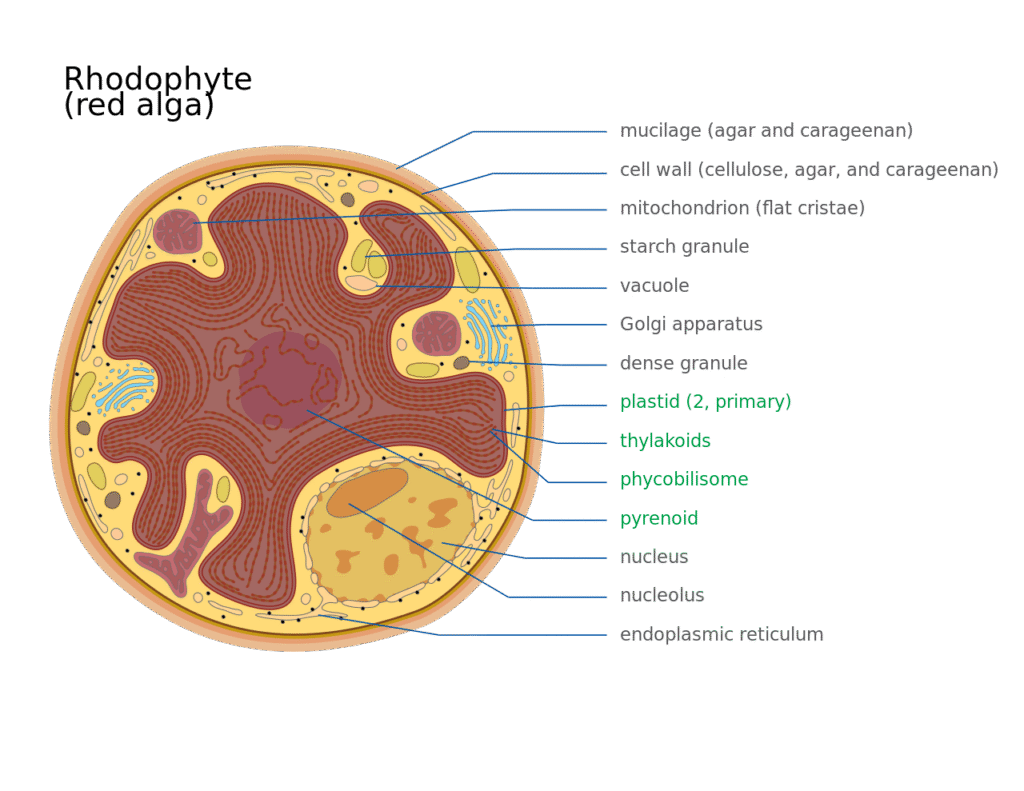
- Red algae show great variation in their form. The plant body may be simple unicellular or complex multicellular thallus.
- Most of the members are multicellular and marine. They form visible sea weeds in the sea water.
- The thallus may be simple filamentous, branched filamentous, feathery, tubular or flat sheet like. Some forms are also crust like.
- The size is mostly macroscopic. Most red algae grow upto about 50 cm in length, but some forms may reach upto 2 meter.
- The plant body is thalloid. It is not differentiated into true root, stem and leaf.
- Flagella are absent in all stages of the life cycle. No motile cells are found in Rhodophyta.
- Centrioles are also absent. This is important cellular character of red algae.
- The advanced red algal thallus may be uniaxial or multiaxial. In uniaxial type, the thallus is formed around one central filament.
- In multiaxial type, the thallus is formed around many central filaments. So the body becomes more compact and complex.
- In many red algae the thallus is pseudoparenchymatous. It appears like parenchyma but actually it is formed by compactly interwoven filaments.
- In simple forms like Bangiophyceae, growth is mostly diffuse. It occurs by intercalary cell division in different parts of the thallus.
- In advanced forms like Florideophyceae, growth is mainly apical. The thallus grows by single apical cell or apical meristem at the tip.
- In simpler red algae, each cell commonly contains one large stellate chloroplast. It may contain pyrenoid.
- In advanced red algae, many small discoid chloroplasts are present. Pyrenoids are generally absent in these forms.
- The cell wall is double layered. Inner layer is made up of cellulose microfibrils and gives strength to the cell.
- The outer layer of cell wall is thick and gelatinous. It contains sulphated polysaccharides like agar and carrageenan.
- In coralline algae, the cell wall is heavily calcified. Calcium carbonate is deposited in the wall and makes the thallus hard.
- Such calcified red algae may grow as flat crusts on rocks. Some are upright and jointed also and take part in coral reef formation.
- The cells of multicellular red algae are connected by pit connections. These are formed due to incomplete cell division.
- The pit connections are closed by protein bodies known as pit plugs. They provide firmness to the thallus and help in limited cell to cell communication.
Reproduction in Red Algae (Rhodophyta)
Red algae reproduce by vegetative, asexual and sexual methods. The reproductive process is special because no motile cell is produced in the life cycle.
In Rhodophyta, flagella are completely absent. So the male gametes, female gametes and spores cannot swim from one place to another.
Due to the absence of motile stages, the transfer of reproductive bodies depends on water current. In some marine forms, small aquatic animals also help in carrying the gametes.
Vegetative reproduction
- Vegetative reproduction commonly occurs by fragmentation of the thallus. This method is mostly found in simple filamentous and branched forms.
- In this process, the thallus breaks into small pieces due to wave action or mechanical injury. Each piece then develops into a new plant body under suitable condition.
- This type of reproduction is simple and does not involve formation of any special reproductive organ. It helps in quick multiplication of the plant.
Asexual reproduction
- Asexual reproduction takes place by formation of non-motile spores. These spores do not have flagella, so they are carried passively by water current.
- In some red algae, monospores are produced as asexual spores. They are formed singly inside the sporangium and germinate directly into new thallus.
- The asexual spores help in increasing the number of plants without fusion of gametes. This method is common in several simpler members of red algae.
Sexual reproduction
- Sexual reproduction in red algae is oogamous type. In this process, the male gamete is small and non-motile, while the female gamete remains inside the female sex organ.
- The male gametes are called spermatia. They are produced inside special male reproductive organs called spermatangia.
- The spermatia are non-motile and they cannot reach the female organ by their own movement. They are carried towards the female plant by water current.
- The female sex organ is called carpogonium. It is flask shaped structure and contains the female gamete at its basal swollen part.
- The carpogonium has a long hair like receptive part called trichogyne. The trichogyne projects outside and receives the drifting spermatium.
- When a spermatium comes in contact with the trichogyne, the male nucleus passes down into the carpogonium. After this, fertilization takes place and zygote is formed.
Post fertilization changes
- After fertilization, the zygote does not immediately develop into an independent plant. It remains attached with the female gametophyte and develops into carposporophyte.
- The carposporophyte is diploid in nature. It remains dependent on the female gametophyte for nutrition, so it is not a free living generation.
- The main function of carposporophyte is to produce a large number of diploid carpospores. Thus one fertilization event gives rise to many spores.
- In many red algae, the carposporophyte is surrounded by protective tissue of female gametophyte. This whole structure is known as cystocarp.
Tetrasporophyte stage
- The carpospores are released from the cystocarp and germinate into diploid tetrasporophyte. This stage is free living and resembles the gametophyte in many forms.
- The tetrasporophyte produces tetrasporangia. Inside the tetrasporangium, meiosis takes place and four haploid tetraspores are produced.
- The tetraspores are non-motile spores. After liberation, they germinate and form new haploid gametophytes.
Triphasic life cycle
- Most advanced red algae show triphasic life cycle. It means the life cycle consists of three different phases.
- These three phases are haploid gametophyte, diploid carposporophyte and diploid tetrasporophyte.
- The gametophyte produces male and female gametes. After fertilization the carposporophyte is formed on the female plant, and it produces carpospores.
- The carpospores form tetrasporophyte, which produces haploid tetraspores by meiosis. These tetraspores again develop into male and female gametophytes.
Life Cycle in Red Algae (Rhodophyta)
Red algae show a very special type of life cycle. In advanced members, the life cycle is mostly triphasic type, because three generations are present in the complete life cycle.
The three generations are gametophyte, carposporophyte and tetrasporophyte. Among these, gametophyte is haploid, while carposporophyte and tetrasporophyte are diploid.
In Rhodophyta, all reproductive cells are non-motile. Flagella are absent in all stages, so gametes and spores are carried by water current.
1. Gametophyte generation
The gametophyte is the first free living generation of red algae. It is haploid in nature and it performs photosynthesis.
The gametophyte may be male or female. In some red algae, male and female sex organs are present on same plant, while in many forms they are present on separate plants.
The male gametophyte produces male sex organs called spermatangia. These spermatangia produce non-motile male gametes known as spermatia.
The female gametophyte produces female sex organ called carpogonium. The carpogonium is flask shaped structure and it contains the female gamete in its basal swollen part.
A long hair like receptive structure is present on the carpogonium. This is called trichogyne. It receives the floating spermatium during fertilization.
2. Fertilization
The spermatia are non-motile and they cannot swim towards the female sex organ. They are carried by water current and come in contact with the trichogyne.
After attachment of spermatium with the trichogyne, the male nucleus passes down into the carpogonium. Then it fuses with the female nucleus and forms diploid zygote.
This fertilization is not followed by formation of free living sporophyte directly. The zygote remains attached with the female gametophyte.
3. Carposporophyte generation
The zygote develops into carposporophyte. It is diploid in nature but it is not free living.
The carposporophyte remains attached to the female gametophyte. It receives food from female plant and behaves like a dependent structure.
The main function of carposporophyte is to multiply the result of one fertilization. It produces large number of diploid carpospores.
In many red algae, the carposporophyte is surrounded by protective tissue of female gametophyte. This complete structure is called cystocarp.
4. Carpospore stage
The carpospores are diploid spores. They are produced from the carposporophyte.
These spores are non-motile and are released into water. After settling on suitable substratum, each carpospore germinates into a new diploid plant.
This diploid plant is called tetrasporophyte. It is the third generation of the life cycle.
5. Tetrasporophyte generation
The tetrasporophyte is diploid and free living. It is also photosynthetic and grows independently.
In many red algae, the tetrasporophyte looks similar to the gametophyte. In some forms, it may be different in external form.
The tetrasporophyte produces special sporangia called tetrasporangia. Inside each tetrasporangium, meiosis takes place.
After meiosis, four haploid tetraspores are formed. These tetraspores are non-motile and are liberated into water.
Each tetraspore germinates and forms new haploid gametophyte. Some develop into male gametophyte and some into female gametophyte.
Types of life cycle variation
1. Isomorphic life cycle
In isomorphic life cycle, the gametophyte and tetrasporophyte are similar in external appearance.
Both generations look almost same but they are different in chromosome number. The gametophyte is haploid and the tetrasporophyte is diploid.
2. Heteromorphic life cycle
In heteromorphic life cycle, the gametophyte and tetrasporophyte are different in appearance.
In some forms, one generation may be leafy blade like and the other may be crust like. This difference is clear in their thallus structure.
3. Biphasic life cycle
Some red algae show biphasic type of life cycle. In this type, the free living tetrasporophyte stage is absent.
The fertilized egg forms special structures on the female gametophyte. These structures produce tetraspores directly.
4. Apomictic life cycle
In some red algae, carposporophyte may be formed without fertilization. This condition is called apomictic or direct type.
Here the female gametophyte produces carposporophyte like structure without male gamete. So fertilization is not necessary in this case.
Examples of Common Red Algae
- Porphyra is a common red alga. It is marine and edible. It is known as nori, gim and laver. It is used in East Asian food and also used as covering material of sushi.
- Chondrus crispus is known as Irish moss. It is a marine red seaweed. It is an important source of carrageenan, which is used as thickening and stabilizing material in food, cosmetics and pharmaceutical products.
- Palmaria palmata is commonly called dulse. It is an edible red alga found in cold coastal region. It contains iodine, protein, magnesium and calcium. So it is used as nutritious seaweed food.
- Gracilaria is an important red alga. It is cultivated in tropical and temperate water. It is used for extraction of agar, which is a gelatinous substance used in microbial culture medium and food material.
- Gelidium is also agar producing red alga. It grows attached on rocks in marine water. The agar obtained from Gelidium is of good quality and used in laboratory for culture of microorganisms.
- Corallina is a common coralline red alga. Its cell wall is hard due to deposition of calcium carbonate. It forms crust like or jointed thallus and helps in formation and fixing of coral reef.
- Kappaphycus alvarezii is a tropical marine red alga. It is cultivated widely in Southeast Asian countries. It is a major source of kappa-carrageenan, which is used in food industries and other commercial preparation.
- Eucheuma denticulatum is also a carrageenan yielding red alga. It is cultivated in warm tropical sea water. It gives iota-carrageenan, which is used as gel forming and thickening substance.
- Batrachospermum is a freshwater red alga. It is called frog’s spawn alga because the thallus is soft, gelatinous and bead like. It is found in clean running water.
- Lemanea is freshwater red alga. The thallus is stiff, bristle like and sometimes looks like coarse horse hair. It grows attached to stones in streams and fast flowing water.
- Mazzaella is a marine red alga of intertidal region. Mazzaella splendens has dark purple rubbery blade and sometimes bluish shining appearance. It is commonly found on rocky sea shore.
- Mastocarpus is another intertidal red alga. Mastocarpus papillatus is a common example. The thallus is leathery, dark red to purple and grows attached on rocks in coastal region.
- Cyanidioschyzon merolae is a primitive unicellular red alga. It is an extremophilic form. It grows in acidic sulphur hot spring and can tolerate high temperature and low pH condition.
Economic Importance of Red Algae
The following are the economic importance of Red algae–
- Food – Many red algae are used as food. Porphyra is used as nori in Japan and other Asian countries. Palmaria palmata is used as dulse. These algae have protein, vitamins, fats and minerals like iodine, calcium and magnesium.
- Agar – Agar is obtained from Gelidium and Gracilaria. It is a jelly like substance. It is used in food industry for jelly, ice cream and other materials. It is also used in laboratory for preparing culture medium of bacteria and fungi.
- Carrageenan – Carrageenan is obtained from Chondrus crispus, Eucheuma and Kappaphycus. It is used as thickening and stabilizing substance. It is used in milk products, pudding, toothpaste, cosmetics and processed food.
- Medicinal use – Some red algae have medicinal value. They contain bioactive compounds which show antiviral, antibacterial, antifungal, antioxidant, anti-inflammatory and anticancer action. Mineral rich forms are also used as food supplement.
- Bone treatment – The calcified coralline red algae are used in some bone replacement treatment. Their wall contains calcium carbonate. So they are useful in bone related medical work.
- Cosmetics – Extracts of red algae are used in cosmetics. They are used in skin cream, acne treatment, anti ageing preparation and hair care materials. It keeps moisture and improves condition of skin.
- Biofertilizer – Red algae are used as manure and biofertilizer. Seaweed meal adds minerals and nitrogenous substances into soil. It improves soil condition and plant growth.
- Animal feed – Some red algae are used as feed for fishes and animals. Asparagopsis taxiformis is mixed with cattle feed. It reduces methane formation from cattle.
- Industrial use – Some red algae are used in industries. They are used for making bioplastics, biofuel and textile materials. Gloiopeltis gives funori, which is a glue like substance used in paper and cloth.
Ecological Significance of Red Algae (Rhodophyta)
The following are the ecological importance of Red algae–
- Primary producer – Red algae are important primary producer in aquatic habitat. They prepare food by photosynthesis and store solar energy in organic matter. Along with other algae, they also help in producing large amount of oxygen in the world.
- Food chain – Red algae form the base of many aquatic food chains. Many herbivorous animals, fishes, crustaceans, worms, molluscs and gastropods feed on them. So they maintain the food supply in marine ecosystem.
- Oxygen production – During photosynthesis, red algae release oxygen into water. This oxygen is used by aquatic animals for respiration. It also helps to keep the water body biologically active.
- Reef formation – Some red algae are called coralline algae. Example- Corallina and Lithothamnion. They deposit calcium carbonate in their cell wall and form hard thallus. These algae help in formation and strengthening of coral reef.
- Reef stabilization – Coralline red algae bind coral pieces and other fragments together. They cement the reef surface and make it more stable. This is important in wave affected sea region.
- Habitat formation – Red algal mats and calcified thalli give shelter to many small marine animals. Young fishes, molluscs and other invertebrates live and breed in such places. It provides protection from waves and predators.
- Control of coastal erosion – Thick growth of red algae and reef forming algae reduce the force of waves. They break the wave energy before it reaches the coast. Thus they help in lowering erosion of coastal region.
- Deep water photosynthesis – Red algae contain phycoerythrin pigment. This pigment absorbs blue and green light which can reach deeper water. So red algae can grow and photosynthesize in deep sea region where many other algae cannot live.
- Bio-indicator – Some red algae are sensitive to pollution, nutrient changes and other environmental changes. Due to this, they are used as bio-indicators of water quality and marine environment.
- Symbiotic relation – Red algae may form association with other organisms like sponges and cyanobacteria. Such relation helps in survival and nutrient exchange in aquatic ecosystem.
- Water purification – Red algae help in natural purification of water. They release oxygen and use some organic and inorganic materials from water. In this way they help to decrease pollution in water body.
References
- A Comprehensive Review of the Nutraceutical and Therapeutic Applications of Red Seaweeds (Rhodophyta) – PMC. (n.d.).
- Daley, J. (2017, March 17). At 1.6 billion years old, these fossils could be the oldest complex life. Smithsonian Magazine.
- Bangiomorpha. (2026, May 8). In Wikipedia.
- Bangiomorpha. (2026, May 8). In Wikipedia.
- Batrachospermum. (2026, January 24). In Wikipedia.
- Biological properties and potential of compounds extracted from red … (n.d.).
- Neish, I., Salling, P., Aregger, P., & Klose, J. (2017, March). CARRAGEENAN AND AGAR | Indonesia seaweed. Ministry of Marine Affairs and Fisheries.
- Carrageenan Deep Dive – Kappa, Iota and Lambda – UL Prospector. (n.d.). UL Prospector.
- Carrageenan From Kappaphycus alvarezii (Rhodophyta, Solieriaceae): Metabolism, Structure, Production, and Application – PMC. (n.d.).
- Keeling, P. J. (2009). Chromalveolates and the evolution of plastids by secondary endosymbiosis. Journal of Eukaryotic Microbiology, 56(1), 1–8. https://doi.org/10.1111/j.1550-7408.2008.00371.x
- Divergence time estimates and the evolution of major lineages in the … (n.d.).
- Pohekar, H. R. (n.d.). Economic importance of algae. Institute of Science, Nagpur.
- Evolutionary Trajectory, Ultrastructural Biology, and Ecological Significance of Phylum Rhodophyta. (n.d.).
- Gaimar, P. (2025, November 3). Exploring the three types of carrageenan – Kappa, iota and lambda. Ingreland.
- FLORIDEOPHYCEANS or FLORIDEANS! | The PhycoLab. (n.d.).
- Fate of Parasite and Host Organelle DNA during Cellular Transformation of Red Algae by Their Parasites – PubMed. (n.d.).
- Florideophyceae. (2026, March 5). In Wikipedia.
- Full article: Development of the red algal parasite Vertebrata aterrimophila sp. nov. (Rhodomelaceae, Ceramiales) from New Zealand – Taylor & Francis. (n.d.).
- Lemanea. (2023, October 14). In Wikipedia.
- Ganesan, E. K., West, J. A., Zuccarello, G. C., Loiseaux de Goër, S., & Rout, J. (2015). Lemanea manipurensis sp. nov. (Batrachospermales), a freshwater red algal species from North-East India. Algae, 30(1), 1-13. https://doi.org/10.4490/algae.2015.30.1.001
- Nan, F., Zhao, Y., Feng, J., Lv, J., Liu, Q., Liu, X., & Xie, S. (2022). Morphological and molecular phylogenetic analysis of a Lemanea specimen (Batrachospermales, Rhodophyta) from China. Diversity, 14(6), 479. https://doi.org/10.3390/d14060479
- Chipello-McGill, C. (2017, December 25). Oldest algae fossils suggest when photosynthesis began. Futurity.
- PIT CONNECTION FORMATION IN THE RED ALGA PSEUDOGLOIOPHLOEA – PubMed. (n.d.).
- Phycobilisome. (2026, February 12). In Wikipedia.
- Phylogenetic relationships among seven freshwater red algal genera in the Batrachospermaceae (Batrachospermales, Rhodophyta) using complete chloroplast genome data – PMC. (n.d.).
- Pit plugs. (n.d.). Marine Botany at FHL.
- Pit connection. (2025, December 20). In Wikipedia.
- Pit connection formation in the red alga Pseudogloiophlea – ResearchGate. (n.d.).
- Plastid. (2026, May 11). In Wikipedia.
- RED ALGAE. (2020). Ataman Chemical.
- Sharma, N. (2025, July 12). Red algae (Rhodophyta): Characteristic, classification, importance. Microbe Notes.
- Red algae. (n.d.). BYJU’S.
- Red algae. (2026, May 11). In Wikipedia.
- Red algae | Botany | Research Starters. (2019). EBSCO.
- Blouin, N. A., & Lane, C. E. (2012). Red algal parasites: Models for a life history evolution that leaves photosynthesis behind again and again. Bioessays. https://doi.org/10.1002/bies.201100139
- Yoon, H. S., Nelson, W., Lindstrom, S. C., Boo, S. M., Pueschel, C., Qiu, H., & Bhattacharya, D. (2017). Rhodophyta. In Handbook of the Protists (pp. 89-133). Springer International Publishing. https://doi.org/10.1007/978-3-319-28149-0_33
- Watanabe, J. (2021). Rhodophyta – red seaweeds. Stanford SeaNet.
- Rhodophyta 1-2 General characteristics phylum (division) of the kingdom Protista consisting of the photosynthetic organisms comm. (2016).
- Purswani, E., & Battista, J. (n.d.). Rhodophyta general characteristics, uses & examples. Study.com.
- Structure and organization of phycobilisomes on membranes of the red alga Porphyridium cruentum – PMC. (n.d.).
- Structure of kappa, iota and lambda carrageenans – ResearchGate. (n.d.).
- Technical article – Carrageenan. (n.d.). CyberColloids Ltd.
- The endosymbiotic origin, diversification and fate of plastids – PMC – NIH. (n.d.).
- The evolution of parasitism in the red algae: Molecular comparisons of adelphoparasites and their hosts | Request PDF – ResearchGate. (n.d.).
- Archibald, J. M., & Keeling, P. J. (2004). The evolutionary history of plastids: A molecular phylogenetic perspective. In Organelles, Genomes and Eukaryote Phylogeny (pp. 55-69). CRC Press.
- Transfer of nuclei from a parasite to its host – PMC – NIH. (n.d.).
- Types of carrageenan: Kappa, iota, lambda & blended solutions from marine hydrocolloids. (2022). Meron.