

Microscope is an instrument that is used in science laboratories to visualize very minute objects, such as cells and microorganisms. It gives a contrasting image that is magnified, so the structures can be observed. The term microscope is derived from Greek words “mikrós” meaning “small” and “skópéō” meaning “look at”.
Microscopes are made up of lenses for magnification, each with its own magnification powers. Depending on the type of lens, it will magnify the specimen according to its focal strength. Their ability to function is because they have been constructed with special components that enable them to achieve high magnification levels.
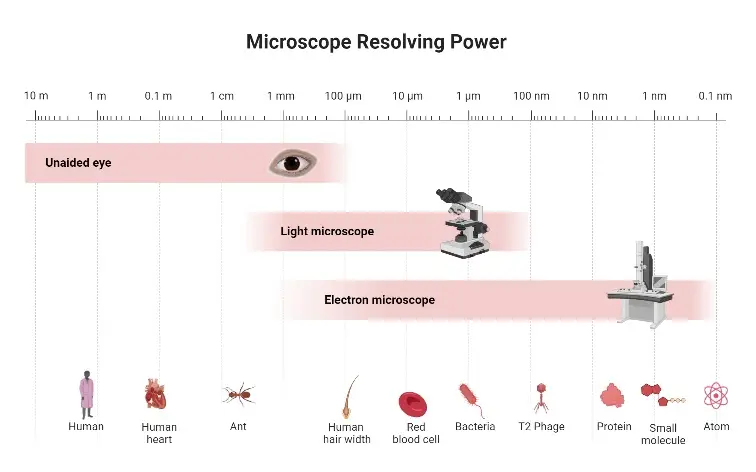
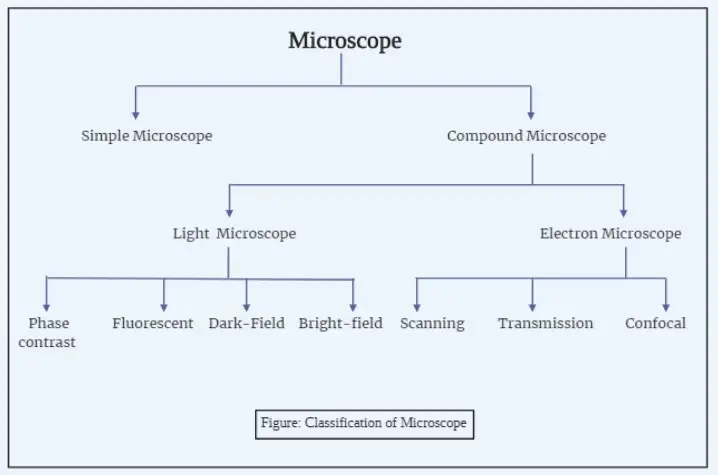
A microscope can view very small specimens and distinguish their structural differences, for example, the view of animal and plant cells viewing microscopic bacterial cells. There are different types of microscopes like light microscope, dark-field microscope, phase contrast microscope, electron microscope, fluorescent microscope, etc.
Microscopes are generally made up of structural parts for holding and supporting the microscope and its components and the optical parts that are used for magnification and viewing of the specimen images. Modern microscopes have additional electronics and display devices, but the basic work is still to produce a magnified image for viewing.
Different Types of Microscopes
Different Types of Microscopes
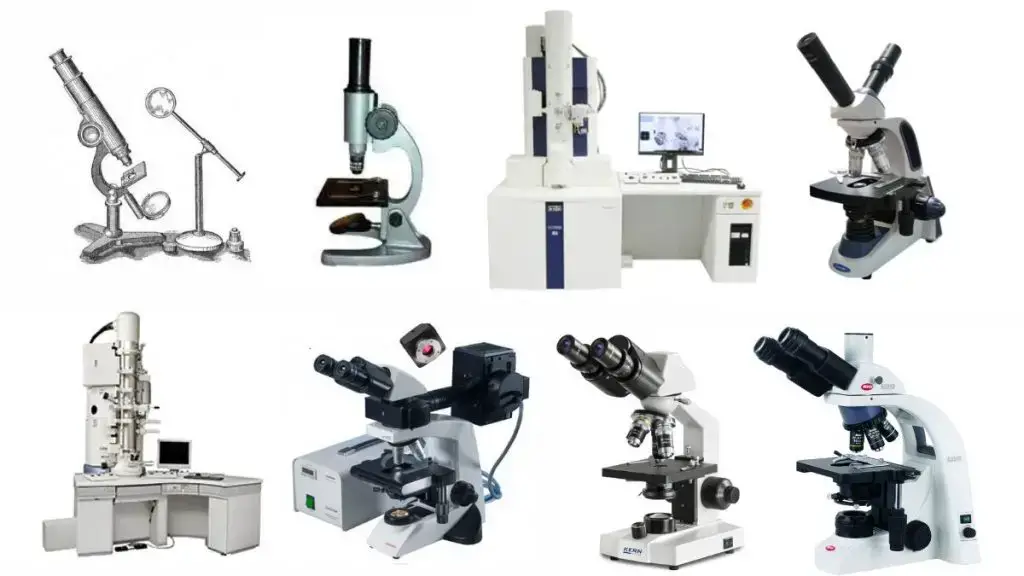
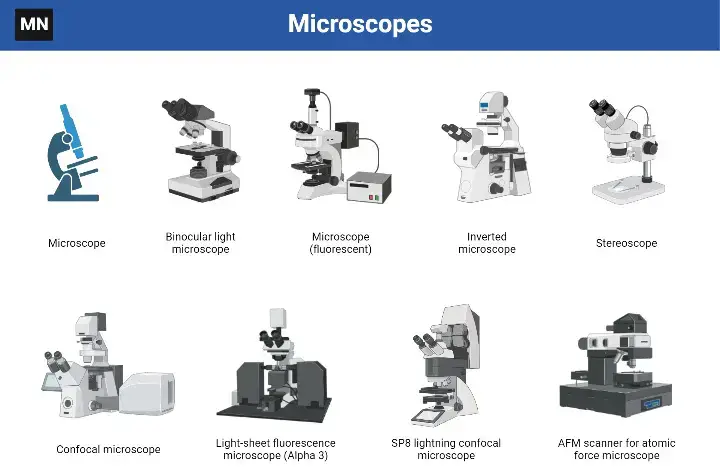
The following are the different types of microscopes-
- Optical or Light Microscope
- Simple microscope- It uses a single convex lens for magnification. It is used to magnify small objects like a magnifying glass.
- Compound microscope- It uses more than one lens for magnification. It has objective lens and eyepiece lens and gives higher magnification.
- Stereo microscope- It is also known as dissecting microscope. It gives three dimensional view of large and opaque specimens.
- Inverted microscope- In this microscope, objective lens is present below the stage and light source is above the stage. It is used to observe living cells in culture dishes.
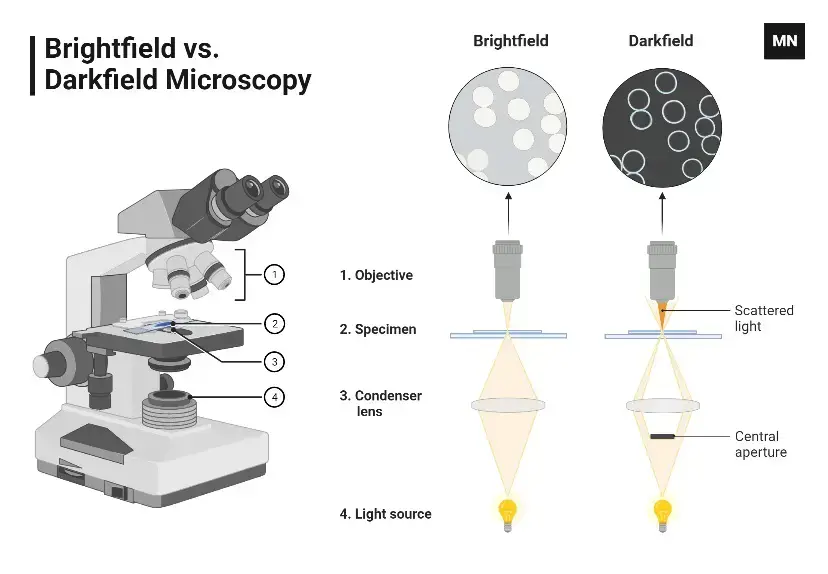
- Brightfield microscope- It uses light rays to produce a dark image against a bright background. It is the standard microscope used in biology and microbiology laboratory.
- Darkfield microscope- It makes the specimen bright against a dark background. It is used to observe unstained and transparent organisms.
- Phase contrast microscope- It is used to observe living and transparent cells without staining. It changes phase difference of light into brightness difference.
- Fluorescence microscope- It uses ultraviolet or blue light to excite fluorescent dye. The specimen emits light and specific structures are seen clearly.
- Confocal laser scanning microscope- It uses focused laser beam and pinhole aperture. It removes out of focus light and forms sharp three dimensional optical sections.
- Polarizing microscope– It uses polarized light filters. It is used to study crystals, minerals, rocks and polymers.
- Digital microscope- It uses a digital camera instead of eyepiece. The magnified image is shown directly on a computer screen.
- Electron Microscope
- Scanning Electron Microscope (SEM)– It scans the surface of specimen by using beam of electrons. It gives detailed three dimensional like image of surface.
- Transmission Electron Microscope (TEM)– It passes electron beam through a very thin specimen. It gives internal details of cells and cellular structures.
- Cryo-Electron Microscope- It is a special type of TEM. It is used to observe rapidly frozen biological sample in native hydrated state.
- Scanning Probe Microscope
- Atomic Force Microscope (AFM)- It uses a sharp physical probe attached with a flexible cantilever. It maps three dimensional nanoscale surface.
- Scanning Tunneling Microscope (STM)- It is based on quantum tunneling. It measures electric current between conductive tip and conductive sample.
- Other Specialized Microscope
- Scanning Acoustic Microscope (SAM)- It uses high frequency ultrasound waves. It is used to detect cracks, voids and internal defects in materials.
- Helium Ion Microscope (HIM)- It uses helium ion beam instead of electron beam. It gives sharp surface image with high depth of field.
- X-Ray Microscope- It uses short wavelength X-ray radiation. It is used to observe internal structures of thick and dense specimens.
1. Simple Microscope
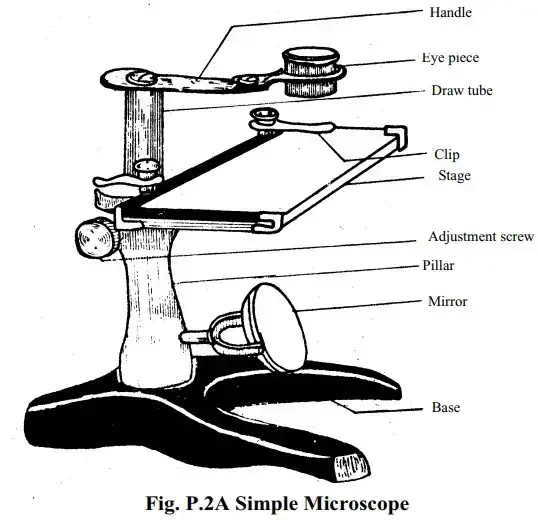
Simple Microscope is a scientific instrument used to magnify small objects so that they are visible to the unaided eye. It is a single convex lens with short focal length. A magnifying glass is the most common example of simple microscope.
Principle of Simple Microscope
Simple microscope is based on the principle of angular magnification by using a single convex lens. The convex lens bends the light rays coming from the object and produces an enlarged image. The object must be placed within the focal length of the convex lens. The image formed is virtual, erect and magnified. It cannot be obtained on a screen.
Parts of Simple Microscope
The following are the main parts of simple microscope-
- Convex lens- It is the main magnifying part of simple microscope. It bends the light rays and enlarges the appearance of the object.
- Lens holder- It holds the convex lens in fixed position. It helps in proper observation of the specimen.
- Stage or flat surface- It is the surface on which the specimen is placed for observation.
- Light source- It may be natural light or artificial light. It is used to illuminate the specimen.
- Handle or stand- It supports the microscope and helps to hold it during observation.
Uses of Simple Microscope
The following are the uses of simple microscope-
- It is used to observe small objects which cannot be seen clearly by naked eye.
- It is used as magnifying glass for reading small letters and observing small details.
- It is used in simple field inspection.
- It is used in dissection work for observing small parts.
- It is used by jewellers and watch makers to observe fine details.
- It was used by Antonie Van Leeuwenhoek to observe microorganisms in freshwater.
- It is used in schools and laboratories for basic observation of specimens.
Limitations of Simple Microscope
The following are the limitations of simple microscope-
- It has low magnification power as compared to compound microscope.
- It generally gives magnification of about 10X to 20X.
- It has low resolving power. Very fine details cannot be observed clearly.
- It depends on visible light, so it cannot show nanoscale structures.
- It has simple optical arrangement and does not have multiple objective lenses.
- It does not have advanced focusing system like compound microscope.
- It does not have condenser and proper illumination system for better image contrast.
2. Compound Microscope
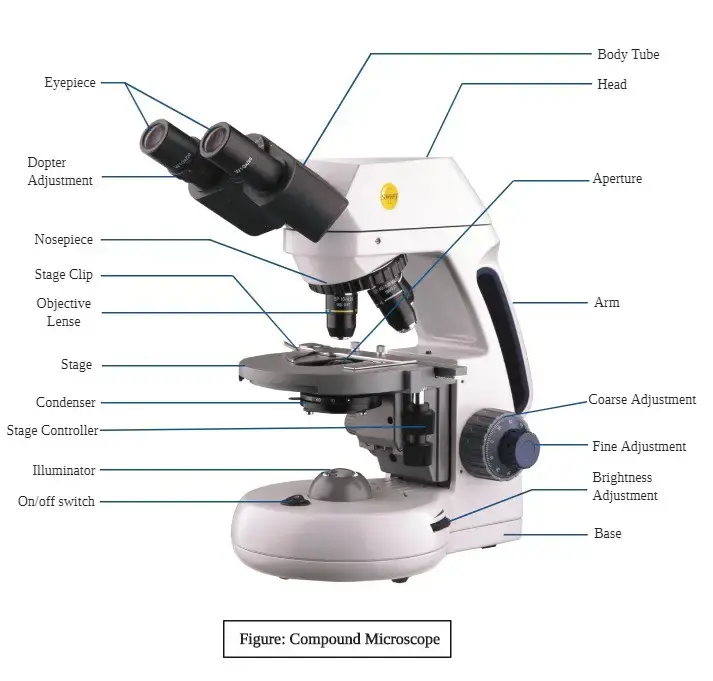
Compound Microscope is a type of light microscope that is used to magnify very small objects by using more than one lens. It is commonly used in biology, microbiology and medical laboratory. It gives higher magnification than simple microscope.
Principle of Compound Microscope
Compound microscope is based on the principle of magnification by two lens system. In this microscope, visible light passes through the specimen from below. The objective lens is present near the specimen and it first forms an enlarged, inverted and real image.
This image is then magnified again by the eyepiece lens. The final image seen by the observer is highly enlarged and virtual image.
Parts of Compound Microscope
The following are the main parts of compound microscope-
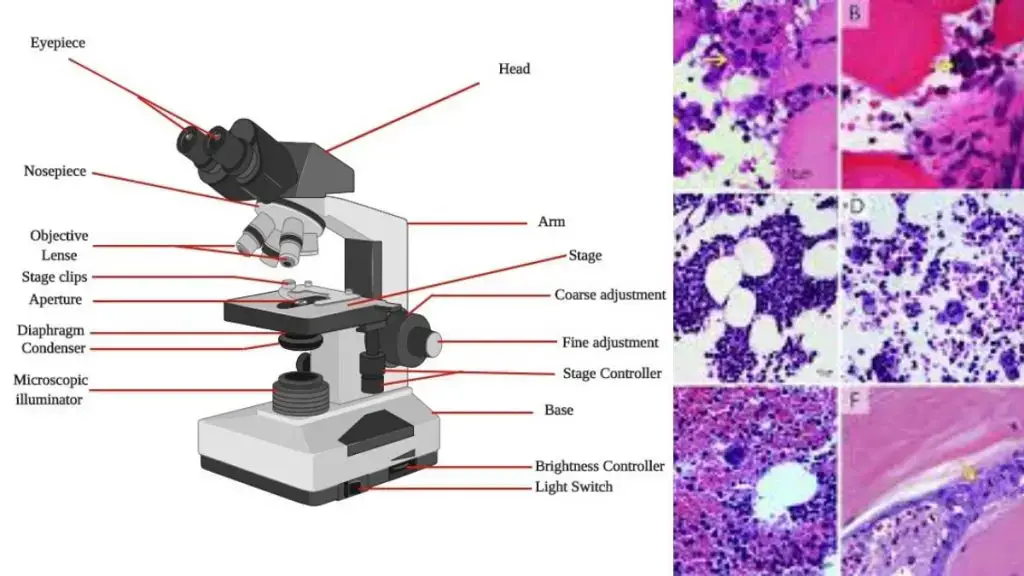
- Eyepiece or ocular lens- It is present at the top of the microscope. It is the lens through which the observer sees the magnified image.
- Objective lenses- These are present near the specimen. They collect light from the specimen and form the first magnified image.
- Revolving nosepiece- It is a rotating part which holds the objective lenses. It helps to change the magnification by rotating different objective lens.
- Stage- It is the flat platform where the glass slide is placed. The specimen is kept on the stage for observation.
- Stage clips- These are used to hold the slide in proper position on the stage.
- Light source or illuminator- It is present at the base of microscope. It sends light upward through the specimen.
- Condenser- It is present below the stage. It collects and focuses light on the specimen.
- Iris diaphragm- It is present below the condenser. It controls the amount of light passing through the specimen.
- Coarse adjustment knob- It is used for rough focusing of the specimen. It moves the stage or body tube quickly.
- Fine adjustment knob- It is used for sharp and clear focusing of the image.
- Arm- It supports the upper part of microscope. It is also used for holding the microscope during carrying.
- Base- It is the lowermost part of the microscope. It supports the whole microscope and gives stability.
Uses of Compound Microscope
The following are the uses of compound microscope-
- It is used to observe microorganisms like bacteria, algae, protozoa and plankton.
- It is used to study cells and tissues in biology laboratory.
- It is used in microbiology for observation of stained microorganisms.
- It is used in pathology for examining blood smear, tissue section and other clinical samples.
- It is used to observe chromosomes and cell division.
- It is used in schools and colleges for practical study of microscopic specimens.
- It is used to observe thin and transparent specimens.
Limitations of Compound Microscope
The following are the limitations of compound microscope-
- It has limited resolving power because it uses visible light.
- It cannot show structures smaller than about 200 nm clearly.
- Its useful magnification is generally limited up to about 1000X to 1500X.
- The specimen must be thin and transparent so that light can pass through it.
- It gives mainly two dimensional image and does not show proper depth.
- The working distance between objective lens and specimen is very small.
- Many living cells are transparent, so staining is needed for better contrast.
- Staining may kill the living specimen and natural condition may be changed.
3. Stereo Microscope
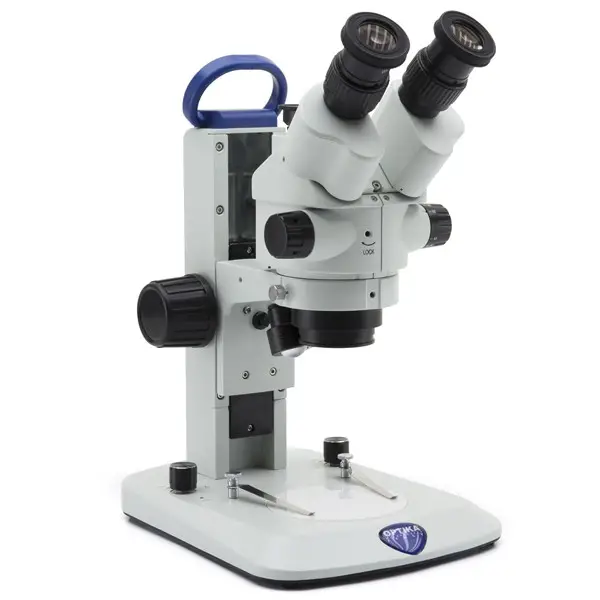
Stereo microscope is also known as dissecting microscope. It is an optical microscope used to observe larger and opaque specimens. It gives three dimensional view of the object at low magnification.
Principle of Stereo Microscope
Stereo microscope is based on the principle of binocular vision by using two separate optical paths. In this microscope, one optical path is present for each eye. The light is mainly reflected from the surface of the specimen and then enters into the objective lenses.
It does not mainly depend on transmitted light like compound microscope. The two separate images are formed and these are combined by the eyes to give stereoscopic three dimensional image.
Parts of Stereo Microscope
The following are the main parts of stereo microscope-
- Eyepieces or ocular lenses- These are two lenses present at the top of microscope. The observer looks through these lenses.
- Objective lenses- These are present near the specimen. They collect light reflected from the surface of the object.
- Prisms- These are present inside the microscope body. They help to deviate, rotate and correct the image.
- Focus knob- It is used to focus the image clearly. It moves the lens system closer or away from the specimen.
- Stage- It is the fixed platform where the specimen is placed. It supports the specimen during observation.
- Stage plate- It is present on the stage. It may be black, white or transparent and helps in better viewing of the specimen.
- Illuminator or light source- It is usually present above the specimen. It gives reflected light for observation.
- Lower light source- In some stereo microscopes, light is also present below the stage. It is used for translucent specimens.
- Arm- It supports the head and optical parts of microscope.
- Base- It is the lower part of microscope. It gives support and stability to the microscope.
- Auxiliary lenses- These are additional lenses. They are used to increase or decrease the total magnification.
Uses of Stereo Microscope
The following are the uses of stereo microscope-
- It is used to observe larger and opaque objects.
- It is used to study insects, plant parts, rocks, gems and bones.
- It is used in dissection work.
- It is used where the specimen has to be manipulated during observation.
- It gives long working distance between lens and specimen.
- It is used in repairing small instruments and circuit boards.
- It is used in textile and manufacturing industries for inspection.
- It is used to observe surface structure of specimens.
Limitations of Stereo Microscope
The following are the limitations of stereo microscope-
- It has low magnification power.
- Its magnification range is generally about 6X to 50X.
- It has lower resolving power than compound microscope.
- It cannot show very minute details of cells.
- It is not suitable for observing bacteria, blood cells and internal cell structures.
- It generally does not have fine adjustment knob.
- It is mainly used for surface observation only.
- It cannot observe thin internal structure like compound microscope.
4. Inverted Microscope
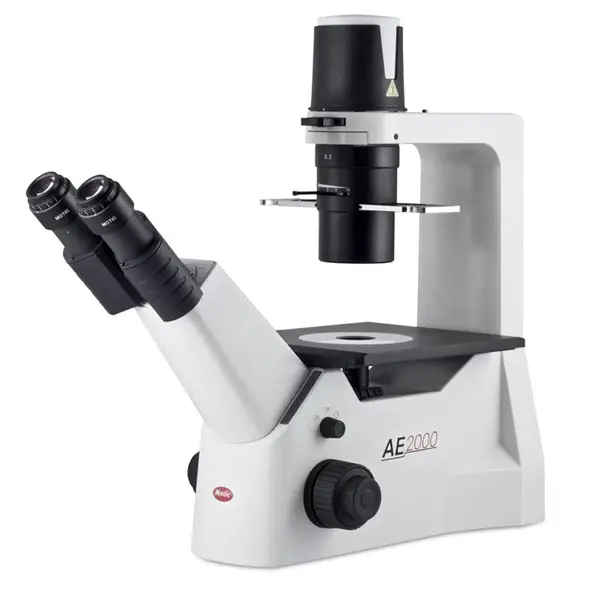
Inverted Microscope is a type of light microscope in which the optical arrangement is opposite to the ordinary upright microscope.
In this microscope, the objective lens is placed below the specimen stage and the light source is placed above the stage.
It is mainly used for observing living cells and tissues in culture vessels.
Principle of Inverted Microscope
Inverted microscope is based on the principle of observing the specimen from below. In this microscope, the light source and condenser are present above the specimen stage. The light passes downward through the specimen.
The objective lens present below the stage collects the light coming from the specimen and forms the image. This arrangement helps to observe cells which are present at the bottom of culture dish or flask.
Parts of Inverted Microscope
The following are the main parts of inverted microscope-
- Eyepiece or ocular lens- It is used to observe the magnified image of the specimen.
- Objective lens- It is present below the specimen stage. It is directed upward towards the specimen.
- Revolving nosepiece- It holds different objective lenses. It helps to change the magnification.
- Specimen stage- It is the platform on which culture dish, flask or slide is placed.
- Light source- It is present above the stage. It gives light for illumination of the specimen.
- Condenser lens- It is present above the specimen stage. It focuses light on the specimen.
- Coarse adjustment knob- It is used for rough focusing of the specimen.
- Fine adjustment knob- It is used for sharp and clear focusing of the image.
- Arm- It supports the body and optical parts of the microscope.
- Base- It supports the whole microscope and gives stability.
- Camera attachment- In some microscopes, digital camera is attached for taking image and recording.
- Special modules- Fluorescence, phase contrast and DIC modules may be attached for special observation.
Uses of Inverted Microscope
The following are the uses of inverted microscope-
- It is used to observe living cells.
- It is used to observe tissues growing in culture dishes.
- It is used to study cells present in liquid medium.
- It is used for observation of cells grown in Petri plates, flasks and multiwell plates.
- It is used in cell biology laboratory.
- It is used in microbiology and tissue culture work.
- It is useful for observing thick, large or heavy specimens.
- It is used where the specimen cannot be placed easily on ordinary microscope stage.
Limitations of Inverted Microscope
The following are the limitations of inverted microscope-
- It is more costly than ordinary compound microscope.
- It requires culture dishes or vessels with clear and thin bottom for better observation.
- It is not suitable for very thick and opaque specimens.
- The image quality may be affected if the culture vessel bottom is dirty or scratched.
- It needs proper handling and adjustment during observation.
- It occupies more space than simple upright microscope.
- Some special modules like fluorescence and DIC increase the cost of microscope.
- It is mainly useful for cell culture and liquid specimen, so its general laboratory use is limited.
5. Fluorescence Microscope
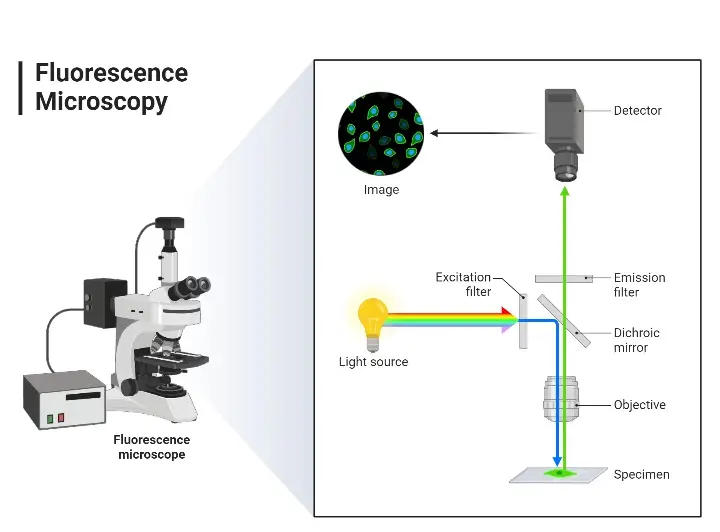
Fluorescence Microscope is a special type of light microscope that uses fluorescence to observe the specimen. It uses fluorescent dye or fluorescent protein for marking the required part of the cell. The labelled part gives light and this light is used to form the image.
Principle of Fluorescence Microscope
Fluorescence microscope is based on the principle of fluorescence. In this microscope, high energy light like ultraviolet light or blue light is passed on the specimen. The specimen is first treated with fluorescent dye, fluorescent protein or labelled antibody.
These fluorescent molecules absorb the short wavelength light and become excited. After excitation, they emit light of longer wavelength. This emitted light is allowed to pass through the filter and excitation light is blocked.
Thus, only the fluorescent part of the specimen is seen bright against dark background.
Parts of Fluorescence Microscope
The following are the main parts of fluorescence microscope-
- Light source- It gives strong light for excitation of fluorescent molecules. Mercury lamp, xenon lamp or LED is used.
- Excitation filter- It selects the required wavelength of light for exciting the specimen.
- Dichroic mirror- It reflects the excitation light towards the specimen. It allows the emitted fluorescent light to pass upward.
- Objective lens- It focuses the light on the specimen. It also collects the light emitted from the specimen.
- Stage- It is the place where the slide is kept for observation.
- Barrier filter or emission filter- It stops the unwanted excitation light. It allows only emitted fluorescent light to pass.
- Eyepiece- It is used to see the fluorescent image.
- Detector or camera- It is used for recording the image in modern microscope.
Uses of Fluorescence Microscope
The following are the uses of fluorescence microscope-
- It is used to observe specific parts of the cell.
- It is used to study nucleus, mitochondria, cytoskeleton and other cell organelles.
- It is used to detect proteins and other molecules in the cell.
- It is used in immunology for antigen antibody reaction.
- It is used to observe DNA by using fluorescent stain like DAPI.
- It is used in study of living cells and fixed cells.
- It is used in medical diagnosis.
- It is used in biological and biomedical research.
Limitations of Fluorescence Microscope
The following are the limitations of fluorescence microscope-
- It needs fluorescent dye or marker.
- The fluorescent dye may damage or change the normal condition of the cell.
- Strong light may damage the living specimen.
- Photobleaching may occur. In this process, fluorescent dye stops giving light after some time.
- Thick specimen gives blurred image due to light coming from above and below the focus.
- It has limited resolving power because it uses visible light.
- Very small structures below about 200 nm cannot be seen clearly.
- The microscope is costly.
- The preparation of specimen needs care.
6. Confocal Laser Scanning Microscope (CLSM)
Confocal Laser Scanning Microscope is a special type of fluorescence microscope. It uses laser light and pinhole aperture for producing clear image of the specimen. It is used to observe thick fluorescent specimens by taking optical sections.
Principle of Confocal Laser Scanning Microscope
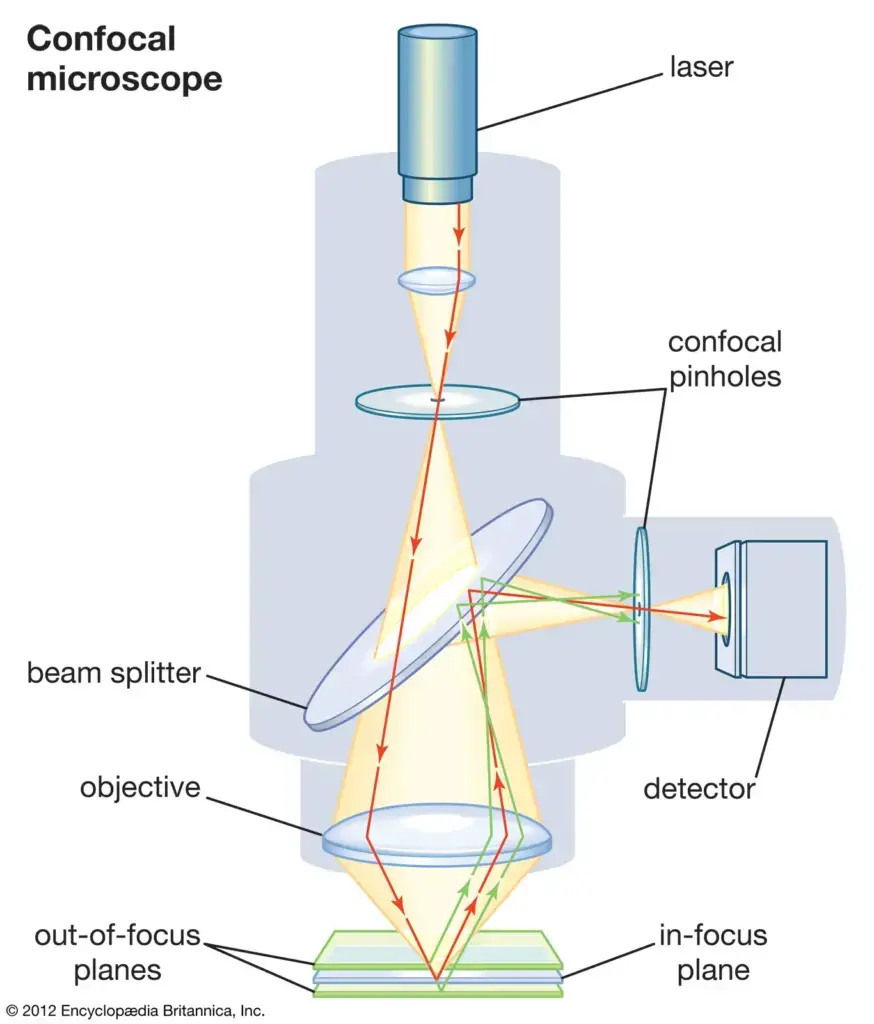
Confocal laser scanning microscope is based on the principle of point by point scanning and removal of out of focus light. In this microscope, a laser beam is focused on a very small point of the specimen.
The fluorescent molecules present at that point become excited and emit light. The emitted light again passes through the optical system and reaches the detector. Before reaching the detector, the light passes through a pinhole aperture.
The pinhole allows only the light coming from the exact focal plane. The light coming from above and below the focal plane is blocked by the pinhole. In this way, out of focus light is removed and a sharp image is produced.
The laser beam scans the specimen in a raster pattern. The image is formed point by point by computer system.
Parts of Confocal Laser Scanning Microscope
The following are the main parts of confocal laser scanning microscope-
- Laser source- It gives strong and focused light for excitation of fluorescent molecules.
- Excitation pinhole- It allows the laser light to pass as a small focused beam.
- Galvanometer scanning mirrors- These mirrors move the laser beam over the specimen in x and y direction.
- Dichroic mirror- It reflects the excitation laser light towards the specimen. It allows the emitted fluorescent light to pass towards the detector.
- Objective lens- It focuses the laser beam on the specimen. It also collects the emitted fluorescent light from the specimen.
- Specimen stage- It is the platform where the specimen slide is placed.
- Emission filter- It allows only the required fluorescent light to pass. It blocks unwanted light.
- Confocal pinhole- It is present in front of the detector. It removes the out of focus light.
- Detector- It detects the fluorescent light. Photomultiplier tube (PMT) or photodiode is generally used.
- Computer system- It converts the signal into image. It stores and displays the reconstructed image.
Uses of Confocal Laser Scanning Microscope
The following are the uses of confocal laser scanning microscope-
- It is used to observe fluorescent specimens with high clarity.
- It is used for optical sectioning of thick specimens.
- It is used to take thin optical sections without cutting the specimen.
- It is used to form three dimensional image of cells and tissues.
- It is used to study subcellular structures.
- It is used in cell biology and neuroscience.
- It is used to observe living cells with fluorescent markers.
- It is used to study movement and changes inside living cells.
- It is used in material science for surface and internal structure study.
Limitations of Confocal Laser Scanning Microscope
The following are the limitations of confocal laser scanning microscope-
- It is very costly than ordinary fluorescence microscope.
- It needs laser source and special detector.
- Strong laser light may damage living cells.
- Phototoxicity may occur during long observation.
- Photobleaching of fluorescent dye may occur.
- Only limited excitation wavelengths are available in common laser system.
- UV laser is very costly.
- The image formation depends on proper fluorescent labelling.
- It needs computer and trained person for operation.
- Scanning takes time, so very fast changes may not be recorded properly.
7. Phase-Contrast Microscope
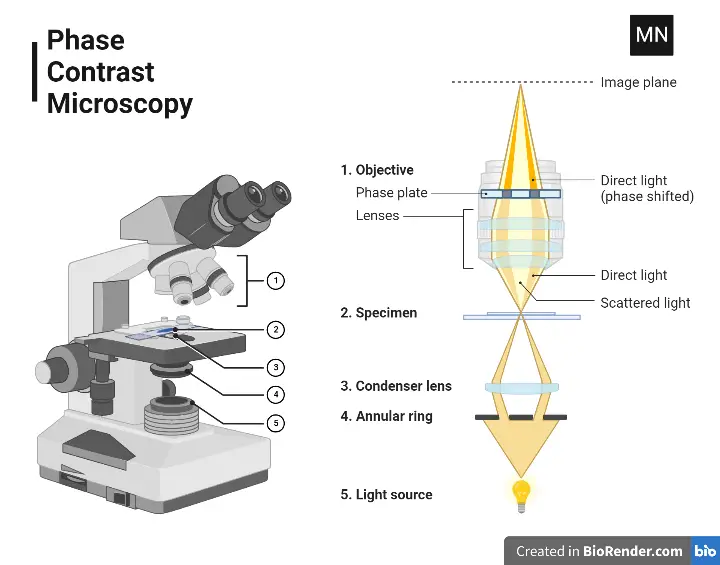
Phase-Contrast Microscope is a special type of light microscope used to observe transparent and living specimens. It is used without staining. It makes colourless cells visible by changing phase difference of light into brightness difference.
Principle of Phase-Contrast Microscope
Phase-contrast microscope is based on the principle of conversion of phase difference into amplitude or brightness difference. When light passes through a transparent specimen, some light passes directly and some light is diffracted by the specimen.
The diffracted light is slightly delayed because different parts of the specimen have different refractive index. These phase differences are not seen by the eye directly. In this microscope, direct light and diffracted light interfere with each other.
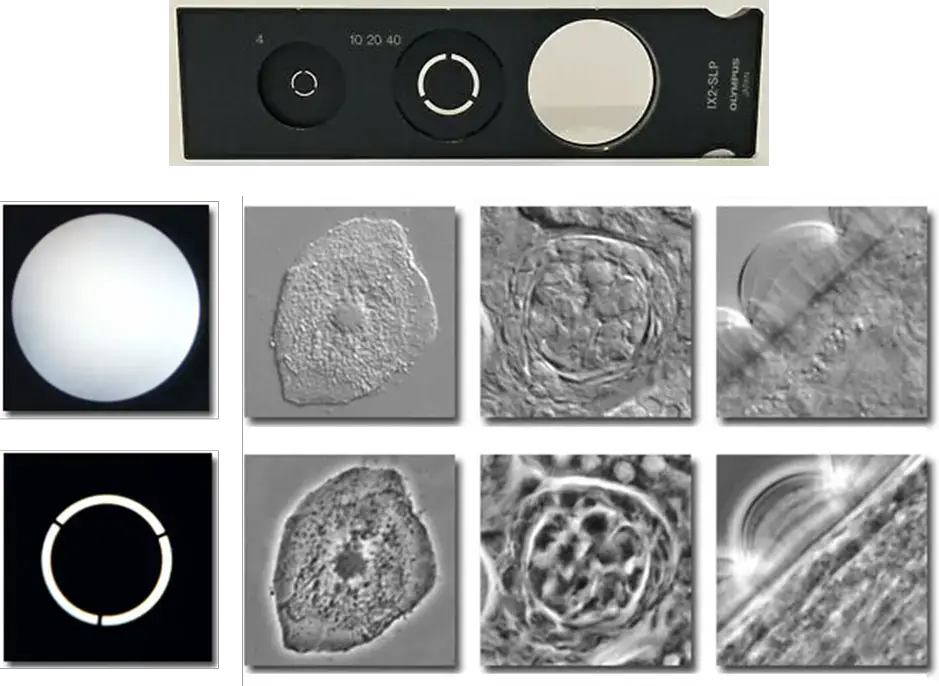
The phase plate changes the phase of direct light. Thus, the small phase changes are converted into visible brightness variation. As a result, transparent living cells are seen clearly without staining.
Parts of Phase-Contrast Microscope
The following are the main parts of phase-contrast microscope-
- Light source- It gives visible light for illumination of the specimen. Halogen lamp or LED lamp is generally used.
- Condenser- It is present below the stage. It focuses light on the specimen.
- Annular diaphragm- It is present in the condenser. It allows light to pass in the form of a hollow ring.
- Stage- It is the platform where the specimen slide is placed.
- Objective lens- It collects the direct and diffracted light from the specimen and forms magnified image.
- Phase plate- It is present at the back focal plane of objective lens. It changes the phase of direct light and helps in producing contrast.
- Eyepiece- It magnifies the image formed by objective lens. It is used to observe the final image.
- Focusing knobs- Coarse and fine adjustment knobs are used to focus the image clearly.
Uses of Phase-Contrast Microscope
The following are the uses of phase-contrast microscope-
- It is used to observe living cells without staining.
- It is used to observe transparent cells and tissues.
- It is used to study mammalian cells in culture.
- It is used to observe microorganisms in living condition.
- It is used to study cell division and mitosis.
- It is used to observe cytoplasmic streaming.
- It is used in microbiology and cell biology.
- It is used in medical laboratory for routine observation of living specimens.
Limitations of Phase-Contrast Microscope
The following are the limitations of phase-contrast microscope-
- Halo formation is seen around the specimen.
- This halo may hide the fine details of the object.
- It cannot observe very thick specimens clearly.
- It has limited resolving power because it uses visible light.
- Structures smaller than about 200 nm cannot be seen clearly.
- It is not suitable for coloured and strongly absorbing specimens.
- Phase plate and annular diaphragm must be properly aligned.
- The microscope is more costly than ordinary brightfield microscope.
8. Bright-field Microscope
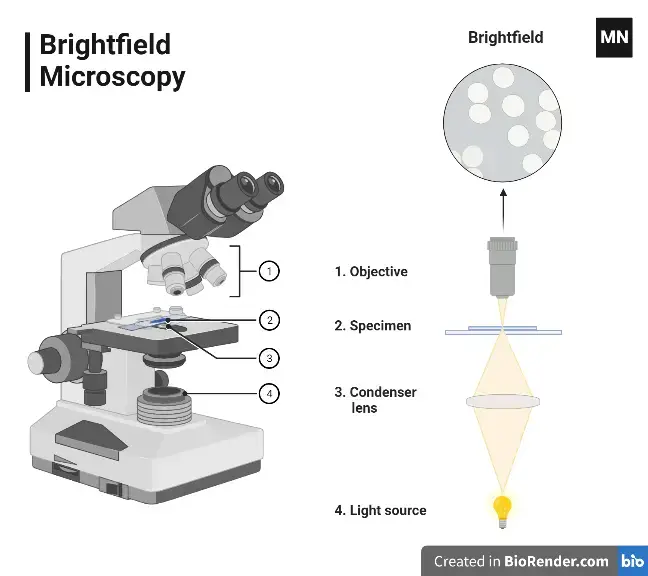
Brightfield Microscope is a type of light microscope that uses visible light for observation of specimen.
It produces a dark image against a bright background. It is the common microscope used in biology and microbiology laboratory.
Principle of Brightfield Microscope
Brightfield microscope is based on the principle of transmission of visible light through the specimen. In this microscope, light passes from below the specimen.
The specimen absorbs and scatters some amount of light. The parts which absorb more light appear dark. The background remains bright because more light passes through it. Thus, a dark image of specimen is formed against a bright background.
Parts of Brightfield Microscope
The following are the main parts of brightfield microscope-
- Light source- It gives visible light for illumination of the specimen.
- Condenser lens- It is present below the stage. It collects and focuses light on the specimen.
- Iris diaphragm- It controls the amount of light reaching the specimen.
- Stage- It is the platform where the slide is placed.
- Stage clips- It holds the slide in fixed position.
- Objective lenses- These are present near the specimen. They magnify the specimen and form the first image.
- Revolving nosepiece- It holds the objective lenses and helps to change magnification.
- Eyepiece- It is used to see the final magnified image.
- Coarse adjustment knob- It is used for rough focusing.
- Fine adjustment knob- It is used for sharp focusing.
- Arm- It supports the upper part of the microscope.
- Base- It supports the whole microscope and gives stability.
Uses of Brightfield Microscope
The following are the uses of brightfield microscope-
- It is used to observe cells and tissues.
- It is used to observe microorganisms.
- It is used in biology laboratory.
- It is used in microbiology laboratory.
- It is used in histology for study of stained tissue sections.
- It is used for observing blood smear and other stained clinical samples.
- It is used in teaching laboratory for practical work.
- It is used in industries for inspection of small parts.
Limitations of Brightfield Microscope
The following are the limitations of brightfield microscope-
- Many biological specimens are transparent.
- Transparent specimens cannot be seen clearly without staining.
- Staining may kill the living cells.
- It has low contrast in unstained specimen.
- It has limited resolving power because it uses visible light.
- Very small structures below about 200 nm cannot be seen clearly.
- It gives mainly two dimensional image.
- Thick specimens cannot be observed clearly.
9. Polarizing Microscope
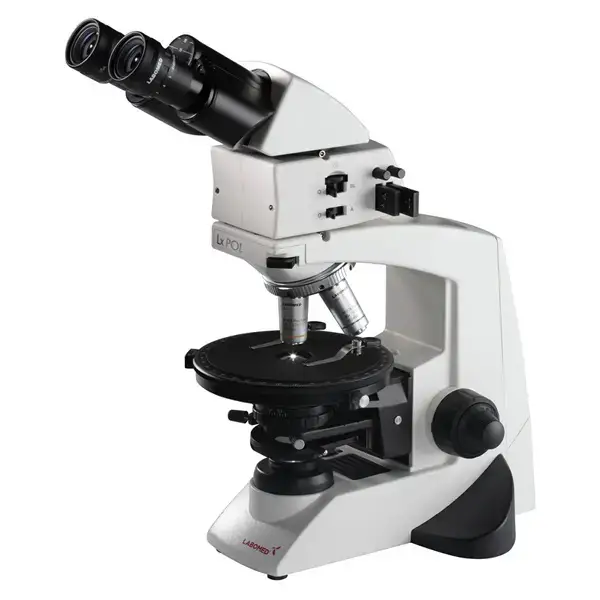
Polarizing Microscope is a type of light microscope which uses polarized light for observing the specimen.
It is mainly used to study crystals, minerals and other materials which show different optical properties in different directions.
Principle of Polarizing Microscope
Polarizing microscope is based on the principle of interaction of polarized light with anisotropic materials. In this microscope, ordinary light is changed into polarized light by using polarizing filter.
Two polarizing filters are used. One is present below the specimen and other is present above the specimen. These two filters are placed at right angle to each other. Only light vibrating in a particular direction is allowed to pass.
When polarized light passes through the specimen, it interacts with its internal structure. Some materials split the light into two rays. This is called birefringence. Some materials absorb light differently in different directions. Thus, contrast is produced and the internal arrangement of crystals and fibres can be observed.
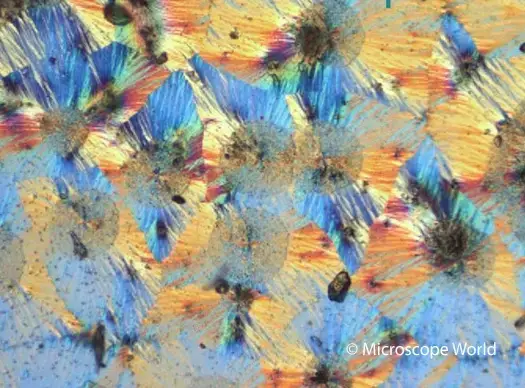
Parts of Polarizing Microscope
The following are the main parts of polarizing microscope-
- Light source- It gives visible light for observation.
- Polarizer- It is the polarizing filter present below the specimen. It converts ordinary light into polarized light.
- Condenser- It focuses the polarized light on the specimen.
- Rotating stage- It is used to place the specimen. It can be rotated for observing the specimen in different orientation.
- Objective lens- It collects light from the specimen and forms the magnified image.
- Analyzer- It is the second polarizing filter present above the specimen. It is placed at right angle to the polarizer.
- Gypsum plate- It is used in optical path for studying minerals and crystalline materials.
- Eyepiece- It magnifies the image formed by objective lens.
- Focusing knobs- These are used to focus the image clearly.
Uses of Polarizing Microscope
The following are the uses of polarizing microscope-
- It is used to study crystals.
- It is used to study minerals and rocks.
- It is used in geology and mineralogy.
- It is used in petrology for study of rock sections.
- It is used to observe birefringent materials.
- It is used to study polymers and fibres.
- It is used in material science.
- It is used to study crystal orientation of metallic objects.
- It is used to observe biological materials like muscle fibres and collagen.
Limitations of Polarizing Microscope
The following are the limitations of polarizing microscope-
- It is useful mainly for anisotropic materials.
- Isotropic materials do not show proper contrast under this microscope.
- It is not suitable for ordinary transparent cells and tissues.
- It has limited resolving power because it uses visible light.
- Very small structures below about 200 nm cannot be seen clearly.
- Proper orientation of specimen is needed.
- Interpretation of image needs knowledge of optical properties.
- It is more specialized than ordinary brightfield microscope.
10. Digital Microscope
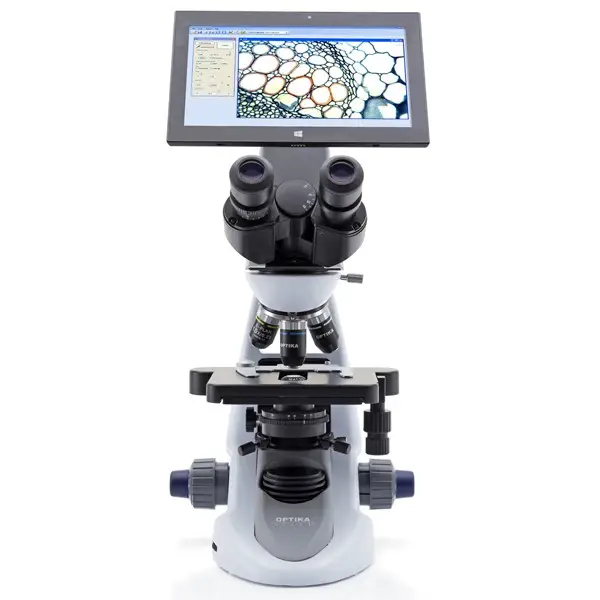
Digital Microscope is a type of microscope in which digital camera is used instead of ordinary eyepiece.
The magnified image is shown on computer monitor or built in screen. It is used for direct observation, storage and analysis of image.
Principle of Digital Microscope
Digital microscope is based on the principle of optical magnification and digital image formation. In this microscope, light is passed on the specimen.
The objective lens forms a magnified image of the specimen. This image falls on digital camera sensor. The camera sensor may be CCD or CMOS type. The sensor changes the light image into electronic signal.
This signal is changed into pixels and shown on the monitor. In some digital light microscope, eyepiece and camera both are present. A prism sends some part of light to the camera and some part to the eyepiece.
Parts of Digital Microscope
The following are the main parts of digital microscope-
- Objective lens- It focuses on the specimen and gives primary magnification.
- Digital camera sensor- It captures the magnified image. CCD or CMOS sensor is generally used.
- Stage- It is the platform where specimen is placed.
- Light source- It gives light for illumination of the specimen. LED light is commonly used.
- Display monitor- It shows the magnified digital image of the specimen.
- Computer system- It receives the image signal and helps in image processing.
- Software- It is used for image capture, measurement, storage and sharing.
- Focus knob- It is used to focus the specimen clearly.
- Base and stand- It supports the microscope and gives stability.
Uses of Digital Microscope
The following are the uses of digital microscope-
- It is used to observe magnified image on monitor.
- It is used where continuous observation is needed without eye strain.
- It is used for taking photograph of specimen.
- It is used for recording live video of the specimen.
- It is used for measuring length, area and other details by software.
- It is used in teaching and demonstration.
- It is used in research work.
- It is used in industry for quality control.
- It is used in failure analysis and inspection of small parts.
Limitations of Digital Microscope
The following are the limitations of digital microscope-
- Its resolution depends on lens and camera sensor.
- Poor quality sensor gives poor image.
- Large monitor may increase the image size but detail does not increase.
- This is called empty magnification.
- Field of view depends on the size of camera sensor and monitor.
- Low cost USB digital microscope has low magnification and low resolution.
- Some digital microscope does not have transmitted light from below.
- It needs computer, software and power supply.
- The image quality may be affected by pixel size and display resolution.
11. Scanning Electron Microscope (SEM)
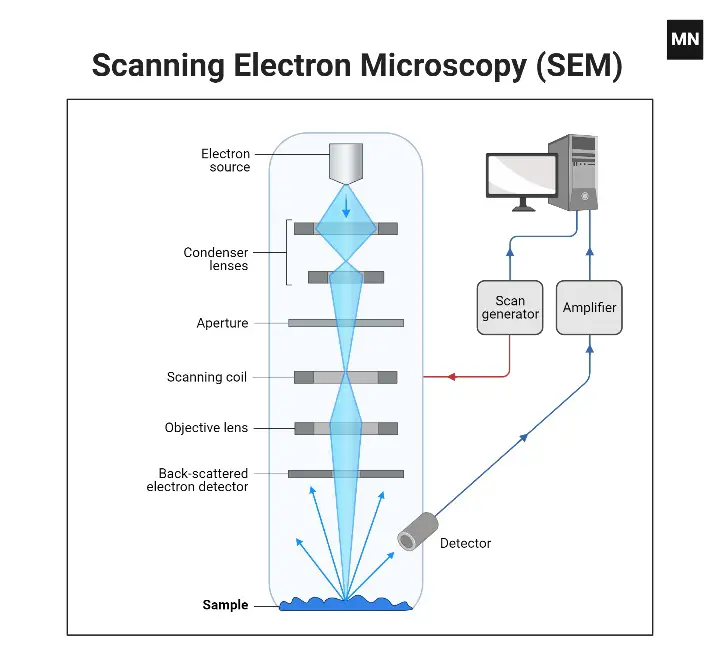
Scanning Electron Microscope (SEM) is a type of electron microscope that scans the surface of the specimen by using beam of electrons.
It is used to observe the surface morphology and topography of the specimen. It gives high resolution and three dimensional like image of the specimen surface.
Principle of Scanning Electron Microscope
Scanning Electron Microscope is based on the principle of interaction of electron beam with the surface of specimen. In this microscope, visible light is not used. A focused beam of high energy electrons is used to scan the specimen surface.
The electron beam moves over the specimen in a raster pattern. When the electron beam strikes the surface of the specimen, different signals are produced. These signals are secondary electrons, backscattered electrons and X-rays.
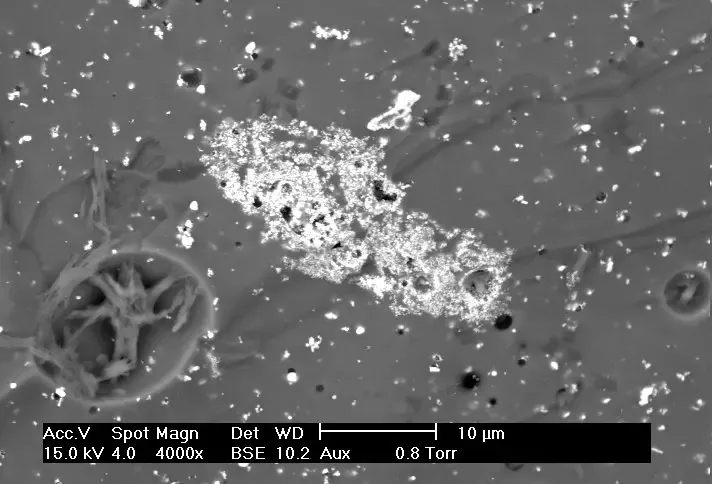
Secondary electrons are mainly used to study the surface morphology. Backscattered electrons are used to show contrast in composition of the specimen. The signals are collected by detectors and changed into image on a monitor.
Thus, a highly magnified and three dimensional like image of specimen surface is produced.
Parts of Scanning Electron Microscope
The following are the main parts of Scanning Electron Microscope-
- Electron gun- It is present at the top of the column. It produces the beam of electrons.
- Anode- It attracts the electrons and helps in accelerating the electron beam.
- Condenser lens- It controls and narrows the electron beam.
- Objective lens- It focuses the electron beam on the surface of specimen.
- Scanning coils- These coils move the electron beam over the specimen in X and Y direction.
- Specimen chamber- It is the place where the specimen is kept for observation.
- Specimen holder or stage- It holds the specimen in proper position.
- Vacuum system- It maintains high vacuum inside the microscope. It prevents scattering of electrons by air molecules.
- Secondary electron detector- It detects secondary electrons coming from the specimen surface.
- Backscattered electron detector- It detects backscattered electrons and gives compositional contrast.
- EDS or EDX detector- It detects X-rays from the specimen and is used for elemental analysis.
- Computer and display screen- It changes the signals into image and shows the image on monitor.
Uses of Scanning Electron Microscope
The following are the uses of Scanning Electron Microscope-
- It is used to study surface structure of the specimen.
- It is used to observe morphology and topography of microorganisms.
- It is used to study insects, pollen grains, cells and tissues surface.
- It is used to observe particle size and surface texture.
- It is used in material science for studying metals, polymers and ceramics.
- It is used in nanotechnology for observation of nanoscale materials.
- It is used in semiconductor and electronics industry.
- It is used to detect cracks, voids, contamination and surface defects.
- It is used in forensic science for studying gunshot residue and other small particles.
- It is used with EDS for chemical and elemental analysis of specimen.
Limitations of Scanning Electron Microscope
The following are the limitations of Scanning Electron Microscope-
- It can observe mainly surface of the specimen.
- It cannot show internal structure like Transmission Electron Microscope.
- It needs high vacuum for operation.
- Living organisms cannot be observed in normal SEM.
- Wet samples are not suitable without special preparation.
- Non-conducting specimen must be coated with thin layer of metal.
- Gold, platinum or carbon coating may be used for this purpose.
- Coating may produce artifact on the specimen surface.
- The image formed is black and white or grayscale.
- It is very costly instrument.
- It needs trained person for operation and maintenance.
12. Transmission Electron Microscope (TEM)
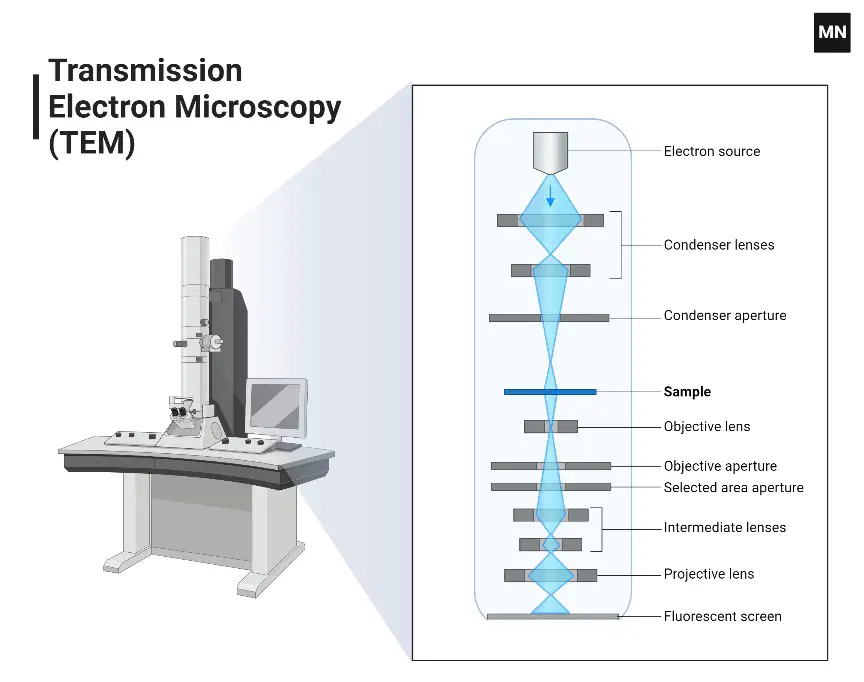
Transmission Electron Microscope (TEM) is a type of electron microscope in which electron beam is passed through very thin specimen.
It is used to observe internal structure of cells, viruses and other very small materials. It gives highly magnified two dimensional image.
Principle of Transmission Electron Microscope
Transmission Electron Microscope is based on the principle of transmission of electrons through an ultra-thin specimen. In this microscope, visible light is not used. A highly focused beam of high energy electrons is passed through the specimen.
The microscope works under high vacuum condition. Vacuum is needed because air molecules can scatter the electron beam. When electrons pass through the specimen, some electrons are transmitted and some are scattered or absorbed.
Dense parts of the specimen scatter more electrons and appear dark. Less dense parts allow more electrons to pass and appear light.
The transmitted electrons are focused by electromagnetic lenses. Thus, a magnified two dimensional image of internal structure is formed.
Parts of Transmission Electron Microscope
The following are the main parts of Transmission Electron Microscope-
- Electron gun- It is present at the top of the microscope. It produces and accelerates the beam of electrons.
- Tungsten filament- It is commonly used as electron source. Lanthanum hexaboride or field emission gun may also be used.
- Condenser lens- It focuses and controls the electron beam before it reaches the specimen.
- Specimen holder- It holds the ultra-thin specimen grid in proper position.
- Specimen stage- It is used to move and tilt the specimen in the path of electron beam.
- Objective lens- It focuses the electrons after they pass through the specimen and forms the first image.
- Projector lens- It further magnifies the image and projects it on viewing system.
- Apertures- These are small metallic plates. They remove highly scattered electrons and help to improve contrast.
- Vacuum system- It maintains very low pressure inside the microscope column.
- Fluorescent screen- It is used to view the final image.
- Photographic film or digital camera- It is used to record the image.
- Computer system- It is used in modern TEM for image display, storage and analysis.
Uses of Transmission Electron Microscope
The following are the uses of Transmission Electron Microscope-
- It is used to observe internal structure of cells.
- It is used to study cell organelles like mitochondria, ribosomes and endoplasmic reticulum.
- It is used to study viruses and their detailed morphology.
- It is used in cell biology and medical research.
- It is used in virology for observation of virus particles.
- It is used in material science.
- It is used to study crystal structure and thin films.
- It is used to observe metals, semiconductors and nanoparticles.
- It is used to study defects like grain boundaries and dislocations.
- It is used with EELS for chemical and elemental analysis of sample.
Limitations of Transmission Electron Microscope
The following are the limitations of Transmission Electron Microscope-
- The specimen must be very thin.
- Generally, specimen thickness should be less than 100 to 150 nm.
- Preparation of specimen is difficult and time consuming.
- Biological samples need fixation, dehydration, embedding and sectioning.
- Heavy metal staining is often required.
- Preparation may change the natural structure of specimen.
- Artifact may be produced during sample preparation.
- High energy electron beam may damage sensitive specimen.
- It can observe only very small area of the specimen at a time.
- Living cells cannot be observed in normal TEM.
- It needs high vacuum for operation.
- TEM is very costly instrument.
- It needs trained person for operation and maintenance.
13. Cryo-Electron Microscope (Cryo-EM)
Cryo-Electron Microscope is a special type of transmission electron microscope. It is used to observe biological molecules in frozen hydrated condition. In this microscope, the sample is rapidly frozen and then observed by electron beam.
Principle of Cryo-Electron Microscope
Cryo-Electron Microscope is based on the principle of transmission of electrons through frozen specimen. In this microscope, high energy electron beam is passed through the sample.
The sample is first rapidly frozen in cryogenic liquid like liquid ethane. This fast freezing changes water into glass like ice. This is called vitreous ice. Ice crystals are not formed during this process.
So, the structure of biological molecule is preserved in its native hydrated state. No chemical fixative or stain is generally needed.
The electron beam passes through the frozen specimen and forms two dimensional images. Many images are taken from different positions and different orientation of particles.
These images are then processed by computer. Finally, a three dimensional structure of the specimen is reconstructed.
Parts of Cryo-Electron Microscope
The following are the main parts of Cryo-Electron Microscope-
- Electron source- It produces the beam of electrons for illumination of the sample.
- Condenser lens- It controls and focuses the electron beam before it reaches the specimen.
- Objective lens- It forms the high resolution image after electrons pass through the specimen.
- Projector lens- It magnifies the image and projects it on the detector.
- Cryogenic specimen holder- It holds the frozen sample at very low temperature.
- Liquid nitrogen or liquid helium system- It maintains the specimen in frozen condition.
- Vacuum system- It maintains high vacuum inside the microscope column.
- Direct electron detector- It detects the electron signal directly and forms clear digital image.
- Computer system- It is used for image processing, storage and three dimensional reconstruction.
- Plunge freezing apparatus- It is used for rapid freezing of the sample before observation.
Uses of Cryo-Electron Microscope
The following are the uses of Cryo-Electron Microscope-
- It is used to study three dimensional structure of biomolecules.
- It is used to observe proteins and protein complexes.
- It is used to study ribosomes.
- It is used to study viruses and bacteria.
- It is used to observe biological molecules in near native condition.
- It does not need crystallization of sample like X-ray crystallography.
- It is used in drug discovery.
- It is used to study binding of drugs with target molecules.
- It is used in vaccine development.
- It is used to study antibody and antigen interaction.
- Cryo-electron tomography is used to observe intact cells and tissues.
Limitations of Cryo-Electron Microscope
The following are the limitations of Cryo-Electron Microscope-
- The raw image has low contrast.
- Low electron dose is used because strong electron beam can damage biological sample.
- Due to low dose, the image becomes noisy and grainy.
- The specimen must be very thin.
- Usually, the thickness should be less than about 100 nm.
- Sample preparation is difficult.
- Proper ice thickness is difficult to maintain.
- Freezing condition must be controlled carefully.
- It is not very suitable for very small proteins.
- Large amount of image data is produced.
- Computer processing needs high power and special software.
- The microscope is very costly.
- It needs large space and trained expert for operation.
14. Scanning Acoustic Microscope (SAM)
Scanning Acoustic Microscope is a special type of microscope that uses high frequency sound waves for observing the internal structure of a specimen.
It is used to detect hidden defects inside opaque materials without cutting or damaging the sample.
Principle of Scanning Acoustic Microscope
Scanning Acoustic Microscope is based on the principle of reflection of high frequency ultrasonic waves. In this microscope, ultrasonic waves are produced and sent into the specimen.
These sound waves penetrate into the material. When the waves meet the boundary between two different materials, some waves are reflected back. The reflection depends on acoustic impedance of the materials.
Acoustic impedance depends on density and sound velocity of the material. Air gaps like cracks, voids and delamination reflect almost all acoustic energy. So these defects are seen clearly in the image.
The reflected waves are collected as echoes. The time taken by the echo to return is measured. By measuring echo strength and time of flight, internal structure and defect depth are detected. The image is then formed on the computer screen.
Parts of Scanning Acoustic Microscope
The following are the main parts of Scanning Acoustic Microscope-
- Piezoelectric transducer- It changes electrical pulses into ultrasonic waves. It also receives the reflected echo waves.
- Acoustic lens- It focuses the ultrasonic wave into a small spot on or inside the specimen.
- Coupling medium- It is usually deionized water. It helps to transfer sound waves from transducer to specimen.
- Specimen stage- It holds the specimen during scanning.
- Scanning system- It moves the transducer or specimen in X and Y direction for scanning.
- Z adjustment system- It is used for focusing at different depth.
- Pulse generator- It produces electrical pulses for the transducer.
- Signal receiver- It receives the echo signals coming from the specimen.
- Analog to digital converter- It changes the received signal into digital form.
- Computer system- It processes the signal and forms the image on monitor.
Uses of Scanning Acoustic Microscope
The following are the uses of Scanning Acoustic Microscope-
- It is used for non-destructive testing of materials.
- It is used to observe internal defects without cutting the specimen.
- It is used to detect cracks, voids and delamination.
- It is used in semiconductor industry.
- It is used to inspect integrated circuits and printed circuit boards.
- It is used to detect poor solder joints.
- It is used to study bonded wafers.
- It is used in material science for studying metals, ceramics, plastics and composites.
- It is used for thickness mapping of layers.
- It is used to check weld and braze joints.
- It is used in aerospace and automobile parts inspection.
- It is used to check seals and adhesive joints in medical devices.
- It is also used to observe subsurface structures in bones, teeth and biological tissues.
Limitations of Scanning Acoustic Microscope
The following are the limitations of Scanning Acoustic Microscope-
- It needs coupling medium for sound transmission.
- Usually water is used as coupling medium.
- Water sensitive samples cannot be studied easily.
- Highly porous samples are not suitable.
- High frequency gives better resolution but penetration becomes less.
- Low frequency penetrates deeper but resolution becomes low.
- The specimen surface should be flat and smooth.
- Rough and irregular surface scatters the sound waves.
- It cannot give chemical composition of the sample.
- It gives mainly structural and physical information.
- Very soft or highly layered materials may disturb the sound signal.
- Deep structures may not be seen clearly in some samples.
15. Helium Ion Microscope (HIM)
Helium Ion Microscope is a special type of microscope that uses helium ion beam for observing the surface of specimen.
It is not based on visible light or electron beam. It gives very sharp surface image with large depth of field.
Principle of Helium Ion Microscope
Helium Ion Microscope is based on the principle of scanning of focused helium ion beam over the specimen surface. In this microscope, helium ions are used instead of electrons.
The helium ion beam is produced from a very sharp needle tip. This tip is kept at high voltage and very low temperature in helium gas. The focused beam of helium ions is scanned over the surface of specimen.
When helium ions strike the specimen, secondary electrons and backscattered ions are produced. These signals are collected by detectors. The signals are then converted into image on the monitor. Helium ions have very short wavelength.
So, it gives very high resolution and clear surface image.
Parts of Helium Ion Microscope
The following are the main parts of Helium Ion Microscope-
- Helium ion source- It produces the helium ion beam. It has very sharp cryogenically cooled needle tip.
- Ion optical column- It contains electrostatic lenses. These lenses focus and direct the helium ion beam on the specimen.
- Aperture- It controls the size and shape of the ion beam.
- Scanning system- It moves the helium ion beam over the specimen surface.
- Specimen chamber- It is the place where specimen is kept for observation.
- Specimen stage- It holds the specimen in proper position.
- Secondary electron detector- It detects secondary electrons coming from the specimen surface.
- Backscattered ion detector- It detects backscattered ions from the specimen.
- Electron flood gun- It is used to neutralize positive charge on non-conducting specimen.
- Vacuum system- It maintains vacuum inside the microscope chamber.
- Computer and display system- It converts the signals into image and shows the image on monitor.
Uses of Helium Ion Microscope
The following are the uses of Helium Ion Microscope-
- It is used for very high resolution surface imaging.
- It is used to observe surface topography of materials.
- It is used to study material contrast and crystal structure.
- It is used to observe non-conducting specimens without metal coating.
- It is used to observe polymers and plastics.
- It is used to study biological and organic materials.
- It is used to observe microbes, plant parts and cellular surface structures.
- It is used to study soot and atmospheric aerosol particles.
- It is used in nanotechnology.
- It is used for nanofabrication, cutting and milling of small structures.
Limitations of Helium Ion Microscope
The following are the limitations of Helium Ion Microscope-
- It is very costly instrument.
- It is highly specialized microscope.
- It needs trained person for operation.
- It needs high vacuum for observation.
- Biological specimens still need special preparation.
- Critical point drying may be needed for some biological samples.
- It mainly gives surface information.
- It cannot easily show internal structure of thick specimen.
- Some specimens may get damaged by ion beam.
- Availability of this microscope is limited.
16. X-Ray Microscope
X-Ray Microscope is a special type of microscope that uses X-rays for observing the specimen.
It is used to observe internal structure of thick and dense materials. It can form three dimensional image without cutting the specimen.
Principle of X-Ray Microscope
X-Ray Microscope is based on the principle of interaction of short wavelength X-rays with the specimen. In this microscope, visible light or electron beam is not used.
Short wavelength X-rays are passed through the specimen. X-rays can penetrate thick and dense samples. When X-rays pass through the specimen, some rays are absorbed and some rays are transmitted.
The transmitted X-rays or fluorescent X-rays are collected by detector. The detector changes the X-ray signal into image. The specimen may be scanned from different angles. These different images are processed by computer.
Thus, a three dimensional image of internal structure is formed without sectioning and staining.
Parts of X-Ray Microscope
The following are the main parts of X-Ray Microscope-
- X-ray source- It produces X-rays for illumination of the specimen. Microfocus X-ray tube or synchrotron radiation source may be used.
- X-ray optics- It controls and directs the X-ray beam towards the specimen.
- X-ray condenser- It focuses the X-rays on the specimen.
- Zone plate- It acts like a lens for X-rays. It helps in focusing and magnifying the X-ray image.
- Specimen stage- It is the place where the specimen is kept for observation.
- Rotating holder- It rotates the specimen for taking images from different angles.
- Cryo or heating stage- It is used when specimen has to be observed at low or high temperature.
- Detector- It detects the transmitted or fluorescent X-ray signals.
- Scintillator screen- It changes X-rays into visible light for detection.
- Vacuum chamber- It reduces absorption of X-rays by air.
- Computer system- It processes the signals and forms the image.
- Reconstruction software- It converts many two dimensional images into three dimensional image.
Uses of X-Ray Microscope
The following are the uses of X-Ray Microscope-
- It is used to observe internal structure of thick specimen.
- It is used for non-destructive testing of materials.
- It is used to detect internal defects in metals, ceramics, polymers and composites.
- It is used to observe welded parts and 3D printed materials.
- It is used in electronics and semiconductor industry.
- It is used to observe silicon wafers, microchips and MEMS.
- It is used to detect solder joint defects.
- It is used in biomedical research.
- It is used to observe bone structure, tissues and medical implants.
- It is used to study drug delivery systems.
- It is used in earth science for studying rocks, minerals and microfossils.
- It is used in battery and fuel cell material study.
- It is used in forensic science to observe hidden materials without destroying the sample.
Limitations of X-Ray Microscope
The following are the limitations of X-Ray Microscope-
- It is very costly instrument.
- Advanced X-ray microscope may need synchrotron radiation source.
- Synchrotron facility is large and not easily available.
- The instrument is complex.
- It needs trained person for operation.
- Vacuum chamber may be needed to reduce absorption of X-rays by air.
- Image reconstruction needs computer and special software.
- Three dimensional image processing takes time.
- Soft biological samples may need special preparation.
- Radiation damage may occur in some sensitive specimens.
- The contrast may be low in materials having similar X-ray absorption.
17. Dark-Field Microscope
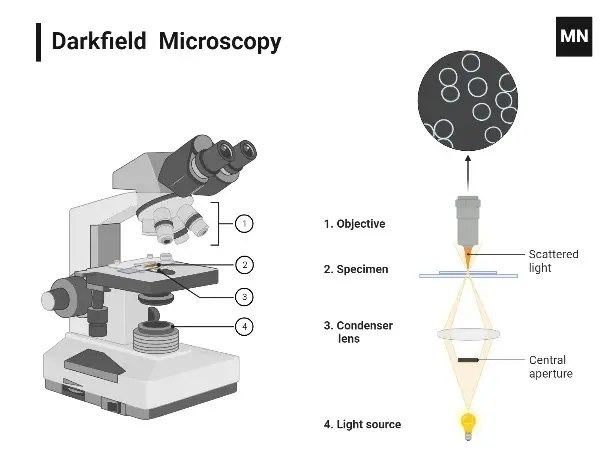
Darkfield Microscope is a type of light microscope in which the specimen appears bright against dark background.
It is used to observe transparent, living and unstained specimens. It gives contrast by scattered light from the specimen.
Principle of Darkfield Microscope
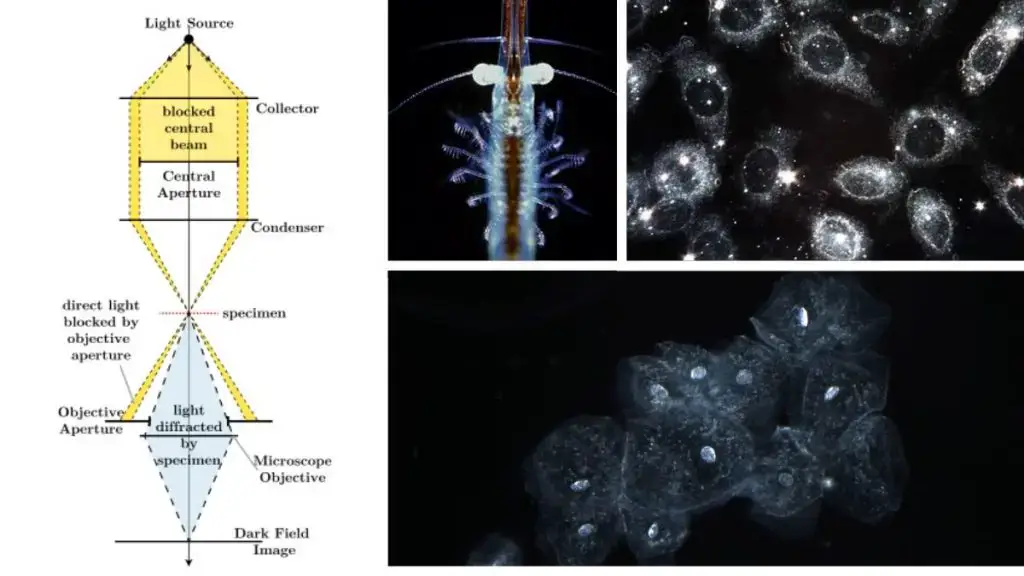
Darkfield microscope is based on the principle of oblique illumination. In this microscope, direct light is blocked from entering into the objective lens. The light is passed on the specimen from the side or at an angle.
When this oblique light strikes the specimen, it is scattered, refracted or diffracted. Only this scattered light enters into the objective lens. The background remains dark because direct light does not enter the objective.
Thus, the specimen appears bright against a completely dark background.
Parts of Darkfield Microscope
The following are the main parts of darkfield microscope-
- Light source- It gives visible light for illumination of the specimen.
- Darkfield condenser- It directs the light on the specimen at an oblique angle.
- Central stop- It is present in the condenser. It blocks the direct light from entering the objective lens.
- Stage- It is the platform where the specimen slide is placed.
- Objective lens- It collects only scattered light from the specimen and forms the image.
- Eyepiece- It magnifies the image formed by objective lens.
- Focusing knobs- Coarse and fine adjustment knobs are used to focus the image clearly.
- Camera- It may be attached for taking photograph of the image.
Uses of Darkfield Microscope
The following are the uses of darkfield microscope-
- It is used to observe unstained specimens.
- It is used to observe living microorganisms.
- It is used to observe transparent specimens which are not seen clearly in brightfield microscope.
- It is used to observe bacteria.
- It is used to observe spirochetes.
- It is used to observe fine structures with high contrast.
- It is used in microbiology laboratory.
- It is used when staining is not required or staining may damage the specimen.
Limitations of Darkfield Microscope
The following are the limitations of darkfield microscope-
- Thick specimens cannot be observed clearly.
- Thick specimens scatter too much light and image becomes distorted.
- Dust particles also scatter light and appear bright.
- So, slide and coverslip must be very clean.
- Sample preparation needs more care.
- Highly refractive materials may distort the image.
- It gives mainly outline and surface details of the specimen.
- Internal details are not seen clearly.
- It needs special darkfield condenser.
- The image may be difficult to interpret in some samples.
18. Atomic Force Microscope (AFM)
Atomic Force Microscope is a type of scanning probe microscope. It is used to study the surface of specimen at nanometer level. It uses a sharp tip instead of light or electron beam.
Principle of Atomic Force Microscope
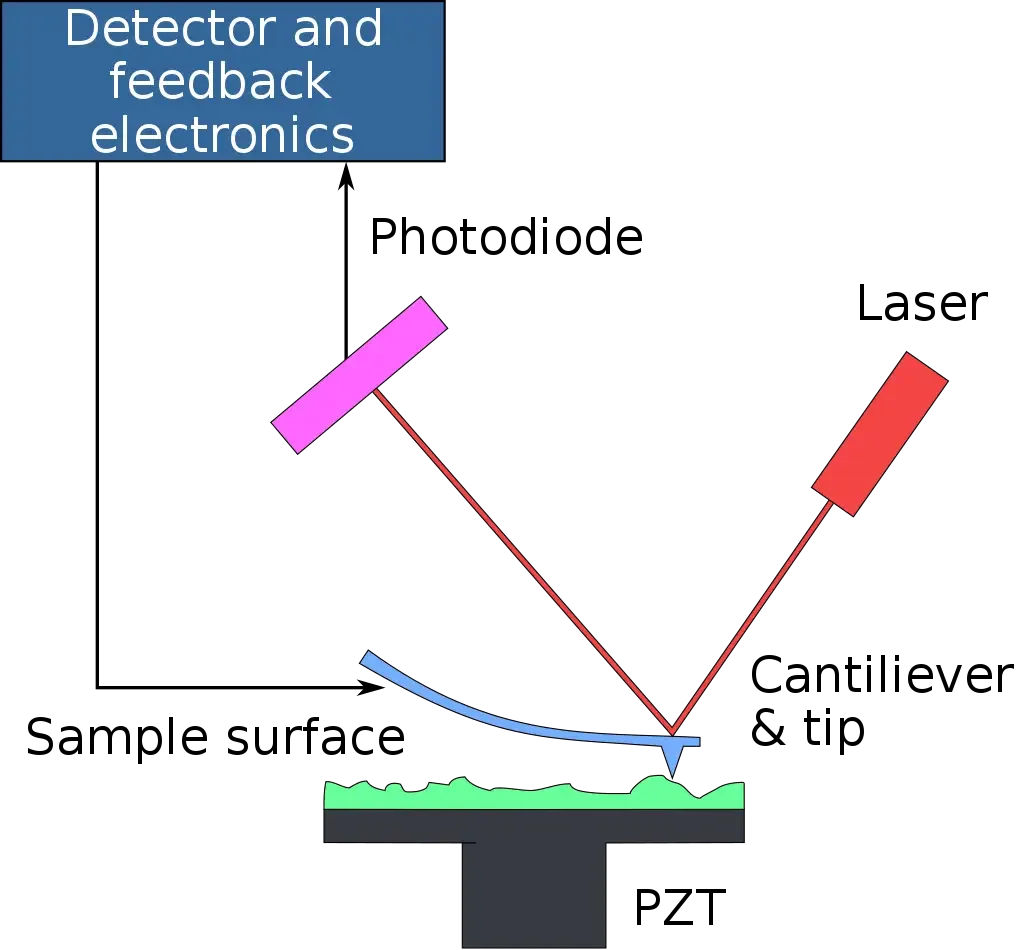
Atomic Force Microscope is based on the principle of interaction force between a sharp tip and specimen surface. mIn this microscope, a very sharp tip is attached to a flexible cantilever.
The tip is moved over the surface of the specimen. When the tip comes near the surface, different forces act between the tip and the specimen. These forces may be contact force, van der Waals force, electrostatic force or magnetic force.
Due to these small forces, the cantilever bends or deflects. A laser beam is focused on the back side of the cantilever.
The reflected laser beam falls on a photodetector. Any bending of cantilever changes the position of reflected laser beam.
This change is converted into electrical signal. A feedback system maintains constant force or constant distance between tip and sample.
Thus, the surface is scanned point by point and three dimensional surface image is formed.
Parts of Atomic Force Microscope
The following are the main parts of Atomic Force Microscope-
- Cantilever- It is a flexible small arm. It bends when force acts between the tip and specimen surface.
- Probe or tip- It is a very sharp point present at the free end of cantilever. It is generally made up of silicon or silicon nitride.
- Laser diode- It gives a focused laser beam on the back side of the cantilever.
- Photodetector- It detects the reflected laser beam. It converts the cantilever deflection into electrical signal.
- Piezoelectric scanner- It moves the sample or tip in x, y and z direction very precisely.
- Feedback system- It controls the distance between tip and specimen surface.
- Sample stage- It holds the specimen during scanning.
- Vibration isolation table- It reduces vibration during observation.
- Computer system- It processes the signal and forms the three dimensional surface image.
Uses of Atomic Force Microscope
The following are the uses of Atomic Force Microscope-
- It is used to study surface topography at nanoscale level.
- It is used to form three dimensional image of surface.
- It is used to measure surface roughness.
- It is used to study elasticity and stiffness of materials.
- It is used to measure friction and adhesion force.
- It is used to observe non-conducting specimens.
- It is used to study biological samples like cells, proteins and tissues.
- It can be used in air and liquid medium.
- It is used in material science and nanotechnology.
- It is used for nanomanipulation of molecules and surface structures.
- It is used in single molecule force study.
Limitations of Atomic Force Microscope
The following are the limitations of Atomic Force Microscope-
- It scans the surface point by point.
- So, image formation is slow.
- It can scan only small area at a time.
- The tip is very delicate and may break easily.
- Damaged or blunt tip gives wrong image.
- Dust or contamination on tip may produce artifact.
- The image depends on the shape of the tip.
- It gives mainly surface information.
- It cannot show internal structure of the specimen.
- Selection of proper tip is difficult.
- It is sensitive to vibration and temperature change.
- Thermal drift may distort the image.
- Operation and interpretation need trained person.
19. Scanning Tunneling Microscope (STM)
Scanning Tunneling Microscope is a type of scanning probe microscope. It is used to observe the surface of conducting materials at atomic level. It uses a sharp metallic tip and tunneling current for image formation.
Principle of Scanning Tunneling Microscope
Scanning Tunneling Microscope is based on the principle of quantum tunneling. In this microscope, a very sharp conducting tip is brought very close to the conducting specimen surface.
The distance between tip and surface is less than one nanometer. A small voltage is applied between the tip and the specimen. Due to this, electrons pass through the gap between the tip and the specimen.
This flow of electrons is called tunneling current. The tunneling current changes with the distance between the tip and the surface. Small change in height gives large change in tunneling current.
The tip is moved over the specimen surface in a raster pattern. A feedback system maintains constant tunneling current by moving the tip up and down.
Thus, the surface structure is mapped and three dimensional atomic image is formed.
Parts of Scanning Tunneling Microscope
The following are the main parts of Scanning Tunneling Microscope-
- Conducting tip- It is a very sharp metallic needle. It is generally made up of tungsten or platinum-iridium.
- Specimen stage- It holds the conducting or semiconducting specimen.
- Bias voltage source- It gives small voltage between the tip and specimen.
- Piezoelectric scanner- It moves the tip in x, y and z direction with very high precision.
- Feedback system- It controls the tip height and maintains constant tunneling current.
- Current amplifier- It amplifies the very small tunneling current.
- Vibration isolation system- It reduces external vibration during observation.
- Computer system- It processes the signal and forms the three dimensional image.
Uses of Scanning Tunneling Microscope
The following are the uses of Scanning Tunneling Microscope-
- It is used to observe atoms on the surface of materials.
- It is used to study atomic arrangement and surface lattice.
- It is used to observe step edges and surface defects.
- It is used to study molecular structures on conducting surface.
- It is used to study local electronic properties of materials.
- It is used to measure density of electronic states.
- It is used in nanotechnology.
- It is used to move and arrange individual atoms and molecules.
- It is used to study nanoscale devices.
- It is used in development of molecular motors and nanoscale transistors.
Limitations of Scanning Tunneling Microscope
The following are the limitations of Scanning Tunneling Microscope-
- It can be used only for conducting or semiconducting specimens.
- Insulating specimens cannot be observed directly.
- The specimen surface must be very clean.
- It often needs ultra-high vacuum condition.
- It is very sensitive to vibration.
- Thermal drift may distort the image.
- Piezoelectric creep may affect the measurement.
- It gives only surface information.
- It cannot show internal structure of specimen.
- The image depends on the sharpness and shape of the tip.
- Damaged or blunt tip gives wrong image.
- It is costly and complex instrument.
- It needs trained person and careful operation.
20. Phase-contrast Microscope
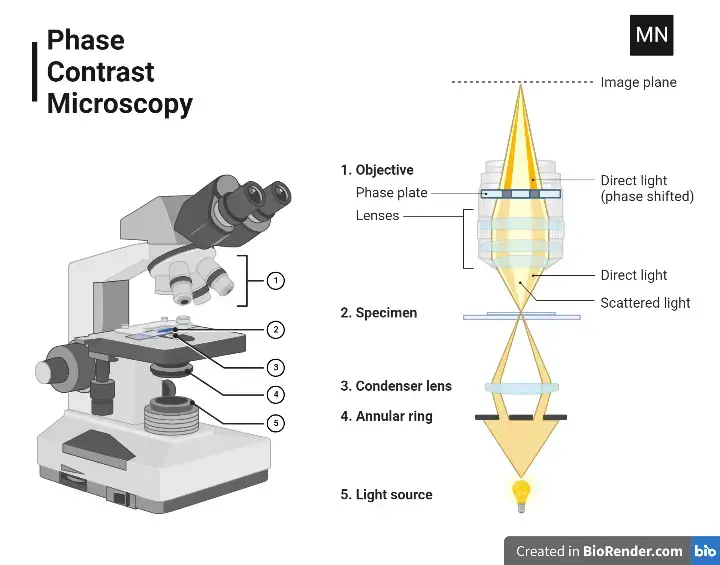
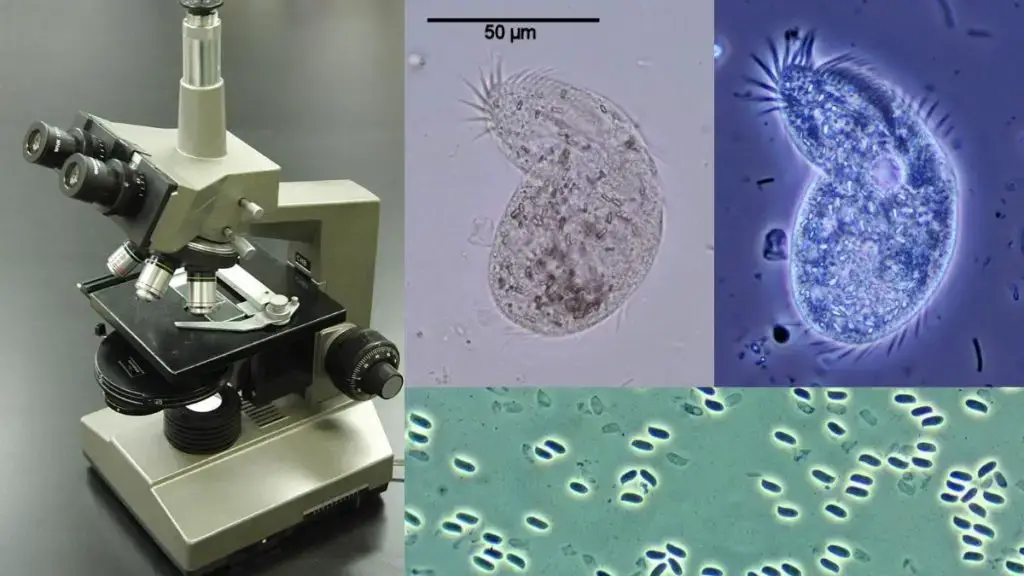
A phase-contrast microscope is a refined optical microscope that transforms minute phase shifts in light into observable differences in intensity. This enhancement provides greater contrast, making otherwise invisible details stand out to the human eye. When light passes through transparent specimens, slight phase shifts occur, which our eyes cannot naturally detect. By employing specialised components, these shifts are converted into changes in brightness, producing clear and detailed images.
Key Principle
The microscope’s functioning revolves around how light interacts with specimens:
- Light from the source is focused onto the specimen using a condenser annulus.
- As the light travels through the sample, it encounters varying refractive indices and thicknesses.
- These variations cause phase shifts in the light, which are imperceptible to human vision.
- A phase plate, located in the optical path, converts these phase differences into intensity variations, creating visible contrast.
This principle makes it possible to observe living cells and transparent structures without needing staining or fixing, preserving their natural state.
Unique Components
The phase-contrast microscope has all the standard parts of a compound microscope, along with two essential optical components:
1. Condenser Annulus:
- Also called the sub-stage annular diaphragm.
- It directs a hollow cone of light onto the specimen.
- Positioned beneath the condenser, it consists of a light-absorbing circular plate with a transparent ring that shapes the beam.
2. Phase Plate:
- Found above the objective’s rear focal plane.
- It alters the phase and amplitude of light emerging from the specimen.
- Divided into two regions: the conjugate area (aligned with the annulus) and the complementary area, which is coated with light-retarding materials like magnesium fluoride.
- Available in two types: positive phase plates (with thinner conjugate areas) and negative phase plates (with thicker ones).
Applications
The phase-contrast microscope is widely used across disciplines, offering a non-invasive way to study living and transparent samples:
- Viewing living cells in their natural state.
- Observing protozoans, diatoms, plankton, cysts, helminths, and larvae.
- Examining subcellular structures and cellular processes.
- Analysing thin tissue slices.
- Investigating materials like glass fragments, crystals, lithographic patterns, and latex dispersions.
Limitations
Despite its advantages, this microscope is not without drawbacks:
- Thick specimens are unsuitable as they obscure light transmission.
- A halo effect and shade-off are common artefacts, which may obscure fine details.
- The condenser annulus reduces aperture size, leading to decreased resolution.
21. Metallurgical Microscopes
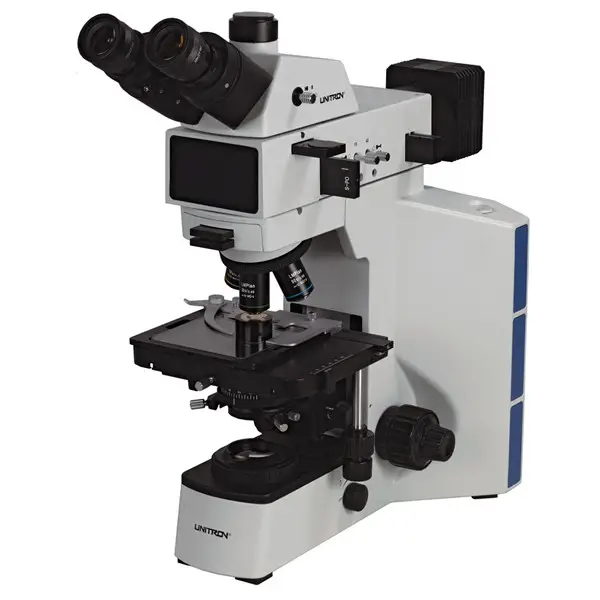
Metallurgical Microscope is a type of optical microscope used to observe metals, alloys and other opaque materials.
It is used in metallurgical analysis for study of grain structure, fractures and surface defects. It may be upright type or inverted type.
Principle of Metallurgical Microscope
Metallurgical microscope is based on the principle of reflected light illumination. In this microscope, transmitted light is not used for normal observation. Metals and alloys are opaque, so light cannot pass through the specimen.
The light is passed from above the specimen. The objective lens focuses the light on the polished surface of the specimen. The light reflected from the specimen surface is again collected by the same objective lens.
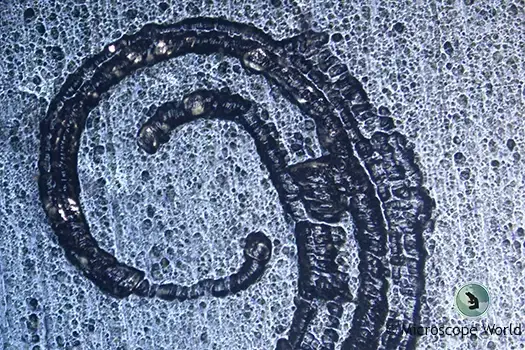
The reflected light forms the magnified image of the surface. After polishing and etching, grain boundaries and different phases become visible.
Thus, the microstructure of metal is observed.
Parts of Metallurgical Microscope
The following are the main parts of metallurgical microscope-
- Light source- It gives light for illumination of the specimen.
- Incident illuminator- It directs the light downward towards the specimen surface.
- Beam splitter or half mirror- It reflects light towards the objective lens. It also allows reflected light from the specimen to pass upward.
- Objective lens- It focuses light on the specimen surface. It also collects the reflected light from the specimen.
- Eyepiece- It is used to observe the magnified image.
- Stage- It is a strong and flat platform where the metal specimen is placed.
- Focusing knobs- Coarse and fine adjustment knobs are used to focus the image clearly.
- Polarizing filters- These are used to reduce glare and improve contrast in shiny metallic surface.
- Camera attachment- It is used for taking photograph of microstructure.
- Base and arm- These parts support the microscope and give stability.
Uses of Metallurgical Microscope
The following are the uses of metallurgical microscope-
- It is used to study metals and alloys.
- It is used to observe grain structure of metals.
- It is used in metallography.
- It is used to study fractures in metal samples.
- It is used to observe micro-cracks and surface defects.
- It is used to study ceramics and semiconductors.
- It is used in material science laboratory.
- It is used in industrial quality control.
- It is used to check heat treatment effect on metals.
- It is used to observe polished and etched metal surfaces.
Limitations of Metallurgical Microscope
The following are the limitations of metallurgical microscope-
- It is mainly used for opaque materials.
- It is not suitable for ordinary biological transparent specimens.
- Proper sample preparation is needed.
- The specimen surface must be ground and polished.
- Etching is needed to see grain boundaries clearly.
- Poor polishing gives scratches and wrong image.
- It has limited resolving power because it uses visible light.
- Very small nanoscale structures cannot be seen clearly.
- It gives mainly surface microstructure.
- Internal structure cannot be seen without cutting and preparing the sample.
- Shiny surface may produce glare.
- Interpretation of microstructure needs trained person.
Types of Microscopes with their applications ppt
Types of Microscopes with their applications Video
Reference
- 2.1.2 General Procedures for Electron Microscopy Applications in Diagnostic Virology. (n.d.).
- Applications of SEM in Semiconductor Device Failure Analysis. (n.d.). Nanoscience Instruments.
- Cappuccino, J. S., & Sherman, N. (n.d.). The Microscope. Microbiology: A Laboratory Manual (5th ed.). Benjamin/Cummings Science Publishing.
- Common Types of Microscopes. (n.d.). Globe Scientific.
- Confocal Microscopy: Principles and Modern Practices. (n.d.). PMC.
- Cryo-EM vs. X-ray Crystallography. (n.d.). JEOL USA.
- DeRose, J., & Doppler, M. (2023, November 8). Understanding Clearly the Magnification of Microscopy. Leica Microsystems.
- Dhull, N., & Craig, M. (2024, March 8). Semiconductor Failure Analysis Techniques. AZoNano.
- Electron Microscopy | TEM vs SEM. (n.d.). Thermo Fisher Scientific.
- Fellers, T. J., & Davidson, M. W. (n.d.). Confocal Microscopy: Principles, Optical Sectioning & 3D Imaging. Evident.
- Fiveable Content Team. (2025, August). 5.2 Scanning Probe Microscopy (STM, AFM). Fiveable.
- Ford, A., & Wood, D. (n.d.). Microscope Overview, Types & Uses – Lesson. Study.com.
- From Photons to Electrons: Optical and Electron Microscopy. (n.d.). Nanoscience Instruments.
- Güneş, H. (2024, October 23). SEM vs TEM: How to choose the most suitable electron microscopy technique for your application. Measurlabs.
- Helium Ion Microscope. (n.d.). Helmholtz Imaging CONNECT.
- Hiwave. (2025, February 21). Failure Analysis of Scanning Acoustic Microscope for IC. Hiwave SAM Systems & NDT Ultrasonic Inspection.
- Holyoak, N., & Marjot, A. (2026, February 4). Resolution & Magnification. Save My Exams.
- Kiderlen, S. (2026, March 24). Super-Resolution Microscopy: Principle, Applications, and ibidi Solutions. ibidi.
- Koenig, F. (2020, November 22). Compound Microscopes vs Stereo Microscopes – How Do They Compare? New York Microscope Company.
- Main Types of Microscopes. (n.d.). Keyence.
- Microscope. (2026, April 18). Wikipedia.
- Microscopes. (n.d.). Idaho State University.
- Microscopy. (n.d.). Precisioneers Group.
- Microscopy in Semiconductor Failure Analysis: Techniques, Tools, and Best Practices. (2026, January 16). Microscope World.
- Module -5 _ Unit-2 Scanning Probe Microscopy (STM, AFM). (n.d.). Deshbandhu College.
- Nie, H.-Y. (2026, March 19). Scanning Probe Microscopy. Western University.
- Optical microscope. (2026, April 12). Wikipedia.
- Postek, M. T., & Vladar, A. (2008, February 6). The Potentials of Helium Ion Microscopy for Semiconductor Process Metrology. NIST.
- Raval, B. (2026, April 4). SEM in Failure Analysis | Applications, Examples & Case Studies. Infinita Lab.
- Raval, B. (2026, April 6). Scanning Acoustic Microscopy (SAM): Principles, Methods & Applications. Infinita Lab.
- Renneboog, R. M. (2024). Scanning Probe Microscopy. In Science | Research Starters. EBSCO.
- Scanning Acoustic Microscopy (SAM) Services. (n.d.). Covalent Metrology.
- Scanning Acoustic Microscopy. (n.d.). PVA TePla AG.
- Scanning Acoustic Microscopy | SAM. (n.d.). EAG Laboratories.
- Scanning Probe Microscopy – Including Scanning Tunneling… (n.d.). Technology Networks.
- Scanning helium ion microscope. (2025, October 12). Wikipedia.
- Scipioni, L. (2010, December 31). Principles and Applications of Helium Ion Microscopy. Wiley Analytical Science.
- Shutthanandan, S. (n.d.). Helium Ion Microscopy. Environmental Molecular Sciences Laboratory.
- Super Resolution Microscopy (STED, SIM, PALM, STORM). (n.d.). TOPTICA Photonics.
- Super Resolution Microscopy. (n.d.). Promega Corporation.
- Super-Resolution Microscopy FAQ. (n.d.). Bruker.
- TEM vs. SEM Imaging: What’s the Difference? (n.d.). JEOL USA.
- The Difference Between SEM and Optical Microscopes. (n.d.). Thermo Fisher Scientific.
- The Evolution of Microscopic Imaging: Principles, Modalities, and Industrial Applications. (n.d.).
- Transmission Electron Microscopy vs. Scanning Electron Microscopy. (n.d.). Creative Biostructure.
- Transmission Electron Microscopy. (n.d.). ViruSure.
- Transmission Electron Microscopy: Applications in Biosafety Testing. (2019, December 17). SGS USA.
- Transmission electron microscopy. (2026, March 26). Wikipedia.
- Types of Microscopes: Working Principle and Applications. (2024, May 15). Blikai.
- Understanding the Difference between Magnification and Resolution in Scanning Electron Microscopy. (n.d.). Nanoscience Instruments.
- What Is a Microscope? A Guide to Principles, Types & Applications. (n.d.). HINOTEK.
- What is Microscope, Types, Working and Diagram. (2025, November 17). Almicro.
- What’s the Difference Between SEM & TEM? (n.d.). Nanoscience Instruments.
- Which microscope has the best resolution? (n.d.). abberior.
- Williams, A., & Steffel, C. (n.d.). Cryo-EM Explained: Visualizing Life’s Machinery. Morgridge Institute for Research.
- Wilson, M., DeRose, J., & Greb, C. (2023, January 19). Microscope Resolution: Concepts, Factors and Calculation. Leica Microsystems.
- X-ray Crystallography vs Cryo-EM: Which is Best for Your Research? (n.d.). Creative Biostructure.