

Stereo microscope is an optical microscope that is used to observe large, three dimensional and opaque specimens at low magnification. It is also called dissecting microscope. It gives a magnified image of the surface of the object by using reflected light.
It is different from compound microscope because compound microscope uses transmitted light through thin transparent specimen. Stereo microscope uses light which falls on the surface of the specimen and then reflected back to the lenses. So, it is useful for observing whole insects, plant parts, small animals, rocks, circuit boards and during dissection.
The main characteristic of stereo microscope is the presence of two separate optical paths. Each path has its own objective lens and eyepiece. These two optical systems give slightly different views to both eyes. The brain combines these two views and a three dimensional image is formed.
The image formed by stereo microscope is erect and non-reversed. So when the object is moved to left side, it also appears to move to left side in the eyepiece. This is very useful during handling, cutting, needle work and dissection of specimen.
Stereo microscopes generally have low magnification power. The magnification range is usually about 5X to 80X. Some advanced zoom stereo microscope may give more magnification by using auxiliary lenses. Due to low magnification, it has a large working distance.
Working distance is the space between the lower part of objective lens and the specimen. In stereo microscope, this distance is large, so the user can easily move forceps, needles, scalpel or other tools under the microscope. This makes it suitable for biological dissection and other manual work.
Stereo microscope may be of two main optical designs. These are Greenough design and Common Main Objective (CMO) design. In Greenough design, two separate and inclined optical systems are present which gives strong 3D effect. In CMO design, one large common objective lens is used with two parallel optical paths, which gives better resolution and allows use of extra accessories.
Thus, dissecting microscope is an important microscope for observing external features and surface structure of specimens. It is mainly used when the specimen is large, thick or opaque and when three dimensional view is required. It is used in biology laboratory, dissection work, microsurgery, forensic work, soldering of circuit boards and industrial inspection.
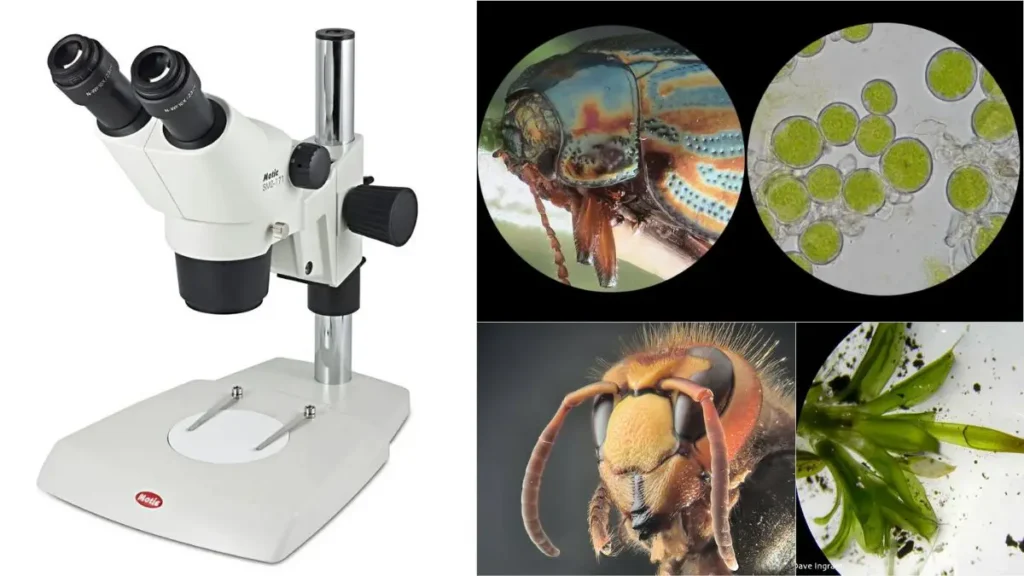
Principle of Dissecting microscope
Principle of Dissecting microscope is based on the principle of stereopsis. In this microscope, two separate optical paths are used to observe the same specimen from two slightly different angles. These two views are received by the two eyes and are fused by the brain to produce a three dimensional image.
Unlike the compound microscope, the dissecting microscope does not mainly use transmitted light through a thin transparent specimen. It uses reflected light from the surface of the specimen. The light falls on the opaque or thick specimen and then reflected back to the lenses.
The two optical paths have their own objective lens and eyepiece. They are arranged at a small angle to each other, usually about 10 to 12 degree. This arrangement gives slightly different image to the left and right eyes, similar to normal human vision.
The brain combines these two images into one image. The image formed is upright, non-reversed and has depth perception. So the height, surface structure and position of the specimen can be seen clearly.
The long working distance also helps in this microscope. It gives enough space between objective lens and specimen. Due to this, needles, forceps, scalpel and other tools can be used easily during observation.
Thus, the dissecting microscope works by reflected light and binocular vision. It produces a clear three dimensional image which is useful for dissection, microsurgery, industrial inspection and other manual works.
Dissecting Microscope Parts (Parts of Stereo microscope)
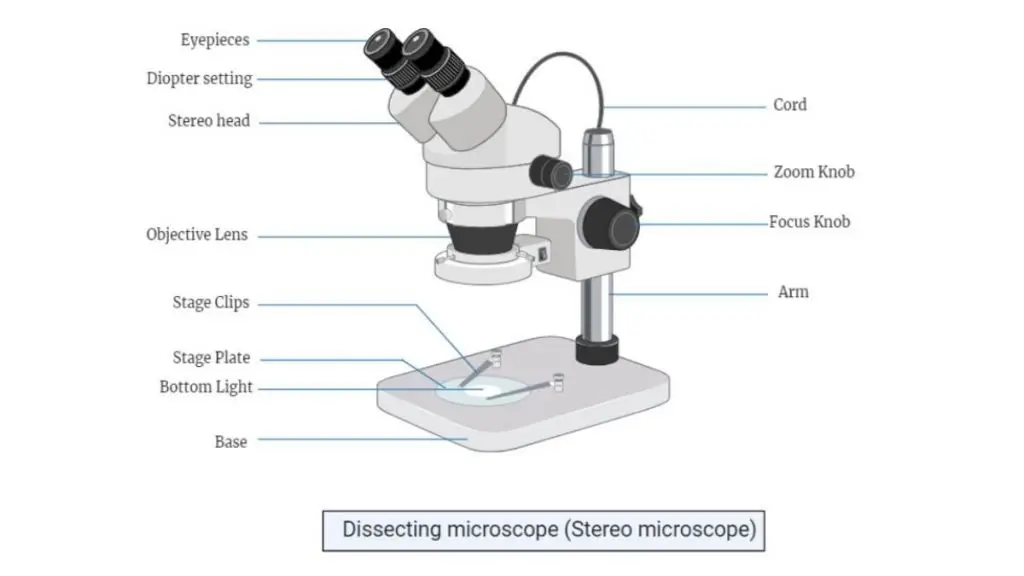
The dissecting microscope is made up of various parts, including-
- Eyepiece (Ocular lens) – It has two eyepiece lenses at the top of the microscope which are used to see the formed image. These lenses usually have 10X or 15X magnification.
- Diopter adjustment ring – It is found on the eyepiece. It is used to adjust the difference between the left and right eye of the observer for clear viewing.
- Head – It is the upper viewing part of the microscope. It holds the eyepieces, ocular lenses and internal optical parts. It is also called viewing assembly.
- Internal prisms – These are present inside the head of the microscope. They make the image erect and correctly oriented, so the image is not seen inverted and reversed.
- Objective lenses – These are the main lenses present near the specimen. They collect the light coming from the object and form the first magnified image.
- Arm – This is the part which connects the head of the microscope with the base or stand. It supports the optical head of the microscope.
- Stand or vertical limb – It is a short and strong vertical rod attached to the base. It supports the head, focus system and other parts of the microscope.
- Base or foot – The base is the lowermost and heavy part of the microscope. It supports the whole microscope and gives stability during observation.
- Stage – The stage is a flat platform where the specimen is placed for observation. It may have a glass plate or opening for light.
- Stage clips – These are small clips present on the stage. They are used to hold the specimen or slide in proper position.
- Adjustment screw or focus knob – These are used to move the microscope head or stage up and down. It helps to focus the specimen and produce a sharp image.
- Illuminator or light source – It gives light to the specimen. In dissecting microscope, top light is used for opaque objects and bottom light is used for transparent or translucent objects.
- Digital camera– It is an optional part of modern stereo microscope. It is used to capture image or video of the specimen and show it on a monitor.
Dissecting microscope Magnification
Dissecting microscope has low magnification power. It is mainly used for observing large, thick and opaque specimen. The magnification is enough to see the surface structure and external parts of the specimen.
The total magnification of dissecting microscope is calculated by multiplying the magnification of eyepiece and objective lens. If any auxiliary lens is used, then it is also multiplied with them.
The formula is as follows-
Total magnification = Eyepiece magnification × Objective magnification × Auxiliary lens magnification
The common magnification range of dissecting microscope is about 10X to 40X. Some stereo microscope may give magnification up to 80X. This low magnification gives a wide field of view and long working distance.
In simple dissecting microscope, the magnification may be fixed. It gives only one constant magnification. This type is used for simple laboratory observation and dissection work.
Some dissecting microscope has turret magnification system. In this system, two or more objective lenses are present on a rotating part. The user can change the magnification step by step, such as 10X, 20X or 30X.
Advanced dissecting microscope has zoom magnification system. In this system, magnification can be changed continuously by using a zoom knob. It helps to move from low power to high power without changing the lenses.
Auxiliary lenses are also used in some stereo microscope. These lenses are attached in front of the objective lens. They may increase or decrease the magnification and also change the working distance of the microscope.
High-end stereo microscope can give much higher magnification by using zoom system and auxiliary lenses. Some research microscope may reach more than 500X. But generally dissecting microscope is considered as a low power microscope.
Types of Dissecting Microscope or Stereo Microscope
Different types of dissecting microscope are mentioned below-
- Greenough stereo microscope – This type of stereo microscope has two identical and separate optical paths. These two paths are placed at an angle and meet on the specimen. It gives strong three dimensional effect.
- Common Main Objective (CMO) stereo microscope – This microscope has one large common objective lens. Two parallel optical paths pass through this common objective. It is also called parallel or Galilean optical design. It gives better resolution and is used for advanced work.
- Fixed or single power stereo microscope – This type gives only one fixed magnification. It is simple in structure and used for normal dissection and observation work.
- Dual power dissecting microscope – This microscope has two fixed magnification powers. It has a rotating nosepiece or turret by which the magnification can be changed. For example, 10X and 30X.
- Zoom stereo microscope – This type has a zoom knob for changing magnification. The magnification can be increased or decreased smoothly without changing the lenses. It is more useful for detailed observation.
- Digital stereo microscope – This microscope has a built-in camera or digital screen. It is used to view the specimen on monitor or computer. It is also used for taking image, recording and analysis.
- Trinocular stereo microscope – This microscope has a special trinocular head. Two eyepieces are used for observation and one extra tube is used for attaching camera. So the specimen can be observed and photographed at the same time.
- Boom stand stereo microscope – This type has a large base and long horizontal arm. It is used when the specimen is large and cannot be placed on normal microscope stage. It is common in surgery and industrial inspection.
- Handheld pocket stereo microscope – This is a small and portable microscope. It usually has single magnification. It is used for field observation and quick examination.
Operating Procedure of Dissecting microscope
The following are the steps to be followed during operating a dissecting microscope-
- Place the dissecting microscope on a flat and stable table. The working place should be clean and free from unnecessary materials.
- Place the specimen or slide at the centre of the stage. The specimen should be placed directly under the objective lens.
- If stage clips are present, fix the specimen with the help of stage clips. It helps to keep the specimen in proper position during observation.
- Turn on the illuminator or adjust the mirror. The light should fall properly on the specimen. The light should be enough bright, but not too much for the eyes.
- Look through the eyepieces and adjust the distance between the two eyepieces. Move them closer or apart until one single field of view is seen.
- Set the microscope at the lowest magnification first. This helps to find the specimen easily.
- Turn the focus knob or adjustment screw slowly. Move the head or vertical limb up and down until the specimen comes in clear focus.
- Set the diopter adjustment rings of eyepieces at zero position. This is done before fine focusing of both eyes.
- Increase the magnification to the highest power and focus the image with the main focus knob. A clear part of the specimen should be selected and kept at the centre.
- Then decrease the magnification again to the lowest power. Focus each eye separately by using only the diopter rings. This helps to keep the image clear during zooming.
- During observation, operate the microscope carefully with both hands. This prevents shaking and helps to keep the image steady.
- After observation, remove the specimen from the stage. Turn off the light source and clean the stage and lenses if required.
Applications of Dissecting microscope (Stereo microscope)
Some of the important applications of dissecting microscope are-
- Biological science and education – It is used by students and biologists for dissecting plant and animal specimens. It is also used to observe insects, small animals, worms, fishes and developing organisms.
- Entomology – It is used to study insects and their external body parts. Wings, legs, antennae, mouth parts and other surface structures can be observed clearly.
- Botany – It is used to observe plant parts such as leaf, flower, seed, root tip and stem surface. It is also used during dissection of floral parts.
- Embryology – It is used to observe embryos and developing model organisms. It helps to see the external changes during development.
- Medical and surgical work – It is used to examine skin tissues, tumour margins and other surface details. Special operating microscopes are used in microsurgery and microinjection work.
- Assisted reproductive technology (ART) – It is used for oocyte cleaning, oocyte freezing and observation of embryo thawing. It helps in handling small biological materials.
- Forensic science – It is used to locate and compare trace evidence like hair, fibre, soil, bullet fragments, fingerprints and surface markings. It is also used in document examination.
- Industrial work – It is used in manufacturing and quality control. Circuit boards, micro-components, watches and small machine parts are examined by this microscope.
- Materials science and engineering – It is used to study surface topography of solid samples. It is also used to examine opaque materials and fracture surfaces for failure analysis.
- Gemology – It is used to study and grade gemstones. Small inclusions and surface defects inside gems can be observed.
- Paleontology and geology – It is used to clean and examine delicate fossils. It is also used to observe rocks, minerals and crystals.
- Textile and fabric industry – It is used to inspect fibres, fabric weave and quality of textile materials. It helps to detect defects in threads and fabrics.
Advantages of Dissecting Microscope (Stereo Microscope)
Some of the advantages of dissecting microscope are-
- Three dimensional image – It gives a true three dimensional image of the specimen. This helps to see depth, height and surface structure clearly.
- Long working distance – It has a large space between objective lens and specimen. So, forceps, needles, scalpel and other tools can be used easily during observation.
- Upright and non-reversed image – The image formed is erect and not reversed. So, movement of hand and tool can be controlled properly under the microscope.
- Wide field of view – It gives a wide field of view. Large area of the specimen can be seen at one time, so it is easy to locate and observe the object.
- Large depth of field – It can keep more parts of thick specimen in focus at the same time. This helps to understand the whole external structure of the object.
- Observation of opaque specimen – It is useful for observing thick, solid and opaque specimens. Rocks, insects, coins, seeds, flowers and circuit boards can be seen directly.
- Less sample preparation – The specimen does not need much preparation. Staining, section cutting or mounting is generally not required.
- Easy to use – It is simple to operate and suitable for students and laboratory work. Many models are small and portable.
- Useful for dissection – It is very useful during dissection of small plants, animals and insects. It gives enough space and clear view for cutting and handling the specimen.
Limitations of Dissecting microscope (Stereo microscope)
Some of the limitations of dissecting microscope are-
- Low magnification power – Dissecting microscope has low magnification power. Standard models usually give magnification up to about 70X to 100X. So, it cannot be used to observe very small details like individual cells and internal tissue structures.
- Low resolution – The resolution of stereo microscope is lower than compound microscope. It cannot separate very minute structures clearly. So, fine cellular details cannot be studied by this microscope.
- High cost – Some stereo microscopes are expensive. The advanced optical system, zoom lens and Galilean optical parts increase the cost of the instrument.
- Optical distortion – Some stereo microscope may produce distortion in image. In Greenough design, keystone effect may occur. It causes slight difference in image size between the two eyes and may produce eye strain.
- Perspective distortion – In Common Main Objective (CMO) microscope, flat object may appear slightly convex. Some off-axis errors like astigmatism and coma may also be produced.
- Not suitable for internal structure – It mainly shows the surface of specimen. It is not suitable for observing internal details unless the specimen is cut or dissected.
- Difficulty in digital imaging – It is difficult to capture the same three dimensional view in a flat photograph. Camera image may not show the same depth and clarity as seen by the eyes.
- Large and advanced models need space – Some boom stand or research stereo microscope needs more working space. They are not always suitable for small laboratory tables.
- Limited use at high magnification – At higher magnification, field of view and depth of field become reduced. So the main advantage of stereo viewing is decreased.
How is total magnification calculated on a stereo microscope?
The total magnification of stereo microscope is calculated by multiplying the magnification power of all optical parts which are present in the light path.
For visual observation, the specimen is seen through eyepieces. In this case, total magnification depends on objective lens, eyepiece lens, zoom or tube factor and auxiliary lens if used.
The formula is as follows-
Total visual magnification = Objective magnification × Zoom or tube factor × Eyepiece magnification × Auxiliary lens magnification
For example, if objective lens is 1X, zoom setting is 4X, eyepiece is 10X and auxiliary lens is 1X, then,
Total magnification = 1 × 4 × 10 × 1
= 40X
If auxiliary lens is not used, then it is not included in calculation. In simple stereo microscope, total magnification is usually calculated by multiplying eyepiece magnification and objective magnification.
For digital imaging, the calculation is different. In this case, eyepiece is generally not included in the optical path of camera.
The magnification on camera sensor is calculated as-
Sensor magnification = Objective magnification × Zoom or tube factor × Projection lens magnification
If beamsplitter or camera port has its own magnification factor, then it is also multiplied.
The display magnification depends on the size of image shown on monitor. It is calculated by multiplying sensor magnification with pixel size ratio of monitor and camera sensor.
Thus, total magnification of stereo microscope depends on viewing method. For normal eye observation, eyepiece is included. For camera and monitor observation, camera adapter, projection lens and display size are also considered.
Compound vs Dissecting microscope
The following are the differences between compound microscope and dissecting microscope-
Image dimension – Compound microscope produces a flat two dimensional image. Dissecting microscope produces a three dimensional image with depth perception.
Magnification – Compound microscope has high magnification power, usually about 40X to 1000X. Dissecting microscope has low magnification power, usually about 2X to 100X.
Image orientation – In compound microscope, the image is inverted and reversed. In dissecting microscope, the image is upright and non-reversed.
Optical path – Compound microscope has single optical path. The same image is passed to both eyepieces. Dissecting microscope has two separate optical paths, one for each eye.
Light path – Compound microscope mainly uses transmitted light. The light passes through the thin specimen from below. Dissecting microscope mainly uses reflected light. The light falls on the surface of specimen and comes back to the lenses.
Working distance – Compound microscope has very short working distance between objective lens and slide. Dissecting microscope has long working distance, so tools can be used easily under the lens.
Specimen type – Compound microscope is used for thin and transparent specimen. It is used for microorganisms, cells and tissue sections on glass slides. Dissecting microscope is used for large, thick, opaque and solid specimens.
Use – Compound microscope is used to see internal details of small microscopic objects. Dissecting microscope is used to see surface features and for dissection or manual work.
Depth perception – Compound microscope does not give true depth perception. Dissecting microscope gives clear depth perception due to binocular optical system.
Field of view – Compound microscope has narrow field of view at high magnification. Dissecting microscope has wide field of view at low magnification.
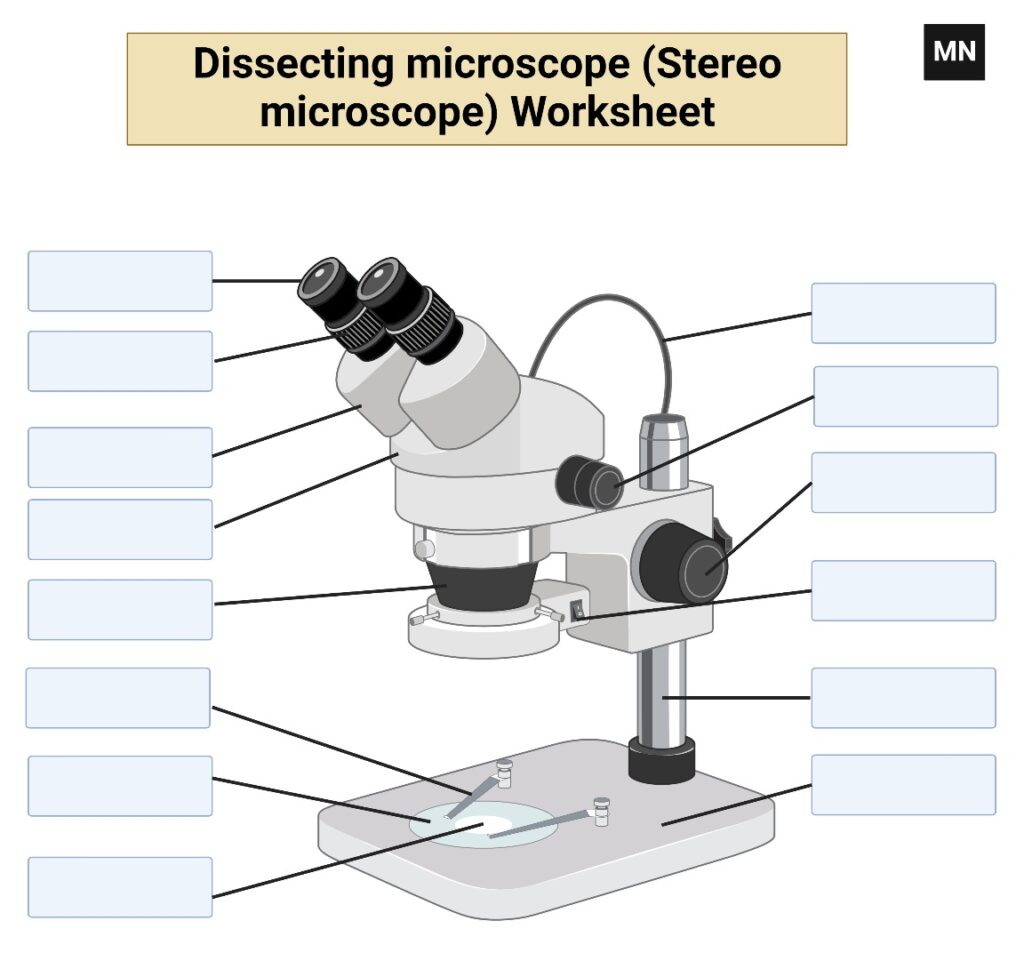
Dissecting Microscope Worksheet
Dissecting microscope images
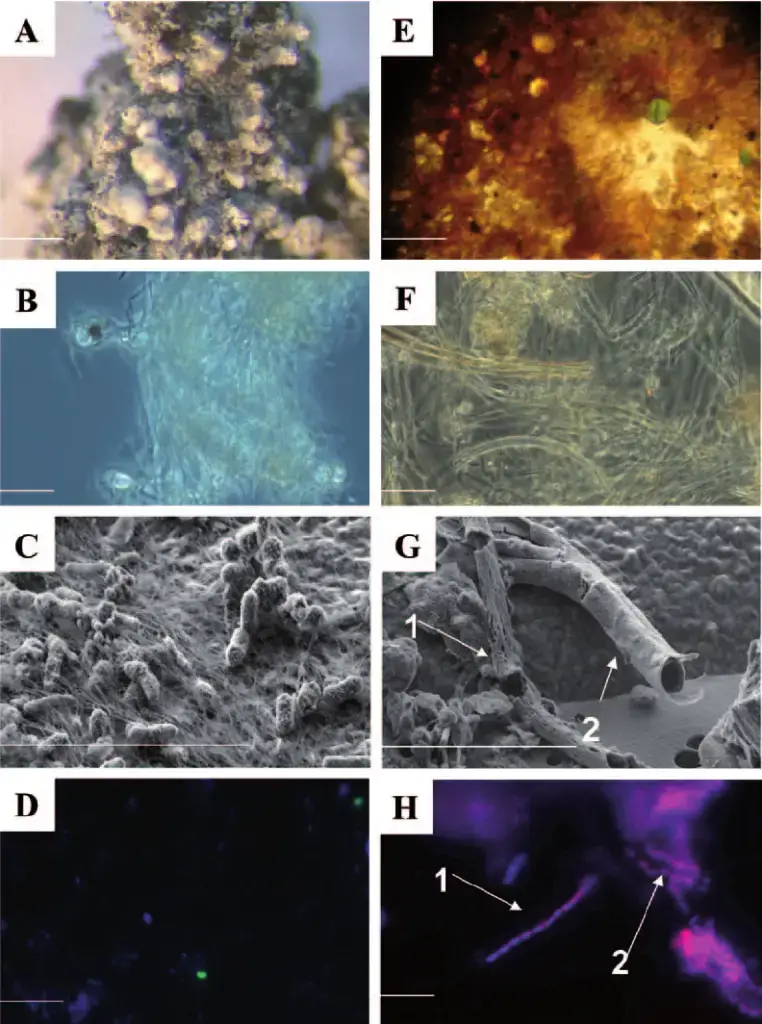
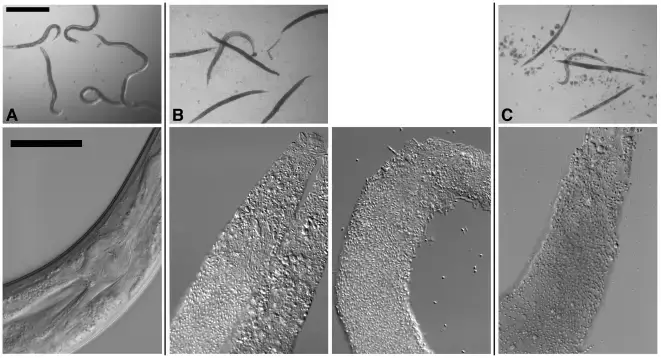
Reference
- Abramowitz, M., & Davidson, M. W. (n.d.). Microscope stages. Microscope Anatomy Guide, Evident Scientific.
- ACCU-SCOPE. (n.d.). A look at stereo microscopes and their applications.
- AmScope. (2025, April 28). The ultimate guide to microscope cleaning & maintenance.
- Biocompare. (n.d.). Stereomicroscopes: Seeing more in 3D than ever before.
- Carr, K. E., & Davidson, M. W. (n.d.). Basic microscope ergonomics. Nikon’s MicroscopyU.
- Centers for Disease Control and Prevention. (n.d.). Care and maintenance of the microscope.
- Colorado State University. (n.d.). Microscope ergonomics. Risk Management & Insurance.
- Danaher Life Sciences. (n.d.). Stereo microscope: Types, features and applications.
- DeRose, J., & Doppler, M. (2023, March 20). Microscope illumination for industrial applications. Leica Microsystems.
- DeRose, J., & Doppler, M. (2023, November 8). Understanding clearly the magnification of microscopy. Leica Microsystems.
- Dover Motion. (n.d.). Microscope calculations: Field of view, depth of field, numerical aperture.
- Edmund Optics. (n.d.). Manual stages and slides.
- Evident Scientific. (n.d.). 5 basic microscope adjustments for ART research. Olympus LS.
- Goeggel, D., & DeRose, J. (2007, January 11). The history of stereo microscopy. Leica Microsystems.
- Home Science Tools. (n.d.). Stereo & dissecting microscopes.
- Idaho State University. (n.d.). Microscopes.
- Keyence. (n.d.). Coaxial illumination. Microscope Lighting Techniques.
- Keyence. (n.d.). Ring illumination. Microscope Lighting Techniques.
- Koenig, F. (2019, May 3). Dissecting microscope uses. New York Microscope Company.
- Lagran, K. (n.d.). Dissecting microscope parts and uses. Scribd.
- Manning, J. (2020, March 9). Stereo microscope primer: Transmitted light observation methods. Olympus LS.
- Microscope Central. (n.d.). A closer look at stereo microscopes.
- Microscope Central. (n.d.). Types of stereo microscopes.
- Microscope World. (2025, December 11). Calibrating a stereo microscope for precision measurement: Methods, standards, and error sources.
- Microscope World. (n.d.). Microscope maintenance tips.
- Microscope World. (n.d.). Stereo microscope heating stage package.
- Microscope.com. (n.d.). How to use a stereo microscope: A beginner’s guide.
- Mokobi, F. (2022, May 27). Dissecting microscope (stereo or stereoscopic microscope) – Definition, principle, parts. Microbe Notes.
- Motic Europe. (n.d.). How to do the parfocality adjustment on an upright microscope. YouTube.
- Nikon Instruments. (n.d.). Stages. Stereo Microscope Accessories.
- Nikon’s MicroscopyU. (n.d.). Depth of field and depth of focus.
- Nikon’s MicroscopyU. (n.d.). Introduction to stereomicroscopy.
- OMAX. (n.d.). OMAX mechanical & thermal stages microscope accessories.
- Sanderson, J. (n.d.). Understanding the microscope. 8. Stereomicroscopy. Quekett Microscopical Club.
- SPOT Imaging. (n.d.). Obtaining parfocality between camera and microscope eyepieces.
- Steemit. (n.d.). The amateur mycologist’s guide to microscopes – Compound vs dissecting/stereoscopic – Greenough vs CMO.
- UC Davis Safety Services. (n.d.). Microscope ergonomics.
- UCLA Ergonomics. (n.d.). Tips for using a microscope.
- Unknown Author. (n.d.). The technical evolution and operational framework of stereomicroscopy in professional practice.
- Vision Engineering. (n.d.). Ergonomics matter for microscope users.
- W. Nuhsbaum, Inc. (2022, October 18). Understand stereo microscopes: Benefits & uses.
- W. Nuhsbaum, Inc. (2022, October 25). Dissecting microscope – Definition, principle, parts.
- Wikipedia. (2025, November 3). Stereo microscope.
- Wilkinson, S. (2023, June 16). Six different types of microscopes explained. Microscopes.com.au.
- ZEISS. (2025, July 22). Microscope cleaning & maintenance: The complete guide for optimal performance.
- Zeiss Campus. (n.d.). Microscopy basics | Microscope maintenance. Florida State University.
- Zona, C. (n.d.). Above, below, and from the sides: Vital illumination techniques you should know. The McCrone Group.