Microbial Control Methods Explained

Transcript
Introduction to Microbial Control
Microbial control refers to the methods used to prevent or inhibit the growth of microorganisms.
Controlling microbes is essential in several key areas of our society.
In healthcare, microbial control prevents infections and reduces disease transmission in clinical settings.
The food industry relies on microbial control to ensure food safety and extend shelf life of products.
In our daily lives, proper microbial control maintains hygiene and prevents common illnesses.
There are four main categories of methods used for microbial control.
Physical methods include heat, cold, radiation, and filtration to eliminate microbes.
Chemical methods use disinfectants, antiseptics, and antibiotics to kill or inhibit microorganisms.
Mechanical removal physically eliminates microbes through washing, scrubbing, and filtration.
Biological agents such as bacteriophages and competitive microbes can be used to control harmful microorganisms.
Understanding these microbial control methods is crucial for several reasons.
These methods help prevent disease transmission in communities and healthcare facilities.
They are essential for maintaining sanitary conditions in various environments.
Proper microbial control significantly reduces healthcare-associated infections.
And they ensure safety throughout the food production and distribution chain.
By applying appropriate microbial control methods, we can effectively manage microorganisms in our environment.
Sterilization is the complete removal or destruction of all microorganisms, including bacterial spores.
This makes sterilization the most rigorous form of microbial control, achieving complete sterility.
Unlike less rigorous methods, sterilization leaves no viable microorganisms, not even highly resistant bacterial spores.
When comparing sterilization to other microbial control methods, sterilization is the only approach that guarantees complete elimination of all microorganisms.
Sterilization targets all microorganisms with 100% efficacy, while disinfection often doesn’t eliminate bacterial spores and achieves lower efficacy.
There are several common methods used to achieve sterilization. Let’s examine the most important techniques.
Autoclaving uses steam under pressure, typically at 121 degrees Celsius and 15 pounds per square inch, for 15 to 30 minutes. It’s the most common method in laboratory settings.
Dry heat sterilization requires higher temperatures of 160 to 180 degrees Celsius for longer periods, typically 2 to 4 hours. It’s suitable for materials that could be damaged by moisture, such as powders and oils.
Radiation sterilization uses gamma rays or electron beams to destroy microorganisms without heat, making it ideal for pre-packaged medical devices.
Chemical sterilization, often using ethylene oxide gas, is suitable for heat-sensitive materials but requires specialized equipment and careful handling due to its toxicity.
Sterilization is critical in several key applications, particularly those involving invasive medical procedures or sensitive laboratory work.
Proper sterilization of surgical instruments prevents surgical site infections, while implantable medical devices must be perfectly sterile to avoid rejection or infection.
Laboratory equipment used in microbiology and cell culture work must be sterilized to prevent contamination that could invalidate research results.
Improper sterilization can lead to serious infections, complications, and even fatal outcomes in healthcare settings, making it a critical safety procedure.
Disinfection is the process of destroying pathogenic organisms on inanimate objects, but not necessarily all microorganisms or bacterial spores.
Disinfection is classified into three levels based on effectiveness against different microorganisms.
High-level disinfection destroys all microorganisms except some bacterial spores. It’s used for semi-critical items like surgical instruments and endoscopes.
Intermediate-level disinfection kills mycobacteria, most viruses and fungi, but not bacterial spores. It’s suitable for stethoscopes, blood pressure cuffs, and some laboratory equipment.
Low-level disinfection kills some viruses and fungi but is not effective against mycobacteria or bacterial spores. It’s used for non-critical surfaces like floors, furniture, and general use areas.
Let’s examine some common disinfectants used in healthcare and laboratory settings.
Bleach solutions, containing sodium hypochlorite, are effective against most microbes and relatively inexpensive, but they’re corrosive and sensitive to organic matter.
Hydrogen peroxide provides broad-spectrum disinfection, is environmentally friendly, and doesn’t leave toxic residues. It’s less affected by organic matter than bleach.
Quaternary ammonium compounds are effective against bacteria and lipid viruses. They’re stable, less corrosive than bleach, and remain active on surfaces after application.
Disinfectants can be applied using various methods, depending on the surface and level of disinfection required.
Spray and wipe is common for larger surfaces like countertops and examining tables. The disinfectant is sprayed on the surface, allowed to dwell for the required contact time, then wiped clean.
Ready-to-use disinfectant wipes are convenient for quick disinfection of smaller items and high-touch surfaces. They’re pre-saturated with the appropriate concentration of disinfectant.
Immersion or soaking is used for small instruments and items that require complete coverage. The items are fully submerged in the disinfectant solution for the specified contact time.
When using disinfectants, there are several important considerations to keep in mind for safety and efficacy.
Always follow the manufacturer’s instructions for contact time, use appropriate personal protective equipment, clean surfaces before disinfection, and consider compatibility between the disinfectant and the surface material.
Understanding the appropriate level of disinfection and choosing the right disinfectant are critical for effective infection control in healthcare and laboratory settings.
Chemical agents are essential tools in microbial control. They work through various mechanisms to destroy or inhibit microorganisms.
The major categories include alcohols, halogens like chlorine and iodine, phenolics, quaternary ammonium compounds, and aldehydes.
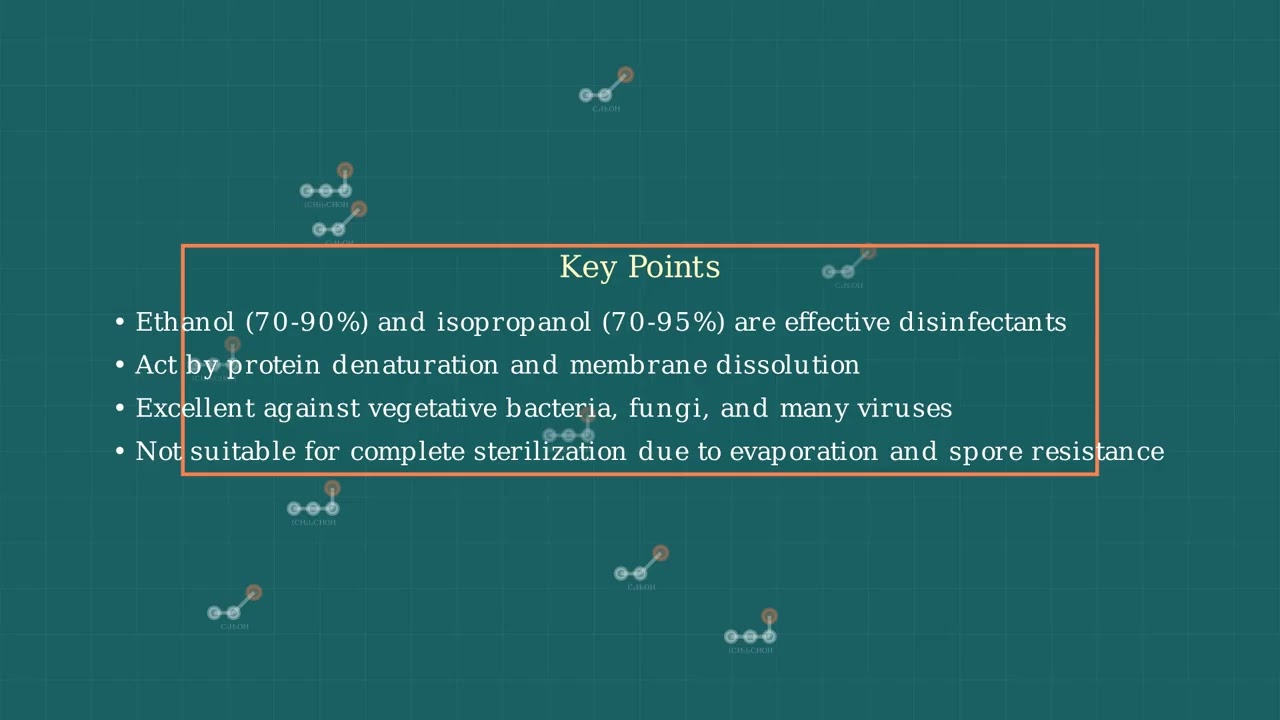
Alcohols, primarily ethanol and isopropanol, are widely used chemical agents. Their structure, with a hydroxyl group, gives them antimicrobial properties.
Alcohols work by denaturing proteins, disrupting cell membranes, and dissolving lipids in the microbial cell wall.
Alcohols are commonly used for skin antisepsis at a concentration of seventy percent, surface disinfection, and equipment sanitization. However, they are not effective against spores and may not penetrate organic matter.
Halogens, particularly chlorine and iodine, are powerful oxidizing agents used in various microbial control applications.
They work by oxidizing cellular components, disrupting enzyme function, and damaging nucleic acids through their strong electron-attracting properties.
Chlorine is widely used in water treatment, swimming pools, and surface disinfection. Iodine is commonly found in surgical scrubs, wound disinfectants, and water purification tablets.
Phenolics, derived from phenol, are among the oldest known antimicrobial agents. Their ring structure with a hydroxyl group gives them powerful disinfectant properties.
They work by disrupting cell walls, inactivating essential enzymes, and altering cell membrane permeability.
Phenolics are commonly used in hospital disinfectants, laboratory surface cleaning, and environmental disinfection. Notable examples include triclosan in antibacterial soaps, hexachlorophene in surgical scrubs, and chloroxylenol in antiseptic solutions.
Quaternary ammonium compounds, or QACs, are surfactants with a positively charged nitrogen atom and four attached groups.
QACs function by disrupting cell membranes, denaturing proteins, and binding to phospholipids in the cell membrane, causing cellular contents to leak out.
QACs are widely used in household disinfectants, food processing facilities, and for low-level medical disinfection. They’re non-toxic at use dilutions and effective against many bacteria, but may have limited efficacy against certain viruses and fungi.
Aldehydes are highly effective chemical agents characterized by their carbon-oxygen double bond and hydrogen atom. Common examples include formaldehyde, glutaraldehyde, and OPA.
Aldehydes work by cross-linking proteins, alkylating nucleic acids, and inactivating essential enzymes within microbial cells.
Aldehydes are used for high-level disinfection, sterilization of heat-sensitive equipment, and tissue preservation. However, caution is required as they produce toxic fumes, cause skin and eye irritation, and require proper ventilation during use.
Several key factors affect the efficacy of chemical agents in microbial control. Understanding these factors is crucial for effective disinfection and sterilization.
Concentration is critical for efficacy. Interestingly, higher isn’t always better – alcohols are most effective at seventy percent concentration, as water helps them penetrate cell membranes better.
Contact time is equally important. Surfaces must remain wet with the disinfectant for the entire recommended time. Different organisms require different contact times – bacterial spores typically need longer exposure than vegetative bacteria.
pH affects chemical activity significantly. Quaternary ammonium compounds work best in alkaline conditions, while chlorine is more active at acidic pH. Each agent has its optimal pH range for maximum efficacy.
Temperature generally increases chemical activity. For instance, glutaraldehyde disinfection is faster at twenty-five degrees Celsius than at twenty degrees. However, some agents become unstable or volatile when heated.
Organic matter like blood, serum, or food residues can inactivate many disinfectants. This is why pre-cleaning is essential before disinfection. Some agents penetrate organic material better than others.
When selecting a chemical agent, consider the target organisms and specific application needs. This guide summarizes the effectiveness of different agents against various microorganisms.
Alcohols excel against bacteria but are poor against spores. Halogens offer broad coverage. Phenolics work well on bacteria and fungi. QACs have limited virus efficacy. Aldehydes provide the most comprehensive coverage, including good activity against resistant spores.
Applications and Best Practices for microbial control vary across different settings.
We apply microbial control in four main settings: healthcare facilities, food service establishments, laboratories, and homes.
In healthcare settings, proper microbial control is critical for patient safety.
Healthcare applications include using bleach solutions on examining tables, autoclave sterilization for surgical instruments, alcohol wipes for medical equipment, and quaternary ammonium compounds for floors and surfaces.
In food service, microbial control prevents foodborne illness and ensures product safety.
Food service environments require chlorine solutions for food preparation surfaces, hot water or chemical sanitizers for dishwashing, proper washing and separation of raw foods, and temperature control for storage.
Laboratories require stringent microbial control to maintain experimental integrity and personnel safety.
Laboratory microbial control includes ethanol sprays for workspaces, UV light for equipment, autoclaving cultures and waste, and dry heat for sterilizing glassware.
Even in home settings, proper microbial control is important for general hygiene and health.
At home, we can use diluted bleach for kitchen surfaces, hydrogen peroxide cleaners for bathrooms, hot water washing for laundry, and HEPA filtration for air quality.
Let’s review some best practices for effective microbial control across all settings.
Effective microbial control depends on proper concentration, adequate contact time, appropriate method selection, and attention to safety precautions.
For comprehensive microbial management, an integrated approach combining multiple methods is most effective.
An integrated approach combines physical methods, chemical agents, and biological controls to create a comprehensive microbial management strategy.
To summarize the key points about applications and best practices in microbial control:
Tailor control methods to specific settings and purposes. Follow best practices for concentration, contact time, and safety. Combine multiple approaches for comprehensive control. And regularly monitor and evaluate to ensure effectiveness.
By applying these principles and best practices across different settings, we can effectively control microbial populations and protect human health.
Related Videos