

Pyruvate Broth Test is a biochemical test used to determine the ability of a bacterium to utilize pyruvate as a carbon and energy source. It is done in a carbohydrate-free broth medium containing sodium pyruvate. The medium contains an indicator (bromothymol blue) which gives greenish-blue colour initially.
If the organism metabolizes pyruvate, organic acids are produced in the broth and pH is lowered. Due to acid production, the colour of the medium changes from greenish-blue to yellow and it is considered as positive. If the organism cannot utilize pyruvate, no significant acid is produced and the broth remains greenish-blue, so it is negative.
It is used in clinical microbiology for differentiation of closely related Enterococcus species. It is used as a rapid screening test to separate Enterococcus faecalis (usually pyruvate positive) from Enterococcus faecium (usually pyruvate negative).
Objectives of Pyruvate Broth Test
- To determine whether the organism can utilize pyruvate as a substrate and produce acidic metabolic end products.
- To identify and differentiate bacterial species based on their metabolic and enzymatic capacity.
- To differentiate Enterococcus faecalis (usually pyruvate positive) from Enterococcus faecium (usually pyruvate negative) as a rapid screening test.
- To aid in identification of other catalase-negative, Gram-positive cocci in schemes (e.g. Aerococcus, Gemella).
- To study bacterial physiology by observing effect of pyruvate utilization on metabolism, and it is useful in food microbiology for tracking flavour compound production like diacetyl and acetoin.
Principle of Pyruvate Broth Test
Principle of Pyruvate Broth Test is based on the ability of the organism to utilize sodium pyruvate as the main carbon and energy source in a nutrient-restricted broth which is free from carbohydrates. The organism is inoculated into pyruvate broth containing bromothymol blue indicator. Initially the medium is greenish-blue due to near neutral pH (around 7.3).
If the organism metabolizes pyruvate, it breaks down the substrate and organic metabolic acids are produced as end products. These acids accumulate in the broth and pH is dropped. When the pH falls below about 6.0, bromothymol blue changes colour and the medium turns yellow, showing a positive reaction.
If the organism cannot utilize pyruvate, no acid is produced and there is no acidic shift in the medium. In some organisms peptones may be utilized causing alkaline shift, so yellow colour is not formed. The broth remains greenish-blue and it is taken as negative.
Requirements of Pyruvate Broth Test
- Pyruvate broth (culture medium)
- Pancreatic digest of casein (10.0 g/L)
- Yeast extract (5.0 g/L)
- Sodium pyruvate (10.0 g/L)
- Sodium chloride (5.0 g/L)
- Dipotassium phosphate (5.0 g/L)
- Bromothymol blue (0.04 g/L)
- Distilled / deionized water
- Test tubes (with loose caps or cotton plugs).
- Incubator (35 ± 2°C).
- Autoclave (for sterilizing prepared broth).
- Weighing machine (for measuring media components).
- Bunsen burner.
- Sterile inoculating loop or needle.
- Personal protective equipment (PPE) and common laboratory materials.
- Test organism
- Fresh pure bacterial culture (18–24 hour old).
- Preferably grown on 5% sheep blood agar.
- Quality control strains
- Positive control: Enterococcus faecalis (e.g. ATCC 29212).
- Negative control: Enterococcus faecium (e.g. ATCC 6569) or Streptococcus bovis (e.g. ATCC 9809).
- No additional chemical reagents are required after incubation for reading the result.
Procedure of Pyruvate Broth Test
- Preparation of medium– Pyruvate broth components are dissolved in distilled / deionized water. It is dispensed into test tubes (about 5 ml each). The tubes are sterilized in autoclave at 121°C for 15 minutes. The medium is allowed to cool to room temperature before use.
- Inoculum selection– A pure fresh bacterial culture (18 to 24 hour old) is taken. It is preferably taken from 5% sheep blood agar plate.
- Inoculation– Using sterile inoculating loop / needle, 2 to 3 well isolated colonies are picked. The broth is inoculated lightly but visible. Heavy inoculum should not be used as it may carry acidic products from plate and can give false positive.
- Incubation– The tubes are incubated aerobically at 35 ± 2°C. The caps are kept loose or cotton plug is used for air exchange.
- Observation– The tubes are checked daily for colour change from greenish-blue to yellow. The main observation is taken at 24 to 48 hours. If no change, it is re-incubated.
- Final reading- Negative result is reported only after 48 to 72 hours. Some slow strains may be observed up to 5 days before final reporting.
Expected Results of Pyruvate Broth Test
- Positive result– The medium changes colour from greenish-blue to yellow. This indicates the organism utilized sodium pyruvate and organic acids are produced which lowers the pH. Example of positive organism is Enterococcus faecalis.
- Negative result– The medium remains greenish-blue / blue-green. This indicates no significant acid is produced and pyruvate is not utilized in acid producing manner. Even if growth is seen as turbidity, without colour change it is reported as negative. Slight yellowish-green (weak) colour is also taken as negative. Examples of negative organisms are Enterococcus faecium and Streptococcus bovis.
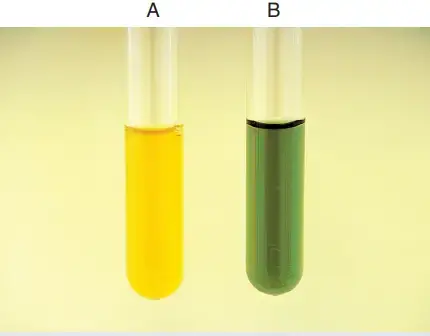
Organisms Showing Results in Pyruvate Broth Test
A. Positive (Yellow colour change)
- Enterococcus faecalis.
- Enterococcus dispar.
- Enterococcus cecorum.
- Enterococcus canis.
- Enterococcus columbae.
- Enterococcus moraviensis.
- Enterococcus sp. nov. CDC PNS-E1.
- Enterococcus sp. nov. CDC PNS-E3.
B. Negative (No colour change / greenish-blue)
- Enterococcus faecium.
- Enterococcus durans.
- Enterococcus avium.
- Enterococcus viikkiensis.
- Enterococcus termitis.
- Enterococcus gallinarum.
- Enterococcus hirae.
- Enterococcus mundtii.
- Enterococcus sp. nov. CDC PNS-E2.
- Streptococcus bovis.
- Lactococcus species.
- Aerococcus species (typically negative or variable).
Quality control strains of Pyruvate Broth Test
- Positive control
- Enterococcus faecalis ATCC 29212 (growth occurs and medium turns yellow).
- Negative controls
- Enterococcus faecium ATCC 6569 (growth occurs but no colour change, medium remains greenish-blue).
- Enterococcus faecium ATCC 700221 (growth occurs but no colour change, medium remains blue / blue-green).
- Streptococcus bovis ATCC 9809 (growth occurs but no colour change, medium remains greenish-blue).
Precautions of Pyruvate Broth Test
- Over-sterilization should be avoided. Prolong heating can degrade sodium pyruvate and bromothymol blue, so baseline colour and reaction may be altered.
- The medium must be strictly carbohydrate free. Any sugar contamination can be fermented by bacteria and false positive result may be seen.
- Light inoculum should be used. Heavy inoculum can carry over acidic end products from the primary plate and gives false positive colour change.
- Incubation should be done with loose caps or cotton plugs. This is done to permit air exchange for proper initial growth of Enterococcus species.
- Final negative result should not be reported early. It should be read after 48 to 72 hours as some strains are slow and late reacting.
- Weak reaction should be interpreted properly. Slight yellowish-green colour should be reported as negative only.
- Medium should be stored properly at 2–8°C. It should be protected from direct light, freezing and excess heat. Before use tubes are kept at room temperature and checked for contamination or deterioration (discolouration, shrinking).
- Aseptic and biohazard precautions should be followed. Clinical isolates are treated as pathogens, PPE is used, and all inoculated tubes and wastes are autoclaved before disposal.
Uses of Pyruvate Broth Test
- It is used to differentiate Enterococcus species. It is commonly used to separate Enterococcus faecalis (pyruvate positive) from Enterococcus faecium (pyruvate negative).
- It is used in general bacterial identification to determine whether the organism can utilize pyruvate as carbon source and produce acidic end products.
- It is used in identification schemes of other catalase-negative Gram-positive cocci (e.g. Aerococcus spp., Gemella spp.).
- It is used along with other biochemical tests to classify and differentiate different groups/species under Enterococcus genus.
- It is used in food microbiology and research to study metabolic pathways and to track flavour compound production like diacetyl and acetoin (cheese ripening).
Advantages of Pyruvate Broth Test
- It is cost effective and inexpensive test. It provides an affordable phenotypic marker for routine clinical laboratory.
- It is used as a rapid screening test. It helps in early differentiation while final antibiotic susceptibility report is awaited.
- It is highly specific for differentiation. It gives a good marker for species level separation, mainly Enterococcus faecalis from Enterococcus faecium.
- It is easy to interpret by visual observation. The indicator shows distinct colour change to yellow in positive result.
- It is a reliable and accessible test. It is useful in laboratories where costly modern instruments (e.g. MALDI-TOF) are not available.
Limitations of Pyruvate Broth Test
- It has limited scope of application. It is mainly used for Enterococcus and some Streptococcus group differentiation, and it is not useful for most other bacterial groups.
- It cannot be used as a standalone test. For complete identification, other biochemical / molecular / immunological or advanced methods are required.
- Negative result takes more time. Positive may be seen within 24 hours but final negative confirmation may require 48–72 hours and sometimes up to 5 days.
- False positive chances are there. The medium must be strictly carbohydrate free, sugar contamination can give false positive. Heavy inoculum can also carry acidic products from primary plate and early false positive reading occurs.
- Result reading is sometimes subjective. Weak reaction may show yellowish-green colour and confusion may occur.
- Atypical strains may give unexpected result. Variant strains (e.g. asaccharolytic variants of Enterococcus faecalis) can lead to misidentification if only this test is depended on.
References
- Aryal, S. (2022, August 10). Pyruvate broth test – Principle, procedure, uses and interpretation. Microbiology Info.com.
- Aryal, S. (2022, September 5). Biochemical test of Enterococcus faecalis. Microbe Notes.
- Carvalho, M. d. G. S., Steigerwalt, A. G., Morey, R. E., Shewmaker, P. L., Teixeira, L. M., & Facklam, R. R. (2004). Characterization of three new enterococcal species, Enterococcus sp. nov. CDC PNS-E1, Enterococcus sp. nov. CDC PNS-E2, and Enterococcus sp. nov. CDC PNS-E3, isolated from human clinical specimens. Journal of Clinical Microbiology, 42(3), 1192–1198. https://doi.org/10.1128/JCM.42.3.1192-1198.2004
- Comprehensive analysis of the pyruvate broth test in clinical microbiology and bacterial phenotyping. (n.d.).
- Dahal, P. (2023, June 5). Pyruvate broth test- Principle, procedure, results, uses. Microbe Notes.
- Dalynn Biologicals. (2014). Pyruvate broth (Catalogue No. TP99).
- Doi, Y., & Ikegami, Y. (2014). Pyruvate formate-lyase is essential for fumarate-independent anaerobic glycerol utilization in the Enterococcus faecalis strain W11. Journal of Bacteriology, 196(13), 2472–2480. https://doi.org/10.1128/JB.01512-14
- Hardy Diagnostics. (2020). Pyruvate broth instructions for use (Cat. no. Y130).
- InformationBoxTicket Lifestyles. (n.d.). Pyruvate broth test: Uses, procedure & results | Microbial identification test | Biochemical tests [Video]. YouTube.
- Lactic acid fermentation is the main aerobic metabolic pathway in Enterococcus faecalis metabolizing a high concentration of glycerol. (n.d.). PubMed.
- Lebreton, F., Willems, R. J. L., & Gilmore, M. S. (2014). Enterococcus diversity, origins in nature, and gut colonization. In M. S. Gilmore, D. B. Clewell, Y. Ike, et al. (Eds.), Enterococci: From commensals to leading causes of drug resistant infection. Massachusetts Eye and Ear Infirmary.
- Manero, A., & Blanch, A. R. (1999). Identification of Enterococcus spp. with a biochemical key. Applied and Environmental Microbiology, 65(10), 4425–4430. https://doi.org/10.1128/aem.65.10.4425-4430.1999
- Megazyme. (n.d.). Pyruvic acid (pyruvate) assay procedure (K-PYRUV 10/20).
- Phenotypic description and antimicrobial susceptibilities of Aerococcus sanguinicola isolates from human clinical samples. (n.d.). PubMed Central (PMC).
- Pyruvate fermentation by Streptococcus faecalis. (n.d.). PubMed.
- Quiloan, M. L. G., Vu, J., & Carvalho, J. (2012). Enterococcus faecalis can be distinguished from Enterococcus faecium via differential susceptibility to antibiotics and growth and fermentation characteristics on mannitol salt agar. Frontiers in Biology, 7(2). https://doi.org/10.1007/s11515-012-1183-5
- Ramsey, M., Hartke, A., & Huycke, M. (2014). The physiology and metabolism of enterococci. In M. S. Gilmore, D. B. Clewell, Y. Ike, et al. (Eds.), Enterococci: From commensals to leading causes of drug resistant infection. Massachusetts Eye and Ear Infirmary.
- Repizo, G. D., Mortera, P., & Magni, C. (2011). Disruption of the alsSD operon of Enterococcus faecalis impairs growth on pyruvate at low pH. Microbiology.
- Sigma-Aldrich. (2003). Sodium pyruvate (P3662) – Product information sheet.
- University of Iowa Department of Pathology. (2018, March 21). Pyruvic acid. UI Health Care Laboratory Services Handbook.
- Useful tests for the differentiation of Group II Enterococcus species. (n.d.). cmpt.
- Watson, R. (n.d.). Tests used to identify Gram negative bacteria. Microbiology Lab: MOLB 2210. University of Wyoming.