

Immune response is the defense mechanism of body by which the body recognizes and removes harmful foreign particles or pathogens.
It is activated when any foreign substances enter into the body by crossing the physical barriers. These foreign substances are called antigens. The antigens may be bacteria, viruses, fungi and parasites.
The immune response is mainly of two types. These are innate immune response and adaptive immune response.
Innate immune response is the first line defense of the body. It acts very fast and gives immediate protection. But it is non-specific in nature, means it acts against many types of pathogens in same general way.
Adaptive immune response is slower than innate response. It is highly specific for particular antigen. It is activated when innate immunity cannot remove the pathogen properly.
During this response, special immune cells are formed which remember the same pathogen. This is called immunological memory. Due to this memory, the body gives faster and stronger response when the same antigen enters again.
What is Primary Immune Response?
Primary immune response is the first immune reaction of body when it comes in contact with a new foreign pathogen or antigen for the first time.
In this response, the immune system identify the antigen newly. So the response is slow than later response. The naive B lymphocytes and T lymphocytes are activated mainly in lymph nodes and spleen.
After activation these lymphocytes multiply rapidly and form many cells against that particular antigen. This process is also called priming of immune system.
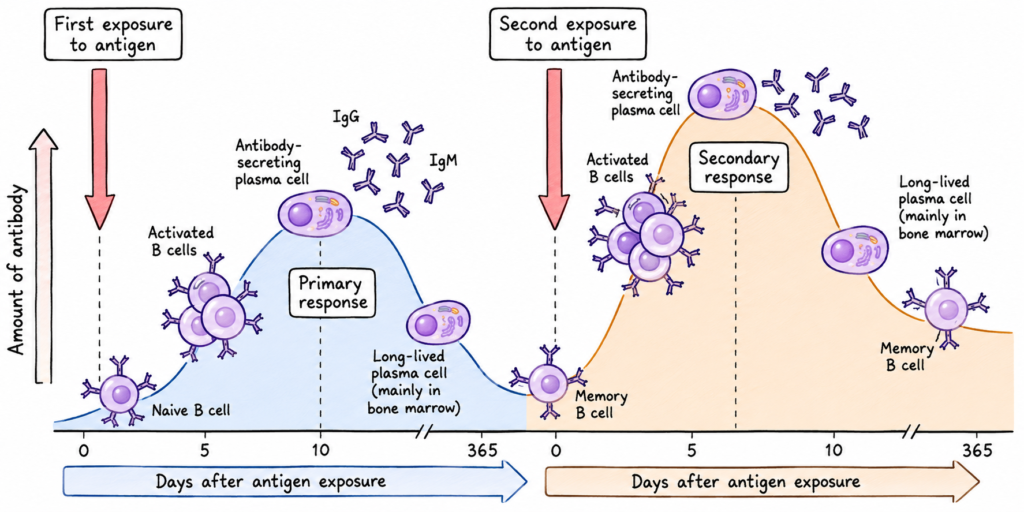
The primary immune response occurs in four phases. These are lag phase, exponential phase, plateau phase and decline phase.
In lag phase, no specific antibody is detected in blood for some days. It generally takes about 4 to 7 days, sometimes more. This happens because body is recognizing the antigen for first time.
In exponential phase, antibody production starts and increases. The antibody level reaches peak usually around 7 to 10 days. The main antibody formed is IgM. It has comparatively low affinity for antigen.
In plateau phase, antibody level remains almost constant for some time. Then in decline phase, antibody level decreases slowly as the antigen is removed.
The short lived plasma cells die by apoptosis after the threat is cleared. But some memory B cells and memory T cells remain in the body for long time.
These memory cells help the body to give faster and stronger response when same antigen enters again. This is referred to as immunological memory.
What is Secondary Immune Response?
Secondary immune response is the immune reaction of body when it meets the same pathogen or antigen for second time.
It is also called anamnestic response. This response does not start from beginning like primary response. It is mainly based on memory B cells and memory T cells which are formed during primary immune response.
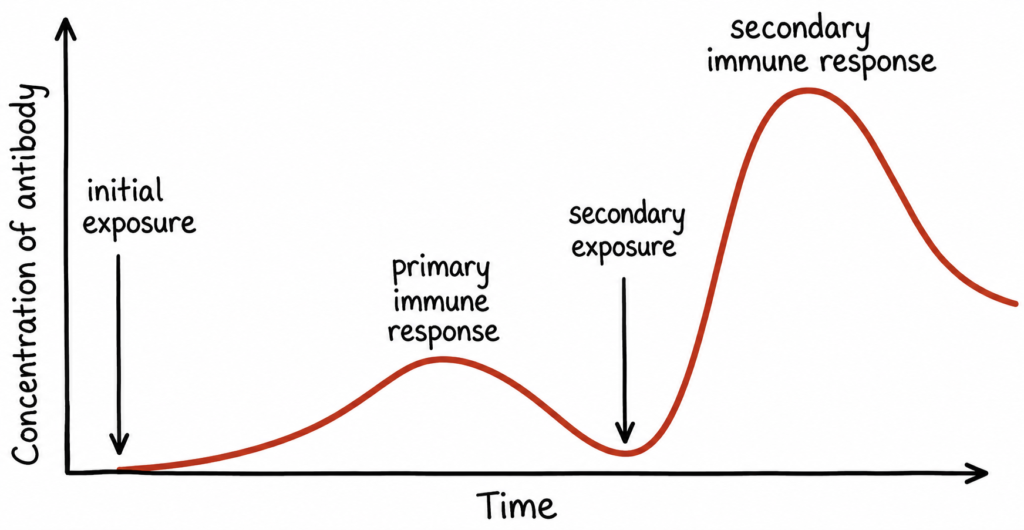
In this response, the memory cells already recognize the particular antigen. So the lag phase is very short. It generally takes about 1 to 4 days only.
The antibody production starts very fast and reaches peak within 3 to 5 days. The amount of antibody formed is much higher than primary response. It may be 100 to 1000 times more.
The main antibodies produced are IgG, IgA or IgE. These antibodies have high affinity for the antigen. So they bind strongly with pathogen and remove it more effectively.
During secondary response, large number of antigen specific cytotoxic T cells are also formed quickly. Their number may increase many times and helps in destroying infected cells.
Due to this fast and strong response, the pathogen is usually removed before it produce disease. This is the main importance of secondary immune response.
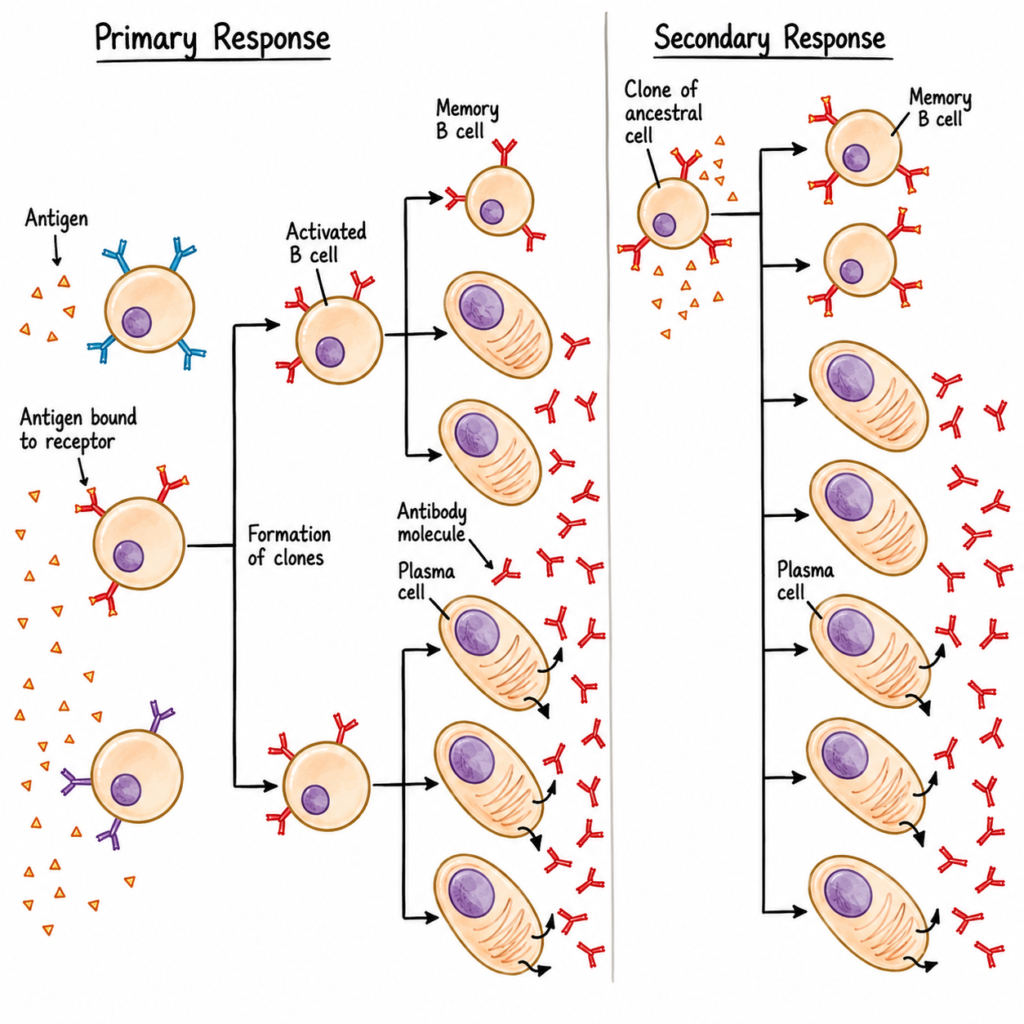
Phases of the Primary Immune Response
The primary immune response takes place after the first entry of a new antigen into the body. It occurs in sequential phases. The following are the phases of primary immune response–
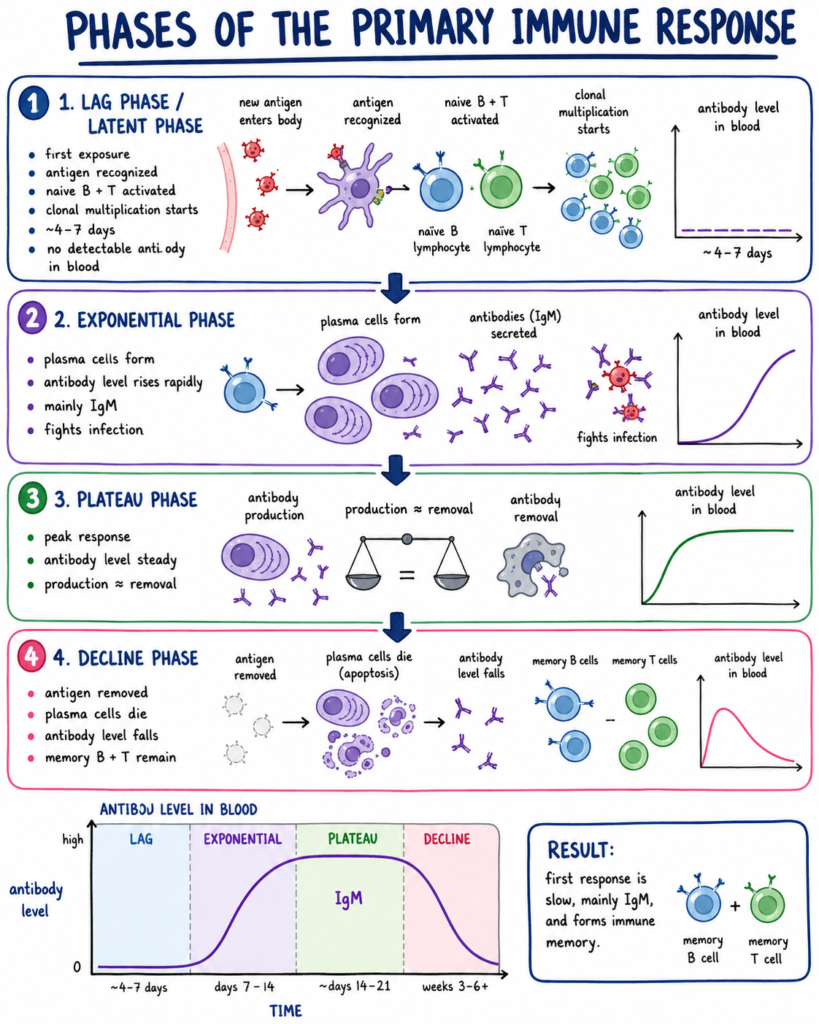
1. Lag phase or Latent phase
In this phase, the antigen enters into the body for the first time. The immune system starts to recognize the foreign antigen.
The naive B lymphocytes and naive T lymphocytes come in contact with the antigen. They become activated and start multiplication.
This phase usually takes about 4 to 7 days, but sometimes it may take more time. In this phase, antibody is not detected in the blood.
2. Exponential phase
In this phase, the activated B lymphocytes differentiate into plasma cells.
The plasma cells start to secrete antigen specific antibodies. So the antibody level in blood increases rapidly.
This rise is sharp and helps the body to fight against the infection. Mainly IgM antibody is formed during this phase.
3. Plateau phase
In this phase, the antibody level reaches a constant state.
The formation of new antibody and removal of old antibody becomes almost equal. So the antibody amount remains steady for some time.
This is the peak period of the primary immune response.
4. Decline phase
In this phase, the antigen is removed from the body.
The short lived plasma cells become exhausted and die by apoptosis. This is also called programmed cell death.
As new plasma cells are not formed, the antibody level starts to decrease rapidly. But some memory B cells and memory T cells remain in the body for future response.
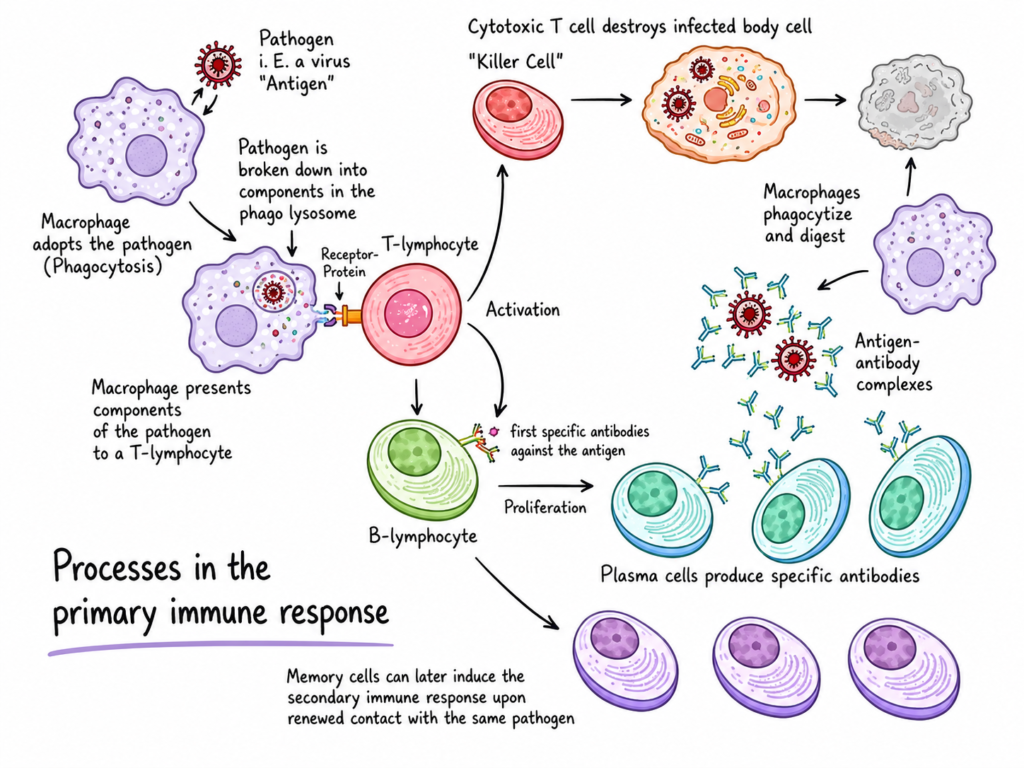
Mechanism of the Primary Immune Response
The following are the steps of primary immune response–
- Antigen entry and transportation – In this step, the foreign pathogen enters into the body by crossing the innate immune barriers. The pathogen is captured by antigen presenting cells (APCs). Mainly dendritic cells capture the antigen and carry it to secondary lymphoid organs like lymph nodes and spleen.
- Antigen presentation (Signal 1) – In this step, dendritic cells process the pathogen into small peptide fragments. These peptides are presented on the surface with Major Histocompatibility Complex (MHC) molecules. The naive T cells recognize the peptide MHC complex by T cell receptors (TCRs).
- Co-stimulation (Signal 2) – In this step, the T cells need another signal for full activation. The CD28 receptor of naive T cell binds with B7.1 or B7.2 ligand present on APC. This signal prevents apoptosis and activates the T cell. After this, T cells multiply rapidly. This is called clonal expansion.
- Specialization by cytokines (Signal 3) – In this step, APCs and nearby cells release chemical messengers called cytokines. These cytokines guide the multiplying T cells to become special effector cells. The cells may become Th1, Th2 or Th17 cells according to the type of pathogen.
- Naive B cell recognition – In this step, the naive B cells directly recognize the free and intact antigen. The antigen binds with surface B cell receptors (BCRs) present on B cells. This is the first recognition by B cell.
- B cell processing and T cell help – In this step, the B cell takes the bound protein antigen inside the cell. It breaks the antigen into small fragments and presents them on its surface by MHC class II molecules. The activated helper T cells, mainly T follicular helper cells, recognize it and bind with B cell. They give activation signals through CD40L to CD40 interaction and also by cytokines.
- Antibody production and memory formation – In this step, the activated B cells divide and differentiate. Some B cells become plasma cells which secrete large amount of antibodies against the antigen. Some B cells become memory B cells which remain in the body for long time. These memory cells help in future response against same antigen.
- Direct B cell activation by non-protein antigen – Some non-protein antigens like lipids and polysaccharides can activate B cells without T cell help. But this response is weak and it does not produce strong immunological memory.
Mechanism of the Secondary Immune Response
The following are the steps of secondary immune response–
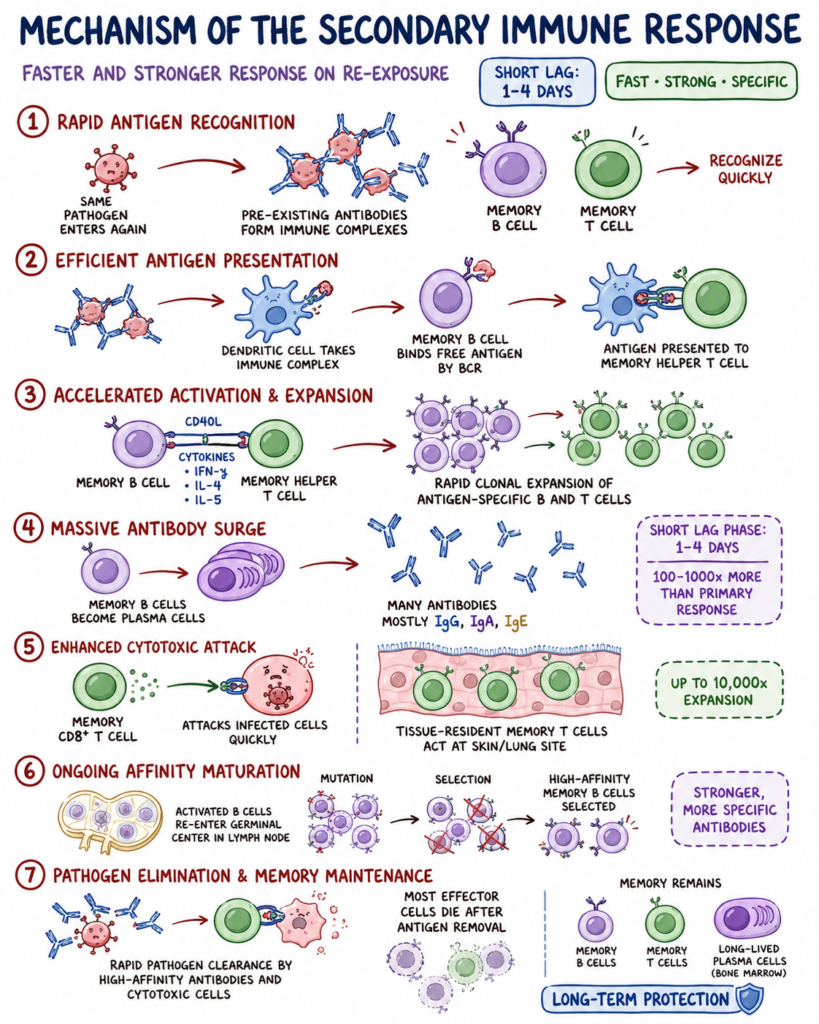
- Rapid antigen recognition – When the same antigen enters again, the already present antibodies bind with it quickly. This forms immune complexes. At the same time memory B cells and memory T cells recognize the same pathogen very fast.
- Efficient antigen presentation – The immune complexes are taken by dendritic cells. The memory B cells also bind with free antigen by their B cell receptors (BCRs). These cells process the antigen and present it to memory helper T cells.
- Accelerated activation and expansion – The memory B cells and memory helper T cells interact with each other. The memory T cells express CD40L and release cytokines like IFN-γ, IL-4 and IL-5. These signals cause rapid multiplication of antigen specific B cells and T cells.
- Massive antibody surge – The memory B cells rapidly change into plasma cells. The lag phase is very short, about 1 to 4 days. A large amount of antibody is produced, about 100 to 1000 times more than primary response. Mainly IgG, IgA or IgE are formed.
- Enhanced cytotoxic attack – The memory CD8+ T cells or cytotoxic T cells are activated quickly. They attack the infected cells. Their number may increase up to 10,000 fold. Tissue resident memory T cells present in skin or lungs also act fast at the infected site.
- Ongoing affinity maturation – Some activated B cells enter again into the germinal centers of lymph nodes. They undergo mutation and selection. Only high affinity memory B cells bind with the remaining antigen. This makes antibody response more strong and specific.
- Pathogen elimination and memory maintenance – The pathogen is removed very fast by high affinity antibodies and cytotoxic cells. After antigen removal, many effector cells die. But memory B cells, memory T cells and long lived plasma cells remain in the body for long time protection.
Antibody Production During the Primary Immune Response
The following are the steps of antibody production during primary immune response–
- Antigen recognition – In this step, the naive B cells recognize the foreign antigen directly. The antigen binds with membrane bound B cell receptors (BCRs) present on the surface of B cells.
- Antigen internalization and presentation – In this step, the B cell takes the bound protein antigen inside by receptor mediated endocytosis. Then antigen is broken into small peptide fragments. These fragments are shown on the surface of B cell with MHC class II molecules.
- T cell help or T-dependent activation – In this step, the B cell acts as antigen presenting cell (APC). It presents peptide MHC class II complex to primed T follicular helper cells (Tfh cells). The CD40L present on T cell binds with CD40 present on B cell. The T cell also secretes cytokines. These signals activate the B cell completely.
- T-independent activation – Some non-protein antigens like bacterial polysaccharides and lipid polymers can activate B cells without T cell help. These antigens have repeated epitopes and they cross-link many BCRs at a time. With danger signals, the B cell becomes activated directly. But this response is not strong like T dependent response.
- Clonal expansion – In this step, the activated B cells enter into lag phase. This phase takes about 4 to 7 days. During this time, the B cells divide rapidly and form many same antigen specific clones.
- Differentiation – In this step, the multiplied B cells change into two types of cells. Some become plasma cells or effector B cells. Some become memory B cells.
- Antibody secretion – In this step, the newly formed plasma cells secrete large amount of antigen specific antibodies into the blood. During primary immune response, mainly IgM antibodies are formed. These antibodies have low affinity for antigen. The antibody production reaches peak usually around 7 to 10 days.
- Resolution and memory – In this step, the infection is cleared and short lived plasma cells become exhausted. They die by apoptosis or programmed cell death. So antibody level decreases. But memory B cells remain in the body for long time and give protection during next exposure of same antigen.
Antibody Production During the Secondary Immune Response
The following are the steps of antibody production during secondary immune response–
- Antigen re-exposure and recognition – In this step, the same antigen enters into the body again. The memory B cells which are formed during primary immune response recognize and bind with the specific antigen very quickly.
- Competitive selection – In this step, the already present antibodies bind with the antigen and remove much amount of it. So only those memory B cells which have very high affinity can bind with the remaining antigen. This makes the response more selected and strong.
- T cell help – In this step, the high affinity memory B cells take the antigen inside the cell. They process it and present the peptide fragments to memory T follicular helper cells (Tfh cells). The Tfh cells bind with B cells and give survival and activation signals.
- Rapid clonal expansion – In this step, the activated memory B cells multiply very fast. They do not need long learning phase because they are already programmed from first exposure. The lag phase is short, about 1 to 4 days only.
- Somatic hypermutation (SHM) – In this step, the multiplying B cells undergo mutation in their antigen binding region inside germinal centers. This process forms B cells with more accurate binding capacity. It helps in affinity maturation.
- Class switch recombination (CSR) – In this step, the cytokines released by Tfh cells help B cells to change the antibody class. The antibody changes from mainly IgM type to more effective antibodies like IgG, IgA or IgE.
- Differentiation – In this step, the selected high affinity B cells change into plasma cells and memory B cells. The plasma cells secrete antibodies. The memory B cells remain in the body for future response. Some rare B cell clones of primary response may also be activated and increase the diversity of response.
- Massive antibody surge – In this step, the newly formed plasma cells secrete large amount of high affinity antibodies into the blood. The antibody production reaches peak within 3 to 5 days. The amount of antibody formed is about 100 to 1000 times more than primary immune response.
Formation of Memory B Cells and Memory T Cells
The following are the steps for formation of memory B cells and memory T cells–
Formation of Memory B Cells
- Antigen binding and processing – In this step, the naive B cells bind with the protein antigen by using membrane bound B cell receptors (BCRs). The antigen is taken inside the B cell, broken into small fragments and presented on the surface with MHC class II molecules.
- T cell help – In this step, T follicular helper cells (Tfh cells) recognize the antigen presented by B cell. The CD40 of B cell binds with CD40L of T cell. The Tfh cells also release cytokines which stimulate the B cell to multiply.
- Germinal center formation and diversification – In this step, the activated B cells enter into follicles of secondary lymphoid organs. They form germinal centers. Here the B cells undergo somatic hypermutation (SHM). This produces changes in antibody binding region and creates different types of B cell receptors.
- Affinity selection – In this step, the mutated B cells compete with each other for binding antigen. The antigen is displayed by follicular dendritic cells. Only those B cells which bind strongly with antigen get survival signals from Tfh cells, mainly by cytokines like IL-21.
- Memory B cell differentiation – In this step, the selected high affinity B cells differentiate into memory B cells. These cells live for long time in the body. Some rare B cell clones may also form memory B cells and help to make secondary response more diverse.
- Non-protein antigen response – Some antigens like polysaccharides can activate B cells without T cell help. But this type of response does not form proper immunological memory.
Formation of Memory T Cells
- Three signal activation – In this step, naive T cells meet with antigen presenting cells (APCs) like dendritic cells. The first signal is binding of TCR with peptide MHC complex. The second signal is co-stimulation like CD28 binding with B7. The third signal is given by cytokines.
- Clonal expansion – In this step, the activated T cells divide rapidly. Growth cytokines like IL-2 help in this multiplication. Many same antigen specific effector T cells are formed to fight the infection.
- Precursor selection – After the pathogen is cleared, most of the effector T cells die by apoptosis. But some special cells remain alive. These are called memory precursor effector cells (MPECs). They may show markers like CD127+ and KLRG1-.
- Formation of central memory T cells – Some memory precursor cells become central memory T cells (Tcm cells). These cells have homing receptors like CCR7 and CD62L. They move through secondary lymphoid organs and can multiply fast when same antigen enters again.
- Formation of effector memory T cells – Some cells become effector memory T cells (Tem cells). These cells do not have strong lymphoid homing receptors. They circulate in blood and inflamed tissues. They give quick effector action against the same antigen.
- Formation of tissue resident memory T cells – Some memory T cells become tissue resident memory T cells (Trm cells). They stay permanently in barrier tissues like skin, gut and lungs. Local cytokines like TGF-β help in their formation.
- Retention in tissues – In this step, Trm cells reduce the receptors which help them to leave tissue. They increase retention markers like CD69, CD103 and CD49a. So they remain fixed in tissue and act as local guards during second infection.
Role of Memory Cells in the Secondary Immune Response
The following are the role of memory cells during secondary immune response–
A. Role of Memory B Cells
- Rapid activation – Memory B cells become activated very fast when the same antigen enters into the body again.
- Low antigen dose response – Memory B cells can respond even in low amount of antigen. They have more MHC class II molecules, so they present antigen to helper T cells quickly.
- High affinity selection – The already present antibodies remove much amount of antigen. So only high affinity memory B cells bind with the remaining antigen and become selected.
- Mature antibody production – Memory B cells already undergone class switching during primary response. So they quickly produce IgG, IgA or IgE instead of mainly IgM.
- More specific antibody response – The antibodies produced are high affinity antibodies. They bind strongly with antigen and remove the pathogen more effectively.
- Increase in response diversity – Some rare memory B cell clones also take part during secondary response. These clones produce different antibodies and increase the diversity of immune response.
B. Role of Memory T Cells
- Rapid cytotoxic attack – Memory CD8+ T cells become activated very quickly after the same antigen enters again. They attack and destroy infected cells.
- Cytokine production – Activated memory T cells release large amount of cytokines like IFN-γ. These cytokines help in killing infected cells and activating other immune cells.
- Local defense by tissue resident memory T cells – Tissue resident memory T cells (Trm cells) stay in tissues like skin, lungs and gut. They act immediately at the site of pathogen entry.
- Pathogen alert state – Trm cells release signaling cytokines after activation. These cytokines attract other immune cells like T cells, B cells and Natural Killer cells (NK cells) to the infected area.
- Peripheral response by effector memory T cells – Effector memory T cells (Tem cells) circulate in blood and non-lymphoid tissues. They give rapid cytolytic action at the inflamed site.
- Reinforcement by central memory T cells – Central memory T cells (Tcm cells) remain mainly in secondary lymphoid organs. They multiply rapidly and form new effector T cells to continue the immune response.
Factors Affecting Primary and Secondary Immune Responses
The following are the important factors affecting primary immune response and secondary immune response–
- Type of antigen – The type of antigen affects the immune response. Primary immune response may be produced by both thymus dependent and thymus independent antigens. But secondary immune response is mainly produced by protein or thymus dependent antigens.
- Antigen dose – The amount of antigen is important for immune response. A small amount below the required level may not activate the immune system properly. Very high dose of antigen may also inhibit the response or produce immune tolerance.
- Route of antigen entry – The route by which antigen enters into the body affects the site and type of response. Antigen entering in blood mainly produces response in spleen. Antigen entering through skin activates regional lymph nodes. Antigen entering through mucosal surface activates submucosal lymphoid tissues.
- Size and complexity of antigen – Large, complex and particulate antigens produce strong immune response. Antigens which are different from body proteins are more immunogenic. Small non-protein molecules and simple antigens are weak, and they may need a carrier protein to become immunogenic.
- Antigen presenting cells (APCs) – The type of antigen presenting cell also affects the response. Dendritic cells are mainly important for starting primary immune response. In secondary immune response, memory B cells act as very efficient antigen presenting cells.
- Presence of adjuvants – Adjuvants increase the immunogenicity of antigen. They make soluble antigen more particulate so that APCs can take it easily. They also give inflammatory or microbial danger signals and make antigen presentation more effective.
- Antigen receptors – The response depends on proper binding of antigen with receptors. T cell receptors (TCRs) and B cell receptors (BCRs) must recognize the correct epitope of antigen. If binding is strong and proper, immune response becomes better.
- Presence of memory cells – The presence or absence of memory B cells and memory T cells decides the type of response. In primary immune response, naive B cells and naive T cells are activated for first time. In secondary immune response, memory cells are already present, so the response is fast and strong.
- Antibody class switching and affinity maturation – In primary response, class switching and affinity maturation starts slowly. In secondary response, memory cells already have undergone these changes. So antibodies are produced faster, with better class and high affinity.
- Condition of host immune system – The immune response also depends on health of the person. Age, nutrition, infection, stress and immune deficiency can reduce both primary and secondary immune responses.
Clinical Significance of Primary and Secondary Immune Responses
The following are the clinical significance of primary immune response and secondary immune response–
- Vaccine design – The idea of vaccination is based on primary and secondary immune response. Vaccine gives a harmless antigen into the body and produces primary response. It forms memory B cells and memory T cells. When real pathogen enters later, the body gives fast and strong secondary response before disease occurs.
- Vaccine dose and booster – Vaccine schedule depends on the nature of immune response. Some killed or subunit vaccines produce weak primary response. So repeated doses are needed. Booster dose again stimulates memory cells and produces secondary response. It increases antibody level and keeps immunity for long time.
- Serological diagnosis – Blood test for antibody helps to know the stage of infection. In primary response, mainly IgM antibody is formed. So high IgM indicates recent or active infection. In secondary response, mainly IgG antibody is formed. So high IgG indicates old infection, vaccination or second exposure.
- Prevention of hemolytic disease of newborn – This is important in Rh incompatibility. If Rh-negative mother carries Rh-positive fetus, fetal red cells may enter mother blood. Anti-Rh antibody is given to mother to remove these fetal cells before primary response starts. It prevents formation of memory B cells. So dangerous secondary response does not occur in next pregnancy.
- Allergy identification – Allergy is due to pre-existing immune memory and specific IgE antibody. In skin test, very small amount of allergen is injected into skin. If memory cells and IgE are present, a local secondary immune reaction occurs. Redness and swelling helps to detect the allergen.
- Tuberculin skin test – This test is based on cell mediated secondary immune response. In this test, tuberculin antigen of Mycobacterium tuberculosis is injected into skin. If the person has memory T cells, delayed type hypersensitivity reaction occurs. A raised red area shows previous exposure to tuberculosis antigen.
- Cancer immunotherapy – The knowledge of T cell and B cell activation is used in cancer treatment. In CAR-T cell therapy, patient T cells are changed to recognize cancer cells as foreign antigen. Checkpoint inhibitors prevent cancer cells from stopping active T cell response. Tissue resident memory T cells (Trm cells) are also studied for tumor protection and solid cancer therapy.
- Understanding immune protection – Primary response shows how body first learns about a pathogen. Secondary response shows how body protects fast after memory is formed. This is useful in infection control, vaccination and treatment planning.
Differences Between Primary and Secondary Immune Responses
The following are the important differences between primary immune response and secondary immune response–
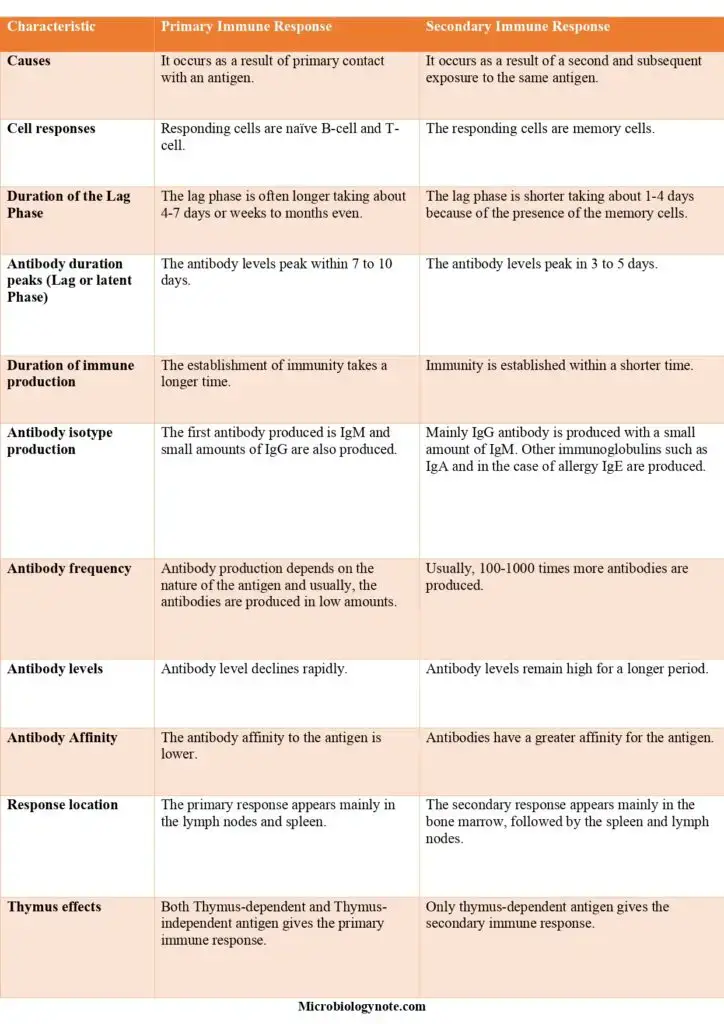
| Characters | Primary immune response | Secondary immune response |
|---|---|---|
| Triggering stimulus | It occurs when the body comes in contact with a new antigen for first time. | It occurs when the body comes in contact with the same antigen again. |
| Responding cells | It activates naive B cells and naive T cells. | It activates memory B cells and memory T cells. |
| Lag phase | Lag phase is long. It usually takes 4 to 7 days, sometimes weeks. | Lag phase is short. It usually takes 1 to 4 days. |
| Time to peak antibody | Antibody level reaches peak slowly, about 7 to 10 days. | Antibody level reaches peak quickly, about 3 to 5 days. |
| Main antibody type | Mainly IgM antibody is produced. Small amount of IgG may also form. | Mainly IgG antibody is produced. Some IgM, IgA or IgE may also form. |
| Amount of antibody | Amount of antibody produced is comparatively low. | Amount of antibody produced is very high. It may be 100 to 1000 times more. |
| Antibody affinity | Antibodies have low affinity for antigen. So binding is less strong. | Antibodies have high affinity for antigen. So binding is more strong and effective. |
| Duration of antibody level | Antibody level decreases rapidly after antigen removal. | Antibody level remains high for longer time. |
| Main site of response | It mainly occurs in lymph nodes and spleen. | It mainly appears in bone marrow, then spleen and lymph nodes. |
| Immunological memory | It forms memory B cells and memory T cells for future response. | It uses already formed memory cells and gives faster response. |
| Effectiveness | It is slow and less strong response. | It is fast, strong and more effective response. |
References
- Janeway, C. A., Jr., Travers, P., Walport, M., & Shlomchik, M. J. (2001). Appendix I. Immunologists’ toolbox. In Immunobiology: The immune system in health and disease (5th ed.). Garland Science. https://www.ncbi.nlm.nih.gov/books/NBK10755/
- iRepertoire. (2026). B cell and T cell structure and function | Immunology. https://irepertoire.com/t-cell-and-b-cell-overview/
- Booster vaccination improves the durability of antibody-secreting cells. (n.d.). bioRxiv. https://www.biorxiv.org/content/10.64898/2026.04.18.719387v1.full
- Brandl, K. (n.d.). Brandl’s basics: Somatic hypermutation and class switch recombination [Video]. YouTube. https://www.youtube.com/watch?v=ba68cC8h3Eo
- Wu, X., Wu, P., Shen, Y., Jiang, X., & Xu, F. (2018). CD8+ resident memory T cells and viral infection. Frontiers in Immunology, 9, Article 2093. https://doi.org/10.3389/fimmu.2018.02093
- Comparative analysis of primary and secondary adaptive immune responses: Molecular kinetics, cellular plasticity, and immunological memory. (n.d.). [Markdown].
- Divergence of tissue-memory T cells: Distribution and function. (n.d.). PubMed Central (PMC). https://pmc.ncbi.nlm.nih.gov/articles/PMC7528850/
- Cusimano, G., Staupe, R. P., & Sullivan, N. L. (2026). Emerging novel methodologies to understand and strategically target long-lived plasma cells in vaccine design to induce durable immunity. Frontiers in Immunology, 16, Article 1680375. https://doi.org/10.3389/fimmu.2025.1680375
- From vaccines to memory and back. (n.d.). PubMed Central (PMC). https://pmc.ncbi.nlm.nih.gov/articles/PMC3760154/
- Wu, X., Wu, P., Shen, Y., Jiang, X., & Xu, F. (2018). CD8+ resident memory T cells and viral infection. Frontiers in Immunology, 9, Article 2093. https://doi.org/10.3389/fimmu.2018.02093
- Heterogeneity and characteristics of memory T cell subsets. (n.d.). ResearchGate. https://www.researchgate.net/figure/Heterogeneity-and-characteristics-of-memory-T-cell-subsets-The-schematic-delineates-the_fig3_397759242
- PatSnap. (2025, May 28). How do vaccine boosters enhance immunity? Synapse. https://synapse.patsnap.com/article/how-do-vaccine-boosters-enhance-immunity
- Mokobi, F. (2022, May 30). Immune response- Definition, types, factors, examples. Microbe Notes. https://microbenotes.com/immune-response/
- Immune responses: Primary and secondary. (n.d.). ResearchGate. https://www.researchgate.net/publication/277707800_Immune_Responses_Primary_and_Secondary
- Schulz, A. R., Fiebig, L., Hirseland, H., Diekmann, L. M., Reinke, S., Hardt, S. K., Niedobitek, A., & Mei, H. E. (2023, September 14). Immune protection through long-lived plasma cells after mRNA vaccination. German Rheumatology Research Center (DRFZ). https://www.drfz.de/en/neuigkeiten/immunschutz-durch-langlebige-plasmazellen-nach-mrna-impfung/
- Khan Academy. (n.d.). Immune system: T cell activation (practice). https://www.khanacademy.org/test-prep/mcat/biological-sciences-practice/x04f6bc56:mcat-bio-biochem-foundation-3-passages/e/activation-of-t-lymphocytes
- Janeway, C. A., Jr., Travers, P., Walport, M., & Shlomchik, M. J. (2001). Immunological memory. In Immunobiology: The immune system in health and disease (5th ed.). Garland Science. https://www.ncbi.nlm.nih.gov/books/NBK27158/
- Hasudungan, A. (n.d.). Immunology – Adaptive immunity (B cell activation, hypermutation and class switching overview) [Video]. YouTube. https://www.youtube.com/watch?v=Bl6vWLqL2D0
- Memory T-cell heterogeneity and terminology. (n.d.). PubMed Central (PMC). https://pmc.ncbi.nlm.nih.gov/articles/PMC8485749/
- Performance Lab. (2025, November 26). Primary vs secondary immune response: A complete guide. https://www.performancelab.com/blogs/immune/primary-vs-secondary-immune-response
- Related mechanisms of antibody somatic hypermutation and class switch recombination. (n.d.). PubMed Central (PMC). https://pmc.ncbi.nlm.nih.gov/articles/PMC4481323/
- Wikipedia contributors. (2026, March 23). Somatic hypermutation. In Wikipedia, The Free Encyclopedia. https://en.wikipedia.org/wiki/Somatic_hypermutation
- OpenStax. (n.d.). T and B lymphocytes. In Biology for majors II. Lumen Learning. https://courses.lumenlearning.com/wm-biology2/chapter/t-and-b-lymphocytes/
- Cavanagh, M., & Findlay, E. G. (2022). T-cell activation. British Society for Immunology. https://www.immunology.org/public-information/bitesized-immunology/systems-processes/t-cell-activation
- The bone marrow as sanctuary for plasma cells and memory T cells. (n.d.). PubMed Central (PMC). https://pmc.ncbi.nlm.nih.gov/articles/PMC8232593/
- Speers, D. (2015). The vaccine non-responder. O&G Magazine, 17(2). https://www.ogmagazine.org.au/17/2-17/vaccine-non-responder/
- Wikipedia contributors. (2026, January 31). Tissue-resident memory T cell. In Wikipedia, The Free Encyclopedia. https://en.wikipedia.org/wiki/Tissue-resident_memory_T_cell
- Pfizer. (n.d.). Understanding six types of vaccine technologies. https://www.pfizer.com/news/articles/understanding_six_types_of_vaccine_technologies
- V(D)J recombination, somatic hypermutation and class switch recombination of immunoglobulins: Mechanism and regulation. (n.d.). PubMed Central (PMC). https://pmc.ncbi.nlm.nih.gov/articles/PMC7341547/
- Immunisation Advisory Centre. (2022, October). Types of vaccines. https://immune.org.nz/vaccines/vaccine-development
- National Institute of Allergy and Infectious Diseases. (n.d.). Vaccine types. https://www.niaid.nih.gov/research/vaccine-types
- Mitrzyk, B. M. (2023). Vaccine types. In Research Starters. EBSCO Information Services. https://www.ebsco.com/research-starters/health-and-medicine/vaccine-types
- Heart and Health Medical. (n.d.). Vaccines and immunology: How they work. https://heartandhealth.com/vaccines-and-immunology-how-they-work/
- Mechanisms in Medicine. (n.d.). Vaccines and the immune response: How vaccines work [Video]. YouTube. https://www.youtube.com/watch?v=Atrx1P2EkiQ
- Zoppi, L. (2023, February 20). What are the different types of vaccines? News-Medical.Net. https://www.news-medical.net/health/What-are-the-Different-Types-of-Vaccines.aspx
- Advocare Haddon Pediatric Group. (2024, July 24). Why are some vaccines given as multiple doses? https://www.advocarehaddonpediatrics.com/why-are-some-vaccines-given-as-multiple-doses
- Emcare Travel Clinic. (n.d.). Why some vaccines require multiple doses & how to manage them. https://emcaretravelclinic.co.uk/why-some-vaccines-require-multiple-doses-how-to-manage-them/
- UCLA Health. (2022, March 14). Why do vaccines require boosters? https://www.uclahealth.org/news/article/why-do-vaccines-require-boosters