

Phycology is the branch of biology and botany which deals with algae. It is also called algology. The name is originated from Greek word phykos, meaning seaweed and logia, meaning study.
Algae are the mostly aquatic and photosynthetic plant like organisms. They are found in freshwater and marine water. They may be small unicellular forms or large multicellular seaweeds.
The person who studies algae is called phycologist. In this branch, different forms of algae are studied, from microscopic phytoplankton and cyanobacteria to large seaweeds such as kelp. Their structure, classification, reproduction, physiology and ecological role are studied.
Phycology is generally concerned with the study of marine algae and freshwater algae. Some workers study soft algae and some study diatoms. Diatoms are the special algae having cell wall made up of silica.
Thus phycology is an important branch because algae are the major producers in aquatic habitat. They are involved in oxygen production, food chain and maintaining aquatic ecosystem.
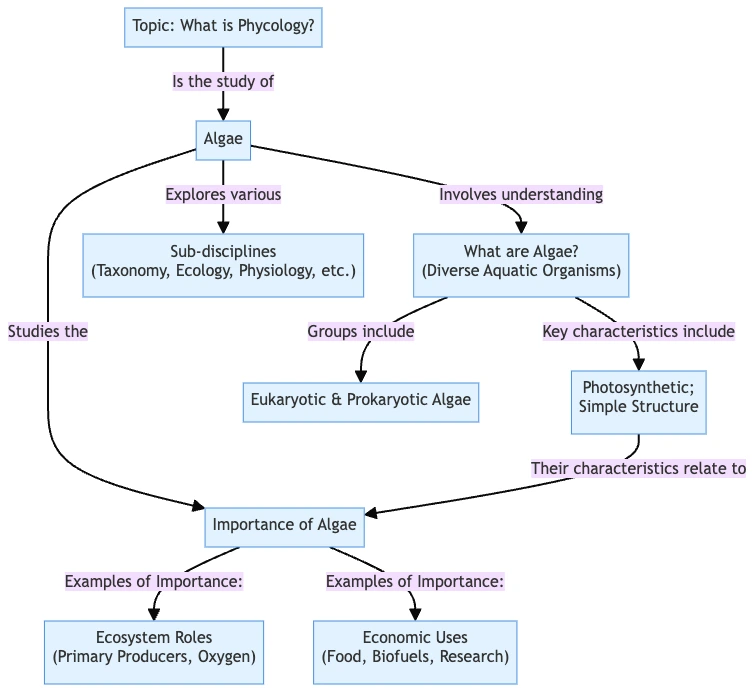
Definition of Phycology
Phycology is the scientific study of algae called algology. It is a branch of biology concerned with morphology physiology taxonomy ecology distribution and applied aspects of algae.
Algae studied range from microscopic phytoplankton to large seaweeds inhabiting diverse aquatic and some terrestrial environments. Phycologists examine algal roles as primary producers in ecosystems biotechnological resources and environmental indicators
History of Phycology
The history of phycology is related with the study, use and classification of algae from ancient time to modern period. The following are the important events in the history of phycology-
- In 2700 BCE, the ancient Chinese medical book Shennong Ben Cao Jing mentioned the use of brown seaweeds like Laminaria. It was used as food and also for medicinal value.
- In 500 BCE, the ancient Greeks and Romans used seaweeds for medicinal purpose. The Greek word phykos means seaweed and from this word later the term phycology was developed.
- In 1665, Robert Hooke used an early microscope and described the cellular structures of microscopic algae.
- In 1674, Antonie van Leeuwenhoek first observed microscopic algae by using microscope. He observed algae such as Spirogyra and Chlamydomonas.
- In 1753, Carl Linnaeus included 14 genera of algae in his book Species Plantarum. He placed algae along with mosses and lichens.
- In 1757, Pehr Osbeck started the formal scientific study of algae by describing and naming Fucus maximus.
- In 1768, Samuel Gottlieb Gmelin published Historia Fucorum. It was the first book fully based on marine algae and also used binomial nomenclature in marine biology.
- In 1803, Jean Pierre Étienne Vaucher published his work on isogamy or sexual conjugation in green algae.
- In 1820s, Carl Adolph Agardh made an early classification system of algae. This classification was based on the reproductive structures of different algae.
- In 1847, the term phycology was used for the botanical branch which deals with algae. The word was formed from phyco meaning seaweed and logy meaning study.
- In mid-1800s, William Henry Harvey classified the macroscopic algae into red, green and brown algae. He is widely regarded as the father of modern phycology.
- In 1855, Nathanael Pringsheim discovered sexual reproduction in green algae. He showed that fertilization takes place by fusion of gametes.
- In 1860s, Anton de Bary explained the alternation of generations in the life cycle of algae.
- In 1889, Kintarô Okamura studied Japanese coastal algae. He gave description and geographical distribution of algae of Japan.
- In 1902, Edward Arthur Lionel Batters published A Catalogue of the British Marine Algae. This work helped in distribution mapping and systematic record of algae.
- In 1935 and 1945, Felix Eugen Fritsch published important volumes on algae. These books collected the knowledge about algal morphology, reproduction and taxonomy.
- In 1949, Dr. Kathleen Mary Drew-Baker discovered the complete life cycle of Porphyra or nori seaweed. She showed that Conchocelis phase is the diploid stage. This discovery helped Japanese nori industry and she was called Mother of the Sea.
- In 1950, Dr. Isabella Aiona Abbott became the first Native Hawaiian woman to get PhD in science. She discovered more than 200 algal species and studied edible seaweeds called limu with traditional Hawaiian knowledge.
- In 1961, Melvin Calvin used the green alga Chlorella to study the Calvin cycle. This explained how algae and plants convert carbon dioxide into organic compounds during photosynthesis.
- In 1967, Lynn Margulis gave the Endosymbiotic Theory. According to this theory, chloroplasts of algae and plants were originated from cyanobacteria.
- In 1990s, DNA sequencing and barcoding were introduced in phycology. These methods helped to identify algae on genetic relation rather than only morphology.
- In 21st century, phycology became related with synthetic biology and genetic engineering. Microalgae are now studied for biofuel production, carbon sequestration, bioplastic synthesis and bioremediation of wastewater.
Phycologists and their Contributions
The following are some important phycologists and their contributions in phycology–
- Antonie van Leeuwenhoek in 1674 first observed microscopic algae by using early microscope. He observed algae such as Chlamydomonas and Spirogyra.
- Carl Linnaeus in 1753 included algae in his biological classification system. In his book Species Plantarum, algae were placed along with mosses and lichens.
- Pehr Osbeck in 1757 started the formal scientific study of algae. He described and named Fucus maximus which is now known as Ecklonia maxima.
- Samuel Gottlieb Gmelin in 1768 published Historia Fucorum. It was the first work based on marine algae and first in marine biology which used binomial nomenclature.
- Jean Pierre Étienne Vaucher in 1803 discovered isogamy in filamentous green algae. This is also called sexual conjugation.
- Jean-Baptiste Lamarck in 1809 proposed an early system of algal classification. It helped in arranging algae in a systematic way.
- Carl Adolph Agardh and Jacob Georg Agardh during 1820s to 1870s developed an extensive taxonomic system of algae. Their classification was based on algal pigmentation, morphology and reproductive characters.
- William Henry Harvey in mid 19th century divided macroscopic algae into four major divisions on the basis of pigmentation. He collected more than 10,000 algal species from different parts of world. He is known as father of modern phycology.
- Friedrich Traugott Kützing in 1849 separated silica structured diatoms and dual celled desmids. He described about six thousand species in his work Species Algarum.
- Nathanael Pringsheim in 1855 discovered sexual reproduction in green algae. He showed that fertilization occurs by the fusion of gametes.
- Anton de Bary in 1860s studied the alternation of generations in algal life cycle. This work helped to understand the reproductive cycle of algae.
- Eduard Strasburger in 1875 described cell division in algae. This work was important in the study of plant cytology.
- Johannes Reinke developed modern naming system for algae. He also described the structure and reproductive process of brown algae.
- Kintarô Okamura in 1889 studied Japanese coastal algae. He gave detailed description and geographical distribution of algae of Japan.
- Anna Weber-Van Bosse during 1899 to 1900 studied coralline algae. This work was done during the Dutch Siboga expedition.
- Edward Arthur Lionel Batters in 1902 published A Catalogue of the British Marine Algae. This work helped in identification keys and distribution mapping of marine algae.
- Lily Newton in 1931 published the first complete identification handbook for algae of the British Isles. It was useful for the identification of British algae.
- Mary Parke in 1931 and 1953 worked on marine algal species. She helped in making standard regional checklists of marine algae.
- Felix Eugen Fritsch in 1935 and 1945 collected global knowledge on algal morphology and reproduction. He also made a large collection of freshwater algae illustrations.
- Kathleen Mary Drew-Baker in 1949 discovered the complete life cycle of Porphyra or nori seaweed. She found the hidden Conchocelis phase. This discovery helped in commercial seaweed cultivation and she is called Mother of the Sea in Japan.
- Sokichi Segawa and Fusao Ota in 1950s used the finding of Drew-Baker. They developed artificial seeding techniques for nori cultivation.
- Melvin Calvin in 1961 used green alga Chlorella with radioactive carbon-14. He mapped the Calvin cycle and explained how algae and plants convert carbon dioxide into organic compounds during photosynthesis.
- Lynn Margulis in 1967 gave the Endosymbiotic Theory. She showed that chloroplasts of algae and plants were evolved from cyanobacteria.
- Margalef Ramon studied the phytoplankton dynamics in marine ecosystem. He developed Margalef Diversity Index for measuring biodiversity.
- Dr. Isabella Aiona Abbott was known as First Lady of Limu. She was the first Native Hawaiian woman to earn PhD in science. She discovered more than 200 algae species and studied seaweeds by joining western taxonomy with traditional Hawaiian knowledge of limu.
Major groups of algae in phycology
The major groups of algae are given below-
- Green algae (Chlorophyta)– These are green algae. Green colour is due to chlorophyll a and chlorophyll b. Cell wall is made up of cellulose. Food is stored as starch. They are considered near to land plants.
- Brown algae (Phaeophyceae / Ochrophyta)– These are mostly marine forms. Brown colour is due to fucoxanthin. They have chlorophyll a and chlorophyll c also. The body is multicellular. Some members are very large like kelp.
- Red algae (Rhodophyta)– These are mostly marine algae. They have chlorophyll a, chlorophyll d and phycobilins. Red colour is due to phycoerythrin. They can grow in deep sea water because they use blue light.
- Blue green algae (Cyanobacteria)– These are prokaryotic organisms. True nucleus is absent. Membrane bound organelles are absent. They have chlorophyll a and phycocyanin. Some members also have phycoerythrin. They perform oxygenic photosynthesis.
- Golden algae (Chrysophyceae)– These are microscopic algae. They are yellowish or golden in colour. This colour is due to fucoxanthin. Flagella are present in many members.
- Diatoms (Bacillariophyceae)– These are microscopic algae. Their cell wall is made up of silica. Cellulose wall is absent. This silica wall is the important character of diatoms.
- Grey algae (Glaucophyta)– These are rare freshwater algae. They have primitive plastids called cyanelles. These cyanelles have thin peptidoglycan wall. It is like cyanobacteria.
- Dinoflagellates (Dinophyta)– These are algal protists. They may be free living. Some are symbiotic in corals and called zooxanthellae. Some members produce harmful algal blooms. Red tide is caused by some dinoflagellates.
Techniques Used in Phycological Research
The following are the important techniques used in phycological research–
- Light microscopy– It is used to study the basic cell structure of algae. Shape, colour, pigments and reproductive structures are observed by this method. Staining may be used for clear observation.
- Fluorescence microscopy– It is used to study chlorophyll and other pigments of algae. Fluorescent dyes are used in this method. It helps to study photosynthetic activity of algae.
- Scanning Electron Microscopy (SEM)– It is used to observe the surface structure of algal cells. It gives high resolution and 3D like image. Cell wall, spores and flagella are studied by this method.
- Transmission Electron Microscopy (TEM)– It is used to study the internal structure of algal cell. Organelles like chloroplast, mitochondria and internal cell parts are observed.
- DNA sequencing and barcoding– It is used for identification of algal species. Genetic markers like 18S rRNA are used. It also helps to study evolutionary relation of algae.
- Polymerase Chain Reaction (PCR)– It is used to amplify selected DNA or RNA sequence. It is important in genetic study of algae. It is also used in detection of harmful algal bloom.
- Multi-omics technique– It includes genomics, transcriptomics, proteomics and metabolomics. These methods are used to study genes, proteins and metabolic changes in algae. It helps to know how algae respond to heavy metals, pollutants and other stress.
- Metagenomics– It is a culture independent technique. It is used to study algal and bacterial community in natural samples. It is useful in wastewater ponds and mixed environmental samples.
- Spectrophotometry and chromatography– These are used to measure pigments and biochemical compounds of algae. GC-MS and HPAEC are used for separation and analysis. Photosynthesis rate and algal chemicals can be studied by this method.
- Fourier Transform Infrared Spectroscopy (FTIR)– It is used to study chemical bonds in dried algal samples. It helps to know the composition of algal polysaccharides like agar and carrageenan. It is also used for biopolymer analysis.
- Axenic culture– It is the culture of algae without bacteria or other microbes. This method gives pure algal culture. It is used for correct experimental result.
- Batch culture– In this method algae are grown in closed system with limited nutrients. Growth continues until the nutrient become low. It is used in laboratory culture work.
- Continuous culture– In this method fresh nutrients are supplied continuously. Algal growth is maintained for long time. It is used when constant growth is needed.
- Large scale cultivation– In this method algae are grown in large amount. Raceway ponds and photobioreactors are used. It is used for biofuel, wastewater treatment and food supplement production.
- CRISPR-Cas9 gene editing– It is used for gene knockout and gene insertion in algae. It helps to improve algal growth, stress tolerance and production of lipids or pigments.
- Transformation methods– These methods are used to introduce foreign DNA into algal cell. Electroporation uses electric pulse to make small pores in cell membrane. Biolistic transformation uses DNA coated particles to enter the algal cell.
- Gene silencing (RNA interference)– It is used to turn off selected genes. This helps to study gene function. It can also change metabolic pathway of algae.
Ecological Importance of Algae
The following are the ecological importance of algae–
- Primary producers– Algae are the producer of aquatic habitat. They prepare their own food by photosynthesis. Phytoplankton are used as food by zooplankton. Then zooplankton are eaten by fishes and other animals.
- Oxygen production– During photosynthesis algae release oxygen. Large amount of oxygen in atmosphere is produced by algae. About 50-70% oxygen is obtained from algal photosynthesis.
- Carbon sequestration– Algae absorb carbon dioxide from water and atmosphere. This carbon dioxide is used in photosynthesis. Thus algae help in reducing carbon level and climate change.
- Habitat formation– Large algae such as kelp make underwater forest. These forests give shelter to many animals. Fishes, crabs, sea urchins and sea snails are found there.
- Symbiotic relation– Some algae live with other organisms. They give food and oxygen to corals and sponges. Algae with fungi form lichens. These lichens can grow in harsh places.
- Nutrient recycling– Algae take part in recycling of nutrients. Nitrogen and phosphorus are used by algae. They again return nutrients in the aquatic system.
- Pollution indicator– Some algae are used as indicator of pollution. Their growth changes when water quality changes. So they are used to know the condition of water body.
Economic Importance of Algae
The following are the economic importance of algae–
- Food– Many algae are used as food. Nori, kombu and wakame are common seaweeds. They are eaten by human beings. Spirulina and Chlorella are also used as food. They are rich in protein, vitamin and minerals.
- Medicine– Algae are used in medicine. They give omega-3 fatty acids. DHA and EPA are obtained from them. Some algal compounds show antibacterial, antiviral and anti-inflammatory activity. They are used in capsules and dressing materials.
- Phycocolloids– Agar, carrageenan and alginate are obtained from red and brown algae. These are used as thickening agents. They are also used as stabilizer and emulsifier. Agar is used in microbiology as culture medium.
- Cosmetics– Seaweed extracts are used in cosmetics. They are used in lotions, toothpaste and sunblocks. They hold moisture. They also make the product thick.
- Agriculture– Algae are used as fertilizer. They improve soil. They increase water holding capacity of soil. They also supply nutrients. So they are used as organic manure.
- Animal feed– Some algae are used as feed supplement. They supply vitamin and minerals to animals. Red algae like Asparagopsis taxiformis reduce methane release from cows and sheep.
- Biofuel– Microalgae contain high oil. They grow very fast. So they are used for making biodiesel, bioethanol and biogas. They give more biomass in small area.
- Bioplastics– Algal polymers are used for making biodegradable plastics. They are used in packing materials. These are better than petroleum plastic because they are renewable.
- Wastewater treatment– Algae are used in treatment of wastewater. They remove heavy metals. They take up excess nitrogen and phosphorus. They also help in breaking pollutants.
Examples of Algae
The following are some important examples of algae–
- Chlamydomonas– It is a unicellular green alga. It is motile. Two flagella are present.
- Chlorella– It is a microscopic single celled green alga. It is mostly freshwater form. It is used as food supplement and also in wastewater treatment.
- Spirogyra– It is filamentous green alga. It has spiral shaped chloroplast. It is commonly found in freshwater pond.
- Ulva– It is also called sea lettuce. It is a multicellular marine green alga. It grows in shallow coastal water.
- Volvox– It is a colonial green alga. The colony is spherical. Many cells are arranged together in the colony.
- Fucus– It is a brown alga. It is also called rockweed. It grows in rocky intertidal marine area.
- Laminaria– It is a large brown alga. It is called kelp. It forms dense underwater forest.
- Macrocystis– It is the largest brown alga. It forms large kelp bed in sea water.
- Sargassum– It is a free floating brown alga. It gives shelter to many marine animals.
- Undaria pinnatifida– It is an edible brown seaweed. It is also called wakame. It is cultivated for human food.
- Asparagopsis taxiformis– It is a marine red alga. It is used as feed supplement in cattle. It reduces methane release from ruminant animals.
- Chondrus crispus– It is a red alga. It is used for obtaining carrageenan. Carrageenan is used as gelling and stabilizing agent.
- Corallina– It is a red alga. It has calcium carbonate deposits. It helps in reef structure formation.
- Gracilaria and Gelidium– These are red marine algae. They are important source of agar. Agar is used in food and microbiological work.
- Porphyra– It is an edible red alga. It is also called nori. It is used in sushi wrapping.
- Spirulina or Arthrospira– It is a blue green alga. It is used as nutritious food. It contains high protein.
- Nostoc– It is a common blue green alga. It forms colony. It performs oxygenic photosynthesis.
- Karenia brevis– It is a marine dinoflagellate. It causes toxic red tide. It may kill many marine animals.
- Pseudo-nitzschia– It is a microscopic diatom. It has silica cell wall. It may produce domoic acid during harmful algal bloom.
- Symbiodinium– It is a dinoflagellate. It lives inside reef forming corals. It gives energy and oxygen to corals by photosynthesis.
References
- Halen Môn. (2026, May 21). ‘Mother of the Sea’ Kathleen Drew-Baker, the unsung hero of seaweed. Halen Môn.
- Wikipedia contributors. (2026, May 18). Algae. In Wikipedia, The Free Encyclopedia.
- Algae-derived hydrocolloids in foods: applications and health-related issues. (n.d.). PMC.
- Khan, A. K., Kausar, H., Jaferi, S. S., Drouet, S., Hano, C., Abbasi, B. H., & Anjum, S. (2020, November 24). Algal Evolution. Encyclopedia. https://encyclopedia.pub/entry/3197
- Algal Phycocolloids: Bioactivities and Pharmaceutical Applications. (n.d.). PMC – NIH.
- Joint Genome Institute. (2024, November 12). Ancient algae reveal secrets of plant evolution.
- Liberti, D., Pinheiro, F., Simões, B., Varela, J., & Barreira, L. (2024). Beyond bioremediation: The untapped potential of microalgae in wastewater treatment. Water, 16(19), 2710. https://doi.org/10.3390/w16192710
- Antonacci, A., Masi, A., Vedi, V., Colella, S., Musella, F., Fiorentino, G., & Scognamiglio, V. (2026). CRISPR-Cas technology turns Chlamydomonas reinhardtii into a flagship for algal biotechnology. Marine Drugs, 24(1), 1. https://doi.org/10.3390/md24010001
- U.S. Environmental Protection Agency. (2026, February 6). Climate change and freshwater harmful algal blooms.
- Cultivation of microalgae Chlorella vulgaris, Monoraphidium sp and Scenedesmus obliquus in wastewater from the household appliance industry for bioremediation and biofuel production. (n.d.). PMC.
- Cyanobacterial Polyhydroxyalkanoates: A Sustainable Alternative in Circular Economy. (n.d.).
- Papahānaumokuākea Marine National Monument. (2020, February 18). Dr. Isabella Abbott.
- Lowell Milken Center for Unsung Heroes. (n.d.). Dr. Isabella Abbott: First lady of limu.
- Trichi, S. (2019). Dr. Isabella Aiona Abbott. Carlson Caspers.
- Wong, A. L. J., Steven, A. N., Azman, S., & Noh, N. I. M. (2025). Effects of nutrients and photoperiod on production of polyhydroxyalkanoates (PHAs) by thermophilic cyanobacteria. Proceedings of International Exchange and Innovation Conference on Engineering & Sciences (IEICES), 11, 933-938. https://doi.org/10.5109/7395624
- Endosymbiotic Evolution of Algae, Secondary Heterotrophy and Parasitism. (n.d.). PMC.
- Wikipedia contributors. (2026, May 18). Evolutionary history of plants. In Wikipedia, The Free Encyclopedia.
- Full article: Scaling up microalgal cultures to commercial scale. (n.d.). Taylor & Francis.
- Shape of Life. (n.d.). Harmful algal blooms.
- Centers for Disease Control and Prevention. (2024, September 19). Harmful algal blooms: Contributing factors and impacts.
- Harmful algal blooms and climate change: Learning from the past …. (n.d.).
- Harnessing synthetic biology for a sustainable future. (n.d.). Scion.
- Pereira, L. (2025, October 28). Industrial applications of red macroalgae phycocolloids. Preprints.org. https://doi.org/10.20944/preprints202510.2134.v1
- ʻĀina Momona. (2021, March 3). Isabella Aiona Abbott.
- Wikipedia contributors. (2026, April 14). Kathleen Drew-Baker. In Wikipedia, The Free Encyclopedia.
- Kiddle Encyclopedia. (2026, January 1). Kathleen Mary Drew-Baker facts for kids.
- Abbott, I. A. (1984). Limu: An ethnobotanical study of some Hawaiian seaweeds. Native Books.
- Pereira, L. (2021). Macroalgae. Encyclopedia, 1(1), 177-188. https://doi.org/10.3390/encyclopedia1010017
- Pereira, L. (2021). Macroalgae. Encyclopedia MDPI.
- Bioeconomy Knowledge Centre. (2024, April 10). Macroalgae. European Commission Knowledge for Policy.
- Madadi, R., Maljaee, H., Serafim, L. S., & Ventura, S. P. M. (2021). Microalgae as contributors to produce biopolymers. Marine Drugs, 19(8), 466. https://doi.org/10.3390/md19080466
- Minhas, A. K., Gaur, S., Sunny, S., Paladugu, C., Ravishankar, G. A., Pereira, L., & Ambati, R. R. (2026). Microalgae-based wastewater treatment processes for the bioremediation and valorization of biomass: A review. Phycology, 6(1), 18. https://doi.org/10.3390/phycology6010018
- Harper, D. (n.d.). Etymology of phycology. Online Etymology Dictionary. Retrieved May 22, 2026, from https://www.etymonline.com/word/phycology
- Wikipedia contributors. (2026, February 12). Phycology. In Wikipedia, The Free Encyclopedia.
- EBSCO. (2022). Phycology. Research Starters.
- Ford, A., & Chesnutt, B. (n.d.). Phycology | Overview, history & facts. Study.com.
- Phycom. (n.d.). Phycology, the study of algae.
- Sharma, N. (2025, June 17). Phycology: History, group, examples, importance, techniques. Microbe Notes.
- Phycology: Scientific foundations, evolutionary history, and applied biological horizons. (n.d.).
- Rockwell, N. C., Lagarias, J. C., & Bhattacharya, D. (2014). Primary endosymbiosis and the evolution of light and oxygen sensing in photosynthetic eukaryotes. Frontiers in Ecology and Evolution, 2, 66. https://doi.org/10.3389/fevo.2014.00066
- Recent Advances and Current Challenges in Synthetic Biology of the Plastid Genetic System and Metabolism. (n.d.). PMC.
- Halder (Paul), S. (2014). Bioremediation of heavy metals through fresh water microalgae: A review. Scholars Academic Journal of Biosciences, 2(11), 825-830. https://doi.org/10.36347/sajb.2014.v02i11.016
- Molla, A., & Meseret, G. (2025). Strain improvement through genetic engineering and synthetic biology for the creation of microalgae with enhanced lipid accumulation, stress tolerance, and production of high-value. Science Frontiers, 6(3), 80-95. https://doi.org/10.11648/j.sf.20250603.14
- Synthetic Biology and Metabolic Engineering of Microalgae for Sustainable Lipid and Terpenoid Production: An Updated Perspective. (n.d.). PMC.
- Synthetic Biology and Metabolic Engineering of Microalgae for Sustainable Lipid and Terpenoid Production: An Updated Perspective. (n.d.). PubMed.
- Boldrini, N. (2025, February 9). Synthetic biology: The next frontier of programmable life. Tech4Future.
- Taxonomic identification of micro and macro algae. (n.d.). SlideShare.
- Kyushu Regional Land Sustainability Plan Promotion Office. (2019). The “Mother of the Sea” – a phycologist who saved Japan’s laver farming industry.
- Chardronnet, E., & Minder, M. (n.d.). The Mother of the Ariake Sea. PALM – Jeu de Paume.
- The strategies microalgae adopt to counteract the toxic effect of heavy metals. (n.d.). PMC.
- J. RETTENMAIER & SÖHNE GmbH + Co KG. (2026). Wound care: Carrageenan as a hydrocolloid. JRS Group.