

Osmosis is the net movement of water (or another solvent) across a selectively permeable membrane due to difference in water availability between its two sides.
In a simple solution, water moves from the side having lower effective solute concentration and more available water toward the side having higher effective solute concentration and less available water.
The membrane allows the solvent to pass, while one or more solutes are restricted. In cell, the same process occurs across the cell membrane and is important for maintaining cellular water balance.
Water molecules can move in both directions across the membrane. When the two sides are different, more water moves in one direction than the other, so a net movement takes place. It proceeds toward osmotic equilibrium. At equilibrium, water molecules do not stop moving. Movement still occurs in both directions, but there is no net movement of water.

How Osmosis Works
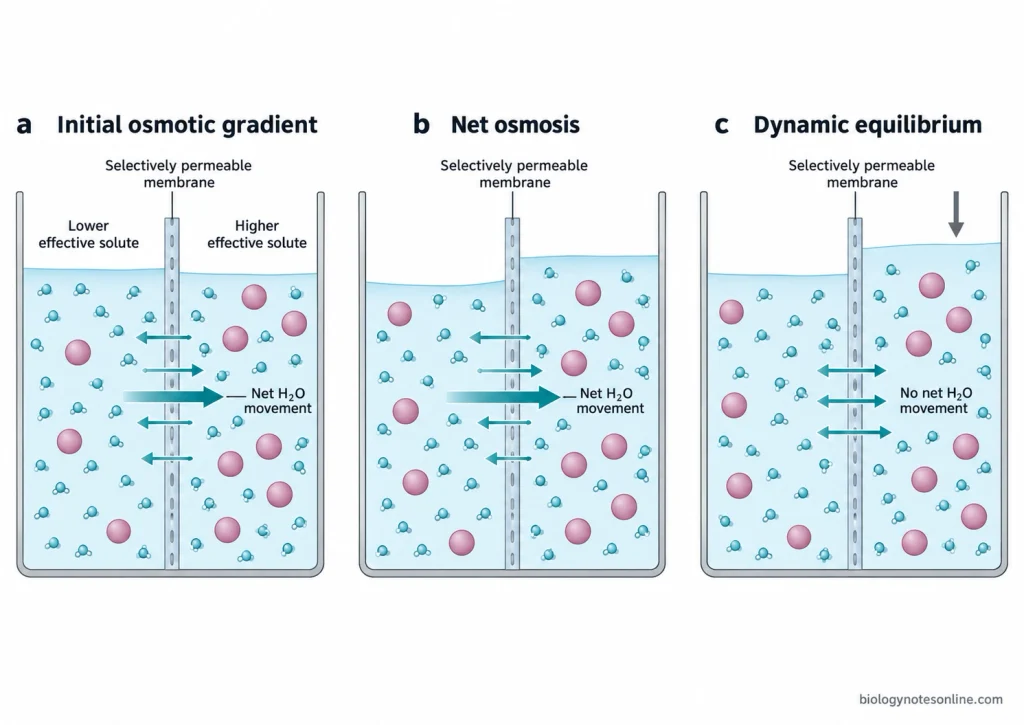
Osmosis occurs because water molecules are continuously moving in random directions. Water can cross a selectively permeable membrane from both sides. When the chemical potential of water is different across the membrane, these movements are not equal and a net movement of water takes place from higher water chemical potential toward lower water chemical potential. Water potential expresses the same driving tendency of water in pressure units, commonly used in biological systems. Dissolved solutes lower the water potential of a solution.
The membrane allows water to move across it, while at least some of the solute is restricted. This selective permeability is required for osmosis. When the solute cannot freely cross and remove the difference between two solutions, water moves across the membrane instead. Individual water molecules still move in both directions.
Osmotic movement continues while there is a difference in the driving forces for water. As water moves, the difference becomes smaller or an opposing pressure may build up. At dynamic equilibrium, water molecules continue to cross the membrane in both directions, but the rates in two directions become equal and there is no net movement. Sufficient hydrostatic pressure on one side can also balance the osmotic driving force.
Does osmosis require energy? Osmosis is a passive process. It does not require direct cellular expenditure of adenosine triphosphate (ATP) for the movement of water.
Several conditions can change the rate or extent of osmosis. A larger osmotic gradient provides a greater driving force for net water movement. Membrane permeability also controls how easily water can pass through the membrane. More membrane surface area allows a greater total amount of water to cross at a time. Temperature affects molecular motion and can also change membrane water permeability and osmotic pressure. An opposing hydrostatic pressure reduces net osmotic movement, and enough pressure can stop the net flow.
Osmotic Pressure
- Osmotic pressure is the pressure required to prevent the net movement of solvent by osmosis through a selectively permeable membrane. The pressure is applied against the direction in which water would normally move.
- During osmosis, water entering the solution may produce a pressure difference. If an equal opposing pressure is applied, net osmosis stops. Water molecules can still move across the membrane in both directions.
- Osmotic pressure depends mainly on the concentration of osmotically active solute particles in the solution. At the same temperature, a solution containing more dissolved particles has a higher osmotic pressure than a more dilute solution.
- The number of dissolved particles is important. For this reason, a solute that separates into several particles in solution can produce a greater osmotic effect than the same molar concentration of a solute that remains as single particles.
- A solution with a larger difference in effective solute concentration requires a greater opposing pressure to prevent the net movement of water across the membrane.
Factors Affecting Osmosis
Some of the important factors affecting osmosis are-
- Concentration gradient- Difference in concentration of osmotically active solutes on two sides of the membrane provides the driving force for osmosis. A greater osmotic difference generally produces greater net movement of water.
- Temperature- Temperature affects the molecular movement of water. At higher temperature, water molecules have greater kinetic energy and movement occurs more rapidly under otherwise similar conditions.
- Membrane permeability- Rate of osmosis depends on how easily water can pass through the membrane. A membrane having greater water permeability allows faster water movement. Biological membranes containing aquaporins can show very high water permeability.
- Surface area- A larger membrane surface provides more area through which water can move. More water can cross at the same time when other conditions are kept same.
- Nature of solute- Solutes which cannot readily cross the membrane maintain an osmotic difference and draw water across it. If a solute can freely pass through the membrane, its concentration difference may not maintain the same osmotic effect.
- Pressure- Hydrostatic pressure can oppose or assist osmotic water movement. When sufficient pressure develops against the direction of osmosis, net water movement is reduced and can eventually be stopped. Water movement through biological membranes may occur down osmotic as well as hydrostatic pressure gradients.
Types of Osmosis
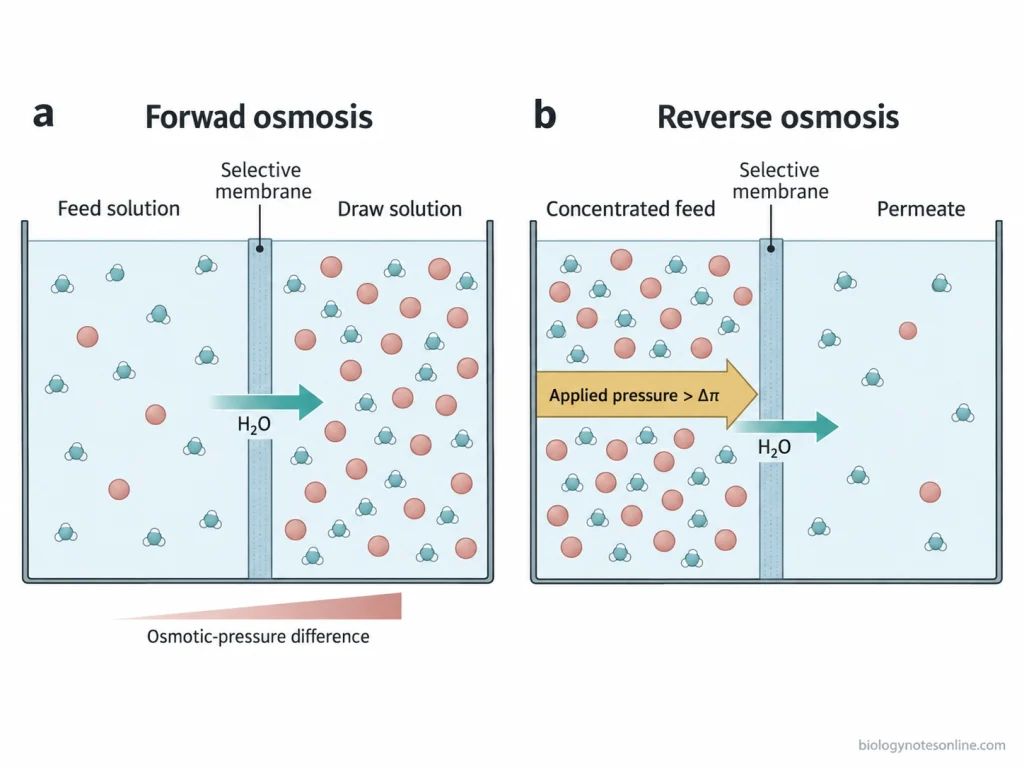
Osmosis can be described according to direction of water movement and the membrane process involved. In biological cells, inward and outward movement are called endosmosis and exosmosis. In membrane processes, forward osmosis and reverse osmosis are commonly used.
- Endosmosis- Endosmosis is the inward movement of water into a cell through a selectively permeable membrane. It occurs when the cell is placed in a hypotonic solution. Water enters the cell. The volume of cell increases and in plant cells, it can produce turgidity.
- Exosmosis- It is the outward movement of water from a cell. When the cell is kept in a hypertonic solution, water moves from cell into the surrounding solution through its selectively permeable membrane. The cell loses water and decreases in volume. In plant cells, sufficient loss of water can result in plasmolysis.
- Forward osmosis (FO)- FO is an osmosis-driven membrane process. Here, difference in osmotic pressure acts as the driving force for movement of water. Water passes from a feed solution having lower osmotic pressure to a draw solution of higher osmotic pressure through a selectively permeable membrane. High external hydraulic pressure is not used as the main driving force.
- Reverse osmosis (RO)- In RO, external hydraulic pressure is applied against the natural direction of osmosis. The applied pressure is greater than the osmotic-pressure difference, which forces water through the membrane in the direction opposite to spontaneous osmosis. It is a pressure-driven membrane process. RO is used for separation and desalination.
Tonicity
Tonicity is the ability of a surrounding solution to produce change in the volume of a cell by movement of water across the plasma membrane. It depends mainly on concentration of solutes which cannot freely cross the membrane (non-penetrating solutes) compared with inside of the cell. Tonicity is not always same as osmolarity. A freely permeable solute can add to osmolarity, but it may not produce a lasting change in cell volume.
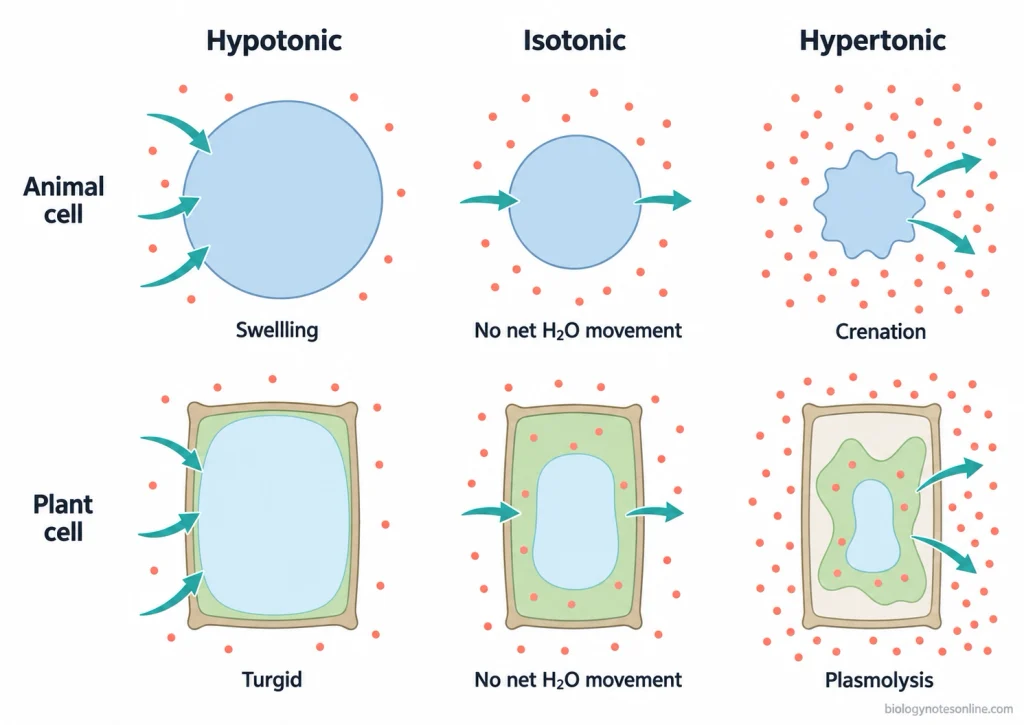
The three types of tonicity are-
- Hypotonic solution- A hypotonic solution contains lower concentration of effective non-penetrating solutes than the cell. Water moves into the cell by osmosis. The cell swells. In animal cell, excessive entry of water can cause lysis, whereas a plant cell becomes turgid due to the presence of cell wall.
- Isotonic solution- In this solution, concentration of effective non-penetrating solutes outside and inside the cell is equal. Water moves across the membrane in both directions, but there is no net movement of water. The cell volume remains nearly unchanged. Animal cells maintain their normal size.
- Hypertonic solution- It contains a higher concentration of effective non-penetrating solutes outside the cell. Water moves out from the cell into the surrounding solution. The cell loses water and decreases in volume. Animal cells become shrunken or crenated. In plant cells, loss of water can result in plasmolysis, where the protoplast pulls away from the cell wall.
Osmosis in Biological Systems
Osmosis takes place across the plasma membrane of living cells. Water moves into or out from the cell depending on difference in solute concentration between the cell and surrounding fluid. In cell, this movement maintains the amount of water required for normal cellular condition.
- Osmosis in cells- The plasma membrane allows movement of water but restricts many dissolved substances. If the surrounding fluid becomes more dilute, water enters the cell. In a more concentrated surrounding, water moves out. Excessive movement in either direction can change the cell volume.
- Plant cells- Plant cells are surrounded by a rigid cell wall. When water enters the cell by osmosis, turgor pressure develops and the cell becomes turgid. The cell wall prevents excessive swelling. In hypertonic condition, water moves out from the cell and the protoplast may pull away from the cell wall. This is known as plasmolysis.
- Animal cells- Animal cells do not have a cell wall. Water entering a cell in hypotonic condition causes swelling, and excessive entry can result in lysis. In hypertonic solution, water is lost from the cell and the cell becomes shrunken. An isotonic surrounding produces no net movement of water and the cell volume remains nearly unchanged.
- Osmosis in humans- Osmosis also occurs in humans. Water moves across the membranes of body cells between intracellular fluid and surrounding body fluids. The kidneys regulate water and electrolyte concentrations in the body, which keeps the osmotic condition of body fluids within a suitable range.
- Osmoregulation- The regulation of water and dissolved solutes in an organism is called osmoregulation. It controls excessive gain or loss of water from the cells. In humans, much of this regulation is carried out by the kidneys.
Examples of Osmosis
Some of the common examples of osmosis are-
- Water absorption by roots- Water moves from soil into the root cells when water potential of soil is higher than that of the root. This movement across cell membrane takes place by osmosis.
- Turgidity of plant cells- When water enters a plant cell by osmosis, the vacuole and cell contents expand against the cell wall. Turgor pressure is developed. If water is lost from the cells, turgor decreases and the plant may wilt.
- Red blood cells- A red blood cell placed in a hypotonic solution takes up water and swells. Excessive entry can cause lysis. In hypertonic solution, water moves out from the cell and it becomes shrunken or crenated, whereas in isotonic condition there is no net movement of water.
- Water reabsorption in kidneys- Water is reabsorbed across epithelial cells of the renal tubules and collecting ducts according to osmotic gradients. Aquaporin channels take part in this water movement. It helps in regulation of body water and concentration of urine.
- Potato in different solutions- Pieces of potato kept in water can gain water, while potato cells placed in concentrated salt solution lose water. The change in mass of potato pieces is commonly used to demonstrate osmosis in plant cells.
- Raisins in water- When dry raisins are placed in water, water moves into the raisin tissues and they become swollen. In a concentrated sugar solution, much less water enters or water may move out depending on the osmotic condition.
Demonstrating Osmosis Experimentally
Osmosis can be demonstrated by using plant tissue or a selectively permeable membrane with solutions having different solute concentrations. Movement of water is observed from change in mass, length, volume, or liquid level.
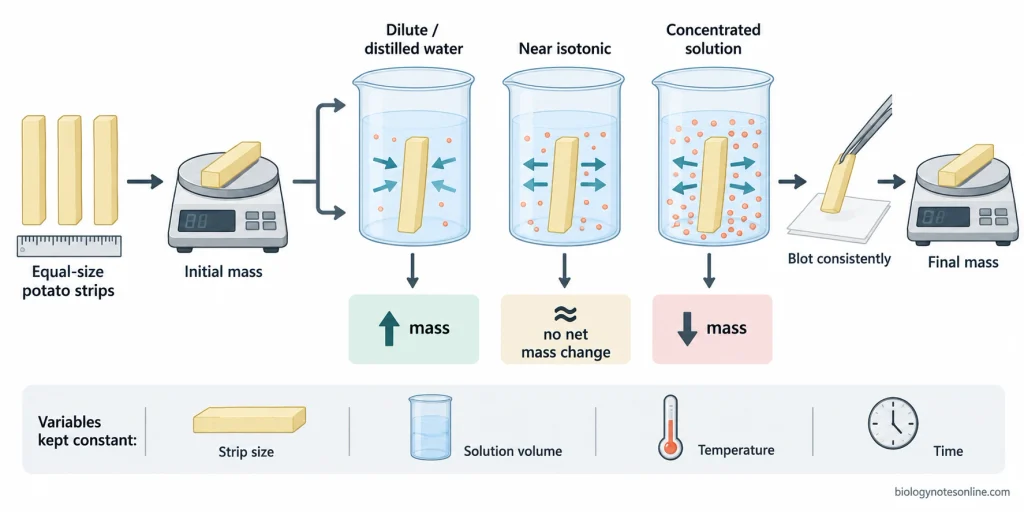
Potato-strip osmosis demonstration
- Potato strips of similar size are placed in solutions having different solute concentrations, such as distilled water and different concentrations of sucrose or salt. Concentration of surrounding solution is changed in this experiment.
- Initial mass or length of potato strips is recorded before placing them into the solutions. After a fixed period, the strips are taken out, blotted in same way and measured again. Change in mass or length is then compared.
- In dilute solution, potato tissue generally gains water and its mass increases. A sufficiently concentrated solution causes water to move out from the potato cells. The mass decreases. Near an isotonic concentration, little or no net change is observed.
- Size and source of potato strips, volume of solution, temperature and duration of experiment should be kept same. Blotting before weighing is also done in same way. Only the selected solute concentration is varied.
Semipermeable-membrane demonstration
- Dialysis tubing can be used as a model selectively permeable membrane. A solution containing a solute retained by the membrane is placed inside the tubing and another solution is kept outside. Water can pass through the membrane.
- When the solution inside has greater effective solute concentration than the surrounding water, water moves into the tubing by osmosis. The bag gains water. Its mass or volume increases, and in an arrangement connected with a narrow tube the liquid level may rise.
- The dialysis membrane allows some molecules to pass while restricting others depending on properties of the membrane. Water movement can be observed separately from the movement of solutes which cannot pass through it.
Importance of Osmosis
Some of the important functions of osmosis in living organisms are-
- Cell water balance- Osmosis regulates movement of water into and out from cells. It helps to maintain normal cell volume and suitable concentration of dissolved substances inside the cell. Excessive gain or loss of water can disturb cellular functions.
- Water absorption in plants– Water enters root cells from the soil partly by osmotic movement across cell membranes. This water then becomes available for transport through the plant.
- Turgor maintenance- Entry of water into plant cells develops turgor pressure against the cell wall. It keeps the cells firm. In non-woody plants, turgor also provides mechanical support to leaves and stems.
- Stomatal movement– Changes in solute concentration of guard cells cause water to move in or out by osmosis. The guard cells change their volume and this takes part in opening and closing of stomata.
- Kidney function- In kidneys, water is reabsorbed from different parts of the renal tubule by osmosis. Water follows osmotic gradients produced by movement of solutes, and water permeability is high in regions containing aquaporin channels. This process takes part in maintaining body water and in formation of urine.
- Cell volume in animals- Animal cells are highly affected by osmotic changes because they lack a rigid cell wall. Water gain can cause swelling and excessive gain may result in lysis. Loss of water causes the cells to shrink.
Osmosis vs Diffusion
Osmosis and diffusion are passive transport processes, but they are not same. Osmosis involves movement of water or another solvent across a selectively permeable membrane, whereas diffusion involves net movement of particles from higher concentration toward lower concentration.
| Feature | Osmosis | Diffusion |
|---|---|---|
| Movement | Movement of water or another solvent. | Movement of molecules or ions. |
| Direction | Water moves from higher water availability toward lower water availability across the membrane. | Particles move from higher concentration toward lower concentration. |
| Membrane | A selectively permeable membrane is required. | A membrane is not always required. |
| Solute movement | Solute does not need to move across the membrane. | The diffusing substance itself moves. |
| Driving force | Difference in water chemical potential or water potential. | Difference in concentration or chemical potential of the diffusing substance. |
| Energy | Direct cellular energy is not required. | It is also a passive process and does not directly require cellular energy. |
| Where it occurs | Commonly occurs across cell membranes and other selectively permeable membranes. | Occurs in gases, liquids and across biological membranes when the substance can pass through them. |
| Equilibrium | At osmotic equilibrium, water still moves in both directions but there is no net water movement. | At diffusion equilibrium, particles continue random movement but there is no net movement from one region to another. |
| Example | Water entering a plant cell from a hypotonic surrounding. | Oxygen diffusing from alveoli into blood. |
Osmosis At a Glance – A Quick Summary Table
| Feature | Description |
|---|---|
| Definition | Osmosis is the net movement of water across a selectively permeable membrane due to difference in water availability between two sides. |
| Substance moving | Water or another solvent. |
| Direction | Water moves from higher water availability toward lower water availability. In simple solutions, this usually means from lower effective solute concentration toward higher effective solute concentration. |
| Membrane requirement | A selectively permeable membrane is required. It allows water to pass while restricting at least some solutes. |
| Energy requirement | Osmosis is a passive process. Direct cellular energy is not required. |
| Driving force | Difference in water chemical potential or water potential across the membrane. |
| Endosmosis | Water moves into the cell or osmotic system. |
| Exosmosis | Water moves out from the cell or osmotic system. |
| Forward osmosis | Water moves across a membrane due to an osmotic-pressure difference. |
| Reverse osmosis | External pressure is applied to move water in the direction opposite to spontaneous osmosis. |
| Hypotonic solution | Water generally enters the cell. Animal cells swell, while plant cells become turgid. |
| Isotonic solution | There is no net movement of water. Cell volume remains nearly unchanged. |
| Hypertonic solution | Water moves out from the cell. Animal cells shrink and plant cells may undergo plasmolysis. |
| Osmotic equilibrium | Water molecules continue to move across the membrane, but there is no net movement. |
| Factors affecting osmosis | Concentration gradient, temperature, membrane permeability, membrane surface area, nature of solute and pressure. |
| Biological importance | Osmosis takes part in cell water balance, plant turgor, water absorption, stomatal movement and water reabsorption in kidneys. |
References
- Bowen, C., Draper, L., & Moore, H. (2024). Fundamentals of nursing. OpenStax. https://openstax.org/books/fundamentals-nursing/pages/20-1-fluid-and-electrolyte-balances
- Cath, T. Y., Childress, A. E., & Elimelech, M. (2006). Forward osmosis: Principles, applications, and recent developments. Journal of Membrane Science, 281(1–2), 70–87. https://doi.org/10.1016/j.memsci.2006.05.048
- Chun, Y., Mulcahy, D., Zou, L., & Kim, I. S. (2017). A short review of membrane fouling in forward osmosis processes. Membranes, 7(2), 30. https://doi.org/10.3390/membranes7020030
- Clark, M. A., Douglas, M., & Choi, J. (2018). Biology 2e. OpenStax. https://openstax.org/books/biology-2e/pages/5-2-passive-transport
- Devuyst, O. (2024). Aquaporin-1 and osmosis: From physiology to precision in peritoneal dialysis. Journal of the American Society of Nephrology, 35(11), 1589–1599. https://doi.org/10.1681/ASN.0000000000000496
- Fell, C. J. D. (1995). Reverse osmosis. In R. D. Noble & S. A. Stern (Eds.), Membrane separations technology: Principles and applications (Vol. 2, pp. 113–142). Elsevier. https://doi.org/10.1016/S0927-5193(06)80006-9
- Flowers, P., Robinson, W. R., Langley, R., & Theopold, K. (2015). Chemistry. OpenStax. https://openstax.org/books/chemistry/pages/11-4-colligative-properties
- Flowers, P., Theopold, K., Langley, R., & Robinson, W. R. (2019). Chemistry 2e. OpenStax. https://openstax.org/books/chemistry-2e/pages/11-4-colligative-properties
- Ibraheem, B. M., Al Aani, S., Alsarayreh, A. A., Alsalhy, Q. F., & Salih, I. K. (2023). Forward osmosis membrane: Review of fabrication, modification, challenges and potential. Membranes, 13(4), 379. https://doi.org/10.3390/membranes13040379
- Lopez, M. J., & Hall, C. A. (2023). Physiology, osmosis. In StatPearls. StatPearls Publishing. https://www.ncbi.nlm.nih.gov/books/NBK557609/
- Markou, A., Unger, L., Abir-Awan, M., Saadallah, A., Halsey, A., Balklava, Z., Conner, M., Törnroth-Horsefield, S., Greenhill, S. D., Conner, A., Bill, R. M., Salman, M. M., & Kitchen, P. (2022). Molecular mechanisms governing aquaporin relocalisation. Biochimica et Biophysica Acta (BBA) – Biomembranes, 1864(4), 183853. https://doi.org/10.1016/j.bbamem.2021.183853
- Ogobuiro, I., & Tuma, F. (2023). Physiology, renal. In StatPearls. StatPearls Publishing. https://www.ncbi.nlm.nih.gov/books/NBK538339/
- Qasim, M., Darwish, N. A., Sarp, S., & Hilal, N. (2015). Water desalination by forward (direct) osmosis phenomenon: A comprehensive review. Desalination, 374, 47–69. https://doi.org/10.1016/j.desal.2015.07.016
- Rye, C., Wise, R., Jurukovski, V., DeSaix, J., Choi, J., & Avissar, Y. (2016). Biology. OpenStax. https://openstax.org/books/biology/pages/5-2-passive-transport
- Su, W., Cao, R., Zhang, X.-Y., & Guan, Y. (2020). Aquaporins in the kidney: Physiology and pathophysiology. American Journal of Physiology-Renal Physiology, 318(1), F193–F203. https://doi.org/10.1152/ajprenal.00304.2019