

Passive transport is a type of membrane transport in which molecules or ions move across the cell membrane in an energetically favorable direction without direct use of cellular energy such as ATP. No ATP is directly used for this movement.
It generally occurs down the concentration gradient, while in case of charged ions the concentration difference and electrical potential together form an electrochemical gradient that determines their movement.
Passive transport can take place directly through the lipid bilayer by simple diffusion, or with the help of specific channel and carrier proteins by facilitated diffusion. Osmosis is also a passive movement of water across a selectively permeable membrane, and water movement can be assisted by aquaporin channels. During this process, the substances move toward equilibrium where no net transport takes place across the membrane.
What Drives Passive Transport Across the Cell Membrane?
The following are the major factors that drive passive transport across the cell membrane-
- Concentration gradient- It is the major driving force for movement of uncharged molecules. Molecules move randomly due to their thermal motion, but the net movement takes place from the region of higher concentration towards the region of lower concentration. This movement continues until equilibrium is reached and there is no net movement of the substance.
- Electrical gradient- The electrical difference across the cell membrane affects the movement of charged ions. A membrane potential can attract an ion towards one side of the membrane or oppose its movement depending on the charge of the ion. Thus, this gradient is particularly important during passive movement of Na⁺, K⁺, Cl⁻ and other ions.
- Electrochemical gradient- In case of ions, concentration gradient and electrical gradient act together. This combined effect is referred to as the electrochemical gradient. It determines the direction in which an ion will move passively through an ion channel or other passive transport protein.
- Osmotic gradient- It drives the passive movement of water across a selectively permeable membrane. Water generally moves from a region having higher concentration of free water molecules to a region having lower concentration of free water molecules. This movement is called osmosis, and in many cells it is facilitated by aquaporin channels.
Major Types of Passive Transport
The major types of passive transport across the cell membrane are as follows-
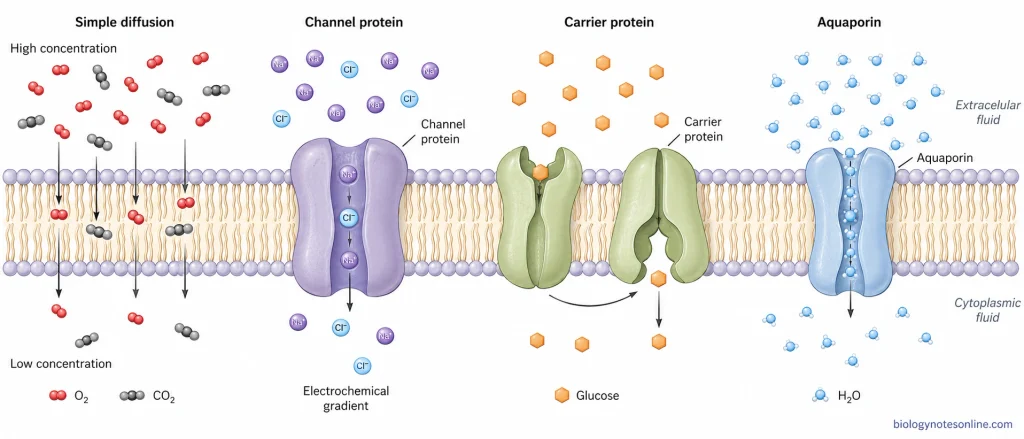
- Simple diffusion– It is the direct movement of substances through the lipid bilayer without the involvement of a membrane transport protein. Small non-polar molecules such as O₂ and CO₂ can pass through the membrane by this process. The molecules move down their concentration gradient and no cellular energy is used.
- Facilitated diffusion– In this type, substances are transported across the membrane with the help of specific channel proteins or carrier proteins. It is used for ions and many polar molecules which cannot easily pass through the hydrophobic lipid bilayer. The movement still takes place down the concentration or electrochemical gradient, therefore ATP is not required.
- Osmosis- Osmosis is the passive movement of water through a selectively permeable membrane. Water moves according to its concentration gradient, generally from a region having lower solute concentration towards the region having higher solute concentration when the solute cannot cross the membrane. In many cells, this movement is facilitated by water channel proteins called aquaporins. It is considered as a special type of diffusion.
Simple Diffusion Through the Lipid Bilayer
Simple diffusion is the movement of molecules directly through the lipid bilayer from higher concentration towards lower concentration. No carrier or channel protein is involved in this process. The process takes place in the following steps-
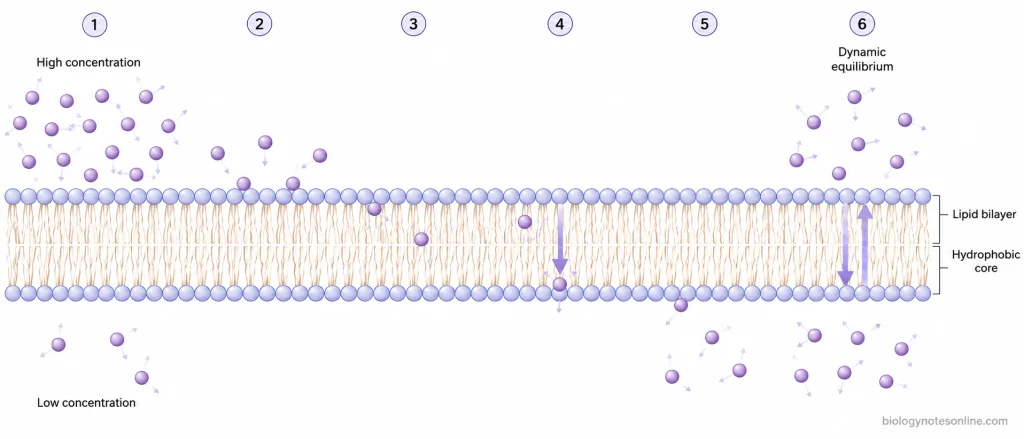
Step 1- Concentration difference
A difference in concentration is present on the two sides of cell membrane. Molecules are continuously moving randomly, with greater number of molecules present at the higher concentration side.
Step 2- Molecules reach the lipid bilayer
Small non-polar or lipid-soluble molecules such as O₂ and CO₂ reach the phospholipid bilayer. These molecules can enter the hydrophobic region of membrane. The movement mainly depends upon their size and lipid solubility.
Step 3- Dissolving into lipid bilayer
The molecule now dissolves into the lipid portion of phospholipid bilayer. Here, no channel protein or carrier protein is required. Charged molecules cannot readily enter this hydrophobic portion of membrane.
Step 4- Movement through the membrane
The molecules move through the hydrophobic interior by random molecular movement. Movement takes place in both directions, but more molecules move from the region of high concentration to low concentration. Thus, a net movement is produced down the concentration gradient.
Step 5- Release from the membrane
After crossing the bilayer, molecule leaves the lipid portion and enters the aqueous solution present on the opposite side. No ATP is utilised during this process.
Step 6- Equilibrium
As diffusion continues, the difference in concentration on both sides is reduced. At equilibrium, molecules still move randomly in both directions. However, there is no net movement of molecules across the membrane.
Facilitated Diffusion Through Membrane Proteins
Facilitated diffusion takes place through specific membrane proteins when a substance cannot easily pass through the lipid bilayer. The movement is down the concentration or electrochemical gradient and ATP is not utilised. Channel proteins and carrier proteins are involved in this process.
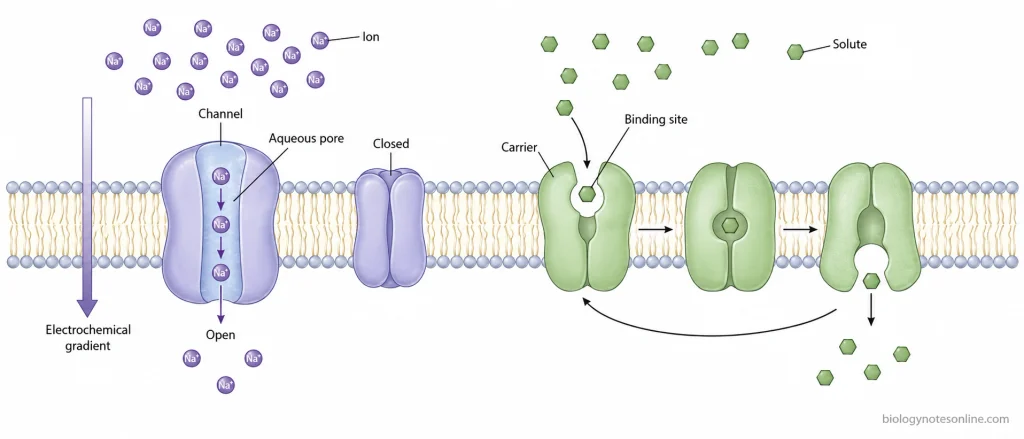
Step 1- Presence of gradient
A concentration difference is first present on the two sides of membrane. For charged ions, electrical difference of the membrane also affects their movement. These together determine the direction in which the ion will pass.
Step 2- Interaction with transport protein
The molecule or ion reaches a specific membrane transport protein. Polar molecules and ions cannot easily move through the hydrophobic portion of lipid bilayer. Therefore, their movement is carried out with the help of channel or carrier protein.
Step 3- Movement through channel protein
In channel-mediated diffusion, the channel forms an aqueous pore across the membrane. When the channel is open, ions or other suitable molecules can pass through it according to their size and charge. Some channels remain open while others are opened or closed by gating.
Step 4- Binding with carrier protein
In case of carrier-mediated diffusion, the substance binds to a specific site of the carrier protein on one side of membrane. The carrier now changes its conformation. This exposes the bound substance towards the opposite side of the membrane.
Step 5- Release of transported substance
The substance is released from the carrier on the other side. After release, carrier returns to its previous form and can bind another molecule. The transported molecule remains chemically unchanged during this movement.
Step 6- Net movement down the gradient
More molecules move from higher concentration towards lower concentration, or down the electrochemical gradient in case of ions. No ATP is directly required for this transport. As the gradient decreases, the net movement also decreases and at equilibrium there is no net transport across the membrane.
Osmosis and Water Movement Across Membranes
Osmosis is the net movement of water across a selectively permeable membrane due to difference in water concentration or osmotic effect of solutes on the two sides. It is only the movement of water and not the movement of solute through membrane. Water molecules move continuously in both directions, but net movement occurs towards the side having lower concentration of free water when an effective solute difference is present. No cellular energy is required during this process.
Aquaporins and Membrane Water Permeability
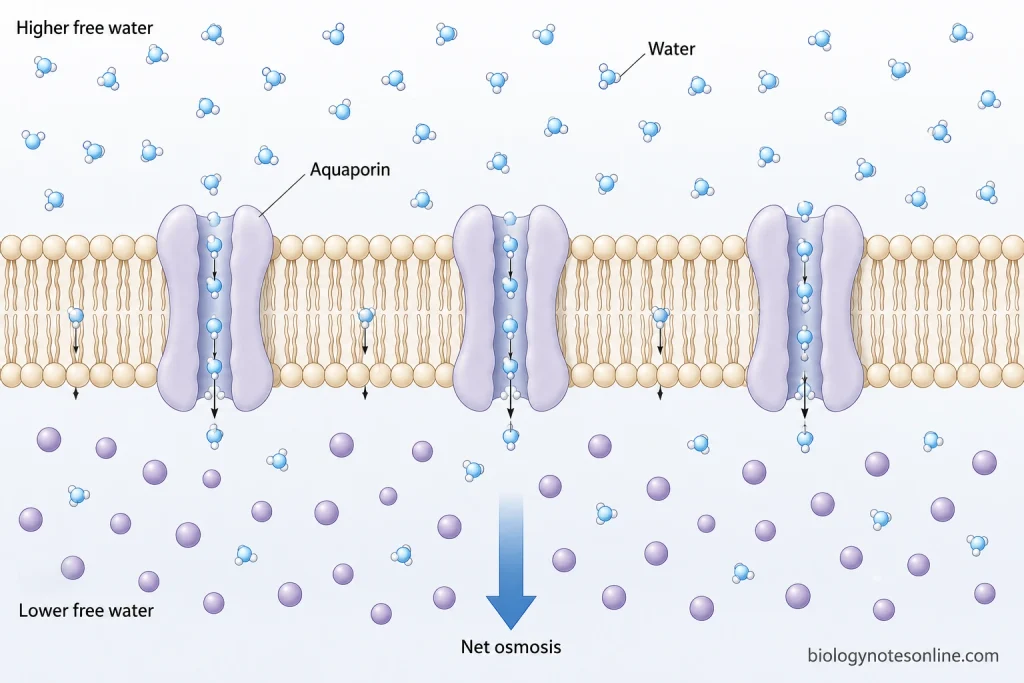
Aquaporins are membrane channel proteins that greatly increase the movement of water through the cell membrane. They form hydrophilic channels through which water molecules can pass at a very high rate. These proteins are especially important in membranes where rapid water movement is required, such as red blood cells and kidney tubules.
Water movement is not completely dependent on aquaporins. Small water molecules can also diffuse directly through the lipid bilayer, but this movement is comparatively slow. In membranes containing large number of aquaporins, membrane permeability to water becomes much greater. Thus, aquaporins facilitate water movement rather than making osmosis possible for the first time.
Hypotonic, Isotonic, and Hypertonic Conditions
The terms hypotonic, isotonic, and hypertonic describe a solution in relation to a reference cell. They indicate how the surrounding solution causes net water movement and changes the cell volume. The effects are as follows-
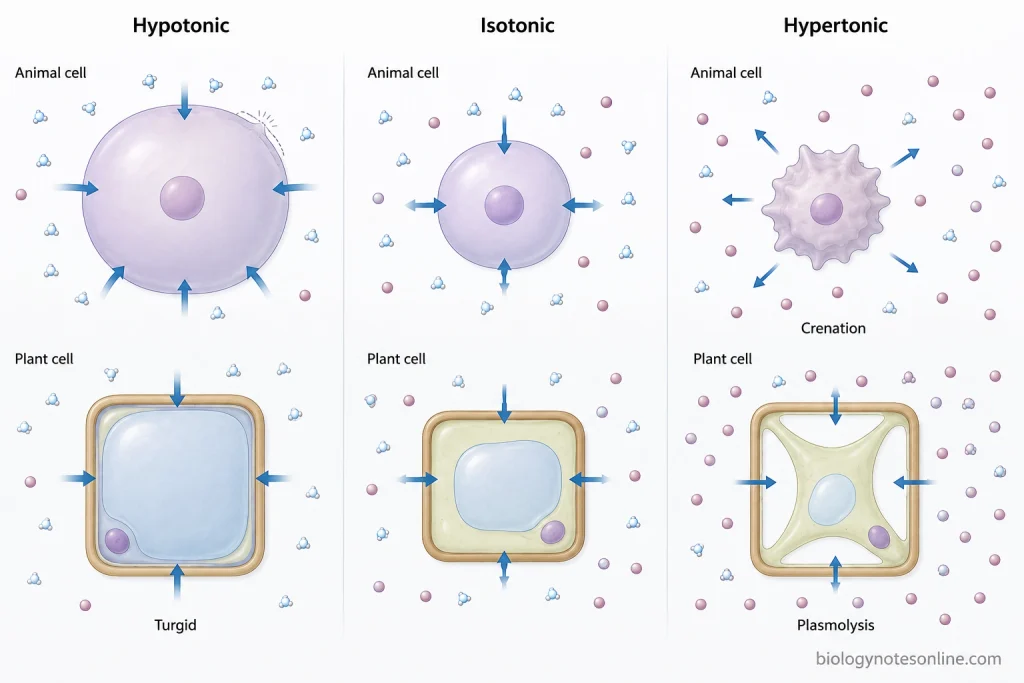
| Condition | Net movement of water | Animal cell | Plant cell |
|---|---|---|---|
| Hypotonic | Water moves into the cell. | Cell swells and may finally undergo lysis if excessive water enters. | Water enters the cell and produces turgor pressure. The cell becomes turgid and cell wall prevents normal osmotic lysis. |
| Isotonic | Water enters and leaves, but there is no net movement. | Cell volume generally remains unchanged. | There is no net water movement and the cell has much less turgor than under hypotonic condition. |
| Hypertonic | Water moves out of the cell. | Cell loses water and shrinks. In red blood cells this shrinkage is referred to as crenation. | Water leaves the cell and turgor is lost. The plasma membrane can pull away from the cell wall, which is called plasmolysis. |
Osmolarity vs Tonicity
Osmolarity is based on the total concentration of dissolved solute particles present in a solution. Every dissolved particle contributes to osmolarity without considering whether the particle can readily cross the cell membrane.
Tonicity, on the other hand, is related to the effect of a solution on cell volume. It mainly depends on the solutes that remain effectively restricted across the membrane and therefore maintain an osmotic gradient. A solute that readily crosses the membrane can increase osmolarity but may have little sustained effect on tonicity. Thus, two terms are related but they are not always interchangeable. Membrane permeability of the particular solute is important in determining tonicity.
Is Filtration a Type of Passive Transport?
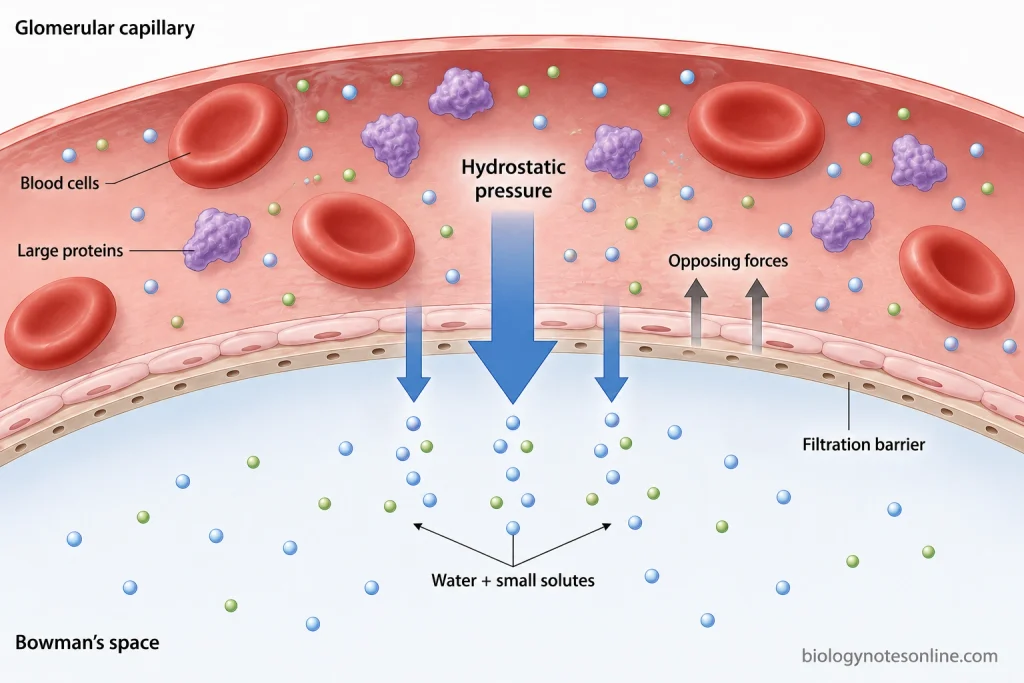
Filtration is a pressure-driven movement of water and dissolved substances through a membrane or porous barrier. It does not require cellular ATP, and because of this, filtration is included as a type of passive transport in some textbooks. However, it is also described separately from simple diffusion, facilitated diffusion and osmosis. This is because ordinary diffusion mainly depends on a concentration gradient, whereas filtration is primarily driven by a hydrostatic pressure gradient.
During filtration, fluid is pushed from a region of higher hydrostatic pressure towards the region of lower hydrostatic pressure. Small dissolved substances can move along with this fluid if the filtration barrier allows their passage. Thus, it is a form of pressure-driven bulk movement rather than the random concentration-driven movement seen during diffusion.
A common example is glomerular filtration in the kidney. In this process, hydrostatic pressure of blood forces water and many small solutes from the glomerular capillaries through the filtration membrane into Bowman’s space. Blood cells and most large proteins are retained by the filtration barrier. The glomerular capillary hydrostatic pressure is the major force favouring this movement, while other hydrostatic and oncotic pressures can oppose it. Therefore, filtration can be considered passive because cellular ATP is not directly used, but its major driving force is pressure and not simply a concentration gradient.
Factors Affecting the Rate of Passive Transport
Factors determining the rate of passive transport across the cell membrane are-
- Concentration gradient- The greater the difference in concentration on two sides of membrane, greater will be the net movement of molecules. As the concentration difference becomes less and approaches equilibrium, rate of net diffusion also decreases.
- Electrochemical gradient- In case of ions, concentration alone does not determine the movement. The electrical potential across membrane also acts on charged ions. Both concentration and electrical gradients together determine the direction and rate of passive ion movement.
- Temperature- Rate of diffusion generally increases with rise in temperature because molecules have greater thermal energy and move more rapidly. Lower temperature reduces this molecular movement.
- Size and mass of molecule- Smaller molecules generally diffuse more rapidly as compared to larger molecules. Larger and heavier molecules move slowly and their passage through lipid bilayer is also more restricted.
- Lipid solubility and nature of molecule- Lipid-soluble and small non-polar molecules can readily dissolve in the lipid bilayer and therefore diffuse rapidly. Polar molecules move less easily, while ions and other charged substances cannot readily cross the hydrophobic portion without membrane proteins.
- Surface area and membrane thickness- Greater membrane surface area provides more area for diffusion and increases the transport rate. In contrast, increase in membrane thickness or diffusion distance decreases the rate because molecules have a longer distance to pass.
- Availability of channel proteins- During facilitated diffusion, the number of available channels and whether channels are open or closed affects ion movement. An open channel allows rapid movement of suitable ions down their electrochemical gradient. Gated channels can be opened or closed by voltage, ligands and other specific stimuli.
- Carrier protein concentration and saturation- Carrier-mediated diffusion depends on the available carrier proteins. When all the binding sites of carrier proteins become occupied, the carrier is saturated and transport reaches a maximum rate. Further increase in solute concentration does not produce a similar increase in carrier-mediated transport.
- Hydrostatic pressure- This factor is mainly important during filtration. Increase in pressure difference across a filtration membrane can increase movement of water and dissolved substances through the membrane, as occurs during filtration in the kidney.
Examples of Passive Transport
Some of the important examples of passive transport are-
- Diffusion of oxygen and carbon dioxide- O₂ and CO₂ are small non-polar molecules and can pass directly through the phospholipid bilayer. Gas exchange across the alveolar membrane is an example where gases diffuse according to their concentration or partial-pressure gradients. No membrane carrier is required for their movement.
- Glucose transport through GLUT- Glucose cannot readily diffuse through the lipid portion of cell membrane. In many cells, it is transported with the help of GLUT transporters by facilitated diffusion. The glucose moves down its concentration gradient without direct utilization of ATP. GLUT1 of red blood cells is a common example of this type of transport.
- Movement of ions through ion channels- Ions such as Na⁺, K⁺, Ca²⁺ and Cl⁻ cannot pass freely through the hydrophobic lipid bilayer. They can move through specific ion channels when the channels are open. The movement takes place down their electrochemical gradient, and therefore this channel-mediated movement is passive.
- Osmosis of water- Water moves across a selectively permeable membrane according to an osmotic gradient. Water can cross the lipid bilayer directly to some extent, while aquaporin channels greatly increase its movement through many cell membranes. This passive water movement is referred to as osmosis.
- Facilitated movement of amino acids and other polar molecules- Many polar substances cannot easily dissolve in the hydrophobic interior of membrane. Specific carrier proteins or channels allow such substances to move down their concentration gradient. Sugars, amino acids and nucleosides can be transported in this manner when the particular transport system is passive.
- Glomerular filtration- Filtration in kidney is also included under passive transport in some textbook classifications. During this process, water and small dissolved substances are forced across the glomerular filtration barrier mainly because of a hydrostatic pressure difference. Cellular ATP is not directly used for this movement, although its driving force is pressure rather than ordinary concentration-driven diffusion.
Biological Importance of Passive Transport
Some of the important biological functions of passive transport are-
- Exchange of respiratory gases- Oxygen and carbon dioxide move by diffusion during gas exchange in lungs and tissues.
- Uptake of nutrients- Nutrients such as glucose can enter cells by facilitated diffusion through specific carrier proteins.
- Movement of cellular substances- Different molecules move into and out of cells according to their concentration gradient.
- Maintenance of water balance- Osmosis helps in maintaining water balance and normal cell volume. In plants, it also helps in maintaining turgor pressure.
- Maintenance of membrane potential- Passive movement of ions through ion channels helps in maintaining the electrical condition of cell membrane.
- Nerve and muscle activity- Movement of Na⁺, K⁺, Ca²⁺ and Cl⁻ through ion channels is important for nerve impulses and muscle activity.
- Transport without direct ATP use- Passive transport allows movement of substances without direct utilization of cellular ATP.
Key Distinctions to Remember
Some of the important differences to remember are-
- Simple diffusion vs facilitated diffusion- In simple diffusion, molecules pass directly through the lipid bilayer. Facilitated diffusion takes place through specific channel or carrier proteins. Both are passive and movement is downhill.
- Concentration vs electrochemical gradient- Concentration gradient mainly determines passive movement of an uncharged substance. In case of ions, concentration and electrical gradients act together. This is referred to as the electrochemical gradient.
- Osmosis vs general diffusion- Osmosis specifically involves net movement of water across a selectively permeable membrane. Diffusion can involve different molecules or ions and is not limited only to water.
- Equilibrium does not mean movement stops- At equilibrium, molecules continue their random movement in both directions. But movement becomes equal in both directions and therefore there is no net movement.
- Passive vs active transport- Passive transport occurs down the concentration or electrochemical gradient without an additional energy source. Active transport moves substances against their gradient and is coupled with an energy source such as ATP hydrolysis or another ion gradient.
References
- Alberts, B., Johnson, A., Lewis, J., Raff, M., Roberts, K., & Walter, P. (2002). Molecular biology of the cell (4th ed.). Garland Science. https://www.ncbi.nlm.nih.gov/books/NBK26815/
- Betts, J. G., Young, K. A., Wise, J. A., Johnson, E., Poe, B., Kruse, D. H., Korol, O., Johnson, J. E., Womble, M., & DeSaix, P. (2013). Anatomy and physiology. OpenStax. https://openstax.org/books/anatomy-and-physiology/pages/20-3-capillary-exchange
- Betts, J. G., Young, K. A., Wise, J. A., Johnson, E., Poe, B., Kruse, D. H., Korol, O., Johnson, J. E., Womble, M., & DeSaix, P. (2022). Anatomy and physiology 2e. OpenStax. https://openstax.org/books/anatomy-and-physiology-2e/pages/3-1-the-cell-membrane
- Clark, M. A., Douglas, M., & Choi, J. (2018). Biology 2e. OpenStax. https://openstax.org/books/biology-2e/pages/5-2-passive-transport
- Cooper, G. M. (2000). The cell: A molecular approach (2nd ed.). Sinauer Associates. https://www.ncbi.nlm.nih.gov/books/NBK9847/
- Hantzidiamantis, P. J., Awosika, A. O., & Lappin, S. L. (2024). Physiology, glucose. In StatPearls. StatPearls Publishing. https://www.ncbi.nlm.nih.gov/books/NBK545201/
- Kaufman, D. P., Basit, H., & Knohl, S. J. (2023). Physiology, glomerular filtration rate. In StatPearls. StatPearls Publishing. https://www.ncbi.nlm.nih.gov/books/NBK500032/
- Lopez, M. J., & Hall, C. A. (2023). Physiology, osmosis. In StatPearls. StatPearls Publishing. https://www.ncbi.nlm.nih.gov/books/NBK557609/
- Maldonado, K. A., & Mohiuddin, S. S. (2023). Biochemistry, hypertonicity. In StatPearls. StatPearls Publishing. https://www.ncbi.nlm.nih.gov/books/NBK541095/
- Rye, C., Wise, R., Jurukovski, V., DeSaix, J., Choi, J., & Avissar, Y. (2016). Biology. OpenStax. https://openstax.org/books/biology/pages/5-2-passive-transport
- Stillwell, W. (2013). Membrane transport. In An introduction to biological membranes: From bilayers to rafts (pp. 305–337). Elsevier. https://doi.org/10.1016/B978-0-444-52153-8.00014-3