

Ocular Micrometer is a precision measuring instrument used in microscope for measuring microscopic objects. It is also known as eyepiece micrometer or reticle. It is used to measure the length, width and diameter of very small objects which are seen under microscope.
It is a small circular glass disc which is placed inside the eyepiece of a microscope. The glass disc has a ruled scale or some patterns like grid and cross-hair. These markings are used as reference lines for measuring the size of the microscopic object.
The divisions present on ocular micrometer are not fixed physical measurement. They are arbitrary units. So the value of each division changes when different objective lens or magnification is used.
For correct measurement, Ocular Micrometer must be calibrated first. It is calibrated with the help of stage micrometer, which has a scale of known measurement. After calibration, the actual value of one ocular division is known for that particular magnification.
The ocular micrometer is used in biological, medical and laboratory microscope works. It helps to measure cells, microorganisms, fibers, spores and other minute structures. The history or exact origin of ocular micrometer is not clearly found in the given reference content.
Working Principle of Ocular Micrometer
Working Principle of Ocular Micrometer is based on the optical superimposition of the ocular scale with the magnified image of the specimen. The ocular micrometer is placed inside the eyepiece of microscope. When the specimen is focused, the micrometer scale and the image of the object are seen together in the same field.
The scale of ocular micrometer is fixed in the eyepiece. The object image is magnified by the objective lens and then comes to the eyepiece. The size of the object is measured by counting how many ocular divisions are covered by the object.
The divisions of ocular micrometer do not show direct measurement. They are only arbitrary divisions. Their actual value changes with the objective lens used. When high power objective is used, the image becomes more magnified and each ocular division represents smaller actual distance.
For this reason, the ocular micrometer must be calibrated before use. It is calibrated with the help of stage micrometer, which has known fixed scale. After calibration, the value of one ocular division is found for each objective lens.
Thus, the measurement of microscopic object is done by multiplying the number of ocular divisions covered by the specimen with the calibrated value of one division. This gives the actual size of the object in micrometer (µm).
Parts of Ocular Micrometer
- Glass Disk – It is the circular transparent base of the ocular micrometer. It is usually made of optical glass or UV-fused silica. It allows light to pass clearly and gives less distortion during observation.
- Engraved Scale – The engraved scale is the main measuring part of the ocular micrometer. It has fine equally spaced lines. These lines are seen along with the specimen image and are used for counting the ocular divisions.
- Reticle Pattern – The reticle pattern may be present in the form of linear scale, cross-hair, grid or concentric circles. It helps in measuring length, width, diameter and sometimes alignment of microscopic objects. The markings may be etched or deposited with chrome on the glass surface.
- Eyepiece Graticule – The eyepiece graticule is the calibrated insert placed inside the eyepiece barrel. It contains uniform divisions and helps in estimating the size of specimen. In many cases, graticule and ocular scale are used for same measuring purpose.
- Body – The body is the outer holding part of the ocular micrometer. It keeps the glass disk and scale in proper position. It also protects the internal parts from shifting and damage.
- Cover Slip – The cover slip is a thin protective glass present over the scale. It protects the engraved lines from dust, scratches and other damage. It helps to keep the scale clear for long time use.
- Frame – The frame gives support to the glass disk and graticule. It keeps the scale in proper orientation inside the eyepiece. Due to this, the scale remains steady during focusing.
- Flange – The flange is the fitting part of the ocular micrometer. It helps to place the micrometer securely inside the eyepiece. If the fitting is loose, the scale may shift and measurement becomes wrong.
- Retaining Ring – The retaining ring is used to hold the ocular micrometer at the focal plane of the eyepiece. It may be threaded or fixed inside the eyepiece. It prevents movement of the micrometer during use.
- Adjustment Screws – Small screws may be present for adjustment of the scale or graticule. These screws are used during alignment or calibration. Fine adjustment helps to get correct measurement of microscopic object.
How to Use an Ocular Micrometer
- The ocular micrometer is placed inside the eyepiece of the microscope. It is better to place it in the eyepiece which is used by the dominant eye. The glass disk should be fitted properly so that the scale does not move.
- The observer looks through the eyepiece and focuses the engraved scale. The upper eye lens is rotated until the lines of the ocular micrometer become sharp and clear.
- The stage micrometer is then placed on the microscope stage. It is a slide having a known fixed scale. The scale of stage micrometer is focused by using coarse and fine adjustment knobs.
- The ocular micrometer scale and stage micrometer scale are brought parallel to each other. This is done by rotating the eyepiece or by adjusting the mechanical stage. Both scales should be clearly visible in the same field.
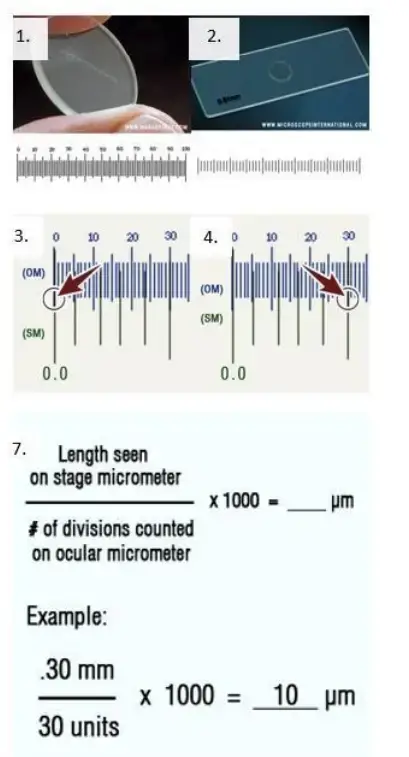
- The zero line of ocular micrometer is matched exactly with the zero line of stage micrometer. This is the starting point for calibration. The lines should overlap properly.
- The observer scans the scale towards right side and finds a second point where one line of ocular micrometer again overlaps with one line of stage micrometer. The slide is not moved during this step.
- The number of ocular divisions and the known stage micrometer distance between two matching points are counted. Then the value of one ocular division is calculated. The stage micrometer distance is divided by number of ocular divisions.
- The value is converted into micrometer (µm) if required. This value is the calibration factor for that particular objective lens. The same process is repeated for 4X, 10X, 40X and 100X objective lenses because the value changes with magnification.
- After calibration, the stage micrometer is removed and the specimen slide is placed on the microscope stage. The specimen is focused clearly with the required objective lens.
- The specimen is moved until one edge of it matches with the zero line of ocular micrometer. The object should lie along the scale for correct measurement.
- The number of ocular divisions covered by the specimen from one edge to another edge is counted carefully. If the object is round, then diameter is measured across the widest part.
- The true size of the specimen is calculated by multiplying the number of ocular divisions with the calibration factor of that objective lens. This gives the actual size of the specimen in µm.
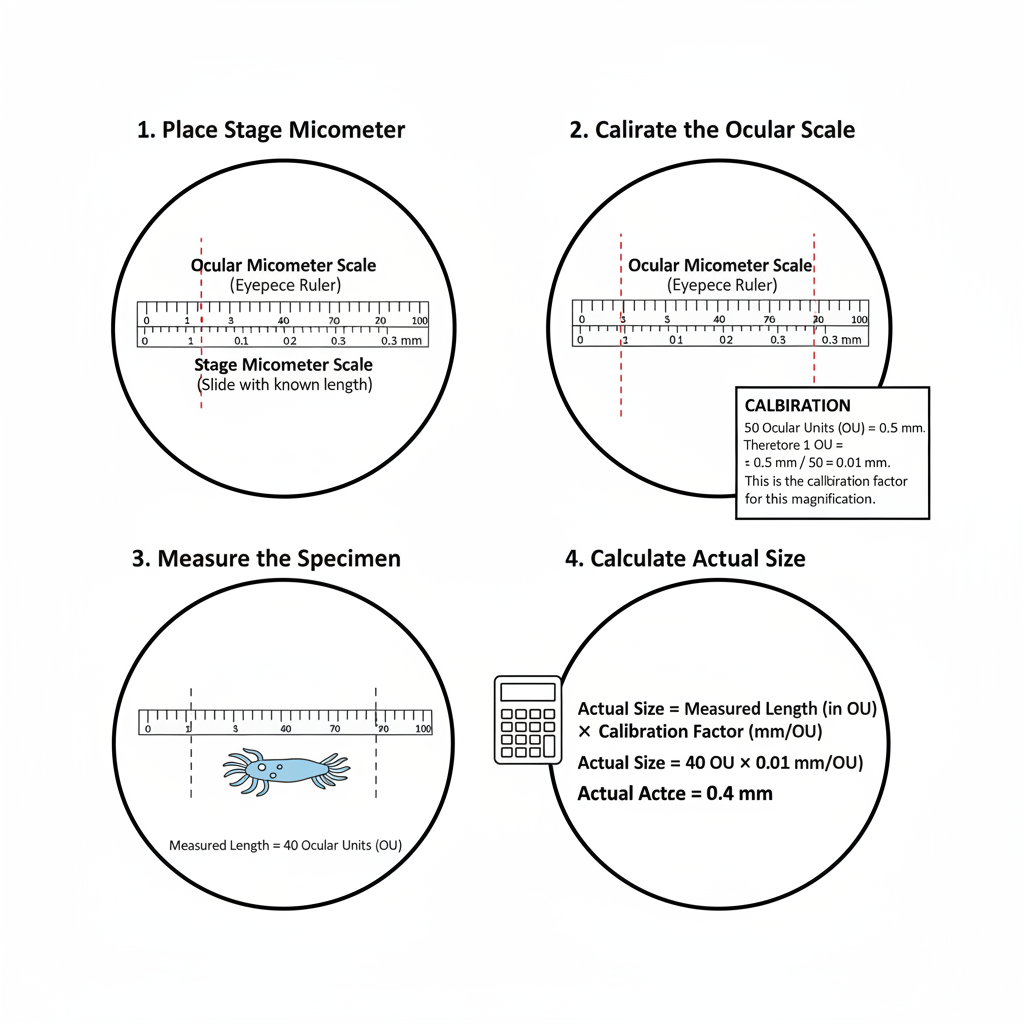


How to Use an Ocular & Stage Micrometer for Calibration
- The ocular micrometer is inserted into the eyepiece of the microscope. It is better to place it on the side of dominant eye. The upper lens of the eyepiece is rotated until the engraved ocular scale becomes sharp and clear.
- The stage micrometer slide is placed on the microscope stage. It has a known fixed scale. The scale is brought into clear focus by using coarse and fine adjustment knobs of the microscope.
- The ocular micrometer scale and stage micrometer scale are aligned with each other. The eyepiece is rotated or the mechanical stage is adjusted until both scales become parallel in the same field.
- The zero line of ocular micrometer is matched exactly with the 0.0 line of stage micrometer. This is the starting point of calibration. Both lines should be superimposed properly.
- Without moving the stage micrometer, the observer looks along the scale towards right side. A second point is found where one line of ocular micrometer exactly overlaps with one line of stage micrometer.
- The number of ocular divisions and stage micrometer divisions between the zero line and second matching point are counted carefully. The stage micrometer distance is the known distance.
- The calibration factor is calculated by dividing the known stage micrometer distance by number of ocular divisions. This gives the actual value of one ocular division at that magnification.
- If the value is in millimeter, it is multiplied by 1000 to convert it into micrometer (µm). Thus, the value of one ocular division is obtained in µm.
- The same calibration process is repeated for every objective lens such as 4X, 10X, 40X and 100X. This is needed because the value of one ocular division changes with magnification.
- The calculated values are written in a reference chart. This chart is kept near the microscope. During future measurement, the specimen size can be found directly by using this calibration factor.
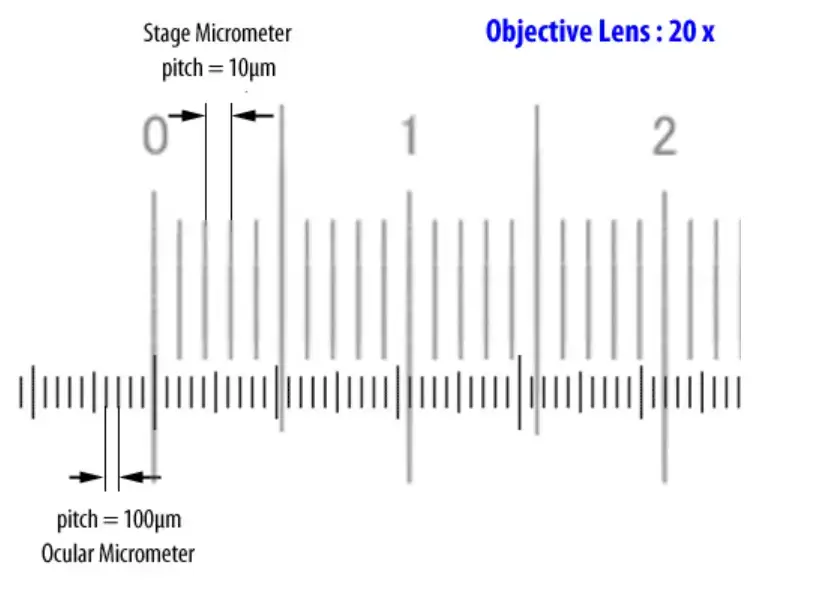
How to install Ocular Micromete

- The eyepiece is first removed from the microscope. Usually 10X eyepiece is used for installing ocular micrometer. In binocular microscope, it is better to fit it on the side of dominant eye.
- The retainer ring of the eyepiece is removed carefully. A small spanner wrench or small flat edge screwdriver may be used for this. Only the reticle retainer ring should be removed, not the ring which holds the lens elements.
- The ocular micrometer glass disk is cleaned before placing. Lens tissue is used for cleaning and compressed air is used to remove dust particles. If dust remains on the disk, it will be seen clearly during observation.
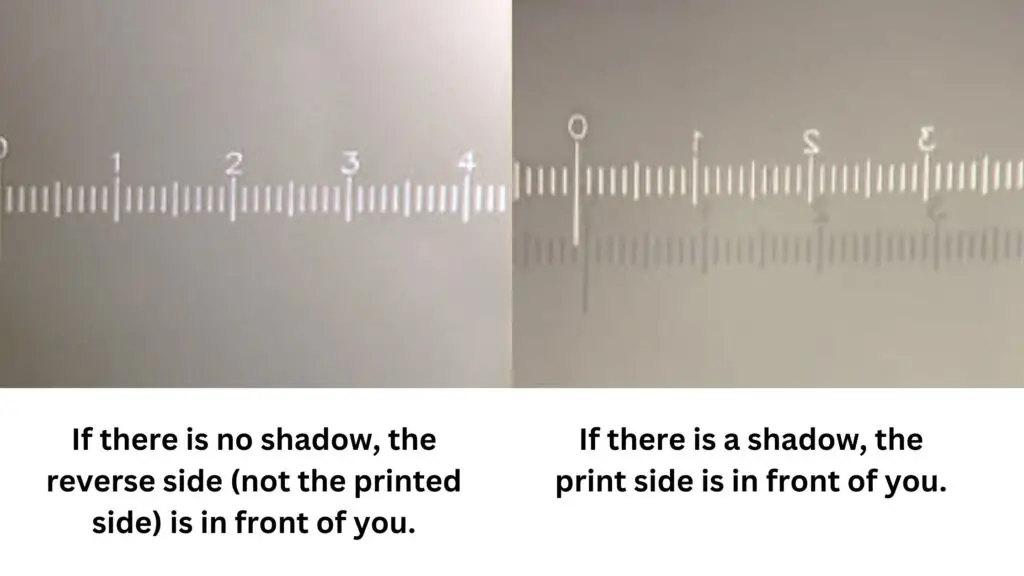
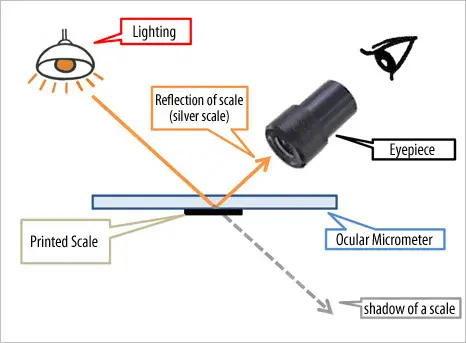
- The orientation of the micrometer scale is checked before fitting. The engraved numbers should not appear backward. This can be checked by holding the eyepiece towards bright light and looking through the lens.
- The ocular micrometer is placed inside the eyepiece on the internal shelf or diaphragm. It should be placed gently and in correct position. The scale should remain flat inside the eyepiece.
- The retainer ring is fitted again and tightened properly. It should not remain loose because loose ring may shift the scale during observation. This may create parallax error and wrong measurement.
- The eyepiece is placed back into the microscope. Then the upper eye lens is adjusted until the engraved scale becomes sharp and clear. After this, the ocular micrometer is ready for calibration and measurement.


Calibration of the Ocular Micrometer Instructions
- The ocular micrometer is inserted into the eyepiece of the microscope. Usually 10X eyepiece is used for this work. The ocular scale should be clearly seen through the eyepiece.
- The stage micrometer is placed on the microscope stage. The scale of the stage micrometer is focused by using coarse and fine adjustment knobs. The lines should appear sharp and clear.
- The ocular micrometer scale and stage micrometer scale are made parallel. This is done by rotating the eyepiece or by adjusting the mechanical stage. Both scales should lie in same direction.
- The zero line of ocular micrometer is superimposed exactly over the 0.0 line of stage micrometer. This point is taken as the starting point of calibration.
- The observer scans the scale towards right side without moving the stage micrometer. A second point is searched where one line of ocular micrometer exactly overlaps with one line of stage micrometer.
- The number of stage micrometer divisions between 0.0 line and the second overlapping point is counted. This gives the known physical distance on the stage micrometer.
- The number of ocular micrometer divisions between zero line and the same overlapping point is also counted. These are the ocular divisions which correspond to the known stage distance.
- The calibration factor is calculated by dividing the known stage micrometer distance by the number of ocular divisions. This gives the value of one ocular division at that magnification.
- If the stage micrometer distance is in millimeter, the final value is multiplied by 1000 to convert it into micrometer (µm). Thus the actual value of one ocular division is obtained.
- The same procedure is repeated for every objective lens of the microscope. The calibration factor changes with each magnification. If the ocular micrometer is shifted to another microscope or new objective lens is added, calibration should be done again.
Applications of Ocular Micrometer
- Ocular Micrometer is used in microbiology and cell biology for measuring microscopic objects. The length, width and diameter of cells, organelles and microorganisms can be measured. It helps to know the size, growth stage and identification of some microorganisms.
- It is used to measure bacteria, fungi, spores, pollen grains and other small biological structures. The measured size helps in comparison of different species and laboratory observation.
- It is used in geology and optical mineralogy. Thin sections of rocks are observed under microscope and the grain size of minerals are measured. It also helps in studying optical properties like extinction angle and optical relief.
- It is used in forensic science for examination of trace evidences. Textile fibers, glass fragments and paint chips can be measured by using ocular micrometer. The diameter and cross-sectional shape of fibers are also observed.
- It is used during microspectrophotometry for proper centering of small samples. The object can be placed at correct position under the microscope before analysis.
- It is used in industrial metrology and quality control. The grain size of metals can be measured which helps to know strength and ductility of metals.
- It is used for checking small manufactured products. Conductor wires, medical tubing and automotive small components are measured for maintaining proper size and quality.
- It is useful in research laboratories for comparing size of microscopic particles. Different samples can be measured and recorded by using the calibrated value of ocular divisions.
Advantages of Ocular Micrometer
- Ocular Micrometer is cost effective measuring instrument. It gives accurate microscopic measurement at low cost than many other high precision instruments.
- It is used for precise measurement of very small objects. The length, width and diameter of microscopic specimens can be measured after proper calibration.
- It gives consistency in measurement result. When the same calibration factor is used, the readings become more uniform between different observations and different samples.
- It helps in better data collection during practical and research work. The measured values can be recorded clearly and used for comparison of cells, microorganisms and other small structures.
- It is simple to use with normal microscope. After calibration, the observer can directly count the ocular divisions and calculate the actual size of the specimen.
- It can be used with different objective lenses. The same ocular micrometer can work with 4X, 10X, 40X and 100X objective lenses after separate calibration.
- It does not damage the specimen during measurement. The object is measured optically under microscope and no direct physical contact is required.
- It is useful in many fields like microbiology, cell biology, geology, forensic science and industrial quality control. Different types of microscopic samples can be measured by using it.
Disadvantages of Ocular Micrometer
- Ocular Micrometer requires calibration before measurement. Its divisions are arbitrary units and do not give direct actual value. It must be calibrated with stage micrometer for every objective lens.
- It needs recalibration when the ocular micrometer is used in another microscope. If a new objective lens is added, calibration should be done again. Otherwise the measurement value may become wrong.
- It may show parallax error during observation. If the micrometer disk is not fixed tightly in the retaining ring, the scale may shift slightly. This affects the alignment and gives incorrect reading.
- It is easily affected by dust and dirt. The glass disk is present at the focal plane of eyepiece, so dust particles are seen very clearly. This may disturb the image or may be confused with specimen parts.
- It depends on the observer’s eye and judgement. The measurement is done by matching the object edge with the scale lines. So the result may change from one operator to another operator.
- It is time consuming method for large number of samples. Counting ocular divisions manually takes more time. It also causes eye strain and fatigue during continuous observation.
- Its accuracy is limited by the resolving power of the light microscope. Very small structures below the optical resolution limit cannot be measured accurately. So sub-resolution measurement is not reliable.
- Small error in linear measurement can create large error in calculated values. When length and width are used for area or volume calculation, the error becomes more increased.
- It has limitation in documentation. When camera is attached with the microscope, sometimes only the specimen image is captured. The ocular scale may not appear in the saved image, so measurement record becomes incomplete.
References
- AliExpress. (2024). Ocular micrometer: A comprehensive guide for microscope users.
- BLDEA’s SSM College of Pharmacy and Research Centre. (n.d.). Ocular and stage micrometers (SOP). Department of Pharmacognosy.
- Caprette, D. R. (2012, August 10). Measuring with the microscope. Rice University.
- Centers for Disease Control and Prevention. (n.d.). Basic microscopy – ocular micrometer calibration. OneLab REACH.
- Centers for Disease Control and Prevention. (n.d.). Calibration of the ocular micrometer.
- Comprehensive analysis of optical micrometry: Theoretical principles, calibration methodologies, and multi-disciplinary applications in quantitative microscopy. (n.d.).
- District of Columbia Department of Forensic Sciences. (2013, April 11). TES04 – Forensic fiber examination (Revision 3).
- Edmund Scientific Co. (1955). Reticles and their uses (Project No. 9039).
- Exercise 3. Cell size measurements: Ocular and stage micrometers. (n.d.). GlobalSpec.
- Groshon, N. (n.d.). Calibrating your microscope [Webinar presentation]. The McCrone Group / Hooke College of Applied Sciences.
- Humphries, D. W. (1973). Size distribution measurement and the Humphries’ micrometer eyepiece. Mineralia Slovaca, 5(4), 545–550.
- KEYENCE America. (n.d.). Grain size analysis and evaluation.
- KEYENCE International Belgium. (n.d.). Optical micrometer / digital micrometer.
- Kubic, T. A., Comanescu, M. A., & Millett, T. J. (2022). A low-cost fiber optic visible microspectrometer for the small forensic science laboratory. The Microscope, 69(3), 99–107.
- Luo, C., Xie, F., Li, B., Lv, X., Jiang, M., Zhang, J., Jian, S., Yang, F., & Wang, Y. (2024). The measurement of metal mineral particle size under the microscope based on Gaussian pyramids and directional maximum intercept. Minerals, 14(12), 1284. https://doi.org/10.3390/min14121284
- Manzuk, R. A., Singh, D., Mehra, A., Geyman, E. C., Edmonsond, S., & Maloof, A. C. (2022). A high-resolution multispectral macro-imager for geology and paleontology. GSA Today, 32(9), 4–9. https://doi.org/10.1130/GSATG533A.1
- Microbus Microscope Educational Website. (2026). Reticles.
- Micro-Epsilon. (n.d.). Optical precision micrometer with high resolution.
- Microscope World. (2026). Reticles and eyepiece micrometers.
- Microscopy of textile fibers 1.0 scope. (n.d.).
- MxRady Lab Solutions Pvt. Ltd. (2023). Ocular micrometer. Kerroscale.
- National Institutes of Health. (n.d.). Identification and visualization textile fibers by Raman imaging. PMC.
- Ocular micrometer. (2026, April 9). In Wikipedia.
- Optical mineralogy. (2026, May 10). In Wikipedia.
- Parry-Hill, M., Fellers, T. J., & Davidson, M. W. (2025). Eyepiece reticle calibration. Nikon’s MicroscopyU.
- Saupe, S. G. (2009, January 7). Using and calibrating an ocular micrometer. College of St. Benedict/St. John’s University.
- Thorlabs, Inc. (n.d.). Reticles.
- VEA s.r.l. (2025). Optical micrometers.
- Woolley, C. (2024, July 17). Industrial applications of laser micrometers. Control Metrix.