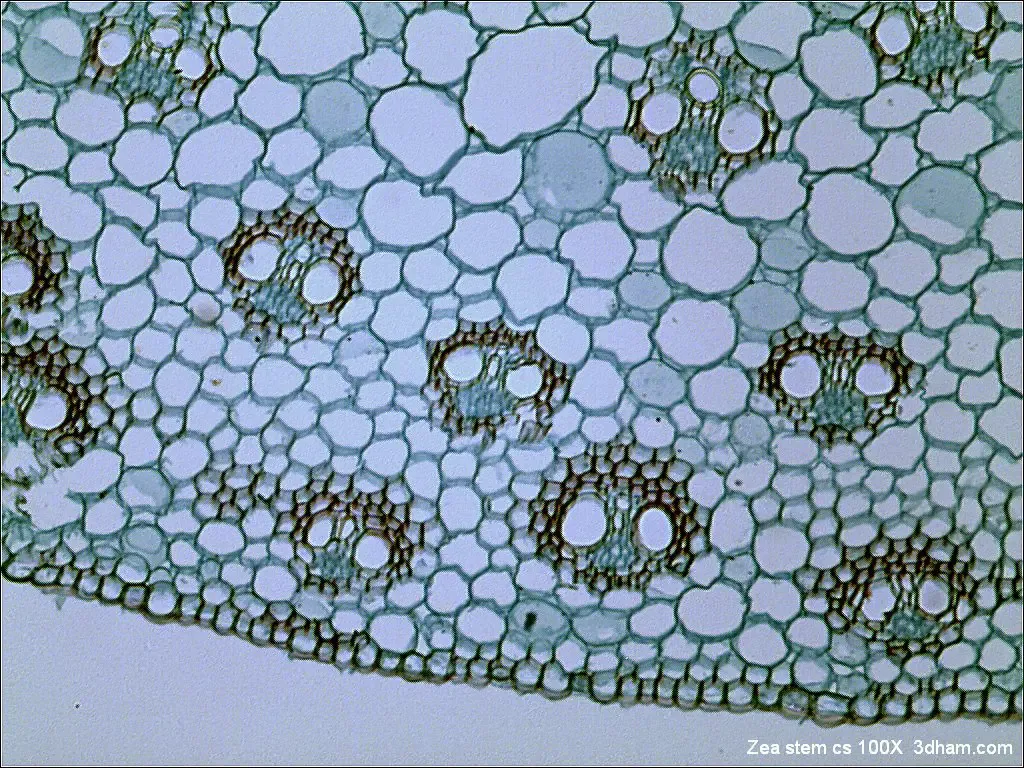
Bright Field Microscope is a simple optical microscope that uses visible white light to observe the specimen. It is also known as compound light microscope. It is the most commonly used microscope in biology, medicine and laboratory works.
In this microscope, light is passed from below the specimen. The light travels through the specimen and then enters into the objective lens. The dense parts of the specimen absorb some light and appear darker than the background.
The image formed in bright field microscope is a dark coloured specimen against a bright illuminated background. Due to this reason, it is called Bright Field Microscope. Many biological cells are transparent, so they are stained with chemical dyes for better contrast and clear observation.
The development of bright field microscope is related with the early development of lenses and compound microscope. The term microscope was given by Giovanni Faber in 1625. Later, Robert Hooke observed cells in 1665 and Antonie van Leeuwenhoek observed microscopic organisms in 1673.
During 19th century, the quality of lenses and mechanical parts were improved. Scientists like Louis Pasteur and Robert Koch used this microscope in the study of microbes and disease. Thus, bright field microscope became an important instrument for cell theory, germ theory and modern laboratory study.
Principle of Brightfield Microscope
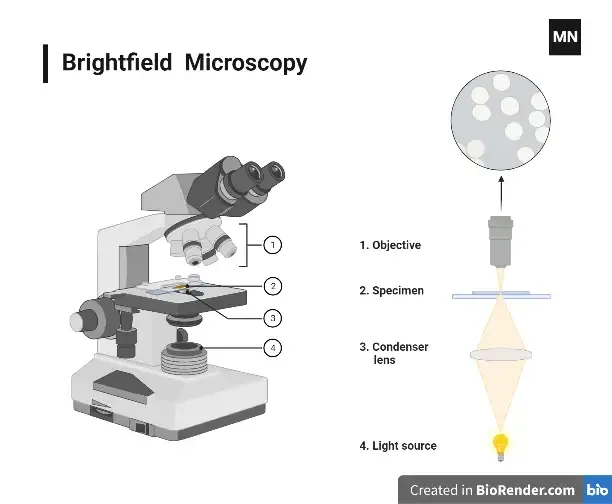
Principle of Brightfield Microscope is based on differential absorption, scattering and refraction of light by the specimen. In this microscope, white light from the light source is focused by the condenser. The condenser makes the light into a uniform beam and passes it through the specimen.
When light passes through the specimen, the dense and thick parts absorb some light rays. Some parts scatter and refract the light also. The thin and transparent parts allow more light to pass through them.
Due to this difference in light intensity, contrast is formed in the image. The specimen appears dark or coloured against a bright background. This is the main principle of Brightfield Microscope.
The transmitted light is collected by the objective lens. The objective lens forms a magnified image of the specimen. This image is again enlarged by the eyepiece and then observed by the viewer.
Many biological specimens are naturally transparent and colourless. So they give very low contrast in brightfield microscope. For this reason, staining is done to increase light absorption and to show the internal structures clearly.
Light Path of Brightfield Microscope
- The light is coming from the light source present at the base of microscope. It may be LED or halogen lamp. This light moves upward.
- The light passes through diaphragm. The diaphragm controls the light entering into the condenser. It also reduces or increases the brightness.
- The light now enters the condenser lens. Condenser lens collect the light and focus on the specimen. So the specimen gets proper light.
- The specimen is present on the stage. When light passes through it, some part absorb light and some part allow light to pass. Due to this difference the image is formed.
- The light which passes from specimen enters into objective lens. Objective lens magnifies the specimen image. It forms the first magnified image.
- The image then passes through body tube. Body tube connects objective lens and eyepiece. It keeps the optical path in straight way.
- Finally image reaches to ocular lens or eyepiece. Eyepiece magnifies the image again. Then the observer can see the dark specimen on bright background.
Parts of Brightfield Microscope
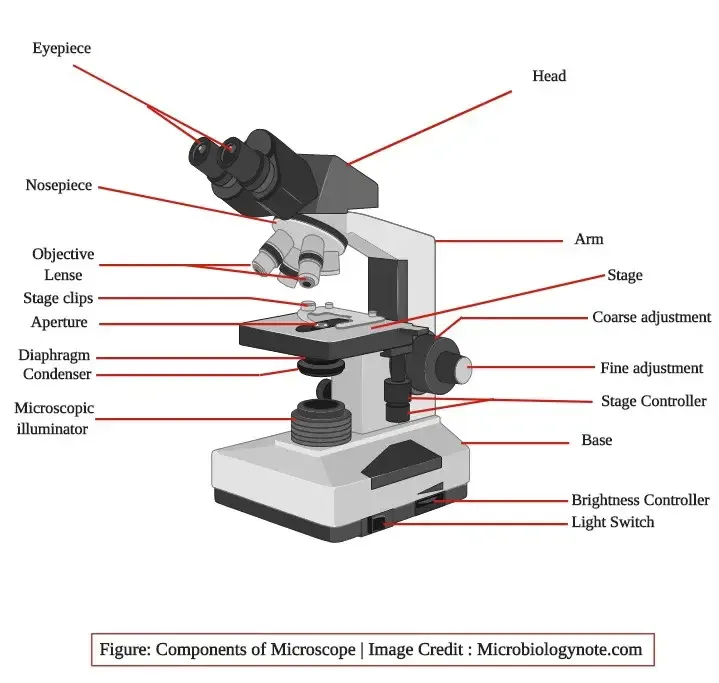
- Eyepiece – Eyepiece is also called ocular lens. It is present at the top of microscope. The observer look through this lens and it usually magnifies the image by 10X or 15X.
- Body Tube – Body tube is the cylindrical tube present between eyepiece and objective lens. It connects both optical parts. It keeps the light path in proper straight position.
- Arm – Arm is the strong metallic part of microscope. It connects the head with the base. It gives support to the upper parts and is also used for carrying microscope.
- Base – Base is the lowermost part of microscope. It supports the whole instrument and gives stability. The light source and electric switches are also present in the base.
- Revolving Nosepiece – Revolving nosepiece is present above the stage. It holds the objective lenses. It can be rotated to bring different objective lens in position.
- Objective Lenses – Objective lenses are present near the specimen. These are the main magnifying lenses of microscope. Common objective lenses are 4X, 10X, 40X and 100X oil immersion.
- Stage – Stage is the flat platform where the glass slide is placed. The specimen slide is kept on it for observation. It has central hole for passing light from below.
- Stage Clips and Controls – Stage clips hold the slide in fixed position. The stage control knobs move the slide left, right, forward and backward. This movement is in X-axis and Y-axis direction.
- Coarse Adjustment Knob – Coarse adjustment knob is the large focusing knob. It moves the stage up and down quickly. It is mainly used for first focusing under low power objective.
- Fine Adjustment Knob – Fine adjustment knob is the small focusing knob. It moves the stage slowly and gives clear sharp image. It is mostly used during high power observation.
- Condenser Lens – Condenser lens is present below the stage. It collects the light from illuminator and focus it on the specimen. It gives proper light to the object.
- Aperture Diaphragm – Aperture diaphragm is attached with condenser. It controls the amount and diameter of light reaching to the specimen. It helps in contrast and clarity of image.
- Light Source – Light source is present in the base of the microscope. It may be LED or halogen bulb. It sends white light upward through the specimen.
- Rack Stop – Rack stop is a safety part of microscope. It stops the stage from moving too much upward. It prevents the objective lens from touching and damaging the slide.
Total Magnification power of Brightfield Microscope
Magnification of Brightfield Microscope is due to two lenses. One is objective lens. Another is eyepiece lens.
The object is first magnified by objective lens. The image formed by objective lens again magnified by eyepiece lens.
The formula is-
Total magnification = Objective lens magnification × Eyepiece lens magnification
Generally eyepiece is 10X.
Objective lenses are 4X, 10X, 40X and 100X.
So the magnification are-
4X objective × 10X eyepiece = 40X
10X objective × 10X eyepiece = 100X
40X objective × 10X eyepiece = 400X
100X objective × 10X eyepiece = 1000X
Therefore the total magnification of brightfield microscope are 40X, 100X, 400X and 1000X.
The useful magnification is up to about 1000X. After this the image is only enlarged. The details are not seen more clearly. This is called empty magnification.
Operating Procedure of Brightfield Microscope
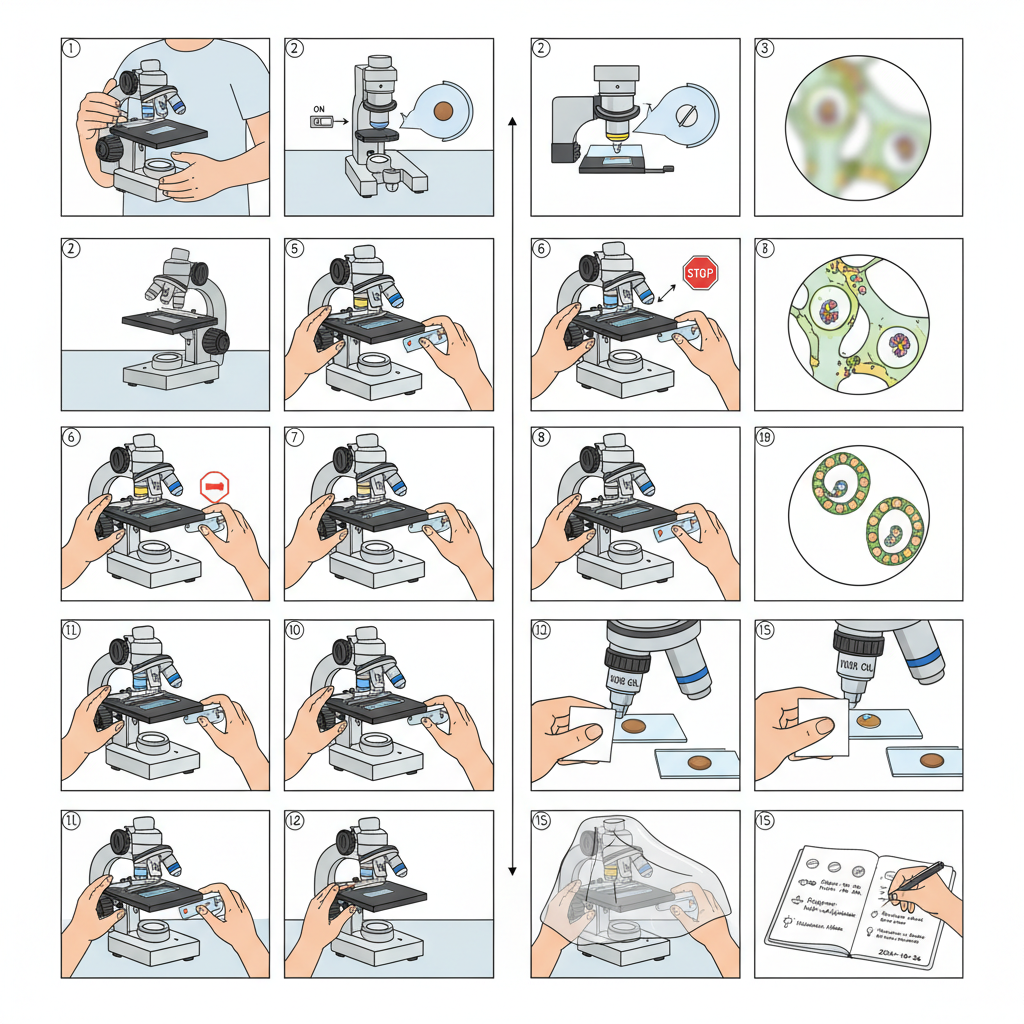
- First switch on the light source of Brightfield Microscope. The light should come from the base and pass upward.
- The prepared slide is placed on the stage. It is fixed by stage clips. The specimen part is kept just above the central hole of the stage.
- The low power objective lens is selected first. Usually 4X or 10X objective is used in the beginning. High power is not used at first.
- The condenser is adjusted below the stage. The iris diaphragm is opened or closed according to the light needed. Too much light or very less light is not suitable.
- The coarse adjustment knob is moved carefully. The stage is brought near the objective lens by watching from side. This is done to prevent touching of lens with slide.
- Now the observer looks through eyepiece. The coarse adjustment knob is slowly moved and the stage is taken away from the lens. When the specimen image is seen, the fine adjustment knob is used.
- The fine adjustment knob makes the image sharp and clear. The slide may be moved by stage control knobs to bring the required part in centre.
- After seeing under low power, the nosepiece is rotated to high power objective. The image generally remain almost focused. Only fine adjustment knob is used for clear image.
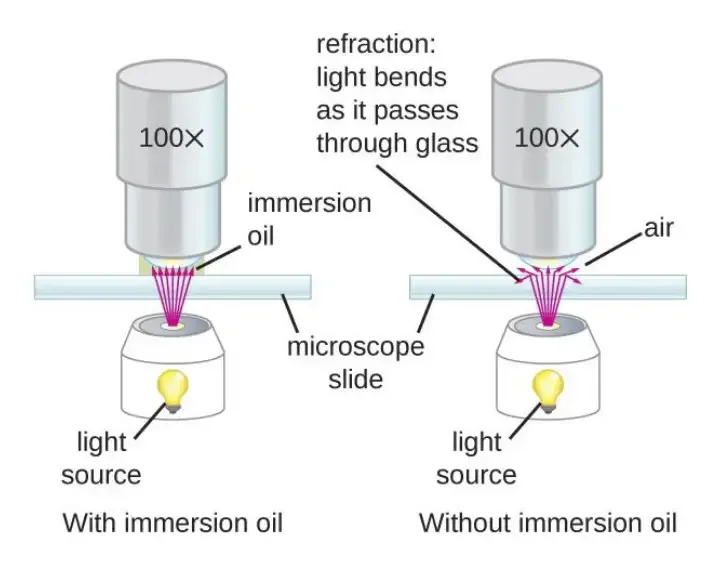
- For 100X oil immersion objective, one drop of immersion oil is placed on the slide over the specimen. The 100X lens is slowly brought into oil. Only fine focus is used in this step.
- After observation, the low power objective is brought back in position. The slide is removed from the stage. The light source is switched off and microscope is cleaned properly.
Application of Brightfield Microscope
- Brightfield Microscope is used in clinical and medical laboratory. It is used to observe tissue biopsy, blood smear and urine sediments. It helps in disease identification.
- It is used in microbiology and bacteriology. Bacterial cells are observed for their shape, size and arrangement. Staining is generally done because bacteria are very small and transparent.
- It is used to observe infectious agents and parasitic protozoa. The stained organism appear dark or coloured on bright background. So their structure can be seen.
- It is used in cell biology and histology. Fixed animal cells and plant cells are observed by this microscope. Cell shape, size and internal arrangement can be studied.
- It is used in school and college laboratory. Students learn microscope handling, basic optics and cell identification by using this microscope. It is simple instrument for teaching purpose.
- It is used in industrial and quality control work. Surface defects, grain structure, circuit board and fibre structure can be inspected. For opaque material, reflected light is used.
- It is used in pharmaceutical and food industries. Chemical formulation, microbial growth and environmental contamination are checked by this microscope.
- It is used in drug discovery and biomedical research. Effect of small molecule drugs and cell therapies can be observed on cells. Structural changes in the sample can be seen clearly.
Advantages of Brightfield Microscope
- Brightfield Microscope is simple in construction. It has less complicated parts and can be used easily. For routine laboratory work it is very useful.
- It does not need much special training. Students and new users can handle it after simple instruction. So it is commonly used in school and college laboratory.
- It is cheaper than many advanced microscopes. The maintenance cost is also low. Spare parts and lenses are easily available.
- It can be used for stained specimens. Staining makes the specimen dark or coloured and the background remain bright. So the cells and tissues can be seen clearly.
- It can also observe naturally coloured specimens. Some algae, plant parts and pigmented cells can be seen without staining. The natural colour of specimen is not changed by the microscope.
- It is non-destructive for some unstained and natural specimens. The same sample can be observed again if it is not damaged during preparation.
- It gives quick observation of slides. Common stains and normal laboratory methods can be used with it. So many samples can be checked in less time.
- It can be adapted with digital camera and image analysis system. The image can be recorded and studied on computer. So its use can be increased in modern laboratory also.
Limitations of Brightfield Microscope
- Brightfield Microscope has low natural contrast. Most of the biological cells are transparent and colourless. So they are not seen clearly without staining.
- It usually needs fixation and staining of specimen. This preparation takes more time. The user should know the proper staining method also.
- Staining may produce some artificial structures in the specimen. Sometimes extra colour, dust or contamination may appear. These are not the original part of the specimen.
- It is not very suitable for live cells. Fixation and staining generally kill the cells. So living cells cannot be studied properly for long time.
- Strong light may produce heat during observation. This heat can damage delicate specimen. It may also kill small living microorganisms.
- Its resolution is limited by visible light. Very small structures cannot be seen clearly. It is not useful for nanometer level observation.
- If the diaphragm is closed too much, image distortion may occur. The contrast may increase but the image becomes less natural and not fully clear.
- Thick specimen is difficult to observe. Thick sample blocks the light coming from below. Due to this, internal details and depth information are not seen properly.
- Fragile specimen may get damaged during slide preparation. Pressing with coverslip or handling by needle may break the sample. So care is required during preparation.
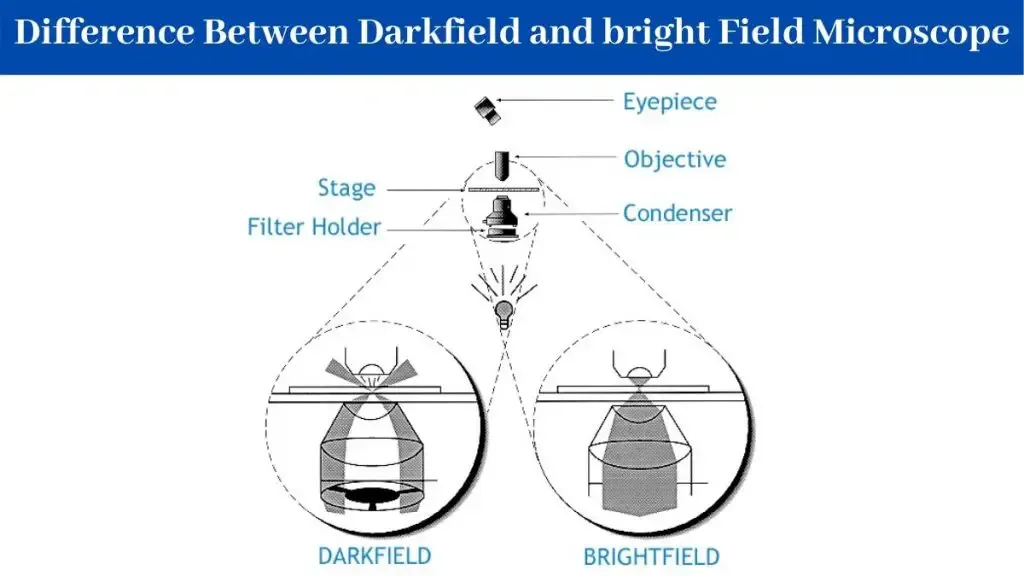
Difference between dark field and bright field Microscope
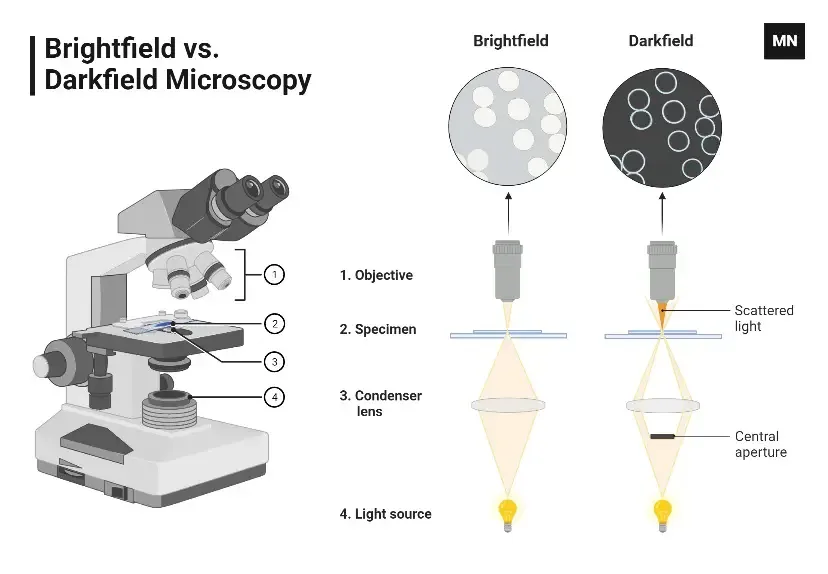
- In Bright Field Microscope, the background appears bright. The specimen appears dark or coloured on the bright background.
- In Dark Field Microscope, the background appears dark. The specimen appears bright and shining on the dark background.
- Bright Field Microscope uses direct transmitted light. The light passes straight through the specimen from below.
- Dark Field Microscope uses oblique light. The direct light is blocked by special condenser or opaque stop. Only the scattered light from specimen enters into objective lens.
- In Bright Field Microscope, contrast is formed because some parts of specimen absorb light. The thick or stained parts absorb more light and appear dark.
- In Dark Field Microscope, contrast is formed by scattered, reflected or refracted light. The specimen scatters the light and then it becomes visible against dark field.
- Bright Field Microscope is mostly used for stained, fixed and naturally coloured specimens. Cells and tissues are generally stained before observation.
- Dark Field Microscope is used for thin, transparent and unstained specimens. It is useful for live microorganisms also because staining is not always required.
- In Bright Field Microscope, transparent specimen is difficult to see clearly without stain. The contrast is low in such samples.
- In Dark Field Microscope, transparent specimen can be seen more clearly. The edges and fine outline of specimen appear bright in the dark background.
| Bright Field Microscope | Dark Field Microscope |
|---|---|
| Background is bright. | Background is dark. |
| Specimen appears dark or coloured. | Specimen appears bright and shining. |
| Direct transmitted light is used. | Oblique light is used. |
| Light passes straight through the specimen. | Direct light is blocked by opaque stop or special condenser. |
| Contrast is formed by absorption of light. | Contrast is formed by scattered, reflected or refracted light. |
| Stained and fixed specimens are mostly observed. | Unstained, thin and transparent specimens are mostly observed. |
| Transparent specimen is not seen clearly without stain. | Transparent specimen is seen clearly on dark background. |
| It is commonly used for cells, tissues and stained bacteria. | It is useful for live microorganisms and fine outline observation. |
References
- Gyan Sanchay. (n.d.). 1.1 Bright field microscopy Bright field Microscopy is the simplest of all the optical micrscopy illumination techniques. Sample.
- W.W. Norton. (n.d.). 2.4 Fixation and staining for bright-field microscopy.
- PMC – NIH. (n.d.). A quick guide to light microscopy in cell biology.
- Taylor & Francis. (n.d.). Bi imaging – Basic principles of microscope objectives.
- MacsChem. (2025). Biological stains | Classification, examples & uses.
- ALMICRO Instruments. (n.d.). Bright field microscope.
- ALMICRO. (2026, January 7). Bright field microscope: Diagram, principle & differences.
- Danaher Life Sciences. (n.d.). Brightfield microscope: Components, applications & advantages.
- Mokobi, F. (2024, September 4). Brightfield microscope: Principle, parts, applications. Microbe Notes.
- Bioimaging Unit – Newcastle University. (n.d.). Brightfield and widefield fluorescence imaging.
- ZEISS Microscopy. (2025, November 6). Brightfield illumination: A guide to the most widely used microscopy technique.
- University Of Pretoria. (n.d.). Brightfield.
- Academic Press. (2009). Chapter 4 – Bright-field microscopy. Light and Video Microscopy.
- MicroBus. (n.d.). Clean microscope lens.
- Pramanik, T., Ghosh, A., & Roychowdhury, P. (2005). Easy lens cleaning solution for laboratory microscopes. Medical Journal of Malaysia, 60(1).
- Wikipedia. (2025, September 8). H&E stain.
- Hobbite Micro Optics Manufacturer. (n.d.). How the three microscope objectives differ in practice.
- Thorlabs. (n.d.). Imaging microscope objectives.
- Davidson, M. W. (n.d.). Introduction to microscope objectives. Nikon’s MicroscopyU.
- Oldfield, R. J. (n.d.). Light microscopy – Brightfield and darkfield illumination.
- Fellers, T. J., & Davidson, M. W. (n.d.). Linear measurements (micrometry). Nikon’s MicroscopyU.
- Microscope World. (2024, February 6). Mechanical stage microscope function.
- Delly, J. G. (n.d.). Microscope activities, 11: Using a mechanical stage. The McCrone Group.
- Davidson, M. W. (n.d.). Microscope objective specifications. Nikon’s MicroscopyU.
- Spring, K. R., Keller, H. E., & Davidson, M. W. (n.d.). Microscope objectives: Types, correction classes & selection guide. Evident Scientific.
- Microscope World. (n.d.). Microscope parts & specifications labeled diagram.
- Wilson, M., DeRose, J., & Greb, C. (2023, January 19). Microscope resolution: Concepts, factors and calculation. Leica Microsystems.
- Potts, C. (2023, August 30). Microscope stage rack and pinions explained. Microscope Marketplace.
- Abramowitz, M., & Davidson, M. W. (n.d.). Microscope stages. Evident Scientific.
- Microscope Central. (n.d.). Microscope terms.
- Duke, C. (2003). Microscope objective lens cleaning – best practice review. Micscape Magazine.
- Nikon’s MicroscopyU. (n.d.). Objective working distance.
- Dahal, P. (2026, May 10). Parts of a microscope with functions and labeled diagram. Microbe Notes.
- Nikon’s MicroscopyU. (n.d.). Properties of microscope objectives.
- Xu, B. (2023, May 23). Skills center standard operating procedure a biofizz producton light microscopy (bright field) module hours.
- Wikipedia. (2026, April 20). Staining.
- ResearchGate. (n.d.). The brightfield microscope.
- Author Unknown. (n.d.). The microscope.
- Author Unknown. (n.d.). Theoretical and practical framework of bright field microscopy: An exhaustive analysis of optical instrumentation, principles, and diagnostic applications.
- Band Optics. (2026, January 9). Top 10 microscope objective lenses for professional and educational use in 2026.
- UBC Bioimaging Facility. (n.d.). Transmitted light microscopy – Bright field, phase contrast and DIC imaging.
- Sanderson, J. (n.d.). Understanding the microscope. 11. Cleaning lenses.
- Author Unknown. (n.d.). Unit 1: Bright field microscopy.
- Yoshikura, T. (2023, August 10). What is brightfield microscopy? Olympus LS – Evident Scientific.
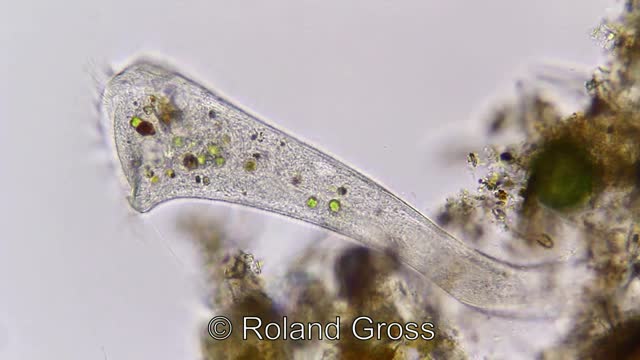
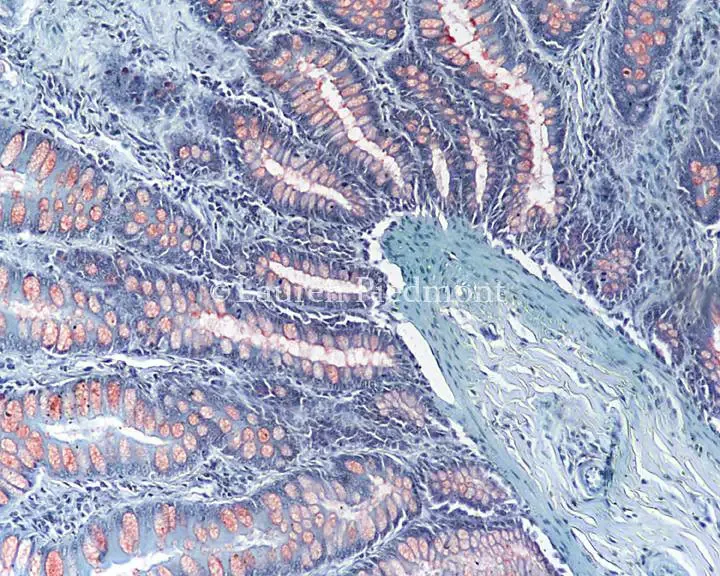
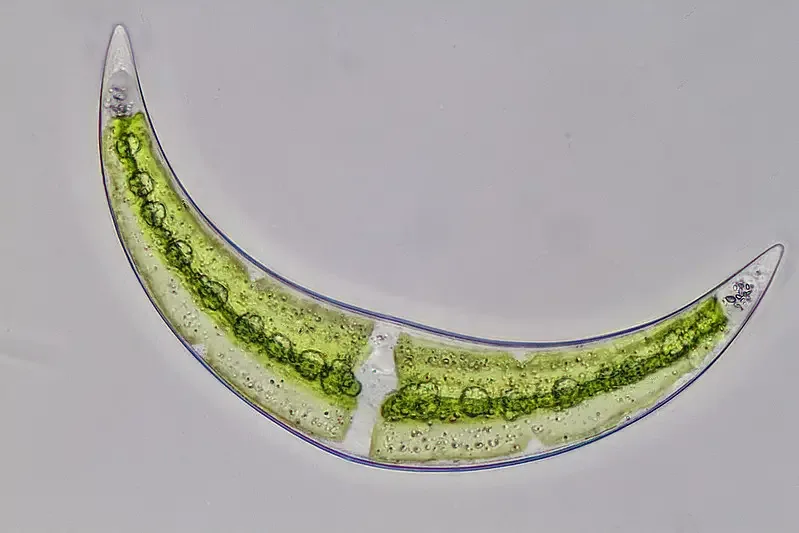
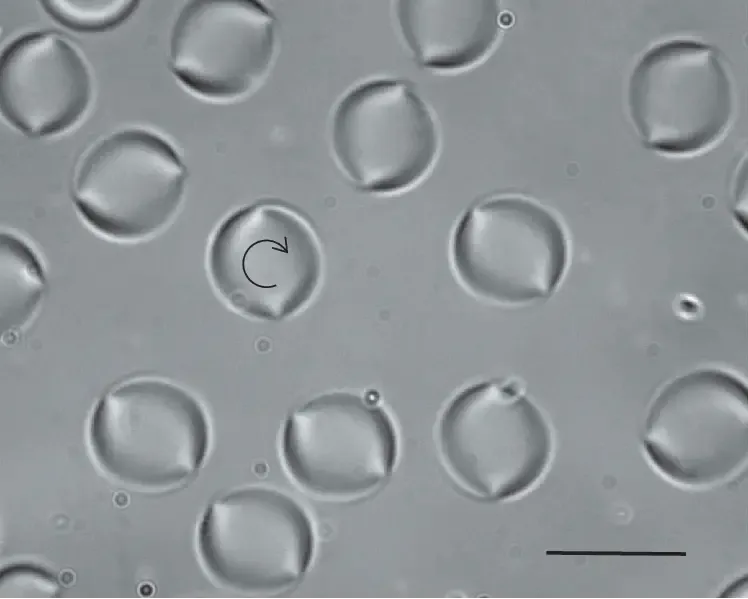
Bright Field microscope image