

MUG test is a rapid biochemical assay used in microbiology. It is used to detect Escherichia coli (E. coli) mainly in food, water and environmental samples.
It uses 4-methylumbelliferyl-β-D-glucuronide (MUG) as the substrate. The test is used to detect β-glucuronidase enzyme activity. About 96% to 97% of E. coli strains produce this enzyme.
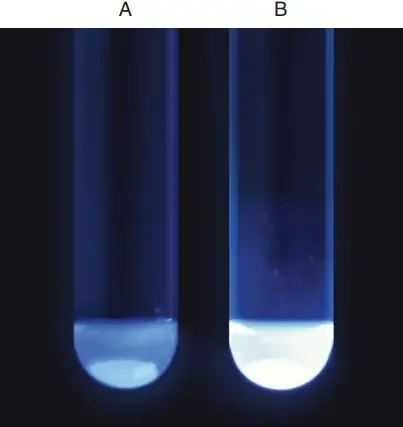
When MUG is broken down, 4-methylumbelliferone is released. This product is fluorescent. It gives electric blue fluorescence under long wave UV light, so it indicates positive test.
If fluorescence is not seen, it is taken as negative MUG test. This negative test is useful in clinical diagnosis for presumptive identification of verotoxin producing E. coli O157:H7, because it lacks β-glucuronidase enzyme.
Objectives of 4-Methylumbelliferyl-β-D-Glucuronide (MUG) Test
The objectives of 4-Methylumbelliferyl-β-D-Glucuronide (MUG) test are as follows–
- To detect β-glucuronidase enzyme activity in the organism. This is done by observing fluorescence under long wave ultraviolet (UV) light (around 365 nm).
- To presumptively identify members of Enterobacteriaceae family. It helps in differentiating some genera based on MUG reaction.
- To rapidly detect and identify Escherichia coli (E. coli) from samples. It is used for clinical samples, food samples, water samples and environmental samples.
- To screen for verotoxin producing E. coli strains like O157:H7. These strains usually do not produce β-glucuronidase, so MUG test will be negative.
- To use as a taxonomically specific support test along with other tests. It is used with oxidase test, indole test and lactose fermentation for complete identification.
Principle of 4-Methylumbelliferyl-β-D-Glucuronide (MUG) Test
Principle of MUG Test is based on the detection of β-D-glucuronidase enzyme. This enzyme is naturally produced by most strains of Escherichia coli. It is also produced by some other Enterobacteriaceae.
In this test a synthetic fluorogenic substrate is used called 4-methylumbelliferyl-β-D-glucuronide (MUG). When the organism possess β-D-glucuronidase, the enzyme hydrolyses the β-O-glycosidic bond present in MUG. The substrate is non-fluorescent before the reaction.
The cleavage reaction breaks MUG into D-glucuronic acid and an aglycone end product called 4-methylumbelliferone (4-MU). The 4-MU released is highly fluorescent. Under long wavelength UV light (around 365 to 366 nm) it gives a distinct electric blue fluorescence.
Appearance of blue fluorescence under UV light is taken as positive MUG test. It indicates presence of β-D-glucuronidase and presumptive identification of E. coli. Absence of fluorescence indicates negative result.
Requirements of 4-Methylumbelliferyl-β-D-Glucuronide (MUG) Test
- Long wave ultraviolet (UV) lamp (365 to 366 nm). Hand-held UV light (4 watt or 6 watt) or dark viewing box is used.
- Incubator maintained at about 35 ± 0.5°C. Covered water bath with circulating system (about 44.5 ± 0.2°C) is used in some protocols.
- Immersion type thermometer. Balance (capacity more than 2 kg, sensitivity 0.1 g) and blender with jar for sample preparation.
- pH meter. Quebec colony counter or equivalent. Loop sterilization device or incinerator.
- Disposable borosilicate glass tubes (100 × 16 mm) and Durham vials (50 × 9 mm) if broth tube method is done. Sterile graduated pipettes (1 ml and 10 ml) and sterile sample handling utensils.
- Dilution bottles (borosilicate glass with teflon lined caps) or prepared dilution bottles. Inoculating loop, swab, or sterile wooden applicator stick.
- Sterile petri dishes, filter paper and forceps (for MUG disk method).
- MUG substrate in medium (LST-MUG broth or EC-MUG medium) or commercially prepared MUG impregnated disks. Sterile diluents like Butterfield’s phosphate buffered water or demineralized water.
- Kovacs’ indole reagent (used along with MUG test in some identification). Positive control strain producing β-glucuronidase (E. coli ATCC 25922).
- Negative control strain (Enterobacter aerogenes ATCC 13048 or Klebsiella pneumoniae or Proteus mirabilis).
Procedure of 4-Methylumbelliferyl-β-D-Glucuronide (MUG) Test
Direct Disk Method
- Place a MUG disk in a sterile petri dish. Moisten the disk with one drop of demineralized water. Or the disk can be placed on agar surface so it absorbs moisture from medium.
- Take 2 to 3 isolated colonies from 18 to 24 hour old pure culture. Smear the colonies directly on the wetted disk.
- Place a piece of water saturated filter paper inside the lid of the petri dish. This is done to maintain humid condition.
- Incubate the dish aerobically at 35°C to 37°C for up to 30 minutes. Some protocols allow up to 2 hours.
- After incubation, take the dish in dark room and observe under long wave UV light (360 to 366 nm). Electric blue fluorescence on disk indicates positive test.
- If required add one drop of Kovacs’ indole reagent on the disk after fluorescence reading. Red colour indicates indole positive.
Tube Test Method
- Take a clean glass or plastic test tube. Add 0.25 ml demineralized water in the tube.
- Add 3 to 5 colonies of the test isolate. Make a heavy suspension in the liquid.
- Drop a MUG disk into the tube using sterile forceps. Shake it vigorously so the substrate elutes in the liquid.
- Incubate the tube aerobically at 35°C to 37°C for 1 hour.
- Take the tube in a dark room and observe under long wave UV light (around 360 nm). Blue fluorescence indicates positive test.
- If required add 2 to 3 drops of Kovacs’ indole reagent after reading. Red colour indicates indole positive.
Results of MUG Disk Test (Direct or Tube Test)
Results of MUG Disk Test (Direct or Tube Test)
Positive result
Electric blue fluorescence is seen when the disk or tube is exposed to long wave UV light (365 to 366 nm). It indicates the organism produces β-D-glucuronidase enzyme. This is taken as presumptive positive for Escherichia coli (E. coli).
Negative result
No fluorescence is seen under the UV light. It generally indicates absence of typical E. coli. A negative MUG test is also seen in some pathogenic strains like verotoxin producing E. coli O157:H7, because they lack β-D-glucuronidase enzyme.
Uses of MUG Test
- It is used for water quality monitoring. It is used to detect and quantify E. coli in drinking water, ground water, surface water, recreational water and waste water.
- It is used in food and beverage safety. It is used as a rapid screening test to detect E. coli contamination in chilled or frozen foods, dairy products and unpasteurized citrus juices.
- It is used for shellfish examination. It is used to test bivalve molluscan shellfish meats for E. coli and EC-MUG broth is used to avoid false positive due to endogenous enzymes in oysters.
- It is used in clinical and pathogen diagnosis. It is used for presumptive identification within Enterobacteriaceae and for screening verotoxin producing E. coli like O157:H7 which gives MUG negative result.
- It is used to speed up traditional testing schemes. MUG substrate is added in media like Lauryl Tryptose (LST) broth or Violet Red Bile Agar (VRBA) so confirmed E. coli identification is obtained without extra subculturing and confirmation steps.
Advantages of MUG Test
- It gives rapid results. Result is obtained within 18 to 24 hours and sometimes within 4 hours depending on method. It reduces the multi day confirmatory steps of standard MPN procedure.
- It is highly sensitive. It can detect even single viable E. coli or coliform organism in 100 ml sample. It also supports recovery of stressed or sublethally injured bacteria.
- It can detect atypical strains. Fluorescence method is more sensitive than gas production method, so anaerogenic (non gas producing) E. coli strains are also detected.
- It can be used for simultaneous detection. When combined with ONPG, it can detect total coliforms and E. coli in a single test without using multiple media.
- It reduces interference. MUG based matrices suppress non target background bacteria, so masking of target organism is reduced and false positive or false negative is less.
- It reduces cost and labour. It reduces cleaning of glassware, colony counting and extra confirmatory tests. Media cost and processing time is reduced.
- It is easy to interpret. Distinct colour change or bright electric blue fluorescence under UV light is seen, so subjective interpretation is less.
Limitation of MUG Test
- It cannot detect E. coli O157:H7 properly. Most strains are MUG negative due to mutation, so test will fail and other confirmatory tests are needed (latex agglutination etc.).
- False positive can occur with other bacteria. Some strains of Shigella, Salmonella, Yersinia, Staphylococcus and Streptococcus can produce β-glucuronidase and show MUG positive.
- Interference is seen in marine and estuarine water samples. Autochthonous marine bacteria like Providencia and Vibrio may give severe false positive, so higher dilution is required.
- Endogenous enzymes in some foods can interfere. Oysters may have their own β-glucuronidase and can mimic positive result, so pre enrichment is needed to dilute the enzyme.
- Media dye can interfere with fluorescence reading. Colonies taken from MacConkey (MAC) or EMB agar may mask fluorescence.
- Glassware autofluorescence can create confusion. Some glass tubes contain cerium oxide and it fluoresces under UV, so it can be mistaken as positive MUG reaction.
- pH sensitivity is a limitation. Fluorescence of 4-MU depends on pH and acidic condition may quench it due to fermentation. Sometimes alkaline reagent like sodium hydroxide or ammonia is added to see the blue glow.
- It gives only presumptive identification. So further biochemical tests (indole test etc.) or serological assays are required for confirmation and differentiation.
- It cannot differentiate viable and dead cells always. The test depends on enzyme activity and enzyme may remain stable even after cell death, so live infectious bacteria and non viable cells may not be separated.
Precautions of MUG Test
- Observe the test under long wave UV light (365 to 366 nm) in a dark room. UV light should have proper power, cheap multi wavelength LED may not give proper fluorescence. If strong UV source is used wear protective glasses or goggles.
- Check the glass test tubes for auto fluorescence before doing the test. Some glass tubes contain cerium oxide and it fluoresces under UV, it can give false positive reading.
- Read the MUG fluorescence first. If indole test is also done, Kovacs’ indole reagent should be added only after fluorescence is interpreted.
- Do not pick colonies from dye containing media like MacConkey, EMB or TSI agar. These dyes can interfere and may cause false negative reaction.
- Always use positive and negative control strains with every batch. Positive control is E. coli ATCC 25922 and negative control can be Klebsiella pneumoniae or other known negative strain.
- Oysters and shellfish tissues may contain endogenous β-glucuronidase. It can give false positive, so pre enrichment without MUG is required. Marine and estuarine water samples may need higher dilution (like 1:20) to reduce false positive due to marine MUG positive bacteria.
- If chlorinated water sample is tested, neutralize it immediately after collection. Sodium thiosulfate is used, so viable indicator organisms are not destroyed.
- Cross reactivity should be considered. Some strains of Salmonella, Shigella and Staphylococcus can also produce β-glucuronidase. MUG test should be used mainly for lactose positive gram negative rods and should be followed by confirmatory tests.
- Remember E. coli O157:H7 is characteristically MUG negative due to non functional enzyme gene. MUG test cannot rule out this pathogen, so other screening methods like latex agglutination or Shiga toxin assays are needed if suspected.
- When solid media is used, use gravity or natural convection incubator. Forced air incubator may dry the media and affects the enzyme diffusion.
- In broth tube method, check Durham tubes properly. Inverted Durham tube should be free of trapped air bubbles before inoculation, otherwise it may be taken as gas production.
References
- Amp Tech Instruments. (n.d.). EPA method 1604 instrumentation guide.
- Andrews, W. H., & Jacobson, A. (2023, March). Bacteriological analytical manual chapter 6: Shigella. U.S. Food and Drug Administration.
- Bacteria associated with false-positive most-probable-number coliform test results for shellfish and estuaries. (n.d.). PubMed Central (PMC).
- Bubert, A., & Siegrist, J. (2016). New standard to detect coliforms. Microbiology Focus, 8(3), 2-7. Merck KGaA.
- cab, m. (n.d.). Colilert procedure es. Academia.edu.
- Centers for Disease Control and Prevention. (2007, January 17). Laboratory-confirmed non-O157 Shiga toxin-producing Escherichia coli — Connecticut, 2000–2005. Morbidity and Mortality Weekly Report (MMWR).
- Cheeptham, N., & Lal, A. (2010, August 23). Use of EC-MUG media to confirm Escherichia coli contamination in water samples protocol. American Society for Microbiology.
- Comparison of commercially available kits with standard methods for the detection of coliforms and Escherichia coli in foods. (n.d.). PubMed Central (PMC).
- Comprehensive analysis of the 4-methylumbelliferyl-β-D-glucuronide (MUG) assay: Principles, methodologies, and applications in diagnostic microbiology. (n.d.).
- Condalab. (n.d.). Chromogenic coliforms agar (CCA) ISO Cat. 2080. BioTrading.
- Dimaano, A. (n.d.). BAM 4 – Enumeration of Escherichia coli and the coliform bacteria. Scribd.
- E&O Laboratories Ltd. (2023, September 12). KM0056 chromogenic coliform agar (CCA) dehydrated culture media: Instructions for use [REV. 001].
- Enzyme characteristics of β-d-galactosidase- and β-d… (n.d.). PubMed Central (PMC).
- Evaluation of a commercial beta-glucuronidase test for the rapid and economical identification of Escherichia coli. (n.d.). PubMed.
- Feng, P. C. H., & Lampel, K. A. (1994, August). Genetic analysis of uidA expression in enterohaemorrhagic Escherichia coli serotype O157:H7. Microbiology, 140(8), 2101-2107.
- Feng, P., Weagant, S. D., Grant, M. A., & Burkhardt, W. (2020, October). Bacteriological analytical manual chapter 4: Enumeration of Escherichia coli and the coliform bacteria. U.S. Food and Drug Administration.
- Fluorogenic assay for rapid detection of Escherichia coli in food. (n.d.). PubMed Central (PMC).
- Fluorogenic substrates based on fluorinated umbelliferones for continuous assays of phosphatases and beta-galactosidases. (n.d.). PubMed.
- Genetic and evolutionary analysis of mutations in the gusA gene that cause the absence of beta-glucuronidase activity in Escherichia coli O157:H7. (n.d.). PubMed.
- Hardy Diagnostics. (2020). CRITERION™ EC medium with MUG: Instructions for use [IFU-10155].
- HiMedia Laboratories. (2015, February). MUG EC broth (M1042) technical data.
- HiMedia Laboratories. (2024, April). MUG EC broth (M1042) technical data.
- Hoffmann, R. (2008). uidA – beta-D-glucuronidase. WikiGenes.
- IDEXX. (n.d.). Coliform and E. coli water testing with Colilert.
- IDEXX. (n.d.). Coliform and E. coli water testing with Colilert-18.
- IDEXX. (n.d.). IDEXX: Colilert: Coliform/E. coli enzyme substrate test. National Environmental Methods Index (NEMI).
- ITW Reagents. (2017, February). CCA agar chromogenic ISO 9308-1:2014 [Info point IP-012EN].
- Marine bacteria cause false-positive results in the Colilert-18 rapid identification test for Escherichia coli in Florida waters. (n.d.). PubMed.
- Marine bacteria cause false-positive results in the Colilert-18 rapid identification test for Escherichia coli in Florida waters. (n.d.). PubMed Central (PMC).
- Marler Clark. (2022, November 8). Non-O157 STEC.
- Pisciotta, J. M., Rath, D. F., Stanek, P. A., Flanery, D. M., & Harwood, V. J. (2002, February). Marine bacteria cause false-positive results in the Colilert-18 rapid identification test for Escherichia coli in Florida waters. Applied and Environmental Microbiology, 68(2), 539-544.
- Rapid Test Methods Ltd. (n.d.). Colilert-18®. Rapidmicrobiology.com.
- Remel Inc. (2020, November). MUG disk: Instructions for use [IFU21135]. Thermo Fisher Scientific.
- Sensitive and rapid detection of E. coli O157:H7 elimination of false-positives using PMAxx-IMS-enhanced real-time PCR. (n.d.). PubMed.
- Sigma. (1998, May). β-glucuronidase (GUS) fluorescent reporter gene activity detection kit [Technical Bulletin MB-470].
- Sigma-Aldrich. (n.d.). Microbial detection using chromogenic and fluorogenic culture media.
- The “Big Six”: Hidden emerging foodborne bacterial pathogens. (n.d.). PubMed Central (PMC).
- U.S. Environmental Protection Agency. (n.d.). Kristen Brenner.
- U.S. Environmental Protection Agency, Office of Water. (2002, September). EPA-OW: 1604: Total coliforms and E. coli in drinking water by membrane filtration. National Environmental Methods Index (NEMI).
- U.S. Environmental Protection Agency, Office of Water. (2002, September). Method 1604: Total coliforms and Escherichia coli in water by membrane filtration using a simultaneous detection technique (MI medium) [EPA-821-R-02-024].
- UK Health Security Agency. (2025, July 31). Identification of Shigella species [UK Standards for Microbiology Investigations, ID 20, Issue 4.1].
- Watson, R. (n.d.). Staphylococcus and Streptococcus species. The Virtual Edge, University of Wyoming.
- Wikipedia contributors. (n.d.). Shigella. In Wikipedia, The Free Encyclopedia.