

Transport across plasma membrane is the controlled movement of substances between the intracellular environment and extracellular environment through the plasma membrane or cell membrane. It is mainly of three ways- passive transport, active transport, and vesicular or bulk transport. The plasma membrane has selective permeability.
In passive transport, substances move along their concentration gradient or electrochemical gradient. Direct cellular energy is not used here.
The molecules move from higher concentration to lower concentration. Diffusion is the movement of molecules from higher to lower concentration. Osmosis is the movement of water through the selectively permeable membrane. Facilitated diffusion is also a passive process, but membrane proteins are needed. These proteins may be a channel protein or a carrier protein, especially when ions and polar molecules are transported.
Active transport is different. In this process, substances are moved against the electrochemical gradient. It is also used to maintain gradients across the membrane. Energy is required in this transport. In primary active transport, Adenosine triphosphate (ATP) is used directly by the transport protein or pump.
In secondary active transport, ATP is not directly used in the same step. The stored energy of ion gradients, such as Na⁺ or H⁺ gradient, is used. Pumps and carrier proteins are involved in active transport.
Vesicular transport is a bulk transport process. Large molecules, particles, and fluid droplets are transported by this method. They do not pass directly through the lipid bilayer. The membrane bends and forms vesicles. By these vesicles, materials are taken in or released out.
Endocytosis carries materials into the cell by inward folding of the plasma membrane. Exocytosis carries materials outside the cell when vesicles fuse with the plasma membrane and release their contents to the extracellular side.
The type of transport across cell membrane depends on the nature of the substance. It also depends on selective permeability, direction of concentration gradient or electrochemical gradient, requirement of membrane protein, and use of cellular energy. Small non-polar molecules can diffuse through the lipid region. Water moves mainly by osmosis. Ions, glucose, amino acids and many polar solutes need specific membrane proteins. When movement is against the gradient, ATP or stored gradient energy is required.
Factors That Determine Membrane Transport
Membrane transport is affected by the properties of substance as well as the nature of plasma membrane. The membrane is selectively permeable, so different substances do not move through it in the same way. Concentration or electrochemical gradient, transport proteins and energy availability also control the movement.
Some of the important factors that determine membrane transport are-
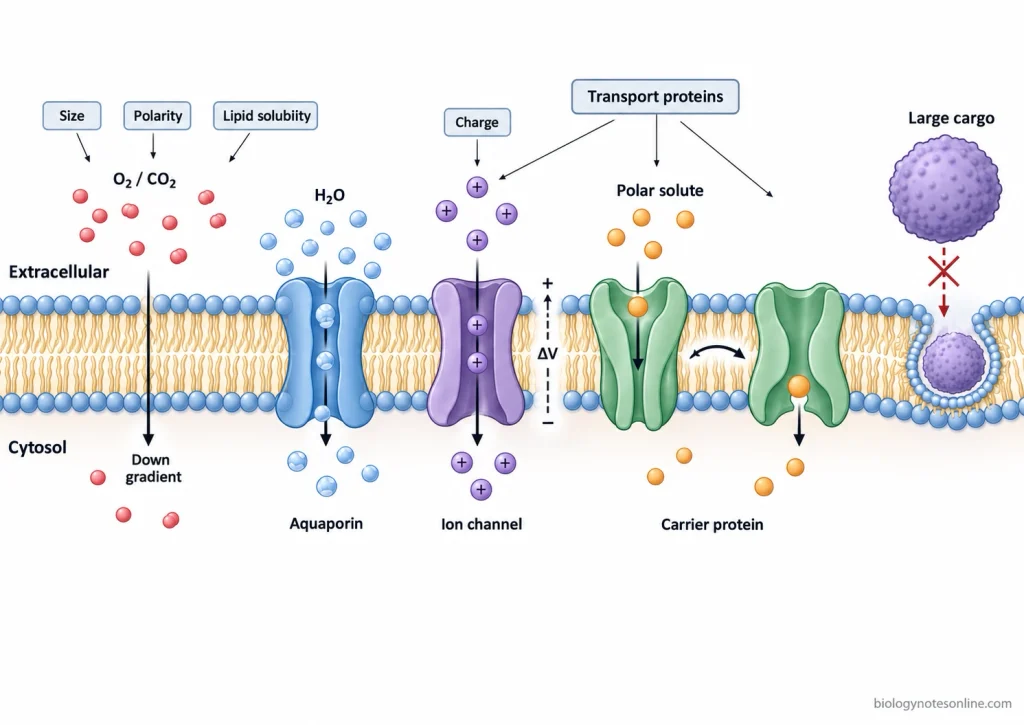
- Molecular size- Size of the molecule affects its movement across the lipid bilayer. Small molecules generally pass through membrane more readily compared to large molecules. Very large molecules or particles cannot diffuse directly through the bilayer and may be moved by vesicular transport.
- Polarity, charge and lipid solubility- Lipid-soluble and nonpolar molecules can move through the hydrophobic part of membrane more easily. Small uncharged polar molecules cross more slowly. Ions and strongly charged molecules have very low permeability through lipid bilayer. These commonly require transport proteins.
- Concentration gradient- For an uncharged substance, the difference in its concentration on two sides of membrane acts as a driving force for passive diffusion. The substance moves from higher concentration towards the lower concentration. A greater concentration difference generally increases the net diffusion rate when other conditions remain unchanged.
- Electrochemical gradient and membrane potential- The transport of ions is not controlled by concentration alone. Electrical potential across the membrane also acts on charged particles, and together with concentration difference it forms an electrochemical gradient. The membrane potential may favor movement of a particular ion or can oppose its movement.
- Availability of membrane transport proteins- Many polar substances and ions are transported with the help of channel proteins, carrier proteins, and pumps. Channel proteins form hydrophilic pathways through the membrane. Carrier proteins first bind their particular solute and then undergo a change in conformation. The type and number of these proteins affect how much of a substance can be transported. Carrier-mediated transport can become saturated when the available binding sites are occupied.
- Opening of membrane channels- Some ion channels remain open, whereas many channels are gated. The gated channels can open or close due to changes in membrane voltage or binding of a chemical signal. An ion can move through the channel down its electrochemical gradient when the suitable channel is open.
- Availability of cellular energy- Movement of substances against their electrochemical gradient needs an energy source. During primary active transport, energy can be obtained directly from hydrolysis of adenosine triphosphate (ATP). In secondary active transport, the energy stored in an ion gradient is used instead. The downhill movement of one solute is coupled with the uphill transport of another substance.
- Surface area and membrane thickness- A larger membrane surface provides more area through which diffusion can take place. Diffusion decreases when the distance or thickness of membrane barrier is increased.
- Temperature- Temperature affects molecular movement and the diffusion coefficient. With an increase in temperature, molecules generally move faster and diffusion can take place at a higher rate.
- Osmotic gradient and water permeability- Water moves through a selectively permeable membrane by osmosis according to the difference in effective solute concentration on the two sides. Its rate also depends on permeability of membrane to water. Aquaporin channels increase the movement of water across plasma membrane.
Passive Transport
Passive transport is the movement of substances across plasma membrane down an already existing concentration or electrochemical gradient. No cellular metabolic energy is directly spent during this process.
It does not directly use adenosine triphosphate (ATP). For uncharged molecules, concentration difference determines the direction of movement, whereas transport of ions depends on both concentration difference and electrical potential across the membrane.
The three major types of passive transport are-
- Simple diffusion- It is the direct movement of molecules through the lipid bilayer from higher concentration towards lower concentration. No membrane transport protein is involved. Small nonpolar and lipid-soluble molecules can cross by this process more readily. Oxygen (O₂) and carbon dioxide (CO₂) are some substances which move through plasma membrane by simple diffusion.
- Facilitated diffusion– In this type, substances move down their concentration or electrochemical gradient with the help of specific membrane proteins. The transported substances do not need to pass directly through the hydrophobic interior of lipid bilayer. Two major proteins are involved, channel proteins and carrier proteins. Channels provide a hydrophilic pathway through membrane, whereas carrier proteins bind the particular solute and change their conformation to transfer it across. Ions and many polar molecules are transported in this way. Energy from ATP is not directly required.
- Osmosis- Osmosis is the passive movement of water across a selectively permeable membrane according to its water concentration or osmotic gradient. Water moves from the region having higher free-water concentration towards the region of lower free-water concentration. It can pass through membrane directly to some extent, and aquaporin channels greatly facilitate water movement in many cell membranes.
Active Transport
Active transport is the movement of substances across plasma membrane by using an energy source, commonly against their concentration or electrochemical gradient. It is carried out by specific carrier proteins or pumps present in the membrane. Energy may be supplied directly by hydrolysis of adenosine triphosphate (ATP) or indirectly from an ion gradient already established across the membrane. Every active transporter does not hydrolyze ATP directly. NCBI
The major types of active transport are-
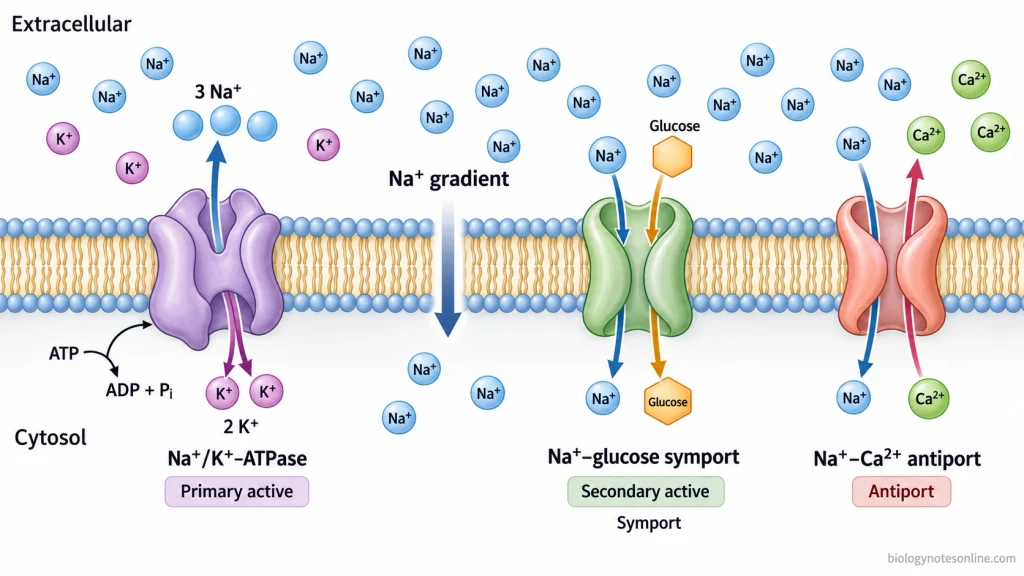
- Primary active transport- In this transport, movement of the solute is directly coupled with an energy-producing reaction, commonly ATP hydrolysis. The transport protein acts as a pump. Ions can be moved against their electrochemical gradients.
- The sodium-potassium pump (Na⁺-K⁺ ATPase) is an important example. For one ATP molecule hydrolyzed, it pumps three Na⁺ out of the cell and two K⁺ into the cell, both against their electrochemical gradients. It is an electrogenic pump.
- Calcium pump (Ca²⁺ ATPase)- It uses ATP for active movement of Ca²⁺ and helps to maintain a very low Ca²⁺ concentration in the cytosol. Hydrogen-potassium pump (H⁺-K⁺ ATPase) is another P-type transport ATPase, which occurs in specialized epithelial cells of stomach and takes part in acid secretion.
- Secondary active transport- ATP is not hydrolyzed directly by the secondary transporter. Instead, it uses energy stored in the electrochemical gradient of another ion, commonly Na⁺ in animal cells. This ion gradient is generally maintained by primary active transport. One substance moves down its electrochemical gradient and provides the energy for another substance to move against its gradient.
- Symport- In symport, the coupled substances are transported in the same direction across the membrane. Sodium-dependent glucose cotransport is an example, where movement of Na⁺ down its electrochemical gradient drives the uptake of glucose against its gradient.
- Antiport- The transported substances move in opposite directions. The Na⁺-Ca²⁺ exchanger uses inward movement of Na⁺ to drive Ca²⁺ out of the cell. This transporter does not directly use ATP.
Vesicular Transport
Vesicular transport is a type of membrane transport by which large particles, macromolecules, fluids, or bulk materials are moved across the cell boundary through membrane-bound vesicles. In this process, the transported material does not physically pass through the hydrophobic lipid core of plasma membrane. The membrane is changed by budding or fusion.
The major types of vesicular transport are-
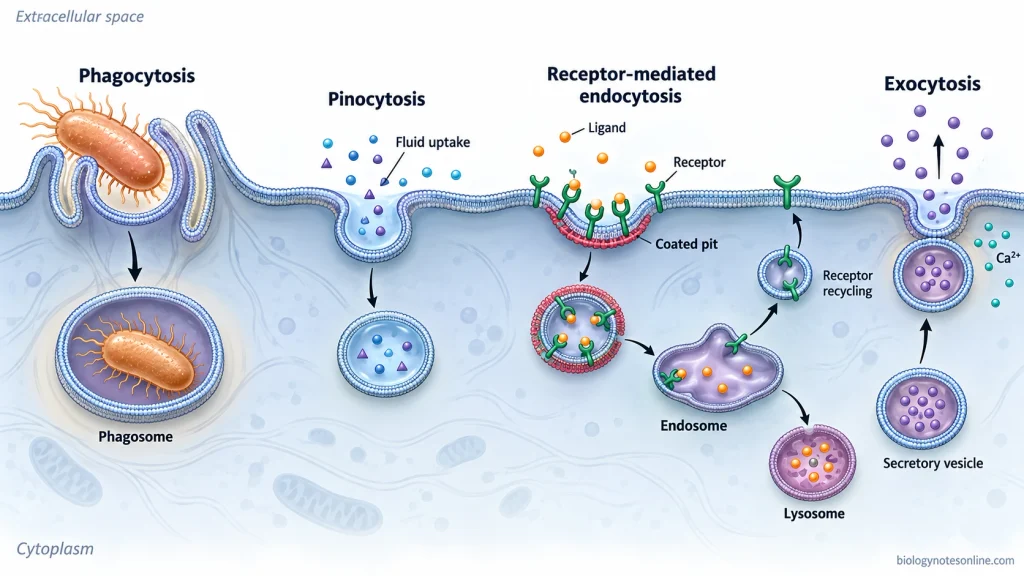
- Endocytosis- Endocytosis carries extracellular substances into the cell. The plasma membrane bends inward around the material and a part of membrane buds off, forming an intracellular vesicle. Different forms of endocytosis are phagocytosis, pinocytosis, and receptor-mediated endocytosis.
- Phagocytosis- It is also referred to as “cell eating”. Large particles such as microorganisms, dead cells, or cellular debris are engulfed by the cell. The plasma membrane extends around the particle and finally encloses it within a large vesicle called a phagosome. Phagosomes can then fuse with lysosomes for digestion of the material.
- Pinocytosis- This is referred to as “cell drinking”. Extracellular fluid along with dissolved solutes is taken up in small vesicles. Pinocytosis occurs in most eukaryotic cells.
- Receptor-mediated endocytosis- It is a selective form of endocytosis used for uptake of particular extracellular macromolecules. First, the molecule binds to its specific receptor present on cell surface. These receptors can become concentrated in coated regions of plasma membrane, which then bud inward to form vesicles containing the receptor and its bound molecule.
- Exocytosis- In exocytosis, material present inside a membrane-bound vesicle is released outside the cell. The vesicle is first brought towards the plasma membrane and its membrane fuses with the plasma membrane. Vesicular contents are then discharged to the extracellular region. Secretory proteins, hormones, digestive enzymes, and neurotransmitters can be released by this process. Some substances are continuously delivered by constitutive exocytosis, whereas regulated secretory vesicles remain stored and fuse with plasma membrane after receiving an appropriate signal. Regulated exocytosis is commonly seen during secretion of neurotransmitters and hormones.
Examples of Transport Across the Plasma Membrane
Different substances are moved across plasma membrane by passive, active, or vesicular transport. Some common examples of transport across the plasma membrane are-
- Oxygen and carbon dioxide- Oxygen (O₂) and carbon dioxide (CO₂) are small nonpolar molecules which can dissolve in the lipid bilayer. They pass directly through plasma membrane by simple diffusion, moving down their concentration gradient. No transport protein is required.
- Water movement- Water moves across a selectively permeable membrane by osmosis. In many cells, its movement is greatly increased by aquaporin channels present in the plasma membrane.
- Glucose by facilitated diffusion- Glucose cannot freely pass through the hydrophobic lipid bilayer because it is a larger polar molecule. It is carried across membrane with the help of specific carrier proteins when movement is down its concentration gradient. Glucose transport in mammalian erythrocytes is an example.
- Movement of ions through channels- Ions are unable to cross the phospholipid bilayer by free diffusion. Ion channels form selective aqueous pathways for their movement through membrane. When the channel is open, ions pass according to their electrochemical gradient.
- Sodium-potassium pump- The sodium-potassium pump (Na⁺-K⁺ ATPase) is an example of primary active transport. Energy obtained from hydrolysis of adenosine triphosphate (ATP) is used. For each ATP hydrolyzed, three Na⁺ are pumped outside and two K⁺ are moved into the cell against their electrochemical gradients.
- Sodium-glucose cotransport- Sodium-glucose cotransporter 1 (SGLT1) in intestinal epithelium is an example of secondary active transport. Na⁺ moves down its electrochemical gradient, and the stored energy of this gradient is used to carry glucose against its gradient into the cell. The SGLT1 transporter does not directly hydrolyze ATP for this transport.
- Phagocytosis of microorganisms- Macrophages and neutrophils can engulf bacteria and other large particles by phagocytosis. The plasma membrane extends around the particle and forms a membrane-bound phagosome. Phagosomes may then fuse with lysosomes where the ingested material is degraded.
- Low-density lipoprotein uptake- Low-density lipoprotein (LDL) carrying cholesterol binds with LDL receptors present on the cell surface. The receptor-bound LDL is taken into the cell by receptor-mediated endocytosis through coated vesicles. LDL later reaches lysosomes, whereas many LDL receptors are recycled back to plasma membrane.
- Release of neurotransmitters- Neurotransmitters stored in synaptic vesicles are released from the presynaptic nerve terminal by exocytosis. During this process, the vesicle membrane fuses with plasma membrane and releases its contents outside the cell.
Physiological Importance of Membrane Transport
Membrane transport is used to maintain the internal conditions of cell by controlling substances that enter or leave through plasma membrane. Some of its important physiological roles are-
- Maintenance of intracellular environment- Specific membrane proteins control ions and polar substances, and different solute concentrations are maintained in the cytosol.
- Nutrient uptake- Sugars, amino acids, ions and vitamins are taken into cells by membrane transport. In intestinal epithelial cells, passive and active processes are involved.
- Waste removal and pH regulation- Metabolic wastes are removed from the cell. Na⁺-H⁺ exchangers also remove excess H⁺ using the Na⁺ gradient and helps in cytosolic pH control.
- Osmotic balance and cell volume- Movement of ions changes the osmotic condition across membrane, which affects movement of water. The Na⁺-K⁺ pump also maintains intracellular solute concentration and cell volume.
- Ion gradients and membrane potential- Unequal concentrations of Na⁺, K⁺, Ca²⁺ and other ions are maintained across the membrane. These ion gradients contribute to membrane potential. Ion movement is required for electrical signals in nerve and muscle cells.
- Absorption and secretion- In intestine, nutrients, ions and water are absorbed. Renal tubular cells reabsorb or secrete selected substances and regulate body fluid, solute and acid balance.
- Cell signaling and secretion- Ca²⁺ movement is involved in different cellular responses. In neurons, Ca²⁺ entry causes synaptic vesicles to fuse with plasma membrane. Neurotransmitters are released by exocytosis.
Transport Across Plasma Membrane at a Glance
| Type of transport | Movement / mechanism | Energy requirement | Membrane protein / vesicle | Examples |
|---|---|---|---|---|
| Simple diffusion | Molecules move directly through lipid bilayer, down their concentration gradient. | No direct cellular energy | Not required | O₂, CO₂, lipid-soluble molecules |
| Facilitated diffusion | Solutes move down concentration or electrochemical gradient with the help of membrane proteins. | No direct cellular energy | Channel or carrier proteins | Ions through channels, glucose through GLUT transporters |
| Osmosis | Water moves across selectively permeable membrane according to osmotic gradient. | No direct cellular energy | Aquaporins may be involved | Water movement across plasma membrane |
| Primary active transport | Substances are moved against their electrochemical gradient by direct coupling with an energy-producing reaction. | Commonly ATP hydrolysis | Pumps | Na⁺-K⁺ ATPase, Ca²⁺ ATPase |
| Secondary active transport | Movement of one solute down its electrochemical gradient drives another solute against its gradient. | Uses stored energy of an ion gradient | Cotransporter or exchanger | Na⁺-glucose cotransport, Na⁺-Ca²⁺ exchange |
| Endocytosis | Plasma membrane bends inward and forms a vesicle carrying material into the cell. | Requires cellular energy | Membrane-bound vesicle | Phagocytosis, pinocytosis, receptor-mediated endocytosis |
| Exocytosis | Intracellular vesicle fuses with plasma membrane and releases its contents outside. | Requires cellular energy | Secretory vesicle | Neurotransmitter, hormone and enzyme secretion |
References
- Alberts, B., Johnson, A., Lewis, J., Raff, M., Roberts, K., & Walter, P. (2002a). Carrier proteins and active membrane transport. In Molecular biology of the cell (4th ed.). Garland Science. https://www.ncbi.nlm.nih.gov/books/NBK26896/
- Alberts, B., Johnson, A., Lewis, J., Raff, M., Roberts, K., & Walter, P. (2002b). Ion channels and the electrical properties of membranes. In Molecular biology of the cell (4th ed.). Garland Science. https://www.ncbi.nlm.nih.gov/books/NBK26910/
- Alberts, B., Johnson, A., Lewis, J., Raff, M., Roberts, K., & Walter, P. (2002c). Membrane transport of small molecules and the electrical properties of membranes. In Molecular biology of the cell (4th ed.). Garland Science. https://www.ncbi.nlm.nih.gov/books/NBK21044/
- Alberts, B., Johnson, A., Lewis, J., Raff, M., Roberts, K., & Walter, P. (2002d). Principles of membrane transport. In Molecular biology of the cell (4th ed.). Garland Science. https://www.ncbi.nlm.nih.gov/books/NBK26815/
- Alberts, B., Johnson, A., Lewis, J., Raff, M., Roberts, K., & Walter, P. (2002e). Transport from the trans Golgi network to the cell exterior: Exocytosis. In Molecular biology of the cell (4th ed.). Garland Science. https://www.ncbi.nlm.nih.gov/books/NBK26892/
- Alberts, B., Johnson, A., Lewis, J., Raff, M., Roberts, K., & Walter, P. (2002f). Transport into the cell from the plasma membrane: Endocytosis. In Molecular biology of the cell (4th ed.). Garland Science. https://www.ncbi.nlm.nih.gov/books/NBK26870/
- Basile, E. J., Shukla, K., Launico, M. V., & Sheer, A. J. (2025). Physiology, nutrient absorption. In StatPearls. StatPearls Publishing. https://www.ncbi.nlm.nih.gov/books/NBK597379/
- Betts, J. G., Young, K. A., Wise, J. A., Johnson, E., Poe, B., Kruse, D. H., Korol, O., Johnson, J. E., Womble, M., & DeSaix, P. (2013). Anatomy and physiology. OpenStax. https://openstax.org/books/anatomy-and-physiology/pages/3-1-the-cell-membrane
- Chen, I., & Lui, F. (2022). Physiology, active transport. In StatPearls. StatPearls Publishing. https://www.ncbi.nlm.nih.gov/books/NBK547718/
- Cooper, G. M. (2000a). Cell membranes. In The cell: A molecular approach (2nd ed.). Sinauer Associates. https://www.ncbi.nlm.nih.gov/books/NBK9928/
- Cooper, G. M. (2000b). Endocytosis. In The cell: A molecular approach (2nd ed.). Sinauer Associates. https://www.ncbi.nlm.nih.gov/books/NBK9831/
- Cooper, G. M. (2000c). The mechanism of vesicular transport. In The cell: A molecular approach (2nd ed.). Sinauer Associates. https://www.ncbi.nlm.nih.gov/books/NBK9886/
- Cooper, G. M. (2000d). Transport of small molecules. In The cell: A molecular approach (2nd ed.). Sinauer Associates. https://www.ncbi.nlm.nih.gov/books/NBK9847/
- Fowler, S., Roush, R., & Wise, J. (2013). Concepts of biology. OpenStax. https://openstax.org/books/concepts-biology/pages/3-5-passive-transport
- Herrmann, T., Leavitt, L., & Sharma, S. (2023). Physiology, membrane. In StatPearls. StatPearls Publishing. https://www.ncbi.nlm.nih.gov/books/NBK538211/
- Purves, D., Augustine, G. J., Fitzpatrick, D., Katz, L. C., LaMantia, A.-S., McNamara, J. O., & Williams, S. M. (Eds.). (2001a). Active transporters create and maintain ion gradients. In Neuroscience (2nd ed.). Sinauer Associates. https://www.ncbi.nlm.nih.gov/books/NBK10973/
- Purves, D., Augustine, G. J., Fitzpatrick, D., Katz, L. C., LaMantia, A.-S., McNamara, J. O., & Williams, S. M. (Eds.). (2001b). The ionic basis of the resting membrane potential. In Neuroscience (2nd ed.). Sinauer Associates. https://www.ncbi.nlm.nih.gov/books/NBK10931/
- Putney, J. W., Jr. (1999). Ca2+ regulation at the plasma membrane. In G. J. Siegel, B. W. Agranoff, R. W. Albers, S. K. Fisher, & M. D. Uhler (Eds.), Basic neurochemistry: Molecular, cellular and medical aspects (6th ed.). Lippincott-Raven. https://www.ncbi.nlm.nih.gov/books/NBK27966/
- Stillwell, W. (2013). Membrane transport. In An introduction to biological membranes: From bilayers to rafts (pp. 305–337). Elsevier. https://doi.org/10.1016/B978-0-444-52153-8.00014-3
- Stillwell, W. (2016). Membrane transport. In An introduction to biological membranes: Composition, structure and function (2nd ed., pp. 423–451). Elsevier. https://doi.org/10.1016/B978-0-444-63772-7.00019-1
- Südhof, T. C. (1999). Intracellular membrane traffic. In G. J. Siegel, B. W. Agranoff, R. W. Albers, S. K. Fisher, & M. D. Uhler (Eds.), Basic neurochemistry: Molecular, cellular and medical aspects (6th ed.). Lippincott-Raven. https://www.ncbi.nlm.nih.gov/books/NBK28179/